Compare commits
246 Commits
v4.50.3-De
...
v4.51.3-Ti
| Author | SHA1 | Date | |
|---|---|---|---|

|
dc8227827d | ||
|
|
2f517200c1 | ||
|
|
0577cae808 | ||
|
|
b33edf1b9b | ||
|
|
503541d7ef | ||
|
|
9ddcf5fce5 | ||
|
|
a91020aed0 | ||
|
|
8669c016d2 | ||
|
|
e3d3b54638 | ||
|
|
61436a9323 | ||
|
|
7752e7487c | ||
|
|
7dafcd0077 | ||
|
|
6fd87d1172 | ||
|
|
ed53809ac5 | ||
|
|
d91858c232 | ||
|
|
4541c2cdef | ||
|
|
a335dc4d6d | ||
|
|
33f6c5a5c8 | ||
|
|
5ab7a7c640 | ||
|
|
3165eb7c28 | ||
|
|
33c6fdb2cf | ||
|
|
4cc6b60654 | ||
|
|
51f544a4d4 | ||
|
|
4f1dbe8152 | ||
|
|
c08997c52e | ||
|
|
57da364d8e | ||
|
|
356b3cd71d | ||
|
|
0ad3710d47 | ||
|
|
f6c79f767c | ||
|
|
ecaeee66bc | ||
|
|
6f7ea1cf00 | ||
|
|
d6ac923ad9 | ||
|
|
c8e0e603de | ||
|
|
4e63a1747c | ||
|
|
8ab296501a | ||
|
|
20ceaca228 | ||
|
|
cb39f7dd5b | ||
|
|
d228f50acc | ||
|
|
a5dfb98977 | ||
|
|
a53a63c9c2 | ||
|
|
4774a39d05 | ||
|
|
e43f168eb3 | ||
|
|
1efcfa9ca4 | ||
|
|
86064035f0 | ||
|
|
7cc9e61a3a | ||
|
|
4e53840920 | ||
|
|
1897a02d83 | ||
|
|
7bff4bdcf6 | ||
|
|
e16775d103 | ||
|
|
49b9a69a36 | ||
|
|
a5079a2c84 | ||
|
|
e7f5724efd | ||
|
|
4b8c6d4cf8 | ||
|
|
ac1df5fccd | ||
|
|
1ef64710d2 | ||
|
|
47b9f06aa2 | ||
|
|
78cea3e22c | ||
|
|
953196a43d | ||
|
|
aaf129cdae | ||
|
|
69e6ddf27f | ||
|
|
623d395aff | ||
|
|
435f88f1db | ||
|
|
954f31cd81 | ||
|
|
28eae8b4bd | ||
|
|
bf46e44878 | ||
|
|
897874748b | ||
|
|
6a75528cbc | ||
|
|
6cef03ba66 | ||
|
|
a563999a02 | ||
|
|
3c39c07939 | ||
|
|
f797e3d98a | ||
|
|
442d356aa5 | ||
|
|
7e9b57ce62 | ||
|
|
54a123f068 | ||
|
|
931126b929 | ||
|
|
c7064cdba1 | ||
|
|
371c44d0ef | ||
|
|
7ff896c0f2 | ||
|
|
10907e2846 | ||
|
|
7d76876498 | ||
|
|
dac443414e | ||
|
|
6daec12d0b | ||
|
|
0ea1151222 | ||
|
|
9c0c323e12 | ||
|
|
bde41d69b4 | ||
|
|
7ecc5b88c0 | ||
|
|
5ae9b2cac0 | ||
|
|
d9e76656ae | ||
|
|
1ae8d54b04 | ||
|
|
10144ff116 | ||
|
|
aa478567f8 | ||
|
|
ae5ce22664 | ||
|
|
4f139f5a50 | ||
|
|
a2c2fb0108 | ||
|
|
0ddad2d655 | ||
|
|
fbb2054ed5 | ||
|
|
6d8b0b3378 | ||
|
|
f5865d32a2 | ||
|
|
e39c732644 | ||
|
|
bc0150bb04 | ||
|
|
9cda4265d6 | ||
|
|
e032d12e8a | ||
|
|
f834ca2c19 | ||
|
|
c5c648dd74 | ||
|
|
71b35387fd | ||
|
|
ad340908e4 | ||
|
|
2527f71a47 | ||
|
|
7ae0be722e | ||
|
|
e3eda6d188 | ||
|
|
1e6ff5fd55 | ||
|
|
6f4058aee3 | ||
|
|
08e3217baf | ||
|
|
4d0de5f73a | ||
|
|
c15a7adb28 | ||
|
|
121f91d36c | ||
|
|
4321b0648c | ||
|
|
aab0878327 | ||
|
|
35f0f5b5da | ||
|
|
530322ccb6 | ||
|
|
8064cd9b4f | ||
|
|
cdfb018d03 | ||
|
|
1e6b546ea6 | ||
|
|
0fc683d1cd | ||
|
|
2515a5a290 | ||
|
|
2da82e432d | ||
|
|
794fde7b1c | ||
|
|
b54c2f4689 | ||
|
|
754a370bca | ||
|
|
31a62c2eb8 | ||
|
|
f830105183 | ||
|
|
e2b0224d94 | ||
|
|
6cc109c354 | ||
|
|
8bbcdf5409 | ||
|
|
3a826a45ca | ||
|
|
5e855095a2 | ||
|
|
416b5a875d | ||
|
|
f8a16805c5 | ||
|
|
48e179857c | ||
|
|
832cb684a0 | ||
|
|
22065bd645 | ||
|
|
f789f960c8 | ||
|
|
12bf24d6ae | ||
|
|
e7ad077012 | ||
|
|
99f9f1042f | ||
|
|
0fb8d49e88 | ||
|
|
08f36771b3 | ||
|
|
9db31ea585 | ||
|
|
debfe904c9 | ||
|
|
54538ebee3 | ||
|
|
d1b92369ca | ||
|
|
25b7f27234 | ||
|
|
aa40fda346 | ||
|
|
e94571580b | ||
|
|
84aa13dd85 | ||
|
|
0ef339ff1b | ||
|
|
46d73910d5 | ||
|
|
579135a2f6 | ||
|
|
8cd57eb731 | ||
|
|
ebe47ce3e9 | ||
|
|
531e4fcf0e | ||
|
|
a4e55fcff8 | ||
|
|
878562b68d | ||
|
|
8ebc435267 | ||
|
|
ad3d157188 | ||
|
|
3d40bda30e | ||
|
|
acbcb5d07d | ||
|
|
4ba0989eab | ||
|
|
352ec8ef22 | ||
|
|
edd345b52e | ||
|
|
b016de1ae4 | ||
|
|
f74d7da836 | ||
|
|
d130cd0e16 | ||
|
|
41b9b92b52 | ||
|
|
8dd0a2b89c | ||
|
|
15ac2b6ac5 | ||
|
|
b552708694 | ||
|
|
2b84831a93 | ||
|
|
2d46a08b63 | ||
|
|
1b29409d89 | ||
|
|
8a828a747e | ||
|
|
3f6af96732 | ||
|
|
9a1c1fe7ed | ||
|
|
782d7d945d | ||
|
|
afafb84b59 | ||
|
|
34ccfebf32 | ||
|
|
f697b3f824 | ||
|
|
2099287a59 | ||
|
|
a0803a9555 | ||
|
|
6ce238fe7a | ||
|
|
12048990a9 | ||
|
|
98601cc818 | ||
|
|
c9302c0983 | ||
|
|
2056287940 | ||
|
|
3e96a0c32b | ||
|
|
199d7adf10 | ||
|
|
126abe3461 | ||
|
|
3d133cc557 | ||
|
|
e90d55ebcc | ||
|
|
cbfa14823b | ||
|
|
7613cf1a45 | ||
|
|
32c12aaec3 | ||
|
|
764ab0d46a | ||
|
|
c94c6ed397 | ||
|
|
e94d607c8b | ||
|
|
adfc91cd46 | ||
|
|
6f5dc9c82e | ||
|
|
a165458901 | ||
|
|
ed95493ce0 | ||
|
|
211e4dc9a4 | ||
|
|
800510c67b | ||
|
|
41f5c3216c | ||
|
|
bc2dea3f54 | ||
|
|
35253076f4 | ||
|
|
bf41e54fc8 | ||
|
|
3249c5dc15 | ||
|
|
24e311f42b | ||
|
|
897ff9af0e | ||
|
|
c0bd8048a5 | ||
|
|
60b75d99b6 | ||
|
|
fac70ff3c0 | ||
|
|
ae34bd75fd | ||
|
|
8f6b27eb5c | ||
|
|
737cbd2109 | ||
|
|
3a6ab46a0b | ||
|
|
4b13a02920 | ||
|
|
786d9c5ed9 | ||
|
|
a1e389e637 | ||
|
|
f304318f5f | ||
|
|
8805600406 | ||
|
|
e686fed635 | ||
|
|
a03cee7a1d | ||
|
|
3b07ca78bb | ||
|
|
475664e2c6 | ||
|
|
0710e9b1e8 | ||
|
|
f99c279d20 | ||
|
|
d1efaf0318 | ||
|
|
19919689b2 | ||
|
|
d0b65bb479 | ||
|
|
ad63d20dff | ||
|
|
286393fbb1 | ||
|
|
4705b04c74 | ||
|
|
2b4734bd49 | ||
|
|
bd41b9c1ac | ||
|
|
6acd5aecb3 | ||
|
|
0d6a60fe55 | ||
|
|
b7fc2daf8b |
@@ -171,6 +171,7 @@ class CircleCIJob:
|
||||
"command": f"TESTS=$(circleci tests split --split-by=timings {self.job_name}_test_list.txt) && echo $TESTS > splitted_tests.txt && echo $TESTS | tr ' ' '\n'" if self.parallelism else f"awk '{{printf \"%s \", $0}}' {self.job_name}_test_list.txt > splitted_tests.txt"
|
||||
}
|
||||
},
|
||||
{"run": {"name": "fetch hub objects before pytest", "command": "python3 utils/fetch_hub_objects_for_ci.py"}},
|
||||
{"run": {
|
||||
"name": "Run tests",
|
||||
"command": f"({timeout_cmd} python3 -m pytest {marker_cmd} -n {self.pytest_num_workers} {junit_flags} {repeat_on_failure_flags} {' '.join(pytest_flags)} $(cat splitted_tests.txt) | tee tests_output.txt)"}
|
||||
|
||||
2
.github/ISSUE_TEMPLATE/i18n.md
vendored
2
.github/ISSUE_TEMPLATE/i18n.md
vendored
@@ -23,7 +23,7 @@ Some notes:
|
||||
* Please translate in a gender-neutral way.
|
||||
* Add your translations to the folder called `<languageCode>` inside the [source folder](https://github.com/huggingface/transformers/tree/main/docs/source).
|
||||
* Register your translation in `<languageCode>/_toctree.yml`; please follow the order of the [English version](https://github.com/huggingface/transformers/blob/main/docs/source/en/_toctree.yml).
|
||||
* Once you're finished, open a pull request and tag this issue by including #issue-number in the description, where issue-number is the number of this issue. Please ping @stevhliu and @MKhalusova for review.
|
||||
* Once you're finished, open a pull request and tag this issue by including #issue-number in the description, where issue-number is the number of this issue. Please ping @stevhliu for review.
|
||||
* 🙋 If you'd like others to help you with the translation, you can also post in the 🤗 [forums](https://discuss.huggingface.co/).
|
||||
|
||||
## Get Started section
|
||||
|
||||
18
.github/scripts/assign_reviewers.py
vendored
18
.github/scripts/assign_reviewers.py
vendored
@@ -54,6 +54,21 @@ def get_file_owners(file_path, codeowners_lines):
|
||||
return owners # Remember, can still be empty!
|
||||
return [] # Should never happen, but just in case
|
||||
|
||||
def pr_author_is_in_hf(pr_author, codeowners_lines):
|
||||
# Check if the PR author is in the codeowners file
|
||||
for line in codeowners_lines:
|
||||
line = line.split('#')[0].strip()
|
||||
if not line:
|
||||
continue
|
||||
|
||||
# Split into pattern and owners
|
||||
parts = line.split()
|
||||
owners = [owner.removeprefix("@") for owner in parts[1:]]
|
||||
|
||||
if pr_author in owners:
|
||||
return True
|
||||
return False
|
||||
|
||||
def main():
|
||||
script_dir = Path(__file__).parent.absolute()
|
||||
with open(script_dir / "codeowners_for_review_action") as f:
|
||||
@@ -68,6 +83,9 @@ def main():
|
||||
pr_number = event['pull_request']['number']
|
||||
pr = repo.get_pull(pr_number)
|
||||
pr_author = pr.user.login
|
||||
if pr_author_is_in_hf(pr_author, codeowners_lines):
|
||||
print(f"PR author {pr_author} is in codeowners, skipping review request.")
|
||||
return
|
||||
|
||||
existing_reviews = list(pr.get_reviews())
|
||||
if existing_reviews:
|
||||
|
||||
36
.github/workflows/build-docker-images.yml
vendored
36
.github/workflows/build-docker-images.yml
vendored
@@ -63,14 +63,14 @@ jobs:
|
||||
uses: huggingface/hf-workflows/.github/actions/post-slack@main
|
||||
with:
|
||||
slack_channel: ${{ secrets.CI_SLACK_CHANNEL_DOCKER }}
|
||||
title: 🤗 Results of the transformers-all-latest-gpu-push-ci docker build
|
||||
title: 🤗 Results of the transformers-all-latest-gpu-push-ci docker build
|
||||
status: ${{ job.status }}
|
||||
slack_token: ${{ secrets.SLACK_CIFEEDBACK_BOT_TOKEN }}
|
||||
|
||||
latest-torch-deepspeed-docker:
|
||||
name: "Latest PyTorch + DeepSpeed"
|
||||
runs-on:
|
||||
group: aws-general-8-plus
|
||||
group: aws-g4dn-2xlarge-cache
|
||||
steps:
|
||||
-
|
||||
name: Set up Docker Buildx
|
||||
@@ -99,7 +99,7 @@ jobs:
|
||||
uses: huggingface/hf-workflows/.github/actions/post-slack@main
|
||||
with:
|
||||
slack_channel: ${{ secrets.CI_SLACK_CHANNEL_DOCKER}}
|
||||
title: 🤗 Results of the transformers-pytorch-deepspeed-latest-gpu docker build
|
||||
title: 🤗 Results of the transformers-pytorch-deepspeed-latest-gpu docker build
|
||||
status: ${{ job.status }}
|
||||
slack_token: ${{ secrets.SLACK_CIFEEDBACK_BOT_TOKEN }}
|
||||
|
||||
@@ -140,7 +140,7 @@ jobs:
|
||||
uses: huggingface/hf-workflows/.github/actions/post-slack@main
|
||||
with:
|
||||
slack_channel: ${{ secrets.CI_SLACK_CHANNEL_DOCKER }}
|
||||
title: 🤗 Results of the transformers-pytorch-deepspeed-latest-gpu-push-ci docker build
|
||||
title: 🤗 Results of the transformers-pytorch-deepspeed-latest-gpu-push-ci docker build
|
||||
status: ${{ job.status }}
|
||||
slack_token: ${{ secrets.SLACK_CIFEEDBACK_BOT_TOKEN }}
|
||||
|
||||
@@ -176,7 +176,7 @@ jobs:
|
||||
uses: huggingface/hf-workflows/.github/actions/post-slack@main
|
||||
with:
|
||||
slack_channel: ${{ secrets.CI_SLACK_CHANNEL_DOCKER }}
|
||||
title: 🤗 Results of the huggingface/transformers-doc-builder docker build
|
||||
title: 🤗 Results of the huggingface/transformers-doc-builder docker build
|
||||
status: ${{ job.status }}
|
||||
slack_token: ${{ secrets.SLACK_CIFEEDBACK_BOT_TOKEN }}
|
||||
|
||||
@@ -214,7 +214,7 @@ jobs:
|
||||
uses: huggingface/hf-workflows/.github/actions/post-slack@main
|
||||
with:
|
||||
slack_channel: ${{ secrets.CI_SLACK_CHANNEL_DOCKER }}
|
||||
title: 🤗 Results of the huggingface/transformers-pytorch-gpudocker build
|
||||
title: 🤗 Results of the huggingface/transformers-pytorch-gpudocker build
|
||||
status: ${{ job.status }}
|
||||
slack_token: ${{ secrets.SLACK_CIFEEDBACK_BOT_TOKEN }}
|
||||
|
||||
@@ -223,19 +223,19 @@ jobs:
|
||||
runs-on:
|
||||
group: aws-general-8-plus
|
||||
steps:
|
||||
-
|
||||
-
|
||||
name: Set up Docker Buildx
|
||||
uses: docker/setup-buildx-action@v3
|
||||
-
|
||||
-
|
||||
name: Check out code
|
||||
uses: actions/checkout@v4
|
||||
-
|
||||
-
|
||||
name: Login to DockerHub
|
||||
uses: docker/login-action@v3
|
||||
with:
|
||||
username: ${{ secrets.DOCKERHUB_USERNAME }}
|
||||
password: ${{ secrets.DOCKERHUB_PASSWORD }}
|
||||
-
|
||||
-
|
||||
name: Build and push
|
||||
uses: docker/build-push-action@v5
|
||||
with:
|
||||
@@ -263,7 +263,7 @@ jobs:
|
||||
uses: huggingface/hf-workflows/.github/actions/post-slack@main
|
||||
with:
|
||||
slack_channel: ${{ secrets.CI_SLACK_CHANNEL_DOCKER }}
|
||||
title: 🤗 Results of the huggingface/transformers-pytorch-amd-gpu-push-ci build
|
||||
title: 🤗 Results of the huggingface/transformers-pytorch-amd-gpu-push-ci build
|
||||
status: ${{ job.status }}
|
||||
slack_token: ${{ secrets.SLACK_CIFEEDBACK_BOT_TOKEN }}
|
||||
|
||||
@@ -301,7 +301,7 @@ jobs:
|
||||
uses: huggingface/hf-workflows/.github/actions/post-slack@main
|
||||
with:
|
||||
slack_channel: ${{ secrets.CI_SLACK_CHANNEL_DOCKER }}
|
||||
title: 🤗 Results of the huggingface/transformers-tensorflow-gpu build
|
||||
title: 🤗 Results of the huggingface/transformers-tensorflow-gpu build
|
||||
status: ${{ job.status }}
|
||||
slack_token: ${{ secrets.SLACK_CIFEEDBACK_BOT_TOKEN }}
|
||||
|
||||
@@ -310,19 +310,19 @@ jobs:
|
||||
runs-on:
|
||||
group: aws-general-8-plus
|
||||
steps:
|
||||
-
|
||||
-
|
||||
name: Set up Docker Buildx
|
||||
uses: docker/setup-buildx-action@v3
|
||||
-
|
||||
-
|
||||
name: Check out code
|
||||
uses: actions/checkout@v4
|
||||
-
|
||||
-
|
||||
name: Login to DockerHub
|
||||
uses: docker/login-action@v3
|
||||
with:
|
||||
username: ${{ secrets.DOCKERHUB_USERNAME }}
|
||||
password: ${{ secrets.DOCKERHUB_PASSWORD }}
|
||||
-
|
||||
-
|
||||
name: Build and push
|
||||
uses: docker/build-push-action@v5
|
||||
with:
|
||||
@@ -350,7 +350,7 @@ jobs:
|
||||
uses: huggingface/hf-workflows/.github/actions/post-slack@main
|
||||
with:
|
||||
slack_channel: ${{ secrets.CI_SLACK_CHANNEL_DOCKER }}
|
||||
title: 🤗 Results of the transformers-pytorch-deepspeed-amd-gpu build
|
||||
title: 🤗 Results of the transformers-pytorch-deepspeed-amd-gpu build
|
||||
status: ${{ job.status }}
|
||||
slack_token: ${{ secrets.SLACK_CIFEEDBACK_BOT_TOKEN }}
|
||||
|
||||
@@ -388,6 +388,6 @@ jobs:
|
||||
uses: huggingface/hf-workflows/.github/actions/post-slack@main
|
||||
with:
|
||||
slack_channel: ${{ secrets.CI_SLACK_CHANNEL_DOCKER }}
|
||||
title: 🤗 Results of the transformers-quantization-latest-gpu build
|
||||
title: 🤗 Results of the transformers-quantization-latest-gpu build
|
||||
status: ${{ job.status }}
|
||||
slack_token: ${{ secrets.SLACK_CIFEEDBACK_BOT_TOKEN }}
|
||||
|
||||
@@ -42,7 +42,7 @@ jobs:
|
||||
nightly-torch-deepspeed-docker:
|
||||
name: "Nightly PyTorch + DeepSpeed"
|
||||
runs-on:
|
||||
group: aws-general-8-plus
|
||||
group: aws-g4dn-2xlarge-cache
|
||||
steps:
|
||||
-
|
||||
name: Set up Docker Buildx
|
||||
|
||||
20
.github/workflows/model_jobs.yml
vendored
20
.github/workflows/model_jobs.yml
vendored
@@ -18,6 +18,10 @@ on:
|
||||
docker:
|
||||
required: true
|
||||
type: string
|
||||
report_name_prefix:
|
||||
required: false
|
||||
default: run_models_gpu
|
||||
type: string
|
||||
|
||||
env:
|
||||
HF_HOME: /mnt/cache
|
||||
@@ -116,23 +120,23 @@ jobs:
|
||||
|
||||
- name: Run all tests on GPU
|
||||
working-directory: /transformers
|
||||
run: python3 -m pytest -rsfE -v --make-reports=${{ env.machine_type }}_run_models_gpu_${{ matrix.folders }}_test_reports tests/${{ matrix.folders }}
|
||||
run: python3 -m pytest -rsfE -v --make-reports=${{ env.machine_type }}_${{ inputs.report_name_prefix }}_${{ matrix.folders }}_test_reports tests/${{ matrix.folders }}
|
||||
|
||||
- name: Failure short reports
|
||||
if: ${{ failure() }}
|
||||
continue-on-error: true
|
||||
run: cat /transformers/reports/${{ env.machine_type }}_run_models_gpu_${{ matrix.folders }}_test_reports/failures_short.txt
|
||||
run: cat /transformers/reports/${{ env.machine_type }}_${{ inputs.report_name_prefix }}_${{ matrix.folders }}_test_reports/failures_short.txt
|
||||
|
||||
- name: Run test
|
||||
shell: bash
|
||||
run: |
|
||||
mkdir -p /transformers/reports/${{ env.machine_type }}_run_models_gpu_${{ matrix.folders }}_test_reports
|
||||
echo "hello" > /transformers/reports/${{ env.machine_type }}_run_models_gpu_${{ matrix.folders }}_test_reports/hello.txt
|
||||
echo "${{ env.machine_type }}_run_models_gpu_${{ matrix.folders }}_test_reports"
|
||||
mkdir -p /transformers/reports/${{ env.machine_type }}_${{ inputs.report_name_prefix }}_${{ matrix.folders }}_test_reports
|
||||
echo "hello" > /transformers/reports/${{ env.machine_type }}_${{ inputs.report_name_prefix }}_${{ matrix.folders }}_test_reports/hello.txt
|
||||
echo "${{ env.machine_type }}_${{ inputs.report_name_prefix }}_${{ matrix.folders }}_test_reports"
|
||||
|
||||
- name: "Test suite reports artifacts: ${{ env.machine_type }}_run_models_gpu_${{ env.matrix_folders }}_test_reports"
|
||||
- name: "Test suite reports artifacts: ${{ env.machine_type }}_${{ inputs.report_name_prefix }}_${{ env.matrix_folders }}_test_reports"
|
||||
if: ${{ always() }}
|
||||
uses: actions/upload-artifact@v4
|
||||
with:
|
||||
name: ${{ env.machine_type }}_run_models_gpu_${{ env.matrix_folders }}_test_reports
|
||||
path: /transformers/reports/${{ env.machine_type }}_run_models_gpu_${{ matrix.folders }}_test_reports
|
||||
name: ${{ env.machine_type }}_${{ inputs.report_name_prefix }}_${{ env.matrix_folders }}_test_reports
|
||||
path: /transformers/reports/${{ env.machine_type }}_${{ inputs.report_name_prefix }}_${{ matrix.folders }}_test_reports
|
||||
|
||||
2
.github/workflows/self-comment-ci.yml
vendored
2
.github/workflows/self-comment-ci.yml
vendored
@@ -29,7 +29,7 @@ jobs:
|
||||
runs-on: ubuntu-22.04
|
||||
name: Get PR number
|
||||
# For security: only allow team members to run
|
||||
if: ${{ github.event.issue.state == 'open' && contains(fromJSON('["ydshieh", "ArthurZucker", "zucchini-nlp", "qubvel", "molbap", "gante", "LysandreJik", "Cyrilvallez", "Rocketknight1", "SunMarc", "muellerzr", "eustlb"]'), github.actor) && (startsWith(github.event.comment.body, 'run-slow') || startsWith(github.event.comment.body, 'run slow') || startsWith(github.event.comment.body, 'run_slow')) }}
|
||||
if: ${{ github.event.issue.state == 'open' && contains(fromJSON('["ydshieh", "ArthurZucker", "zucchini-nlp", "qubvel", "molbap", "gante", "LysandreJik", "Cyrilvallez", "Rocketknight1", "SunMarc", "muellerzr", "eustlb", "MekkCyber"]'), github.actor) && (startsWith(github.event.comment.body, 'run-slow') || startsWith(github.event.comment.body, 'run slow') || startsWith(github.event.comment.body, 'run_slow')) }}
|
||||
outputs:
|
||||
PR_NUMBER: ${{ steps.set_pr_number.outputs.PR_NUMBER }}
|
||||
steps:
|
||||
|
||||
13
.github/workflows/self-scheduled-caller.yml
vendored
13
.github/workflows/self-scheduled-caller.yml
vendored
@@ -54,12 +54,23 @@ jobs:
|
||||
ci_event: Daily CI
|
||||
secrets: inherit
|
||||
|
||||
trainer-fsdp-ci:
|
||||
name: Trainer/FSDP CI
|
||||
uses: ./.github/workflows/self-scheduled.yml
|
||||
with:
|
||||
job: run_trainer_and_fsdp_gpu
|
||||
slack_report_channel: "#transformers-ci-daily-training"
|
||||
runner: daily-ci
|
||||
docker: huggingface/transformers-all-latest-gpu
|
||||
ci_event: Daily CI
|
||||
secrets: inherit
|
||||
|
||||
deepspeed-ci:
|
||||
name: DeepSpeed CI
|
||||
uses: ./.github/workflows/self-scheduled.yml
|
||||
with:
|
||||
job: run_torch_cuda_extensions_gpu
|
||||
slack_report_channel: "#transformers-ci-daily-deepspeed"
|
||||
slack_report_channel: "#transformers-ci-daily-training"
|
||||
runner: daily-ci
|
||||
docker: huggingface/transformers-pytorch-deepspeed-latest-gpu
|
||||
ci_event: Daily CI
|
||||
|
||||
35
.github/workflows/self-scheduled.yml
vendored
35
.github/workflows/self-scheduled.yml
vendored
@@ -45,7 +45,7 @@ env:
|
||||
|
||||
jobs:
|
||||
setup:
|
||||
if: contains(fromJSON('["run_models_gpu", "run_quantization_torch_gpu"]'), inputs.job)
|
||||
if: contains(fromJSON('["run_models_gpu", "run_trainer_and_fsdp_gpu", "run_quantization_torch_gpu"]'), inputs.job)
|
||||
name: Setup
|
||||
strategy:
|
||||
matrix:
|
||||
@@ -77,12 +77,17 @@ jobs:
|
||||
run: pip freeze
|
||||
|
||||
- id: set-matrix
|
||||
if: ${{ inputs.job == 'run_models_gpu' }}
|
||||
if: contains(fromJSON('["run_models_gpu", "run_trainer_and_fsdp_gpu"]'), inputs.job)
|
||||
name: Identify models to test
|
||||
working-directory: /transformers/tests
|
||||
run: |
|
||||
echo "folder_slices=$(python3 ../utils/split_model_tests.py --num_splits ${{ env.NUM_SLICES }})" >> $GITHUB_OUTPUT
|
||||
echo "slice_ids=$(python3 -c 'd = list(range(${{ env.NUM_SLICES }})); print(d)')" >> $GITHUB_OUTPUT
|
||||
if [ "${{ inputs.job }}" = "run_models_gpu" ]; then
|
||||
echo "folder_slices=$(python3 ../utils/split_model_tests.py --num_splits ${{ env.NUM_SLICES }})" >> $GITHUB_OUTPUT
|
||||
echo "slice_ids=$(python3 -c 'd = list(range(${{ env.NUM_SLICES }})); print(d)')" >> $GITHUB_OUTPUT
|
||||
elif [ "${{ inputs.job }}" = "run_trainer_and_fsdp_gpu" ]; then
|
||||
echo "folder_slices=[['trainer'], ['fsdp']]" >> $GITHUB_OUTPUT
|
||||
echo "slice_ids=[0, 1]" >> $GITHUB_OUTPUT
|
||||
fi
|
||||
|
||||
- id: set-matrix-quantization
|
||||
if: ${{ inputs.job == 'run_quantization_torch_gpu' }}
|
||||
@@ -113,6 +118,25 @@ jobs:
|
||||
docker: ${{ inputs.docker }}
|
||||
secrets: inherit
|
||||
|
||||
run_trainer_and_fsdp_gpu:
|
||||
if: ${{ inputs.job == 'run_trainer_and_fsdp_gpu' }}
|
||||
name: " "
|
||||
needs: setup
|
||||
strategy:
|
||||
fail-fast: false
|
||||
matrix:
|
||||
machine_type: [aws-g4dn-2xlarge-cache, aws-g4dn-12xlarge-cache]
|
||||
slice_id: [0, 1]
|
||||
uses: ./.github/workflows/model_jobs.yml
|
||||
with:
|
||||
folder_slices: ${{ needs.setup.outputs.folder_slices }}
|
||||
machine_type: ${{ matrix.machine_type }}
|
||||
slice_id: ${{ matrix.slice_id }}
|
||||
runner: ${{ inputs.runner }}
|
||||
docker: ${{ inputs.docker }}
|
||||
report_name_prefix: run_trainer_and_fsdp_gpu
|
||||
secrets: inherit
|
||||
|
||||
run_pipelines_torch_gpu:
|
||||
if: ${{ inputs.job == 'run_pipelines_torch_gpu' }}
|
||||
name: PyTorch pipelines
|
||||
@@ -382,7 +406,7 @@ jobs:
|
||||
run: pip freeze
|
||||
|
||||
- name: Set `machine_type` for report and artifact names
|
||||
working-directory: /transformers
|
||||
working-directory: ${{ inputs.working-directory-prefix }}/transformers
|
||||
shell: bash
|
||||
run: |
|
||||
echo "${{ matrix.machine_type }}"
|
||||
@@ -541,6 +565,7 @@ jobs:
|
||||
needs: [
|
||||
setup,
|
||||
run_models_gpu,
|
||||
run_trainer_and_fsdp_gpu,
|
||||
run_pipelines_torch_gpu,
|
||||
run_pipelines_tf_gpu,
|
||||
run_examples_gpu,
|
||||
|
||||
@@ -26,7 +26,7 @@ There are two main venues to receive support: [the forums](https://discuss.huggi
|
||||
|
||||
[The user forums](https://discuss.huggingface.co/) are supported by the wide community of the library users and backed up by developers when needed.
|
||||
|
||||
If you have a difficulty with deploying this library or some questions, or you'd like to discuss a new feature, please first consider discussing those things at the forums. Only when you feel your subject matter has been crystalized and you still need support from the library developers do proceed to file an [issue](https://github.com/huggingface/transformers/issues).
|
||||
If you have a difficulty with deploying this library or some questions, or you'd like to discuss a new feature, please first consider discussing those things at the forums. Only when you feel your subject matter has been crystallized and you still need support from the library developers do proceed to file an [issue](https://github.com/huggingface/transformers/issues).
|
||||
|
||||
In particular all "Please explain" questions or objectively very user-specific feature requests belong to the forums. Here are some example of such questions:
|
||||
|
||||
|
||||
@@ -70,7 +70,7 @@ Explore the [Hub](https://huggingface.com/) today to find a model and use Transf
|
||||
|
||||
## Installation
|
||||
|
||||
Transformers works with Python 3.9+ [PyTorch](https://pytorch.org/get-started/locally/) 2.0+, [TensorFlow](https://www.tensorflow.org/install/pip) 2.6+, and [Flax](https://flax.readthedocs.io/en/latest/) 0.4.1+.
|
||||
Transformers works with Python 3.9+ [PyTorch](https://pytorch.org/get-started/locally/) 2.1+, [TensorFlow](https://www.tensorflow.org/install/pip) 2.6+, and [Flax](https://flax.readthedocs.io/en/latest/) 0.4.1+.
|
||||
|
||||
Create and activate a virtual environment with [venv](https://docs.python.org/3/library/venv.html) or [uv](https://docs.astral.sh/uv/), a fast Rust-based Python package and project manager.
|
||||
|
||||
|
||||
@@ -27,13 +27,6 @@ These models require the `trust_remote_code=True` parameter to be set when using
|
||||
the content of the modeling files when using this argument. We recommend setting a revision in order to ensure you
|
||||
protect yourself from updates on the repository.
|
||||
|
||||
#### Tools
|
||||
|
||||
Through the `Agent` framework, remote tools can be downloaded to be used by the Agent. You're to specify these tools
|
||||
yourself, but please keep in mind that their code will be run on your machine if the Agent chooses to run them.
|
||||
|
||||
Please inspect the code of the tools before passing them to the Agent to protect your runtime and local setup.
|
||||
|
||||
## Reporting a Vulnerability
|
||||
|
||||
Feel free to submit vulnerability reports to [security@huggingface.co](mailto:security@huggingface.co), where someone from the HF security team will review and recommend next steps. If reporting a vulnerability specific to open source, please note [Huntr](https://huntr.com) is a vulnerability disclosure program for open source software.
|
||||
|
||||
@@ -118,7 +118,7 @@ def run_benchmark(logger: Logger, branch: str, commit_id: str, commit_msg: str,
|
||||
with torch.no_grad():
|
||||
past_key_values = StaticCache(
|
||||
model.config,
|
||||
batch_size=batch_size,
|
||||
max_batch_size=batch_size,
|
||||
device=device,
|
||||
dtype=torch.float16,
|
||||
max_cache_len=seq_length + num_tokens_to_generate,
|
||||
@@ -144,7 +144,7 @@ def run_benchmark(logger: Logger, branch: str, commit_id: str, commit_msg: str,
|
||||
|
||||
past_key_values = StaticCache(
|
||||
model.config,
|
||||
batch_size=batch_size,
|
||||
max_batch_size=batch_size,
|
||||
device=device,
|
||||
dtype=torch.float16,
|
||||
max_cache_len=seq_length + num_tokens_to_generate,
|
||||
@@ -187,7 +187,7 @@ def run_benchmark(logger: Logger, branch: str, commit_id: str, commit_msg: str,
|
||||
# TODO use decode_one_token(model, input_id.clone(), cache_position) for verification
|
||||
past_key_values = StaticCache(
|
||||
model.config,
|
||||
batch_size=batch_size,
|
||||
max_batch_size=batch_size,
|
||||
device=device,
|
||||
dtype=torch.float16,
|
||||
max_cache_len=seq_length + num_tokens_to_generate + 10,
|
||||
@@ -204,7 +204,7 @@ def run_benchmark(logger: Logger, branch: str, commit_id: str, commit_msg: str,
|
||||
time_to_first_token = end - start
|
||||
logger.info(f"completed first compile generation in: {time_to_first_token}s")
|
||||
cache_position += 1
|
||||
all_generated_tokens += next_token.clone().detach().cpu().tolist()
|
||||
all_generated_tokens += next_token.tolist()
|
||||
|
||||
cache_position = torch.tensor([seq_length], device=device)
|
||||
### First compile, decoding
|
||||
@@ -217,7 +217,7 @@ def run_benchmark(logger: Logger, branch: str, commit_id: str, commit_msg: str,
|
||||
time_to_second_token = end - start
|
||||
logger.info(f"completed second compile generation in: {time_to_second_token}s")
|
||||
cache_position += 1
|
||||
all_generated_tokens += next_token.clone().detach().cpu().tolist()
|
||||
all_generated_tokens += next_token.tolist()
|
||||
|
||||
### Second compile, decoding
|
||||
start = perf_counter()
|
||||
@@ -229,13 +229,13 @@ def run_benchmark(logger: Logger, branch: str, commit_id: str, commit_msg: str,
|
||||
time_to_third_token = end - start
|
||||
logger.info(f"completed third compile forward in: {time_to_third_token}s")
|
||||
cache_position += 1
|
||||
all_generated_tokens += next_token.clone().detach().cpu().tolist()
|
||||
all_generated_tokens += next_token.tolist()
|
||||
|
||||
### Using cuda graphs decoding
|
||||
|
||||
start = perf_counter()
|
||||
for _ in range(1, num_tokens_to_generate):
|
||||
all_generated_tokens += next_token.clone().detach().cpu().tolist()
|
||||
all_generated_tokens += next_token.tolist()
|
||||
next_token = decode_one_token(
|
||||
model, next_token.clone(), cache_position=cache_position, past_key_values=past_key_values
|
||||
)
|
||||
@@ -254,7 +254,7 @@ def run_benchmark(logger: Logger, branch: str, commit_id: str, commit_msg: str,
|
||||
|
||||
past_key_values = StaticCache(
|
||||
model.config,
|
||||
batch_size=batch_size,
|
||||
max_batch_size=batch_size,
|
||||
device=device,
|
||||
dtype=torch.float16,
|
||||
max_cache_len=seq_length + 128,
|
||||
@@ -271,7 +271,7 @@ def run_benchmark(logger: Logger, branch: str, commit_id: str, commit_msg: str,
|
||||
|
||||
past_key_values = StaticCache(
|
||||
model.config,
|
||||
batch_size=batch_size,
|
||||
max_batch_size=batch_size,
|
||||
device=device,
|
||||
dtype=torch.float16,
|
||||
max_cache_len=seq_length + 128,
|
||||
@@ -287,7 +287,7 @@ def run_benchmark(logger: Logger, branch: str, commit_id: str, commit_msg: str,
|
||||
|
||||
past_key_values = StaticCache(
|
||||
model.config,
|
||||
batch_size=batch_size,
|
||||
max_batch_size=batch_size,
|
||||
device=device,
|
||||
dtype=torch.float16,
|
||||
max_cache_len=seq_length + 128,
|
||||
@@ -303,7 +303,7 @@ def run_benchmark(logger: Logger, branch: str, commit_id: str, commit_msg: str,
|
||||
|
||||
past_key_values = StaticCache(
|
||||
model.config,
|
||||
batch_size=batch_size,
|
||||
max_batch_size=batch_size,
|
||||
device=device,
|
||||
dtype=torch.float16,
|
||||
max_cache_len=seq_length + 128,
|
||||
|
||||
@@ -46,10 +46,6 @@ NOT_DEVICE_TESTS = {
|
||||
"test_keep_in_fp32_modules",
|
||||
"test_gradient_checkpointing_backward_compatibility",
|
||||
"test_gradient_checkpointing_enable_disable",
|
||||
"test_save_load_fast_init_from_base",
|
||||
"test_fast_init_context_manager",
|
||||
"test_fast_init_tied_embeddings",
|
||||
"test_save_load_fast_init_to_base",
|
||||
"test_torch_save_load",
|
||||
"test_initialization",
|
||||
"test_forward_signature",
|
||||
@@ -70,7 +66,6 @@ NOT_DEVICE_TESTS = {
|
||||
"ModelTester::test_pipeline_",
|
||||
"/repo_utils/",
|
||||
"/utils/",
|
||||
"/agents/",
|
||||
}
|
||||
|
||||
# allow having multiple repository checkouts and not needing to remember to rerun
|
||||
@@ -87,7 +82,6 @@ def pytest_configure(config):
|
||||
config.addinivalue_line("markers", "is_pipeline_test: mark test to run only when pipelines are tested")
|
||||
config.addinivalue_line("markers", "is_staging_test: mark test to run only in the staging environment")
|
||||
config.addinivalue_line("markers", "accelerate_tests: mark test that require accelerate")
|
||||
config.addinivalue_line("markers", "agent_tests: mark the agent tests that are run on their specific schedule")
|
||||
config.addinivalue_line("markers", "not_device_test: mark the tests always running on cpu")
|
||||
|
||||
|
||||
|
||||
@@ -7,5 +7,5 @@ ENV UV_PYTHON=/usr/local/bin/python
|
||||
RUN pip --no-cache-dir install uv && uv venv && uv pip install --no-cache-dir -U pip setuptools
|
||||
RUN uv pip install --no-cache-dir 'torch' 'torchvision' 'torchaudio' --index-url https://download.pytorch.org/whl/cpu
|
||||
RUN uv pip install --no-deps timm accelerate --extra-index-url https://download.pytorch.org/whl/cpu
|
||||
RUN uv pip install --no-cache-dir librosa "git+https://github.com/huggingface/transformers.git@${REF}#egg=transformers[sklearn,sentencepiece,vision,testing,tiktoken,num2words]"
|
||||
RUN uv pip install --no-cache-dir librosa "git+https://github.com/huggingface/transformers.git@${REF}#egg=transformers[sklearn,sentencepiece,vision,testing,tiktoken,num2words,video]"
|
||||
RUN uv pip uninstall transformers
|
||||
|
||||
@@ -14,6 +14,8 @@ ARG PYTORCH='2.6.0'
|
||||
ARG INTEL_TORCH_EXT='2.3.0'
|
||||
# Example: `cu102`, `cu113`, etc.
|
||||
ARG CUDA='cu121'
|
||||
# Disable kernel mapping for now until all tests pass
|
||||
ENV DISABLE_KERNEL_MAPPING=1
|
||||
|
||||
RUN apt update
|
||||
RUN apt install -y git libsndfile1-dev tesseract-ocr espeak-ng python3 python3-pip ffmpeg git-lfs
|
||||
@@ -57,7 +59,8 @@ RUN python3 -m pip uninstall -y ninja
|
||||
|
||||
# For `dinat` model
|
||||
# The `XXX` part in `torchXXX` needs to match `PYTORCH` (to some extent)
|
||||
RUN python3 -m pip install --no-cache-dir natten==0.15.1+torch220$CUDA -f https://shi-labs.com/natten/wheels
|
||||
# pin `0.17.4` otherwise `cannot import name 'natten2dav' from 'natten.functional'`
|
||||
RUN python3 -m pip install --no-cache-dir natten==0.17.4+torch250cu121 -f https://shi-labs.com/natten/wheels
|
||||
|
||||
# For `nougat` tokenizer
|
||||
RUN python3 -m pip install --no-cache-dir python-Levenshtein
|
||||
|
||||
@@ -1,12 +1,12 @@
|
||||
# https://docs.nvidia.com/deeplearning/frameworks/pytorch-release-notes/rel-23-11.html#rel-23-11
|
||||
FROM nvcr.io/nvidia/pytorch:23.11-py3
|
||||
# https://docs.nvidia.com/deeplearning/frameworks/pytorch-release-notes/rel-24-08.html
|
||||
FROM nvcr.io/nvidia/pytorch:24.08-py3
|
||||
LABEL maintainer="Hugging Face"
|
||||
|
||||
ARG DEBIAN_FRONTEND=noninteractive
|
||||
|
||||
ARG PYTORCH='2.2.0'
|
||||
ARG PYTORCH='2.6.0'
|
||||
# Example: `cu102`, `cu113`, etc.
|
||||
ARG CUDA='cu121'
|
||||
ARG CUDA='cu126'
|
||||
|
||||
RUN apt -y update
|
||||
RUN apt install -y libaio-dev
|
||||
@@ -15,7 +15,8 @@ RUN python3 -m pip install --no-cache-dir --upgrade pip
|
||||
ARG REF=main
|
||||
RUN git clone https://github.com/huggingface/transformers && cd transformers && git checkout $REF
|
||||
|
||||
RUN python3 -m pip install --no-cache-dir ./transformers[deepspeed-testing]
|
||||
# `datasets` requires pandas, pandas has some modules compiled with numpy=1.x causing errors
|
||||
RUN python3 -m pip install --no-cache-dir './transformers[deepspeed-testing]' 'pandas<2' 'numpy<2'
|
||||
|
||||
# Install latest release PyTorch
|
||||
# (PyTorch must be installed before pre-compiling any DeepSpeed c++/cuda ops.)
|
||||
|
||||
@@ -1,11 +1,11 @@
|
||||
# https://docs.nvidia.com/deeplearning/frameworks/pytorch-release-notes/rel-23-11.html#rel-23-11
|
||||
FROM nvcr.io/nvidia/pytorch:23.11-py3
|
||||
FROM nvcr.io/nvidia/pytorch:24.08-py3
|
||||
LABEL maintainer="Hugging Face"
|
||||
|
||||
ARG DEBIAN_FRONTEND=noninteractive
|
||||
|
||||
# Example: `cu102`, `cu113`, etc.
|
||||
ARG CUDA='cu121'
|
||||
ARG CUDA='cu126'
|
||||
|
||||
RUN apt -y update
|
||||
RUN apt install -y libaio-dev
|
||||
@@ -21,7 +21,8 @@ RUN python3 -m pip uninstall -y torch torchvision torchaudio
|
||||
# (https://www.deepspeed.ai/tutorials/advanced-install/#pre-install-deepspeed-ops)
|
||||
RUN python3 -m pip install --no-cache-dir -U --pre torch torchvision torchaudio --extra-index-url https://download.pytorch.org/whl/nightly/$CUDA
|
||||
|
||||
RUN python3 -m pip install --no-cache-dir ./transformers[deepspeed-testing]
|
||||
# `datasets` requires pandas, pandas has some modules compiled with numpy=1.x causing errors
|
||||
RUN python3 -m pip install --no-cache-dir './transformers[deepspeed-testing]' 'pandas<2' 'numpy<2'
|
||||
|
||||
RUN python3 -m pip install --no-cache-dir git+https://github.com/huggingface/accelerate@main#egg=accelerate
|
||||
|
||||
|
||||
@@ -12,6 +12,8 @@ SHELL ["sh", "-lc"]
|
||||
ARG PYTORCH='2.6.0'
|
||||
# Example: `cu102`, `cu113`, etc.
|
||||
ARG CUDA='cu121'
|
||||
# Disable kernel mapping for quantization tests
|
||||
ENV DISABLE_KERNEL_MAPPING=1
|
||||
|
||||
RUN apt update
|
||||
RUN apt install -y git libsndfile1-dev tesseract-ocr espeak-ng python3 python3-pip ffmpeg
|
||||
|
||||
@@ -23,8 +23,6 @@
|
||||
title: تحميل النماذج المخصصة وتدريبها باستخدام 🤗 PEFT
|
||||
- local: model_sharing
|
||||
title: مشاركة نموذجك
|
||||
- local: agents
|
||||
title: الوكلاء
|
||||
- local: llm_tutorial
|
||||
title: التوليد باستخدام LLMs
|
||||
- local: conversations
|
||||
@@ -252,8 +250,6 @@
|
||||
title: أطر مفاهيمية
|
||||
# - sections:
|
||||
# - sections:
|
||||
# - local: main_classes/agent
|
||||
# title: الوكلاء والأدوات
|
||||
# - local: model_doc/auto
|
||||
# title: فئات يتم إنشاؤها ديناميكيًا
|
||||
# - local: main_classes/backbones
|
||||
|
||||
@@ -1,539 +0,0 @@
|
||||
# الوكلاء والأدوات
|
||||
|
||||
[[open-in-colab]]
|
||||
|
||||
### ما هو الوكيل؟
|
||||
|
||||
يمكن للنظم اللغوية الكبيرة (LLMs) التي تم تدريبها على أداء [نمذجة اللغة السببية](./tasks/language_modeling.) التعامل مع مجموعة واسعة من المهام، ولكنها غالبًا ما تواجه صعوبات في المهام الأساسية مثل المنطق والحساب والبحث. وعندما يتم استدعاؤها في مجالات لا تؤدي فيها أداءً جيدًا، فإنها غالبًا ما تفشل في توليد الإجابة التي نتوقعها منها.
|
||||
|
||||
يتمثل أحد النهج للتغلب على هذا القصور في إنشاء "وكيل".
|
||||
|
||||
الوكيل هو نظام يستخدم LLM كمحرك له، ولديه حق الوصول إلى وظائف تسمى "أدوات".
|
||||
|
||||
هذه "الأدوات" هي وظائف لأداء مهمة، وتحتوي على جميع الأوصاف اللازمة للوكيل لاستخدامها بشكل صحيح.
|
||||
|
||||
يمكن برمجة الوكيل للقيام بما يلي:
|
||||
- وضع سلسلة من الإجراءات/الأدوات وتشغيلها جميعًا في نفس الوقت مثل [`CodeAgent`] على سبيل المثال
|
||||
- التخطيط للاجراءات/الأدوات وتنفيذها واحدة تلو الأخرى والانتظار حتى انتهاء كل إجراء قبل إطلاق التالي مثل [`ReactJsonAgent`] على سبيل المثال
|
||||
|
||||
### أنواع الوكلاء
|
||||
|
||||
#### الوكيل البرمجي (Code agent)
|
||||
|
||||
يتمتع هذا الوكيل يتبع خطوات محددة: أولًا، يخطط لسلسلة من الإجراءات التي يريد تنفيذها، ثم شفرة Python لتنفيذ جميع الإجراءات في نفس الوقت. وهو يتعامل بشكل أصلي مع أنواع مختلفة من المدخلات والمخرجات للأدوات التي يستخدمها، وبالتالي فهو الخيار الموصى به للمهام متعددة الوسائط.
|
||||
|
||||
#### وكلاء التفاعل
|
||||
|
||||
هذا هو الوكيل الذي يتم اللجوء إليه لحل مهام الاستدلال، حيث يجعل إطار ReAct ([Yao et al.، 2022](https://huggingface.co/papers/2210.03629)) من الكفاءة حقًا التفكير على أساس ملاحظاته السابقة.
|
||||
|
||||
نقوم بتنفيذ إصدارين من ReactJsonAgent:
|
||||
- [`ReactJsonAgent`] يقوم بتوليد استدعاءات الأدوات كـ JSON في إخراجها.
|
||||
- [`ReactCodeAgent`] هو نوع جديد من ReactJsonAgent يقوم بتوليد استدعاءات أدواته كمقاطع من التعليمات البرمجية، والتي تعمل بشكل جيد حقًا مع LLMs التي تتمتع بأداء قوي في البرمجة.
|
||||
|
||||
> [!TIP]
|
||||
> اقرأ منشور المدونة [Open-source LLMs as LangChain Agents](https://huggingface.co/blog/open-source-llms-as-agents) لمعرفة المزيد عن وكيل ReAct.
|
||||
|
||||
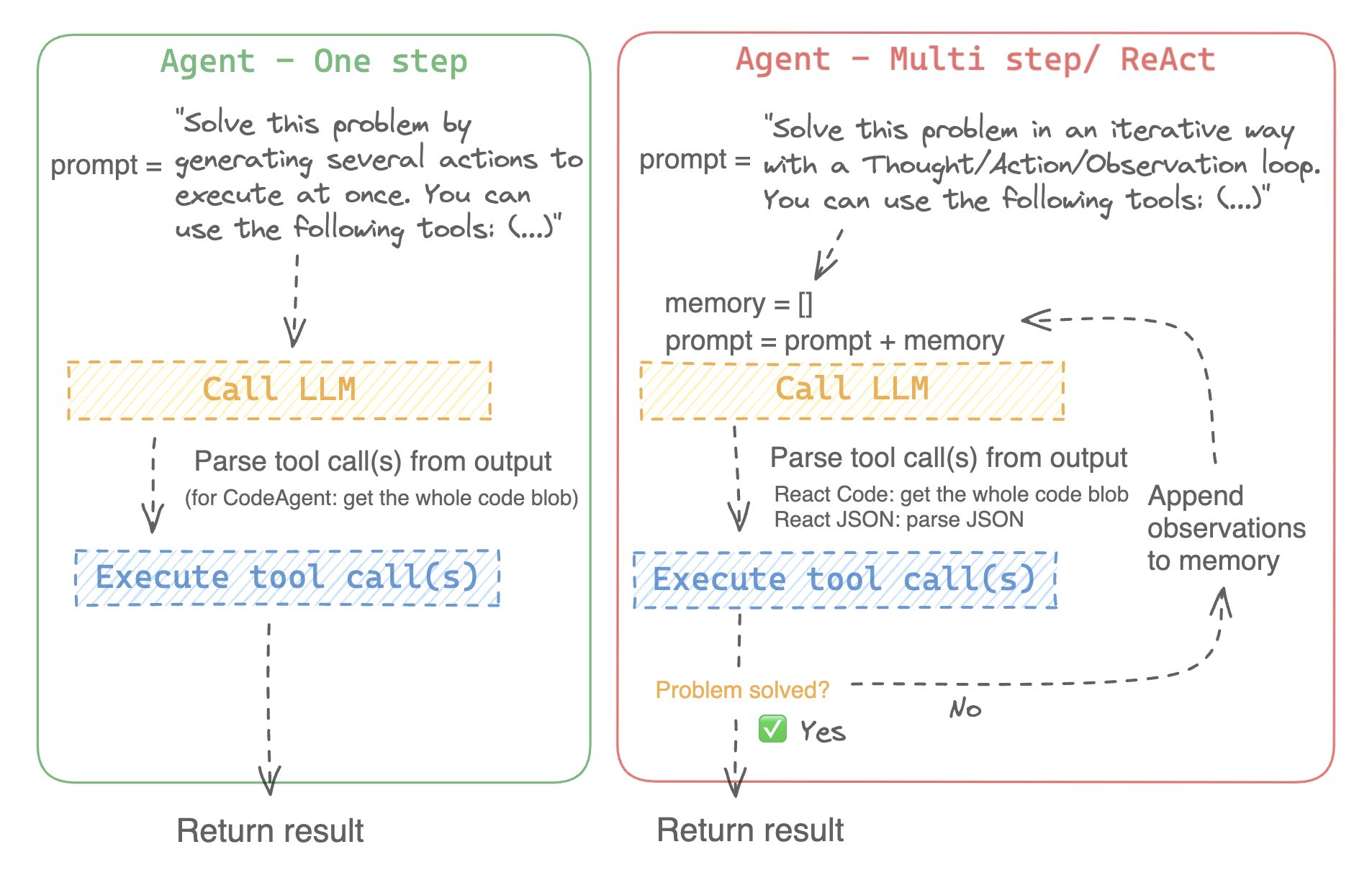
|
||||
|
||||
على سبيل المثال، إليك كيف يعمل وكيل ReAct Code طريقه من خلال السؤال التالي.
|
||||
|
||||
```py3
|
||||
>>> agent.run(
|
||||
... "How many more blocks (also denoted as layers) in BERT base encoder than the encoder from the architecture proposed in Attention is All You Need?",
|
||||
... )
|
||||
=====New task=====
|
||||
How many more blocks (also denoted as layers) in BERT base encoder than the encoder from the architecture proposed in Attention is All You Need?
|
||||
====Agent is executing the code below:
|
||||
bert_blocks = search(query="number of blocks in BERT base encoder")
|
||||
print("BERT blocks:", bert_blocks)
|
||||
====
|
||||
Print outputs:
|
||||
BERT blocks: twelve encoder blocks
|
||||
|
||||
====Agent is executing the code below:
|
||||
attention_layer = search(query="number of layers in Attention is All You Need")
|
||||
print("Attention layers:", attention_layer)
|
||||
====
|
||||
Print outputs:
|
||||
Attention layers: Encoder: The encoder is composed of a stack of N = 6 identical layers. Each layer has two sub-layers. The first is a multi-head self-attention mechanism, and the second is a simple, position- 2 Page 3 Figure 1: The Transformer - model architecture.
|
||||
|
||||
====Agent is executing the code below:
|
||||
bert_blocks = 12
|
||||
attention_layers = 6
|
||||
diff = bert_blocks - attention_layers
|
||||
print("Difference in blocks:", diff)
|
||||
final_answer(diff)
|
||||
====
|
||||
|
||||
Print outputs:
|
||||
Difference in blocks: 6
|
||||
|
||||
Final answer: 6
|
||||
```
|
||||
|
||||
### كيف يمكنني بناء وكيل؟
|
||||
|
||||
لتهيئة وكيل، تحتاج إلى هذه الوسائط:
|
||||
|
||||
- نموذج لغوي كبير (LLM) يشكل المحرك الأساسي للوكيل. الوكيل نفسه ليس النموذج اللغوي، بل هو برنامج يستخدم النموذج اللغوي كمحرك له.
|
||||
- موجه النظام (system prompt): هذه هي التعليمات التي يتم إعطاؤها للنموذج اللغوي لإنشاء مخرجاته.
|
||||
- صندوق أدوات (toolbox) يختار الوكيل منه الأدوات لتنفيذها
|
||||
- محلل (parser) لاستخراج الأدوات التي يجب استدعاؤها من مخرجات النموذج اللغوي LLM والأدوات التي يجب استخدامها
|
||||
|
||||
عند تهيئة نظام الوكيل، يتم استخدام سمات الأداة لإنشاء وصف للأداة، ثم يتم دمجها في موجه النظام الخاص `system_prompt` للوكيل لإعلامه بالأدوات التي يمكنه استخدامها ولماذا.
|
||||
|
||||
للبدء، يرجى تثبيت `agents` الإضافية لتثبيت جميع التبعيات الافتراضية.
|
||||
|
||||
```bash
|
||||
pip install transformers[agents]
|
||||
```
|
||||
|
||||
قم ببناء محرك LLM الخاص بك من خلال تعريف طريقة `llm_engine` التي تقبل قائمة من [الرسائل](./chat_templating.) وتعيد النص. يجب أن تقبل هذه الدالة القابلة للاستدعاء أيضًا معامل `stop` يشير إلى متى يجب التوقف عن التوليد.
|
||||
|
||||
```python
|
||||
from huggingface_hub import login, InferenceClient
|
||||
|
||||
login("<YOUR_HUGGINGFACEHUB_API_TOKEN>")
|
||||
|
||||
client = InferenceClient(model="meta-llama/Meta-Llama-3-70B-Instruct")
|
||||
|
||||
def llm_engine(messages, stop_sequences=["Task"]) -> str:
|
||||
response = client.chat_completion(messages, stop=stop_sequences, max_tokens=1000)
|
||||
answer = response.choices[0].message.content
|
||||
return answer
|
||||
```
|
||||
|
||||
يمكنك استخدام أي طريقة `llm_engine` طالما أنها:
|
||||
1. يتبع تنسيق [رسائل](./chat_templating.md) لإدخاله (`List [Dict [str، str]]`) ويعيد `str`
|
||||
2. يتوقف عن توليد المخراجات من التسلسلات التي تم تمريرها في معامل `stop`
|
||||
|
||||
أنت بحاجة أيضًا إلى معامل "الأدوات" الذي يقبل قائمة من "الأدوات". يمكنك توفير قائمة فارغة لـ "الأدوات"، ولكن استخدم صندوق الأدوات الافتراضي مع معامل اختياري `add_base_tools=True`.
|
||||
|
||||
الآن يمكنك إنشاء وكيل، مثل [`CodeAgent`], وتشغيله. ولتسهيل الأمر، نقدم أيضًا فئة [`HfEngine`] التي تستخدم `huggingface_hub.InferenceClient` بشكل مخفى.
|
||||
|
||||
```python
|
||||
from transformers import CodeAgent, HfEngine
|
||||
|
||||
llm_engine = HfEngine(model="meta-llama/Meta-Llama-3-70B-Instruct")
|
||||
agent = CodeAgent(tools=[], llm_engine=llm_engine, add_base_tools=True)
|
||||
|
||||
agent.run(
|
||||
"Could you translate this sentence from French, say it out loud and return the audio.",
|
||||
sentence="Où est la boulangerie la plus proche?",
|
||||
)
|
||||
```
|
||||
|
||||
هذه الميزة ستكون مفيدة في حالة الحاجة الملحة! يمكنك حتى ترك معامل `llm_engine` غير محدد، وسيتم إنشاء [`HfEngine`] بشكل تلقائي.
|
||||
|
||||
```python
|
||||
from transformers import CodeAgent
|
||||
|
||||
agent = CodeAgent(tools=[], add_base_tools=True)
|
||||
|
||||
agent.run(
|
||||
"Could you translate this sentence from French, say it out loud and give me the audio.",
|
||||
sentence="Où est la boulangerie la plus proche?",
|
||||
)
|
||||
```
|
||||
|
||||
لاحظ أننا استخدمنا معامل "sentence" إضافي: يمكنك تمرير النص كمعامل إضافي إلى النموذج.
|
||||
|
||||
يمكنك أيضًا استخدام هذا للإشارة إلى مسار الملفات المحلية أو البعيدة للنموذج لاستخدامها:
|
||||
|
||||
```py
|
||||
from transformers import ReactCodeAgent
|
||||
|
||||
agent = ReactCodeAgent(tools=[], llm_engine=llm_engine, add_base_tools=True)
|
||||
|
||||
agent.run("Why does Mike not know many people in New York?", audio="https://huggingface.co/datasets/huggingface/documentation-images/resolve/main/transformers/recording.mp3")
|
||||
```
|
||||
|
||||
|
||||
تم تحديد موجه النظام ومحلل المخرجات تلقائيًا، ولكن يمكنك فحصهما بسهولة عن طريق استدعاء `system_prompt_template` على وكيلك.
|
||||
|
||||
```python
|
||||
print(agent.system_prompt_template)
|
||||
```
|
||||
|
||||
من المهم أن تشرح بأكبر قدر ممكن من الوضوح المهمة التي تريد تنفيذها.
|
||||
كل عملية [`~Agent.run`] مستقلة، وبما أن الوكيل مدعوم من LLM، فقد تؤدي الاختلافات الطفيفة في موجهك إلى نتائج مختلفة تمامًا.
|
||||
يمكنك أيضًا تشغيل وكيل بشكل متتالي لمهام مختلفة: في كل مرة يتم فيها إعادة تهيئة سمتي `agent.task` و`agent.logs`.
|
||||
|
||||
|
||||
#### تنفيذ التعليمات البرمجية
|
||||
|
||||
يقوم مفسر Python بتنفيذ التعليمات البرمجية على مجموعة من المدخلات التي يتم تمريرها جنبًا إلى جنب مع أدواتك.
|
||||
يجب أن يكون هذا الأمر آمنًا لأن الوظائف الوحيدة التي يمكن استدعاؤها هي الأدوات التي قدمتها (خاصة إذا كانت أدوات من Hugging Face فقط) ووظيفة الطباعة، لذا فأنت مقيد بالفعل بما يمكن تنفيذه.
|
||||
|
||||
مفسر Python لا يسمح أيضًا باستدعاء دوال بشكل افتراضي خارج قائمة آمنة، لذا فإن جميع الهجمات الأكثر وضوحًا لا ينبغي أن تكون مشكلة.
|
||||
يمكنك أيضًا الإذن باستيرادات إضافية عن طريق تمرير الوحدات النمطية المصرح بها كقائمة من السلاسل في معامل `additional_authorized_imports` عند تهيئة [`ReactCodeAgent`] أو [`CodeAgent`]:
|
||||
|
||||
```py
|
||||
>>> from transformers import ReactCodeAgent
|
||||
|
||||
>>> agent = ReactCodeAgent(tools=[], additional_authorized_imports=['requests', 'bs4'])
|
||||
>>> agent.run("Could you get me the title of the page at url 'https://huggingface.co/blog'?")
|
||||
|
||||
(...)
|
||||
'Hugging Face – Blog'
|
||||
```
|
||||
|
||||
سيتم إيقاف التنفيذ عند أي رمز يحاول تنفيذ عملية غير قانونية أو إذا كان هناك خطأ Python عادي في التعليمات البرمجية التي تم إنشاؤها بواسطة الوكيل.
|
||||
|
||||
> [!WARNING]
|
||||
> يمكن لـ LLM توليد شفرة برمجية عشوائية سيتم تنفيذها بعد ذلك: لا تقمب استدعاء أى دوال غير آمنة!
|
||||
|
||||
### موجه النظام
|
||||
|
||||
ينشئ الوكيل، أو بالأحرى LLM الذي يقود الوكيل، يولد مخرجات بناءً على موجه النظام. يمكن تخصيص موجه النظام وتصميمه للمهام المقصودة. على سبيل المثال، تحقق من موجه النظام لـ [`ReactCodeAgent`] (الإصدار أدناه مبسط قليلاً).
|
||||
|
||||
```text
|
||||
You will be given a task to solve as best you can.
|
||||
You have access to the following tools:
|
||||
<<tool_descriptions>>
|
||||
|
||||
To solve the task, you must plan forward to proceed in a series of steps, in a cycle of 'Thought:', 'Code:', and 'Observation:' sequences.
|
||||
|
||||
At each step, in the 'Thought:' sequence, you should first explain your reasoning towards solving the task, then the tools that you want to use.
|
||||
Then in the 'Code:' sequence, you should write the code in simple Python. The code sequence must end with '/End code' sequence.
|
||||
During each intermediate step, you can use 'print()' to save whatever important information you will then need.
|
||||
These print outputs will then be available in the 'Observation:' field, for using this information as input for the next step.
|
||||
|
||||
In the end you have to return a final answer using the `final_answer` tool.
|
||||
|
||||
Here are a few examples using notional tools:
|
||||
---
|
||||
{examples}
|
||||
|
||||
Above example were using notional tools that might not exist for you. You only have access to those tools:
|
||||
<<tool_names>>
|
||||
You also can perform computations in the python code you generate.
|
||||
|
||||
Always provide a 'Thought:' and a 'Code:\n```py' sequence ending with '```<end_code>' sequence. You MUST provide at least the 'Code:' sequence to move forward.
|
||||
|
||||
Remember to not perform too many operations in a single code block! You should split the task into intermediate code blocks.
|
||||
Print results at the end of each step to save the intermediate results. Then use final_answer() to return the final result.
|
||||
|
||||
Remember to make sure that variables you use are all defined.
|
||||
|
||||
Now Begin!
|
||||
```
|
||||
|
||||
يتضمن موجه النظام:
|
||||
- *مقدمة* تشرح كيف يجب أن يتصرف الوكيل والأدوات التي يجب عليه استخدامها.
|
||||
- وصف لجميع الأدوات التي يتم تحديدها بواسطة رمز `<<tool_descriptions>>` الذي يتم استبداله ديناميكيًا في وقت التشغيل بالأدوات التي يحددها المستخدم أو يختارها.
|
||||
- يأتي وصف الأداة من سمات الأداة، `name`، و`description`، و`inputs` و`output_type`، وقالب `jinja2` بسيط يمكنك تحسينه.
|
||||
- شكل المخرج المتوقع.
|
||||
|
||||
يمكنك تحسين موجه النظام، على سبيل المثال، عن طريق إضافة شرح لتنسيق المخرجات.
|
||||
|
||||
للحصول على أقصى قدر من المرونة، يمكنك الكتابة فوق قالب موجه النظام بالكامل عن طريق تمرير موجه مخصص كمعامل إلى معلمة `system_prompt`.
|
||||
|
||||
```python
|
||||
from transformers import ReactJsonAgent
|
||||
from transformers.agents import PythonInterpreterTool
|
||||
|
||||
agent = ReactJsonAgent(tools=[PythonInterpreterTool()], system_prompt="{your_custom_prompt}")
|
||||
```
|
||||
|
||||
> [!WARNING]
|
||||
> يرجى التأكد من تحديد سلسلة `<<tool_descriptions>>` في مكان ما في `template` حتى يكون الوكيل على علم
|
||||
بالأدوات المتاحة.
|
||||
|
||||
|
||||
### فحص تشغيل الوكيل
|
||||
|
||||
فيما يلي بعض السمات المفيدة لفحص ما حدث بعد التشغيل:
|
||||
- تخزن `agent.logs` سجلات مفصلة للوكيل. في كل خطوة من تشغيل الوكيل، يتم تخزين كل شيء في قاموس إلحاقه بـ `agent.logs`.
|
||||
- تشغيل `agent.write_inner_memory_from_logs()` يخلق ذاكرة داخلية لسجلات الوكيل للنظام LLM لعرضها، كقائمة من رسائل الدردشة. تنتقل هذه الطريقة عبر كل خطوة من سجل الوكيل ولا تخزن سوى ما يهمها كرسالة: على سبيل المثال، سيحفظ موجه النظام والمهمة في رسائل منفصلة، ثم لكل خطوة سيخزن مخرج LLM كرسالة، ومخرج استدعاء الأداة كرسالة أخرى. استخدم هذا إذا كنت تريد عرضًا عامًا لما حدث - ولكن لن يتم نسخ كل سجل بواسطة هذه الطريقة.
|
||||
|
||||
## الأدوات
|
||||
|
||||
الأداة هي عبارة عن وظيفة أساسية يستخدمها الوكيل لتنفيذ مهمة محددة.
|
||||
|
||||
يمكنك على سبيل المثال التحقق من [`PythonInterpreterTool`]: لديه اسم ووصف ووصف للمدخلات ونوع للمخرج، وطريقة `__call__` التي تقوم بتنفيذ المهمة المطلوبة.
|
||||
|
||||
عند تهيئة الوكيل، يتم استخدام سمات الأداة لتوليد وصف للأداة يتم تضمينه في موجه النظام الخاص بالوكيل. يتيح هذا للوكيل معرفة الأدوات التي يمكنه استخدامها ولماذا.
|
||||
|
||||
### صندوق الأدوات الافتراضي
|
||||
|
||||
يأتي Transformers مع صندوق أدوات افتراضي لتمكين الوكلاء، والذي يمكنك إضافته إلى وكيلك عند التهيئة باستخدام معامل `add_base_tools = True`:
|
||||
|
||||
- **الإجابة على أسئلة المستند**: الإجابة على سؤال حول المستند (مثل ملف PDF) بتنسيق صورة ([Donut](./model_doc/donut))
|
||||
- **الإجابة على أسئلة الصور**: الإجابة على سؤال حول صورة ([VILT](./model_doc/vilt))
|
||||
- **التحدث إلى النص**: قم بتفريغ الكلام إلى نص ([Whisper](./model_doc/whisper))
|
||||
- **النص إلى كلام**: تحويل النص إلى كلام ([SpeechT5](./model_doc/speecht5))
|
||||
- **الترجمة**: ترجمة جملة معينة من لغة المصدر إلى لغة الهدف.
|
||||
- **مفسر كود Python**: تشغيل كود Python الذي تم إنشاؤه بواسطة LLM في بيئة آمنة. لن يتم إضافة هذه الأداة إلى [`ReactJsonAgent`] إلا إذا استخدمت `add_base_tools=True`، نظرًا لأن الأدوات المستندة إلى التعليمات البرمجية يمكنها بالفعل تنفيذ كود Python
|
||||
لا تترجم النصوص الخاصة ولا الأكواد البرمجية ولا الروابط ولا رموز HTML وCSS:
|
||||
|
||||
يمكنك استخدام أداة يدويًا عن طريق استدعاء دالة [`load_tool`] وتحديد مهمة لتنفيذها.
|
||||
|
||||
```python
|
||||
from transformers import load_tool
|
||||
|
||||
tool = load_tool("text-to-speech")
|
||||
audio = tool("This is a text to speech tool")
|
||||
```
|
||||
|
||||
### إنشاء أداة جديدة
|
||||
|
||||
يمكنك إنشاء أداتك الخاصة لتغطية حالات الاستخدام التي لا تغطيها الأدوات الافتراضية من Hugging Face.
|
||||
على سبيل المثال، دعنا نقوم بإنشاء أداة تعرض النموذج الأكثر تنزيلًا لمهمة معينة من Hub.
|
||||
|
||||
سوف نبدأ بالكود التالي.
|
||||
|
||||
```python
|
||||
from huggingface_hub import list_models
|
||||
|
||||
task = "text-classification"
|
||||
|
||||
model = next(iter(list_models(filter=task, sort="downloads", direction=-1)))
|
||||
print(model.id)
|
||||
```
|
||||
|
||||
يمكن تحويل هذه الشيفرة إلى فئة ترث من الفئة العليا [`Tool`].
|
||||
|
||||
تحتاج الأداة المخصصة إلى:
|
||||
|
||||
- اسم `name`، والتي تمثل اسم الأداة نفسها. عادةً ما يصف الاسم وظيفتها. بما أن الكود يعيد النموذج الأكثر تنزيلًا لمهمة ما، فلنسمها `model_download_counter`.
|
||||
- تستخدم خاصية `description` لملء موجه نظام الوكيل.
|
||||
- خاصية `inputs`، والتي هي عبارة عن قاموس بمفاتيح "type" و"description". يحتوي على معلومات تساعد المفسر Python على اتخاذ خيارات مستنيرة بشأن المدخلات.
|
||||
- خاصية `output_type`، والتي تحدد نوع المخرج.
|
||||
- طريقة `forward` والتي تحتوي على الكود الذي سيتم تنفيذه للحصول على النتيجة النهائية.
|
||||
|
||||
```python
|
||||
from transformers import Tool
|
||||
from huggingface_hub import list_models
|
||||
|
||||
class HFModelDownloadsTool(Tool):
|
||||
name = "model_download_counter"
|
||||
description = (
|
||||
"This is a tool that returns the most downloaded model of a given task on the Hugging Face Hub. "
|
||||
"It returns the name of the checkpoint."
|
||||
)
|
||||
|
||||
inputs = {
|
||||
"task": {
|
||||
"type": "text",
|
||||
"description": "the task category (such as text-classification, depth-estimation, etc)",
|
||||
}
|
||||
}
|
||||
output_type = "text"
|
||||
|
||||
def forward(self, task: str):
|
||||
model = next(iter(list_models(filter=task, sort="downloads", direction=-1)))
|
||||
return model.id
|
||||
```
|
||||
|
||||
الآن بعد أن أصبحت فئة `HfModelDownloadsTool` المخصصة جاهزة، يمكنك حفظها في ملف باسم `model_downloads.py` واستيرادها للاستخدام.
|
||||
|
||||
```python
|
||||
from model_downloads import HFModelDownloadsTool
|
||||
|
||||
tool = HFModelDownloadsTool()
|
||||
```
|
||||
|
||||
يمكنك أيضًا مشاركة أداتك المخصصة في Hub عن طريق استدعاء [`~Tool.push_to_hub`] على الأداة. تأكد من أنك قمت بإنشاء مستودع لها على Hub وأنك تستخدم رمز وصول للقراءة.
|
||||
|
||||
```python
|
||||
tool.push_to_hub("{your_username}/hf-model-downloads")
|
||||
```
|
||||
|
||||
قم بتحميل الأداة باستخدام دالة [`~Tool.load_tool`] ومررها إلى معلمة `tools` في الوكيل الخاص بك.
|
||||
|
||||
```python
|
||||
from transformers import load_tool, CodeAgent
|
||||
|
||||
model_download_tool = load_tool("m-ric/hf-model-downloads")
|
||||
agent = CodeAgent(tools=[model_download_tool], llm_engine=llm_engine)
|
||||
agent.run(
|
||||
"Can you give me the name of the model that has the most downloads in the 'text-to-video' task on the Hugging Face Hub?"
|
||||
)
|
||||
```
|
||||
|
||||
ستحصل على ما يلي:
|
||||
|
||||
```text
|
||||
======== New task ========
|
||||
Can you give me the name of the model that has the most downloads in the 'text-to-video' task on the Hugging Face Hub?
|
||||
==== Agent is executing the code below:
|
||||
most_downloaded_model = model_download_counter(task="text-to-video")
|
||||
print(f"The most downloaded model for the 'text-to-video' task is {most_downloaded_model}.")
|
||||
====
|
||||
```
|
||||
|
||||
والناتج:
|
||||
|
||||
`"النموذج الأكثر تنزيلًا لمهمة `text-to-video` هو ByteDance/AnimateDiff-Lightning."`
|
||||
|
||||
### إدارة صندوق أدوات الوكيل الخاص بك
|
||||
|
||||
إذا كنت قد قمت بتهيئة وكيل، فمن غير الملائم إعادة تهيئته من البداية لإضافة أداة جديدة ترغب في استخدامها. باستخدام مكتبة Transformers، يمكنك إدارة صندوق أدوات الوكيل بإضافة أو استبدال أداة موجودة.
|
||||
|
||||
دعنا نضيف الأداة `model_download_tool` إلى وكيل تم تهيئته مسبقًا باستخدام صندوق الأدوات الافتراضي.
|
||||
|
||||
```python
|
||||
from transformers import CodeAgent
|
||||
|
||||
agent = CodeAgent(tools=[], llm_engine=llm_engine, add_base_tools=True)
|
||||
agent.toolbox.add_tool(model_download_tool)
|
||||
```
|
||||
|
||||
الآن يمكننا الاستفادة من الأداة الجديدة وأداة تحويل النص إلى كلام السابقة:
|
||||
|
||||
```python
|
||||
agent.run(
|
||||
"Can you read out loud the name of the model that has the most downloads in the 'text-to-video' task on the Hugging Face Hub and return the audio?"
|
||||
)
|
||||
```
|
||||
|
||||
| **Audio** |
|
||||
|------------------------------------------------------------------------------------------------------------------------------------------------------|
|
||||
| <audio controls><source src="https://huggingface.co/datasets/huggingface/documentation-images/resolve/main/transformers/damo.wav" type="audio/wav"/> |
|
||||
|
||||
> [!WARNING]
|
||||
> احترس عند إضافة أدوات إلى وكيل يعمل بالفعل لأنه يمكن أن يؤثر على اختيار الأداة لصالح أداتك أو اختيار أداة أخرى غير المحددة بالفعل.
|
||||
|
||||
استخدم طريقة `agent.toolbox.update_tool()` لاستبدال أداة موجودة في صندوق أدوات الوكيل.
|
||||
هذا مفيد إذا كانت أداتك الجديدة بديلاً مباشرًا للأداة الموجودة لأن الوكيل يعرف بالفعل كيفية تنفيذ تلك المهمة المحددة.
|
||||
تأكد فقط من اتباع الأداة الجديدة لنفس واجهة برمجة التطبيقات (API) للأداة المستبدلة أو قم بتكييف قالب موجه النظام لضمان تحديث جميع الأمثلة التي تستخدم الأداة المستبدلة.
|
||||
|
||||
### استخدام مجموعة من الأدوات
|
||||
|
||||
يمكنك الاستفادة من مجموعات الأدوات باستخدام كائن ToolCollection، مع تحديد مجموعة الأدوات التي تريد استخدامها.
|
||||
ثم قم بتمريرها كقائمة لتهيئة الوكيل الخاص بك، وبدء استخدامها!
|
||||
|
||||
```py
|
||||
from transformers import ToolCollection, ReactCodeAgent
|
||||
|
||||
image_tool_collection = ToolCollection(collection_slug="huggingface-tools/diffusion-tools-6630bb19a942c2306a2cdb6f")
|
||||
agent = ReactCodeAgent(tools=[*image_tool_collection.tools], add_base_tools=True)
|
||||
|
||||
agent.run("Please draw me a picture of rivers and lakes.")
|
||||
```
|
||||
|
||||
لتسريع البداية، يتم تحميل الأدوات فقط إذا استدعاها الوكيل.
|
||||
|
||||
ستحصل على هذه الصورة:
|
||||
|
||||
<img src="https://huggingface.co/datasets/huggingface/documentation-images/resolve/main/transformers/rivers_and_lakes.png" />
|
||||
|
||||
### استخدام gradio-tools
|
||||
|
||||
[gradio-tools](https://github.com/freddyaboulton/gradio-tools) هي مكتبة قوية تتيح استخدام Hugging
|
||||
Face Spaces كأدوات. تدعم العديد من المساحات الموجودة بالإضافة إلى مساحات مخصصة.
|
||||
|
||||
تدعم مكتبة Transformers `gradio_tools` باستخدام طريقة [`Tool.from_gradio`] في الفئة. على سبيل المثال، دعنا نستخدم [`StableDiffusionPromptGeneratorTool`](https://github.com/freddyaboulton/gradio-tools/blob/main/gradio_tools/tools/prompt_generator.py) من مجموعة أدوات `gradio-tools` لتحسين المطالبات لإنشاء صور أفضل.
|
||||
|
||||
استورد وقم بتهيئة الأداة، ثم مررها إلى طريقة `Tool.from_gradio`:
|
||||
|
||||
```python
|
||||
from gradio_tools import StableDiffusionPromptGeneratorTool
|
||||
from transformers import Tool, load_tool, CodeAgent
|
||||
|
||||
gradio_prompt_generator_tool = StableDiffusionPromptGeneratorTool()
|
||||
prompt_generator_tool = Tool.from_gradio(gradio_prompt_generator_tool)
|
||||
```
|
||||
|
||||
الآن يمكنك استخدامه مثل أي أداة أخرى. على سبيل المثال، دعنا نحسن الموجه `a rabbit wearing a space suit`.
|
||||
|
||||
```python
|
||||
image_generation_tool = load_tool('huggingface-tools/text-to-image')
|
||||
agent = CodeAgent(tools=[prompt_generator_tool, image_generation_tool], llm_engine=llm_engine)
|
||||
|
||||
agent.run(
|
||||
"Improve this prompt, then generate an image of it.", prompt='A rabbit wearing a space suit'
|
||||
)
|
||||
```
|
||||
|
||||
يستفيد النموذج بشكل كافٍ من الأداة:
|
||||
|
||||
```text
|
||||
======== New task ========
|
||||
Improve this prompt, then generate an image of it.
|
||||
You have been provided with these initial arguments: {'prompt': 'A rabbit wearing a space suit'}.
|
||||
==== Agent is executing the code below:
|
||||
improved_prompt = StableDiffusionPromptGenerator(query=prompt)
|
||||
while improved_prompt == "QUEUE_FULL":
|
||||
improved_prompt = StableDiffusionPromptGenerator(query=prompt)
|
||||
print(f"The improved prompt is {improved_prompt}.")
|
||||
image = image_generator(prompt=improved_prompt)
|
||||
====
|
||||
```
|
||||
|
||||
قبل إنشاء الصورة أخيرًا:
|
||||
|
||||
<img src="https://huggingface.co/datasets/huggingface/documentation-images/resolve/main/transformers/rabbit_spacesuit_flux.webp" />
|
||||
|
||||
> [!WARNING]
|
||||
> تتطلب gradio-tools إدخالات وإخراجات *نصية* حتى عند العمل مع طرائق مختلفة مثل كائنات الصور والصوت. الإدخالات والإخراجات الصورية والصوتية غير متوافقة حاليًا.
|
||||
|
||||
### استخدام أدوات LangChain
|
||||
|
||||
نحن نحب Langchain ونعتقد أنها تحتوي على مجموعة أدوات قوية للغاية.
|
||||
لاستيراد أداة من LangChain، استخدم الطريقة `from_langchain()`.
|
||||
|
||||
فيما يلي كيفية استخدامها لإعادة إنشاء نتيجة البحث في المقدمة باستخدام أداة بحث الويب LangChain.
|
||||
|
||||
```python
|
||||
from langchain.agents import load_tools
|
||||
from transformers import Tool, ReactCodeAgent
|
||||
|
||||
search_tool = Tool.from_langchain(load_tools(["serpapi"])[0])
|
||||
|
||||
agent = ReactCodeAgent(tools=[search_tool])
|
||||
|
||||
agent.run("How many more blocks (also denoted as layers) in BERT base encoder than the encoder from the architecture proposed in Attention is All You Need?")
|
||||
```
|
||||
|
||||
## واجهة Gradio
|
||||
|
||||
يمكنك الاستفادة من `gradio.Chatbot` لعرض أفكار الوكيل الخاص بك باستخدام `stream_to_gradio`، إليك مثال:
|
||||
|
||||
```py
|
||||
import gradio as gr
|
||||
from transformers import (
|
||||
load_tool,
|
||||
ReactCodeAgent,
|
||||
HfEngine,
|
||||
stream_to_gradio,
|
||||
)
|
||||
|
||||
# Import tool from Hub
|
||||
image_generation_tool = load_tool("m-ric/text-to-image")
|
||||
|
||||
llm_engine = HfEngine("meta-llama/Meta-Llama-3-70B-Instruct")
|
||||
|
||||
# Initialize the agent with the image generation tool
|
||||
agent = ReactCodeAgent(tools=[image_generation_tool], llm_engine=llm_engine)
|
||||
|
||||
|
||||
def interact_with_agent(task):
|
||||
messages = []
|
||||
messages.append(gr.ChatMessage(role="user", content=task))
|
||||
yield messages
|
||||
for msg in stream_to_gradio(agent, task):
|
||||
messages.append(msg)
|
||||
yield messages + [
|
||||
gr.ChatMessage(role="assistant", content="⏳ Task not finished yet!")
|
||||
]
|
||||
yield messages
|
||||
|
||||
|
||||
with gr.Blocks() as demo:
|
||||
text_input = gr.Textbox(lines=1, label="Chat Message", value="Make me a picture of the Statue of Liberty.")
|
||||
submit = gr.Button("Run illustrator agent!")
|
||||
chatbot = gr.Chatbot(
|
||||
label="Agent",
|
||||
type="messages",
|
||||
avatar_images=(
|
||||
None,
|
||||
"https://em-content.zobj.net/source/twitter/53/robot-face_1f916.png",
|
||||
),
|
||||
)
|
||||
submit.click(interact_with_agent, [text_input], [chatbot])
|
||||
|
||||
if __name__ == "__main__":
|
||||
demo.launch()
|
||||
```
|
||||
@@ -77,7 +77,7 @@ model = AutoModelForCausalLM.from_pretrained(model_id, gguf_file=filename)
|
||||
|
||||
الآن لديك إمكانية الوصول إلى النسخة الكامل غير المكممة للنموذج في بيئة PyTorch، حيث يمكنك دمجه مع مجموعة كبيرة من الأدوات الأخرى.
|
||||
|
||||
لإعادة التحويل إلى ملف `gguf`، نوصي باستخدام ملف [`convert-hf-to-gguf.py`](https://github.com/ggerganov/llama.cpp/blob/master/convert-hf-to-gguf.py) من llama.cpp.
|
||||
لإعادة التحويل إلى ملف `gguf`، نوصي باستخدام ملف [`convert-hf-to-gguf.py`](https://github.com/ggerganov/llama.cpp/blob/master/convert_hf_to_gguf.py) من llama.cpp.
|
||||
|
||||
فيما يلي كيفية إكمال البرنامج النصي أعلاه لحفظ النموذج وإعادة تصديره مرة أخرى إلى `gguf`:
|
||||
|
||||
|
||||
@@ -674,29 +674,7 @@ use_cpu: false
|
||||
```
|
||||
|
||||
</hfoption>
|
||||
<hfoption id="Tensor Parallelism with PyTorch 2">
|
||||
|
||||
```yml
|
||||
compute_environment: LOCAL_MACHINE
|
||||
tp_config:
|
||||
tp_size: 4
|
||||
distributed_type: TP
|
||||
downcast_bf16: 'no'
|
||||
machine_rank: 0
|
||||
main_training_function: main
|
||||
mixed_precision: 'no'
|
||||
num_machines: 1
|
||||
num_processes: 4
|
||||
rdzv_backend: static
|
||||
same_network: true
|
||||
tpu_env: []
|
||||
tpu_use_cluster: false
|
||||
tpu_use_sudo: false
|
||||
use_cpu: false
|
||||
|
||||
```
|
||||
|
||||
</hfoption>
|
||||
</hfoptions>
|
||||
يُعد أمر [`accelerate_launch`](https://huggingface.co/docs/accelerate/package_reference/cli#accelerate-launch) هو الطريقة المُوصى بها لتشغيل نص البرمجى للتدريب على نظام موزع باستخدام Accelerate و [`Trainer`] مع المعلمات المحددة في `config_file.yaml`. يتم حفظ هذا الملف في مجلد ذاكرة التخزين المؤقت لـ Accelerate ويتم تحميله تلقائيًا عند تشغيل `accelerate_launch`.
|
||||
|
||||
|
||||
@@ -23,8 +23,6 @@
|
||||
title: Laden und Trainieren von Adaptern mit 🤗 PEFT
|
||||
- local: model_sharing
|
||||
title: Ein Modell teilen
|
||||
- local: transformers_agents
|
||||
title: Agents
|
||||
- local: llm_tutorial
|
||||
title: Generation with LLMs
|
||||
title: Tutorials
|
||||
@@ -39,4 +37,4 @@
|
||||
title: Testen
|
||||
- local: pr_checks
|
||||
title: Überprüfung einer Pull Request
|
||||
title: Contribute
|
||||
title: Contribute
|
||||
|
||||
@@ -1,323 +0,0 @@
|
||||
<!--Copyright 2023 The HuggingFace Team. All rights reserved.
|
||||
|
||||
Licensed under the Apache License, Version 2.0 (the "License"); you may not use this file except in compliance with
|
||||
the License. You may obtain a copy of the License at
|
||||
|
||||
http://www.apache.org/licenses/LICENSE-2.0
|
||||
|
||||
Unless required by applicable law or agreed to in writing, software distributed under the License is distributed on
|
||||
an "AS IS" BASIS, WITHOUT WARRANTIES OR CONDITIONS OF ANY KIND, either express or implied. See the License for the
|
||||
specific language governing permissions and limitations under the License.
|
||||
|
||||
⚠️ Note that this file is in Markdown but contain specific syntax for our doc-builder (similar to MDX) that may not be
|
||||
rendered properly in your Markdown viewer.
|
||||
|
||||
-->
|
||||
|
||||
# Transformers Agents
|
||||
|
||||
<Tip warning={true}>
|
||||
|
||||
Transformers Agents ist eine experimentelle API, die jederzeit geändert werden kann. Die von den Agenten zurückgegebenen Ergebnisse
|
||||
zurückgegeben werden, können variieren, da sich die APIs oder die zugrunde liegenden Modelle ändern können.
|
||||
|
||||
</Tip>
|
||||
|
||||
Transformers Version v4.29.0, die auf dem Konzept von *Tools* und *Agenten* aufbaut. Sie können damit spielen in
|
||||
[dieses Colab](https://colab.research.google.com/drive/1c7MHD-T1forUPGcC_jlwsIptOzpG3hSj).
|
||||
|
||||
Kurz gesagt, es bietet eine API für natürliche Sprache auf der Grundlage von Transformers: Wir definieren eine Reihe von kuratierten Tools und entwerfen einen
|
||||
Agenten, um natürliche Sprache zu interpretieren und diese Werkzeuge zu verwenden. Es ist von vornherein erweiterbar; wir haben einige relevante Tools kuratiert,
|
||||
aber wir werden Ihnen zeigen, wie das System einfach erweitert werden kann, um jedes von der Community entwickelte Tool zu verwenden.
|
||||
|
||||
Beginnen wir mit einigen Beispielen dafür, was mit dieser neuen API erreicht werden kann. Sie ist besonders leistungsfähig, wenn es um
|
||||
Sie ist besonders leistungsstark, wenn es um multimodale Aufgaben geht. Lassen Sie uns also eine Runde drehen, um Bilder zu erzeugen und Text vorzulesen.
|
||||
|
||||
```py
|
||||
agent.run("Caption the following image", image=image)
|
||||
```
|
||||
|
||||
| **Input** | **Output** |
|
||||
|-----------------------------------------------------------------------------------------------------------------------------|-----------------------------------|
|
||||
| <img src="https://huggingface.co/datasets/huggingface/documentation-images/resolve/main/transformers/beaver.png" width=200> | A beaver is swimming in the water |
|
||||
|
||||
---
|
||||
|
||||
```py
|
||||
agent.run("Read the following text out loud", text=text)
|
||||
```
|
||||
| **Input** | **Output** |
|
||||
|-------------------------------------------------------------------------------------------------------------------------|----------------------------------------------|
|
||||
| A beaver is swimming in the water | <audio controls><source src="https://huggingface.co/datasets/huggingface/documentation-images/resolve/main/transformers/tts_example.wav" type="audio/wav"> your browser does not support the audio element. </audio>
|
||||
|
||||
---
|
||||
|
||||
```py
|
||||
agent.run(
|
||||
"In the following `document`, where will the TRRF Scientific Advisory Council Meeting take place?",
|
||||
document=document,
|
||||
)
|
||||
```
|
||||
| **Input** | **Output** |
|
||||
|-----------------------------------------------------------------------------------------------------------------------------|----------------|
|
||||
| <img src="https://datasets-server.huggingface.co/assets/hf-internal-testing/example-documents/--/hf-internal-testing--example-documents/test/0/image/image.jpg" width=200> | ballroom foyer |
|
||||
|
||||
## Schnellstart
|
||||
|
||||
Bevor Sie `agent.run` verwenden können, müssen Sie einen Agenten instanziieren, der ein großes Sprachmodell (LLM) ist.
|
||||
Wir bieten Unterstützung für openAI-Modelle sowie für OpenSource-Alternativen von BigCode und OpenAssistant. Die openAI
|
||||
Modelle sind leistungsfähiger (erfordern aber einen openAI-API-Schlüssel, können also nicht kostenlos verwendet werden); Hugging Face
|
||||
bietet kostenlosen Zugang zu Endpunkten für BigCode- und OpenAssistant-Modelle.
|
||||
|
||||
To start with, please install the `agents` extras in order to install all default dependencies.
|
||||
```bash
|
||||
pip install transformers[agents]
|
||||
```
|
||||
|
||||
Um openAI-Modelle zu verwenden, instanziieren Sie einen [`OpenAiAgent`], nachdem Sie die `openai`-Abhängigkeit installiert haben:
|
||||
|
||||
```bash
|
||||
pip install openai
|
||||
```
|
||||
|
||||
|
||||
```py
|
||||
from transformers import OpenAiAgent
|
||||
|
||||
agent = OpenAiAgent(model="text-davinci-003", api_key="<your_api_key>")
|
||||
```
|
||||
|
||||
Um BigCode oder OpenAssistant zu verwenden, melden Sie sich zunächst an, um Zugriff auf die Inference API zu erhalten:
|
||||
|
||||
```py
|
||||
from huggingface_hub import login
|
||||
|
||||
login("<YOUR_TOKEN>")
|
||||
```
|
||||
|
||||
Dann instanziieren Sie den Agenten
|
||||
|
||||
```py
|
||||
from transformers import HfAgent
|
||||
|
||||
# Starcoder
|
||||
agent = HfAgent("https://api-inference.huggingface.co/models/bigcode/starcoder")
|
||||
# StarcoderBase
|
||||
# agent = HfAgent("https://api-inference.huggingface.co/models/bigcode/starcoderbase")
|
||||
# OpenAssistant
|
||||
# agent = HfAgent(url_endpoint="https://api-inference.huggingface.co/models/OpenAssistant/oasst-sft-4-pythia-12b-epoch-3.5")
|
||||
```
|
||||
|
||||
Dies geschieht mit der Inferenz-API, die Hugging Face derzeit kostenlos zur Verfügung stellt. Wenn Sie Ihren eigenen Inferenz
|
||||
Endpunkt für dieses Modell (oder einen anderen) haben, können Sie die obige URL durch Ihren URL-Endpunkt ersetzen.
|
||||
|
||||
<Tip>
|
||||
|
||||
StarCoder und OpenAssistant sind kostenlos und leisten bei einfachen Aufgaben bewundernswert gute Arbeit. Allerdings halten die Kontrollpunkte
|
||||
nicht, wenn es um komplexere Aufforderungen geht. Wenn Sie mit einem solchen Problem konfrontiert sind, empfehlen wir Ihnen, das OpenAI
|
||||
Modell auszuprobieren, das zwar leider nicht quelloffen ist, aber zur Zeit eine bessere Leistung erbringt.
|
||||
|
||||
</Tip>
|
||||
|
||||
Sie sind jetzt startklar! Lassen Sie uns in die beiden APIs eintauchen, die Ihnen jetzt zur Verfügung stehen.
|
||||
|
||||
### Einzelne Ausführung (run)
|
||||
|
||||
Die Methode der einmaligen Ausführung ist die Verwendung der [`~Agent.run`] Methode des Agenten:
|
||||
|
||||
```py
|
||||
agent.run("Draw me a picture of rivers and lakes.")
|
||||
```
|
||||
|
||||
<img src="https://huggingface.co/datasets/huggingface/documentation-images/resolve/main/transformers/rivers_and_lakes.png" width=200>
|
||||
|
||||
Es wählt automatisch das (oder die) Werkzeug(e) aus, das (die) für die von Ihnen gewünschte Aufgabe geeignet ist (sind) und führt es (sie) entsprechend aus. Es
|
||||
kann eine oder mehrere Aufgaben in der gleichen Anweisung ausführen (je komplexer Ihre Anweisung ist, desto wahrscheinlicher ist ein
|
||||
der Agent scheitern).
|
||||
|
||||
```py
|
||||
agent.run("Draw me a picture of the sea then transform the picture to add an island")
|
||||
```
|
||||
|
||||
<img src="https://huggingface.co/datasets/huggingface/documentation-images/resolve/main/transformers/sea_and_island.png" width=200>
|
||||
|
||||
<br/>
|
||||
|
||||
|
||||
Jede [`~Agent.run`] Operation ist unabhängig, so dass Sie sie mehrmals hintereinander mit unterschiedlichen Aufgaben ausführen können.
|
||||
|
||||
Beachten Sie, dass Ihr `Agent` nur ein großsprachiges Modell ist, so dass kleine Variationen in Ihrer Eingabeaufforderung völlig unterschiedliche Ergebnisse liefern können.
|
||||
unterschiedliche Ergebnisse liefern. Es ist wichtig, dass Sie die Aufgabe, die Sie ausführen möchten, so genau wie möglich erklären. Wir gehen noch weiter ins Detail
|
||||
wie man gute Prompts schreibt [hier](custom_tools#writing-good-user-inputs).
|
||||
|
||||
Wenn Sie einen Status über Ausführungszeiten hinweg beibehalten oder dem Agenten Nicht-Text-Objekte übergeben möchten, können Sie dies tun, indem Sie
|
||||
Variablen, die der Agent verwenden soll. Sie könnten zum Beispiel das erste Bild von Flüssen und Seen erzeugen,
|
||||
und das Modell bitten, dieses Bild zu aktualisieren und eine Insel hinzuzufügen, indem Sie Folgendes tun:
|
||||
|
||||
```python
|
||||
picture = agent.run("Generate a picture of rivers and lakes.")
|
||||
updated_picture = agent.run("Transform the image in `picture` to add an island to it.", picture=picture)
|
||||
```
|
||||
|
||||
<Tip>
|
||||
|
||||
Dies kann hilfreich sein, wenn das Modell Ihre Anfrage nicht verstehen kann und die Werkzeuge verwechselt. Ein Beispiel wäre:
|
||||
|
||||
```py
|
||||
agent.run("Draw me the picture of a capybara swimming in the sea")
|
||||
```
|
||||
|
||||
Hier könnte das Modell auf zwei Arten interpretieren:
|
||||
- Die Funktion `Text-zu-Bild` erzeugt ein Wasserschwein, das im Meer schwimmt.
|
||||
- Oder Sie lassen das `Text-zu-Bild` ein Wasserschwein erzeugen und verwenden dann das Werkzeug `Bildtransformation`, um es im Meer schwimmen zu lassen.
|
||||
|
||||
Falls Sie das erste Szenario erzwingen möchten, können Sie dies tun, indem Sie die Eingabeaufforderung als Argument übergeben:
|
||||
|
||||
```py
|
||||
agent.run("Draw me a picture of the `prompt`", prompt="a capybara swimming in the sea")
|
||||
```
|
||||
|
||||
</Tip>
|
||||
|
||||
|
||||
### Chat-basierte Ausführung (Chat)
|
||||
|
||||
Der Agent verfügt auch über einen Chat-basierten Ansatz, der die Methode [`~Agent.chat`] verwendet:
|
||||
|
||||
```py
|
||||
agent.chat("Generate a picture of rivers and lakes")
|
||||
```
|
||||
|
||||
<img src="https://huggingface.co/datasets/huggingface/documentation-images/resolve/main/transformers/rivers_and_lakes.png" width=200>
|
||||
|
||||
```py
|
||||
agent.chat("Transform the picture so that there is a rock in there")
|
||||
```
|
||||
|
||||
<img src="https://huggingface.co/datasets/huggingface/documentation-images/resolve/main/transformers/rivers_and_lakes_and_beaver.png" width=200>
|
||||
|
||||
<br/>
|
||||
|
||||
Dies ist ein interessanter Ansatz, wenn Sie den Zustand über Anweisungen hinweg beibehalten möchten. Er ist besser für Experimente geeignet,
|
||||
eignet sich aber eher für einzelne Anweisungen als für komplexe Anweisungen (die die [`~Agent.run`]
|
||||
Methode besser verarbeiten kann).
|
||||
|
||||
Diese Methode kann auch Argumente entgegennehmen, wenn Sie Nicht-Text-Typen oder bestimmte Aufforderungen übergeben möchten.
|
||||
|
||||
### ⚠️ Fernausführung
|
||||
|
||||
Zu Demonstrationszwecken und damit es mit allen Setups verwendet werden kann, haben wir Remote-Executors für mehrere
|
||||
der Standard-Tools erstellt, auf die der Agent in dieser Version Zugriff hat. Diese werden erstellt mit
|
||||
[inference endpoints](https://huggingface.co/inference-endpoints).
|
||||
|
||||
Wir haben diese vorerst deaktiviert, aber um zu sehen, wie Sie selbst Remote Executors Tools einrichten können,
|
||||
empfehlen wir die Lektüre des [custom tool guide](./custom_tools).
|
||||
|
||||
### Was passiert hier? Was sind Tools und was sind Agenten?
|
||||
|
||||
<img src="https://huggingface.co/datasets/huggingface/documentation-images/resolve/main/transformers/diagram.png">
|
||||
|
||||
#### Agenten
|
||||
|
||||
Der "Agent" ist hier ein großes Sprachmodell, das wir auffordern, Zugang zu einem bestimmten Satz von Tools zu erhalten.
|
||||
|
||||
LLMs sind ziemlich gut darin, kleine Codeproben zu erzeugen. Diese API macht sich das zunutze, indem sie das
|
||||
LLM ein kleines Codebeispiel gibt, das eine Aufgabe mit einer Reihe von Werkzeugen ausführt. Diese Aufforderung wird dann ergänzt durch die
|
||||
Aufgabe, die Sie Ihrem Agenten geben, und die Beschreibung der Werkzeuge, die Sie ihm geben. Auf diese Weise erhält er Zugriff auf die Dokumentation der
|
||||
Tools, insbesondere die erwarteten Eingaben und Ausgaben, und kann den entsprechenden Code generieren.
|
||||
|
||||
#### Tools
|
||||
|
||||
Tools sind sehr einfach: Sie bestehen aus einer einzigen Funktion mit einem Namen und einer Beschreibung. Wir verwenden dann die Beschreibungen dieser Tools
|
||||
um den Agenten aufzufordern. Anhand der Eingabeaufforderung zeigen wir dem Agenten, wie er die Tools nutzen kann, um das zu tun, was in der
|
||||
in der Abfrage angefordert wurde.
|
||||
|
||||
Dies geschieht mit brandneuen Tools und nicht mit Pipelines, denn der Agent schreibt besseren Code mit sehr atomaren Tools.
|
||||
Pipelines sind stärker refaktorisiert und fassen oft mehrere Aufgaben in einer einzigen zusammen. Tools sind dafür gedacht, sich auf
|
||||
eine einzige, sehr einfache Aufgabe konzentrieren.
|
||||
|
||||
#### Code-Ausführung?!
|
||||
|
||||
Dieser Code wird dann mit unserem kleinen Python-Interpreter auf den mit Ihren Tools übergebenen Eingaben ausgeführt.
|
||||
Wir hören Sie schon schreien "Willkürliche Codeausführung!", aber lassen Sie uns erklären, warum das nicht der Fall ist.
|
||||
|
||||
Die einzigen Funktionen, die aufgerufen werden können, sind die von Ihnen zur Verfügung gestellten Tools und die Druckfunktion, so dass Sie bereits eingeschränkt sind
|
||||
eingeschränkt, was ausgeführt werden kann. Sie sollten sicher sein, wenn es sich auf die Werkzeuge für das Umarmungsgesicht beschränkt.
|
||||
|
||||
Dann lassen wir keine Attributsuche oder Importe zu (die ohnehin nicht benötigt werden, um die
|
||||
Inputs/Outputs an eine kleine Gruppe von Funktionen), so dass alle offensichtlichen Angriffe (und Sie müssten den LLM
|
||||
dazu auffordern, sie auszugeben) kein Problem darstellen sollten. Wenn Sie auf Nummer sicher gehen wollen, können Sie die
|
||||
run()-Methode mit dem zusätzlichen Argument return_code=True ausführen. In diesem Fall gibt der Agent nur den auszuführenden Code
|
||||
zur Ausführung zurück und Sie können entscheiden, ob Sie ihn ausführen möchten oder nicht.
|
||||
|
||||
Die Ausführung bricht bei jeder Zeile ab, in der versucht wird, eine illegale Operation auszuführen, oder wenn ein regulärer Python-Fehler
|
||||
mit dem vom Agenten generierten Code.
|
||||
|
||||
### Ein kuratierter Satz von Tools
|
||||
|
||||
Wir haben eine Reihe von Tools identifiziert, die solche Agenten unterstützen können. Hier ist eine aktualisierte Liste der Tools, die wir integriert haben
|
||||
in `transformers` integriert haben:
|
||||
|
||||
- **Beantwortung von Fragen zu Dokumenten**: Beantworten Sie anhand eines Dokuments (z.B. PDF) im Bildformat eine Frage zu diesem Dokument ([Donut](./model_doc/donut))
|
||||
- Beantworten von Textfragen**: Geben Sie einen langen Text und eine Frage an, beantworten Sie die Frage im Text ([Flan-T5](./model_doc/flan-t5))
|
||||
- **Unbedingte Bildunterschriften**: Beschriften Sie das Bild! ([BLIP](./model_doc/blip))
|
||||
- **Bildfragebeantwortung**: Beantworten Sie bei einem Bild eine Frage zu diesem Bild ([VILT](./model_doc/vilt))
|
||||
- **Bildsegmentierung**: Geben Sie ein Bild und einen Prompt an und geben Sie die Segmentierungsmaske dieses Prompts aus ([CLIPSeg](./model_doc/clipseg))
|
||||
- **Sprache in Text**: Geben Sie eine Audioaufnahme einer sprechenden Person an und transkribieren Sie die Sprache in Text ([Whisper](./model_doc/whisper))
|
||||
- **Text in Sprache**: wandelt Text in Sprache um ([SpeechT5](./model_doc/speecht5))
|
||||
- **Zero-Shot-Textklassifizierung**: Ermitteln Sie anhand eines Textes und einer Liste von Bezeichnungen, welcher Bezeichnung der Text am ehesten entspricht ([BART](./model_doc/bart))
|
||||
- **Textzusammenfassung**: fassen Sie einen langen Text in einem oder wenigen Sätzen zusammen ([BART](./model_doc/bart))
|
||||
- **Übersetzung**: Übersetzen des Textes in eine bestimmte Sprache ([NLLB](./model_doc/nllb))
|
||||
|
||||
Diese Tools sind in Transformatoren integriert und können auch manuell verwendet werden, zum Beispiel:
|
||||
|
||||
```py
|
||||
from transformers import load_tool
|
||||
|
||||
tool = load_tool("text-to-speech")
|
||||
audio = tool("This is a text to speech tool")
|
||||
```
|
||||
|
||||
### Benutzerdefinierte Tools
|
||||
|
||||
Wir haben zwar eine Reihe von Tools identifiziert, sind aber der festen Überzeugung, dass der Hauptwert dieser Implementierung darin besteht
|
||||
die Möglichkeit, benutzerdefinierte Tools schnell zu erstellen und weiterzugeben.
|
||||
|
||||
Indem Sie den Code eines Tools in einen Hugging Face Space oder ein Modell-Repository stellen, können Sie das Tool
|
||||
direkt mit dem Agenten nutzen. Wir haben ein paar neue Funktionen hinzugefügt
|
||||
**transformers-agnostic** Tools zur [`huggingface-tools` Organisation](https://huggingface.co/huggingface-tools) hinzugefügt:
|
||||
|
||||
- **Text-Downloader**: zum Herunterladen eines Textes von einer Web-URL
|
||||
- **Text zu Bild**: erzeugt ein Bild nach einer Eingabeaufforderung und nutzt dabei stabile Diffusion
|
||||
- **Bildtransformation**: verändert ein Bild anhand eines Ausgangsbildes und einer Eingabeaufforderung, unter Ausnutzung der stabilen pix2pix-Diffusion
|
||||
- **Text zu Video**: Erzeugen eines kleinen Videos nach einer Eingabeaufforderung, unter Verwendung von damo-vilab
|
||||
|
||||
Das Text-zu-Bild-Tool, das wir von Anfang an verwendet haben, ist ein Remote-Tool, das sich in
|
||||
[*huggingface-tools/text-to-image*](https://huggingface.co/spaces/huggingface-tools/text-to-image)! Wir werden
|
||||
weiterhin solche Tools für diese und andere Organisationen veröffentlichen, um diese Implementierung weiter zu verbessern.
|
||||
|
||||
Die Agenten haben standardmäßig Zugriff auf die Tools, die sich auf [*huggingface-tools*](https://huggingface.co/huggingface-tools) befinden.
|
||||
Wie Sie Ihre eigenen Tools schreiben und freigeben können und wie Sie jedes benutzerdefinierte Tool, das sich auf dem Hub befindet, nutzen können, erklären wir in [folgender Anleitung](custom_tools).
|
||||
|
||||
### Code-Erzeugung
|
||||
|
||||
Bisher haben wir gezeigt, wie Sie die Agenten nutzen können, um Aktionen für Sie durchzuführen. Der Agent generiert jedoch nur Code
|
||||
den wir dann mit einem sehr eingeschränkten Python-Interpreter ausführen. Falls Sie den generierten Code in einer anderen Umgebung verwenden möchten
|
||||
einer anderen Umgebung verwenden möchten, können Sie den Agenten auffordern, den Code zusammen mit einer Tooldefinition und genauen Importen zurückzugeben.
|
||||
|
||||
Zum Beispiel die folgende Anweisung
|
||||
```python
|
||||
agent.run("Draw me a picture of rivers and lakes", return_code=True)
|
||||
```
|
||||
|
||||
gibt den folgenden Code zurück
|
||||
|
||||
```python
|
||||
from transformers import load_tool
|
||||
|
||||
image_generator = load_tool("huggingface-tools/text-to-image")
|
||||
|
||||
image = image_generator(prompt="rivers and lakes")
|
||||
```
|
||||
|
||||
die Sie dann selbst ändern und ausführen können.
|
||||
@@ -161,6 +161,10 @@
|
||||
sections:
|
||||
- local: quantization/overview
|
||||
title: Overview
|
||||
- local: quantization/selecting
|
||||
title: Selecting a quantization method
|
||||
- local: quantization/concept_guide
|
||||
title: Quantization concepts
|
||||
- local: quantization/aqlm
|
||||
title: AQLM
|
||||
- local: quantization/awq
|
||||
@@ -279,6 +283,8 @@
|
||||
title: Image-text-to-text
|
||||
- local: tasks/video_text_to_text
|
||||
title: Video-text-to-text
|
||||
- local: tasks/visual_document_retrieval
|
||||
title: Visual Document Retrieval
|
||||
title: Multimodal
|
||||
title: Task recipes
|
||||
- local: run_scripts
|
||||
@@ -306,8 +312,6 @@
|
||||
- isExpanded: false
|
||||
sections:
|
||||
- sections:
|
||||
- local: main_classes/agent
|
||||
title: Agents and Tools
|
||||
- local: model_doc/auto
|
||||
title: Auto Classes
|
||||
- local: main_classes/backbones
|
||||
@@ -461,6 +465,8 @@
|
||||
title: Gemma2
|
||||
- local: model_doc/glm
|
||||
title: GLM
|
||||
- local: model_doc/glm4
|
||||
title: glm4
|
||||
- local: model_doc/openai-gpt
|
||||
title: GPT
|
||||
- local: model_doc/gpt_neo
|
||||
@@ -507,6 +513,8 @@
|
||||
title: Llama2
|
||||
- local: model_doc/llama3
|
||||
title: Llama3
|
||||
- local: model_doc/llama4
|
||||
title: Llama4
|
||||
- local: model_doc/longformer
|
||||
title: Longformer
|
||||
- local: model_doc/longt5
|
||||
@@ -603,6 +611,10 @@
|
||||
title: Qwen2
|
||||
- local: model_doc/qwen2_moe
|
||||
title: Qwen2MoE
|
||||
- local: model_doc/qwen3
|
||||
title: Qwen3
|
||||
- local: model_doc/qwen3_moe
|
||||
title: Qwen3MoE
|
||||
- local: model_doc/rag
|
||||
title: RAG
|
||||
- local: model_doc/realm
|
||||
@@ -729,6 +741,8 @@
|
||||
title: Mask2Former
|
||||
- local: model_doc/maskformer
|
||||
title: MaskFormer
|
||||
- local: model_doc/mlcd
|
||||
title: MLCD
|
||||
- local: model_doc/mobilenet_v1
|
||||
title: MobileNetV1
|
||||
- local: model_doc/mobilenet_v2
|
||||
@@ -813,6 +827,8 @@
|
||||
title: EnCodec
|
||||
- local: model_doc/fastspeech2_conformer
|
||||
title: FastSpeech2Conformer
|
||||
- local: model_doc/granite_speech
|
||||
title: GraniteSpeech
|
||||
- local: model_doc/hubert
|
||||
title: Hubert
|
||||
- local: model_doc/mctct
|
||||
@@ -983,6 +999,8 @@
|
||||
title: Pix2Struct
|
||||
- local: model_doc/pixtral
|
||||
title: Pixtral
|
||||
- local: model_doc/qwen2_5_omni
|
||||
title: Qwen2.5-Omni
|
||||
- local: model_doc/qwen2_5_vl
|
||||
title: Qwen2.5-VL
|
||||
- local: model_doc/qwen2_audio
|
||||
@@ -1043,6 +1061,8 @@
|
||||
title: PatchTST
|
||||
- local: model_doc/time_series_transformer
|
||||
title: Time Series Transformer
|
||||
- local: model_doc/timesfm
|
||||
title: TimesFM
|
||||
title: Time series models
|
||||
- sections:
|
||||
- local: model_doc/graphormer
|
||||
@@ -1068,6 +1088,8 @@
|
||||
title: Utilities for Audio processing
|
||||
- local: internal/file_utils
|
||||
title: General Utilities
|
||||
- local: internal/import_utils
|
||||
title: Importing Utilities
|
||||
- local: internal/time_series_utils
|
||||
title: Utilities for Time Series
|
||||
title: Internal helpers
|
||||
|
||||
@@ -15,283 +15,4 @@ rendered properly in your Markdown viewer.
|
||||
-->
|
||||
|
||||
> [!WARNING]
|
||||
> Agents and tools are being spun out into the standalone [smolagents](https://huggingface.co/docs/smolagents/index) library. These docs will be deprecated in the future!
|
||||
|
||||
# Agents
|
||||
|
||||
[[open-in-colab]]
|
||||
|
||||
An agent is a system where a large language model (LLM) can execute more complex tasks through *planning* and using *tools*.
|
||||
|
||||
- Planning helps a LLM reason its way through a task by breaking it down into smaller subtasks. For example, [`CodeAgent`] plans a series of actions to take and then generates Python code to execute all the actions at once.
|
||||
|
||||
Another planning method is by self-reflection and refinement of its previous actions to improve its performance. The [`ReactJsonAgent`] is an example of this type of planning, and it's based on the [ReAct](https://hf.co/papers/2210.03629) framework. This agent plans and executes actions one at a time based on the feedback it receives from each action.
|
||||
|
||||
- Tools give a LLM access to external functions or APIs that it can use to help it complete a task. For example, [gradio-tools](https://github.com/freddyaboulton/gradio-tools) gives a LLM access to any of the [Gradio](https://www.gradio.app/) apps available on Hugging Face [Spaces](https://hf.co/spaces). These apps can be used for a wide range of tasks such as image generation, video generation, audio transcription, and more.
|
||||
|
||||
To use agents in Transformers, make sure you have the extra `agents` dependencies installed.
|
||||
|
||||
```bash
|
||||
!pip install transformers[agents]
|
||||
```
|
||||
|
||||
Create an agent instance (refer to the [Agents](./main_classes/agent#agents) API for supported agents in Transformers) and a list of tools available for it to use, then [`~ReactAgent.run`] the agent on your task. The example below demonstrates how a ReAct agent reasons through a task.
|
||||
|
||||
```py
|
||||
from transformers import ReactCodeAgent
|
||||
|
||||
agent = ReactCodeAgent(tools=[])
|
||||
agent.run(
|
||||
"How many more blocks (also denoted as layers) in BERT base encoder than the encoder from the architecture proposed in Attention is All You Need?",
|
||||
)
|
||||
```
|
||||
|
||||
```bash
|
||||
======== New task ========
|
||||
How many more blocks (also denoted as layers) in BERT base encoder than the encoder from the architecture proposed in Attention is All You Need?
|
||||
==== Agent is executing the code below:
|
||||
bert_layers = 12 # BERT base encoder has 12 layers
|
||||
attention_layers = 6 # Encoder in Attention is All You Need has 6 layers
|
||||
layer_diff = bert_layers - attention_layers
|
||||
print("The difference in layers between BERT base encoder and Attention is All You Need is", layer_diff)
|
||||
====
|
||||
Print outputs:
|
||||
The difference in layers between BERT base encoder and Attention is All You Need is 6
|
||||
|
||||
==== Agent is executing the code below:
|
||||
final_answer("BERT base encoder has {} more layers than the encoder from Attention is All You Need.".format(layer_diff))
|
||||
====
|
||||
Print outputs:
|
||||
|
||||
>>> Final answer:
|
||||
BERT base encoder has 6 more layers than the encoder from Attention is All You Need.
|
||||
```
|
||||
|
||||
This guide will walk you through in more detail how to initialize an agent.
|
||||
|
||||
## LLM
|
||||
|
||||
An agent uses a LLM to plan and execute a task; it is the engine that powers the agent. To choose and build your own LLM engine, you need a method that:
|
||||
|
||||
1. the input uses the [chat template](./chat_templating) format, `List[Dict[str, str]]`, and it returns a string
|
||||
2. the LLM stops generating outputs when it encounters the sequences in `stop_sequences`
|
||||
|
||||
```py
|
||||
def llm_engine(messages, stop_sequences=["Task"]) -> str:
|
||||
response = client.chat_completion(messages, stop=stop_sequences, max_tokens=1000)
|
||||
answer = response.choices[0].message.content
|
||||
return answer
|
||||
```
|
||||
|
||||
Next, initialize an engine to load a model. To run an agent locally, create a [`TransformersEngine`] to load a preinitialized [`Pipeline`].
|
||||
|
||||
However, you could also leverage Hugging Face's powerful inference infrastructure, [Inference API](https://hf.co/docs/api-inference/index) or [Inference Endpoints](https://hf.co/docs/inference-endpoints/index), to run your model. This is useful for loading larger models that are typically required for agentic behavior. In this case, load the [`HfApiEngine`] to run the agent.
|
||||
|
||||
The agent requires a list of tools it can use to complete a task. If you aren't using any additional tools, pass an empty list. The default tools provided by Transformers are loaded automatically, but you can optionally set `add_base_tools=True` to explicitly enable them.
|
||||
|
||||
<hfoptions id="engine">
|
||||
<hfoption id="TransformersEngine">
|
||||
|
||||
```py
|
||||
from transformers import AutoModelForCausalLM, AutoTokenizer, pipeline, TransformersEngine, CodeAgent
|
||||
|
||||
tokenizer = AutoTokenizer.from_pretrained("meta-llama/Llama-3.1-8B-Instruct")
|
||||
model = AutoModelForCausalLM.from_pretrained("meta-llama/Llama-3.1-8B-Instruct").to("cuda")
|
||||
pipeline = pipeline("text-generation", model=model, tokenizer=tokenizer)
|
||||
llm_engine = TransformersEngine(pipeline)
|
||||
agent = CodeAgent(tools=[], llm_engine=llm_engine)
|
||||
agent.run(
|
||||
"What causes bread to rise?",
|
||||
)
|
||||
```
|
||||
|
||||
</hfoption>
|
||||
<hfoption id="HfApiEngine">
|
||||
|
||||
```py
|
||||
from transformers import CodeAgent, HfApiEngine
|
||||
|
||||
llm_engine = HfApiEngine(model="meta-llama/Meta-Llama-3-70B-Instruct")
|
||||
agent = CodeAgent(tools=[], llm_engine=llm_engine)
|
||||
agent.run(
|
||||
"Could you translate this sentence from French, say it out loud and return the audio.",
|
||||
sentence="Où est la boulangerie la plus proche?",
|
||||
)
|
||||
```
|
||||
|
||||
</hfoption>
|
||||
</hfoptions>
|
||||
|
||||
The agent supports [constrained generation](https://hf.co/docs/text-generation-inference/conceptual/guidance) for generating outputs according to a specific structure with the `grammar` parameter. The `grammar` parameter should be specified in the `llm_engine` method or you can set it when initializing an agent.
|
||||
|
||||
Lastly, an agent accepts additional inputs such as text and audio. In the [`HfApiEngine`] example above, the agent accepted a sentence to translate. But you could also pass a path to a local or remote file for the agent to access. The example below demonstrates how to pass a path to an audio file.
|
||||
|
||||
```py
|
||||
from transformers import ReactCodeAgent
|
||||
|
||||
agent = ReactCodeAgent(tools=[], llm_engine=llm_engine)
|
||||
agent.run("Why doesn't he know many people in New York?", audio="https://huggingface.co/datasets/huggingface/documentation-images/resolve/main/transformers/recording.mp3")
|
||||
```
|
||||
|
||||
## System prompt
|
||||
|
||||
A system prompt describes how an agent should behave, a description of the available tools, and the expected output format.
|
||||
|
||||
Tools are defined by the `<<tool_descriptions>>` token which is dynamically replaced during runtime with the actual tool. The tool description is derived from the tool name, description, inputs, output type, and a Jinja2 template. Refer to the [Tools](./tools) guide for more information about how to describe tools.
|
||||
|
||||
The example below is the system prompt for [`ReactCodeAgent`].
|
||||
|
||||
```py
|
||||
You will be given a task to solve as best you can.
|
||||
You have access to the following tools:
|
||||
<<tool_descriptions>>
|
||||
|
||||
To solve the task, you must plan forward to proceed in a series of steps, in a cycle of 'Thought:', 'Code:', and 'Observation:' sequences.
|
||||
|
||||
At each step, in the 'Thought:' sequence, you should first explain your reasoning towards solving the task, then the tools that you want to use.
|
||||
Then in the 'Code:' sequence, you should write the code in simple Python. The code sequence must end with '/End code' sequence.
|
||||
During each intermediate step, you can use 'print()' to save whatever important information you will then need.
|
||||
These print outputs will then be available in the 'Observation:' field, for using this information as input for the next step.
|
||||
|
||||
In the end you have to return a final answer using the `final_answer` tool.
|
||||
|
||||
Here are a few examples using notional tools:
|
||||
---
|
||||
{examples}
|
||||
|
||||
Above example were using notional tools that might not exist for you. You only have access to those tools:
|
||||
<<tool_names>>
|
||||
You also can perform computations in the python code you generate.
|
||||
|
||||
Always provide a 'Thought:' and a 'Code:\n```py' sequence ending with '```<end_code>' sequence. You MUST provide at least the 'Code:' sequence to move forward.
|
||||
|
||||
Remember to not perform too many operations in a single code block! You should split the task into intermediate code blocks.
|
||||
Print results at the end of each step to save the intermediate results. Then use final_answer() to return the final result.
|
||||
|
||||
Remember to make sure that variables you use are all defined.
|
||||
|
||||
Now Begin!
|
||||
```
|
||||
|
||||
The system prompt can be tailored to the intended task. For example, you can add a better explanation of the output format or you can overwrite the system prompt template entirely with your own custom system prompt as shown below.
|
||||
|
||||
> [!WARNING]
|
||||
> If you're writing a custom system prompt, make sure to include `<<tool_descriptions>>` in the template so the agent is aware of the available tools.
|
||||
|
||||
```py
|
||||
from transformers import ReactJsonAgent
|
||||
from transformers.agents import PythonInterpreterTool
|
||||
|
||||
agent = ReactJsonAgent(tools=[PythonInterpreterTool()], system_prompt="{your_custom_prompt}")
|
||||
```
|
||||
|
||||
## Code execution
|
||||
|
||||
For safety, only the tools you provide (and the default Transformers tools) and the `print` function are executed. The interpreter doesn't allow importing modules that aren't on a safe list.
|
||||
|
||||
To import modules that aren't on the list, add them as a list to the `additional_authorized_imports` parameter when initializing an agent.
|
||||
|
||||
```py
|
||||
from transformers import ReactCodeAgent
|
||||
|
||||
agent = ReactCodeAgent(tools=[], additional_authorized_imports=['requests', 'bs4'])
|
||||
agent.run("Could you get me the title of the page at url 'https://huggingface.co/blog'?")
|
||||
```
|
||||
|
||||
Code execution stops if a tool isn't on the safe list, it isn't authorized, or if the code generated by the agent returns a Python error.
|
||||
|
||||
> [!WARNING]
|
||||
> A LLM can generate any arbitrary code that can be executed, so don't add any unsafe imports!
|
||||
|
||||
## Multi-agent
|
||||
|
||||
[Multi-agent](https://hf.co/papers/2308.08155) refers to multiple agents working together to solve a task. Performance is typically better because each agent is specialized for a particular subtask.
|
||||
|
||||
Multi-agents are created through a [`ManagedAgent`] class, where a *manager agent* oversees how other agents work together. The manager agent requires an agent and their name and description. These are added to the manager agents system prompt which lets it know how to call and use them.
|
||||
|
||||
The multi-agent example below creates a web search agent that is managed by another [`ReactCodeAgent`].
|
||||
|
||||
```py
|
||||
from transformers.agents import ReactCodeAgent, HfApiEngine, DuckDuckGoSearchTool, ManagedAgent
|
||||
|
||||
llm_engine = HfApiEngine()
|
||||
web_agent = ReactCodeAgent(tools=[DuckDuckGoSearchTool()], llm_engine=llm_engine)
|
||||
managed_web_agent = ManagedAgent(
|
||||
agent=web_agent,
|
||||
name="web_search",
|
||||
description="Runs web searches for you. Give it your query as an argument."
|
||||
)
|
||||
manager_agent = ReactCodeAgent(
|
||||
tools=[], llm_engine=llm_engine, managed_agents=[managed_web_agent]
|
||||
)
|
||||
manager_agent.run("Who is the CEO of Hugging Face?")
|
||||
```
|
||||
|
||||
## Gradio integration
|
||||
|
||||
[Gradio](https://www.gradio.app/) is a library for quickly creating and sharing machine learning apps. The [gradio.Chatbot](https://www.gradio.app/docs/gradio/chatbot) supports chatting with a Transformers agent with the [`stream_to_gradio`] function.
|
||||
|
||||
Load a tool and LLM with an agent, and then create a Gradio app. The key is to use [`stream_to_gradio`] to stream the agents messages and display how it's reasoning through a task.
|
||||
|
||||
```py
|
||||
import gradio as gr
|
||||
from transformers import (
|
||||
load_tool,
|
||||
ReactCodeAgent,
|
||||
HfApiEngine,
|
||||
stream_to_gradio,
|
||||
)
|
||||
|
||||
# Import tool from Hub
|
||||
image_generation_tool = load_tool("m-ric/text-to-image")
|
||||
llm_engine = HfApiEngine("meta-llama/Meta-Llama-3-70B-Instruct")
|
||||
|
||||
# Initialize the agent with the image generation tool
|
||||
agent = ReactCodeAgent(tools=[image_generation_tool], llm_engine=llm_engine)
|
||||
|
||||
def interact_with_agent(task):
|
||||
messages = []
|
||||
messages.append(gr.ChatMessage(role="user", content=task))
|
||||
yield messages
|
||||
for msg in stream_to_gradio(agent, task):
|
||||
messages.append(msg)
|
||||
yield messages + [
|
||||
gr.ChatMessage(role="assistant", content="⏳ Task not finished yet!")
|
||||
]
|
||||
yield messages
|
||||
|
||||
with gr.Blocks() as demo:
|
||||
text_input = gr.Textbox(lines=1, label="Chat Message", value="Make me a picture of the Statue of Liberty.")
|
||||
submit = gr.Button("Run illustrator agent!")
|
||||
chatbot = gr.Chatbot(
|
||||
label="Agent",
|
||||
type="messages",
|
||||
avatar_images=(
|
||||
None,
|
||||
"https://em-content.zobj.net/source/twitter/53/robot-face_1f916.png",
|
||||
),
|
||||
)
|
||||
submit.click(interact_with_agent, [text_input], [chatbot])
|
||||
|
||||
if __name__ == "__main__":
|
||||
demo.launch()
|
||||
```
|
||||
|
||||
## Troubleshoot
|
||||
|
||||
For a better idea of what is happening when you call an agent, it is always a good idea to check the system prompt template first.
|
||||
|
||||
```py
|
||||
print(agent.system_prompt_template)
|
||||
```
|
||||
|
||||
If the agent is behaving unexpectedly, remember to explain the task you want to perform as clearly as possible. Every [`~Agent.run`] is different and minor variations in your system prompt may yield completely different results.
|
||||
|
||||
To find out what happened after a run, check the following agent attributes.
|
||||
|
||||
- `agent.logs` stores the finegrained agent logs. At every step of the agents run, everything is stored in a dictionary and appended to `agent.logs`.
|
||||
- `agent.write_inner_memory_from_logs` only stores a high-level overview of the agents run. For example, at each step, it stores the LLM output as a message and the tool call output as a separate message. Not every detail from a step is transcripted by `write_inner_memory_from_logs`.
|
||||
|
||||
## Resources
|
||||
|
||||
Learn more about ReAct agents in the [Open-source LLMs as LangChain Agents](https://hf.co/blog/open-source-llms-as-agents) blog post.
|
||||
> Agents and tools were spun out into the standalone [smolagents](https://huggingface.co/docs/smolagents/index) library. They were removed from `transformers` in v4.52.
|
||||
|
||||
@@ -181,35 +181,6 @@ processed_chat = processor.apply_chat_template(
|
||||
print(processed_chat.keys())
|
||||
```
|
||||
|
||||
</hfoption>
|
||||
<hfoption id="custom frame sampling">
|
||||
|
||||
Some models don't sample frames *uniformly* and require more complex logic to determine which frames to use. For example, the model may have an *adaptive frame selection* or if the model prioritizes *key moments* in a video rather than evenly spaced frames.
|
||||
|
||||
If a model has a different sampling strategy, you can write a function that customizes frame selection. The function should include the following requirements.
|
||||
|
||||
- Use the `sample_indices_fn` parameter to pass a callable function for sampling.
|
||||
- If provided, this function *overrides* the standard `num_frames` and `fps` parameters.
|
||||
- The function receives all the parameters passed to `load_video` and must return valid frame indices to sample from.
|
||||
|
||||
An example function is shown below. This gives you full control over frame selection, making the model more adaptable to different video scenarios.
|
||||
|
||||
```py
|
||||
def sample_indices_fn(metadata, **kwargs):
|
||||
# samples only the first and the second frame
|
||||
return [0, 1]
|
||||
|
||||
processed_chat = processor.apply_chat_template(
|
||||
messages,
|
||||
add_generation_prompt=True,
|
||||
tokenize=True,
|
||||
return_dict=True,
|
||||
sample_indices_fn=sample_indices_fn,
|
||||
video_load_backend="decord",
|
||||
)
|
||||
print(processed_chat.keys())
|
||||
```
|
||||
|
||||
</hfoption>
|
||||
<hfoption id="list of image frames">
|
||||
|
||||
|
||||
@@ -43,4 +43,3 @@ Transformers is designed for developers and machine learning engineers and resea
|
||||
</a>
|
||||
</div>
|
||||
|
||||
Join us on the Hugging Face [Hub](https://huggingface.co/), [Discord](https://discord.com/invite/JfAtkvEtRb), or [forum](https://discuss.huggingface.co/) to collaborate and build models, datasets, and applications together.
|
||||
|
||||
@@ -20,7 +20,7 @@ rendered properly in your Markdown viewer.
|
||||
|
||||
# Installation
|
||||
|
||||
Transformers works with [PyTorch](https://pytorch.org/get-started/locally/), [TensorFlow 2.0](https://www.tensorflow.org/install/pip), and [Flax](https://flax.readthedocs.io/en/latest/). It has been tested on Python 3.9+, PyTorch 2.0+, TensorFlow 2.6+, and Flax 0.4.1+.
|
||||
Transformers works with [PyTorch](https://pytorch.org/get-started/locally/), [TensorFlow 2.0](https://www.tensorflow.org/install/pip), and [Flax](https://flax.readthedocs.io/en/latest/). It has been tested on Python 3.9+, PyTorch 2.1+, TensorFlow 2.6+, and Flax 0.4.1+.
|
||||
|
||||
## Virtual environment
|
||||
|
||||
|
||||
91
docs/source/en/internal/import_utils.md
Normal file
91
docs/source/en/internal/import_utils.md
Normal file
@@ -0,0 +1,91 @@
|
||||
<!--Copyright 2025 The HuggingFace Team. All rights reserved.
|
||||
|
||||
Licensed under the Apache License, Version 2.0 (the "License"); you may not use this file except in compliance with
|
||||
the License. You may obtain a copy of the License at
|
||||
|
||||
http://www.apache.org/licenses/LICENSE-2.0
|
||||
|
||||
Unless required by applicable law or agreed to in writing, software distributed under the License is distributed on
|
||||
an "AS IS" BASIS, WITHOUT WARRANTIES OR CONDITIONS OF ANY KIND, either express or implied. See the License for the
|
||||
specific language governing permissions and limitations under the License.
|
||||
|
||||
⚠️ Note that this file is in Markdown but contain specific syntax for our doc-builder (similar to MDX) that may not be
|
||||
rendered properly in your Markdown viewer.
|
||||
|
||||
-->
|
||||
|
||||
# Import Utilities
|
||||
|
||||
This page goes through the transformers utilities to enable lazy and fast object import.
|
||||
While we strive for minimal dependencies, some models have specific dependencies requirements that cannot be
|
||||
worked around. We don't want for all users of `transformers` to have to install those dependencies to use other models,
|
||||
we therefore mark those as soft dependencies rather than hard dependencies.
|
||||
|
||||
The transformers toolkit is not made to error-out on import of a model that has a specific dependency; instead, an
|
||||
object for which you are lacking a dependency will error-out when calling any method on it. As an example, if
|
||||
`torchvision` isn't installed, the fast image processors will not be available.
|
||||
|
||||
This object is still importable:
|
||||
|
||||
```python
|
||||
>>> from transformers import DetrImageProcessorFast
|
||||
>>> print(DetrImageProcessorFast)
|
||||
<class 'DetrImageProcessorFast'>
|
||||
```
|
||||
|
||||
However, no method can be called on that object:
|
||||
|
||||
```python
|
||||
>>> DetrImageProcessorFast.from_pretrained()
|
||||
ImportError:
|
||||
DetrImageProcessorFast requires the Torchvision library but it was not found in your environment. Checkout the instructions on the
|
||||
installation page: https://pytorch.org/get-started/locally/ and follow the ones that match your environment.
|
||||
Please note that you may need to restart your runtime after installation.
|
||||
```
|
||||
|
||||
Let's see how to specify specific object dependencies.
|
||||
|
||||
## Specifying Object Dependencies
|
||||
|
||||
### Filename-based
|
||||
|
||||
All objects under a given filename have an automatic dependency to the tool linked to the filename
|
||||
|
||||
**TensorFlow**: All files starting with `modeling_tf_` have an automatic TensorFlow dependency.
|
||||
|
||||
**Flax**: All files starting with `modeling_flax_` have an automatic Flax dependency
|
||||
|
||||
**PyTorch**: All files starting with `modeling_` and not valid with the above (TensorFlow and Flax) have an automatic
|
||||
PyTorch dependency
|
||||
|
||||
**Tokenizers**: All files starting with `tokenization_` and ending with `_fast` have an automatic `tokenizers` dependency
|
||||
|
||||
**Vision**: All files starting with `image_processing_` have an automatic dependency to the `vision` dependency group;
|
||||
at the time of writing, this only contains the `pillow` dependency.
|
||||
|
||||
**Vision + Torch + Torchvision**: All files starting with `image_processing_` and ending with `_fast` have an automatic
|
||||
dependency to `vision`, `torch`, and `torchvision`.
|
||||
|
||||
All of these automatic dependencies are added on top of the explicit dependencies that are detailed below.
|
||||
|
||||
### Explicit Object Dependencies
|
||||
|
||||
We add a method called `requires` that is used to explicitly specify the dependencies of a given object. As an
|
||||
example, the `Trainer` class has two hard dependencies: `torch` and `accelerate`. Here is how we specify these
|
||||
required dependencies:
|
||||
|
||||
```python
|
||||
from .utils.import_utils import requires
|
||||
|
||||
@requires(backends=("torch", "accelerate"))
|
||||
class Trainer:
|
||||
...
|
||||
```
|
||||
|
||||
Backends that can be added here are all the backends that are available in the `import_utils.py` module.
|
||||
|
||||
## Methods
|
||||
|
||||
[[autodoc]] utils.import_utils.define_import_structure
|
||||
|
||||
[[autodoc]] utils.import_utils.requires
|
||||
@@ -25,6 +25,10 @@ Most of those are only useful if you are studying the code of the models in the
|
||||
[[autodoc]] AttentionInterface
|
||||
- register
|
||||
|
||||
## Rotary Position Embedding Functions
|
||||
|
||||
[[autodoc]] dynamic_rope_update
|
||||
|
||||
## Pytorch custom modules
|
||||
|
||||
[[autodoc]] pytorch_utils.Conv1D
|
||||
|
||||
@@ -93,7 +93,7 @@ model.generation_config.max_new_tokens = 16
|
||||
|
||||
past_key_values = StaticCache(
|
||||
config=model.config,
|
||||
batch_size=1,
|
||||
max_batch_size=1,
|
||||
# If you plan to reuse the cache, make sure the cache length is large enough for all cases
|
||||
max_cache_len=prompt_length+(model.generation_config.max_new_tokens*2),
|
||||
device=model.device,
|
||||
@@ -159,7 +159,7 @@ from torch.nn.attention import SDPBackend, sdpa_kernel
|
||||
batch_size, seq_length = inputs["input_ids"].shape
|
||||
with torch.no_grad():
|
||||
past_key_values = StaticCache(
|
||||
config=model.config, batch_size=2, max_cache_len=4096, device=torch_device, dtype=model.dtype
|
||||
config=model.config, max_batch_size=2, max_cache_len=4096, device=torch_device, dtype=model.dtype
|
||||
)
|
||||
cache_position = torch.arange(seq_length, device=torch_device)
|
||||
generated_ids = torch.zeros(
|
||||
|
||||
@@ -1,167 +0,0 @@
|
||||
<!--Copyright 2023 The HuggingFace Team. All rights reserved.
|
||||
|
||||
Licensed under the Apache License, Version 2.0 (the "License"); you may not use this file except in compliance with
|
||||
the License. You may obtain a copy of the License at
|
||||
|
||||
http://www.apache.org/licenses/LICENSE-2.0
|
||||
|
||||
Unless required by applicable law or agreed to in writing, software distributed under the License is distributed on
|
||||
an "AS IS" BASIS, WITHOUT WARRANTIES OR CONDITIONS OF ANY KIND, either express or implied. See the License for the
|
||||
specific language governing permissions and limitations under the License.
|
||||
|
||||
⚠️ Note that this file is in Markdown but contain specific syntax for our doc-builder (similar to MDX) that may not be
|
||||
rendered properly in your Markdown viewer.
|
||||
|
||||
-->
|
||||
|
||||
# Agents & Tools
|
||||
|
||||
<Tip warning={true}>
|
||||
|
||||
Transformers Agents is an experimental API which is subject to change at any time. Results returned by the agents
|
||||
can vary as the APIs or underlying models are prone to change.
|
||||
|
||||
</Tip>
|
||||
|
||||
To learn more about agents and tools make sure to read the [introductory guide](../transformers_agents). This page
|
||||
contains the API docs for the underlying classes.
|
||||
|
||||
## Agents
|
||||
|
||||
We provide two types of agents, based on the main [`Agent`] class:
|
||||
- [`CodeAgent`] acts in one shot, generating code to solve the task, then executes it at once.
|
||||
- [`ReactAgent`] acts step by step, each step consisting of one thought, then one tool call and execution. It has two classes:
|
||||
- [`ReactJsonAgent`] writes its tool calls in JSON.
|
||||
- [`ReactCodeAgent`] writes its tool calls in Python code.
|
||||
|
||||
### Agent
|
||||
|
||||
[[autodoc]] Agent
|
||||
|
||||
### CodeAgent
|
||||
|
||||
[[autodoc]] CodeAgent
|
||||
|
||||
### React agents
|
||||
|
||||
[[autodoc]] ReactAgent
|
||||
|
||||
[[autodoc]] ReactJsonAgent
|
||||
|
||||
[[autodoc]] ReactCodeAgent
|
||||
|
||||
### ManagedAgent
|
||||
|
||||
[[autodoc]] ManagedAgent
|
||||
|
||||
## Tools
|
||||
|
||||
### load_tool
|
||||
|
||||
[[autodoc]] load_tool
|
||||
|
||||
### tool
|
||||
|
||||
[[autodoc]] tool
|
||||
|
||||
### Tool
|
||||
|
||||
[[autodoc]] Tool
|
||||
|
||||
### Toolbox
|
||||
|
||||
[[autodoc]] Toolbox
|
||||
|
||||
### PipelineTool
|
||||
|
||||
[[autodoc]] PipelineTool
|
||||
|
||||
### launch_gradio_demo
|
||||
|
||||
[[autodoc]] launch_gradio_demo
|
||||
|
||||
### stream_to_gradio
|
||||
|
||||
[[autodoc]] stream_to_gradio
|
||||
|
||||
### ToolCollection
|
||||
|
||||
[[autodoc]] ToolCollection
|
||||
|
||||
## Engines
|
||||
|
||||
You're free to create and use your own engines to be usable by the Agents framework.
|
||||
These engines have the following specification:
|
||||
1. Follow the [messages format](../chat_templating.md) for its input (`List[Dict[str, str]]`) and return a string.
|
||||
2. Stop generating outputs *before* the sequences passed in the argument `stop_sequences`
|
||||
|
||||
### TransformersEngine
|
||||
|
||||
For convenience, we have added a `TransformersEngine` that implements the points above, taking a pre-initialized `Pipeline` as input.
|
||||
|
||||
```python
|
||||
>>> from transformers import AutoModelForCausalLM, AutoTokenizer, pipeline, TransformersEngine
|
||||
|
||||
>>> model_name = "HuggingFaceTB/SmolLM-135M-Instruct"
|
||||
>>> tokenizer = AutoTokenizer.from_pretrained(model_name)
|
||||
>>> model = AutoModelForCausalLM.from_pretrained(model_name)
|
||||
|
||||
>>> pipe = pipeline("text-generation", model=model, tokenizer=tokenizer)
|
||||
|
||||
>>> engine = TransformersEngine(pipe)
|
||||
>>> engine([{"role": "user", "content": "Ok!"}], stop_sequences=["great"])
|
||||
|
||||
"What a "
|
||||
```
|
||||
|
||||
[[autodoc]] TransformersEngine
|
||||
|
||||
### HfApiEngine
|
||||
|
||||
The `HfApiEngine` is an engine that wraps an [HF Inference API](https://huggingface.co/docs/api-inference/index) client for the execution of the LLM.
|
||||
|
||||
```python
|
||||
>>> from transformers import HfApiEngine
|
||||
|
||||
>>> messages = [
|
||||
... {"role": "user", "content": "Hello, how are you?"},
|
||||
... {"role": "assistant", "content": "I'm doing great. How can I help you today?"},
|
||||
... {"role": "user", "content": "No need to help, take it easy."},
|
||||
... ]
|
||||
|
||||
>>> HfApiEngine()(messages, stop_sequences=["conversation"])
|
||||
|
||||
"That's very kind of you to say! It's always nice to have a relaxed "
|
||||
```
|
||||
|
||||
[[autodoc]] HfApiEngine
|
||||
|
||||
|
||||
## Agent Types
|
||||
|
||||
Agents can handle any type of object in-between tools; tools, being completely multimodal, can accept and return
|
||||
text, image, audio, video, among other types. In order to increase compatibility between tools, as well as to
|
||||
correctly render these returns in ipython (jupyter, colab, ipython notebooks, ...), we implement wrapper classes
|
||||
around these types.
|
||||
|
||||
The wrapped objects should continue behaving as initially; a text object should still behave as a string, an image
|
||||
object should still behave as a `PIL.Image`.
|
||||
|
||||
These types have three specific purposes:
|
||||
|
||||
- Calling `to_raw` on the type should return the underlying object
|
||||
- Calling `to_string` on the type should return the object as a string: that can be the string in case of an `AgentText`
|
||||
but will be the path of the serialized version of the object in other instances
|
||||
- Displaying it in an ipython kernel should display the object correctly
|
||||
|
||||
### AgentText
|
||||
|
||||
[[autodoc]] transformers.agents.agent_types.AgentText
|
||||
|
||||
### AgentImage
|
||||
|
||||
[[autodoc]] transformers.agents.agent_types.AgentImage
|
||||
|
||||
### AgentAudio
|
||||
|
||||
[[autodoc]] transformers.agents.agent_types.AgentAudio
|
||||
@@ -58,6 +58,11 @@ If you're interested in submitting a resource to be included here, please feel f
|
||||
[[autodoc]] BitImageProcessor
|
||||
- preprocess
|
||||
|
||||
## BitImageProcessorFast
|
||||
|
||||
[[autodoc]] BitImageProcessorFast
|
||||
- preprocess
|
||||
|
||||
## BitModel
|
||||
|
||||
[[autodoc]] BitModel
|
||||
|
||||
@@ -88,6 +88,11 @@ The original code can be found [here](https://github.com/salesforce/BLIP).
|
||||
[[autodoc]] BlipTextModel
|
||||
- forward
|
||||
|
||||
## BlipTextLMHeadModel
|
||||
|
||||
[[autodoc]] BlipTextLMHeadModel
|
||||
- forward
|
||||
|
||||
## BlipVisionModel
|
||||
|
||||
[[autodoc]] BlipVisionModel
|
||||
@@ -123,6 +128,11 @@ The original code can be found [here](https://github.com/salesforce/BLIP).
|
||||
[[autodoc]] TFBlipTextModel
|
||||
- call
|
||||
|
||||
## TFBlipTextLMHeadModel
|
||||
|
||||
[[autodoc]] TFBlipTextLMHeadModel
|
||||
- forward
|
||||
|
||||
## TFBlipVisionModel
|
||||
|
||||
[[autodoc]] TFBlipVisionModel
|
||||
|
||||
@@ -90,6 +90,11 @@ Currently, following scales of pretrained Chinese-CLIP models are available on
|
||||
[[autodoc]] ChineseCLIPImageProcessor
|
||||
- preprocess
|
||||
|
||||
## ChineseCLIPImageProcessorFast
|
||||
|
||||
[[autodoc]] ChineseCLIPImageProcessorFast
|
||||
- preprocess
|
||||
|
||||
## ChineseCLIPFeatureExtractor
|
||||
|
||||
[[autodoc]] ChineseCLIPFeatureExtractor
|
||||
|
||||
@@ -14,221 +14,77 @@ rendered properly in your Markdown viewer.
|
||||
|
||||
-->
|
||||
|
||||
# CLIP
|
||||
|
||||
<div class="flex flex-wrap space-x-1">
|
||||
<img alt="PyTorch" src="https://img.shields.io/badge/PyTorch-DE3412?style=flat&logo=pytorch&logoColor=white">
|
||||
<img alt="TensorFlow" src="https://img.shields.io/badge/TensorFlow-FF6F00?style=flat&logo=tensorflow&logoColor=white">
|
||||
<img alt="Flax" src="https://img.shields.io/badge/Flax-29a79b.svg?style=flat&logo=data:image/png;base64,iVBORw0KGgoAAAANSUhEUgAAAC0AAAAtCAMAAAANxBKoAAAC7lBMVEUAAADg5vYHPVgAoJH+/v76+v39/f9JbLP///9+AIgAnY3///+mcqzt8fXy9fgkXa3Ax9709fr+///9/f8qXq49qp5AaLGMwrv8/P0eW60VWawxYq8yqJzG2dytt9Wyu9elzci519Lf3O3S2efY3OrY0+Xp7PT///////+dqNCexMc6Z7AGpJeGvbenstPZ5ejQ1OfJzOLa7ejh4+/r8fT29vpccbklWK8PVa0AS6ghW63O498vYa+lsdKz1NDRt9Kw1c672tbD3tnAxt7R6OHp5vDe7OrDyuDn6vLl6/EAQKak0MgATakkppo3ZK/Bz9y8w9yzu9jey97axdvHzeG21NHH4trTwthKZrVGZLSUSpuPQJiGAI+GAI8SWKydycLL4d7f2OTi1+S9xNzL0ePT6OLGzeEAo5U0qJw/aLEAo5JFa7JBabEAp5Y4qZ2QxLyKmsm3kL2xoMOehrRNb7RIbbOZgrGre68AUqwAqZqNN5aKJ5N/lMq+qsd8kMa4pcWzh7muhLMEV69juq2kbKqgUaOTR5uMMZWLLZSGAI5VAIdEAH+ovNDHuNCnxcy3qcaYx8K8msGplrx+wLahjbYdXrV6vbMvYK9DrZ8QrZ8tqJuFms+Sos6sw8ecy8RffsNVeMCvmb43aLltv7Q4Y7EZWK4QWa1gt6meZKUdr6GOAZVeA4xPAISyveLUwtivxtKTpNJ2jcqfvcltiMiwwcfAoMVxhL+Kx7xjdrqTe60tsaNQs6KaRKACrJ6UTZwkqpqTL5pkHY4AloSgsd2ptNXPvNOOncuxxsqFl8lmg8apt8FJcr9EbryGxLqlkrkrY7dRa7ZGZLQ5t6iXUZ6PPpgVpZeJCJFKAIGareTa0+KJod3H0deY2M+esM25usmYu8d2zsJOdcBVvrCLbqcAOaaHaKQAMaScWqKBXqCXMJ2RHpiLF5NmJZAdAHN2kta11dKu1M+DkcZLdb+Mcql3TppyRJdzQ5ZtNZNlIY+DF4+voCOQAAAAZ3RSTlMABAT+MEEJ/RH+/TP+Zlv+pUo6Ifz8+fco/fz6+evr39S9nJmOilQaF/7+/f38+smmoYp6b1T+/v7++vj189zU0tDJxsGzsrKSfv34+Pf27dDOysG9t6+n/vv6+vr59uzr1tG+tZ6Qg9Ym3QAABR5JREFUSMeNlVVUG1EQhpcuxEspXqS0SKEtxQp1d3d332STTRpIQhIISQgJhODu7lAoDoUCpe7u7u7+1puGpqnCPOyZvffbOXPm/PsP9JfQgyCC+tmTABTOcbxDz/heENS7/1F+9nhvkHePG0wNDLbGWwdXL+rbLWvpmZHXD8+gMfBjTh+aSe6Gnn7lwQIOTR0c8wfX3PWgv7avbdKwf/ZoBp1Gp/PvuvXW3vw5ib7emnTW4OR+3D4jB9vjNJ/7gNvfWWeH/TO/JyYrsiKCRjVEZA3UB+96kON+DxOQ/NLE8PE5iUYgIXjFnCOlxEQMaSGVxjg4gxOnEycGz8bptuNjVx08LscIgrzH3umcn+KKtiBIyvzOO2O99aAdR8cF19oZalnCtvREUw79tCd5sow1g1UKM6kXqUx4T8wsi3sTjJ3yzDmmhenLXLpo8u45eG5y4Vvbk6kkC4LLtJMowkSQxmk4ggVJEG+7c6QpHT8vvW9X7/o7+3ELmiJi2mEzZJiz8cT6TBlanBk70cB5GGIGC1gRDdZ00yADLW1FL6gqhtvNXNG5S9gdSrk4M1qu7JAsmYshzDS4peoMrU/gT7qQdqYGZaYhxZmVbGJAm/CS/HloWyhRUlknQ9KYcExTwS80d3VNOxUZJpITYyspl0LbhArhpZCD9cRWEQuhYkNGMHToQ/2Cs6swJlb39CsllxdXX6IUKh/H5jbnSsPKjgmoaFQ1f8wRLR0UnGE/RcDEjj2jXG1WVTwUs8+zxfcrVO+vSsuOpVKxCfYZiQ0/aPKuxQbQ8lIz+DClxC8u+snlcJ7Yr1z1JPqUH0V+GDXbOwAib931Y4Imaq0NTIXPXY+N5L18GJ37SVWu+hwXff8l72Ds9XuwYIBaXPq6Shm4l+Vl/5QiOlV+uTk6YR9PxKsI9xNJny31ygK1e+nIRC1N97EGkFPI+jCpiHe5PCEy7oWqWSwRrpOvhFzcbTWMbm3ZJAOn1rUKpYIt/lDhW/5RHHteeWFN60qo98YJuoq1nK3uW5AabyspC1BcIEpOhft+SZAShYoLSvnmSfnYADUERP5jJn2h5XtsgCRuhYQqAvwTwn33+YWEKUI72HX5AtfSAZDe8F2DtPPm77afhl0EkthzuCQU0BWApgQIH9+KB0JhopMM7bJrdTRoleM2JAVNMyPF+wdoaz+XJpGoVAQ7WXUkcV7gT3oUZyi/ISIJAVKhgNp+4b4veCFhYVJw4locdSjZCp9cPUhLF9EZ3KKzURepMEtCDPP3VcWFx4UIiZIklIpFNfHpdEafIF2aRmOcrUmjohbT2WUllbmRvgfbythbQO3222fpDJoufaQPncYYuqoGtUEsCJZL6/3PR5b4syeSjZMQG/T2maGANlXT2v8S4AULWaUkCxfLyW8iW4kdka+nEMjxpL2NCwsYNBp+Q61PF43zyDg9Bm9+3NNySn78jMZUUkumqE4Gp7JmFOdP1vc8PpRrzj9+wPinCy8K1PiJ4aYbnTYpCCbDkBSbzhu2QJ1Gd82t8jI8TH51+OzvXoWbnXUOBkNW+0mWFwGcGOUVpU81/n3TOHb5oMt2FgYGjzau0Nif0Ss7Q3XB33hjjQHjHA5E5aOyIQc8CBrLdQSs3j92VG+3nNEjbkbdbBr9zm04ruvw37vh0QKOdeGIkckc80fX3KH/h7PT4BOjgCty8VZ5ux1MoO5Cf5naca2LAsEgehI+drX8o/0Nu+W0m6K/I9gGPd/dfx/EN/wN62AhsBWuAAAAAElFTkSuQmCC
|
||||
">
|
||||
<img alt="FlashAttention" src="https://img.shields.io/badge/%E2%9A%A1%EF%B8%8E%20FlashAttention-eae0c8?style=flat">
|
||||
<img alt="SDPA" src="https://img.shields.io/badge/SDPA-DE3412?style=flat&logo=pytorch&logoColor=white">
|
||||
<div style="float: right;">
|
||||
<div class="flex flex-wrap space-x-1">
|
||||
<img alt="PyTorch" src="https://img.shields.io/badge/PyTorch-DE3412?style=flat&logo=pytorch&logoColor=white">
|
||||
<img alt="TensorFlow" src="https://img.shields.io/badge/TensorFlow-FF6F00?style=flat&logo=tensorflow&logoColor=white">
|
||||
<img alt="Flax" src="https://img.shields.io/badge/Flax-29a79b.svg?style=flat&logo=data:image/png;base64,iVBORw0KGgoAAAANSUhEUgAAAC0AAAAtCAMAAAANxBKoAAAC7lBMVEUAAADg5vYHPVgAoJH+/v76+v39/f9JbLP///9+AIgAnY3///+mcqzt8fXy9fgkXa3Ax9709fr+///9/f8qXq49qp5AaLGMwrv8/P0eW60VWawxYq8yqJzG2dytt9Wyu9elzci519Lf3O3S2efY3OrY0+Xp7PT///////+dqNCexMc6Z7AGpJeGvbenstPZ5ejQ1OfJzOLa7ejh4+/r8fT29vpccbklWK8PVa0AS6ghW63O498vYa+lsdKz1NDRt9Kw1c672tbD3tnAxt7R6OHp5vDe7OrDyuDn6vLl6/EAQKak0MgATakkppo3ZK/Bz9y8w9yzu9jey97axdvHzeG21NHH4trTwthKZrVGZLSUSpuPQJiGAI+GAI8SWKydycLL4d7f2OTi1+S9xNzL0ePT6OLGzeEAo5U0qJw/aLEAo5JFa7JBabEAp5Y4qZ2QxLyKmsm3kL2xoMOehrRNb7RIbbOZgrGre68AUqwAqZqNN5aKJ5N/lMq+qsd8kMa4pcWzh7muhLMEV69juq2kbKqgUaOTR5uMMZWLLZSGAI5VAIdEAH+ovNDHuNCnxcy3qcaYx8K8msGplrx+wLahjbYdXrV6vbMvYK9DrZ8QrZ8tqJuFms+Sos6sw8ecy8RffsNVeMCvmb43aLltv7Q4Y7EZWK4QWa1gt6meZKUdr6GOAZVeA4xPAISyveLUwtivxtKTpNJ2jcqfvcltiMiwwcfAoMVxhL+Kx7xjdrqTe60tsaNQs6KaRKACrJ6UTZwkqpqTL5pkHY4AloSgsd2ptNXPvNOOncuxxsqFl8lmg8apt8FJcr9EbryGxLqlkrkrY7dRa7ZGZLQ5t6iXUZ6PPpgVpZeJCJFKAIGareTa0+KJod3H0deY2M+esM25usmYu8d2zsJOdcBVvrCLbqcAOaaHaKQAMaScWqKBXqCXMJ2RHpiLF5NmJZAdAHN2kta11dKu1M+DkcZLdb+Mcql3TppyRJdzQ5ZtNZNlIY+DF4+voCOQAAAAZ3RSTlMABAT+MEEJ/RH+/TP+Zlv+pUo6Ifz8+fco/fz6+evr39S9nJmOilQaF/7+/f38+smmoYp6b1T+/v7++vj189zU0tDJxsGzsrKSfv34+Pf27dDOysG9t6+n/vv6+vr59uzr1tG+tZ6Qg9Ym3QAABR5JREFUSMeNlVVUG1EQhpcuxEspXqS0SKEtxQp1d3d332STTRpIQhIISQgJhODu7lAoDoUCpe7u7u7+1puGpqnCPOyZvffbOXPm/PsP9JfQgyCC+tmTABTOcbxDz/heENS7/1F+9nhvkHePG0wNDLbGWwdXL+rbLWvpmZHXD8+gMfBjTh+aSe6Gnn7lwQIOTR0c8wfX3PWgv7avbdKwf/ZoBp1Gp/PvuvXW3vw5ib7emnTW4OR+3D4jB9vjNJ/7gNvfWWeH/TO/JyYrsiKCRjVEZA3UB+96kON+DxOQ/NLE8PE5iUYgIXjFnCOlxEQMaSGVxjg4gxOnEycGz8bptuNjVx08LscIgrzH3umcn+KKtiBIyvzOO2O99aAdR8cF19oZalnCtvREUw79tCd5sow1g1UKM6kXqUx4T8wsi3sTjJ3yzDmmhenLXLpo8u45eG5y4Vvbk6kkC4LLtJMowkSQxmk4ggVJEG+7c6QpHT8vvW9X7/o7+3ELmiJi2mEzZJiz8cT6TBlanBk70cB5GGIGC1gRDdZ00yADLW1FL6gqhtvNXNG5S9gdSrk4M1qu7JAsmYshzDS4peoMrU/gT7qQdqYGZaYhxZmVbGJAm/CS/HloWyhRUlknQ9KYcExTwS80d3VNOxUZJpITYyspl0LbhArhpZCD9cRWEQuhYkNGMHToQ/2Cs6swJlb39CsllxdXX6IUKh/H5jbnSsPKjgmoaFQ1f8wRLR0UnGE/RcDEjj2jXG1WVTwUs8+zxfcrVO+vSsuOpVKxCfYZiQ0/aPKuxQbQ8lIz+DClxC8u+snlcJ7Yr1z1JPqUH0V+GDXbOwAib931Y4Imaq0NTIXPXY+N5L18GJ37SVWu+hwXff8l72Ds9XuwYIBaXPq6Shm4l+Vl/5QiOlV+uTk6YR9PxKsI9xNJny31ygK1e+nIRC1N97EGkFPI+jCpiHe5PCEy7oWqWSwRrpOvhFzcbTWMbm3ZJAOn1rUKpYIt/lDhW/5RHHteeWFN60qo98YJuoq1nK3uW5AabyspC1BcIEpOhft+SZAShYoLSvnmSfnYADUERP5jJn2h5XtsgCRuhYQqAvwTwn33+YWEKUI72HX5AtfSAZDe8F2DtPPm77afhl0EkthzuCQU0BWApgQIH9+KB0JhopMM7bJrdTRoleM2JAVNMyPF+wdoaz+XJpGoVAQ7WXUkcV7gT3oUZyi/ISIJAVKhgNp+4b4veCFhYVJw4locdSjZCp9cPUhLF9EZ3KKzURepMEtCDPP3VcWFx4UIiZIklIpFNfHpdEafIF2aRmOcrUmjohbT2WUllbmRvgfbythbQO3222fpDJoufaQPncYYuqoGtUEsCJZL6/3PR5b4syeSjZMQG/T2maGANlXT2v8S4AULWaUkCxfLyW8iW4kdka+nEMjxpL2NCwsYNBp+Q61PF43zyDg9Bm9+3NNySn78jMZUUkumqE4Gp7JmFOdP1vc8PpRrzj9+wPinCy8K1PiJ4aYbnTYpCCbDkBSbzhu2QJ1Gd82t8jI8TH51+OzvXoWbnXUOBkNW+0mWFwGcGOUVpU81/n3TOHb5oMt2FgYGjzau0Nif0Ss7Q3XB33hjjQHjHA5E5aOyIQc8CBrLdQSs3j92VG+3nNEjbkbdbBr9zm04ruvw37vh0QKOdeGIkckc80fX3KH/h7PT4BOjgCty8VZ5ux1MoO5Cf5naca2LAsEgehI+drX8o/0Nu+W0m6K/I9gGPd/dfx/EN/wN62AhsBWuAAAAAElFTkSuQmCC
|
||||
">
|
||||
<img alt="FlashAttention" src="https://img.shields.io/badge/%E2%9A%A1%EF%B8%8E%20FlashAttention-eae0c8?style=flat">
|
||||
<img alt="SDPA" src="https://img.shields.io/badge/SDPA-DE3412?style=flat&logo=pytorch&logoColor=white">
|
||||
</div>
|
||||
</div>
|
||||
|
||||
## Overview
|
||||
# CLIP
|
||||
|
||||
The CLIP model was proposed in [Learning Transferable Visual Models From Natural Language Supervision](https://arxiv.org/abs/2103.00020) by Alec Radford, Jong Wook Kim, Chris Hallacy, Aditya Ramesh, Gabriel Goh,
|
||||
Sandhini Agarwal, Girish Sastry, Amanda Askell, Pamela Mishkin, Jack Clark, Gretchen Krueger, Ilya Sutskever. CLIP
|
||||
(Contrastive Language-Image Pre-Training) is a neural network trained on a variety of (image, text) pairs. It can be
|
||||
instructed in natural language to predict the most relevant text snippet, given an image, without directly optimizing
|
||||
for the task, similarly to the zero-shot capabilities of GPT-2 and 3.
|
||||
[CLIP](https://huggingface.co/papers/2103.00020) is a is a multimodal vision and language model motivated by overcoming the fixed number of object categories when training a computer vision model. CLIP learns about images directly from raw text by jointly training on 400M (image, text) pairs. Pretraining on this scale enables zero-shot transfer to downstream tasks. CLIP uses an image encoder and text encoder to get visual features and text features. Both features are projected to a latent space with the same number of dimensions and their dot product gives a similarity score.
|
||||
|
||||
The abstract from the paper is the following:
|
||||
You can find all the original CLIP checkpoints under the [OpenAI](https://huggingface.co/openai?search_models=clip) organization.
|
||||
|
||||
*State-of-the-art computer vision systems are trained to predict a fixed set of predetermined object categories. This
|
||||
restricted form of supervision limits their generality and usability since additional labeled data is needed to specify
|
||||
any other visual concept. Learning directly from raw text about images is a promising alternative which leverages a
|
||||
much broader source of supervision. We demonstrate that the simple pre-training task of predicting which caption goes
|
||||
with which image is an efficient and scalable way to learn SOTA image representations from scratch on a dataset of 400
|
||||
million (image, text) pairs collected from the internet. After pre-training, natural language is used to reference
|
||||
learned visual concepts (or describe new ones) enabling zero-shot transfer of the model to downstream tasks. We study
|
||||
the performance of this approach by benchmarking on over 30 different existing computer vision datasets, spanning tasks
|
||||
such as OCR, action recognition in videos, geo-localization, and many types of fine-grained object classification. The
|
||||
model transfers non-trivially to most tasks and is often competitive with a fully supervised baseline without the need
|
||||
for any dataset specific training. For instance, we match the accuracy of the original ResNet-50 on ImageNet zero-shot
|
||||
without needing to use any of the 1.28 million training examples it was trained on. We release our code and pre-trained
|
||||
model weights at this https URL.*
|
||||
> [!TIP]
|
||||
> Click on the CLIP models in the right sidebar for more examples of how to apply CLIP to different image and language tasks.
|
||||
|
||||
This model was contributed by [valhalla](https://huggingface.co/valhalla). The original code can be found [here](https://github.com/openai/CLIP).
|
||||
The example below demonstrates how to calculate similarity scores between multiple text descriptions and an image with [`Pipeline`] or the [`AutoModel`] class.
|
||||
|
||||
## Usage tips and example
|
||||
<hfoptions id="usage">
|
||||
<hfoption id="Pipeline">
|
||||
|
||||
CLIP is a multi-modal vision and language model. It can be used for image-text similarity and for zero-shot image
|
||||
classification. CLIP uses a ViT like transformer to get visual features and a causal language model to get the text
|
||||
features. Both the text and visual features are then projected to a latent space with identical dimension. The dot
|
||||
product between the projected image and text features is then used as a similar score.
|
||||
```py
|
||||
import torch
|
||||
from transformers import pipeline
|
||||
|
||||
To feed images to the Transformer encoder, each image is split into a sequence of fixed-size non-overlapping patches,
|
||||
which are then linearly embedded. A [CLS] token is added to serve as representation of an entire image. The authors
|
||||
also add absolute position embeddings, and feed the resulting sequence of vectors to a standard Transformer encoder.
|
||||
The [`CLIPImageProcessor`] can be used to resize (or rescale) and normalize images for the model.
|
||||
|
||||
The [`CLIPTokenizer`] is used to encode the text. The [`CLIPProcessor`] wraps
|
||||
[`CLIPImageProcessor`] and [`CLIPTokenizer`] into a single instance to both
|
||||
encode the text and prepare the images. The following example shows how to get the image-text similarity scores using
|
||||
[`CLIPProcessor`] and [`CLIPModel`].
|
||||
|
||||
|
||||
```python
|
||||
>>> from PIL import Image
|
||||
>>> import requests
|
||||
|
||||
>>> from transformers import CLIPProcessor, CLIPModel
|
||||
|
||||
>>> model = CLIPModel.from_pretrained("openai/clip-vit-base-patch32")
|
||||
>>> processor = CLIPProcessor.from_pretrained("openai/clip-vit-base-patch32")
|
||||
|
||||
>>> url = "http://images.cocodataset.org/val2017/000000039769.jpg"
|
||||
>>> image = Image.open(requests.get(url, stream=True).raw)
|
||||
|
||||
>>> inputs = processor(text=["a photo of a cat", "a photo of a dog"], images=image, return_tensors="pt", padding=True)
|
||||
|
||||
>>> outputs = model(**inputs)
|
||||
>>> logits_per_image = outputs.logits_per_image # this is the image-text similarity score
|
||||
>>> probs = logits_per_image.softmax(dim=1) # we can take the softmax to get the label probabilities
|
||||
clip = pipeline(
|
||||
task="zero-shot-image-classification",
|
||||
model="openai/clip-vit-base-patch32",
|
||||
torch_dtype=torch.bfloat16,
|
||||
device=0
|
||||
)
|
||||
labels = ["a photo of a cat", "a photo of a dog", "a photo of a car"]
|
||||
clip("http://images.cocodataset.org/val2017/000000039769.jpg", candidate_labels=labels)
|
||||
```
|
||||
|
||||
</hfoption>
|
||||
<hfoption id="AutoModel">
|
||||
|
||||
### Combining CLIP and Flash Attention 2
|
||||
```py
|
||||
import requests
|
||||
import torch
|
||||
from PIL import Image
|
||||
from transformers import AutoProcessor, AutoModel
|
||||
|
||||
First, make sure to install the latest version of Flash Attention 2.
|
||||
model = AutoModel.from_pretrained("openai/clip-vit-base-patch32", torch_dtype=torch.bfloat16, attn_implementation="sdpa")
|
||||
processor = AutoProcessor.from_pretrained("openai/clip-vit-base-patch32")
|
||||
|
||||
```bash
|
||||
pip install -U flash-attn --no-build-isolation
|
||||
url = "http://images.cocodataset.org/val2017/000000039769.jpg"
|
||||
image = Image.open(requests.get(url, stream=True).raw)
|
||||
labels = ["a photo of a cat", "a photo of a dog", "a photo of a car"]
|
||||
|
||||
inputs = processor(text=labels, images=image, return_tensors="pt", padding=True)
|
||||
|
||||
outputs = model(**inputs)
|
||||
logits_per_image = outputs.logits_per_image
|
||||
probs = logits_per_image.softmax(dim=1)
|
||||
most_likely_idx = probs.argmax(dim=1).item()
|
||||
most_likely_label = labels[most_likely_idx]
|
||||
print(f"Most likely label: {most_likely_label} with probability: {probs[0][most_likely_idx].item():.3f}")
|
||||
```
|
||||
|
||||
Make also sure that you have a hardware that is compatible with Flash-Attention 2. Read more about it in the official documentation of flash-attn repository. Make also sure to load your model in half-precision (e.g. `torch.float16`)
|
||||
</hfoption>
|
||||
</hfoptions>
|
||||
|
||||
<Tip warning={true}>
|
||||
## Notes
|
||||
|
||||
For small batch sizes, you might notice a slowdown in your model when using flash attention. Refer to the section [Expected speedups with Flash Attention and SDPA](#Expected-speedups-with-Flash-Attention-and-SDPA) below and select an appropriate attention implementation.
|
||||
|
||||
</Tip>
|
||||
|
||||
To load and run a model using Flash Attention 2, refer to the snippet below:
|
||||
|
||||
```python
|
||||
>>> import torch
|
||||
>>> import requests
|
||||
>>> from PIL import Image
|
||||
|
||||
>>> from transformers import CLIPProcessor, CLIPModel
|
||||
|
||||
>>> device = "cuda"
|
||||
>>> torch_dtype = torch.float16
|
||||
|
||||
>>> model = CLIPModel.from_pretrained(
|
||||
... "openai/clip-vit-base-patch32",
|
||||
... attn_implementation="flash_attention_2",
|
||||
... device_map=device,
|
||||
... torch_dtype=torch_dtype,
|
||||
... )
|
||||
>>> processor = CLIPProcessor.from_pretrained("openai/clip-vit-base-patch32")
|
||||
|
||||
>>> url = "http://images.cocodataset.org/val2017/000000039769.jpg"
|
||||
>>> image = Image.open(requests.get(url, stream=True).raw)
|
||||
|
||||
>>> inputs = processor(text=["a photo of a cat", "a photo of a dog"], images=image, return_tensors="pt", padding=True)
|
||||
>>> inputs.to(device)
|
||||
|
||||
>>> with torch.no_grad():
|
||||
... with torch.autocast(device):
|
||||
... outputs = model(**inputs)
|
||||
|
||||
>>> logits_per_image = outputs.logits_per_image # this is the image-text similarity score
|
||||
>>> probs = logits_per_image.softmax(dim=1) # we can take the softmax to get the label probabilities
|
||||
>>> print(probs)
|
||||
tensor([[0.9946, 0.0052]], device='cuda:0', dtype=torch.float16)
|
||||
```
|
||||
|
||||
|
||||
### Using Scaled Dot Product Attention (SDPA)
|
||||
|
||||
PyTorch includes a native scaled dot-product attention (SDPA) operator as part of `torch.nn.functional`. This function
|
||||
encompasses several implementations that can be applied depending on the inputs and the hardware in use. See the
|
||||
[official documentation](https://pytorch.org/docs/stable/generated/torch.nn.functional.scaled_dot_product_attention.html)
|
||||
or the [GPU Inference](https://huggingface.co/docs/transformers/main/en/perf_infer_gpu_one#pytorch-scaled-dot-product-attention)
|
||||
page for more information.
|
||||
|
||||
SDPA is used by default for `torch>=2.1.1` when an implementation is available, but you may also set
|
||||
`attn_implementation="sdpa"` in `from_pretrained()` to explicitly request SDPA to be used.
|
||||
|
||||
```python
|
||||
from transformers import CLIPModel
|
||||
|
||||
model = CLIPModel.from_pretrained("openai/clip-vit-base-patch32", torch_dtype=torch.float16, attn_implementation="sdpa")
|
||||
```
|
||||
|
||||
For the best speedups, we recommend loading the model in half-precision (e.g. `torch.float16` or `torch.bfloat16`).
|
||||
|
||||
### Expected speedups with Flash Attention and SDPA
|
||||
|
||||
On a local benchmark (NVIDIA A10G, PyTorch 2.3.1+cu121) with `float16`, we saw the following speedups during inference for `"openai/clip-vit-large-patch14"` checkpoint ([code](https://gist.github.com/qubvel/ac691a54e54f9fae8144275f866a7ff8)):
|
||||
|
||||
#### CLIPTextModel
|
||||
|
||||
| Num text labels | Eager (s/iter) | FA2 (s/iter) | FA2 speedup | SDPA (s/iter) | SDPA speedup |
|
||||
|------------------:|-----------------:|---------------:|--------------:|----------------:|---------------:|
|
||||
| 4 | 0.009 | 0.012 | 0.737 | 0.007 | 1.269 |
|
||||
| 16 | 0.009 | 0.014 | 0.659 | 0.008 | 1.187 |
|
||||
| 32 | 0.018 | 0.021 | 0.862 | 0.016 | 1.142 |
|
||||
| 64 | 0.034 | 0.034 | 1.001 | 0.03 | 1.163 |
|
||||
| 128 | 0.063 | 0.058 | 1.09 | 0.054 | 1.174 |
|
||||
|
||||

|
||||
|
||||
#### CLIPVisionModel
|
||||
|
||||
| Image batch size | Eager (s/iter) | FA2 (s/iter) | FA2 speedup | SDPA (s/iter) | SDPA speedup |
|
||||
|-------------------:|-----------------:|---------------:|--------------:|----------------:|---------------:|
|
||||
| 1 | 0.016 | 0.013 | 1.247 | 0.012 | 1.318 |
|
||||
| 4 | 0.025 | 0.021 | 1.198 | 0.021 | 1.202 |
|
||||
| 16 | 0.093 | 0.075 | 1.234 | 0.075 | 1.24 |
|
||||
| 32 | 0.181 | 0.147 | 1.237 | 0.146 | 1.241 |
|
||||
|
||||

|
||||
|
||||
#### CLIPModel
|
||||
|
||||
| Image batch size | Num text labels | Eager (s/iter) | FA2 (s/iter) | FA2 speedup | SDPA (s/iter) | SDPA speedup |
|
||||
|-------------------:|------------------:|-----------------:|---------------:|--------------:|----------------:|---------------:|
|
||||
| 1 | 4 | 0.025 | 0.026 | 0.954 | 0.02 | 1.217 |
|
||||
| 1 | 16 | 0.026 | 0.028 | 0.918 | 0.02 | 1.287 |
|
||||
| 1 | 64 | 0.042 | 0.046 | 0.906 | 0.036 | 1.167 |
|
||||
| 4 | 4 | 0.028 | 0.033 | 0.849 | 0.024 | 1.189 |
|
||||
| 4 | 16 | 0.034 | 0.035 | 0.955 | 0.029 | 1.169 |
|
||||
| 4 | 64 | 0.059 | 0.055 | 1.072 | 0.05 | 1.179 |
|
||||
| 16 | 4 | 0.096 | 0.088 | 1.091 | 0.078 | 1.234 |
|
||||
| 16 | 16 | 0.102 | 0.09 | 1.129 | 0.083 | 1.224 |
|
||||
| 16 | 64 | 0.127 | 0.11 | 1.157 | 0.105 | 1.218 |
|
||||
| 32 | 4 | 0.185 | 0.159 | 1.157 | 0.149 | 1.238 |
|
||||
| 32 | 16 | 0.19 | 0.162 | 1.177 | 0.154 | 1.233 |
|
||||
| 32 | 64 | 0.216 | 0.181 | 1.19 | 0.176 | 1.228 |
|
||||
|
||||
## Resources
|
||||
|
||||
A list of official Hugging Face and community (indicated by 🌎) resources to help you get started with CLIP.
|
||||
|
||||
- [Fine tuning CLIP with Remote Sensing (Satellite) images and captions](https://huggingface.co/blog/fine-tune-clip-rsicd), a blog post about how to fine-tune CLIP with [RSICD dataset](https://github.com/201528014227051/RSICD_optimal) and comparison of performance changes due to data augmentation.
|
||||
- This [example script](https://github.com/huggingface/transformers/tree/main/examples/pytorch/contrastive-image-text) shows how to train a CLIP-like vision-text dual encoder model using a pre-trained vision and text encoder using [COCO dataset](https://cocodataset.org/#home).
|
||||
|
||||
<PipelineTag pipeline="image-to-text"/>
|
||||
|
||||
- A [notebook](https://colab.research.google.com/drive/1tuoAC5F4sC7qid56Z0ap-stR3rwdk0ZV?usp=sharing) on how to use a pretrained CLIP for inference with beam search for image captioning. 🌎
|
||||
|
||||
**Image retrieval**
|
||||
|
||||
- A [notebook](https://colab.research.google.com/drive/1bLVwVKpAndpEDHqjzxVPr_9nGrSbuOQd?usp=sharing) on image retrieval using pretrained CLIP and computing MRR(Mean Reciprocal Rank) score. 🌎
|
||||
- A [notebook](https://colab.research.google.com/github/deep-diver/image_search_with_natural_language/blob/main/notebooks/Image_Search_CLIP.ipynb) on image retrieval and showing the similarity score. 🌎
|
||||
- A [notebook](https://colab.research.google.com/drive/1xO-wC_m_GNzgjIBQ4a4znvQkvDoZJvH4?usp=sharing) on how to map images and texts to the same vector space using Multilingual CLIP. 🌎
|
||||
- A [notebook](https://colab.research.google.com/github/vivien000/clip-demo/blob/master/clip.ipynb#scrollTo=uzdFhRGqiWkR) on how to run CLIP on semantic image search using [Unsplash](https://unsplash.com) and [TMDB](https://www.themoviedb.org/) datasets. 🌎
|
||||
|
||||
**Explainability**
|
||||
|
||||
- A [notebook](https://colab.research.google.com/github/hila-chefer/Transformer-MM-Explainability/blob/main/CLIP_explainability.ipynb) on how to visualize similarity between input token and image segment. 🌎
|
||||
|
||||
If you're interested in submitting a resource to be included here, please feel free to open a Pull Request and we will review it.
|
||||
The resource should ideally demonstrate something new instead of duplicating an existing resource.
|
||||
- Use [`CLIPImageProcessor`] to resize (or rescale) and normalizes images for the model.
|
||||
|
||||
## CLIPConfig
|
||||
|
||||
|
||||
@@ -14,108 +14,154 @@ rendered properly in your Markdown viewer.
|
||||
|
||||
-->
|
||||
|
||||
# CodeLlama
|
||||
|
||||
<div class="flex flex-wrap space-x-1">
|
||||
<img alt="PyTorch" src="https://img.shields.io/badge/PyTorch-DE3412?style=flat&logo=pytorch&logoColor=white">
|
||||
<img alt="Flax" src="https://img.shields.io/badge/Flax-29a79b.svg?style=flat&logo=data:image/png;base64,iVBORw0KGgoAAAANSUhEUgAAAC0AAAAtCAMAAAANxBKoAAAC7lBMVEUAAADg5vYHPVgAoJH+/v76+v39/f9JbLP///9+AIgAnY3///+mcqzt8fXy9fgkXa3Ax9709fr+///9/f8qXq49qp5AaLGMwrv8/P0eW60VWawxYq8yqJzG2dytt9Wyu9elzci519Lf3O3S2efY3OrY0+Xp7PT///////+dqNCexMc6Z7AGpJeGvbenstPZ5ejQ1OfJzOLa7ejh4+/r8fT29vpccbklWK8PVa0AS6ghW63O498vYa+lsdKz1NDRt9Kw1c672tbD3tnAxt7R6OHp5vDe7OrDyuDn6vLl6/EAQKak0MgATakkppo3ZK/Bz9y8w9yzu9jey97axdvHzeG21NHH4trTwthKZrVGZLSUSpuPQJiGAI+GAI8SWKydycLL4d7f2OTi1+S9xNzL0ePT6OLGzeEAo5U0qJw/aLEAo5JFa7JBabEAp5Y4qZ2QxLyKmsm3kL2xoMOehrRNb7RIbbOZgrGre68AUqwAqZqNN5aKJ5N/lMq+qsd8kMa4pcWzh7muhLMEV69juq2kbKqgUaOTR5uMMZWLLZSGAI5VAIdEAH+ovNDHuNCnxcy3qcaYx8K8msGplrx+wLahjbYdXrV6vbMvYK9DrZ8QrZ8tqJuFms+Sos6sw8ecy8RffsNVeMCvmb43aLltv7Q4Y7EZWK4QWa1gt6meZKUdr6GOAZVeA4xPAISyveLUwtivxtKTpNJ2jcqfvcltiMiwwcfAoMVxhL+Kx7xjdrqTe60tsaNQs6KaRKACrJ6UTZwkqpqTL5pkHY4AloSgsd2ptNXPvNOOncuxxsqFl8lmg8apt8FJcr9EbryGxLqlkrkrY7dRa7ZGZLQ5t6iXUZ6PPpgVpZeJCJFKAIGareTa0+KJod3H0deY2M+esM25usmYu8d2zsJOdcBVvrCLbqcAOaaHaKQAMaScWqKBXqCXMJ2RHpiLF5NmJZAdAHN2kta11dKu1M+DkcZLdb+Mcql3TppyRJdzQ5ZtNZNlIY+DF4+voCOQAAAAZ3RSTlMABAT+MEEJ/RH+/TP+Zlv+pUo6Ifz8+fco/fz6+evr39S9nJmOilQaF/7+/f38+smmoYp6b1T+/v7++vj189zU0tDJxsGzsrKSfv34+Pf27dDOysG9t6+n/vv6+vr59uzr1tG+tZ6Qg9Ym3QAABR5JREFUSMeNlVVUG1EQhpcuxEspXqS0SKEtxQp1d3d332STTRpIQhIISQgJhODu7lAoDoUCpe7u7u7+1puGpqnCPOyZvffbOXPm/PsP9JfQgyCC+tmTABTOcbxDz/heENS7/1F+9nhvkHePG0wNDLbGWwdXL+rbLWvpmZHXD8+gMfBjTh+aSe6Gnn7lwQIOTR0c8wfX3PWgv7avbdKwf/ZoBp1Gp/PvuvXW3vw5ib7emnTW4OR+3D4jB9vjNJ/7gNvfWWeH/TO/JyYrsiKCRjVEZA3UB+96kON+DxOQ/NLE8PE5iUYgIXjFnCOlxEQMaSGVxjg4gxOnEycGz8bptuNjVx08LscIgrzH3umcn+KKtiBIyvzOO2O99aAdR8cF19oZalnCtvREUw79tCd5sow1g1UKM6kXqUx4T8wsi3sTjJ3yzDmmhenLXLpo8u45eG5y4Vvbk6kkC4LLtJMowkSQxmk4ggVJEG+7c6QpHT8vvW9X7/o7+3ELmiJi2mEzZJiz8cT6TBlanBk70cB5GGIGC1gRDdZ00yADLW1FL6gqhtvNXNG5S9gdSrk4M1qu7JAsmYshzDS4peoMrU/gT7qQdqYGZaYhxZmVbGJAm/CS/HloWyhRUlknQ9KYcExTwS80d3VNOxUZJpITYyspl0LbhArhpZCD9cRWEQuhYkNGMHToQ/2Cs6swJlb39CsllxdXX6IUKh/H5jbnSsPKjgmoaFQ1f8wRLR0UnGE/RcDEjj2jXG1WVTwUs8+zxfcrVO+vSsuOpVKxCfYZiQ0/aPKuxQbQ8lIz+DClxC8u+snlcJ7Yr1z1JPqUH0V+GDXbOwAib931Y4Imaq0NTIXPXY+N5L18GJ37SVWu+hwXff8l72Ds9XuwYIBaXPq6Shm4l+Vl/5QiOlV+uTk6YR9PxKsI9xNJny31ygK1e+nIRC1N97EGkFPI+jCpiHe5PCEy7oWqWSwRrpOvhFzcbTWMbm3ZJAOn1rUKpYIt/lDhW/5RHHteeWFN60qo98YJuoq1nK3uW5AabyspC1BcIEpOhft+SZAShYoLSvnmSfnYADUERP5jJn2h5XtsgCRuhYQqAvwTwn33+YWEKUI72HX5AtfSAZDe8F2DtPPm77afhl0EkthzuCQU0BWApgQIH9+KB0JhopMM7bJrdTRoleM2JAVNMyPF+wdoaz+XJpGoVAQ7WXUkcV7gT3oUZyi/ISIJAVKhgNp+4b4veCFhYVJw4locdSjZCp9cPUhLF9EZ3KKzURepMEtCDPP3VcWFx4UIiZIklIpFNfHpdEafIF2aRmOcrUmjohbT2WUllbmRvgfbythbQO3222fpDJoufaQPncYYuqoGtUEsCJZL6/3PR5b4syeSjZMQG/T2maGANlXT2v8S4AULWaUkCxfLyW8iW4kdka+nEMjxpL2NCwsYNBp+Q61PF43zyDg9Bm9+3NNySn78jMZUUkumqE4Gp7JmFOdP1vc8PpRrzj9+wPinCy8K1PiJ4aYbnTYpCCbDkBSbzhu2QJ1Gd82t8jI8TH51+OzvXoWbnXUOBkNW+0mWFwGcGOUVpU81/n3TOHb5oMt2FgYGjzau0Nif0Ss7Q3XB33hjjQHjHA5E5aOyIQc8CBrLdQSs3j92VG+3nNEjbkbdbBr9zm04ruvw37vh0QKOdeGIkckc80fX3KH/h7PT4BOjgCty8VZ5ux1MoO5Cf5naca2LAsEgehI+drX8o/0Nu+W0m6K/I9gGPd/dfx/EN/wN62AhsBWuAAAAAElFTkSuQmCC
|
||||
">
|
||||
<div style="float: right;">
|
||||
<div class="flex flex-wrap space-x-1">
|
||||
<img alt="PyTorch" src="https://img.shields.io/badge/PyTorch-DE3412?style=flat&logo=pytorch&logoColor=white">
|
||||
<img alt="Flax" src="https://img.shields.io/badge/Flax-29a79b.svg?style=flat&logo=data:image/png;base64,iVBORw0KGgoAAAANSUhEUgAAAC0AAAAtCAMAAAANxBKoAAAC7lBMVEUAAADg5vYHPVgAoJH+/v76+v39/f9JbLP///9+AIgAnY3///+mcqzt8fXy9fgkXa3Ax9709fr+///9/f8qXq49qp5AaLGMwrv8/P0eW60VWawxYq8yqJzG2dytt9Wyu9elzci519Lf3O3S2efY3OrY0+Xp7PT///////+dqNCexMc6Z7AGpJeGvbenstPZ5ejQ1OfJzOLa7ejh4+/r8fT29vpccbklWK8PVa0AS6ghW63O498vYa+lsdKz1NDRt9Kw1c672tbD3tnAxt7R6OHp5vDe7OrDyuDn6vLl6/EAQKak0MgATakkppo3ZK/Bz9y8w9yzu9jey97axdvHzeG21NHH4trTwthKZrVGZLSUSpuPQJiGAI+GAI8SWKydycLL4d7f2OTi1+S9xNzL0ePT6OLGzeEAo5U0qJw/aLEAo5JFa7JBabEAp5Y4qZ2QxLyKmsm3kL2xoMOehrRNb7RIbbOZgrGre68AUqwAqZqNN5aKJ5N/lMq+qsd8kMa4pcWzh7muhLMEV69juq2kbKqgUaOTR5uMMZWLLZSGAI5VAIdEAH+ovNDHuNCnxcy3qcaYx8K8msGplrx+wLahjbYdXrV6vbMvYK9DrZ8QrZ8tqJuFms+Sos6sw8ecy8RffsNVeMCvmb43aLltv7Q4Y7EZWK4QWa1gt6meZKUdr6GOAZVeA4xPAISyveLUwtivxtKTpNJ2jcqfvcltiMiwwcfAoMVxhL+Kx7xjdrqTe60tsaNQs6KaRKACrJ6UTZwkqpqTL5pkHY4AloSgsd2ptNXPvNOOncuxxsqFl8lmg8apt8FJcr9EbryGxLqlkrkrY7dRa7ZGZLQ5t6iXUZ6PPpgVpZeJCJFKAIGareTa0+KJod3H0deY2M+esM25usmYu8d2zsJOdcBVvrCLbqcAOaaHaKQAMaScWqKBXqCXMJ2RHpiLF5NmJZAdAHN2kta11dKu1M+DkcZLdb+Mcql3TppyRJdzQ5ZtNZNlIY+DF4+voCOQAAAAZ3RSTlMABAT+MEEJ/RH+/TP+Zlv+pUo6Ifz8+fco/fz6+evr39S9nJmOilQaF/7+/f38+smmoYp6b1T+/v7++vj189zU0tDJxsGzsrKSfv34+Pf27dDOysG9t6+n/vv6+vr59uzr1tG+tZ6Qg9Ym3QAABR5JREFUSMeNlVVUG1EQhpcuxEspXqS0SKEtxQp1d3d332STTRpIQhIISQgJhODu7lAoDoUCpe7u7u7+1puGpqnCPOyZvffbOXPm/PsP9JfQgyCC+tmTABTOcbxDz/heENS7/1F+9nhvkHePG0wNDLbGWwdXL+rbLWvpmZHXD8+gMfBjTh+aSe6Gnn7lwQIOTR0c8wfX3PWgv7avbdKwf/ZoBp1Gp/PvuvXW3vw5ib7emnTW4OR+3D4jB9vjNJ/7gNvfWWeH/TO/JyYrsiKCRjVEZA3UB+96kON+DxOQ/NLE8PE5iUYgIXjFnCOlxEQMaSGVxjg4gxOnEycGz8bptuNjVx08LscIgrzH3umcn+KKtiBIyvzOO2O99aAdR8cF19oZalnCtvREUw79tCd5sow1g1UKM6kXqUx4T8wsi3sTjJ3yzDmmhenLXLpo8u45eG5y4Vvbk6kkC4LLtJMowkSQxmk4ggVJEG+7c6QpHT8vvW9X7/o7+3ELmiJi2mEzZJiz8cT6TBlanBk70cB5GGIGC1gRDdZ00yADLW1FL6gqhtvNXNG5S9gdSrk4M1qu7JAsmYshzDS4peoMrU/gT7qQdqYGZaYhxZmVbGJAm/CS/HloWyhRUlknQ9KYcExTwS80d3VNOxUZJpITYyspl0LbhArhpZCD9cRWEQuhYkNGMHToQ/2Cs6swJlb39CsllxdXX6IUKh/H5jbnSsPKjgmoaFQ1f8wRLR0UnGE/RcDEjj2jXG1WVTwUs8+zxfcrVO+vSsuOpVKxCfYZiQ0/aPKuxQbQ8lIz+DClxC8u+snlcJ7Yr1z1JPqUH0V+GDXbOwAib931Y4Imaq0NTIXPXY+N5L18GJ37SVWu+hwXff8l72Ds9XuwYIBaXPq6Shm4l+Vl/5QiOlV+uTk6YR9PxKsI9xNJny31ygK1e+nIRC1N97EGkFPI+jCpiHe5PCEy7oWqWSwRrpOvhFzcbTWMbm3ZJAOn1rUKpYIt/lDhW/5RHHteeWFN60qo98YJuoq1nK3uW5AabyspC1BcIEpOhft+SZAShYoLSvnmSfnYADUERP5jJn2h5XtsgCRuhYQqAvwTwn33+YWEKUI72HX5AtfSAZDe8F2DtPPm77afhl0EkthzuCQU0BWApgQIH9+KB0JhopMM7bJrdTRoleM2JAVNMyPF+wdoaz+XJpGoVAQ7WXUkcV7gT3oUZyi/ISIJAVKhgNp+4b4veCFhYVJw4locdSjZCp9cPUhLF9EZ3KKzURepMEtCDPP3VcWFx4UIiZIklIpFNfHpdEafIF2aRmOcrUmjohbT2WUllbmRvgfbythbQO3222fpDJoufaQPncYYuqoGtUEsCJZL6/3PR5b4syeSjZMQG/T2maGANlXT2v8S4AULWaUkCxfLyW8iW4kdka+nEMjxpL2NCwsYNBp+Q61PF43zyDg9Bm9+3NNySn78jMZUUkumqE4Gp7JmFOdP1vc8PpRrzj9+wPinCy8K1PiJ4aYbnTYpCCbDkBSbzhu2QJ1Gd82t8jI8TH51+OzvXoWbnXUOBkNW+0mWFwGcGOUVpU81/n3TOHb5oMt2FgYGjzau0Nif0Ss7Q3XB33hjjQHjHA5E5aOyIQc8CBrLdQSs3j92VG+3nNEjbkbdbBr9zm04ruvw37vh0QKOdeGIkckc80fX3KH/h7PT4BOjgCty8VZ5ux1MoO5Cf5naca2LAsEgehI+drX8o/0Nu+W0m6K/I9gGPd/dfx/EN/wN62AhsBWuAAAAAElFTkSuQmCC
|
||||
">
|
||||
</div>
|
||||
</div>
|
||||
|
||||
## Overview
|
||||
# CodeLlama
|
||||
|
||||
The Code Llama model was proposed in [Code Llama: Open Foundation Models for Code](https://ai.meta.com/research/publications/code-llama-open-foundation-models-for-code/) by Baptiste Rozière, Jonas Gehring, Fabian Gloeckle, Sten Sootla, Itai Gat, Xiaoqing Ellen Tan, Yossi Adi, Jingyu Liu, Tal Remez, Jérémy Rapin, Artyom Kozhevnikov, Ivan Evtimov, Joanna Bitton, Manish Bhatt, Cristian Canton Ferrer, Aaron Grattafiori, Wenhan Xiong, Alexandre Défossez, Jade Copet, Faisal Azhar, Hugo Touvron, Louis Martin, Nicolas Usunier, Thomas Scialom, Gabriel Synnaeve.
|
||||
[Code Llama](https://huggingface.co/papers/2308.12950) is a specialized family of large language models based on [Llama 2](./llama2) for coding tasks. It comes in different flavors - general code, Python-specific, and instruction-following variant - all available in 7B, 13B, 34B, and 70B parameters. Code Llama models can generate, explain, and even fill in missing parts of your code (called "infilling"). It can also handle very long contexts with stable generation up to 100k tokens, even though it was trained on sequences of 16K tokens.
|
||||
|
||||
The abstract from the paper is the following:
|
||||
You can find all the original Code Llama checkpoints under the [Code Llama](https://huggingface.co/collections/meta-llama/code-llama-family-661da32d0a9d678b6f55b933) collection.
|
||||
|
||||
*We release Code Llama, a family of large language models for code based on Llama 2 providing state-of-the-art performance among open models, infilling capabilities, support for large input contexts, and zero-shot instruction following ability for programming tasks. We provide multiple flavors to cover a wide range of applications: foundation models (Code Llama), Python specializations (Code Llama - Python), and instruction-following models (Code Llama - Instruct) with 7B, 13B and 34B parameters each. All models are trained on sequences of 16k tokens and show improvements on inputs with up to 100k tokens. 7B and 13B Code Llama and Code Llama - Instruct variants support infilling based on surrounding content. Code Llama reaches state-of-the-art performance among open models on several code benchmarks, with scores of up to 53% and 55% on HumanEval and MBPP, respectively. Notably, Code Llama - Python 7B outperforms Llama 2 70B on HumanEval and MBPP, and all our models outperform every other publicly available model on MultiPL-E. We release Code Llama under a permissive license that allows for both research and commercial use.*
|
||||
> [!TIP]
|
||||
> Click on the Code Llama models in the right sidebar for more examples of how to apply Code Llama to different coding tasks.
|
||||
|
||||
Check out all Code Llama model checkpoints [here](https://huggingface.co/models?search=code_llama) and the officially released ones in the [Meta Llama org](https://huggingface.co/meta-llama).
|
||||
The example below demonstrates how to generate code with [`Pipeline`], or the [`AutoModel`], and from the command line.
|
||||
|
||||
This model was contributed by [ArthurZucker](https://huggingface.co/ArthurZ). The original code of the authors can be found [here](https://github.com/facebookresearch/llama).
|
||||
<hfoptions id="usage">
|
||||
<hfoption id="Pipeline">
|
||||
|
||||
```py
|
||||
import torch
|
||||
from transformers import pipeline
|
||||
|
||||
## Usage tips and examples
|
||||
pipe = pipeline(
|
||||
"text-generation",
|
||||
model="meta-llama/CodeLlama-7b-hf",
|
||||
torch_dtype=torch.float16,
|
||||
device_map=0
|
||||
)
|
||||
|
||||
<Tip warning={true}>
|
||||
# basic code generation
|
||||
result = pipe("# Function to calculate the factorial of a number\ndef factorial(n):", max_new_tokens=256)
|
||||
print(result[0]['generated_text'])
|
||||
|
||||
The `Llama2` family models, on which Code Llama is based, were trained using `bfloat16`, but the original inference uses `float16`. Let's look at the different precisions:
|
||||
# infilling
|
||||
infill_result = pipe("def remove_non_ascii(s: str) -> str:\n \"\"\" <FILL_ME>\n return result", max_new_tokens=200)
|
||||
print(infill_result[0]['generated_text'])
|
||||
```
|
||||
|
||||
* `float32`: PyTorch convention on model initialization is to load models in `float32`, no matter with which `dtype` the model weights were stored. `transformers` also follows this convention for consistency with PyTorch. This will be picked by default. If you want the `AutoModel` API to load the checkpoints with the storage weights type, you must specify `torch_dtype="auto"`, e.g. `model = AutoModelForCausalLM.from_pretrained("path", torch_dtype = "auto")`.
|
||||
* `bfloat16`: Code Llama was trained with this precision, so we recommend using it for further training or fine-tuning.
|
||||
* `float16`: We recommend running inference using this precision, as it's usually faster than `bfloat16`, and evaluation metrics show no discernible degradation with respect to `bfloat16`. You can also run inference using `bfloat16`, and we recommend you check inference results with both `float16` and `bfloat16` after fine-tuning.
|
||||
</hfoption>
|
||||
<hfoption id="AutoModel">
|
||||
|
||||
As mentioned above, the `dtype` of the storage weights is mostly irrelevant unless you are using `torch_dtype="auto"` when initializing a model using. The reason is that the model will first be downloaded (using the `dtype` of the checkpoints online) and then will be casted to the default `dtype` of `torch` (becomes `torch.float32`). If there is a specified `torch_dtype`, it will be used instead.
|
||||
```py
|
||||
import torch
|
||||
from transformers import AutoModelForCausalLM, AutoTokenizer
|
||||
|
||||
</Tip>
|
||||
tokenizer = AutoTokenizer.from_pretrained("meta-llama/CodeLlama-7b-hf")
|
||||
model = AutoModelForCausalLM.from_pretrained(
|
||||
"meta-llama/CodeLlama-7b-hf",
|
||||
torch_dtype=torch.float16,
|
||||
device_map="auto",
|
||||
attn_implementation="sdpa"
|
||||
)
|
||||
|
||||
# basic code generation
|
||||
prompt = "# Function to calculate the factorial of a number\ndef factorial(n):"
|
||||
input_ids = tokenizer(prompt, return_tensors="pt").to("cuda")
|
||||
|
||||
Tips:
|
||||
- The infilling task is supported out of the box. You should be using the `tokenizer.fill_token` where you want your input to be filled.
|
||||
- The model conversion script is the same as for the `Llama2` family:
|
||||
output = model.generate(
|
||||
**input_ids,
|
||||
max_new_tokens=256,
|
||||
cache_implementation="static"
|
||||
)
|
||||
print(tokenizer.decode(output[0], skip_special_tokens=True))
|
||||
|
||||
Here is a sample usage:
|
||||
# infilling
|
||||
infill_prompt = "def remove_non_ascii(s: str) -> str:\n \"\"\" <FILL_ME>\n return result"
|
||||
input_ids = tokenizer(infill_prompt, return_tensors="pt").to(model.device)
|
||||
|
||||
filled_output = model.generate(**input_ids, max_new_tokens=200)
|
||||
filled_text = tokenizer.decode(filled_output[0], skip_special_tokens=True)
|
||||
print(filled_text)
|
||||
```
|
||||
|
||||
</hfoption>
|
||||
<hfoption id="transformers-cli">
|
||||
|
||||
```bash
|
||||
python src/transformers/models/llama/convert_llama_weights_to_hf.py \
|
||||
--input_dir /path/to/downloaded/llama/weights --model_size 7B --output_dir /output/path
|
||||
echo -e "# Function to calculate the factorial of a number\ndef factorial(n):" | transformers-cli run --task text-generation --model meta-llama/CodeLlama-7b-hf --device 0
|
||||
```
|
||||
|
||||
Note that executing the script requires enough CPU RAM to host the whole model in float16 precision (even if the biggest versions
|
||||
come in several checkpoints they each contain a part of each weight of the model, so we need to load them all in RAM).
|
||||
</hfoption>
|
||||
</hfoptions>
|
||||
|
||||
After conversion, the model and tokenizer can be loaded via:
|
||||
Quantization reduces the memory burden of large models by representing the weights in a lower precision. Refer to the [Quantization](../quantization/overview) overview for more available quantization backends.
|
||||
|
||||
```python
|
||||
>>> from transformers import LlamaForCausalLM, CodeLlamaTokenizer
|
||||
The example below uses [bitsandbytes](../quantization/bitsandbytes) to only quantize the weights to 4-bits.
|
||||
|
||||
>>> tokenizer = CodeLlamaTokenizer.from_pretrained("meta-llama/CodeLlama-7b-hf")
|
||||
>>> model = LlamaForCausalLM.from_pretrained("meta-llama/CodeLlama-7b-hf")
|
||||
>>> PROMPT = '''def remove_non_ascii(s: str) -> str:
|
||||
... """ <FILL_ME>
|
||||
... return result
|
||||
... '''
|
||||
>>> input_ids = tokenizer(PROMPT, return_tensors="pt")["input_ids"]
|
||||
>>> generated_ids = model.generate(input_ids, max_new_tokens=128)
|
||||
```py
|
||||
# pip install bitsandbytes
|
||||
import torch
|
||||
from transformers import AutoModelForCausalLM, CodeLlamaTokenizer, BitsAndBytesConfig
|
||||
|
||||
>>> filling = tokenizer.batch_decode(generated_ids[:, input_ids.shape[1]:], skip_special_tokens = True)[0]
|
||||
>>> print(PROMPT.replace("<FILL_ME>", filling))
|
||||
def remove_non_ascii(s: str) -> str:
|
||||
""" Remove non-ASCII characters from a string.
|
||||
<BLANKLINE>
|
||||
Args:
|
||||
s: The string to remove non-ASCII characters from.
|
||||
<BLANKLINE>
|
||||
Returns:
|
||||
The string with non-ASCII characters removed.
|
||||
"""
|
||||
result = ""
|
||||
for c in s:
|
||||
if ord(c) < 128:
|
||||
result += c
|
||||
return result
|
||||
<BLANKLINE>
|
||||
bnb_config = BitsAndBytesConfig(load_in_4bit=True, bnb_4bit_compute_dtype=torch.bfloat16, bnb_4bit_quant_type="nf4", bnb_4bit_use_double_quant=True)
|
||||
tokenizer = CodeLlamaTokenizer.from_pretrained("meta-llama/CodeLlama-34b-hf")
|
||||
model = AutoModelForCausalLM.from_pretrained(
|
||||
"meta-llama/CodeLlama-34b-hf",
|
||||
torch_dtype=torch.bfloat16,
|
||||
device_map="auto",
|
||||
quantization_config=bnb_config
|
||||
)
|
||||
|
||||
prompt = "# Write a Python function to check if a string is a palindrome\ndef is_palindrome(s):"
|
||||
input_ids = tokenizer(prompt, return_tensors="pt").to("cuda")
|
||||
|
||||
output = model.generate(**input_ids, max_new_tokens=200, cache_implementation="static")
|
||||
print(tokenizer.decode(output[0], skip_special_tokens=True))
|
||||
```
|
||||
|
||||
If you only want the infilled part:
|
||||
```python
|
||||
>>> from transformers import pipeline
|
||||
>>> import torch
|
||||
Use the [AttentionMaskVisualizer](https://github.com/huggingface/transformers/blob/beb9b5b02246b9b7ee81ddf938f93f44cfeaad19/src/transformers/utils/attention_visualizer.py#L139) to better understand what tokens the model can and cannot attend to.
|
||||
|
||||
>>> generator = pipeline("text-generation",model="meta-llama/CodeLlama-7b-hf",torch_dtype=torch.float16, device_map="auto")
|
||||
>>> generator('def remove_non_ascii(s: str) -> str:\n """ <FILL_ME>\n return result', max_new_tokens = 128)
|
||||
[{'generated_text': 'def remove_non_ascii(s: str) -> str:\n """ <FILL_ME>\n return resultRemove non-ASCII characters from a string. """\n result = ""\n for c in s:\n if ord(c) < 128:\n result += c'}]
|
||||
```py
|
||||
from transformers.utils.attention_visualizer import AttentionMaskVisualizer
|
||||
|
||||
visualizer = AttentionMaskVisualizer("meta-llama/CodeLlama-7b-hf")
|
||||
visualizer("""def func(a, b):
|
||||
return a + b""")
|
||||
```
|
||||
|
||||
Under the hood, the tokenizer [automatically splits by `<FILL_ME>`](https://huggingface.co/docs/transformers/main/model_doc/code_llama#transformers.CodeLlamaTokenizer.fill_token) to create a formatted input string that follows [the original training pattern](https://github.com/facebookresearch/codellama/blob/cb51c14ec761370ba2e2bc351374a79265d0465e/llama/generation.py#L402). This is more robust than preparing the pattern yourself: it avoids pitfalls, such as token glueing, that are very hard to debug. To see how much CPU and GPU memory you need for this model or others, try [this calculator](https://huggingface.co/spaces/hf-accelerate/model-memory-usage) which can help determine that value.
|
||||
<div class="flex justify-center">
|
||||
<img src="https://huggingface.co/datasets/huggingface/documentation-images/resolve/main/transformers/model_doc/codellama-attn-mask.png"/>
|
||||
</div>
|
||||
|
||||
The LLaMA tokenizer is a BPE model based on [sentencepiece](https://github.com/google/sentencepiece). One quirk of sentencepiece is that when decoding a sequence, if the first token is the start of the word (e.g. "Banana"), the tokenizer does not prepend the prefix space to the string.
|
||||
|
||||
<Tip>
|
||||
|
||||
Code Llama has the same architecture as the `Llama2` models, refer to [Llama2's documentation page](llama2) for the API reference.
|
||||
Find Code Llama tokenizer reference below.
|
||||
</Tip>
|
||||
## Notes
|
||||
|
||||
- Infilling is only available in the 7B and 13B base models, and not in the Python, Instruct, 34B, or 70B models.
|
||||
- Use the `<FILL_ME>` token where you want your input to be filled. The tokenizer splits this token to create a formatted input string that follows the [original training pattern](https://github.com/facebookresearch/codellama/blob/cb51c14ec761370ba2e2bc351374a79265d0465e/llama/generation.py#L402). This is more robust than preparing the pattern yourself.
|
||||
```py
|
||||
from transformers import LlamaForCausalLM, CodeLlamaTokenizer
|
||||
|
||||
tokenizer = CodeLlamaTokenizer.from_pretrained("meta-llama/CodeLlama-7b-hf")
|
||||
model = LlamaForCausalLM.from_pretrained("meta-llama/CodeLlama-7b-hf")
|
||||
PROMPT = '''def remove_non_ascii(s: str) -> str:
|
||||
""" <FILL_ME>
|
||||
return result
|
||||
'''
|
||||
input_ids = tokenizer(PROMPT, return_tensors="pt")["input_ids"]
|
||||
generated_ids = model.generate(input_ids, max_new_tokens=128)
|
||||
|
||||
filling = tokenizer.batch_decode(generated_ids[:, input_ids.shape[1]:], skip_special_tokens = True)[0]
|
||||
print(PROMPT.replace("<FILL_ME>", filling))
|
||||
```
|
||||
- Use `bfloat16` for further training or fine-tuning and `float16` for inference.
|
||||
- The `BOS` character is not used for infilling when encoding the prefix or suffix, but only at the beginning of each prompt.
|
||||
- The tokenizer is a byte-pair encoding model based on [SentencePiece](https://github.com/google/sentencepiece). During decoding, if the first token is the start of the word (for example, “Banana”), the tokenizer doesn’t prepend the prefix space to the string.
|
||||
|
||||
## CodeLlamaTokenizer
|
||||
|
||||
|
||||
@@ -1,124 +1,115 @@
|
||||
# Cohere
|
||||
|
||||
<div class="flex flex-wrap space-x-1">
|
||||
<img alt="PyTorch" src="https://img.shields.io/badge/PyTorch-DE3412?style=flat&logo=pytorch&logoColor=white">
|
||||
<img alt="FlashAttention" src="https://img.shields.io/badge/%E2%9A%A1%EF%B8%8E%20FlashAttention-eae0c8?style=flat">
|
||||
<img alt="SDPA" src="https://img.shields.io/badge/SDPA-DE3412?style=flat&logo=pytorch&logoColor=white">
|
||||
<div style="float: right;">
|
||||
<div class="flex flex-wrap space-x-1">
|
||||
<img alt="PyTorch" src="https://img.shields.io/badge/PyTorch-DE3412?style=flat&logo=pytorch&logoColor=white">
|
||||
<img alt="FlashAttention" src="https://img.shields.io/badge/%E2%9A%A1%EF%B8%8E%20FlashAttention-eae0c8?style=flat">
|
||||
<img alt="SDPA" src="https://img.shields.io/badge/SDPA-DE3412?style=flat&logo=pytorch&logoColor=white">
|
||||
</div>
|
||||
</div>
|
||||
|
||||
## Overview
|
||||
|
||||
The Cohere Command-R model was proposed in the blogpost [Command-R: Retrieval Augmented Generation at Production Scale](https://txt.cohere.com/command-r/) by the Cohere Team.
|
||||
# Cohere
|
||||
|
||||
The abstract from the paper is the following:
|
||||
Cohere Command-R is a 35B parameter multilingual large language model designed for long context tasks like retrieval-augmented generation (RAG) and calling external APIs and tools. The model is specifically trained for grounded generation and supports both single-step and multi-step tool use. It supports a context length of 128K tokens.
|
||||
|
||||
*Command-R is a scalable generative model targeting RAG and Tool Use to enable production-scale AI for enterprise. Today, we are introducing Command-R, a new LLM aimed at large-scale production workloads. Command-R targets the emerging “scalable” category of models that balance high efficiency with strong accuracy, enabling companies to move beyond proof of concept, and into production.*
|
||||
You can find all the original Command-R checkpoints under the [Command Models](https://huggingface.co/collections/CohereForAI/command-models-67652b401665205e17b192ad) collection.
|
||||
|
||||
*Command-R is a generative model optimized for long context tasks such as retrieval augmented generation (RAG) and using external APIs and tools. It is designed to work in concert with our industry-leading Embed and Rerank models to provide best-in-class integration for RAG applications and excel at enterprise use cases. As a model built for companies to implement at scale, Command-R boasts:
|
||||
- Strong accuracy on RAG and Tool Use
|
||||
- Low latency, and high throughput
|
||||
- Longer 128k context and lower pricing
|
||||
- Strong capabilities across 10 key languages
|
||||
- Model weights available on HuggingFace for research and evaluation
|
||||
|
||||
Checkout model checkpoints [here](https://huggingface.co/CohereForAI/c4ai-command-r-v01).
|
||||
This model was contributed by [Saurabh Dash](https://huggingface.co/saurabhdash) and [Ahmet Üstün](https://huggingface.co/ahmetustun). The code of the implementation in Hugging Face is based on GPT-NeoX [here](https://github.com/EleutherAI/gpt-neox).
|
||||
> [!TIP]
|
||||
> Click on the Cohere models in the right sidebar for more examples of how to apply Cohere to different language tasks.
|
||||
|
||||
## Usage tips
|
||||
The example below demonstrates how to generate text with [`Pipeline`] or the [`AutoModel`], and from the command line.
|
||||
|
||||
<Tip warning={true}>
|
||||
|
||||
The checkpoints uploaded on the Hub use `torch_dtype = 'float16'`, which will be
|
||||
used by the `AutoModel` API to cast the checkpoints from `torch.float32` to `torch.float16`.
|
||||
|
||||
The `dtype` of the online weights is mostly irrelevant unless you are using `torch_dtype="auto"` when initializing a model using `model = AutoModelForCausalLM.from_pretrained("path", torch_dtype = "auto")`. The reason is that the model will first be downloaded ( using the `dtype` of the checkpoints online), then it will be casted to the default `dtype` of `torch` (becomes `torch.float32`), and finally, if there is a `torch_dtype` provided in the config, it will be used.
|
||||
|
||||
Training the model in `float16` is not recommended and is known to produce `nan`; as such, the model should be trained in `bfloat16`.
|
||||
|
||||
</Tip>
|
||||
The model and tokenizer can be loaded via:
|
||||
<hfoptions id="usage">
|
||||
<hfoption id="Pipeline">
|
||||
|
||||
```python
|
||||
# pip install transformers
|
||||
import torch
|
||||
from transformers import pipeline
|
||||
|
||||
pipeline = pipeline(
|
||||
task="text-generation",
|
||||
model="CohereForAI/c4ai-command-r-v01",
|
||||
torch_dtype=torch.float16,
|
||||
device=0
|
||||
)
|
||||
pipeline("Plants create energy through a process known as")
|
||||
```
|
||||
|
||||
</hfoption>
|
||||
<hfoption id="AutoModel">
|
||||
|
||||
```python
|
||||
import torch
|
||||
from transformers import AutoTokenizer, AutoModelForCausalLM
|
||||
|
||||
model_id = "CohereForAI/c4ai-command-r-v01"
|
||||
tokenizer = AutoTokenizer.from_pretrained(model_id)
|
||||
model = AutoModelForCausalLM.from_pretrained(model_id)
|
||||
tokenizer = AutoTokenizer.from_pretrained("CohereForAI/c4ai-command-r-v01")
|
||||
model = AutoModelForCausalLM.from_pretrained("CohereForAI/c4ai-command-r-v01", torch_dtype=torch.float16, device_map="auto", attn_implementation="sdpa")
|
||||
|
||||
# Format message with the command-r chat template
|
||||
messages = [{"role": "user", "content": "Hello, how are you?"}]
|
||||
input_ids = tokenizer.apply_chat_template(messages, tokenize=True, add_generation_prompt=True, return_tensors="pt")
|
||||
## <BOS_TOKEN><|START_OF_TURN_TOKEN|><|USER_TOKEN|>Hello, how are you?<|END_OF_TURN_TOKEN|><|START_OF_TURN_TOKEN|><|CHATBOT_TOKEN|>
|
||||
|
||||
gen_tokens = model.generate(
|
||||
# format message with the Command-R chat template
|
||||
messages = [{"role": "user", "content": "How do plants make energy?"}]
|
||||
input_ids = tokenizer.apply_chat_template(messages, tokenize=True, add_generation_prompt=True, return_tensors="pt").to("cuda")
|
||||
output = model.generate(
|
||||
input_ids,
|
||||
max_new_tokens=100,
|
||||
do_sample=True,
|
||||
temperature=0.3,
|
||||
)
|
||||
|
||||
gen_text = tokenizer.decode(gen_tokens[0])
|
||||
print(gen_text)
|
||||
cache_implementation="static",
|
||||
)
|
||||
print(tokenizer.decode(output[0], skip_special_tokens=True))
|
||||
```
|
||||
|
||||
- When using Flash Attention 2 via `attn_implementation="flash_attention_2"`, don't pass `torch_dtype` to the `from_pretrained` class method and use Automatic Mixed-Precision training. When using `Trainer`, it is simply specifying either `fp16` or `bf16` to `True`. Otherwise, make sure you are using `torch.autocast`. This is required because the Flash Attention only support `fp16` and `bf16` data type.
|
||||
</hfoption>
|
||||
<hfoption id="transformers-cli">
|
||||
|
||||
|
||||
## Resources
|
||||
|
||||
A list of official Hugging Face and community (indicated by 🌎) resources to help you get started with Command-R. If you're interested in submitting a resource to be included here, please feel free to open a Pull Request and we'll review it! The resource should ideally demonstrate something new instead of duplicating an existing resource.
|
||||
|
||||
|
||||
<PipelineTag pipeline="text-generation"/>
|
||||
|
||||
Loading FP16 model
|
||||
```python
|
||||
# pip install transformers
|
||||
from transformers import AutoTokenizer, AutoModelForCausalLM
|
||||
|
||||
model_id = "CohereForAI/c4ai-command-r-v01"
|
||||
tokenizer = AutoTokenizer.from_pretrained(model_id)
|
||||
model = AutoModelForCausalLM.from_pretrained(model_id)
|
||||
|
||||
# Format message with the command-r chat template
|
||||
messages = [{"role": "user", "content": "Hello, how are you?"}]
|
||||
input_ids = tokenizer.apply_chat_template(messages, tokenize=True, add_generation_prompt=True, return_tensors="pt")
|
||||
## <BOS_TOKEN><|START_OF_TURN_TOKEN|><|USER_TOKEN|>Hello, how are you?<|END_OF_TURN_TOKEN|><|START_OF_TURN_TOKEN|><|CHATBOT_TOKEN|>
|
||||
|
||||
gen_tokens = model.generate(
|
||||
input_ids,
|
||||
max_new_tokens=100,
|
||||
do_sample=True,
|
||||
temperature=0.3,
|
||||
)
|
||||
|
||||
gen_text = tokenizer.decode(gen_tokens[0])
|
||||
print(gen_text)
|
||||
```bash
|
||||
# pip install -U flash-attn --no-build-isolation
|
||||
transformers-cli chat --model_name_or_path CohereForAI/c4ai-command-r-v01 --torch_dtype auto --attn_implementation flash_attention_2
|
||||
```
|
||||
|
||||
Loading bitsnbytes 4bit quantized model
|
||||
</hfoption>
|
||||
</hfoptions>
|
||||
|
||||
Quantization reduces the memory burden of large models by representing the weights in a lower precision. Refer to the [Quantization](../quantization/overview) overview for more available quantization backends.
|
||||
|
||||
The example below uses [bitsandbytes](../quantization/bitsandbytes) to quantize the weights to 4-bits.
|
||||
|
||||
```python
|
||||
# pip install transformers bitsandbytes accelerate
|
||||
from transformers import AutoTokenizer, AutoModelForCausalLM, BitsAndBytesConfig
|
||||
import torch
|
||||
from transformers import BitsAndBytesConfig, AutoTokenizer, AutoModelForCausalLM
|
||||
|
||||
bnb_config = BitsAndBytesConfig(load_in_4bit=True)
|
||||
tokenizer = AutoTokenizer.from_pretrained("CohereForAI/c4ai-command-r-v01")
|
||||
model = AutoModelForCausalLM.from_pretrained("CohereForAI/c4ai-command-r-v01", torch_dtype=torch.float16, device_map="auto", quantization_config=bnb_config, attn_implementation="sdpa")
|
||||
|
||||
model_id = "CohereForAI/c4ai-command-r-v01"
|
||||
tokenizer = AutoTokenizer.from_pretrained(model_id)
|
||||
model = AutoModelForCausalLM.from_pretrained(model_id, quantization_config=bnb_config)
|
||||
|
||||
gen_tokens = model.generate(
|
||||
# format message with the Command-R chat template
|
||||
messages = [{"role": "user", "content": "How do plants make energy?"}]
|
||||
input_ids = tokenizer.apply_chat_template(messages, tokenize=True, add_generation_prompt=True, return_tensors="pt").to("cuda")
|
||||
output = model.generate(
|
||||
input_ids,
|
||||
max_new_tokens=100,
|
||||
do_sample=True,
|
||||
temperature=0.3,
|
||||
)
|
||||
|
||||
gen_text = tokenizer.decode(gen_tokens[0])
|
||||
print(gen_text)
|
||||
cache_implementation="static",
|
||||
)
|
||||
print(tokenizer.decode(output[0], skip_special_tokens=True))
|
||||
```
|
||||
|
||||
Use the [AttentionMaskVisualizer](https://github.com/huggingface/transformers/blob/beb9b5b02246b9b7ee81ddf938f93f44cfeaad19/src/transformers/utils/attention_visualizer.py#L139) to better understand what tokens the model can and cannot attend to.
|
||||
|
||||
```py
|
||||
from transformers.utils.attention_visualizer import AttentionMaskVisualizer
|
||||
|
||||
visualizer = AttentionMaskVisualizer("CohereForAI/c4ai-command-r-v01")
|
||||
visualizer("Plants create energy through a process known as")
|
||||
```
|
||||
|
||||
<div class="flex justify-center">
|
||||
<img src="https://huggingface.co/datasets/huggingface/documentation-images/resolve/main/transformers/model_doc/cohere-attn-mask.png"/>
|
||||
</div>
|
||||
|
||||
|
||||
## Notes
|
||||
- Don’t use the torch_dtype parameter in [`~AutoModel.from_pretrained`] if you’re using FlashAttention-2 because it only supports fp16 or bf16. You should use [Automatic Mixed Precision](https://pytorch.org/tutorials/recipes/recipes/amp_recipe.html), set fp16 or bf16 to True if using [`Trainer`], or use [torch.autocast](https://pytorch.org/docs/stable/amp.html#torch.autocast).
|
||||
|
||||
## CohereConfig
|
||||
|
||||
@@ -143,5 +134,3 @@ print(gen_text)
|
||||
|
||||
[[autodoc]] CohereForCausalLM
|
||||
- forward
|
||||
|
||||
|
||||
|
||||
@@ -1,5 +1,4 @@
|
||||
<!--Copyright 2024 The HuggingFace Team. All rights reserved.
|
||||
|
||||
Licensed under the Apache License, Version 2.0 (the "License"); you may not use this file except in compliance with
|
||||
the License. You may obtain a copy of the License at
|
||||
|
||||
@@ -9,76 +8,134 @@ Unless required by applicable law or agreed to in writing, software distributed
|
||||
an "AS IS" BASIS, WITHOUT WARRANTIES OR CONDITIONS OF ANY KIND, either express or implied. See the License for the
|
||||
specific language governing permissions and limitations under the License.
|
||||
|
||||
⚠️ Note that this file is in Markdown but contain specific syntax for our doc-builder (similar to MDX) that may not be
|
||||
⚠️ Note that this file is in Markdown but contains specific syntax for our doc-builder (similar to MDX) that may not be
|
||||
rendered properly in your Markdown viewer.
|
||||
|
||||
-->
|
||||
|
||||
<div style="float: right;">
|
||||
<div class="flex flex-wrap space-x-1">
|
||||
<img alt="PyTorch" src="https://img.shields.io/badge/PyTorch-DE3412?style=flat&logo=pytorch&logoColor=white">
|
||||
</div>
|
||||
</div>
|
||||
|
||||
# ColPali
|
||||
|
||||
<div class="flex flex-wrap space-x-1">
|
||||
<img alt="PyTorch" src="https://img.shields.io/badge/PyTorch-DE3412?style=flat&logo=pytorch&logoColor=white">
|
||||
</div>
|
||||
[ColPali](https://huggingface.co/papers/2407.01449) is a model designed to retrieve documents by analyzing their visual features. Unlike traditional systems that rely heavily on text extraction and OCR, ColPali treats each page as an image. It uses [Paligemma-3B](./paligemma) to capture not only text, but also the layout, tables, charts, and other visual elements to create detailed embeddings. This offers a more comprehensive understanding of documents and enables more efficient and accurate retrieval.
|
||||
|
||||
## Overview
|
||||
You can find all the original ColPali checkpoints under the [ColPali](https://huggingface.co/collections/vidore/hf-native-colvision-models-6755d68fc60a8553acaa96f7) collection.
|
||||
|
||||
The *ColPali* model was proposed in [ColPali: Efficient Document Retrieval with Vision Language Models](https://doi.org/10.48550/arXiv.2407.01449) by **Manuel Faysse***, **Hugues Sibille***, **Tony Wu***, Bilel Omrani, Gautier Viaud, Céline Hudelot, Pierre Colombo (* denotes equal contribution). Work lead by ILLUIN Technology.
|
||||
> [!TIP]
|
||||
> Click on the ColPali models in the right sidebar for more examples of how to use ColPali for image retrieval.
|
||||
|
||||
In our proposed *ColPali* approach, we leverage VLMs to construct efficient multi-vector embeddings directly from document images (“screenshots”) for document retrieval. We train the model to maximize the similarity between these document embeddings and the corresponding query embeddings, using the late interaction method introduced in ColBERT.
|
||||
<hfoptions id="usage">
|
||||
<hfoption id="image retrieval">
|
||||
|
||||
Using *ColPali* removes the need for potentially complex and brittle layout recognition and OCR pipelines with a single model that can take into account both the textual and visual content (layout, charts, etc.) of a document.
|
||||
|
||||
## Resources
|
||||
|
||||
- The *ColPali* arXiv paper can be found [here](https://doi.org/10.48550/arXiv.2407.01449). 📄
|
||||
- The official blog post detailing ColPali can be found [here](https://huggingface.co/blog/manu/colpali). 📝
|
||||
- The original model implementation code for the ColPali model and for the `colpali-engine` package can be found [here](https://github.com/illuin-tech/colpali). 🌎
|
||||
- Cookbooks for learning to use the transformers-native version of *ColPali*, fine-tuning, and similarity maps generation can be found [here](https://github.com/tonywu71/colpali-cookbooks). 📚
|
||||
|
||||
This model was contributed by [@tonywu71](https://huggingface.co/tonywu71) and [@yonigozlan](https://huggingface.co/yonigozlan).
|
||||
|
||||
## Usage
|
||||
|
||||
This example demonstrates how to use *ColPali* to embed both queries and images, calculate their similarity scores, and identify the most relevant matches. For a specific query, you can retrieve the top-k most similar images by selecting the ones with the highest similarity scores.
|
||||
|
||||
```python
|
||||
```py
|
||||
import requests
|
||||
import torch
|
||||
from PIL import Image
|
||||
|
||||
from transformers import ColPaliForRetrieval, ColPaliProcessor
|
||||
|
||||
model_name = "vidore/colpali-v1.2-hf"
|
||||
|
||||
# Load model (bfloat16 support is limited; fallback to float32 if needed)
|
||||
model = ColPaliForRetrieval.from_pretrained(
|
||||
model_name,
|
||||
torch_dtype=torch.bfloat16,
|
||||
device_map="cuda:0", # or "mps" if on Apple Silicon
|
||||
"vidore/colpali-v1.2-hf",
|
||||
torch_dtype=torch.bfloat16 if torch.cuda.is_available() else torch.float32,
|
||||
device_map="auto", # "cpu", "cuda", or "mps" for Apple Silicon
|
||||
).eval()
|
||||
|
||||
processor = ColPaliProcessor.from_pretrained(model_name)
|
||||
|
||||
# Your inputs (replace dummy images with screenshots of your documents)
|
||||
url1 = "https://upload.wikimedia.org/wikipedia/commons/8/89/US-original-Declaration-1776.jpg"
|
||||
url2 = "https://upload.wikimedia.org/wikipedia/commons/thumb/4/4c/Romeoandjuliet1597.jpg/500px-Romeoandjuliet1597.jpg"
|
||||
|
||||
images = [
|
||||
Image.new("RGB", (32, 32), color="white"),
|
||||
Image.new("RGB", (16, 16), color="black"),
|
||||
Image.open(requests.get(url1, stream=True).raw),
|
||||
Image.open(requests.get(url2, stream=True).raw),
|
||||
]
|
||||
|
||||
queries = [
|
||||
"What is the organizational structure for our R&D department?",
|
||||
"Can you provide a breakdown of last year’s financial performance?",
|
||||
"Who printed the edition of Romeo and Juliet?",
|
||||
"When was the United States Declaration of Independence proclaimed?",
|
||||
]
|
||||
|
||||
# Process the inputs
|
||||
batch_images = processor(images=images).to(model.device)
|
||||
batch_queries = processor(text=queries).to(model.device)
|
||||
inputs_images = processor(images=images, return_tensors="pt").to(model.device)
|
||||
inputs_text = processor(text=queries, return_tensors="pt").to(model.device)
|
||||
|
||||
# Forward pass
|
||||
with torch.no_grad():
|
||||
image_embeddings = model(**batch_images).embeddings
|
||||
query_embeddings = model(**batch_queries).embeddings
|
||||
image_embeddings = model(**inputs_images).embeddings
|
||||
query_embeddings = model(**inputs_text).embeddings
|
||||
|
||||
# Score the queries against the images
|
||||
scores = processor.score_retrieval(query_embeddings, image_embeddings)
|
||||
|
||||
print("Retrieval scores (query x image):")
|
||||
print(scores)
|
||||
```
|
||||
</hfoption>
|
||||
</hfoptions>
|
||||
|
||||
Quantization reduces the memory burden of large models by representing the weights in a lower precision. Refer to the [Quantization](../quantization/overview) overview for more available quantization backends.
|
||||
|
||||
The example below uses [bitsandbytes](../quantization/bitsandbytes.md) to quantize the weights to int4.
|
||||
|
||||
```py
|
||||
import requests
|
||||
import torch
|
||||
from PIL import Image
|
||||
from transformers import ColPaliForRetrieval, ColPaliProcessor
|
||||
from transformers import BitsAndBytesConfig
|
||||
|
||||
# 4-bit quantization configuration
|
||||
bnb_config = BitsAndBytesConfig(
|
||||
load_in_4bit=True,
|
||||
bnb_4bit_use_double_quant=True,
|
||||
bnb_4bit_quant_type="nf4",
|
||||
bnb_4bit_compute_dtype=torch.float16,
|
||||
)
|
||||
|
||||
model_name = "vidore/colpali-v1.2-hf"
|
||||
|
||||
# Load model
|
||||
model = ColPaliForRetrieval.from_pretrained(
|
||||
model_name,
|
||||
quantization_config=bnb_config,
|
||||
device_map="cuda"
|
||||
).eval()
|
||||
|
||||
processor = ColPaliProcessor.from_pretrained(model_name)
|
||||
|
||||
url1 = "https://upload.wikimedia.org/wikipedia/commons/8/89/US-original-Declaration-1776.jpg"
|
||||
url2 = "https://upload.wikimedia.org/wikipedia/commons/thumb/4/4c/Romeoandjuliet1597.jpg/500px-Romeoandjuliet1597.jpg"
|
||||
|
||||
images = [
|
||||
Image.open(requests.get(url1, stream=True).raw),
|
||||
Image.open(requests.get(url2, stream=True).raw),
|
||||
]
|
||||
|
||||
queries = [
|
||||
"Who printed the edition of Romeo and Juliet?",
|
||||
"When was the United States Declaration of Independence proclaimed?",
|
||||
]
|
||||
|
||||
# Process the inputs
|
||||
inputs_images = processor(images=images, return_tensors="pt").to(model.device)
|
||||
inputs_text = processor(text=queries, return_tensors="pt").to(model.device)
|
||||
|
||||
# Forward pass
|
||||
with torch.no_grad():
|
||||
image_embeddings = model(**inputs_images).embeddings
|
||||
query_embeddings = model(**inputs_text).embeddings
|
||||
|
||||
scores = processor.score_retrieval(query_embeddings, image_embeddings)
|
||||
|
||||
print("Retrieval scores (query x image):")
|
||||
print(scores)
|
||||
```
|
||||
|
||||
## Notes
|
||||
|
||||
- [`~ColPaliProcessor.score_retrieval`] returns a 2D tensor where the first dimension is the number of queries and the second dimension is the number of images. A higher score indicates more similarity between the query and image.
|
||||
|
||||
## ColPaliConfig
|
||||
|
||||
|
||||
@@ -48,6 +48,11 @@ This model was contributed by [DepuMeng](https://huggingface.co/DepuMeng). The o
|
||||
|
||||
[[autodoc]] ConditionalDetrImageProcessor
|
||||
- preprocess
|
||||
|
||||
## ConditionalDetrImageProcessorFast
|
||||
|
||||
[[autodoc]] ConditionalDetrImageProcessorFast
|
||||
- preprocess
|
||||
- post_process_object_detection
|
||||
- post_process_instance_segmentation
|
||||
- post_process_semantic_segmentation
|
||||
|
||||
@@ -14,101 +14,69 @@ rendered properly in your Markdown viewer.
|
||||
|
||||
-->
|
||||
|
||||
# Depth Anything
|
||||
|
||||
<div class="flex flex-wrap space-x-1">
|
||||
<img alt="PyTorch" src="https://img.shields.io/badge/PyTorch-DE3412?style=flat&logo=pytorch&logoColor=white">
|
||||
<div style="float: right;">
|
||||
<div class="flex flex-wrap space-x-1">
|
||||
<img alt="PyTorch" src="https://img.shields.io/badge/PyTorch-DE3412?style=flat&logo=pytorch&logoColor=white">
|
||||
</div>
|
||||
</div>
|
||||
|
||||
## Overview
|
||||
# Depth Anything
|
||||
|
||||
The Depth Anything model was proposed in [Depth Anything: Unleashing the Power of Large-Scale Unlabeled Data](https://arxiv.org/abs/2401.10891) by Lihe Yang, Bingyi Kang, Zilong Huang, Xiaogang Xu, Jiashi Feng, Hengshuang Zhao. Depth Anything is based on the [DPT](dpt) architecture, trained on ~62 million images, obtaining state-of-the-art results for both relative and absolute depth estimation.
|
||||
[Depth Anything](https://huggingface.co/papers/2401.10891) is designed to be a foundation model for monocular depth estimation (MDE). It is jointly trained on labeled and ~62M unlabeled images to enhance the dataset. It uses a pretrained [DINOv2](./dinov2) model as an image encoder to inherit its existing rich semantic priors, and [DPT](./dpt) as the decoder. A teacher model is trained on unlabeled images to create pseudo-labels. The student model is trained on a combination of the pseudo-labels and labeled images. To improve the student model's performance, strong perturbations are added to the unlabeled images to challenge the student model to learn more visual knowledge from the image.
|
||||
|
||||
<Tip>
|
||||
You can find all the original Depth Anything checkpoints under the [Depth Anything](https://huggingface.co/collections/LiheYoung/depth-anything-release-65b317de04eec72abf6b55aa) collection.
|
||||
|
||||
[Depth Anything V2](depth_anything_v2) was released in June 2024. It uses the same architecture as Depth Anything and therefore it is compatible with all code examples and existing workflows. However, it leverages synthetic data and a larger capacity teacher model to achieve much finer and robust depth predictions.
|
||||
> [!TIP]
|
||||
> Click on the Depth Anything models in the right sidebar for more examples of how to apply Depth Anything to different vision tasks.
|
||||
|
||||
</Tip>
|
||||
The example below demonstrates how to obtain a depth map with [`Pipeline`] or the [`AutoModel`] class.
|
||||
|
||||
The abstract from the paper is the following:
|
||||
<hfoptions id="usage">
|
||||
<hfoption id="Pipeline">
|
||||
|
||||
*This work presents Depth Anything, a highly practical solution for robust monocular depth estimation. Without pursuing novel technical modules, we aim to build a simple yet powerful foundation model dealing with any images under any circumstances. To this end, we scale up the dataset by designing a data engine to collect and automatically annotate large-scale unlabeled data (~62M), which significantly enlarges the data coverage and thus is able to reduce the generalization error. We investigate two simple yet effective strategies that make data scaling-up promising. First, a more challenging optimization target is created by leveraging data augmentation tools. It compels the model to actively seek extra visual knowledge and acquire robust representations. Second, an auxiliary supervision is developed to enforce the model to inherit rich semantic priors from pre-trained encoders. We evaluate its zero-shot capabilities extensively, including six public datasets and randomly captured photos. It demonstrates impressive generalization ability. Further, through fine-tuning it with metric depth information from NYUv2 and KITTI, new SOTAs are set. Our better depth model also results in a better depth-conditioned ControlNet.*
|
||||
```py
|
||||
import torch
|
||||
from transformers import pipeline
|
||||
|
||||
<img src="https://huggingface.co/datasets/huggingface/documentation-images/resolve/main/transformers/model_doc/depth_anything_overview.jpg"
|
||||
alt="drawing" width="600"/>
|
||||
|
||||
<small> Depth Anything overview. Taken from the <a href="https://arxiv.org/abs/2401.10891">original paper</a>.</small>
|
||||
|
||||
This model was contributed by [nielsr](https://huggingface.co/nielsr).
|
||||
The original code can be found [here](https://github.com/LiheYoung/Depth-Anything).
|
||||
|
||||
## Usage example
|
||||
|
||||
There are 2 main ways to use Depth Anything: either using the pipeline API, which abstracts away all the complexity for you, or by using the `DepthAnythingForDepthEstimation` class yourself.
|
||||
|
||||
### Pipeline API
|
||||
|
||||
The pipeline allows to use the model in a few lines of code:
|
||||
|
||||
```python
|
||||
>>> from transformers import pipeline
|
||||
>>> from PIL import Image
|
||||
>>> import requests
|
||||
|
||||
>>> # load pipe
|
||||
>>> pipe = pipeline(task="depth-estimation", model="LiheYoung/depth-anything-small-hf")
|
||||
|
||||
>>> # load image
|
||||
>>> url = 'http://images.cocodataset.org/val2017/000000039769.jpg'
|
||||
>>> image = Image.open(requests.get(url, stream=True).raw)
|
||||
|
||||
>>> # inference
|
||||
>>> depth = pipe(image)["depth"]
|
||||
pipe = pipeline(task="depth-estimation", model="LiheYoung/depth-anything-base-hf", torch_dtype=torch.bfloat16, device=0)
|
||||
pipe("http://images.cocodataset.org/val2017/000000039769.jpg")["depth"]
|
||||
```
|
||||
|
||||
### Using the model yourself
|
||||
</hfoption>
|
||||
<hfoption id="AutoModel">
|
||||
|
||||
If you want to do the pre- and postprocessing yourself, here's how to do that:
|
||||
```py
|
||||
import torch
|
||||
import requests
|
||||
import numpy as np
|
||||
from PIL import Image
|
||||
from transformers import AutoImageProcessor, AutoModelForDepthEstimation
|
||||
|
||||
```python
|
||||
>>> from transformers import AutoImageProcessor, AutoModelForDepthEstimation
|
||||
>>> import torch
|
||||
>>> import numpy as np
|
||||
>>> from PIL import Image
|
||||
>>> import requests
|
||||
image_processor = AutoImageProcessor.from_pretrained("LiheYoung/depth-anything-base-hf")
|
||||
model = AutoModelForDepthEstimation.from_pretrained("LiheYoung/depth-anything-base-hf", torch_dtype=torch.bfloat16)
|
||||
url = "http://images.cocodataset.org/val2017/000000039769.jpg"
|
||||
image = Image.open(requests.get(url, stream=True).raw)
|
||||
inputs = image_processor(images=image, return_tensors="pt")
|
||||
|
||||
>>> url = "http://images.cocodataset.org/val2017/000000039769.jpg"
|
||||
>>> image = Image.open(requests.get(url, stream=True).raw)
|
||||
with torch.no_grad():
|
||||
outputs = model(**inputs)
|
||||
|
||||
>>> image_processor = AutoImageProcessor.from_pretrained("LiheYoung/depth-anything-small-hf")
|
||||
>>> model = AutoModelForDepthEstimation.from_pretrained("LiheYoung/depth-anything-small-hf")
|
||||
|
||||
>>> # prepare image for the model
|
||||
>>> inputs = image_processor(images=image, return_tensors="pt")
|
||||
|
||||
>>> with torch.no_grad():
|
||||
... outputs = model(**inputs)
|
||||
|
||||
>>> # interpolate to original size and visualize the prediction
|
||||
>>> post_processed_output = image_processor.post_process_depth_estimation(
|
||||
... outputs,
|
||||
... target_sizes=[(image.height, image.width)],
|
||||
... )
|
||||
|
||||
>>> predicted_depth = post_processed_output[0]["predicted_depth"]
|
||||
>>> depth = (predicted_depth - predicted_depth.min()) / (predicted_depth.max() - predicted_depth.min())
|
||||
>>> depth = depth.detach().cpu().numpy() * 255
|
||||
>>> depth = Image.fromarray(depth.astype("uint8"))
|
||||
post_processed_output = image_processor.post_process_depth_estimation(
|
||||
outputs,
|
||||
target_sizes=[(image.height, image.width)],
|
||||
)
|
||||
predicted_depth = post_processed_output[0]["predicted_depth"]
|
||||
depth = (predicted_depth - predicted_depth.min()) / (predicted_depth.max() - predicted_depth.min())
|
||||
depth = depth.detach().cpu().numpy() * 255
|
||||
Image.fromarray(depth.astype("uint8"))
|
||||
```
|
||||
|
||||
## Resources
|
||||
</hfoption>
|
||||
</hfoptions>
|
||||
|
||||
A list of official Hugging Face and community (indicated by 🌎) resources to help you get started with Depth Anything.
|
||||
## Notes
|
||||
|
||||
- [Monocular depth estimation task guide](../tasks/monocular_depth_estimation)
|
||||
- A notebook showcasing inference with [`DepthAnythingForDepthEstimation`] can be found [here](https://github.com/NielsRogge/Transformers-Tutorials/blob/master/Depth%20Anything/Predicting_depth_in_an_image_with_Depth_Anything.ipynb). 🌎
|
||||
|
||||
If you're interested in submitting a resource to be included here, please feel free to open a Pull Request and we'll review it! The resource should ideally demonstrate something new instead of duplicating an existing resource.
|
||||
- [DepthAnythingV2](./depth_anything_v2), released in June 2024, uses the same architecture as Depth Anything and is compatible with all code examples and existing workflows. It uses synthetic data and a larger capacity teacher model to achieve much finer and robust depth predictions.
|
||||
|
||||
## DepthAnythingConfig
|
||||
|
||||
|
||||
@@ -10,71 +10,134 @@ an "AS IS" BASIS, WITHOUT WARRANTIES OR CONDITIONS OF ANY KIND, either express o
|
||||
specific language governing permissions and limitations under the License.
|
||||
-->
|
||||
|
||||
# DINOv2
|
||||
|
||||
<div class="flex flex-wrap space-x-1">
|
||||
<img alt="PyTorch" src="https://img.shields.io/badge/PyTorch-DE3412?style=flat&logo=pytorch&logoColor=white">
|
||||
<img alt="Flax" src="https://img.shields.io/badge/Flax-29a79b.svg?style=flat&logo=data:image/png;base64,iVBORw0KGgoAAAANSUhEUgAAAC0AAAAtCAMAAAANxBKoAAAC7lBMVEUAAADg5vYHPVgAoJH+/v76+v39/f9JbLP///9+AIgAnY3///+mcqzt8fXy9fgkXa3Ax9709fr+///9/f8qXq49qp5AaLGMwrv8/P0eW60VWawxYq8yqJzG2dytt9Wyu9elzci519Lf3O3S2efY3OrY0+Xp7PT///////+dqNCexMc6Z7AGpJeGvbenstPZ5ejQ1OfJzOLa7ejh4+/r8fT29vpccbklWK8PVa0AS6ghW63O498vYa+lsdKz1NDRt9Kw1c672tbD3tnAxt7R6OHp5vDe7OrDyuDn6vLl6/EAQKak0MgATakkppo3ZK/Bz9y8w9yzu9jey97axdvHzeG21NHH4trTwthKZrVGZLSUSpuPQJiGAI+GAI8SWKydycLL4d7f2OTi1+S9xNzL0ePT6OLGzeEAo5U0qJw/aLEAo5JFa7JBabEAp5Y4qZ2QxLyKmsm3kL2xoMOehrRNb7RIbbOZgrGre68AUqwAqZqNN5aKJ5N/lMq+qsd8kMa4pcWzh7muhLMEV69juq2kbKqgUaOTR5uMMZWLLZSGAI5VAIdEAH+ovNDHuNCnxcy3qcaYx8K8msGplrx+wLahjbYdXrV6vbMvYK9DrZ8QrZ8tqJuFms+Sos6sw8ecy8RffsNVeMCvmb43aLltv7Q4Y7EZWK4QWa1gt6meZKUdr6GOAZVeA4xPAISyveLUwtivxtKTpNJ2jcqfvcltiMiwwcfAoMVxhL+Kx7xjdrqTe60tsaNQs6KaRKACrJ6UTZwkqpqTL5pkHY4AloSgsd2ptNXPvNOOncuxxsqFl8lmg8apt8FJcr9EbryGxLqlkrkrY7dRa7ZGZLQ5t6iXUZ6PPpgVpZeJCJFKAIGareTa0+KJod3H0deY2M+esM25usmYu8d2zsJOdcBVvrCLbqcAOaaHaKQAMaScWqKBXqCXMJ2RHpiLF5NmJZAdAHN2kta11dKu1M+DkcZLdb+Mcql3TppyRJdzQ5ZtNZNlIY+DF4+voCOQAAAAZ3RSTlMABAT+MEEJ/RH+/TP+Zlv+pUo6Ifz8+fco/fz6+evr39S9nJmOilQaF/7+/f38+smmoYp6b1T+/v7++vj189zU0tDJxsGzsrKSfv34+Pf27dDOysG9t6+n/vv6+vr59uzr1tG+tZ6Qg9Ym3QAABR5JREFUSMeNlVVUG1EQhpcuxEspXqS0SKEtxQp1d3d332STTRpIQhIISQgJhODu7lAoDoUCpe7u7u7+1puGpqnCPOyZvffbOXPm/PsP9JfQgyCC+tmTABTOcbxDz/heENS7/1F+9nhvkHePG0wNDLbGWwdXL+rbLWvpmZHXD8+gMfBjTh+aSe6Gnn7lwQIOTR0c8wfX3PWgv7avbdKwf/ZoBp1Gp/PvuvXW3vw5ib7emnTW4OR+3D4jB9vjNJ/7gNvfWWeH/TO/JyYrsiKCRjVEZA3UB+96kON+DxOQ/NLE8PE5iUYgIXjFnCOlxEQMaSGVxjg4gxOnEycGz8bptuNjVx08LscIgrzH3umcn+KKtiBIyvzOO2O99aAdR8cF19oZalnCtvREUw79tCd5sow1g1UKM6kXqUx4T8wsi3sTjJ3yzDmmhenLXLpo8u45eG5y4Vvbk6kkC4LLtJMowkSQxmk4ggVJEG+7c6QpHT8vvW9X7/o7+3ELmiJi2mEzZJiz8cT6TBlanBk70cB5GGIGC1gRDdZ00yADLW1FL6gqhtvNXNG5S9gdSrk4M1qu7JAsmYshzDS4peoMrU/gT7qQdqYGZaYhxZmVbGJAm/CS/HloWyhRUlknQ9KYcExTwS80d3VNOxUZJpITYyspl0LbhArhpZCD9cRWEQuhYkNGMHToQ/2Cs6swJlb39CsllxdXX6IUKh/H5jbnSsPKjgmoaFQ1f8wRLR0UnGE/RcDEjj2jXG1WVTwUs8+zxfcrVO+vSsuOpVKxCfYZiQ0/aPKuxQbQ8lIz+DClxC8u+snlcJ7Yr1z1JPqUH0V+GDXbOwAib931Y4Imaq0NTIXPXY+N5L18GJ37SVWu+hwXff8l72Ds9XuwYIBaXPq6Shm4l+Vl/5QiOlV+uTk6YR9PxKsI9xNJny31ygK1e+nIRC1N97EGkFPI+jCpiHe5PCEy7oWqWSwRrpOvhFzcbTWMbm3ZJAOn1rUKpYIt/lDhW/5RHHteeWFN60qo98YJuoq1nK3uW5AabyspC1BcIEpOhft+SZAShYoLSvnmSfnYADUERP5jJn2h5XtsgCRuhYQqAvwTwn33+YWEKUI72HX5AtfSAZDe8F2DtPPm77afhl0EkthzuCQU0BWApgQIH9+KB0JhopMM7bJrdTRoleM2JAVNMyPF+wdoaz+XJpGoVAQ7WXUkcV7gT3oUZyi/ISIJAVKhgNp+4b4veCFhYVJw4locdSjZCp9cPUhLF9EZ3KKzURepMEtCDPP3VcWFx4UIiZIklIpFNfHpdEafIF2aRmOcrUmjohbT2WUllbmRvgfbythbQO3222fpDJoufaQPncYYuqoGtUEsCJZL6/3PR5b4syeSjZMQG/T2maGANlXT2v8S4AULWaUkCxfLyW8iW4kdka+nEMjxpL2NCwsYNBp+Q61PF43zyDg9Bm9+3NNySn78jMZUUkumqE4Gp7JmFOdP1vc8PpRrzj9+wPinCy8K1PiJ4aYbnTYpCCbDkBSbzhu2QJ1Gd82t8jI8TH51+OzvXoWbnXUOBkNW+0mWFwGcGOUVpU81/n3TOHb5oMt2FgYGjzau0Nif0Ss7Q3XB33hjjQHjHA5E5aOyIQc8CBrLdQSs3j92VG+3nNEjbkbdbBr9zm04ruvw37vh0QKOdeGIkckc80fX3KH/h7PT4BOjgCty8VZ5ux1MoO5Cf5naca2LAsEgehI+drX8o/0Nu+W0m6K/I9gGPd/dfx/EN/wN62AhsBWuAAAAAElFTkSuQmCC
|
||||
">
|
||||
<img alt="FlashAttention" src="https://img.shields.io/badge/%E2%9A%A1%EF%B8%8E%20FlashAttention-eae0c8?style=flat">
|
||||
<img alt="SDPA" src="https://img.shields.io/badge/SDPA-DE3412?style=flat&logo=pytorch&logoColor=white">
|
||||
<div style="float: right;">
|
||||
<div class="flex flex-wrap space-x-1">
|
||||
<img alt="PyTorch" src="https://img.shields.io/badge/PyTorch-DE3412?style=flat&logo=pytorch&logoColor=white">
|
||||
<img alt="Flax" src="https://img.shields.io/badge/Flax-29a79b.svg?style=flat&logo=data:image/png;base64,iVBORw0KGgoAAAANSUhEUgAAAC0AAAAtCAMAAAANxBKoAAAC7lBMVEUAAADg5vYHPVgAoJH+/v76+v39/f9JbLP///9+AIgAnY3///+mcqzt8fXy9fgkXa3Ax9709fr+///9/f8qXq49qp5AaLGMwrv8/P0eW60VWawxYq8yqJzG2dytt9Wyu9elzci519Lf3O3S2efY3OrY0+Xp7PT///////+dqNCexMc6Z7AGpJeGvbenstPZ5ejQ1OfJzOLa7ejh4+/r8fT29vpccbklWK8PVa0AS6ghW63O498vYa+lsdKz1NDRt9Kw1c672tbD3tnAxt7R6OHp5vDe7OrDyuDn6vLl6/EAQKak0MgATakkppo3ZK/Bz9y8w9yzu9jey97axdvHzeG21NHH4trTwthKZrVGZLSUSpuPQJiGAI+GAI8SWKydycLL4d7f2OTi1+S9xNzL0ePT6OLGzeEAo5U0qJw/aLEAo5JFa7JBabEAp5Y4qZ2QxLyKmsm3kL2xoMOehrRNb7RIbbOZgrGre68AUqwAqZqNN5aKJ5N/lMq+qsd8kMa4pcWzh7muhLMEV69juq2kbKqgUaOTR5uMMZWLLZSGAI5VAIdEAH+ovNDHuNCnxcy3qcaYx8K8msGplrx+wLahjbYdXrV6vbMvYK9DrZ8QrZ8tqJuFms+Sos6sw8ecy8RffsNVeMCvmb43aLltv7Q4Y7EZWK4QWa1gt6meZKUdr6GOAZVeA4xPAISyveLUwtivxtKTpNJ2jcqfvcltiMiwwcfAoMVxhL+Kx7xjdrqTe60tsaNQs6KaRKACrJ6UTZwkqpqTL5pkHY4AloSgsd2ptNXPvNOOncuxxsqFl8lmg8apt8FJcr9EbryGxLqlkrkrY7dRa7ZGZLQ5t6iXUZ6PPpgVpZeJCJFKAIGareTa0+KJod3H0deY2M+esM25usmYu8d2zsJOdcBVvrCLbqcAOaaHaKQAMaScWqKBXqCXMJ2RHpiLF5NmJZAdAHN2kta11dKu1M+DkcZLdb+Mcql3TppyRJdzQ5ZtNZNlIY+DF4+voCOQAAAAZ3RSTlMABAT+MEEJ/RH+/TP+Zlv+pUo6Ifz8+fco/fz6+evr39S9nJmOilQaF/7+/f38+smmoYp6b1T+/v7++vj189zU0tDJxsGzsrKSfv34+Pf27dDOysG9t6+n/vv6+vr59uzr1tG+tZ6Qg9Ym3QAABR5JREFUSMeNlVVUG1EQhpcuxEspXqS0SKEtxQp1d3d332STTRpIQhIISQgJhODu7lAoDoUCpe7u7u7+1puGpqnCPOyZvffbOXPm/PsP9JfQgyCC+tmTABTOcbxDz/heENS7/1F+9nhvkHePG0wNDLbGWwdXL+rbLWvpmZHXD8+gMfBjTh+aSe6Gnn7lwQIOTR0c8wfX3PWgv7avbdKwf/ZoBp1Gp/PvuvXW3vw5ib7emnTW4OR+3D4jB9vjNJ/7gNvfWWeH/TO/JyYrsiKCRjVEZA3UB+96kON+DxOQ/NLE8PE5iUYgIXjFnCOlxEQMaSGVxjg4gxOnEycGz8bptuNjVx08LscIgrzH3umcn+KKtiBIyvzOO2O99aAdR8cF19oZalnCtvREUw79tCd5sow1g1UKM6kXqUx4T8wsi3sTjJ3yzDmmhenLXLpo8u45eG5y4Vvbk6kkC4LLtJMowkSQxmk4ggVJEG+7c6QpHT8vvW9X7/o7+3ELmiJi2mEzZJiz8cT6TBlanBk70cB5GGIGC1gRDdZ00yADLW1FL6gqhtvNXNG5S9gdSrk4M1qu7JAsmYshzDS4peoMrU/gT7qQdqYGZaYhxZmVbGJAm/CS/HloWyhRUlknQ9KYcExTwS80d3VNOxUZJpITYyspl0LbhArhpZCD9cRWEQuhYkNGMHToQ/2Cs6swJlb39CsllxdXX6IUKh/H5jbnSsPKjgmoaFQ1f8wRLR0UnGE/RcDEjj2jXG1WVTwUs8+zxfcrVO+vSsuOpVKxCfYZiQ0/aPKuxQbQ8lIz+DClxC8u+snlcJ7Yr1z1JPqUH0V+GDXbOwAib931Y4Imaq0NTIXPXY+N5L18GJ37SVWu+hwXff8l72Ds9XuwYIBaXPq6Shm4l+Vl/5QiOlV+uTk6YR9PxKsI9xNJny31ygK1e+nIRC1N97EGkFPI+jCpiHe5PCEy7oWqWSwRrpOvhFzcbTWMbm3ZJAOn1rUKpYIt/lDhW/5RHHteeWFN60qo98YJuoq1nK3uW5AabyspC1BcIEpOhft+SZAShYoLSvnmSfnYADUERP5jJn2h5XtsgCRuhYQqAvwTwn33+YWEKUI72HX5AtfSAZDe8F2DtPPm77afhl0EkthzuCQU0BWApgQIH9+KB0JhopMM7bJrdTRoleM2JAVNMyPF+wdoaz+XJpGoVAQ7WXUkcV7gT3oUZyi/ISIJAVKhgNp+4b4veCFhYVJw4locdSjZCp9cPUhLF9EZ3KKzURepMEtCDPP3VcWFx4UIiZIklIpFNfHpdEafIF2aRmOcrUmjohbT2WUllbmRvgfbythbQO3222fpDJoufaQPncYYuqoGtUEsCJZL6/3PR5b4syeSjZMQG/T2maGANlXT2v8S4AULWaUkCxfLyW8iW4kdka+nEMjxpL2NCwsYNBp+Q61PF43zyDg9Bm9+3NNySn78jMZUUkumqE4Gp7JmFOdP1vc8PpRrzj9+wPinCy8K1PiJ4aYbnTYpCCbDkBSbzhu2QJ1Gd82t8jI8TH51+OzvXoWbnXUOBkNW+0mWFwGcGOUVpU81/n3TOHb5oMt2FgYGjzau0Nif0Ss7Q3XB33hjjQHjHA5E5aOyIQc8CBrLdQSs3j92VG+3nNEjbkbdbBr9zm04ruvw37vh0QKOdeGIkckc80fX3KH/h7PT4BOjgCty8VZ5ux1MoO5Cf5naca2LAsEgehI+drX8o/0Nu+W0m6K/I9gGPd/dfx/EN/wN62AhsBWuAAAAAElFTkSuQmCC">
|
||||
<img alt="FlashAttention" src="https://img.shields.io/badge/%E2%9A%A1%EF%B8%8E%20FlashAttention-eae0c8?style=flat">
|
||||
<img alt="SDPA" src="https://img.shields.io/badge/SDPA-DE3412?style=flat&logo=pytorch&logoColor=white">
|
||||
</div>
|
||||
</div>
|
||||
|
||||
## Overview
|
||||
|
||||
The DINOv2 model was proposed in [DINOv2: Learning Robust Visual Features without Supervision](https://arxiv.org/abs/2304.07193) by
|
||||
Maxime Oquab, Timothée Darcet, Théo Moutakanni, Huy Vo, Marc Szafraniec, Vasil Khalidov, Pierre Fernandez, Daniel Haziza, Francisco Massa, Alaaeldin El-Nouby, Mahmoud Assran, Nicolas Ballas, Wojciech Galuba, Russell Howes, Po-Yao Huang, Shang-Wen Li, Ishan Misra, Michael Rabbat, Vasu Sharma, Gabriel Synnaeve, Hu Xu, Hervé Jegou, Julien Mairal, Patrick Labatut, Armand Joulin, Piotr Bojanowski.
|
||||
DINOv2 is an upgrade of [DINO](https://arxiv.org/abs/2104.14294), a self-supervised method applied on [Vision Transformers](vit). This method enables all-purpose visual features, i.e., features that work across image distributions and tasks without finetuning.
|
||||
# DINOv2
|
||||
|
||||
The abstract from the paper is the following:
|
||||
[DINOv2](https://huggingface.co/papers/2304.07193) is a vision foundation model that uses [ViT](./vit) as a feature extractor for multiple downstream tasks like image classification and depth estimation. It focuses on stabilizing and accelerating training through techniques like a faster memory-efficient attention, sequence packing, improved stochastic depth, Fully Sharded Data Parallel (FSDP), and model distillation.
|
||||
|
||||
*The recent breakthroughs in natural language processing for model pretraining on large quantities of data have opened the way for similar foundation models in computer vision. These models could greatly simplify the use of images in any system by producing all-purpose visual features, i.e., features that work across image distributions and tasks without finetuning. This work shows that existing pretraining methods, especially self-supervised methods, can produce such features if trained on enough curated data from diverse sources. We revisit existing approaches and combine different techniques to scale our pretraining in terms of data and model size. Most of the technical contributions aim at accelerating and stabilizing the training at scale. In terms of data, we propose an automatic pipeline to build a dedicated, diverse, and curated image dataset instead of uncurated data, as typically done in the self-supervised literature. In terms of models, we train a ViT model (Dosovitskiy et al., 2020) with 1B parameters and distill it into a series of smaller models that surpass the best available all-purpose features, OpenCLIP (Ilharco et al., 2021) on most of the benchmarks at image and pixel levels.*
|
||||
You can find all the original DINOv2 checkpoints under the [Dinov2](https://huggingface.co/collections/facebook/dinov2-6526c98554b3d2576e071ce3) collection.
|
||||
|
||||
This model was contributed by [nielsr](https://huggingface.co/nielsr).
|
||||
The original code can be found [here](https://github.com/facebookresearch/dinov2).
|
||||
> [!TIP]
|
||||
> Click on the DINOv2 models in the right sidebar for more examples of how to apply DINOv2 to different vision tasks.
|
||||
|
||||
## Usage tips
|
||||
The example below demonstrates how to obtain an image embedding with [`Pipeline`] or the [`AutoModel`] class.
|
||||
|
||||
The model can be traced using `torch.jit.trace` which leverages JIT compilation to optimize the model making it faster to run. Note this still produces some mis-matched elements and the difference between the original model and the traced model is of the order of 1e-4.
|
||||
<hfoptions id="usage">
|
||||
<hfoption id="Pipeline">
|
||||
|
||||
```python
|
||||
```py
|
||||
import torch
|
||||
from transformers import AutoImageProcessor, AutoModel
|
||||
from PIL import Image
|
||||
from transformers import pipeline
|
||||
|
||||
pipe = pipeline(
|
||||
task="image-classification",
|
||||
model="facebook/dinov2-small-imagenet1k-1-layer",
|
||||
torch_dtype=torch.float16,
|
||||
device=0
|
||||
)
|
||||
|
||||
pipe("https://huggingface.co/datasets/huggingface/documentation-images/resolve/main/pipeline-cat-chonk.jpeg")
|
||||
```
|
||||
|
||||
</hfoption>
|
||||
<hfoption id="AutoModel">
|
||||
|
||||
```py
|
||||
import requests
|
||||
from transformers import AutoImageProcessor, AutoModelForImageClassification
|
||||
from PIL import Image
|
||||
|
||||
url = "http://images.cocodataset.org/val2017/000000039769.jpg"
|
||||
image = Image.open(requests.get(url, stream=True).raw)
|
||||
|
||||
processor = AutoImageProcessor.from_pretrained("facebook/dinov2-small-imagenet1k-1-layer")
|
||||
model = AutoModelForImageClassification.from_pretrained(
|
||||
"facebook/dinov2-small-imagenet1k-1-layer",
|
||||
torch_dtype=torch.float16,
|
||||
device_map="auto",
|
||||
attn_implementation="sdpa"
|
||||
)
|
||||
|
||||
inputs = processor(images=image, return_tensors="pt")
|
||||
logits = model(**inputs).logits
|
||||
predicted_class_idx = logits.argmax(-1).item()
|
||||
print("Predicted class:", model.config.id2label[predicted_class_idx])
|
||||
```
|
||||
|
||||
</hfoption>
|
||||
</hfoptions>
|
||||
|
||||
Quantization reduces the memory burden of large models by representing the weights in a lower precision. Refer to the [Quantization](../quantization/overview) overview for more available quantization backends.
|
||||
|
||||
The example below uses [torchao](../quantization/torchao) to only quantize the weights to int4.
|
||||
|
||||
```py
|
||||
# pip install torchao
|
||||
import requests
|
||||
from transformers import TorchAoConfig, AutoImageProcessor, AutoModelForImageClassification
|
||||
from torchao.quantization import Int4WeightOnlyConfig
|
||||
from PIL import Image
|
||||
|
||||
url = 'http://images.cocodataset.org/val2017/000000039769.jpg'
|
||||
image = Image.open(requests.get(url, stream=True).raw)
|
||||
|
||||
processor = AutoImageProcessor.from_pretrained('facebook/dinov2-base')
|
||||
model = AutoModel.from_pretrained('facebook/dinov2-base')
|
||||
processor = AutoImageProcessor.from_pretrained('facebook/dinov2-giant-imagenet1k-1-layer')
|
||||
|
||||
quant_config = Int4WeightOnlyConfig(group_size=128)
|
||||
quantization_config = TorchAoConfig(quant_type=quant_config)
|
||||
|
||||
model = AutoModelForImageClassification.from_pretrained(
|
||||
'facebook/dinov2-giant-imagenet1k-1-layer',
|
||||
torch_dtype=torch.bfloat16,
|
||||
device_map="auto",
|
||||
quantization_config=quantization_config
|
||||
)
|
||||
|
||||
inputs = processor(images=image, return_tensors="pt")
|
||||
outputs = model(**inputs)
|
||||
last_hidden_states = outputs[0]
|
||||
|
||||
# We have to force return_dict=False for tracing
|
||||
model.config.return_dict = False
|
||||
|
||||
with torch.no_grad():
|
||||
traced_model = torch.jit.trace(model, [inputs.pixel_values])
|
||||
traced_outputs = traced_model(inputs.pixel_values)
|
||||
|
||||
print((last_hidden_states - traced_outputs[0]).abs().max())
|
||||
logits = outputs.logits
|
||||
predicted_class_idx = logits.argmax(-1).item()
|
||||
print("Predicted class:", model.config.id2label[predicted_class_idx])
|
||||
```
|
||||
|
||||
## Resources
|
||||
## Notes
|
||||
|
||||
A list of official Hugging Face and community (indicated by 🌎) resources to help you get started with DINOv2.
|
||||
- Use [torch.jit.trace](https://pytorch.org/docs/stable/generated/torch.jit.trace.html) to speedup inference. However, it will produce some mismatched elements. The difference between the original and traced model is 1e-4.
|
||||
|
||||
- Demo notebooks for DINOv2 can be found [here](https://github.com/NielsRogge/Transformers-Tutorials/tree/master/DINOv2). 🌎
|
||||
```py
|
||||
import torch
|
||||
from transformers import AutoImageProcessor, AutoModel
|
||||
from PIL import Image
|
||||
import requests
|
||||
|
||||
<PipelineTag pipeline="image-classification"/>
|
||||
url = 'http://images.cocodataset.org/val2017/000000039769.jpg'
|
||||
image = Image.open(requests.get(url, stream=True).raw)
|
||||
|
||||
- [`Dinov2ForImageClassification`] is supported by this [example script](https://github.com/huggingface/transformers/tree/main/examples/pytorch/image-classification) and [notebook](https://colab.research.google.com/github/huggingface/notebooks/blob/main/examples/image_classification.ipynb).
|
||||
- See also: [Image classification task guide](../tasks/image_classification)
|
||||
processor = AutoImageProcessor.from_pretrained('facebook/dinov2-base')
|
||||
model = AutoModel.from_pretrained('facebook/dinov2-base')
|
||||
|
||||
If you're interested in submitting a resource to be included here, please feel free to open a Pull Request and we'll review it! The resource should ideally demonstrate something new instead of duplicating an existing resource.
|
||||
inputs = processor(images=image, return_tensors="pt")
|
||||
outputs = model(**inputs)
|
||||
last_hidden_states = outputs[0]
|
||||
|
||||
# We have to force return_dict=False for tracing
|
||||
model.config.return_dict = False
|
||||
|
||||
with torch.no_grad():
|
||||
traced_model = torch.jit.trace(model, [inputs.pixel_values])
|
||||
traced_outputs = traced_model(inputs.pixel_values)
|
||||
|
||||
print((last_hidden_states - traced_outputs[0]).abs().max())
|
||||
```
|
||||
|
||||
## Dinov2Config
|
||||
|
||||
|
||||
@@ -14,199 +14,91 @@ rendered properly in your Markdown viewer.
|
||||
|
||||
-->
|
||||
|
||||
# DistilBERT
|
||||
|
||||
<div class="flex flex-wrap space-x-1">
|
||||
<img alt="PyTorch" src="https://img.shields.io/badge/PyTorch-DE3412?style=flat&logo=pytorch&logoColor=white">
|
||||
<img alt="TensorFlow" src="https://img.shields.io/badge/TensorFlow-FF6F00?style=flat&logo=tensorflow&logoColor=white">
|
||||
<img alt="Flax" src="https://img.shields.io/badge/Flax-29a79b.svg?style=flat&logo=data:image/png;base64,iVBORw0KGgoAAAANSUhEUgAAAC0AAAAtCAMAAAANxBKoAAAC7lBMVEUAAADg5vYHPVgAoJH+/v76+v39/f9JbLP///9+AIgAnY3///+mcqzt8fXy9fgkXa3Ax9709fr+///9/f8qXq49qp5AaLGMwrv8/P0eW60VWawxYq8yqJzG2dytt9Wyu9elzci519Lf3O3S2efY3OrY0+Xp7PT///////+dqNCexMc6Z7AGpJeGvbenstPZ5ejQ1OfJzOLa7ejh4+/r8fT29vpccbklWK8PVa0AS6ghW63O498vYa+lsdKz1NDRt9Kw1c672tbD3tnAxt7R6OHp5vDe7OrDyuDn6vLl6/EAQKak0MgATakkppo3ZK/Bz9y8w9yzu9jey97axdvHzeG21NHH4trTwthKZrVGZLSUSpuPQJiGAI+GAI8SWKydycLL4d7f2OTi1+S9xNzL0ePT6OLGzeEAo5U0qJw/aLEAo5JFa7JBabEAp5Y4qZ2QxLyKmsm3kL2xoMOehrRNb7RIbbOZgrGre68AUqwAqZqNN5aKJ5N/lMq+qsd8kMa4pcWzh7muhLMEV69juq2kbKqgUaOTR5uMMZWLLZSGAI5VAIdEAH+ovNDHuNCnxcy3qcaYx8K8msGplrx+wLahjbYdXrV6vbMvYK9DrZ8QrZ8tqJuFms+Sos6sw8ecy8RffsNVeMCvmb43aLltv7Q4Y7EZWK4QWa1gt6meZKUdr6GOAZVeA4xPAISyveLUwtivxtKTpNJ2jcqfvcltiMiwwcfAoMVxhL+Kx7xjdrqTe60tsaNQs6KaRKACrJ6UTZwkqpqTL5pkHY4AloSgsd2ptNXPvNOOncuxxsqFl8lmg8apt8FJcr9EbryGxLqlkrkrY7dRa7ZGZLQ5t6iXUZ6PPpgVpZeJCJFKAIGareTa0+KJod3H0deY2M+esM25usmYu8d2zsJOdcBVvrCLbqcAOaaHaKQAMaScWqKBXqCXMJ2RHpiLF5NmJZAdAHN2kta11dKu1M+DkcZLdb+Mcql3TppyRJdzQ5ZtNZNlIY+DF4+voCOQAAAAZ3RSTlMABAT+MEEJ/RH+/TP+Zlv+pUo6Ifz8+fco/fz6+evr39S9nJmOilQaF/7+/f38+smmoYp6b1T+/v7++vj189zU0tDJxsGzsrKSfv34+Pf27dDOysG9t6+n/vv6+vr59uzr1tG+tZ6Qg9Ym3QAABR5JREFUSMeNlVVUG1EQhpcuxEspXqS0SKEtxQp1d3d332STTRpIQhIISQgJhODu7lAoDoUCpe7u7u7+1puGpqnCPOyZvffbOXPm/PsP9JfQgyCC+tmTABTOcbxDz/heENS7/1F+9nhvkHePG0wNDLbGWwdXL+rbLWvpmZHXD8+gMfBjTh+aSe6Gnn7lwQIOTR0c8wfX3PWgv7avbdKwf/ZoBp1Gp/PvuvXW3vw5ib7emnTW4OR+3D4jB9vjNJ/7gNvfWWeH/TO/JyYrsiKCRjVEZA3UB+96kON+DxOQ/NLE8PE5iUYgIXjFnCOlxEQMaSGVxjg4gxOnEycGz8bptuNjVx08LscIgrzH3umcn+KKtiBIyvzOO2O99aAdR8cF19oZalnCtvREUw79tCd5sow1g1UKM6kXqUx4T8wsi3sTjJ3yzDmmhenLXLpo8u45eG5y4Vvbk6kkC4LLtJMowkSQxmk4ggVJEG+7c6QpHT8vvW9X7/o7+3ELmiJi2mEzZJiz8cT6TBlanBk70cB5GGIGC1gRDdZ00yADLW1FL6gqhtvNXNG5S9gdSrk4M1qu7JAsmYshzDS4peoMrU/gT7qQdqYGZaYhxZmVbGJAm/CS/HloWyhRUlknQ9KYcExTwS80d3VNOxUZJpITYyspl0LbhArhpZCD9cRWEQuhYkNGMHToQ/2Cs6swJlb39CsllxdXX6IUKh/H5jbnSsPKjgmoaFQ1f8wRLR0UnGE/RcDEjj2jXG1WVTwUs8+zxfcrVO+vSsuOpVKxCfYZiQ0/aPKuxQbQ8lIz+DClxC8u+snlcJ7Yr1z1JPqUH0V+GDXbOwAib931Y4Imaq0NTIXPXY+N5L18GJ37SVWu+hwXff8l72Ds9XuwYIBaXPq6Shm4l+Vl/5QiOlV+uTk6YR9PxKsI9xNJny31ygK1e+nIRC1N97EGkFPI+jCpiHe5PCEy7oWqWSwRrpOvhFzcbTWMbm3ZJAOn1rUKpYIt/lDhW/5RHHteeWFN60qo98YJuoq1nK3uW5AabyspC1BcIEpOhft+SZAShYoLSvnmSfnYADUERP5jJn2h5XtsgCRuhYQqAvwTwn33+YWEKUI72HX5AtfSAZDe8F2DtPPm77afhl0EkthzuCQU0BWApgQIH9+KB0JhopMM7bJrdTRoleM2JAVNMyPF+wdoaz+XJpGoVAQ7WXUkcV7gT3oUZyi/ISIJAVKhgNp+4b4veCFhYVJw4locdSjZCp9cPUhLF9EZ3KKzURepMEtCDPP3VcWFx4UIiZIklIpFNfHpdEafIF2aRmOcrUmjohbT2WUllbmRvgfbythbQO3222fpDJoufaQPncYYuqoGtUEsCJZL6/3PR5b4syeSjZMQG/T2maGANlXT2v8S4AULWaUkCxfLyW8iW4kdka+nEMjxpL2NCwsYNBp+Q61PF43zyDg9Bm9+3NNySn78jMZUUkumqE4Gp7JmFOdP1vc8PpRrzj9+wPinCy8K1PiJ4aYbnTYpCCbDkBSbzhu2QJ1Gd82t8jI8TH51+OzvXoWbnXUOBkNW+0mWFwGcGOUVpU81/n3TOHb5oMt2FgYGjzau0Nif0Ss7Q3XB33hjjQHjHA5E5aOyIQc8CBrLdQSs3j92VG+3nNEjbkbdbBr9zm04ruvw37vh0QKOdeGIkckc80fX3KH/h7PT4BOjgCty8VZ5ux1MoO5Cf5naca2LAsEgehI+drX8o/0Nu+W0m6K/I9gGPd/dfx/EN/wN62AhsBWuAAAAAElFTkSuQmCC
|
||||
">
|
||||
<img alt="FlashAttention" src="https://img.shields.io/badge/%E2%9A%A1%EF%B8%8E%20FlashAttention-eae0c8?style=flat">
|
||||
<img alt="SDPA" src="https://img.shields.io/badge/SDPA-DE3412?style=flat&logo=pytorch&logoColor=white">
|
||||
<div style="float: right;">
|
||||
<div class="flex flex-wrap space-x-1">
|
||||
<img alt="PyTorch" src="https://img.shields.io/badge/PyTorch-DE3412?style=flat&logo=pytorch&logoColor=white">
|
||||
<img alt="TensorFlow" src="https://img.shields.io/badge/TensorFlow-FF6F00?style=flat&logo=tensorflow&logoColor=white">
|
||||
<img alt="Flax" src="https://img.shields.io/badge/Flax-29a79b.svg?style=flat&logo=data:image/png;base64,iVBORw0KGgoAAAANSUhEUgAAAC0AAAAtCAMAAAANxBKoAAAC7lBMVEUAAADg5vYHPVgAoJH+/v76+v39/f9JbLP///9+AIgAnY3///+mcqzt8fXy9fgkXa3Ax9709fr+///9/f8qXq49qp5AaLGMwrv8/P0eW60VWawxYq8yqJzG2dytt9Wyu9elzci519Lf3O3S2efY3OrY0+Xp7PT///////+dqNCexMc6Z7AGpJeGvbenstPZ5ejQ1OfJzOLa7ejh4+/r8fT29vpccbklWK8PVa0AS6ghW63O498vYa+lsdKz1NDRt9Kw1c672tbD3tnAxt7R6OHp5vDe7OrDyuDn6vLl6/EAQKak0MgATakkppo3ZK/Bz9y8w9yzu9jey97axdvHzeG21NHH4trTwthKZrVGZLSUSpuPQJiGAI+GAI8SWKydycLL4d7f2OTi1+S9xNzL0ePT6OLGzeEAo5U0qJw/aLEAo5JFa7JBabEAp5Y4qZ2QxLyKmsm3kL2xoMOehrRNb7RIbbOZgrGre68AUqwAqZqNN5aKJ5N/lMq+qsd8kMa4pcWzh7muhLMEV69juq2kbKqgUaOTR5uMMZWLLZSGAI5VAIdEAH+ovNDHuNCnxcy3qcaYx8K8msGplrx+wLahjbYdXrV6vbMvYK9DrZ8QrZ8tqJuFms+Sos6sw8ecy8RffsNVeMCvmb43aLltv7Q4Y7EZWK4QWa1gt6meZKUdr6GOAZVeA4xPAISyveLUwtivxtKTpNJ2jcqfvcltiMiwwcfAoMVxhL+Kx7xjdrqTe60tsaNQs6KaRKACrJ6UTZwkqpqTL5pkHY4AloSgsd2ptNXPvNOOncuxxsqFl8lmg8apt8FJcr9EbryGxLqlkrkrY7dRa7ZGZLQ5t6iXUZ6PPpgVpZeJCJFKAIGareTa0+KJod3H0deY2M+esM25usmYu8d2zsJOdcBVvrCLbqcAOaaHaKQAMaScWqKBXqCXMJ2RHpiLF5NmJZAdAHN2kta11dKu1M+DkcZLdb+Mcql3TppyRJdzQ5ZtNZNlIY+DF4+voCOQAAAAZ3RSTlMABAT+MEEJ/RH+/TP+Zlv+pUo6Ifz8+fco/fz6+evr39S9nJmOilQaF/7+/f38+smmoYp6b1T+/v7++vj189zU0tDJxsGzsrKSfv34+Pf27dDOysG9t6+n/vv6+vr59uzr1tG+tZ6Qg9Ym3QAABR5JREFUSMeNlVVUG1EQhpcuxEspXqS0SKEtxQp1d3d332STTRpIQhIISQgJhODu7lAoDoUCpe7u7u7+1puGpqnCPOyZvffbOXPm/PsP9JfQgyCC+tmTABTOcbxDz/heENS7/1F+9nhvkHePG0wNDLbGWwdXL+rbLWvpmZHXD8+gMfBjTh+aSe6Gnn7lwQIOTR0c8wfX3PWgv7avbdKwf/ZoBp1Gp/PvuvXW3vw5ib7emnTW4OR+3D4jB9vjNJ/7gNvfWWeH/TO/JyYrsiKCRjVEZA3UB+96kON+DxOQ/NLE8PE5iUYgIXjFnCOlxEQMaSGVxjg4gxOnEycGz8bptuNjVx08LscIgrzH3umcn+KKtiBIyvzOO2O99aAdR8cF19oZalnCtvREUw79tCd5sow1g1UKM6kXqUx4T8wsi3sTjJ3yzDmmhenLXLpo8u45eG5y4Vvbk6kkC4LLtJMowkSQxmk4ggVJEG+7c6QpHT8vvW9X7/o7+3ELmiJi2mEzZJiz8cT6TBlanBk70cB5GGIGC1gRDdZ00yADLW1FL6gqhtvNXNG5S9gdSrk4M1qu7JAsmYshzDS4peoMrU/gT7qQdqYGZaYhxZmVbGJAm/CS/HloWyhRUlknQ9KYcExTwS80d3VNOxUZJpITYyspl0LbhArhpZCD9cRWEQuhYkNGMHToQ/2Cs6swJlb39CsllxdXX6IUKh/H5jbnSsPKjgmoaFQ1f8wRLR0UnGE/RcDEjj2jXG1WVTwUs8+zxfcrVO+vSsuOpVKxCfYZiQ0/aPKuxQbQ8lIz+DClxC8u+snlcJ7Yr1z1JPqUH0V+GDXbOwAib931Y4Imaq0NTIXPXY+N5L18GJ37SVWu+hwXff8l72Ds9XuwYIBaXPq6Shm4l+Vl/5QiOlV+uTk6YR9PxKsI9xNJny31ygK1e+nIRC1N97EGkFPI+jCpiHe5PCEy7oWqWSwRrpOvhFzcbTWMbm3ZJAOn1rUKpYIt/lDhW/5RHHteeWFN60qo98YJuoq1nK3uW5AabyspC1BcIEpOhft+SZAShYoLSvnmSfnYADUERP5jJn2h5XtsgCRuhYQqAvwTwn33+YWEKUI72HX5AtfSAZDe8F2DtPPm77afhl0EkthzuCQU0BWApgQIH9+KB0JhopMM7bJrdTRoleM2JAVNMyPF+wdoaz+XJpGoVAQ7WXUkcV7gT3oUZyi/ISIJAVKhgNp+4b4veCFhYVJw4locdSjZCp9cPUhLF9EZ3KKzURepMEtCDPP3VcWFx4UIiZIklIpFNfHpdEafIF2aRmOcrUmjohbT2WUllbmRvgfbythbQO3222fpDJoufaQPncYYuqoGtUEsCJZL6/3PR5b4syeSjZMQG/T2maGANlXT2v8S4AULWaUkCxfLyW8iW4kdka+nEMjxpL2NCwsYNBp+Q61PF43zyDg9Bm9+3NNySn78jMZUUkumqE4Gp7JmFOdP1vc8PpRrzj9+wPinCy8K1PiJ4aYbnTYpCCbDkBSbzhu2QJ1Gd82t8jI8TH51+OzvXoWbnXUOBkNW+0mWFwGcGOUVpU81/n3TOHb5oMt2FgYGjzau0Nif0Ss7Q3XB33hjjQHjHA5E5aOyIQc8CBrLdQSs3j92VG+3nNEjbkbdbBr9zm04ruvw37vh0QKOdeGIkckc80fX3KH/h7PT4BOjgCty8VZ5ux1MoO5Cf5naca2LAsEgehI+drX8o/0Nu+W0m6K/I9gGPd/dfx/EN/wN62AhsBWuAAAAAElFTkSuQmCC">
|
||||
<img alt="SDPA" src="https://img.shields.io/badge/SDPA-DE3412?style=flat&logo=pytorch&logoColor=white">
|
||||
<img alt="FlashAttention" src="https://img.shields.io/badge/%E2%9A%A1%EF%B8%8E%20FlashAttention-eae0c8?style=flat">
|
||||
</div>
|
||||
</div>
|
||||
|
||||
## Overview
|
||||
# DistilBERT
|
||||
|
||||
The DistilBERT model was proposed in the blog post [Smaller, faster, cheaper, lighter: Introducing DistilBERT, a
|
||||
distilled version of BERT](https://medium.com/huggingface/distilbert-8cf3380435b5), and the paper [DistilBERT, a
|
||||
distilled version of BERT: smaller, faster, cheaper and lighter](https://arxiv.org/abs/1910.01108). DistilBERT is a
|
||||
small, fast, cheap and light Transformer model trained by distilling BERT base. It has 40% less parameters than
|
||||
*google-bert/bert-base-uncased*, runs 60% faster while preserving over 95% of BERT's performances as measured on the GLUE language
|
||||
understanding benchmark.
|
||||
[DistilBERT](https://huggingface.co/papers/1910.01108) is pretrained by knowledge distillation to create a smaller model with faster inference and requires less compute to train. Through a triple loss objective during pretraining, language modeling loss, distillation loss, cosine-distance loss, DistilBERT demonstrates similar performance to a larger transformer language model.
|
||||
|
||||
The abstract from the paper is the following:
|
||||
You can find all the original DistilBERT checkpoints under the [DistilBERT](https://huggingface.co/distilbert) organization.
|
||||
|
||||
*As Transfer Learning from large-scale pre-trained models becomes more prevalent in Natural Language Processing (NLP),
|
||||
operating these large models in on-the-edge and/or under constrained computational training or inference budgets
|
||||
remains challenging. In this work, we propose a method to pre-train a smaller general-purpose language representation
|
||||
model, called DistilBERT, which can then be fine-tuned with good performances on a wide range of tasks like its larger
|
||||
counterparts. While most prior work investigated the use of distillation for building task-specific models, we leverage
|
||||
knowledge distillation during the pretraining phase and show that it is possible to reduce the size of a BERT model by
|
||||
40%, while retaining 97% of its language understanding capabilities and being 60% faster. To leverage the inductive
|
||||
biases learned by larger models during pretraining, we introduce a triple loss combining language modeling,
|
||||
distillation and cosine-distance losses. Our smaller, faster and lighter model is cheaper to pre-train and we
|
||||
demonstrate its capabilities for on-device computations in a proof-of-concept experiment and a comparative on-device
|
||||
study.*
|
||||
> [!TIP]
|
||||
> Click on the DistilBERT models in the right sidebar for more examples of how to apply DistilBERT to different language tasks.
|
||||
|
||||
This model was contributed by [victorsanh](https://huggingface.co/victorsanh). This model jax version was
|
||||
contributed by [kamalkraj](https://huggingface.co/kamalkraj). The original code can be found [here](https://github.com/huggingface/transformers-research-projects/tree/main/distillation).
|
||||
The example below demonstrates how to classify text with [`Pipeline`], [`AutoModel`], and from the command line.
|
||||
|
||||
## Usage tips
|
||||
<hfoptions id="usage">
|
||||
|
||||
<hfoption id="Pipeline">
|
||||
|
||||
```py
|
||||
from transformers import pipeline
|
||||
|
||||
classifier = pipeline(
|
||||
task="text-classification",
|
||||
model="distilbert-base-uncased-finetuned-sst-2-english",
|
||||
torch_dtype=torch.float16,
|
||||
device=0
|
||||
)
|
||||
|
||||
result = classifier("I love using Hugging Face Transformers!")
|
||||
print(result)
|
||||
# Output: [{'label': 'POSITIVE', 'score': 0.9998}]
|
||||
```
|
||||
|
||||
</hfoption>
|
||||
|
||||
<hfoption id="AutoModel">
|
||||
|
||||
```py
|
||||
import torch
|
||||
from transformers import AutoModelForSequenceClassification, AutoTokenizer
|
||||
|
||||
tokenizer = AutoTokenizer.from_pretrained(
|
||||
"distilbert/distilbert-base-uncased-finetuned-sst-2-english",
|
||||
)
|
||||
model = AutoModelForSequenceClassification.from_pretrained(
|
||||
"distilbert/distilbert-base-uncased-finetuned-sst-2-english",
|
||||
torch_dtype=torch.float16,
|
||||
device_map="auto",
|
||||
attn_implementation="sdpa"
|
||||
)
|
||||
inputs = tokenizer("I love using Hugging Face Transformers!", return_tensors="pt").to("cuda")
|
||||
|
||||
with torch.no_grad():
|
||||
outputs = model(**inputs)
|
||||
|
||||
predicted_class_id = torch.argmax(outputs.logits, dim=-1).item()
|
||||
predicted_label = model.config.id2label[predicted_class_id]
|
||||
print(f"Predicted label: {predicted_label}")
|
||||
```
|
||||
|
||||
</hfoption>
|
||||
|
||||
<hfoption id="transformers-cli">
|
||||
|
||||
```bash
|
||||
echo -e "I love using Hugging Face Transformers!" | transformers-cli run --task text-classification --model distilbert-base-uncased-finetuned-sst-2-english
|
||||
```
|
||||
|
||||
</hfoption>
|
||||
|
||||
</hfoptions>
|
||||
|
||||
## Notes
|
||||
|
||||
- DistilBERT doesn't have `token_type_ids`, you don't need to indicate which token belongs to which segment. Just
|
||||
separate your segments with the separation token `tokenizer.sep_token` (or `[SEP]`).
|
||||
- DistilBERT doesn't have options to select the input positions (`position_ids` input). This could be added if
|
||||
necessary though, just let us know if you need this option.
|
||||
- Same as BERT but smaller. Trained by distillation of the pretrained BERT model, meaning it’s been trained to predict the same probabilities as the larger model. The actual objective is a combination of:
|
||||
|
||||
* finding the same probabilities as the teacher model
|
||||
* predicting the masked tokens correctly (but no next-sentence objective)
|
||||
* a cosine similarity between the hidden states of the student and the teacher model
|
||||
|
||||
### Using Scaled Dot Product Attention (SDPA)
|
||||
|
||||
PyTorch includes a native scaled dot-product attention (SDPA) operator as part of `torch.nn.functional`. This function
|
||||
encompasses several implementations that can be applied depending on the inputs and the hardware in use. See the
|
||||
[official documentation](https://pytorch.org/docs/stable/generated/torch.nn.functional.scaled_dot_product_attention.html)
|
||||
or the [GPU Inference](https://huggingface.co/docs/transformers/main/en/perf_infer_gpu_one#pytorch-scaled-dot-product-attention)
|
||||
page for more information.
|
||||
|
||||
SDPA is used by default for `torch>=2.1.1` when an implementation is available, but you may also set
|
||||
`attn_implementation="sdpa"` in `from_pretrained()` to explicitly request SDPA to be used.
|
||||
|
||||
```
|
||||
from transformers import DistilBertModel
|
||||
model = DistilBertModel.from_pretrained("distilbert-base-uncased", torch_dtype=torch.float16, attn_implementation="sdpa")
|
||||
```
|
||||
|
||||
For the best speedups, we recommend loading the model in half-precision (e.g. `torch.float16` or `torch.bfloat16`).
|
||||
|
||||
On a local benchmark (NVIDIA GeForce RTX 2060-8GB, PyTorch 2.3.1, OS Ubuntu 20.04) with `float16` and the `distilbert-base-uncased` model with
|
||||
a MaskedLM head, we saw the following speedups during training and inference.
|
||||
|
||||
#### Training
|
||||
|
||||
| num_training_steps | batch_size | seq_len | is cuda | Time per batch (eager - s) | Time per batch (sdpa - s) | Speedup (%) | Eager peak mem (MB) | sdpa peak mem (MB) | Mem saving (%) |
|
||||
|--------------------|------------|---------|---------|----------------------------|---------------------------|-------------|---------------------|--------------------|----------------|
|
||||
| 100 | 1 | 128 | False | 0.010 | 0.008 | 28.870 | 397.038 | 399.629 | -0.649 |
|
||||
| 100 | 1 | 256 | False | 0.011 | 0.009 | 20.681 | 412.505 | 412.606 | -0.025 |
|
||||
| 100 | 2 | 128 | False | 0.011 | 0.009 | 23.741 | 412.213 | 412.606 | -0.095 |
|
||||
| 100 | 2 | 256 | False | 0.015 | 0.013 | 16.502 | 427.491 | 425.787 | 0.400 |
|
||||
| 100 | 4 | 128 | False | 0.015 | 0.013 | 13.828 | 427.491 | 425.787 | 0.400 |
|
||||
| 100 | 4 | 256 | False | 0.025 | 0.022 | 12.882 | 594.156 | 502.745 | 18.182 |
|
||||
| 100 | 8 | 128 | False | 0.023 | 0.022 | 8.010 | 545.922 | 502.745 | 8.588 |
|
||||
| 100 | 8 | 256 | False | 0.046 | 0.041 | 12.763 | 983.450 | 798.480 | 23.165 |
|
||||
|
||||
#### Inference
|
||||
|
||||
| num_batches | batch_size | seq_len | is cuda | is half | use mask | Per token latency eager (ms) | Per token latency SDPA (ms) | Speedup (%) | Mem eager (MB) | Mem BT (MB) | Mem saved (%) |
|
||||
|-------------|------------|---------|---------|---------|----------|-----------------------------|-----------------------------|-------------|----------------|--------------|---------------|
|
||||
| 50 | 2 | 64 | True | True | True | 0.032 | 0.025 | 28.192 | 154.532 | 155.531 | -0.642 |
|
||||
| 50 | 2 | 128 | True | True | True | 0.033 | 0.025 | 32.636 | 157.286 | 157.482 | -0.125 |
|
||||
| 50 | 4 | 64 | True | True | True | 0.032 | 0.026 | 24.783 | 157.023 | 157.449 | -0.271 |
|
||||
| 50 | 4 | 128 | True | True | True | 0.034 | 0.028 | 19.299 | 162.794 | 162.269 | 0.323 |
|
||||
| 50 | 8 | 64 | True | True | True | 0.035 | 0.028 | 25.105 | 160.958 | 162.204 | -0.768 |
|
||||
| 50 | 8 | 128 | True | True | True | 0.052 | 0.046 | 12.375 | 173.155 | 171.844 | 0.763 |
|
||||
| 50 | 16 | 64 | True | True | True | 0.051 | 0.045 | 12.882 | 172.106 | 171.713 | 0.229 |
|
||||
| 50 | 16 | 128 | True | True | True | 0.096 | 0.081 | 18.524 | 191.257 | 191.517 | -0.136 |
|
||||
|
||||
|
||||
## Resources
|
||||
|
||||
A list of official Hugging Face and community (indicated by 🌎) resources to help you get started with DistilBERT. If you're interested in submitting a resource to be included here, please feel free to open a Pull Request and we'll review it! The resource should ideally demonstrate something new instead of duplicating an existing resource.
|
||||
|
||||
<PipelineTag pipeline="text-classification"/>
|
||||
|
||||
- A blog post on [Getting Started with Sentiment Analysis using Python](https://huggingface.co/blog/sentiment-analysis-python) with DistilBERT.
|
||||
- A blog post on how to [train DistilBERT with Blurr for sequence classification](https://huggingface.co/blog/fastai).
|
||||
- A blog post on how to use [Ray to tune DistilBERT hyperparameters](https://huggingface.co/blog/ray-tune).
|
||||
- A blog post on how to [train DistilBERT with Hugging Face and Amazon SageMaker](https://huggingface.co/blog/the-partnership-amazon-sagemaker-and-hugging-face).
|
||||
- A notebook on how to [finetune DistilBERT for multi-label classification](https://colab.research.google.com/github/DhavalTaunk08/Transformers_scripts/blob/master/Transformers_multilabel_distilbert.ipynb). 🌎
|
||||
- A notebook on how to [finetune DistilBERT for multiclass classification with PyTorch](https://colab.research.google.com/github/abhimishra91/transformers-tutorials/blob/master/transformers_multiclass_classification.ipynb). 🌎
|
||||
- A notebook on how to [finetune DistilBERT for text classification in TensorFlow](https://colab.research.google.com/github/peterbayerle/huggingface_notebook/blob/main/distilbert_tf.ipynb). 🌎
|
||||
- [`DistilBertForSequenceClassification`] is supported by this [example script](https://github.com/huggingface/transformers/tree/main/examples/pytorch/text-classification) and [notebook](https://colab.research.google.com/github/huggingface/notebooks/blob/main/examples/text_classification.ipynb).
|
||||
- [`TFDistilBertForSequenceClassification`] is supported by this [example script](https://github.com/huggingface/transformers/tree/main/examples/tensorflow/text-classification) and [notebook](https://colab.research.google.com/github/huggingface/notebooks/blob/main/examples/text_classification-tf.ipynb).
|
||||
- [`FlaxDistilBertForSequenceClassification`] is supported by this [example script](https://github.com/huggingface/transformers/tree/main/examples/flax/text-classification) and [notebook](https://colab.research.google.com/github/huggingface/notebooks/blob/main/examples/text_classification_flax.ipynb).
|
||||
- [Text classification task guide](../tasks/sequence_classification)
|
||||
|
||||
|
||||
<PipelineTag pipeline="token-classification"/>
|
||||
|
||||
- [`DistilBertForTokenClassification`] is supported by this [example script](https://github.com/huggingface/transformers/tree/main/examples/pytorch/token-classification) and [notebook](https://colab.research.google.com/github/huggingface/notebooks/blob/main/examples/token_classification.ipynb).
|
||||
- [`TFDistilBertForTokenClassification`] is supported by this [example script](https://github.com/huggingface/transformers/tree/main/examples/tensorflow/token-classification) and [notebook](https://colab.research.google.com/github/huggingface/notebooks/blob/main/examples/token_classification-tf.ipynb).
|
||||
- [`FlaxDistilBertForTokenClassification`] is supported by this [example script](https://github.com/huggingface/transformers/tree/main/examples/flax/token-classification).
|
||||
- [Token classification](https://huggingface.co/course/chapter7/2?fw=pt) chapter of the 🤗 Hugging Face Course.
|
||||
- [Token classification task guide](../tasks/token_classification)
|
||||
|
||||
|
||||
<PipelineTag pipeline="fill-mask"/>
|
||||
|
||||
- [`DistilBertForMaskedLM`] is supported by this [example script](https://github.com/huggingface/transformers/tree/main/examples/pytorch/language-modeling#robertabertdistilbert-and-masked-language-modeling) and [notebook](https://colab.research.google.com/github/huggingface/notebooks/blob/main/examples/language_modeling.ipynb).
|
||||
- [`TFDistilBertForMaskedLM`] is supported by this [example script](https://github.com/huggingface/transformers/tree/main/examples/tensorflow/language-modeling#run_mlmpy) and [notebook](https://colab.research.google.com/github/huggingface/notebooks/blob/main/examples/language_modeling-tf.ipynb).
|
||||
- [`FlaxDistilBertForMaskedLM`] is supported by this [example script](https://github.com/huggingface/transformers/tree/main/examples/flax/language-modeling#masked-language-modeling) and [notebook](https://colab.research.google.com/github/huggingface/notebooks/blob/main/examples/masked_language_modeling_flax.ipynb).
|
||||
- [Masked language modeling](https://huggingface.co/course/chapter7/3?fw=pt) chapter of the 🤗 Hugging Face Course.
|
||||
- [Masked language modeling task guide](../tasks/masked_language_modeling)
|
||||
|
||||
<PipelineTag pipeline="question-answering"/>
|
||||
|
||||
- [`DistilBertForQuestionAnswering`] is supported by this [example script](https://github.com/huggingface/transformers/tree/main/examples/pytorch/question-answering) and [notebook](https://colab.research.google.com/github/huggingface/notebooks/blob/main/examples/question_answering.ipynb).
|
||||
- [`TFDistilBertForQuestionAnswering`] is supported by this [example script](https://github.com/huggingface/transformers/tree/main/examples/tensorflow/question-answering) and [notebook](https://colab.research.google.com/github/huggingface/notebooks/blob/main/examples/question_answering-tf.ipynb).
|
||||
- [`FlaxDistilBertForQuestionAnswering`] is supported by this [example script](https://github.com/huggingface/transformers/tree/main/examples/flax/question-answering).
|
||||
- [Question answering](https://huggingface.co/course/chapter7/7?fw=pt) chapter of the 🤗 Hugging Face Course.
|
||||
- [Question answering task guide](../tasks/question_answering)
|
||||
|
||||
**Multiple choice**
|
||||
- [`DistilBertForMultipleChoice`] is supported by this [example script](https://github.com/huggingface/transformers/tree/main/examples/pytorch/multiple-choice) and [notebook](https://colab.research.google.com/github/huggingface/notebooks/blob/main/examples/multiple_choice.ipynb).
|
||||
- [`TFDistilBertForMultipleChoice`] is supported by this [example script](https://github.com/huggingface/transformers/tree/main/examples/tensorflow/multiple-choice) and [notebook](https://colab.research.google.com/github/huggingface/notebooks/blob/main/examples/multiple_choice-tf.ipynb).
|
||||
- [Multiple choice task guide](../tasks/multiple_choice)
|
||||
|
||||
⚗️ Optimization
|
||||
|
||||
- A blog post on how to [quantize DistilBERT with 🤗 Optimum and Intel](https://huggingface.co/blog/intel).
|
||||
- A blog post on how [Optimizing Transformers for GPUs with 🤗 Optimum](https://www.philschmid.de/optimizing-transformers-with-optimum-gpu).
|
||||
- A blog post on [Optimizing Transformers with Hugging Face Optimum](https://www.philschmid.de/optimizing-transformers-with-optimum).
|
||||
|
||||
⚡️ Inference
|
||||
|
||||
- A blog post on how to [Accelerate BERT inference with Hugging Face Transformers and AWS Inferentia](https://huggingface.co/blog/bert-inferentia-sagemaker) with DistilBERT.
|
||||
- A blog post on [Serverless Inference with Hugging Face's Transformers, DistilBERT and Amazon SageMaker](https://www.philschmid.de/sagemaker-serverless-huggingface-distilbert).
|
||||
|
||||
🚀 Deploy
|
||||
|
||||
- A blog post on how to [deploy DistilBERT on Google Cloud](https://huggingface.co/blog/how-to-deploy-a-pipeline-to-google-clouds).
|
||||
- A blog post on how to [deploy DistilBERT with Amazon SageMaker](https://huggingface.co/blog/deploy-hugging-face-models-easily-with-amazon-sagemaker).
|
||||
- A blog post on how to [Deploy BERT with Hugging Face Transformers, Amazon SageMaker and Terraform module](https://www.philschmid.de/terraform-huggingface-amazon-sagemaker).
|
||||
|
||||
|
||||
## Combining DistilBERT and Flash Attention 2
|
||||
|
||||
First, make sure to install the latest version of Flash Attention 2 to include the sliding window attention feature.
|
||||
|
||||
```bash
|
||||
pip install -U flash-attn --no-build-isolation
|
||||
```
|
||||
|
||||
Make also sure that you have a hardware that is compatible with Flash-Attention 2. Read more about it in the official documentation of flash-attn repository. Make also sure to load your model in half-precision (e.g. `torch.float16`)
|
||||
|
||||
To load and run a model using Flash Attention 2, refer to the snippet below:
|
||||
|
||||
```python
|
||||
>>> import torch
|
||||
>>> from transformers import AutoTokenizer, AutoModel
|
||||
|
||||
>>> device = "cuda" # the device to load the model onto
|
||||
|
||||
>>> tokenizer = AutoTokenizer.from_pretrained('distilbert/distilbert-base-uncased')
|
||||
>>> model = AutoModel.from_pretrained("distilbert/distilbert-base-uncased", torch_dtype=torch.float16, attn_implementation="flash_attention_2")
|
||||
|
||||
>>> text = "Replace me by any text you'd like."
|
||||
|
||||
>>> encoded_input = tokenizer(text, return_tensors='pt').to(device)
|
||||
>>> model.to(device)
|
||||
|
||||
>>> output = model(**encoded_input)
|
||||
```
|
||||
|
||||
|
||||
## DistilBertConfig
|
||||
|
||||
|
||||
@@ -13,180 +13,191 @@ rendered properly in your Markdown viewer.
|
||||
|
||||
specific language governing permissions and limitations under the License. -->
|
||||
|
||||
<div style="float: right;">
|
||||
<div class="flex flex-wrap space-x-1">
|
||||
<img alt="PyTorch" src="https://img.shields.io/badge/PyTorch-DE3412?style=flat&logo=pytorch&logoColor=white">
|
||||
</div>
|
||||
</div>
|
||||
|
||||
# Donut
|
||||
|
||||
## Overview
|
||||
[Donut (Document Understanding Transformer)](https://huggingface.co/papers2111.15664) is a visual document understanding model that doesn't require an Optical Character Recognition (OCR) engine. Unlike traditional approaches that extract text using OCR before processing, Donut employs an end-to-end Transformer-based architecture to directly analyze document images. This eliminates OCR-related inefficiencies making it more accurate and adaptable to diverse languages and formats.
|
||||
|
||||
The Donut model was proposed in [OCR-free Document Understanding Transformer](https://arxiv.org/abs/2111.15664) by
|
||||
Geewook Kim, Teakgyu Hong, Moonbin Yim, Jeongyeon Nam, Jinyoung Park, Jinyeong Yim, Wonseok Hwang, Sangdoo Yun, Dongyoon Han, Seunghyun Park.
|
||||
Donut consists of an image Transformer encoder and an autoregressive text Transformer decoder to perform document understanding
|
||||
tasks such as document image classification, form understanding and visual question answering.
|
||||
Donut features vision encoder ([Swin](./swin)) and a text decoder ([BART](./bart)). Swin converts document images into embeddings and BART processes them into meaningful text sequences.
|
||||
|
||||
The abstract from the paper is the following:
|
||||
You can find all the original Donut checkpoints under the [Naver Clova Information Extraction](https://huggingface.co/naver-clova-ix) organization.
|
||||
|
||||
*Understanding document images (e.g., invoices) is a core but challenging task since it requires complex functions such as reading text and a holistic understanding of the document. Current Visual Document Understanding (VDU) methods outsource the task of reading text to off-the-shelf Optical Character Recognition (OCR) engines and focus on the understanding task with the OCR outputs. Although such OCR-based approaches have shown promising performance, they suffer from 1) high computational costs for using OCR; 2) inflexibility of OCR models on languages or types of document; 3) OCR error propagation to the subsequent process. To address these issues, in this paper, we introduce a novel OCR-free VDU model named Donut, which stands for Document understanding transformer. As the first step in OCR-free VDU research, we propose a simple architecture (i.e., Transformer) with a pre-training objective (i.e., cross-entropy loss). Donut is conceptually simple yet effective. Through extensive experiments and analyses, we show a simple OCR-free VDU model, Donut, achieves state-of-the-art performances on various VDU tasks in terms of both speed and accuracy. In addition, we offer a synthetic data generator that helps the model pre-training to be flexible in various languages and domains.*
|
||||
> [!TIP]
|
||||
> Click on the Donut models in the right sidebar for more examples of how to apply Donut to different language and vision tasks.
|
||||
|
||||
<img src="https://huggingface.co/datasets/huggingface/documentation-images/resolve/main/transformers/model_doc/donut_architecture.jpg"
|
||||
alt="drawing" width="600"/>
|
||||
The examples below demonstrate how to perform document understanding tasks using Donut with [`Pipeline`] and [`AutoModel`]
|
||||
|
||||
<small> Donut high-level overview. Taken from the <a href="https://arxiv.org/abs/2111.15664">original paper</a>. </small>
|
||||
|
||||
This model was contributed by [nielsr](https://huggingface.co/nielsr). The original code can be found
|
||||
[here](https://github.com/clovaai/donut).
|
||||
|
||||
## Usage tips
|
||||
|
||||
- The quickest way to get started with Donut is by checking the [tutorial
|
||||
notebooks](https://github.com/NielsRogge/Transformers-Tutorials/tree/master/Donut), which show how to use the model
|
||||
at inference time as well as fine-tuning on custom data.
|
||||
- Donut is always used within the [VisionEncoderDecoder](vision-encoder-decoder) framework.
|
||||
|
||||
## Inference examples
|
||||
|
||||
Donut's [`VisionEncoderDecoder`] model accepts images as input and makes use of
|
||||
[`~generation.GenerationMixin.generate`] to autoregressively generate text given the input image.
|
||||
|
||||
The [`DonutImageProcessor`] class is responsible for preprocessing the input image and
|
||||
[`XLMRobertaTokenizer`/`XLMRobertaTokenizerFast`] decodes the generated target tokens to the target string. The
|
||||
[`DonutProcessor`] wraps [`DonutImageProcessor`] and [`XLMRobertaTokenizer`/`XLMRobertaTokenizerFast`]
|
||||
into a single instance to both extract the input features and decode the predicted token ids.
|
||||
|
||||
- Step-by-step Document Image Classification
|
||||
<hfoptions id="usage">
|
||||
<hfoption id="Pipeline">
|
||||
|
||||
```py
|
||||
>>> import re
|
||||
# pip install datasets
|
||||
import torch
|
||||
from transformers import pipeline
|
||||
from PIL import Image
|
||||
|
||||
>>> from transformers import DonutProcessor, VisionEncoderDecoderModel
|
||||
>>> from datasets import load_dataset
|
||||
>>> import torch
|
||||
pipeline = pipeline(
|
||||
task="document-question-answering",
|
||||
model="naver-clova-ix/donut-base-finetuned-docvqa",
|
||||
device=0,
|
||||
torch_dtype=torch.float16
|
||||
)
|
||||
dataset = load_dataset("hf-internal-testing/example-documents", split="test")
|
||||
image = dataset[0]["image"]
|
||||
|
||||
>>> processor = DonutProcessor.from_pretrained("naver-clova-ix/donut-base-finetuned-rvlcdip")
|
||||
>>> model = VisionEncoderDecoderModel.from_pretrained("naver-clova-ix/donut-base-finetuned-rvlcdip")
|
||||
|
||||
>>> device = "cuda" if torch.cuda.is_available() else "cpu"
|
||||
>>> model.to(device) # doctest: +IGNORE_RESULT
|
||||
|
||||
>>> # load document image
|
||||
>>> dataset = load_dataset("hf-internal-testing/example-documents", split="test")
|
||||
>>> image = dataset[1]["image"]
|
||||
|
||||
>>> # prepare decoder inputs
|
||||
>>> task_prompt = "<s_rvlcdip>"
|
||||
>>> decoder_input_ids = processor.tokenizer(task_prompt, add_special_tokens=False, return_tensors="pt").input_ids
|
||||
|
||||
>>> pixel_values = processor(image, return_tensors="pt").pixel_values
|
||||
|
||||
>>> outputs = model.generate(
|
||||
... pixel_values.to(device),
|
||||
... decoder_input_ids=decoder_input_ids.to(device),
|
||||
... max_length=model.decoder.config.max_position_embeddings,
|
||||
... pad_token_id=processor.tokenizer.pad_token_id,
|
||||
... eos_token_id=processor.tokenizer.eos_token_id,
|
||||
... use_cache=True,
|
||||
... bad_words_ids=[[processor.tokenizer.unk_token_id]],
|
||||
... return_dict_in_generate=True,
|
||||
... )
|
||||
|
||||
>>> sequence = processor.batch_decode(outputs.sequences)[0]
|
||||
>>> sequence = sequence.replace(processor.tokenizer.eos_token, "").replace(processor.tokenizer.pad_token, "")
|
||||
>>> sequence = re.sub(r"<.*?>", "", sequence, count=1).strip() # remove first task start token
|
||||
>>> print(processor.token2json(sequence))
|
||||
{'class': 'advertisement'}
|
||||
pipeline(image=image, question="What time is the coffee break?")
|
||||
```
|
||||
|
||||
- Step-by-step Document Parsing
|
||||
</hfoption>
|
||||
<hfoption id="AutoModel">
|
||||
|
||||
```py
|
||||
>>> import re
|
||||
# pip install datasets
|
||||
import torch
|
||||
from datasets import load_dataset
|
||||
from transformers import AutoProcessor, AutoModelForVision2Seq
|
||||
|
||||
>>> from transformers import DonutProcessor, VisionEncoderDecoderModel
|
||||
>>> from datasets import load_dataset
|
||||
>>> import torch
|
||||
processor = AutoProcessor.from_pretrained("naver-clova-ix/donut-base-finetuned-docvqa")
|
||||
model = AutoModelForVision2Seq.from_pretrained("naver-clova-ix/donut-base-finetuned-docvqa")
|
||||
|
||||
>>> processor = DonutProcessor.from_pretrained("naver-clova-ix/donut-base-finetuned-cord-v2")
|
||||
>>> model = VisionEncoderDecoderModel.from_pretrained("naver-clova-ix/donut-base-finetuned-cord-v2")
|
||||
dataset = load_dataset("hf-internal-testing/example-documents", split="test")
|
||||
image = dataset[0]["image"]
|
||||
question = "What time is the coffee break?"
|
||||
task_prompt = f"<s_docvqa><s_question>{question}</s_question><s_answer>"
|
||||
inputs = processor(image, task_prompt, return_tensors="pt")
|
||||
|
||||
>>> device = "cuda" if torch.cuda.is_available() else "cpu"
|
||||
>>> model.to(device) # doctest: +IGNORE_RESULT
|
||||
|
||||
>>> # load document image
|
||||
>>> dataset = load_dataset("hf-internal-testing/example-documents", split="test")
|
||||
>>> image = dataset[2]["image"]
|
||||
|
||||
>>> # prepare decoder inputs
|
||||
>>> task_prompt = "<s_cord-v2>"
|
||||
>>> decoder_input_ids = processor.tokenizer(task_prompt, add_special_tokens=False, return_tensors="pt").input_ids
|
||||
|
||||
>>> pixel_values = processor(image, return_tensors="pt").pixel_values
|
||||
|
||||
>>> outputs = model.generate(
|
||||
... pixel_values.to(device),
|
||||
... decoder_input_ids=decoder_input_ids.to(device),
|
||||
... max_length=model.decoder.config.max_position_embeddings,
|
||||
... pad_token_id=processor.tokenizer.pad_token_id,
|
||||
... eos_token_id=processor.tokenizer.eos_token_id,
|
||||
... use_cache=True,
|
||||
... bad_words_ids=[[processor.tokenizer.unk_token_id]],
|
||||
... return_dict_in_generate=True,
|
||||
... )
|
||||
|
||||
>>> sequence = processor.batch_decode(outputs.sequences)[0]
|
||||
>>> sequence = sequence.replace(processor.tokenizer.eos_token, "").replace(processor.tokenizer.pad_token, "")
|
||||
>>> sequence = re.sub(r"<.*?>", "", sequence, count=1).strip() # remove first task start token
|
||||
>>> print(processor.token2json(sequence))
|
||||
{'menu': {'nm': 'CINNAMON SUGAR', 'unitprice': '17,000', 'cnt': '1 x', 'price': '17,000'}, 'sub_total': {'subtotal_price': '17,000'}, 'total': {'total_price': '17,000', 'cashprice': '20,000', 'changeprice': '3,000'}}
|
||||
outputs = model.generate(
|
||||
input_ids=inputs.input_ids,
|
||||
pixel_values=inputs.pixel_values,
|
||||
max_length=512
|
||||
)
|
||||
answer = processor.decode(outputs[0], skip_special_tokens=True)
|
||||
print(answer)
|
||||
```
|
||||
|
||||
- Step-by-step Document Visual Question Answering (DocVQA)
|
||||
</hfoption>
|
||||
</hfoptions>
|
||||
|
||||
Quantization reduces the memory burden of large models by representing the weights in a lower precision. Refer to the [Quantization](../quantization/overview) overview for more available quantization backends.
|
||||
|
||||
The example below uses [torchao](../quantization/torchao) to only quantize the weights to int4.
|
||||
|
||||
```py
|
||||
>>> import re
|
||||
# pip install datasets torchao
|
||||
import torch
|
||||
from datasets import load_dataset
|
||||
from transformers import TorchAoConfig, AutoProcessor, AutoModelForVision2Seq
|
||||
|
||||
>>> from transformers import DonutProcessor, VisionEncoderDecoderModel
|
||||
>>> from datasets import load_dataset
|
||||
>>> import torch
|
||||
quantization_config = TorchAoConfig("int4_weight_only", group_size=128)
|
||||
processor = AutoProcessor.from_pretrained("naver-clova-ix/donut-base-finetuned-docvqa")
|
||||
model = AutoModelForVision2Seq.from_pretrained("naver-clova-ix/donut-base-finetuned-docvqa", quantization_config=quantization_config)
|
||||
|
||||
>>> processor = DonutProcessor.from_pretrained("naver-clova-ix/donut-base-finetuned-docvqa")
|
||||
>>> model = VisionEncoderDecoderModel.from_pretrained("naver-clova-ix/donut-base-finetuned-docvqa")
|
||||
dataset = load_dataset("hf-internal-testing/example-documents", split="test")
|
||||
image = dataset[0]["image"]
|
||||
question = "What time is the coffee break?"
|
||||
task_prompt = f"<s_docvqa><s_question>{question}</s_question><s_answer>"
|
||||
inputs = processor(image, task_prompt, return_tensors="pt")
|
||||
|
||||
>>> device = "cuda" if torch.cuda.is_available() else "cpu"
|
||||
>>> model.to(device) # doctest: +IGNORE_RESULT
|
||||
|
||||
>>> # load document image from the DocVQA dataset
|
||||
>>> dataset = load_dataset("hf-internal-testing/example-documents", split="test")
|
||||
>>> image = dataset[0]["image"]
|
||||
|
||||
>>> # prepare decoder inputs
|
||||
>>> task_prompt = "<s_docvqa><s_question>{user_input}</s_question><s_answer>"
|
||||
>>> question = "When is the coffee break?"
|
||||
>>> prompt = task_prompt.replace("{user_input}", question)
|
||||
>>> decoder_input_ids = processor.tokenizer(prompt, add_special_tokens=False, return_tensors="pt").input_ids
|
||||
|
||||
>>> pixel_values = processor(image, return_tensors="pt").pixel_values
|
||||
|
||||
>>> outputs = model.generate(
|
||||
... pixel_values.to(device),
|
||||
... decoder_input_ids=decoder_input_ids.to(device),
|
||||
... max_length=model.decoder.config.max_position_embeddings,
|
||||
... pad_token_id=processor.tokenizer.pad_token_id,
|
||||
... eos_token_id=processor.tokenizer.eos_token_id,
|
||||
... use_cache=True,
|
||||
... bad_words_ids=[[processor.tokenizer.unk_token_id]],
|
||||
... return_dict_in_generate=True,
|
||||
... )
|
||||
|
||||
>>> sequence = processor.batch_decode(outputs.sequences)[0]
|
||||
>>> sequence = sequence.replace(processor.tokenizer.eos_token, "").replace(processor.tokenizer.pad_token, "")
|
||||
>>> sequence = re.sub(r"<.*?>", "", sequence, count=1).strip() # remove first task start token
|
||||
>>> print(processor.token2json(sequence))
|
||||
{'question': 'When is the coffee break?', 'answer': '11-14 to 11:39 a.m.'}
|
||||
outputs = model.generate(
|
||||
input_ids=inputs.input_ids,
|
||||
pixel_values=inputs.pixel_values,
|
||||
max_length=512
|
||||
)
|
||||
answer = processor.decode(outputs[0], skip_special_tokens=True)
|
||||
print(answer)
|
||||
```
|
||||
|
||||
See the [model hub](https://huggingface.co/models?filter=donut) to look for Donut checkpoints.
|
||||
## Notes
|
||||
|
||||
## Training
|
||||
- Use Donut for document image classification as shown below.
|
||||
|
||||
We refer to the [tutorial notebooks](https://github.com/NielsRogge/Transformers-Tutorials/tree/master/Donut).
|
||||
```py
|
||||
>>> import re
|
||||
>>> from transformers import DonutProcessor, VisionEncoderDecoderModel
|
||||
>>> from datasets import load_dataset
|
||||
>>> import torch
|
||||
|
||||
>>> processor = DonutProcessor.from_pretrained("naver-clova-ix/donut-base-finetuned-rvlcdip")
|
||||
>>> model = VisionEncoderDecoderModel.from_pretrained("naver-clova-ix/donut-base-finetuned-rvlcdip")
|
||||
|
||||
>>> device = "cuda" if torch.cuda.is_available() else "cpu"
|
||||
>>> model.to(device) # doctest: +IGNORE_RESULT
|
||||
|
||||
>>> # load document image
|
||||
>>> dataset = load_dataset("hf-internal-testing/example-documents", split="test")
|
||||
>>> image = dataset[1]["image"]
|
||||
|
||||
>>> # prepare decoder inputs
|
||||
>>> task_prompt = "<s_rvlcdip>"
|
||||
>>> decoder_input_ids = processor.tokenizer(task_prompt, add_special_tokens=False, return_tensors="pt").input_ids
|
||||
|
||||
>>> pixel_values = processor(image, return_tensors="pt").pixel_values
|
||||
|
||||
>>> outputs = model.generate(
|
||||
... pixel_values.to(device),
|
||||
... decoder_input_ids=decoder_input_ids.to(device),
|
||||
... max_length=model.decoder.config.max_position_embeddings,
|
||||
... pad_token_id=processor.tokenizer.pad_token_id,
|
||||
... eos_token_id=processor.tokenizer.eos_token_id,
|
||||
... use_cache=True,
|
||||
... bad_words_ids=[[processor.tokenizer.unk_token_id]],
|
||||
... return_dict_in_generate=True,
|
||||
... )
|
||||
|
||||
>>> sequence = processor.batch_decode(outputs.sequences)[0]
|
||||
>>> sequence = sequence.replace(processor.tokenizer.eos_token, "").replace(processor.tokenizer.pad_token, "")
|
||||
>>> sequence = re.sub(r"<.*?>", "", sequence, count=1).strip() # remove first task start token
|
||||
>>> print(processor.token2json(sequence))
|
||||
{'class': 'advertisement'}
|
||||
```
|
||||
|
||||
- Use Donut for document parsing as shown below.
|
||||
|
||||
```py
|
||||
>>> import re
|
||||
>>> from transformers import DonutProcessor, VisionEncoderDecoderModel
|
||||
>>> from datasets import load_dataset
|
||||
>>> import torch
|
||||
|
||||
>>> processor = DonutProcessor.from_pretrained("naver-clova-ix/donut-base-finetuned-cord-v2")
|
||||
>>> model = VisionEncoderDecoderModel.from_pretrained("naver-clova-ix/donut-base-finetuned-cord-v2")
|
||||
|
||||
>>> device = "cuda" if torch.cuda.is_available() else "cpu"
|
||||
>>> model.to(device) # doctest: +IGNORE_RESULT
|
||||
|
||||
>>> # load document image
|
||||
>>> dataset = load_dataset("hf-internal-testing/example-documents", split="test")
|
||||
>>> image = dataset[2]["image"]
|
||||
|
||||
>>> # prepare decoder inputs
|
||||
>>> task_prompt = "<s_cord-v2>"
|
||||
>>> decoder_input_ids = processor.tokenizer(task_prompt, add_special_tokens=False, return_tensors="pt").input_ids
|
||||
|
||||
>>> pixel_values = processor(image, return_tensors="pt").pixel_values
|
||||
|
||||
>>> outputs = model.generate(
|
||||
... pixel_values.to(device),
|
||||
... decoder_input_ids=decoder_input_ids.to(device),
|
||||
... max_length=model.decoder.config.max_position_embeddings,
|
||||
... pad_token_id=processor.tokenizer.pad_token_id,
|
||||
... eos_token_id=processor.tokenizer.eos_token_id,
|
||||
... use_cache=True,
|
||||
... bad_words_ids=[[processor.tokenizer.unk_token_id]],
|
||||
... return_dict_in_generate=True,
|
||||
... )
|
||||
|
||||
>>> sequence = processor.batch_decode(outputs.sequences)[0]
|
||||
>>> sequence = sequence.replace(processor.tokenizer.eos_token, "").replace(processor.tokenizer.pad_token, "")
|
||||
>>> sequence = re.sub(r"<.*?>", "", sequence, count=1).strip() # remove first task start token
|
||||
>>> print(processor.token2json(sequence))
|
||||
{'menu': {'nm': 'CINNAMON SUGAR', 'unitprice': '17,000', 'cnt': '1 x', 'price': '17,000'}, 'sub_total': {'subtotal_price': '17,000'}, 'total':
|
||||
{'total_price': '17,000', 'cashprice': '20,000', 'changeprice': '3,000'}}
|
||||
```
|
||||
|
||||
## DonutSwinConfig
|
||||
|
||||
@@ -197,6 +208,11 @@ We refer to the [tutorial notebooks](https://github.com/NielsRogge/Transformers-
|
||||
[[autodoc]] DonutImageProcessor
|
||||
- preprocess
|
||||
|
||||
## DonutImageProcessorFast
|
||||
|
||||
[[autodoc]] DonutImageProcessorFast
|
||||
- preprocess
|
||||
|
||||
## DonutFeatureExtractor
|
||||
|
||||
[[autodoc]] DonutFeatureExtractor
|
||||
@@ -215,3 +231,8 @@ We refer to the [tutorial notebooks](https://github.com/NielsRogge/Transformers-
|
||||
|
||||
[[autodoc]] DonutSwinModel
|
||||
- forward
|
||||
|
||||
## DonutSwinForImageClassification
|
||||
|
||||
[[autodoc]] transformers.DonutSwinForImageClassification
|
||||
- forward
|
||||
@@ -14,66 +14,95 @@ rendered properly in your Markdown viewer.
|
||||
|
||||
-->
|
||||
|
||||
# ELECTRA
|
||||
|
||||
<div class="flex flex-wrap space-x-1">
|
||||
<img alt="PyTorch" src="https://img.shields.io/badge/PyTorch-DE3412?style=flat&logo=pytorch&logoColor=white">
|
||||
<img alt="TensorFlow" src="https://img.shields.io/badge/TensorFlow-FF6F00?style=flat&logo=tensorflow&logoColor=white">
|
||||
<img alt="Flax" src="https://img.shields.io/badge/Flax-29a79b.svg?style=flat&logo=data:image/png;base64,iVBORw0KGgoAAAANSUhEUgAAAC0AAAAtCAMAAAANxBKoAAAC7lBMVEUAAADg5vYHPVgAoJH+/v76+v39/f9JbLP///9+AIgAnY3///+mcqzt8fXy9fgkXa3Ax9709fr+///9/f8qXq49qp5AaLGMwrv8/P0eW60VWawxYq8yqJzG2dytt9Wyu9elzci519Lf3O3S2efY3OrY0+Xp7PT///////+dqNCexMc6Z7AGpJeGvbenstPZ5ejQ1OfJzOLa7ejh4+/r8fT29vpccbklWK8PVa0AS6ghW63O498vYa+lsdKz1NDRt9Kw1c672tbD3tnAxt7R6OHp5vDe7OrDyuDn6vLl6/EAQKak0MgATakkppo3ZK/Bz9y8w9yzu9jey97axdvHzeG21NHH4trTwthKZrVGZLSUSpuPQJiGAI+GAI8SWKydycLL4d7f2OTi1+S9xNzL0ePT6OLGzeEAo5U0qJw/aLEAo5JFa7JBabEAp5Y4qZ2QxLyKmsm3kL2xoMOehrRNb7RIbbOZgrGre68AUqwAqZqNN5aKJ5N/lMq+qsd8kMa4pcWzh7muhLMEV69juq2kbKqgUaOTR5uMMZWLLZSGAI5VAIdEAH+ovNDHuNCnxcy3qcaYx8K8msGplrx+wLahjbYdXrV6vbMvYK9DrZ8QrZ8tqJuFms+Sos6sw8ecy8RffsNVeMCvmb43aLltv7Q4Y7EZWK4QWa1gt6meZKUdr6GOAZVeA4xPAISyveLUwtivxtKTpNJ2jcqfvcltiMiwwcfAoMVxhL+Kx7xjdrqTe60tsaNQs6KaRKACrJ6UTZwkqpqTL5pkHY4AloSgsd2ptNXPvNOOncuxxsqFl8lmg8apt8FJcr9EbryGxLqlkrkrY7dRa7ZGZLQ5t6iXUZ6PPpgVpZeJCJFKAIGareTa0+KJod3H0deY2M+esM25usmYu8d2zsJOdcBVvrCLbqcAOaaHaKQAMaScWqKBXqCXMJ2RHpiLF5NmJZAdAHN2kta11dKu1M+DkcZLdb+Mcql3TppyRJdzQ5ZtNZNlIY+DF4+voCOQAAAAZ3RSTlMABAT+MEEJ/RH+/TP+Zlv+pUo6Ifz8+fco/fz6+evr39S9nJmOilQaF/7+/f38+smmoYp6b1T+/v7++vj189zU0tDJxsGzsrKSfv34+Pf27dDOysG9t6+n/vv6+vr59uzr1tG+tZ6Qg9Ym3QAABR5JREFUSMeNlVVUG1EQhpcuxEspXqS0SKEtxQp1d3d332STTRpIQhIISQgJhODu7lAoDoUCpe7u7u7+1puGpqnCPOyZvffbOXPm/PsP9JfQgyCC+tmTABTOcbxDz/heENS7/1F+9nhvkHePG0wNDLbGWwdXL+rbLWvpmZHXD8+gMfBjTh+aSe6Gnn7lwQIOTR0c8wfX3PWgv7avbdKwf/ZoBp1Gp/PvuvXW3vw5ib7emnTW4OR+3D4jB9vjNJ/7gNvfWWeH/TO/JyYrsiKCRjVEZA3UB+96kON+DxOQ/NLE8PE5iUYgIXjFnCOlxEQMaSGVxjg4gxOnEycGz8bptuNjVx08LscIgrzH3umcn+KKtiBIyvzOO2O99aAdR8cF19oZalnCtvREUw79tCd5sow1g1UKM6kXqUx4T8wsi3sTjJ3yzDmmhenLXLpo8u45eG5y4Vvbk6kkC4LLtJMowkSQxmk4ggVJEG+7c6QpHT8vvW9X7/o7+3ELmiJi2mEzZJiz8cT6TBlanBk70cB5GGIGC1gRDdZ00yADLW1FL6gqhtvNXNG5S9gdSrk4M1qu7JAsmYshzDS4peoMrU/gT7qQdqYGZaYhxZmVbGJAm/CS/HloWyhRUlknQ9KYcExTwS80d3VNOxUZJpITYyspl0LbhArhpZCD9cRWEQuhYkNGMHToQ/2Cs6swJlb39CsllxdXX6IUKh/H5jbnSsPKjgmoaFQ1f8wRLR0UnGE/RcDEjj2jXG1WVTwUs8+zxfcrVO+vSsuOpVKxCfYZiQ0/aPKuxQbQ8lIz+DClxC8u+snlcJ7Yr1z1JPqUH0V+GDXbOwAib931Y4Imaq0NTIXPXY+N5L18GJ37SVWu+hwXff8l72Ds9XuwYIBaXPq6Shm4l+Vl/5QiOlV+uTk6YR9PxKsI9xNJny31ygK1e+nIRC1N97EGkFPI+jCpiHe5PCEy7oWqWSwRrpOvhFzcbTWMbm3ZJAOn1rUKpYIt/lDhW/5RHHteeWFN60qo98YJuoq1nK3uW5AabyspC1BcIEpOhft+SZAShYoLSvnmSfnYADUERP5jJn2h5XtsgCRuhYQqAvwTwn33+YWEKUI72HX5AtfSAZDe8F2DtPPm77afhl0EkthzuCQU0BWApgQIH9+KB0JhopMM7bJrdTRoleM2JAVNMyPF+wdoaz+XJpGoVAQ7WXUkcV7gT3oUZyi/ISIJAVKhgNp+4b4veCFhYVJw4locdSjZCp9cPUhLF9EZ3KKzURepMEtCDPP3VcWFx4UIiZIklIpFNfHpdEafIF2aRmOcrUmjohbT2WUllbmRvgfbythbQO3222fpDJoufaQPncYYuqoGtUEsCJZL6/3PR5b4syeSjZMQG/T2maGANlXT2v8S4AULWaUkCxfLyW8iW4kdka+nEMjxpL2NCwsYNBp+Q61PF43zyDg9Bm9+3NNySn78jMZUUkumqE4Gp7JmFOdP1vc8PpRrzj9+wPinCy8K1PiJ4aYbnTYpCCbDkBSbzhu2QJ1Gd82t8jI8TH51+OzvXoWbnXUOBkNW+0mWFwGcGOUVpU81/n3TOHb5oMt2FgYGjzau0Nif0Ss7Q3XB33hjjQHjHA5E5aOyIQc8CBrLdQSs3j92VG+3nNEjbkbdbBr9zm04ruvw37vh0QKOdeGIkckc80fX3KH/h7PT4BOjgCty8VZ5ux1MoO5Cf5naca2LAsEgehI+drX8o/0Nu+W0m6K/I9gGPd/dfx/EN/wN62AhsBWuAAAAAElFTkSuQmCC
|
||||
<div style="float: right;">
|
||||
<div class="flex flex-wrap space-x-1">
|
||||
<img alt="PyTorch" src="https://img.shields.io/badge/PyTorch-DE3412?style=flat&logo=pytorch&logoColor=white">
|
||||
<img alt="TensorFlow" src="https://img.shields.io/badge/TensorFlow-FF6F00?style=flat&logo=tensorflow&logoColor=white">
|
||||
<img alt="Flax" src="https://img.shields.io/badge/Flax-29a79b.svg?style=flat&logo=data:image/png;base64,iVBORw0KGgoAAAANSUhEUgAAAC0AAAAtCAMAAAANxBKoAAAC7lBMVEUAAADg5vYHPVgAoJH+/v76+v39/f9JbLP///9+AIgAnY3///+mcqzt8fXy9fgkXa3Ax9709fr+///9/f8qXq49qp5AaLGMwrv8/P0eW60VWawxYq8yqJzG2dytt9Wyu9elzci519Lf3O3S2efY3OrY0+Xp7PT///////+dqNCexMc6Z7AGpJeGvbenstPZ5ejQ1OfJzOLa7ejh4+/r8fT29vpccbklWK8PVa0AS6ghW63O498vYa+lsdKz1NDRt9Kw1c672tbD3tnAxt7R6OHp5vDe7OrDyuDn6vLl6/EAQKak0MgATakkppo3ZK/Bz9y8w9yzu9jey97axdvHzeG21NHH4trTwthKZrVGZLSUSpuPQJiGAI+GAI8SWKydycLL4d7f2OTi1+S9xNzL0ePT6OLGzeEAo5U0qJw/aLEAo5JFa7JBabEAp5Y4qZ2QxLyKmsm3kL2xoMOehrRNb7RIbbOZgrGre68AUqwAqZqNN5aKJ5N/lMq+qsd8kMa4pcWzh7muhLMEV69juq2kbKqgUaOTR5uMMZWLLZSGAI5VAIdEAH+ovNDHuNCnxcy3qcaYx8K8msGplrx+wLahjbYdXrV6vbMvYK9DrZ8QrZ8tqJuFms+Sos6sw8ecy8RffsNVeMCvmb43aLltv7Q4Y7EZWK4QWa1gt6meZKUdr6GOAZVeA4xPAISyveLUwtivxtKTpNJ2jcqfvcltiMiwwcfAoMVxhL+Kx7xjdrqTe60tsaNQs6KaRKACrJ6UTZwkqpqTL5pkHY4AloSgsd2ptNXPvNOOncuxxsqFl8lmg8apt8FJcr9EbryGxLqlkrkrY7dRa7ZGZLQ5t6iXUZ6PPpgVpZeJCJFKAIGareTa0+KJod3H0deY2M+esM25usmYu8d2zsJOdcBVvrCLbqcAOaaHaKQAMaScWqKBXqCXMJ2RHpiLF5NmJZAdAHN2kta11dKu1M+DkcZLdb+Mcql3TppyRJdzQ5ZtNZNlIY+DF4+voCOQAAAAZ3RSTlMABAT+MEEJ/RH+/TP+Zlv+pUo6Ifz8+fco/fz6+evr39S9nJmOilQaF/7+/f38+smmoYp6b1T+/v7++vj189zU0tDJxsGzsrKSfv34+Pf27dDOysG9t6+n/vv6+vr59uzr1tG+tZ6Qg9Ym3QAABR5JREFUSMeNlVVUG1EQhpcuxEspXqS0SKEtxQp1d3d332STTRpIQhIISQgJhODu7lAoDoUCpe7u7u7+1puGpqnCPOyZvffbOXPm/PsP9JfQgyCC+tmTABTOcbxDz/heENS7/1F+9nhvkHePG0wNDLbGWwdXL+rbLWvpmZHXD8+gMfBjTh+aSe6Gnn7lwQIOTR0c8wfX3PWgv7avbdKwf/ZoBp1Gp/PvuvXW3vw5ib7emnTW4OR+3D4jB9vjNJ/7gNvfWWeH/TO/JyYrsiKCRjVEZA3UB+96kON+DxOQ/NLE8PE5iUYgIXjFnCOlxEQMaSGVxjg4gxOnEycGz8bptuNjVx08LscIgrzH3umcn+KKtiBIyvzOO2O99aAdR8cF19oZalnCtvREUw79tCd5sow1g1UKM6kXqUx4T8wsi3sTjJ3yzDmmhenLXLpo8u45eG5y4Vvbk6kkC4LLtJMowkSQxmk4ggVJEG+7c6QpHT8vvW9X7/o7+3ELmiJi2mEzZJiz8cT6TBlanBk70cB5GGIGC1gRDdZ00yADLW1FL6gqhtvNXNG5S9gdSrk4M1qu7JAsmYshzDS4peoMrU/gT7qQdqYGZaYhxZmVbGJAm/CS/HloWyhRUlknQ9KYcExTwS80d3VNOxUZJpITYyspl0LbhArhpZCD9cRWEQuhYkNGMHToQ/2Cs6swJlb39CsllxdXX6IUKh/H5jbnSsPKjgmoaFQ1f8wRLR0UnGE/RcDEjj2jXG1WVTwUs8+zxfcrVO+vSsuOpVKxCfYZiQ0/aPKuxQbQ8lIz+DClxC8u+snlcJ7Yr1z1JPqUH0V+GDXbOwAib931Y4Imaq0NTIXPXY+N5L18GJ37SVWu+hwXff8l72Ds9XuwYIBaXPq6Shm4l+Vl/5QiOlV+uTk6YR9PxKsI9xNJny31ygK1e+nIRC1N97EGkFPI+jCpiHe5PCEy7oWqWSwRrpOvhFzcbTWMbm3ZJAOn1rUKpYIt/lDhW/5RHHteeWFN60qo98YJuoq1nK3uW5AabyspC1BcIEpOhft+SZAShYoLSvnmSfnYADUERP5jJn2h5XtsgCRuhYQqAvwTwn33+YWEKUI72HX5AtfSAZDe8F2DtPPm77afhl0EkthzuCQU0BWApgQIH9+KB0JhopMM7bJrdTRoleM2JAVNMyPF+wdoaz+XJpGoVAQ7WXUkcV7gT3oUZyi/ISIJAVKhgNp+4b4veCFhYVJw4locdSjZCp9cPUhLF9EZ3KKzURepMEtCDPP3VcWFx4UIiZIklIpFNfHpdEafIF2aRmOcrUmjohbT2WUllbmRvgfbythbQO3222fpDJoufaQPncYYuqoGtUEsCJZL6/3PR5b4syeSjZMQG/T2maGANlXT2v8S4AULWaUkCxfLyW8iW4kdka+nEMjxpL2NCwsYNBp+Q61PF43zyDg9Bm9+3NNySn78jMZUUkumqE4Gp7JmFOdP1vc8PpRrzj9+wPinCy8K1PiJ4aYbnTYpCCbDkBSbzhu2QJ1Gd82t8jI8TH51+OzvXoWbnXUOBkNW+0mWFwGcGOUVpU81/n3TOHb5oMt2FgYGjzau0Nif0Ss7Q3XB33hjjQHjHA5E5aOyIQc8CBrLdQSs3j92VG+3nNEjbkbdbBr9zm04ruvw37vh0QKOdeGIkckc80fX3KH/h7PT4BOjgCty8VZ5ux1MoO5Cf5naca2LAsEgehI+drX8o/0Nu+W0m6K/I9gGPd/dfx/EN/wN62AhsBWuAAAAAElFTkSuQmCC
|
||||
">
|
||||
<img alt="SDPA" src="https://img.shields.io/badge/SDPA-DE3412?style=flat&logo=pytorch&logoColor=white">
|
||||
</div>
|
||||
</div>
|
||||
|
||||
## Overview
|
||||
# ELECTRA
|
||||
|
||||
The ELECTRA model was proposed in the paper [ELECTRA: Pre-training Text Encoders as Discriminators Rather Than
|
||||
Generators](https://openreview.net/pdf?id=r1xMH1BtvB). ELECTRA is a new pretraining approach which trains two
|
||||
transformer models: the generator and the discriminator. The generator's role is to replace tokens in a sequence, and
|
||||
is therefore trained as a masked language model. The discriminator, which is the model we're interested in, tries to
|
||||
identify which tokens were replaced by the generator in the sequence.
|
||||
[ELECTRA](https://huggingface.co/papers/2003.10555) modifies the pretraining objective of traditional masked language models like BERT. Instead of just masking tokens and asking the model to predict them, ELECTRA trains two models, a generator and a discriminator. The generator replaces some tokens with plausible alternatives and the discriminator (the model you'll actually use) learns to detect which tokens are original and which were replaced. This training approach is very efficient and scales to larger models while using considerably less compute.
|
||||
|
||||
The abstract from the paper is the following:
|
||||
This approach is super efficient because ELECTRA learns from every single token in the input, not just the masked ones. That's why even the small ELECTRA models can match or outperform much larger models while using way less computing resources.
|
||||
|
||||
*Masked language modeling (MLM) pretraining methods such as BERT corrupt the input by replacing some tokens with [MASK]
|
||||
and then train a model to reconstruct the original tokens. While they produce good results when transferred to
|
||||
downstream NLP tasks, they generally require large amounts of compute to be effective. As an alternative, we propose a
|
||||
more sample-efficient pretraining task called replaced token detection. Instead of masking the input, our approach
|
||||
corrupts it by replacing some tokens with plausible alternatives sampled from a small generator network. Then, instead
|
||||
of training a model that predicts the original identities of the corrupted tokens, we train a discriminative model that
|
||||
predicts whether each token in the corrupted input was replaced by a generator sample or not. Thorough experiments
|
||||
demonstrate this new pretraining task is more efficient than MLM because the task is defined over all input tokens
|
||||
rather than just the small subset that was masked out. As a result, the contextual representations learned by our
|
||||
approach substantially outperform the ones learned by BERT given the same model size, data, and compute. The gains are
|
||||
particularly strong for small models; for example, we train a model on one GPU for 4 days that outperforms GPT (trained
|
||||
using 30x more compute) on the GLUE natural language understanding benchmark. Our approach also works well at scale,
|
||||
where it performs comparably to RoBERTa and XLNet while using less than 1/4 of their compute and outperforms them when
|
||||
using the same amount of compute.*
|
||||
You can find all the original ELECTRA checkpoints under the [ELECTRA](https://huggingface.co/collections/google/electra-release-64ff6e8b18830fabea30a1ab) release.
|
||||
|
||||
This model was contributed by [lysandre](https://huggingface.co/lysandre). The original code can be found [here](https://github.com/google-research/electra).
|
||||
> [!TIP]
|
||||
> Click on the right sidebar for more examples of how to use ELECTRA for different language tasks like sequence classification, token classification, and question answering.
|
||||
|
||||
## Usage tips
|
||||
The example below demonstrates how to classify text with [`Pipeline`] or the [`AutoModel`] class.
|
||||
|
||||
- ELECTRA is the pretraining approach, therefore there is nearly no changes done to the underlying model: BERT. The
|
||||
only change is the separation of the embedding size and the hidden size: the embedding size is generally smaller,
|
||||
while the hidden size is larger. An additional projection layer (linear) is used to project the embeddings from their
|
||||
embedding size to the hidden size. In the case where the embedding size is the same as the hidden size, no projection
|
||||
layer is used.
|
||||
- ELECTRA is a transformer model pretrained with the use of another (small) masked language model. The inputs are corrupted by that language model, which takes an input text that is randomly masked and outputs a text in which ELECTRA has to predict which token is an original and which one has been replaced. Like for GAN training, the small language model is trained for a few steps (but with the original texts as objective, not to fool the ELECTRA model like in a traditional GAN setting) then the ELECTRA model is trained for a few steps.
|
||||
- The ELECTRA checkpoints saved using [Google Research's implementation](https://github.com/google-research/electra)
|
||||
contain both the generator and discriminator. The conversion script requires the user to name which model to export
|
||||
into the correct architecture. Once converted to the HuggingFace format, these checkpoints may be loaded into all
|
||||
available ELECTRA models, however. This means that the discriminator may be loaded in the
|
||||
[`ElectraForMaskedLM`] model, and the generator may be loaded in the
|
||||
[`ElectraForPreTraining`] model (the classification head will be randomly initialized as it
|
||||
doesn't exist in the generator).
|
||||
<hfoptions id="usage">
|
||||
<hfoption id="Pipeline">
|
||||
|
||||
## Resources
|
||||
```py
|
||||
import torch
|
||||
from transformers import pipeline
|
||||
|
||||
- [Text classification task guide](../tasks/sequence_classification)
|
||||
- [Token classification task guide](../tasks/token_classification)
|
||||
- [Question answering task guide](../tasks/question_answering)
|
||||
- [Causal language modeling task guide](../tasks/language_modeling)
|
||||
- [Masked language modeling task guide](../tasks/masked_language_modeling)
|
||||
- [Multiple choice task guide](../tasks/multiple_choice)
|
||||
classifier = pipeline(
|
||||
task="text-classification",
|
||||
model="bhadresh-savani/electra-base-emotion",
|
||||
torch_dtype=torch.float16,
|
||||
device=0
|
||||
)
|
||||
classifier("This restaurant has amazing food!")
|
||||
```
|
||||
|
||||
</hfoption>
|
||||
<hfoption id="AutoModel">
|
||||
|
||||
```py
|
||||
import torch
|
||||
from transformers import AutoTokenizer, AutoModelForSequenceClassification
|
||||
|
||||
tokenizer = AutoTokenizer.from_pretrained(
|
||||
"bhadresh-savani/electra-base-emotion",
|
||||
)
|
||||
model = AutoModelForSequenceClassification.from_pretrained(
|
||||
"bhadresh-savani/electra-base-emotion",
|
||||
torch_dtype=torch.float16
|
||||
)
|
||||
inputs = tokenizer("ELECTRA is more efficient than BERT", return_tensors="pt")
|
||||
|
||||
with torch.no_grad():
|
||||
outputs = model(**inputs)
|
||||
logits = outputs.logits
|
||||
predicted_class_id = logits.argmax(dim=-1).item()
|
||||
predicted_label = model.config.id2label[predicted_class_id]
|
||||
print(f"Predicted label: {predicted_label}")
|
||||
```
|
||||
|
||||
</hfoption>
|
||||
<hfoption id="transformers-cli">
|
||||
|
||||
```bash
|
||||
echo -e "This restaurant has amazing food." | transformers-cli run --task text-classification --model bhadresh-savani/electra-base-emotion --device 0
|
||||
```
|
||||
|
||||
</hfoption>
|
||||
</hfoptions>
|
||||
|
||||
## Notes
|
||||
|
||||
- ELECTRA consists of two transformer models, a generator (G) and a discriminator (D). For most downstream tasks, use the discriminator model (as indicated by `*-discriminator` in the name) rather than the generator.
|
||||
- ELECTRA comes in three sizes: small (14M parameters), base (110M parameters), and large (335M parameters).
|
||||
- ELECTRA can use a smaller embedding size than the hidden size for efficiency. When `embedding_size` is smaller than `hidden_size` in the configuration, a projection layer connects them.
|
||||
- When using batched inputs with padding, make sure to use attention masks to prevent the model from attending to padding tokens.
|
||||
|
||||
```py
|
||||
# Example of properly handling padding with attention masks
|
||||
inputs = tokenizer(["Short text", "This is a much longer text that needs padding"],
|
||||
padding=True,
|
||||
return_tensors="pt")
|
||||
outputs = model(**inputs) # automatically uses the attention_mask
|
||||
```
|
||||
|
||||
- When using the discriminator for a downstream task, you can load it into any of the ELECTRA model classes ([`ElectraForSequenceClassification`], [`ElectraForTokenClassification`], etc.).
|
||||
|
||||
## ElectraConfig
|
||||
|
||||
|
||||
@@ -14,48 +14,113 @@ rendered properly in your Markdown viewer.
|
||||
|
||||
-->
|
||||
|
||||
# Falcon
|
||||
|
||||
<div class="flex flex-wrap space-x-1">
|
||||
<img alt="PyTorch" src="https://img.shields.io/badge/PyTorch-DE3412?style=flat&logo=pytorch&logoColor=white">
|
||||
<img alt="FlashAttention" src="https://img.shields.io/badge/%E2%9A%A1%EF%B8%8E%20FlashAttention-eae0c8?style=flat">
|
||||
<img alt="SDPA" src="https://img.shields.io/badge/SDPA-DE3412?style=flat&logo=pytorch&logoColor=white">
|
||||
<div style="float: right;">
|
||||
<div class="flex flex-wrap space-x-1">
|
||||
<img alt="PyTorch" src="https://img.shields.io/badge/PyTorch-DE3412?style=flat&logo=pytorch&logoColor=white">
|
||||
<img alt="FlashAttention" src="https://img.shields.io/badge/%E2%9A%A1%EF%B8%8E%20FlashAttention-eae0c8?style=flat">
|
||||
<img alt="SDPA" src="https://img.shields.io/badge/SDPA-DE3412?style=flat&logo=pytorch&logoColor=white">
|
||||
</div>
|
||||
</div>
|
||||
|
||||
## Overview
|
||||
# Falcon
|
||||
|
||||
Falcon is a class of causal decoder-only models built by [TII](https://www.tii.ae/). The largest Falcon checkpoints
|
||||
have been trained on >=1T tokens of text, with a particular emphasis on the [RefinedWeb](https://arxiv.org/abs/2306.01116)
|
||||
corpus. They are made available under the Apache 2.0 license.
|
||||
[Falcon](https://huggingface.co/papers/2311.16867) is a family of large language models, available in 7B, 40B, and 180B parameters, as pretrained and instruction tuned variants. This model focuses on scaling pretraining over three categories, performance, data, and hardware. Falcon uses multigroup attention to significantly reduce inference memory requirements and rotary positional embeddings (RoPE). These models are pretrained on [RefinedWeb](https://huggingface.co/datasets/tiiuae/falcon-refinedweb), a high-quality and deduplicated 5T token dataset.
|
||||
|
||||
You can find all the original Falcon checkpoints under the [Falcon](https://huggingface.co/collections/tiiuae/falcon-64fb432660017eeec9837b5a) collection.
|
||||
|
||||
Falcon's architecture is modern and optimized for inference, with multi-query attention and support for efficient
|
||||
attention variants like `FlashAttention`. Both 'base' models trained only as causal language models as well as
|
||||
'instruct' models that have received further fine-tuning are available.
|
||||
> [!TIP]
|
||||
> Click on the Falcon models in the right sidebar for more examples of how to apply Falcon to different language tasks.
|
||||
|
||||
The example below demonstrates how to generate text with [`Pipeline`], [`AutoModel`], and from the command line.
|
||||
|
||||
Falcon models are (as of 2023) some of the largest and most powerful open-source language models,
|
||||
and consistently rank highly in the [OpenLLM leaderboard](https://huggingface.co/spaces/HuggingFaceH4/open_llm_leaderboard).
|
||||
<hfoptions id="usage">
|
||||
<hfoption id="Pipeline">
|
||||
|
||||
## Converting custom checkpoints
|
||||
```py
|
||||
import torch
|
||||
from transformers import pipeline
|
||||
|
||||
<Tip>
|
||||
pipeline = pipeline(
|
||||
task="text-generation",
|
||||
model="tiiuae/falcon-7b-instruct",
|
||||
torch_dtype=torch.bfloat16,
|
||||
device=0
|
||||
)
|
||||
pipeline(
|
||||
"Write a short poem about coding",
|
||||
max_length=100,
|
||||
do_sample=True,
|
||||
temperature=0.7
|
||||
)
|
||||
```
|
||||
|
||||
Falcon models were initially added to the Hugging Face Hub as custom code checkpoints. However, Falcon is now fully
|
||||
supported in the Transformers library. If you fine-tuned a model from a custom code checkpoint, we recommend converting
|
||||
your checkpoint to the new in-library format, as this should give significant improvements to stability and
|
||||
performance, especially for generation, as well as removing the need to use `trust_remote_code=True`!
|
||||
</hfoption>
|
||||
<hfoption id="AutoModel">
|
||||
|
||||
</Tip>
|
||||
```py
|
||||
import torch
|
||||
from transformers import AutoTokenizer, AutoModelForCausalLM
|
||||
|
||||
You can convert custom code checkpoints to full Transformers checkpoints using the `convert_custom_code_checkpoint.py`
|
||||
script located in the
|
||||
[Falcon model directory](https://github.com/huggingface/transformers/tree/main/src/transformers/models/falcon)
|
||||
of the Transformers library. To use this script, simply call it with
|
||||
`python convert_custom_code_checkpoint.py --checkpoint_dir my_model`. This will convert your checkpoint in-place, and
|
||||
you can immediately load it from the directory afterwards with e.g. `from_pretrained()`. If your model hasn't been
|
||||
uploaded to the Hub, we recommend making a backup before attempting the conversion, just in case!
|
||||
tokenizer = AutoTokenizer.from_pretrained("tiiuae/falcon-7b-instruct")
|
||||
model = AutoModelForCausalLM.from_pretrained(
|
||||
"tiiuae/falcon-7b-instruct",
|
||||
torch_dtype=torch.bfloat16,
|
||||
device_map="auto",
|
||||
attn_implementation="sdpa",
|
||||
)
|
||||
|
||||
input_ids = tokenizer("Write a short poem about coding", return_tensors="pt").to("cuda")
|
||||
|
||||
output = model.generate(**input_ids)
|
||||
print(tokenizer.decode(output[0], skip_special_tokens=True))
|
||||
```
|
||||
|
||||
</hfoption>
|
||||
<hfoption id="transformers-cli">
|
||||
|
||||
```bash
|
||||
# pip install -U flash-attn --no-build-isolation
|
||||
transformers-cli chat --model_name_or_path tiiuae/falcon-7b-instruct --torch_dtype auto --attn_implementation flash_attention_2 --device 0
|
||||
```
|
||||
|
||||
</hfoption>
|
||||
</hfoptions>
|
||||
|
||||
Quantization reduces the memory burden of large models by representing the weights in a lower precision. Refer to the [Quantization](../quantization/overview) overview for more available quantization backends.
|
||||
|
||||
The example below uses [bitsandbytes](../quantization/bitsandbytes) to only quantize the weights to 4-bits.
|
||||
|
||||
```python
|
||||
import torch
|
||||
from transformers import AutoTokenizer, AutoModelForCausalLM, BitsAndBytesConfig
|
||||
|
||||
quantization_config = BitsAndBytesConfig(
|
||||
load_in_4bit=True,
|
||||
bnb_4bit_compute_dtype=torch.bfloat16,
|
||||
bnb_4bit_quant_type="nf4",
|
||||
bnb_4bit_use_double_quant=True,
|
||||
)
|
||||
|
||||
tokenizer = AutoTokenizer.from_pretrained("tiiuae/falcon-7b")
|
||||
model = AutoModelForCausalLM.from_pretrained(
|
||||
"tiiuae/falcon-7b",
|
||||
torch_dtype=torch.bfloat16,
|
||||
device_map="auto",
|
||||
quantization_config=quantization_config,
|
||||
)
|
||||
|
||||
inputs = tokenizer("In quantum physics, entanglement means", return_tensors="pt").to("cuda")
|
||||
outputs = model.generate(**inputs, max_new_tokens=100)
|
||||
print(tokenizer.decode(outputs[0], skip_special_tokens=True))
|
||||
```
|
||||
|
||||
## Notes
|
||||
|
||||
- If you're upgrading from an older custom code checkpoint, remember to convert it to the official Transformers format for better stability and performance using the conversion script located in the [Falcon model directory](https://github.com/huggingface/transformers/tree/main/src/transformers/models/falcon).
|
||||
|
||||
```bash
|
||||
python convert_custom_code_checkpoint.py --checkpoint_dir my_model
|
||||
```
|
||||
|
||||
## FalconConfig
|
||||
|
||||
@@ -85,6 +150,4 @@ uploaded to the Hub, we recommend making a backup before attempting the conversi
|
||||
## FalconForQuestionAnswering
|
||||
|
||||
[[autodoc]] FalconForQuestionAnswering
|
||||
- forward
|
||||
|
||||
|
||||
- forward
|
||||
@@ -14,95 +14,100 @@ rendered properly in your Markdown viewer.
|
||||
|
||||
-->
|
||||
|
||||
# FalconMamba
|
||||
|
||||
<div class="flex flex-wrap space-x-1">
|
||||
<img alt="PyTorch" src="https://img.shields.io/badge/PyTorch-DE3412?style=flat&logo=pytorch&logoColor=white">
|
||||
<div style="float: right;">
|
||||
<div class="flex flex-wrap space-x-1">
|
||||
<img alt="PyTorch" src="https://img.shields.io/badge/PyTorch-DE3412?style=flat&logo=pytorch&logoColor=white">
|
||||
</div>
|
||||
</div>
|
||||
|
||||
## Overview
|
||||
# FalconMamba
|
||||
|
||||
The FalconMamba model was proposed by TII UAE (Technology Innovation Institute) in their release.
|
||||
[FalconMamba](https://huggingface.co/papers/2410.05355) is a 7B large language model, available as pretrained and instruction-tuned variants, based on the [Mamba](./mamba). This model implements a pure Mamba design that focuses on computational efficiency while maintaining strong performance. FalconMamba is significantly faster at inference and requires substantially less memory for long sequence generation. The models are pretrained on a diverse 5.8T token dataset including [RefinedWeb](https://huggingface.co/datasets/tiiuae/falcon-refinedweb), technical content, code, and mathematical data.
|
||||
|
||||
The abstract from the paper is the following:
|
||||
You can find the official FalconMamba checkpoints in the [FalconMamba 7B](https://huggingface.co/collections/tiiuae/falconmamba-7b-66b9a580324dd1598b0f6d4a) collection.
|
||||
|
||||
*We present FalconMamba, a new base large language model based on the novel Mamba architecture. FalconMamba is trained on 5.8 trillion tokens with carefully selected data mixtures. As a pure Mamba-based model, FalconMamba surpasses leading open-weight models based on Transformers, such as Mistral 7B, Llama3 8B, and Falcon2 11B. It is on par with Gemma 7B and outperforms models with different architecture designs, such as RecurrentGemma 9B. Currently, FalconMamba is the best-performing Mamba model in the literature at this scale, surpassing both existing Mamba and hybrid Mamba-Transformer models.
|
||||
Due to its architecture, FalconMamba is significantly faster at inference and requires substantially less memory for long sequence generation. Despite recent studies suggesting that hybrid Mamba-Transformer models outperform pure architecture designs, we argue and demonstrate that the pure Mamba design can achieve similar, even superior results compared to the hybrid design. We make the weights of our implementation of FalconMamba publicly available under a permissive license.*
|
||||
> [!TIP]
|
||||
> Click on the FalconMamba models in the right sidebar for more examples of how to apply FalconMamba to different language tasks.
|
||||
|
||||
Tips:
|
||||
The examples below demonstrate how to generate text with [`Pipeline`], [`AutoModel`], and from the command line.
|
||||
|
||||
- FalconMamba is mostly based on Mamba architecture, the same [tips and best practices](./mamba) would be relevant here.
|
||||
<hfoptions id="usage">
|
||||
<hfoption id="Pipeline">
|
||||
|
||||
The model has been trained on approximtely 6T tokens consisting a mixture of many data sources such as RefineWeb, Cosmopedia and Math data.
|
||||
|
||||
For more details about the training procedure and the architecture, have a look at [the technical paper of FalconMamba]() (coming soon).
|
||||
|
||||
# Usage
|
||||
|
||||
Below we demonstrate how to use the model:
|
||||
|
||||
```python
|
||||
from transformers import FalconMambaForCausalLM, AutoTokenizer
|
||||
```py
|
||||
import torch
|
||||
from transformers import pipeline
|
||||
|
||||
tokenizer = AutoTokenizer.from_pretrained("tiiuae/falcon-mamba-7b")
|
||||
model = FalconMambaForCausalLM.from_pretrained("tiiuae/falcon-mamba-7b")
|
||||
|
||||
input_ids = tokenizer("Hey how are you doing?", return_tensors= "pt")["input_ids"]
|
||||
|
||||
out = model.generate(input_ids, max_new_tokens=10)
|
||||
print(tokenizer.batch_decode(out))
|
||||
pipeline = pipeline(
|
||||
"text-generation",
|
||||
model="tiiuae/falcon-mamba-7b-instruct",
|
||||
torch_dtype=torch.bfloat16,
|
||||
device=0
|
||||
)
|
||||
pipeline(
|
||||
"Explain the difference between transformers and SSMs",
|
||||
max_length=100,
|
||||
do_sample=True,
|
||||
temperature=0.7
|
||||
)
|
||||
```
|
||||
|
||||
The architecture is also compatible with `torch.compile` for faster generation:
|
||||
</hfoption>
|
||||
<hfoption id="AutoModel">
|
||||
|
||||
```python
|
||||
from transformers import FalconMambaForCausalLM, AutoTokenizer
|
||||
import torch
|
||||
|
||||
tokenizer = AutoTokenizer.from_pretrained("tiiuae/falcon-mamba-7b")
|
||||
model = FalconMambaForCausalLM.from_pretrained("tiiuae/falcon-mamba-7b", torch_dtype=torch.bfloat16).to(0)
|
||||
model = torch.compile(model)
|
||||
|
||||
input_ids = tokenizer("Hey how are you doing?", return_tensors= "pt")["input_ids"]
|
||||
|
||||
out = model.generate(input_ids, max_new_tokens=10)
|
||||
print(tokenizer.batch_decode(out))
|
||||
```
|
||||
|
||||
If you have access to a GPU that is compatible with `bitsandbytes`, you can also quantize the model in 4-bit precision:
|
||||
|
||||
```python
|
||||
from transformers import FalconMambaForCausalLM, AutoTokenizer, BitsAndBytesConfig
|
||||
import torch
|
||||
|
||||
tokenizer = AutoTokenizer.from_pretrained("tiiuae/falcon-mamba-7b")
|
||||
quantization_config = BitsAndBytesConfig(load_in_4bit=True)
|
||||
model = FalconMambaForCausalLM.from_pretrained("tiiuae/falcon-mamba-7b", quantization_config=quantization_config)
|
||||
|
||||
input_ids = tokenizer("Hey how are you doing?", return_tensors= "pt")["input_ids"]
|
||||
|
||||
out = model.generate(input_ids, max_new_tokens=10)
|
||||
print(tokenizer.batch_decode(out))
|
||||
```
|
||||
|
||||
You can also play with the instruction fine-tuned model:
|
||||
|
||||
```python
|
||||
from transformers import FalconMambaForCausalLM, AutoTokenizer
|
||||
```py
|
||||
import torch
|
||||
from transformers import AutoTokenizer, AutoModelForCausalLM
|
||||
|
||||
tokenizer = AutoTokenizer.from_pretrained("tiiuae/falcon-mamba-7b-instruct")
|
||||
model = FalconMambaForCausalLM.from_pretrained("tiiuae/falcon-mamba-7b-instruct")
|
||||
model = AutoModelForCausalLM.from_pretrained(
|
||||
"tiiuae/falcon-mamba-7b-instruct",
|
||||
torch_dtype=torch.bfloat16,
|
||||
device_map="auto"
|
||||
)
|
||||
|
||||
# We use the tokenizer's chat template to format each message - see https://huggingface.co/docs/transformers/main/en/chat_templating
|
||||
messages = [
|
||||
{"role": "user", "content": "How many helicopters can a human eat in one sitting?"},
|
||||
]
|
||||
input_ids = tokenizer.apply_chat_template(messages, tokenize=False, add_generation_prompt=True).input_ids
|
||||
input_ids = tokenizer("Explain the difference between transformers and SSMs", return_tensors="pt").to("cuda")
|
||||
|
||||
outputs = model.generate(input_ids)
|
||||
print(tokenizer.decode(outputs[0]))
|
||||
output = model.generate(**input_ids, max_new_tokens=100, cache_implementation="static")
|
||||
print(tokenizer.decode(output[0], skip_special_tokens=True))
|
||||
```
|
||||
|
||||
</hfoption>
|
||||
<hfoption id="transformers-cli">
|
||||
|
||||
```bash
|
||||
transformers-cli chat --model_name_or_path tiiuae/falcon-mamba-7b-instruct --torch_dtype auto --device 0
|
||||
```
|
||||
|
||||
</hfoption>
|
||||
</hfoptions>
|
||||
|
||||
Quantization reduces the memory burden of large models by representing the weights in a lower precision. Refer to the [Quantization](../quantization/overview) overview for more available quantization backends.
|
||||
|
||||
The example below uses [bitsandbytes](../quantization/bitsandbytes) to quantize the weights to 4-bits.
|
||||
|
||||
```python
|
||||
import torch
|
||||
from transformers import AutoTokenizer, FalconMambaForCausalLM, BitsAndBytesConfig
|
||||
|
||||
quantization_config = BitsAndBytesConfig(
|
||||
load_in_4bit=True,
|
||||
bnb_4bit_compute_dtype=torch.bfloat16,
|
||||
bnb_4bit_quant_type="nf4",
|
||||
bnb_4bit_use_double_quant=True,
|
||||
)
|
||||
|
||||
tokenizer = AutoTokenizer.from_pretrained("tiiuae/falcon-mamba-7b")
|
||||
model = FalconMambaForCausalLM.from_pretrained(
|
||||
"tiiuae/falcon-mamba-7b",
|
||||
torch_dtype=torch.bfloat16,
|
||||
device_map="auto",
|
||||
quantization_config=quantization_config,
|
||||
)
|
||||
|
||||
inputs = tokenizer("Explain the concept of state space models in simple terms", return_tensors="pt").to("cuda")
|
||||
outputs = model.generate(**inputs, max_new_tokens=100)
|
||||
print(tokenizer.decode(outputs[0], skip_special_tokens=True))
|
||||
```
|
||||
|
||||
## FalconMambaConfig
|
||||
|
||||
@@ -72,6 +72,11 @@ This model was contributed by [aps](https://huggingface.co/aps). The original co
|
||||
[[autodoc]] FlavaImageProcessor
|
||||
- preprocess
|
||||
|
||||
## FlavaImageProcessorFast
|
||||
|
||||
[[autodoc]] FlavaImageProcessorFast
|
||||
- preprocess
|
||||
|
||||
## FlavaForPreTraining
|
||||
|
||||
[[autodoc]] FlavaForPreTraining
|
||||
|
||||
@@ -14,36 +14,133 @@ specific language governing permissions and limitations under the License.
|
||||
rendered properly in your Markdown viewer.
|
||||
|
||||
-->
|
||||
<div style="float: right;">
|
||||
<div class="flex flex-wrap space-x-1">
|
||||
<img alt="PyTorch" src="https://img.shields.io/badge/PyTorch-DE3412?style=flat&logo=pytorch&logoColor=white">
|
||||
<img alt="TensorFlow" src="https://img.shields.io/badge/TensorFlow-FF6F00?style=flat&logo=tensorflow&logoColor=white">
|
||||
<img alt="Flax" src="https://img.shields.io/badge/Flax-29a79b.svg?style=flat&logo=data:image/png;base64,iVBORw0KGgoAAAANSUhEUgAAAC0AAAAtCAMAAAANxBKoAAAC7lBMVEUAAADg5vYHPVgAoJH+/v76+v39/f9JbLP///9+AIgAnY3///+mcqzt8fXy9fgkXa3Ax9709fr+///9/f8qXq49qp5AaLGMwrv8/P0eW60VWawxYq8yqJzG2dytt9Wyu9elzci519Lf3O3S2efY3OrY0+Xp7PT///////+dqNCexMc6Z7AGpJeGvbenstPZ5ejQ1OfJzOLa7ejh4+/r8fT29vpccbklWK8PVa0AS6ghW63O498vYa+lsdKz1NDRt9Kw1c672tbD3tnAxt7R6OHp5vDe7OrDyuDn6vLl6/EAQKak0MgATakkppo3ZK/Bz9y8w9yzu9jey97axdvHzeG21NHH4trTwthKZrVGZLSUSpuPQJiGAI+GAI8SWKydycLL4d7f2OTi1+S9xNzL0ePT6OLGzeEAo5U0qJw/aLEAo5JFa7JBabEAp5Y4qZ2QxLyKmsm3kL2xoMOehrRNb7RIbbOZgrGre68AUqwAqZqNN5aKJ5N/lMq+qsd8kMa4pcWzh7muhLMEV69juq2kbKqgUaOTR5uMMZWLLZSGAI5VAIdEAH+ovNDHuNCnxcy3qcaYx8K8msGplrx+wLahjbYdXrV6vbMvYK9DrZ8QrZ8tqJuFms+Sos6sw8ecy8RffsNVeMCvmb43aLltv7Q4Y7EZWK4QWa1gt6meZKUdr6GOAZVeA4xPAISyveLUwtivxtKTpNJ2jcqfvcltiMiwwcfAoMVxhL+Kx7xjdrqTe60tsaNQs6KaRKACrJ6UTZwkqpqTL5pkHY4AloSgsd2ptNXPvNOOncuxxsqFl8lmg8apt8FJcr9EbryGxLqlkrkrY7dRa7ZGZLQ5t6iXUZ6PPpgVpZeJCJFKAIGareTa0+KJod3H0deY2M+esM25usmYu8d2zsJOdcBVvrCLbqcAOaaHaKQAMaScWqKBXqCXMJ2RHpiLF5NmJZAdAHN2kta11dKu1M+DkcZLdb+Mcql3TppyRJdzQ5ZtNZNlIY+DF4+voCOQAAAAZ3RSTlMABAT+MEEJ/RH+/TP+Zlv+pUo6Ifz8+fco/fz6+evr39S9nJmOilQaF/7+/f38+smmoYp6b1T+/v7++vj189zU0tDJxsGzsrKSfv34+Pf27dDOysG9t6+n/vv6+vr59uzr1tG+tZ6Qg9Ym3QAABR5JREFUSMeNlVVUG1EQhpcuxEspXqS0SKEtxQp1d3d332STTRpIQhIISQgJhODu7lAoDoUCpe7u7u7+1puGpqnCPOyZvffbOXPm/PsP9JfQgyCC+tmTABTOcbxDz/heENS7/1F+9nhvkHePG0wNDLbGWwdXL+rbLWvpmZHXD8+gMfBjTh+aSe6Gnn7lwQIOTR0c8wfX3PWgv7avbdKwf/ZoBp1Gp/PvuvXW3vw5ib7emnTW4OR+3D4jB9vjNJ/7gNvfWWeH/TO/JyYrsiKCRjVEZA3UB+96kON+DxOQ/NLE8PE5iUYgIXjFnCOlxEQMaSGVxjg4gxOnEycGz8bptuNjVx08LscIgrzH3umcn+KKtiBIyvzOO2O99aAdR8cF19oZalnCtvREUw79tCd5sow1g1UKM6kXqUx4T8wsi3sTjJ3yzDmmhenLXLpo8u45eG5y4Vvbk6kkC4LLtJMowkSQxmk4ggVJEG+7c6QpHT8vvW9X7/o7+3ELmiJi2mEzZJiz8cT6TBlanBk70cB5GGIGC1gRDdZ00yADLW1FL6gqhtvNXNG5S9gdSrk4M1qu7JAsmYshzDS4peoMrU/gT7qQdqYGZaYhxZmVbGJAm/CS/HloWyhRUlknQ9KYcExTwS80d3VNOxUZJpITYyspl0LbhArhpZCD9cRWEQuhYkNGMHToQ/2Cs6swJlb39CsllxdXX6IUKh/H5jbnSsPKjgmoaFQ1f8wRLR0UnGE/RcDEjj2jXG1WVTwUs8+zxfcrVO+vSsuOpVKxCfYZiQ0/aPKuxQbQ8lIz+DClxC8u+snlcJ7Yr1z1JPqUH0V+GDXbOwAib931Y4Imaq0NTIXPXY+N5L18GJ37SVWu+hwXff8l72Ds9XuwYIBaXPq6Shm4l+Vl/5QiOlV+uTk6YR9PxKsI9xNJny31ygK1e+nIRC1N97EGkFPI+jCpiHe5PCEy7oWqWSwRrpOvhFzcbTWMbm3ZJAOn1rUKpYIt/lDhW/5RHHteeWFN60qo98YJuoq1nK3uW5AabyspC1BcIEpOhft+SZAShYoLSvnmSfnYADUERP5jJn2h5XtsgCRuhYQqAvwTwn33+YWEKUI72HX5AtfSAZDe8F2DtPPm77afhl0EkthzuCQU0BWApgQIH9+KB0JhopMM7bJrdTRoleM2JAVNMyPF+wdoaz+XJpGoVAQ7WXUkcV7gT3oUZyi/ISIJAVKhgNp+4b4veCFhYVJw4locdSjZCp9cPUhLF9EZ3KKzURepMEtCDPP3VcWFx4UIiZIklIpFNfHpdEafIF2aRmOcrUmjohbT2WUllbmRvgfbythbQO3222fpDJoufaQPncYYuqoGtUEsCJZL6/3PR5b4syeSjZMQG/T2maGANlXT2v8S4AULWaUkCxfLyW8iW4kdka+nEMjxpL2NCwsYNBp+Q61PF43zyDg9Bm9+3NNySn78jMZUUkumqE4Gp7JmFOdP1vc8PpRrzj9+wPinCy8K1PiJ4aYbnTYpCCbDkBSbzhu2QJ1Gd82t8jI8TH51+OzvXoWbnXUOBkNW+0mWFwGcGOUVpU81/n3TOHb5oMt2FgYGjzau0Nif0Ss7Q3XB33hjjQHjHA5E5aOyIQc8CBrLdQSs3j92VG+3nNEjbkbdbBr9zm04ruvw37vh0QKOdeGIkckc80fX3KH/h7PT4BOjgCty8VZ5ux1MoO5Cf5naca2LAsEgehI+drX8o/0Nu+W0m6K/I9gGPd/dfx/EN/wN62AhsBWuAAAAAElFTkSuQmCC
|
||||
">
|
||||
<img alt="FlashAttention" src="https://img.shields.io/badge/%E2%9A%A1%EF%B8%8E%20FlashAttention-eae0c8?style=flat">
|
||||
<img alt="SDPA" src="https://img.shields.io/badge/SDPA-DE3412?style=flat&logo=pytorch&logoColor=white">
|
||||
</div>
|
||||
</div>
|
||||
|
||||
# Gemma2
|
||||
|
||||
<div class="flex flex-wrap space-x-1">
|
||||
<img alt="PyTorch" src="https://img.shields.io/badge/PyTorch-DE3412?style=flat&logo=pytorch&logoColor=white">
|
||||
<img alt="FlashAttention" src="https://img.shields.io/badge/%E2%9A%A1%EF%B8%8E%20FlashAttention-eae0c8?style=flat">
|
||||
<img alt="SDPA" src="https://img.shields.io/badge/SDPA-DE3412?style=flat&logo=pytorch&logoColor=white">
|
||||
[Gemma 2](https://huggingface.co/papers/2408.00118) is a family of language models with pretrained and instruction-tuned variants, available in 2B, 9B, 27B parameters. The architecture is similar to the previous Gemma, except it features interleaved local attention (4096 tokens) and global attention (8192 tokens) and grouped-query attention (GQA) to increase inference performance.
|
||||
|
||||
The 2B and 9B models are trained with knowledge distillation, and the instruction-tuned variant was post-trained with supervised fine-tuning and reinforcement learning.
|
||||
|
||||
You can find all the original Gemma 2 checkpoints under the [Gemma 2](https://huggingface.co/collections/google/gemma-2-release-667d6600fd5220e7b967f315) collection.
|
||||
|
||||
> [!TIP]
|
||||
> Click on the Gemma 2 models in the right sidebar for more examples of how to apply Gemma to different language tasks.
|
||||
|
||||
The example below demonstrates how to chat with the model with [`Pipeline`] or the [`AutoModel`] class, and from the command line.
|
||||
|
||||
<hfoptions id="usage">
|
||||
<hfoption id="Pipeline">
|
||||
|
||||
|
||||
```python
|
||||
import torch
|
||||
from transformers import pipeline
|
||||
|
||||
pipe = pipeline(
|
||||
task="text-generation",
|
||||
model="google/gemma-2-9b",
|
||||
torch_dtype=torch.bfloat16,
|
||||
device="cuda",
|
||||
)
|
||||
|
||||
pipe("Explain quantum computing simply. ", max_new_tokens=50)
|
||||
```
|
||||
|
||||
</hfoption>
|
||||
<hfoption id="AutoModel">
|
||||
|
||||
```python
|
||||
import torch
|
||||
from transformers import AutoTokenizer, AutoModelForCausalLM
|
||||
|
||||
tokenizer = AutoTokenizer.from_pretrained("google/gemma-2-9b")
|
||||
model = AutoModelForCausalLM.from_pretrained(
|
||||
"google/gemma-2-9b",
|
||||
torch_dtype=torch.bfloat16,
|
||||
device_map="auto",
|
||||
attn_implementation="sdpa"
|
||||
)
|
||||
|
||||
input_text = "Explain quantum computing simply."
|
||||
input_ids = tokenizer(input_text, return_tensors="pt").to("cuda")
|
||||
|
||||
outputs = model.generate(**input_ids, max_new_tokens=32, cache_implementation="static")
|
||||
print(tokenizer.decode(outputs[0], skip_special_tokens=True))
|
||||
|
||||
```
|
||||
|
||||
</hfoption>
|
||||
<hfoption id="transformers-cli">
|
||||
|
||||
```
|
||||
echo -e "Explain quantum computing simply." | transformers-cli run --task text-generation --model google/gemma-2-2b --device 0
|
||||
```
|
||||
</hfoption>
|
||||
</hfoptions>
|
||||
|
||||
Quantization reduces the memory burden of large models by representing the weights in a lower precision. Refer to the [Quantization](../quantization/overview) overview for more available quantization backends.
|
||||
|
||||
The example below uses [bitsandbytes](../quantization/bitsandbytes) to only quantize the weights to int4.
|
||||
|
||||
```python
|
||||
import torch
|
||||
from transformers import AutoTokenizer, AutoModelForCausalLM, BitsAndBytesConfig
|
||||
|
||||
quantization_config = BitsAndBytesConfig(load_in_4bit=True)
|
||||
tokenizer = AutoTokenizer.from_pretrained("google/gemma-2-27b")
|
||||
model = AutoModelForCausalLM.from_pretrained(
|
||||
"google/gemma-2-27b",
|
||||
torch_dtype=torch.bfloat16,
|
||||
device_map="auto",
|
||||
attn_implementation="sdpa"
|
||||
)
|
||||
|
||||
input_text = "Explain quantum computing simply."
|
||||
input_ids = tokenizer(input_text, return_tensors="pt").to("cuda")
|
||||
|
||||
outputs = model.generate(**input_ids, max_new_tokens=32, cache_implementation="static")
|
||||
print(tokenizer.decode(outputs[0], skip_special_tokens=True))
|
||||
```
|
||||
|
||||
Use the [AttentionMaskVisualizer](https://github.com/huggingface/transformers/blob/beb9b5b02246b9b7ee81ddf938f93f44cfeaad19/src/transformers/utils/attention_visualizer.py#L139) to better understand what tokens the model can and cannot attend to.
|
||||
|
||||
|
||||
```python
|
||||
from transformers.utils.attention_visualizer import AttentionMaskVisualizer
|
||||
visualizer = AttentionMaskVisualizer("google/gemma-2b")
|
||||
visualizer("You are an assistant. Make sure you print me")
|
||||
```
|
||||
|
||||
<div class="flex justify-center">
|
||||
<img src="https://huggingface.co/datasets/huggingface/documentation-images/resolve/main/transformers/model_doc/gemma-2-attn-mask.png"/>
|
||||
</div>
|
||||
|
||||
## Overview
|
||||
## Notes
|
||||
|
||||
The Gemma2 model was proposed in [Gemma2: Open Models Based on Gemini Technology and Research](https://blog.google/technology/developers/google-gemma-2/) by Gemma2 Team, Google.
|
||||
Two Gemma2 models are released, with parameters sizes of 9 billion (9B) and 27 billion (27B).
|
||||
- Use a [`HybridCache`] instance to enable caching in Gemma 2. Gemma 2 doesn't support kv-caching strategies like [`DynamicCache`] or tuples of tensors because it uses sliding window attention every second layer.
|
||||
|
||||
The abstract from the blog post is the following:
|
||||
```python
|
||||
from transformers import AutoTokenizer, AutoModelForCausalLM, HybridCache
|
||||
|
||||
*Now we’re officially releasing Gemma 2 to researchers and developers globally. Available in both 9 billion (9B) and 27 billion (27B) parameter sizes, Gemma 2 is higher-performing and more efficient at inference than the first generation, with significant safety advancements built in. In fact, at 27B, it offers competitive alternatives to models more than twice its size, delivering the kind of performance that was only possible with proprietary models as recently as December.*
|
||||
|
||||
Tips:
|
||||
|
||||
- The original checkpoints can be converted using the conversion script `src/transformers/models/Gemma2/convert_Gemma2_weights_to_hf.py`
|
||||
|
||||
<Tip warning={true}>
|
||||
|
||||
- Gemma2 uses sliding window attention every second layer, which makes it unsuitable for typical kv caching with [`~DynamicCache`] or tuples of tensors. To enable caching in Gemma2 forward call, you must initialize a [`~HybridCache`] instance and pass it as `past_key_values` to the forward call. Note, that you also have to prepare `cache_position` if the `past_key_values` already contains previous keys and values.
|
||||
|
||||
</Tip>
|
||||
|
||||
This model was contributed by [Arthur Zucker](https://huggingface.co/ArthurZ), [Pedro Cuenca](https://huggingface.co/pcuenq) and [Tom Arsen]().
|
||||
model = AutoModelForCausalLM.from_pretrained("google/gemma-2-2b")
|
||||
tokenizer = AutoTokenizer.from_pretrained("google/gemma-2-2b")
|
||||
|
||||
inputs = tokenizer(text="My name is Gemma", return_tensors="pt")
|
||||
max_generated_length = inputs.input_ids.shape[1] + 10
|
||||
past_key_values = HybridCache(config=model.config, max_batch_size=1,
|
||||
max_cache_len=max_generated_length, device=model.device, dtype=model.dtype)
|
||||
outputs = model(**inputs, past_key_values=past_key_values, use_cache=True)
|
||||
```
|
||||
|
||||
## Gemma2Config
|
||||
|
||||
|
||||
@@ -1,4 +1,4 @@
|
||||
<!--Copyright 2023 The HuggingFace Team. All rights reserved.
|
||||
<!--Copyright 2025 The GLM & ZhipuAI team and The HuggingFace Team. All rights reserved.
|
||||
|
||||
Licensed under the Apache License, Version 2.0 (the "License"); you may not use this file except in compliance with
|
||||
the License. You may obtain a copy of the License at
|
||||
@@ -14,13 +14,32 @@ rendered properly in your Markdown viewer.
|
||||
|
||||
-->
|
||||
|
||||
# エージェントとツール
|
||||
# Glm4
|
||||
|
||||
<Tip warning={true}>
|
||||
## Overview
|
||||
|
||||
The Agents framework has significantly changed in version v4.41.0.
|
||||
This document has been removed as it was referencing an older API.
|
||||
To be released with the official model launch.
|
||||
|
||||
We eagerly welcome new contributions for the updated API.
|
||||
## Glm4Config
|
||||
|
||||
</Tip>
|
||||
[[autodoc]] Glm4Config
|
||||
|
||||
## Glm4Model
|
||||
|
||||
[[autodoc]] Glm4Model
|
||||
- forward
|
||||
|
||||
## Glm4ForCausalLM
|
||||
|
||||
[[autodoc]] Glm4ForCausalLM
|
||||
- forward
|
||||
|
||||
## Glm4ForSequenceClassification
|
||||
|
||||
[[autodoc]] Glm4ForSequenceClassification
|
||||
- forward
|
||||
|
||||
## Glm4ForTokenClassification
|
||||
|
||||
[[autodoc]] Glm4ForTokenClassification
|
||||
- forward
|
||||
@@ -14,197 +14,97 @@ rendered properly in your Markdown viewer.
|
||||
|
||||
-->
|
||||
|
||||
# OpenAI GPT2
|
||||
|
||||
<div class="flex flex-wrap space-x-1">
|
||||
<a href="https://huggingface.co/models?filter=gpt2">
|
||||
<img alt="Models" src="https://img.shields.io/badge/All_model_pages-gpt2-blueviolet">
|
||||
</a>
|
||||
<a href="https://huggingface.co/spaces/docs-demos/gpt2">
|
||||
<img alt="Spaces" src="https://img.shields.io/badge/%F0%9F%A4%97%20Hugging%20Face-Spaces-blue">
|
||||
</a>
|
||||
<div style="float: right;">
|
||||
<div class="flex flex-wrap space-x-1">
|
||||
<img alt="PyTorch" src="https://img.shields.io/badge/PyTorch-DE3412?style=flat&logo=pytorch&logoColor=white">
|
||||
<img alt="TensorFlow" src="https://img.shields.io/badge/TensorFlow-FF6F00?style=flat&logo=tensorflow&logoColor=white">
|
||||
<img alt="FlashAttention" src="https://img.shields.io/badge/%E2%9A%A1%EF%B8%8E%20FlashAttention-eae0c8?style=flat">
|
||||
<img alt="SDPA" src="https://img.shields.io/badge/SDPA-DE3412?style=flat&logo=pytorch&logoColor=white">
|
||||
</div>
|
||||
</div>
|
||||
|
||||
## Overview
|
||||
|
||||
OpenAI GPT-2 model was proposed in [Language Models are Unsupervised Multitask Learners](https://cdn.openai.com/better-language-models/language_models_are_unsupervised_multitask_learners.pdf) by Alec
|
||||
Radford, Jeffrey Wu, Rewon Child, David Luan, Dario Amodei and Ilya Sutskever from [OpenAI](https://huggingface.co/openai). It's a causal (unidirectional)
|
||||
transformer pretrained using language modeling on a very large corpus of ~40 GB of text data.
|
||||
# GPT-2
|
||||
|
||||
The abstract from the paper is the following:
|
||||
[GPT-2](https://cdn.openai.com/better-language-models/language_models_are_unsupervised_multitask_learners.pdf) is a scaled up version of GPT, a causal transformer language model, with 10x more parameters and training data. The model was pretrained on a 40GB dataset to predict the next word in a sequence based on all the previous words. This approach enabled the model to perform many downstream tasks in a zero-shot setting.
|
||||
|
||||
*GPT-2 is a large transformer-based language model with 1.5 billion parameters, trained on a dataset[1] of 8 million
|
||||
web pages. GPT-2 is trained with a simple objective: predict the next word, given all of the previous words within some
|
||||
text. The diversity of the dataset causes this simple goal to contain naturally occurring demonstrations of many tasks
|
||||
across diverse domains. GPT-2 is a direct scale-up of GPT, with more than 10X the parameters and trained on more than
|
||||
10X the amount of data.*
|
||||
The model architecture uses a unidirectional (causal) attention mechanism where each token can only attend to previous tokens, making it particularly effective for text generation tasks.
|
||||
|
||||
[Write With Transformer](https://transformer.huggingface.co/doc/gpt2-large) is a webapp created and hosted by
|
||||
Hugging Face showcasing the generative capabilities of several models. GPT-2 is one of them and is available in five
|
||||
different sizes: small, medium, large, xl and a distilled version of the small checkpoint: *distilgpt-2*.
|
||||
You can find all the original GPT-2 checkpoints under the [OpenAI community](https://huggingface.co/openai-community?search_models=gpt) organization.
|
||||
|
||||
This model was contributed by [thomwolf](https://huggingface.co/thomwolf). The original code can be found [here](https://openai.com/blog/better-language-models/).
|
||||
> [!TIP]
|
||||
> Click on the GPT-2 models in the right sidebar for more examples of how to apply GPT-2 to different language tasks.
|
||||
|
||||
## Usage tips
|
||||
The example below demonstrates how to generate text with [`Pipeline`] or the [`AutoModel`], and from the command line.
|
||||
|
||||
- GPT-2 is a model with absolute position embeddings so it's usually advised to pad the inputs on the right rather than
|
||||
the left.
|
||||
- GPT-2 was trained with a causal language modeling (CLM) objective and is therefore powerful at predicting the next
|
||||
token in a sequence. Leveraging this feature allows GPT-2 to generate syntactically coherent text as it can be
|
||||
observed in the *run_generation.py* example script.
|
||||
- The model can take the *past_key_values* (for PyTorch) or *past* (for TF) as input, which is the previously computed
|
||||
key/value attention pairs. Using this (*past_key_values* or *past*) value prevents the model from re-computing
|
||||
pre-computed values in the context of text generation. For PyTorch, see *past_key_values* argument of the
|
||||
[`GPT2Model.forward`] method, or for TF the *past* argument of the
|
||||
[`TFGPT2Model.call`] method for more information on its usage.
|
||||
- Enabling the *scale_attn_by_inverse_layer_idx* and *reorder_and_upcast_attn* flags will apply the training stability
|
||||
improvements from [Mistral](https://github.com/stanford-crfm/mistral/) (for PyTorch only).
|
||||
<hfoptions id="usage">
|
||||
<hfoption id="Pipeline">
|
||||
|
||||
## Usage example
|
||||
```py
|
||||
import torch
|
||||
from transformers import pipeline
|
||||
|
||||
The `generate()` method can be used to generate text using GPT2 model.
|
||||
pipeline = pipeline(task="text-generation", model="openai-community/gpt2", torch_dtype=torch.float16, device=0)
|
||||
pipeline("Hello, I'm a language model")
|
||||
```
|
||||
</hfoption>
|
||||
<hfoption id="AutoModel">
|
||||
|
||||
```python
|
||||
>>> from transformers import AutoModelForCausalLM, AutoTokenizer
|
||||
```py
|
||||
import torch
|
||||
from transformers import AutoModelForCausalLM, AutoTokenizer
|
||||
|
||||
>>> model = AutoModelForCausalLM.from_pretrained("gpt2")
|
||||
>>> tokenizer = AutoTokenizer.from_pretrained("gpt2")
|
||||
model = AutoModelForCausalLM.from_pretrained("openai-community/gpt2", torch_dtype=torch.float16, device_map="auto", attn_implementation="sdpa")
|
||||
tokenizer = AutoTokenizer.from_pretrained("openai-community/gpt2")
|
||||
|
||||
>>> prompt = "GPT2 is a model developed by OpenAI."
|
||||
input_ids = tokenzier("Hello, I'm a language model". return_tensors="pt").to("cuda")
|
||||
|
||||
>>> input_ids = tokenizer(prompt, return_tensors="pt").input_ids
|
||||
|
||||
>>> gen_tokens = model.generate(
|
||||
... input_ids,
|
||||
... do_sample=True,
|
||||
... temperature=0.9,
|
||||
... max_length=100,
|
||||
... )
|
||||
>>> gen_text = tokenizer.batch_decode(gen_tokens)[0]
|
||||
output = model.generate(**input_ids, cache_implementation="static")
|
||||
print(tokenizer.decode(output[0], skip_special_tokens=True))
|
||||
```
|
||||
|
||||
## Using Flash Attention 2
|
||||
|
||||
Flash Attention 2 is a faster, optimized version of the attention scores computation which relies on `cuda` kernels.
|
||||
|
||||
### Installation
|
||||
|
||||
First, check whether your hardware is compatible with Flash Attention 2. The latest list of compatible hardware can be found in the [official documentation](https://github.com/Dao-AILab/flash-attention#installation-and-features). If your hardware is not compatible with Flash Attention 2, you can still benefit from attention kernel optimisations through Better Transformer support covered [above](https://huggingface.co/docs/transformers/main/en/model_doc/bark#using-better-transformer).
|
||||
|
||||
Next, [install](https://github.com/Dao-AILab/flash-attention#installation-and-features) the latest version of Flash Attention 2:
|
||||
</hfoption>
|
||||
<hfoption id="transformers-cli">
|
||||
|
||||
```bash
|
||||
pip install -U flash-attn --no-build-isolation
|
||||
echo -e "Hello, I'm a language model" | transformers-cli run --task text-generation --model openai-community/gpt2 --device 0
|
||||
```
|
||||
|
||||
### Usage
|
||||
</hfoption>
|
||||
</hfoptions>
|
||||
|
||||
To load a model using Flash Attention 2, we can pass the argument `attn_implementation="flash_attention_2"` to [`.from_pretrained`](https://huggingface.co/docs/transformers/main/en/main_classes/model#transformers.PreTrainedModel.from_pretrained). We'll also load the model in half-precision (e.g. `torch.float16`), since it results in almost no degradation to audio quality but significantly lower memory usage and faster inference:
|
||||
Quantization reduces the memory burden of large models by representing the weights in a lower precision. Refer to the [Quantization](../quantization/overview) overview for more available quantization backends.
|
||||
|
||||
```python
|
||||
>>> import torch
|
||||
>>> from transformers import AutoModelForCausalLM, AutoTokenizer
|
||||
>>> device = "cuda" # the device to load the model onto
|
||||
The example below uses [bitsandbytes](../quantization/bitsandbytes) to only quantize the weights to 4-bits.
|
||||
|
||||
>>> model = AutoModelForCausalLM.from_pretrained("gpt2", torch_dtype=torch.float16, attn_implementation="flash_attention_2")
|
||||
>>> tokenizer = AutoTokenizer.from_pretrained("gpt2")
|
||||
```py
|
||||
import torch
|
||||
from transformers import AutoModelForCausalLM, AutoTokenizer, BitsAndBytesConfig, pipeline
|
||||
|
||||
>>> prompt = "def hello_world():"
|
||||
quantization_config = BitsAndBytesConfig(
|
||||
load_in_4bit=True,
|
||||
bnb_4bit_quant_type="nf4",
|
||||
bnb_4bit_compute_dtype="float16",
|
||||
bnb_4bit_use_double_quant=True
|
||||
)
|
||||
|
||||
>>> model_inputs = tokenizer([prompt], return_tensors="pt").to(device)
|
||||
>>> model.to(device)
|
||||
model = AutoModelForCausalLM.from_pretrained(
|
||||
"openai-community/gpt2-xl",
|
||||
quantization_config=quantization_config,
|
||||
device_map="auto"
|
||||
)
|
||||
|
||||
>>> generated_ids = model.generate(**model_inputs, max_new_tokens=100, do_sample=True)
|
||||
>>> tokenizer.batch_decode(generated_ids)[0]
|
||||
tokenizer = AutoTokenizer.from_pretrained("openai-community/gpt2-xl")
|
||||
inputs = tokenizer("Once upon a time, there was a magical forest", return_tensors="pt").to("cuda")
|
||||
outputs = model.generate(**inputs, max_new_tokens=100)
|
||||
print(tokenizer.decode(outputs[0], skip_special_tokens=True))
|
||||
```
|
||||
|
||||
## Notes
|
||||
|
||||
### Expected speedups
|
||||
|
||||
Below is an expected speedup diagram that compares pure inference time between the native implementation in transformers using `gpt2` checkpoint and the Flash Attention 2 version of the model using a sequence length of 512.
|
||||
|
||||
<div style="text-align: center">
|
||||
<img src="https://huggingface.co/datasets/EduardoPacheco/documentation-images/resolve/main/gpt2_flash_attention_2_speedup.jpg">
|
||||
</div>
|
||||
|
||||
|
||||
## Using Scaled Dot Product Attention (SDPA)
|
||||
PyTorch includes a native scaled dot-product attention (SDPA) operator as part of `torch.nn.functional`. This function
|
||||
encompasses several implementations that can be applied depending on the inputs and the hardware in use. See the
|
||||
[official documentation](https://pytorch.org/docs/stable/generated/torch.nn.functional.scaled_dot_product_attention.html)
|
||||
or the [GPU Inference](https://huggingface.co/docs/transformers/main/en/perf_infer_gpu_one#pytorch-scaled-dot-product-attention)
|
||||
page for more information.
|
||||
|
||||
SDPA is used by default for `torch>=2.1.1` when an implementation is available, but you may also set
|
||||
`attn_implementation="sdpa"` in `from_pretrained()` to explicitly request SDPA to be used.
|
||||
|
||||
```python
|
||||
from transformers import AutoModelForCausalLM
|
||||
model = AutoModelForCausalLM.from_pretrained("gpt2", torch_dtype=torch.float16, attn_implementation="sdpa")
|
||||
...
|
||||
```
|
||||
|
||||
For the best speedups, we recommend loading the model in half-precision (e.g. `torch.float16` or `torch.bfloat16`).
|
||||
|
||||
On a local benchmark (rtx3080ti-16GB, PyTorch 2.2.1, OS Ubuntu 22.04) using `float16` with
|
||||
[gpt2-large](https://huggingface.co/openai-community/gpt2-large), we saw the
|
||||
following speedups during training and inference.
|
||||
|
||||
### Training
|
||||
| Batch size | Seq len | Time per batch (Eager - s) | Time per batch (SDPA - s) | Speedup (%) | Eager peak mem (MB) | SDPA peak mem (MB) | Mem saving (%) |
|
||||
|-----------:|--------:|----------------------------:|--------------------------:|------------:|--------------------:|-------------------:|------------------:|
|
||||
| 1 | 128 | 0.039 | 0.032 | 23.042 | 3482.32 | 3494.62 | -0.352 |
|
||||
| 1 | 256 | 0.073 | 0.059 | 25.15 | 3546.66 | 3552.6 | -0.167 |
|
||||
| 1 | 512 | 0.155 | 0.118 | 30.96 | 4230.1 | 3665.59 | 15.4 |
|
||||
| 1 | 1024 | 0.316 | 0.209 | 50.839 | 8682.26 | 4881.09 | 77.875 |
|
||||
| 2 | 128 | 0.07 | 0.06 | 15.324 | 3557.8 | 3545.91 | 0.335 |
|
||||
| 2 | 256 | 0.143 | 0.122 | 16.53 | 3901.5 | 3657.68 | 6.666 |
|
||||
| 2 | 512 | 0.267 | 0.213 | 25.626 | 7062.21 | 4876.47 | 44.822 |
|
||||
| 2 | 1024 | OOM | 0.404 | / | OOM | 8096.35 | SDPA does not OOM |
|
||||
| 4 | 128 | 0.134 | 0.128 | 4.412 | 3675.79 | 3648.72 | 0.742 |
|
||||
| 4 | 256 | 0.243 | 0.217 | 12.292 | 6129.76 | 4871.12 | 25.839 |
|
||||
| 4 | 512 | 0.494 | 0.406 | 21.687 | 12466.6 | 8102.64 | 53.858 |
|
||||
| 4 | 1024 | OOM | 0.795 | / | OOM | 14568.2 | SDPA does not OOM |
|
||||
|
||||
### Inference
|
||||
| Batch size | Seq len | Per token latency Eager (ms) | Per token latency SDPA (ms) | Speedup (%) | Mem Eager (MB) | Mem SDPA (MB) | Mem saved (%) |
|
||||
|-----------:|--------:|-----------------------------:|----------------------------:|------------:|---------------:|--------------:|--------------:|
|
||||
| 1 | 128 | 7.991 | 6.968 | 14.681 | 1685.2 | 1701.32 | -0.947 |
|
||||
| 1 | 256 | 8.462 | 7.199 | 17.536 | 1745.49 | 1770.78 | -1.428 |
|
||||
| 1 | 512 | 8.68 | 7.853 | 10.529 | 1907.69 | 1921.29 | -0.708 |
|
||||
| 1 | 768 | 9.101 | 8.365 | 8.791 | 2032.93 | 2068.12 | -1.701 |
|
||||
| 2 | 128 | 9.169 | 9.001 | 1.861 | 1803.84 | 1811.4 | -0.418 |
|
||||
| 2 | 256 | 9.907 | 9.78 | 1.294 | 1907.72 | 1921.44 | -0.714 |
|
||||
| 2 | 512 | 11.519 | 11.644 | -1.071 | 2176.86 | 2197.75 | -0.951 |
|
||||
| 2 | 768 | 13.022 | 13.407 | -2.873 | 2464.3 | 2491.06 | -1.074 |
|
||||
| 4 | 128 | 10.097 | 9.831 | 2.709 | 1942.25 | 1985.13 | -2.16 |
|
||||
| 4 | 256 | 11.599 | 11.398 | 1.764 | 2177.28 | 2197.86 | -0.937 |
|
||||
| 4 | 512 | 14.653 | 14.45 | 1.411 | 2753.16 | 2772.57 | -0.7 |
|
||||
| 4 | 768 | 17.846 | 17.617 | 1.299 | 3327.04 | 3343.97 | -0.506 |
|
||||
|
||||
|
||||
|
||||
|
||||
## Resources
|
||||
|
||||
A list of official Hugging Face and community (indicated by 🌎) resources to help you get started with GPT2. If you're interested in submitting a resource to be included here, please feel free to open a Pull Request and we'll review it! The resource should ideally demonstrate something new instead of duplicating an existing resource.
|
||||
|
||||
<PipelineTag pipeline="text-generation"/>
|
||||
|
||||
- A blog on how to [Finetune a non-English GPT-2 Model with Hugging Face](https://www.philschmid.de/fine-tune-a-non-english-gpt-2-model-with-huggingface).
|
||||
- A blog on [How to generate text: using different decoding methods for language generation with Transformers](https://huggingface.co/blog/how-to-generate) with GPT-2.
|
||||
- A blog on [Training CodeParrot 🦜 from Scratch](https://huggingface.co/blog/codeparrot), a large GPT-2 model.
|
||||
- A blog on [Faster Text Generation with TensorFlow and XLA](https://huggingface.co/blog/tf-xla-generate) with GPT-2.
|
||||
- A blog on [How to train a Language Model with Megatron-LM](https://huggingface.co/blog/megatron-training) with a GPT-2 model.
|
||||
- A notebook on how to [finetune GPT2 to generate lyrics in the style of your favorite artist](https://colab.research.google.com/github/AlekseyKorshuk/huggingartists/blob/master/huggingartists-demo.ipynb). 🌎
|
||||
- A notebook on how to [finetune GPT2 to generate tweets in the style of your favorite Twitter user](https://colab.research.google.com/github/borisdayma/huggingtweets/blob/master/huggingtweets-demo.ipynb). 🌎
|
||||
- [Causal language modeling](https://huggingface.co/course/en/chapter7/6?fw=pt#training-a-causal-language-model-from-scratch) chapter of the 🤗 Hugging Face Course.
|
||||
- [`GPT2LMHeadModel`] is supported by this [causal language modeling example script](https://github.com/huggingface/transformers/tree/main/examples/pytorch/language-modeling#gpt-2gpt-and-causal-language-modeling), [text generation example script](https://github.com/huggingface/transformers/tree/main/examples/pytorch/text-generation), and [notebook](https://colab.research.google.com/github/huggingface/notebooks/blob/main/examples/language_modeling.ipynb).
|
||||
- [`TFGPT2LMHeadModel`] is supported by this [causal language modeling example script](https://github.com/huggingface/transformers/tree/main/examples/tensorflow/language-modeling#run_clmpy) and [notebook](https://colab.research.google.com/github/huggingface/notebooks/blob/main/examples/language_modeling-tf.ipynb).
|
||||
- [`FlaxGPT2LMHeadModel`] is supported by this [causal language modeling example script](https://github.com/huggingface/transformers/tree/main/examples/flax/language-modeling#causal-language-modeling) and [notebook](https://colab.research.google.com/github/huggingface/notebooks/blob/main/examples/causal_language_modeling_flax.ipynb).
|
||||
- [Text classification task guide](../tasks/sequence_classification)
|
||||
- [Token classification task guide](../tasks/token_classification)
|
||||
- [Causal language modeling task guide](../tasks/language_modeling)
|
||||
- Pad inputs on the right because GPT-2 uses absolute position embeddings.
|
||||
- GPT-2 can reuse previously computed key-value attention pairs. Access this feature with the [past_key_values](https://huggingface.co/docs/transformers//en/model_doc/gpt2#transformers.GPT2Model.forward.past_key_values) parameter in [`GPT2Model.forward`].
|
||||
- Enable the [scale_attn_by_inverse_layer_idx](https://huggingface.co/docs/transformers/en/model_doc/gpt2#transformers.GPT2Config.scale_attn_by_inverse_layer_idx) and [reorder_and_upcast_attn](https://huggingface.co/docs/transformers/en/model_doc/gpt2#transformers.GPT2Config.reorder_and_upcast_attn) parameters to apply the training stability improvements from [Mistral](./mistral).
|
||||
|
||||
## GPT2Config
|
||||
|
||||
|
||||
68
docs/source/en/model_doc/granite_speech.md
Normal file
68
docs/source/en/model_doc/granite_speech.md
Normal file
@@ -0,0 +1,68 @@
|
||||
<!--Copyright 2025 The HuggingFace Team. All rights reserved.
|
||||
|
||||
Licensed under the Apache License, Version 2.0 (the "License"); you may not use this file except in compliance with
|
||||
the License. You may obtain a copy of the License at
|
||||
|
||||
http://www.apache.org/licenses/LICENSE-2.0
|
||||
|
||||
Unless required by applicable law or agreed to in writing, software distributed under the License is distributed on
|
||||
an "AS IS" BASIS, WITHOUT WARRANTIES OR CONDITIONS OF ANY KIND, either express or implied. See the License for the
|
||||
specific language governing permissions and limitations under the License.
|
||||
|
||||
⚠️ Note that this file is in Markdown but contain specific syntax for our doc-builder (similar to MDX) that may not be
|
||||
rendered properly in your Markdown viewer.
|
||||
|
||||
-->
|
||||
|
||||
# Granite Speech
|
||||
|
||||
<div class="flex flex-wrap space-x-1">
|
||||
<img alt="PyTorch" src="https://img.shields.io/badge/PyTorch-DE3412?style=flat&logo=pytorch&logoColor=white">
|
||||
</div>
|
||||
|
||||
## Overview
|
||||
The Granite Speech model is a multimodal language model, consisting of a speech encoder, speech projector, large language model, and LoRA adapter(s). More details regarding each component for the current (Granite 3.2 Speech) model architecture may be found below.
|
||||
|
||||
1. Speech Encoder: A [Conformer](https://arxiv.org/abs/2005.08100) encoder trained with Connectionist Temporal Classification (CTC) on character-level targets on ASR corpora. The encoder uses block-attention and self-conditioned CTC from the middle layer.
|
||||
|
||||
2. Speech Projector: A query transformer (q-former) operating on the outputs of the last encoder block. The encoder and projector temporally downsample the audio features to be merged into the multimodal embeddings to be processed by the llm.
|
||||
|
||||
3. Large Language Model: The Granite Speech model leverages Granite LLMs, which were originally proposed in [this paper](https://arxiv.org/abs/2408.13359).
|
||||
|
||||
4. LoRA adapter(s): The Granite Speech model contains a modality specific LoRA, which will be enabled when audio features are provided, and disabled otherwise.
|
||||
|
||||
|
||||
Note that most of the aforementioned components are implemented generically to enable compatability and potential integration with other model architectures in transformers.
|
||||
|
||||
|
||||
This model was contributed by [Alexander Brooks](https://huggingface.co/abrooks9944), [Avihu Dekel](https://huggingface.co/Avihu), and [George Saon](https://huggingface.co/gsaon).
|
||||
|
||||
## Usage tips
|
||||
- This model bundles its own LoRA adapter, which will be automatically loaded and enabled/disabled as needed during inference calls. Be sure to install [PEFT](https://github.com/huggingface/peft) to ensure the LoRA is correctly applied!
|
||||
|
||||
<!-- TODO (@alex-jw-brooks) Add an example here once the model compatible with the transformers implementation is released -->
|
||||
|
||||
## GraniteSpeechConfig
|
||||
|
||||
[[autodoc]] GraniteSpeechConfig
|
||||
|
||||
|
||||
## GraniteSpeechEncoderConfig
|
||||
|
||||
[[autodoc]] GraniteSpeechEncoderConfig
|
||||
|
||||
|
||||
## GraniteSpeechProcessor
|
||||
|
||||
[[autodoc]] GraniteSpeechProcessor
|
||||
|
||||
|
||||
## GraniteSpeechFeatureExtractor
|
||||
|
||||
[[autodoc]] GraniteSpeechFeatureExtractor
|
||||
|
||||
|
||||
## GraniteSpeechForConditionalGeneration
|
||||
|
||||
[[autodoc]] GraniteSpeechForConditionalGeneration
|
||||
- forward
|
||||
@@ -102,6 +102,11 @@ A list of official Hugging Face and community (indicated by 🌎) resources to h
|
||||
|
||||
[[autodoc]] GroundingDinoImageProcessor
|
||||
- preprocess
|
||||
|
||||
## GroundingDinoImageProcessorFast
|
||||
|
||||
[[autodoc]] GroundingDinoImageProcessorFast
|
||||
- preprocess
|
||||
- post_process_object_detection
|
||||
|
||||
## GroundingDinoProcessor
|
||||
|
||||
@@ -14,96 +14,126 @@ rendered properly in your Markdown viewer.
|
||||
|
||||
-->
|
||||
|
||||
# Jamba
|
||||
|
||||
<div class="flex flex-wrap space-x-1">
|
||||
<img alt="PyTorch" src="https://img.shields.io/badge/PyTorch-DE3412?style=flat&logo=pytorch&logoColor=white">
|
||||
<img alt="FlashAttention" src="https://img.shields.io/badge/%E2%9A%A1%EF%B8%8E%20FlashAttention-eae0c8?style=flat">
|
||||
<img alt="SDPA" src="https://img.shields.io/badge/SDPA-DE3412?style=flat&logo=pytorch&logoColor=white">
|
||||
<div style="float: right;">
|
||||
<div class="flex flex-wrap space-x-1">
|
||||
<img alt="PyTorch" src="https://img.shields.io/badge/PyTorch-DE3412?style=flat&logo=pytorch&logoColor=white">
|
||||
<img alt="FlashAttention" src="https://img.shields.io/badge/%E2%9A%A1%EF%B8%8E%20FlashAttention-eae0c8?style=flat">
|
||||
<img alt="SDPA" src="https://img.shields.io/badge/SDPA-DE3412?style=flat&logo=pytorch&logoColor=white">
|
||||
</div>
|
||||
</div>
|
||||
|
||||
## Overview
|
||||
# Jamba
|
||||
|
||||
Jamba is a state-of-the-art, hybrid SSM-Transformer LLM. It is the first production-scale Mamba implementation, which opens up interesting research and application opportunities. While this initial experimentation shows encouraging gains, we expect these to be further enhanced with future optimizations and explorations.
|
||||
[Jamba](https://huggingface.co/papers/2403.19887) is a hybrid Transformer-Mamba mixture-of-experts (MoE) language model ranging from 52B to 398B total parameters. This model aims to combine the advantages of both model families, the performance of transformer models and the efficiency and longer context (256K tokens) of state space models (SSMs) like Mamba.
|
||||
|
||||
For full details of this model please read the [release blog post](https://www.ai21.com/blog/announcing-jamba).
|
||||
Jamba's architecture features a blocks-and-layers approach that allows Jamba to successfully integrate Transformer and Mamba architectures altogether. Each Jamba block contains either an attention or a Mamba layer, followed by a multi-layer perceptron (MLP), producing an overall ratio of one Transformer layer out of every eight total layers. MoE layers are mixed in to increase model capacity.
|
||||
|
||||
### Model Details
|
||||
You can find all the original Jamba checkpoints under the [AI21](https://huggingface.co/ai21labs) organization.
|
||||
|
||||
Jamba is a pretrained, mixture-of-experts (MoE) generative text model, with 12B active parameters and an overall of 52B parameters across all experts. It supports a 256K context length, and can fit up to 140K tokens on a single 80GB GPU.
|
||||
> [!TIP]
|
||||
> Click on the Jamba models in the right sidebar for more examples of how to apply Jamba to different language tasks.
|
||||
|
||||
As depicted in the diagram below, Jamba's architecture features a blocks-and-layers approach that allows Jamba to successfully integrate Transformer and Mamba architectures altogether. Each Jamba block contains either an attention or a Mamba layer, followed by a multi-layer perceptron (MLP), producing an overall ratio of one Transformer layer out of every eight total layers.
|
||||
The example below demonstrates how to generate text with [`Pipeline`], [`AutoModel`], and from the command line.
|
||||
|
||||
<img src="https://huggingface.co/datasets/huggingface/documentation-images/resolve/main/transformers/model_doc/jamba_architecture.png"
|
||||
alt="drawing" width="600"/>
|
||||
<hfoptions id="usage">
|
||||
<hfoption id="Pipeline">
|
||||
|
||||
## Usage
|
||||
```py
|
||||
# install optimized Mamba implementations
|
||||
# !pip install mamba-ssm causal-conv1d>=1.2.0
|
||||
import torch
|
||||
from transformers import pipeline
|
||||
|
||||
### Prerequisites
|
||||
|
||||
Jamba requires you use `transformers` version 4.39.0 or higher:
|
||||
```bash
|
||||
pip install transformers>=4.39.0
|
||||
pipeline = pipeline(
|
||||
task="text-generation",
|
||||
model="ai21labs/AI21-Jamba-Mini-1.6",
|
||||
torch_dtype=torch.float16,
|
||||
device=0
|
||||
)
|
||||
pipeline("Plants create energy through a process known as")
|
||||
```
|
||||
|
||||
In order to run optimized Mamba implementations, you first need to install `mamba-ssm` and `causal-conv1d`:
|
||||
```bash
|
||||
pip install mamba-ssm causal-conv1d>=1.2.0
|
||||
```
|
||||
You also have to have the model on a CUDA device.
|
||||
</hfoption>
|
||||
<hfoption id="AutoModel">
|
||||
|
||||
You can run the model not using the optimized Mamba kernels, but it is **not** recommended as it will result in significantly lower latencies. In order to do that, you'll need to specify `use_mamba_kernels=False` when loading the model.
|
||||
|
||||
### Run the model
|
||||
```python
|
||||
```py
|
||||
import torch
|
||||
from transformers import AutoModelForCausalLM, AutoTokenizer
|
||||
|
||||
model = AutoModelForCausalLM.from_pretrained("ai21labs/Jamba-v0.1")
|
||||
tokenizer = AutoTokenizer.from_pretrained("ai21labs/Jamba-v0.1")
|
||||
tokenizer = AutoTokenizer.from_pretrained(
|
||||
"ai21labs/AI21-Jamba-Large-1.6",
|
||||
)
|
||||
model = AutoModelForCausalLM.from_pretrained(
|
||||
"ai21labs/AI21-Jamba-Large-1.6",
|
||||
torch_dtype=torch.float16,
|
||||
device_map="auto",
|
||||
attn_implementation="sdpa"
|
||||
)
|
||||
input_ids = tokenizer("Plants create energy through a process known as", return_tensors="pt").to("cuda")
|
||||
|
||||
input_ids = tokenizer("In the recent Super Bowl LVIII,", return_tensors='pt').to(model.device)["input_ids"]
|
||||
output = model.generate(**input_ids, cache_implementation="static")
|
||||
print(tokenizer.decode(output[0], skip_special_tokens=True))
|
||||
```
|
||||
</hfoption>
|
||||
<hfoption id="transformers-cli">
|
||||
|
||||
```bash
|
||||
echo -e "Plants create energy through a process known as" | transformers-cli run --task text-generation --model ai21labs/AI21-Jamba-Mini-1.6 --device 0
|
||||
```
|
||||
|
||||
</hfoption>
|
||||
</hfoptions>
|
||||
|
||||
Quantization reduces the memory burden of large models by representing the weights in a lower precision. Refer to the [Quantization](../quantization/overview) overview for more available quantization backends.
|
||||
|
||||
The example below uses [bitsandbytes](../quantization/bitsandbytes) to only quantize the weights to 8-bits.
|
||||
|
||||
```py
|
||||
import torch
|
||||
from transformers import AutoTokenizer, AutoModelForCausalLM, BitsAndBytesConfig
|
||||
|
||||
quantization_config = BitsAndBytesConfig(load_in_8bit=True,
|
||||
llm_int8_skip_modules=["mamba"])
|
||||
|
||||
# a device map to distribute the model evenly across 8 GPUs
|
||||
device_map = {'model.embed_tokens': 0, 'model.layers.0': 0, 'model.layers.1': 0, 'model.layers.2': 0, 'model.layers.3': 0, 'model.layers.4': 0, 'model.layers.5': 0, 'model.layers.6': 0, 'model.layers.7': 0, 'model.layers.8': 0, 'model.layers.9': 1, 'model.layers.10': 1, 'model.layers.11': 1, 'model.layers.12': 1, 'model.layers.13': 1, 'model.layers.14': 1, 'model.layers.15': 1, 'model.layers.16': 1, 'model.layers.17': 1, 'model.layers.18': 2, 'model.layers.19': 2, 'model.layers.20': 2, 'model.layers.21': 2, 'model.layers.22': 2, 'model.layers.23': 2, 'model.layers.24': 2, 'model.layers.25': 2, 'model.layers.26': 2, 'model.layers.27': 3, 'model.layers.28': 3, 'model.layers.29': 3, 'model.layers.30': 3, 'model.layers.31': 3, 'model.layers.32': 3, 'model.layers.33': 3, 'model.layers.34': 3, 'model.layers.35': 3, 'model.layers.36': 4, 'model.layers.37': 4, 'model.layers.38': 4, 'model.layers.39': 4, 'model.layers.40': 4, 'model.layers.41': 4, 'model.layers.42': 4, 'model.layers.43': 4, 'model.layers.44': 4, 'model.layers.45': 5, 'model.layers.46': 5, 'model.layers.47': 5, 'model.layers.48': 5, 'model.layers.49': 5, 'model.layers.50': 5, 'model.layers.51': 5, 'model.layers.52': 5, 'model.layers.53': 5, 'model.layers.54': 6, 'model.layers.55': 6, 'model.layers.56': 6, 'model.layers.57': 6, 'model.layers.58': 6, 'model.layers.59': 6, 'model.layers.60': 6, 'model.layers.61': 6, 'model.layers.62': 6, 'model.layers.63': 7, 'model.layers.64': 7, 'model.layers.65': 7, 'model.layers.66': 7, 'model.layers.67': 7, 'model.layers.68': 7, 'model.layers.69': 7, 'model.layers.70': 7, 'model.layers.71': 7, 'model.final_layernorm': 7, 'lm_head': 7}
|
||||
model = AutoModelForCausalLM.from_pretrained("ai21labs/AI21-Jamba-Large-1.6",
|
||||
torch_dtype=torch.bfloat16,
|
||||
attn_implementation="flash_attention_2",
|
||||
quantization_config=quantization_config,
|
||||
device_map=device_map)
|
||||
|
||||
tokenizer = AutoTokenizer.from_pretrained("ai21labs/AI21-Jamba-Large-1.6")
|
||||
|
||||
messages = [
|
||||
{"role": "system", "content": "You are an ancient oracle who speaks in cryptic but wise phrases, always hinting at deeper meanings."},
|
||||
{"role": "user", "content": "Hello!"},
|
||||
]
|
||||
|
||||
input_ids = tokenizer.apply_chat_template(messages, add_generation_prompt=True, return_tensors='pt').to(model.device)
|
||||
|
||||
outputs = model.generate(input_ids, max_new_tokens=216)
|
||||
|
||||
print(tokenizer.batch_decode(outputs))
|
||||
# ["<|startoftext|>In the recent Super Bowl LVIII, the Kansas City Chiefs emerged victorious, defeating the San Francisco 49ers in a thrilling overtime showdown. The game was a nail-biter, with both teams showcasing their skills and determination.\n\nThe Chiefs, led by their star quarterback Patrick Mahomes, displayed their offensive prowess, while the 49ers, led by their strong defense, put up a tough fight. The game went into overtime, with the Chiefs ultimately securing the win with a touchdown.\n\nThe victory marked the Chiefs' second Super Bowl win in four years, solidifying their status as one of the top teams in the NFL. The game was a testament to the skill and talent of both teams, and a thrilling end to the NFL season.\n\nThe Super Bowl is not just about the game itself, but also about the halftime show and the commercials. This year's halftime show featured a star-studded lineup, including Usher, Alicia Keys, and Lil Jon. The show was a spectacle of music and dance, with the performers delivering an energetic and entertaining performance.\n"]
|
||||
# Decode the output
|
||||
conversation = tokenizer.decode(outputs[0], skip_special_tokens=True)
|
||||
|
||||
# Split the conversation to get only the assistant's response
|
||||
assistant_response = conversation.split(messages[-1]['content'])[1].strip()
|
||||
print(assistant_response)
|
||||
# Output: Seek and you shall find. The path is winding, but the journey is enlightening. What wisdom do you seek from the ancient echoes?
|
||||
```
|
||||
|
||||
<details>
|
||||
<summary><strong>Loading the model in half precision</strong></summary>
|
||||
## Notes
|
||||
|
||||
The published checkpoint is saved in BF16. In order to load it into RAM in BF16/FP16, you need to specify `torch_dtype`:
|
||||
- Don't quantize the Mamba blocks to prevent model performance degradation.
|
||||
- It is not recommended to use Mamba without the optimized Mamba kernels as it results in significantly lower latencies. If you still want to use Mamba without the kernels, then set `use_mamba_kernels=False` in [`~AutoModel.from_pretrained`].
|
||||
|
||||
```python
|
||||
from transformers import AutoModelForCausalLM
|
||||
import torch
|
||||
model = AutoModelForCausalLM.from_pretrained("ai21labs/Jamba-v0.1", torch_dtype=torch.bfloat16)
|
||||
# you can also use torch_dtype=torch.float16
|
||||
```
|
||||
|
||||
When using half precision, you can enable the [FlashAttention2](https://github.com/Dao-AILab/flash-attention) implementation of the Attention blocks. In order to use it, you also need the model on a CUDA device. Since in this precision the model is to big to fit on a single 80GB GPU, you'll also need to parallelize it using [accelerate](https://huggingface.co/docs/accelerate/index):
|
||||
```python
|
||||
from transformers import AutoModelForCausalLM
|
||||
import torch
|
||||
model = AutoModelForCausalLM.from_pretrained("ai21labs/Jamba-v0.1",
|
||||
torch_dtype=torch.bfloat16,
|
||||
attn_implementation="flash_attention_2",
|
||||
device_map="auto")
|
||||
```
|
||||
|
||||
</details>
|
||||
<details><summary><strong>Load the model in 8-bit</strong></summary>
|
||||
|
||||
**Using 8-bit precision, it is possible to fit up to 140K sequence lengths on a single 80GB GPU.** You can easily quantize the model to 8-bit using [bitsandbytes](https://huggingface.co/docs/bitsandbytes/index). In order to not degrade model quality, we recommend to exclude the Mamba blocks from the quantization:
|
||||
|
||||
```python
|
||||
from transformers import AutoModelForCausalLM, BitsAndBytesConfig
|
||||
quantization_config = BitsAndBytesConfig(load_in_8bit=True, llm_int8_skip_modules=["mamba"])
|
||||
model = AutoModelForCausalLM.from_pretrained(
|
||||
"ai21labs/Jamba-v0.1", torch_dtype=torch.bfloat16, attn_implementation="flash_attention_2", quantization_config=quantization_config
|
||||
)
|
||||
```
|
||||
</details>
|
||||
```py
|
||||
import torch
|
||||
from transformers import AutoModelForCausalLM
|
||||
model = AutoModelForCausalLM.from_pretrained("ai21labs/AI21-Jamba-1.5-Large",
|
||||
use_mamba_kernels=False)
|
||||
```
|
||||
|
||||
## JambaConfig
|
||||
|
||||
|
||||
@@ -310,6 +310,11 @@ print(encoding.keys())
|
||||
[[autodoc]] LayoutLMv2ImageProcessor
|
||||
- preprocess
|
||||
|
||||
## LayoutLMv2ImageProcessorFast
|
||||
|
||||
[[autodoc]] LayoutLMv2ImageProcessorFast
|
||||
- preprocess
|
||||
|
||||
## LayoutLMv2Tokenizer
|
||||
|
||||
[[autodoc]] LayoutLMv2Tokenizer
|
||||
|
||||
@@ -88,6 +88,11 @@ LayoutLMv3 is nearly identical to LayoutLMv2, so we've also included LayoutLMv2
|
||||
[[autodoc]] LayoutLMv3ImageProcessor
|
||||
- preprocess
|
||||
|
||||
## LayoutLMv3ImageProcessorFast
|
||||
|
||||
[[autodoc]] LayoutLMv3ImageProcessorFast
|
||||
- preprocess
|
||||
|
||||
## LayoutLMv3Tokenizer
|
||||
|
||||
[[autodoc]] LayoutLMv3Tokenizer
|
||||
|
||||
@@ -94,6 +94,11 @@ If you're interested in submitting a resource to be included here, please feel f
|
||||
[[autodoc]] LevitImageProcessor
|
||||
- preprocess
|
||||
|
||||
## LevitImageProcessorFast
|
||||
|
||||
[[autodoc]] LevitImageProcessorFast
|
||||
- preprocess
|
||||
|
||||
## LevitModel
|
||||
|
||||
[[autodoc]] LevitModel
|
||||
|
||||
442
docs/source/en/model_doc/llama4.md
Normal file
442
docs/source/en/model_doc/llama4.md
Normal file
@@ -0,0 +1,442 @@
|
||||
<!--Copyright 2025 The HuggingFace Team. All rights reserved.
|
||||
|
||||
Licensed under the Apache License, Version 2.0 (the "License"); you may not use this file except in compliance with
|
||||
the License. You may obtain a copy of the License at
|
||||
|
||||
http://www.apache.org/licenses/LICENSE-2.0
|
||||
|
||||
Unless required by applicable law or agreed to in writing, software distributed under the License is distributed on
|
||||
an "AS IS" BASIS, WITHOUT WARRANTIES OR CONDITIONS OF ANY KIND, either express or implied. See the License for the
|
||||
specific language governing permissions and limitations under the License.
|
||||
|
||||
⚠️ Note that this file is in Markdown but contain specific syntax for our doc-builder (similar to MDX) that may not be
|
||||
rendered properly in your Markdown viewer.
|
||||
|
||||
-->
|
||||
|
||||
# Llama4
|
||||
|
||||
|
||||
<div style="float: right;">
|
||||
<div class="flex flex-wrap space-x-1">
|
||||
<img alt="PyTorch" src="https://img.shields.io/badge/PyTorch-DE3412?style=flat&logo=pytorch&logoColor=white">
|
||||
<img alt="FlashAttention" src="https://img.shields.io/badge/%E2%9A%A1%EF%B8%8E%20FlashAttention-eae0c8?style=flat">
|
||||
</div>
|
||||
</div>
|
||||
|
||||
Llama 4, developed by Meta, introduces a new auto-regressive Mixture-of-Experts (MoE) architecture.
|
||||
This generation includes two models:
|
||||
- The highly capable Llama 4 Maverick with 17B active parameters out of ~400B total, with 128 experts.
|
||||
- The efficient Llama 4 Scout also has 17B active parameters out of ~109B total, using just 16 experts.
|
||||
-
|
||||
Both models leverage early fusion for native multimodality, enabling them to process text and image inputs.
|
||||
Maverick and Scout are both trained on up to 40 trillion tokens on data encompassing 200 languages
|
||||
(with specific fine-tuning support for 12 languages including Arabic, Spanish, German, and Hindi).
|
||||
|
||||
For deployment, Llama 4 Scout is designed for accessibility, fitting on a single server-grade GPU via
|
||||
on-the-fly 4-bit or 8-bitint4 quantization, while Maverick is available in BF16 and FP8 formats.
|
||||
These models are released under the custom Llama 4 Community License Agreement, available on the model repositories.
|
||||
|
||||
You can find all the original Llama checkpoints under the [meta-llama](https://huggingface.co/meta-llama) organization.
|
||||
|
||||
> [!TIP]
|
||||
> The Llama 4 family of models comes in two flavors: 109B, and 402B parameters. Both of these flavors are extremely
|
||||
> large and won't fit on your run-of-the-mill device. See below for some examples to reduce the memory usage of the
|
||||
> model.
|
||||
>
|
||||
> For the download to be faster and more resilient, we recommend installing the `hf_xet` dependency as followed:
|
||||
> `pip install transformers[hf_xet]`
|
||||
|
||||
The examples below demonstrates how to generate with [`Pipeline`] or the [`AutoModel`]. We additionally add an example
|
||||
showcasing how to toggle the right attributes to enable very long-context generations, as some flavors of Llama 4
|
||||
have context lengths going up to 10 million tokens.
|
||||
|
||||
|
||||
<hfoptions id="usage">
|
||||
<hfoption id="Pipeline">
|
||||
|
||||
```py
|
||||
from transformers import pipeline
|
||||
import torch
|
||||
|
||||
model_id = "meta-llama/Llama-4-Scout-17B-16E-Instruct"
|
||||
|
||||
messages = [
|
||||
{"role": "user", "content": "what is the recipe of mayonnaise?"},
|
||||
]
|
||||
|
||||
pipe = pipeline(
|
||||
"text-generation",
|
||||
model=model_id,
|
||||
device_map="auto",
|
||||
torch_dtype=torch.bfloat16
|
||||
)
|
||||
|
||||
output = pipe(messages, do_sample=False, max_new_tokens=200)
|
||||
print(output[0]["generated_text"][-1]["content"])
|
||||
```
|
||||
|
||||
</hfoption>
|
||||
<hfoption id="AutoModel - Text only">
|
||||
|
||||
```py
|
||||
from transformers import AutoTokenizer, Llama4ForConditionalGeneration
|
||||
import torch
|
||||
|
||||
model_id = "meta-llama/Llama-4-Scout-17B-16E-Instruct"
|
||||
|
||||
tokenizer = AutoTokenizer.from_pretrained(model_id)
|
||||
|
||||
messages = [
|
||||
{"role": "user", "content": "Who are you?"},
|
||||
]
|
||||
inputs = tokenizer.apply_chat_template(messages, add_generation_prompt=True, return_tensors="pt", return_dict=True)
|
||||
|
||||
model = Llama4ForConditionalGeneration.from_pretrained(
|
||||
model_id,
|
||||
device_map="auto",
|
||||
torch_dtype=torch.bfloat16
|
||||
)
|
||||
|
||||
outputs = model.generate(**inputs.to(model.device), max_new_tokens=100)
|
||||
outputs = tokenizer.batch_decode(outputs[:, inputs["input_ids"].shape[-1]:])
|
||||
print(outputs[0])
|
||||
```
|
||||
|
||||
</hfoption>
|
||||
<hfoption id="AutoModel - Multimodal">
|
||||
|
||||
```py
|
||||
from transformers import AutoProcessor, Llama4ForConditionalGeneration
|
||||
import torch
|
||||
|
||||
model_id = "meta-llama/Llama-4-Scout-17B-16E-Instruct"
|
||||
|
||||
processor = AutoProcessor.from_pretrained(model_id)
|
||||
model = Llama4ForConditionalGeneration.from_pretrained(
|
||||
model_id,
|
||||
device_map="auto",
|
||||
torch_dtype=torch.bfloat16,
|
||||
)
|
||||
|
||||
img_url = "https://huggingface.co/datasets/huggingface/documentation-images/resolve/0052a70beed5bf71b92610a43a52df6d286cd5f3/diffusers/rabbit.jpg"
|
||||
messages = [
|
||||
{
|
||||
"role": "user",
|
||||
"content": [
|
||||
{"type": "image", "url": img_url},
|
||||
{"type": "text", "text": "Describe this image in two sentences."},
|
||||
]
|
||||
},
|
||||
]
|
||||
|
||||
inputs = processor.apply_chat_template(
|
||||
messages,
|
||||
add_generation_prompt=True,
|
||||
tokenize=True,
|
||||
return_dict=True,
|
||||
return_tensors="pt",
|
||||
).to(model.device)
|
||||
|
||||
outputs = model.generate(
|
||||
**inputs,
|
||||
max_new_tokens=256,
|
||||
)
|
||||
|
||||
response = processor.batch_decode(outputs[:, inputs["input_ids"].shape[-1]:])[0]
|
||||
print(response)
|
||||
```
|
||||
|
||||
</hfoption>
|
||||
<hfoption id="AutoModel - Multimodal with multiple images">
|
||||
|
||||
```py
|
||||
from transformers import AutoProcessor, Llama4ForConditionalGeneration
|
||||
import torch
|
||||
|
||||
model_id = "meta-llama/Llama-4-Scout-17B-16E-Instruct"
|
||||
|
||||
processor = AutoProcessor.from_pretrained(model_id)
|
||||
model = Llama4ForConditionalGeneration.from_pretrained(
|
||||
model_id,
|
||||
device_map="auto",
|
||||
torch_dtype=torch.bfloat16,
|
||||
)
|
||||
|
||||
url1 = "https://huggingface.co/datasets/huggingface/documentation-images/resolve/0052a70beed5bf71b92610a43a52df6d286cd5f3/diffusers/rabbit.jpg"
|
||||
url2 = "https://huggingface.co/datasets/huggingface/documentation-images/resolve/main/datasets/cat_style_layout.png"
|
||||
messages = [
|
||||
{
|
||||
"role": "user",
|
||||
"content": [
|
||||
{"type": "image", "url": url1},
|
||||
{"type": "image", "url": url2},
|
||||
{"type": "text", "text": "Can you describe how these two images are similar, and how they differ?"},
|
||||
]
|
||||
},
|
||||
]
|
||||
|
||||
inputs = processor.apply_chat_template(
|
||||
messages,
|
||||
add_generation_prompt=True,
|
||||
tokenize=True,
|
||||
return_dict=True,
|
||||
return_tensors="pt",
|
||||
).to(model.device)
|
||||
|
||||
outputs = model.generate(
|
||||
**inputs,
|
||||
max_new_tokens=256,
|
||||
)
|
||||
|
||||
response = processor.batch_decode(outputs[:, inputs["input_ids"].shape[-1]:])[0]
|
||||
print(response)
|
||||
```
|
||||
|
||||
</hfoption>
|
||||
<hfoption id="AutoModel - Long context">
|
||||
|
||||
Beware: the example below uses both `device_map="auto"` and flex-attention.
|
||||
Please use `torchrun` to run this example in tensor-parallel mode.
|
||||
|
||||
We will work to enable running with `device_map="auto"` and flex-attention without
|
||||
tensor-parallel in the future.
|
||||
|
||||
```py
|
||||
from transformers import Llama4ForConditionalGeneration, AutoTokenizer
|
||||
import torch
|
||||
import time
|
||||
|
||||
file = "very_long_context_prompt.txt"
|
||||
model_id = "meta-llama/Llama-4-Scout-17B-16E-Instruct"
|
||||
|
||||
with open(file, "r") as f:
|
||||
very_long_text = "\n".join(f.readlines())
|
||||
|
||||
tokenizer = AutoTokenizer.from_pretrained(model_id)
|
||||
model = Llama4ForConditionalGeneration.from_pretrained(
|
||||
model_id,
|
||||
device_map="auto",
|
||||
attn_implementation="flex_attention",
|
||||
torch_dtype=torch.bfloat16
|
||||
)
|
||||
|
||||
messages = [
|
||||
{"role": "user", "content": f"Look at the following texts: [{very_long_text}]\n\n\n\nWhat are the books, and who wrote them? Make me a nice list."},
|
||||
]
|
||||
input_ids = tokenizer.apply_chat_template(messages, add_generation_prompt=True, return_tensors="pt")
|
||||
|
||||
torch.cuda.synchronize()
|
||||
start = time.time()
|
||||
out = model.generate(
|
||||
input_ids.to(model.device),
|
||||
prefill_chunk_size=2048*8,
|
||||
max_new_tokens=300,
|
||||
cache_implementation="hybrid",
|
||||
)
|
||||
print(time.time()-start)
|
||||
print(tokenizer.batch_decode(out[:, input_ids.shape[-1]:]))
|
||||
print(f"{torch.cuda.max_memory_allocated(model.device) / 1024**3:.2f} GiB")
|
||||
```
|
||||
|
||||
</hfoption>
|
||||
</hfoptions>
|
||||
|
||||
## Efficiency; how to get the best out of llama 4
|
||||
|
||||
### The Attention methods
|
||||
|
||||
Updating the default attention function can significantly improve compute performance as well as memory usage. Refer to the [Attention Interface](../attention_interface) overview for an in-depth explanation of our interface.
|
||||
|
||||
As of release, the Llama 4 model supports the following attention methods: `eager`, `flex_attention`, `sdpa`. We recommend using `flex_attention` for best results.
|
||||
Switching attention mechanism is done at the model initialization step:
|
||||
|
||||
|
||||
<hfoptions id="Attention">
|
||||
<hfoption id="Flex Attention">
|
||||
|
||||
Setting Flex Attention ensures the best results with the very long context the model can handle.
|
||||
|
||||
> [!TIP] Beware: the example below uses both `device_map="auto"` and flex-attention.
|
||||
> Please use `torchrun` to run this example in tensor-parallel mode.
|
||||
>
|
||||
> We will work to enable running with `device_map="auto"` and flex-attention without
|
||||
> tensor-parallel in the future.
|
||||
|
||||
```py
|
||||
from transformers import Llama4ForConditionalGeneration
|
||||
import torch
|
||||
|
||||
model = Llama4ForConditionalGeneration.from_pretrained(
|
||||
model_id,
|
||||
attn_implementation="flex_attention",
|
||||
device_map="auto",
|
||||
torch_dtype=torch.bfloat16,
|
||||
)
|
||||
```
|
||||
</hfoption>
|
||||
<hfoption id="SDPA">
|
||||
The `sdpa` attention method is generally more compute-efficient than the `eager` method.
|
||||
|
||||
```py
|
||||
from transformers import Llama4ForConditionalGeneration
|
||||
import torch
|
||||
|
||||
model = Llama4ForConditionalGeneration.from_pretrained(
|
||||
model_id,
|
||||
attn_implementation="sdpa",
|
||||
device_map="auto",
|
||||
torch_dtype=torch.bfloat16,
|
||||
)
|
||||
```
|
||||
</hfoption>
|
||||
<hfoption id="Eager">
|
||||
The `eager` attention method is set by default, so no need for anything different when loading the model:
|
||||
|
||||
```py
|
||||
from transformers import Llama4ForConditionalGeneration
|
||||
import torch
|
||||
|
||||
model = Llama4ForConditionalGeneration.from_pretrained(
|
||||
model_id,
|
||||
device_map="auto",
|
||||
torch_dtype=torch.bfloat16,
|
||||
)
|
||||
```
|
||||
</hfoption>
|
||||
</hfoptions>
|
||||
|
||||
|
||||
### Quantization
|
||||
|
||||
Quantization reduces the memory burden of large models by representing the weights in a lower precision. Refer to the [Quantization](../quantization/overview) overview for available quantization backends.
|
||||
At time of release, both FBGEMM and LLM-Compressor are supported; more quantization methods will be supported in the days that follow the release.
|
||||
|
||||
See below for examples using both:
|
||||
|
||||
|
||||
|
||||
Here is an example loading an BF16 model in FP8 using the FBGEMM approach:
|
||||
|
||||
<hfoptions id="Quantization">
|
||||
<hfoption id="FBGEMM">
|
||||
|
||||
```python
|
||||
from transformers import AutoTokenizer, Llama4ForConditionalGeneration, FbgemmFp8Config
|
||||
import torch
|
||||
|
||||
model_id = "meta-llama/Llama-4-Scout-17B-16E-Instruct"
|
||||
|
||||
tokenizer = AutoTokenizer.from_pretrained(model_id)
|
||||
|
||||
messages = [
|
||||
{"role": "user", "content": "Who are you?"},
|
||||
]
|
||||
inputs = tokenizer.apply_chat_template(messages, add_generation_prompt=True, return_tensors="pt", return_dict=True)
|
||||
|
||||
model = Llama4ForConditionalGeneration.from_pretrained(
|
||||
model_id,
|
||||
device_map="auto",
|
||||
torch_dtype=torch.bfloat16,
|
||||
quantization_config=FbgemmFp8Config()
|
||||
)
|
||||
|
||||
outputs = model.generate(**inputs.to(model.device), max_new_tokens=100)
|
||||
outputs = tokenizer.batch_decode(outputs[:, inputs["input_ids"].shape[-1]:])
|
||||
print(outputs[0])
|
||||
```
|
||||
|
||||
</hfoption>
|
||||
<hfoption id="LLM-Compressor">
|
||||
|
||||
To use the LLM-Compressor technique, we recommend leveraging the pre-quantized FP8 checkpoint available with the release:
|
||||
|
||||
```python
|
||||
from transformers import AutoTokenizer, Llama4ForConditionalGeneration
|
||||
import torch
|
||||
|
||||
model_id = "meta-llama/Llama-4-Maverick-17B-128E-Instruct-FP8"
|
||||
|
||||
tokenizer = AutoTokenizer.from_pretrained(model_id)
|
||||
|
||||
messages = [
|
||||
{"role": "user", "content": "Who are you?"},
|
||||
]
|
||||
inputs = tokenizer.apply_chat_template(messages, add_generation_prompt=True, return_tensors="pt", return_dict=True)
|
||||
|
||||
model = Llama4ForConditionalGeneration.from_pretrained(
|
||||
model_id,
|
||||
tp_plan="auto",
|
||||
torch_dtype=torch.bfloat16,
|
||||
)
|
||||
|
||||
outputs = model.generate(**inputs.to(model.device), max_new_tokens=100)
|
||||
outputs = tokenizer.batch_decode(outputs[:, inputs["input_ids"].shape[-1]:])
|
||||
print(outputs[0])
|
||||
```
|
||||
</hfoption>
|
||||
</hfoptions>
|
||||
|
||||
### Offloading
|
||||
|
||||
Enabling CPU-offloading means that components of the model might be moved to CPU instead of GPU in case the GPU-memory available isn't sufficient to load the entire model.
|
||||
At inference, different components will be loaded/unloaded from/to the GPU on the fly. This ensures that the model can be loaded on smaller machines as long as the CPU-memory is sufficient.
|
||||
However, this also slows down inference as it adds communication overhead.
|
||||
|
||||
In order to enable CPU-offloading, you simply need to specify the `device_map` to `auto` at model load:
|
||||
|
||||
```py
|
||||
from transformers import Llama4ForConditionalGeneration
|
||||
import torch
|
||||
|
||||
model = Llama4ForConditionalGeneration.from_pretrained(
|
||||
model_id,
|
||||
device_map="auto",
|
||||
torch_dtype=torch.bfloat16,
|
||||
)
|
||||
```
|
||||
|
||||
## Llama4Config
|
||||
|
||||
[[autodoc]] Llama4Config
|
||||
|
||||
## Llama4TextConfig
|
||||
|
||||
[[autodoc]] Llama4TextConfig
|
||||
|
||||
## Llama4VisionConfig
|
||||
|
||||
[[autodoc]] Llama4VisionConfig
|
||||
|
||||
## Llama4Processor
|
||||
|
||||
[[autodoc]] Llama4Processor
|
||||
|
||||
## Llama4ImageProcessorFast
|
||||
|
||||
[[autodoc]] Llama4ImageProcessorFast
|
||||
|
||||
## Llama4ForConditionalGeneration
|
||||
|
||||
[[autodoc]] Llama4ForConditionalGeneration
|
||||
- forward
|
||||
|
||||
## Llama4ForCausalLM
|
||||
|
||||
[[autodoc]] Llama4ForCausalLM
|
||||
- forward
|
||||
|
||||
## Llama4TextModel
|
||||
|
||||
[[autodoc]] Llama4TextModel
|
||||
- forward
|
||||
|
||||
## Llama4ForCausalLM
|
||||
|
||||
[[autodoc]] Llama4ForCausalLM
|
||||
- forward
|
||||
|
||||
## Llama4VisionModel
|
||||
|
||||
[[autodoc]] Llama4VisionModel
|
||||
- forward
|
||||
@@ -14,74 +14,55 @@ rendered properly in your Markdown viewer.
|
||||
|
||||
-->
|
||||
|
||||
# Mistral
|
||||
|
||||
<div class="flex flex-wrap space-x-1">
|
||||
<img alt="PyTorch" src="https://img.shields.io/badge/PyTorch-DE3412?style=flat&logo=pytorch&logoColor=white">
|
||||
<img alt="TensorFlow" src="https://img.shields.io/badge/TensorFlow-FF6F00?style=flat&logo=tensorflow&logoColor=white">
|
||||
<img alt="Flax" src="https://img.shields.io/badge/Flax-29a79b.svg?style=flat&logo=data:image/png;base64,iVBORw0KGgoAAAANSUhEUgAAAC0AAAAtCAMAAAANxBKoAAAC7lBMVEUAAADg5vYHPVgAoJH+/v76+v39/f9JbLP///9+AIgAnY3///+mcqzt8fXy9fgkXa3Ax9709fr+///9/f8qXq49qp5AaLGMwrv8/P0eW60VWawxYq8yqJzG2dytt9Wyu9elzci519Lf3O3S2efY3OrY0+Xp7PT///////+dqNCexMc6Z7AGpJeGvbenstPZ5ejQ1OfJzOLa7ejh4+/r8fT29vpccbklWK8PVa0AS6ghW63O498vYa+lsdKz1NDRt9Kw1c672tbD3tnAxt7R6OHp5vDe7OrDyuDn6vLl6/EAQKak0MgATakkppo3ZK/Bz9y8w9yzu9jey97axdvHzeG21NHH4trTwthKZrVGZLSUSpuPQJiGAI+GAI8SWKydycLL4d7f2OTi1+S9xNzL0ePT6OLGzeEAo5U0qJw/aLEAo5JFa7JBabEAp5Y4qZ2QxLyKmsm3kL2xoMOehrRNb7RIbbOZgrGre68AUqwAqZqNN5aKJ5N/lMq+qsd8kMa4pcWzh7muhLMEV69juq2kbKqgUaOTR5uMMZWLLZSGAI5VAIdEAH+ovNDHuNCnxcy3qcaYx8K8msGplrx+wLahjbYdXrV6vbMvYK9DrZ8QrZ8tqJuFms+Sos6sw8ecy8RffsNVeMCvmb43aLltv7Q4Y7EZWK4QWa1gt6meZKUdr6GOAZVeA4xPAISyveLUwtivxtKTpNJ2jcqfvcltiMiwwcfAoMVxhL+Kx7xjdrqTe60tsaNQs6KaRKACrJ6UTZwkqpqTL5pkHY4AloSgsd2ptNXPvNOOncuxxsqFl8lmg8apt8FJcr9EbryGxLqlkrkrY7dRa7ZGZLQ5t6iXUZ6PPpgVpZeJCJFKAIGareTa0+KJod3H0deY2M+esM25usmYu8d2zsJOdcBVvrCLbqcAOaaHaKQAMaScWqKBXqCXMJ2RHpiLF5NmJZAdAHN2kta11dKu1M+DkcZLdb+Mcql3TppyRJdzQ5ZtNZNlIY+DF4+voCOQAAAAZ3RSTlMABAT+MEEJ/RH+/TP+Zlv+pUo6Ifz8+fco/fz6+evr39S9nJmOilQaF/7+/f38+smmoYp6b1T+/v7++vj189zU0tDJxsGzsrKSfv34+Pf27dDOysG9t6+n/vv6+vr59uzr1tG+tZ6Qg9Ym3QAABR5JREFUSMeNlVVUG1EQhpcuxEspXqS0SKEtxQp1d3d332STTRpIQhIISQgJhODu7lAoDoUCpe7u7u7+1puGpqnCPOyZvffbOXPm/PsP9JfQgyCC+tmTABTOcbxDz/heENS7/1F+9nhvkHePG0wNDLbGWwdXL+rbLWvpmZHXD8+gMfBjTh+aSe6Gnn7lwQIOTR0c8wfX3PWgv7avbdKwf/ZoBp1Gp/PvuvXW3vw5ib7emnTW4OR+3D4jB9vjNJ/7gNvfWWeH/TO/JyYrsiKCRjVEZA3UB+96kON+DxOQ/NLE8PE5iUYgIXjFnCOlxEQMaSGVxjg4gxOnEycGz8bptuNjVx08LscIgrzH3umcn+KKtiBIyvzOO2O99aAdR8cF19oZalnCtvREUw79tCd5sow1g1UKM6kXqUx4T8wsi3sTjJ3yzDmmhenLXLpo8u45eG5y4Vvbk6kkC4LLtJMowkSQxmk4ggVJEG+7c6QpHT8vvW9X7/o7+3ELmiJi2mEzZJiz8cT6TBlanBk70cB5GGIGC1gRDdZ00yADLW1FL6gqhtvNXNG5S9gdSrk4M1qu7JAsmYshzDS4peoMrU/gT7qQdqYGZaYhxZmVbGJAm/CS/HloWyhRUlknQ9KYcExTwS80d3VNOxUZJpITYyspl0LbhArhpZCD9cRWEQuhYkNGMHToQ/2Cs6swJlb39CsllxdXX6IUKh/H5jbnSsPKjgmoaFQ1f8wRLR0UnGE/RcDEjj2jXG1WVTwUs8+zxfcrVO+vSsuOpVKxCfYZiQ0/aPKuxQbQ8lIz+DClxC8u+snlcJ7Yr1z1JPqUH0V+GDXbOwAib931Y4Imaq0NTIXPXY+N5L18GJ37SVWu+hwXff8l72Ds9XuwYIBaXPq6Shm4l+Vl/5QiOlV+uTk6YR9PxKsI9xNJny31ygK1e+nIRC1N97EGkFPI+jCpiHe5PCEy7oWqWSwRrpOvhFzcbTWMbm3ZJAOn1rUKpYIt/lDhW/5RHHteeWFN60qo98YJuoq1nK3uW5AabyspC1BcIEpOhft+SZAShYoLSvnmSfnYADUERP5jJn2h5XtsgCRuhYQqAvwTwn33+YWEKUI72HX5AtfSAZDe8F2DtPPm77afhl0EkthzuCQU0BWApgQIH9+KB0JhopMM7bJrdTRoleM2JAVNMyPF+wdoaz+XJpGoVAQ7WXUkcV7gT3oUZyi/ISIJAVKhgNp+4b4veCFhYVJw4locdSjZCp9cPUhLF9EZ3KKzURepMEtCDPP3VcWFx4UIiZIklIpFNfHpdEafIF2aRmOcrUmjohbT2WUllbmRvgfbythbQO3222fpDJoufaQPncYYuqoGtUEsCJZL6/3PR5b4syeSjZMQG/T2maGANlXT2v8S4AULWaUkCxfLyW8iW4kdka+nEMjxpL2NCwsYNBp+Q61PF43zyDg9Bm9+3NNySn78jMZUUkumqE4Gp7JmFOdP1vc8PpRrzj9+wPinCy8K1PiJ4aYbnTYpCCbDkBSbzhu2QJ1Gd82t8jI8TH51+OzvXoWbnXUOBkNW+0mWFwGcGOUVpU81/n3TOHb5oMt2FgYGjzau0Nif0Ss7Q3XB33hjjQHjHA5E5aOyIQc8CBrLdQSs3j92VG+3nNEjbkbdbBr9zm04ruvw37vh0QKOdeGIkckc80fX3KH/h7PT4BOjgCty8VZ5ux1MoO5Cf5naca2LAsEgehI+drX8o/0Nu+W0m6K/I9gGPd/dfx/EN/wN62AhsBWuAAAAAElFTkSuQmCC
|
||||
">
|
||||
<img alt="FlashAttention" src="https://img.shields.io/badge/%E2%9A%A1%EF%B8%8E%20FlashAttention-eae0c8?style=flat">
|
||||
<img alt="SDPA" src="https://img.shields.io/badge/SDPA-DE3412?style=flat&logo=pytorch&logoColor=white">
|
||||
<div style="float: right;">
|
||||
<div class="flex flex-wrap space-x-1">
|
||||
<img alt="PyTorch" src="https://img.shields.io/badge/PyTorch-DE3412?style=flat&logo=pytorch&logoColor=white">
|
||||
<img alt="TensorFlow" src="https://img.shields.io/badge/TensorFlow-FF6F00?style=flat&logo=tensorflow&logoColor=white">
|
||||
<img alt="Flax" src="https://img.shields.io/badge/Flax-29a79b.svg?style=flat&logo=data:image/png;base64,iVBORw0KGgoAAAANSUhEUgAAAC0AAAAtCAMAAAANxBKoAAAC7lBMVEUAAADg5vYHPVgAoJH+/v76+v39/f9JbLP///9+AIgAnY3///+mcqzt8fXy9fgkXa3Ax9709fr+///9/f8qXq49qp5AaLGMwrv8/P0eW60VWawxYq8yqJzG2dytt9Wyu9elzci519Lf3O3S2efY3OrY0+Xp7PT///////+dqNCexMc6Z7AGpJeGvbenstPZ5ejQ1OfJzOLa7ejh4+/r8fT29vpccbklWK8PVa0AS6ghW63O498vYa+lsdKz1NDRt9Kw1c672tbD3tnAxt7R6OHp5vDe7OrDyuDn6vLl6/EAQKak0MgATakkppo3ZK/Bz9y8w9yzu9jey97axdvHzeG21NHH4trTwthKZrVGZLSUSpuPQJiGAI+GAI8SWKydycLL4d7f2OTi1+S9xNzL0ePT6OLGzeEAo5U0qJw/aLEAo5JFa7JBabEAp5Y4qZ2QxLyKmsm3kL2xoMOehrRNb7RIbbOZgrGre68AUqwAqZqNN5aKJ5N/lMq+qsd8kMa4pcWzh7muhLMEV69juq2kbKqgUaOTR5uMMZWLLZSGAI5VAIdEAH+ovNDHuNCnxcy3qcaYx8K8msGplrx+wLahjbYdXrV6vbMvYK9DrZ8QrZ8tqJuFms+Sos6sw8ecy8RffsNVeMCvmb43aLltv7Q4Y7EZWK4QWa1gt6meZKUdr6GOAZVeA4xPAISyveLUwtivxtKTpNJ2jcqfvcltiMiwwcfAoMVxhL+Kx7xjdrqTe60tsaNQs6KaRKACrJ6UTZwkqpqTL5pkHY4AloSgsd2ptNXPvNOOncuxxsqFl8lmg8apt8FJcr9EbryGxLqlkrkrY7dRa7ZGZLQ5t6iXUZ6PPpgVpZeJCJFKAIGareTa0+KJod3H0deY2M+esM25usmYu8d2zsJOdcBVvrCLbqcAOaaHaKQAMaScWqKBXqCXMJ2RHpiLF5NmJZAdAHN2kta11dKu1M+DkcZLdb+Mcql3TppyRJdzQ5ZtNZNlIY+DF4+voCOQAAAAZ3RSTlMABAT+MEEJ/RH+/TP+Zlv+pUo6Ifz8+fco/fz6+evr39S9nJmOilQaF/7+/f38+smmoYp6b1T+/v7++vj189zU0tDJxsGzsrKSfv34+Pf27dDOysG9t6+n/vv6+vr59uzr1tG+tZ6Qg9Ym3QAABR5JREFUSMeNlVVUG1EQhpcuxEspXqS0SKEtxQp1d3d332STTRpIQhIISQgJhODu7lAoDoUCpe7u7u7+1puGpqnCPOyZvffbOXPm/PsP9JfQgyCC+tmTABTOcbxDz/heENS7/1F+9nhvkHePG0wNDLbGWwdXL+rbLWvpmZHXD8+gMfBjTh+aSe6Gnn7lwQIOTR0c8wfX3PWgv7avbdKwf/ZoBp1Gp/PvuvXW3vw5ib7emnTW4OR+3D4jB9vjNJ/7gNvfWWeH/TO/JyYrsiKCRjVEZA3UB+96kON+DxOQ/NLE8PE5iUYgIXjFnCOlxEQMaSGVxjg4gxOnEycGz8bptuNjVx08LscIgrzH3umcn+KKtiBIyvzOO2O99aAdR8cF19oZalnCtvREUw79tCd5sow1g1UKM6kXqUx4T8wsi3sTjJ3yzDmmhenLXLpo8u45eG5y4Vvbk6kkC4LLtJMowkSQxmk4ggVJEG+7c6QpHT8vvW9X7/o7+3ELmiJi2mEzZJiz8cT6TBlanBk70cB5GGIGC1gRDdZ00yADLW1FL6gqhtvNXNG5S9gdSrk4M1qu7JAsmYshzDS4peoMrU/gT7qQdqYGZaYhxZmVbGJAm/CS/HloWyhRUlknQ9KYcExTwS80d3VNOxUZJpITYyspl0LbhArhpZCD9cRWEQuhYkNGMHToQ/2Cs6swJlb39CsllxdXX6IUKh/H5jbnSsPKjgmoaFQ1f8wRLR0UnGE/RcDEjj2jXG1WVTwUs8+zxfcrVO+vSsuOpVKxCfYZiQ0/aPKuxQbQ8lIz+DClxC8u+snlcJ7Yr1z1JPqUH0V+GDXbOwAib931Y4Imaq0NTIXPXY+N5L18GJ37SVWu+hwXff8l72Ds9XuwYIBaXPq6Shm4l+Vl/5QiOlV+uTk6YR9PxKsI9xNJny31ygK1e+nIRC1N97EGkFPI+jCpiHe5PCEy7oWqWSwRrpOvhFzcbTWMbm3ZJAOn1rUKpYIt/lDhW/5RHHteeWFN60qo98YJuoq1nK3uW5AabyspC1BcIEpOhft+SZAShYoLSvnmSfnYADUERP5jJn2h5XtsgCRuhYQqAvwTwn33+YWEKUI72HX5AtfSAZDe8F2DtPPm77afhl0EkthzuCQU0BWApgQIH9+KB0JhopMM7bJrdTRoleM2JAVNMyPF+wdoaz+XJpGoVAQ7WXUkcV7gT3oUZyi/ISIJAVKhgNp+4b4veCFhYVJw4locdSjZCp9cPUhLF9EZ3KKzURepMEtCDPP3VcWFx4UIiZIklIpFNfHpdEafIF2aRmOcrUmjohbT2WUllbmRvgfbythbQO3222fpDJoufaQPncYYuqoGtUEsCJZL6/3PR5b4syeSjZMQG/T2maGANlXT2v8S4AULWaUkCxfLyW8iW4kdka+nEMjxpL2NCwsYNBp+Q61PF43zyDg9Bm9+3NNySn78jMZUUkumqE4Gp7JmFOdP1vc8PpRrzj9+wPinCy8K1PiJ4aYbnTYpCCbDkBSbzhu2QJ1Gd82t8jI8TH51+OzvXoWbnXUOBkNW+0mWFwGcGOUVpU81/n3TOHb5oMt2FgYGjzau0Nif0Ss7Q3XB33hjjQHjHA5E5aOyIQc8CBrLdQSs3j92VG+3nNEjbkbdbBr9zm04ruvw37vh0QKOdeGIkckc80fX3KH/h7PT4BOjgCty8VZ5ux1MoO5Cf5naca2LAsEgehI+drX8o/0Nu+W0m6K/I9gGPd/dfx/EN/wN62AhsBWuAAAAAElFTkSuQmCC
|
||||
">
|
||||
<img alt="FlashAttention" src="https://img.shields.io/badge/%E2%9A%A1%EF%B8%8E%20FlashAttention-eae0c8?style=flat">
|
||||
<img alt="SDPA" src="https://img.shields.io/badge/SDPA-DE3412?style=flat&logo=pytorch&logoColor=white">
|
||||
</div>
|
||||
</div>
|
||||
|
||||
## Overview
|
||||
# Mistral
|
||||
|
||||
Mistral was introduced in the [this blogpost](https://mistral.ai/news/announcing-mistral-7b/) by Albert Jiang, Alexandre Sablayrolles, Arthur Mensch, Chris Bamford, Devendra Singh Chaplot, Diego de las Casas, Florian Bressand, Gianna Lengyel, Guillaume Lample, Lélio Renard Lavaud, Lucile Saulnier, Marie-Anne Lachaux, Pierre Stock, Teven Le Scao, Thibaut Lavril, Thomas Wang, Timothée Lacroix, William El Sayed.
|
||||
[Mistral](https://huggingface.co/papers/2310.06825) is a 7B parameter language model, available as a pretrained and instruction-tuned variant, focused on balancing
|
||||
the scaling costs of large models with performance and efficient inference. This model uses sliding window attention (SWA) trained with a 8K context length and a fixed cache size to handle longer sequences more effectively. Grouped-query attention (GQA) speeds up inference and reduces memory requirements. Mistral also features a byte-fallback BPE tokenizer to improve token handling and efficiency by ensuring characters are never mapped to out-of-vocabulary tokens.
|
||||
|
||||
The introduction of the blog post says:
|
||||
You can find all the original Mistral checkpoints under the [Mistral AI_](https://huggingface.co/mistralai) organization.
|
||||
|
||||
*Mistral AI team is proud to release Mistral 7B, the most powerful language model for its size to date.*
|
||||
> [!TIP]
|
||||
> Click on the Mistral models in the right sidebar for more examples of how to apply Mistral to different language tasks.
|
||||
|
||||
Mistral-7B is the first large language model (LLM) released by [mistral.ai](https://mistral.ai/).
|
||||
The example below demonstrates how to chat with [`Pipeline`] or the [`AutoModel`], and from the command line.
|
||||
|
||||
### Architectural details
|
||||
|
||||
Mistral-7B is a decoder-only Transformer with the following architectural choices:
|
||||
|
||||
- Sliding Window Attention - Trained with 8k context length and fixed cache size, with a theoretical attention span of 128K tokens
|
||||
- GQA (Grouped Query Attention) - allowing faster inference and lower cache size.
|
||||
- Byte-fallback BPE tokenizer - ensures that characters are never mapped to out of vocabulary tokens.
|
||||
|
||||
For more details refer to the [release blog post](https://mistral.ai/news/announcing-mistral-7b/).
|
||||
|
||||
### License
|
||||
|
||||
`Mistral-7B` is released under the Apache 2.0 license.
|
||||
|
||||
## Usage tips
|
||||
|
||||
The Mistral team has released 3 checkpoints:
|
||||
|
||||
- a base model, [Mistral-7B-v0.1](https://huggingface.co/mistralai/Mistral-7B-v0.1), which has been pre-trained to predict the next token on internet-scale data.
|
||||
- an instruction tuned model, [Mistral-7B-Instruct-v0.1](https://huggingface.co/mistralai/Mistral-7B-Instruct-v0.1), which is the base model optimized for chat purposes using supervised fine-tuning (SFT) and direct preference optimization (DPO).
|
||||
- an improved instruction tuned model, [Mistral-7B-Instruct-v0.2](https://huggingface.co/mistralai/Mistral-7B-Instruct-v0.2), which improves upon v1.
|
||||
|
||||
The base model can be used as follows:
|
||||
<hfoptions id="usage">
|
||||
<hfoption id="Pipeline">
|
||||
|
||||
```python
|
||||
>>> from transformers import AutoModelForCausalLM, AutoTokenizer
|
||||
>>> import torch
|
||||
>>> from transformers import pipeline
|
||||
|
||||
>>> model = AutoModelForCausalLM.from_pretrained("mistralai/Mistral-7B-v0.1", device_map="auto")
|
||||
>>> tokenizer = AutoTokenizer.from_pretrained("mistralai/Mistral-7B-v0.1")
|
||||
>>> messages = [
|
||||
... {"role": "user", "content": "What is your favourite condiment?"},
|
||||
... {"role": "assistant", "content": "Well, I'm quite partial to a good squeeze of fresh lemon juice. It adds just the right amount of zesty flavour to whatever I'm cooking up in the kitchen!"},
|
||||
... {"role": "user", "content": "Do you have mayonnaise recipes?"}
|
||||
... ]
|
||||
|
||||
>>> prompt = "My favourite condiment is"
|
||||
|
||||
>>> model_inputs = tokenizer([prompt], return_tensors="pt").to("cuda")
|
||||
>>> model.to(device)
|
||||
|
||||
>>> generated_ids = model.generate(**model_inputs, max_new_tokens=100, do_sample=True)
|
||||
>>> tokenizer.batch_decode(generated_ids)[0]
|
||||
"My favourite condiment is to ..."
|
||||
>>> chatbot = pipeline("text-generation", model="mistralai/Mistral-7B-Instruct-v0.3", torch_dtype=torch.bfloat16, device=0)
|
||||
>>> chatbot(messages)
|
||||
```
|
||||
|
||||
The instruction tuned model can be used as follows:
|
||||
</hfoption>
|
||||
<hfoption id="AutoModel">
|
||||
|
||||
```python
|
||||
>>> import torch
|
||||
>>> from transformers import AutoModelForCausalLM, AutoTokenizer
|
||||
|
||||
>>> model = AutoModelForCausalLM.from_pretrained("mistralai/Mistral-7B-Instruct-v0.2", device_map="auto")
|
||||
>>> tokenizer = AutoTokenizer.from_pretrained("mistralai/Mistral-7B-Instruct-v0.2")
|
||||
>>> model = AutoModelForCausalLM.from_pretrained("mistralai/Mistral-7B-Instruct-v0.3", torch_dtype=torch.bfloat16, attn_implementation="sdpa", device_map="auto")
|
||||
>>> tokenizer = AutoTokenizer.from_pretrained("mistralai/Mistral-7B-Instruct-v0.3")
|
||||
|
||||
>>> messages = [
|
||||
... {"role": "user", "content": "What is your favourite condiment?"},
|
||||
@@ -96,59 +77,20 @@ The instruction tuned model can be used as follows:
|
||||
"Mayonnaise can be made as follows: (...)"
|
||||
```
|
||||
|
||||
As can be seen, the instruction-tuned model requires a [chat template](../chat_templating) to be applied to make sure the inputs are prepared in the right format.
|
||||
|
||||
## Speeding up Mistral by using Flash Attention
|
||||
|
||||
The code snippets above showcase inference without any optimization tricks. However, one can drastically speed up the model by leveraging [Flash Attention](../perf_train_gpu_one#flash-attention-2), which is a faster implementation of the attention mechanism used inside the model.
|
||||
|
||||
First, make sure to install the latest version of Flash Attention 2 to include the sliding window attention feature.
|
||||
|
||||
```bash
|
||||
pip install -U flash-attn --no-build-isolation
|
||||
```
|
||||
|
||||
Make also sure that you have a hardware that is compatible with Flash-Attention 2. Read more about it in the official documentation of the [flash attention repository](https://github.com/Dao-AILab/flash-attention). Make also sure to load your model in half-precision (e.g. `torch.float16`)
|
||||
|
||||
To load and run a model using Flash Attention-2, refer to the snippet below:
|
||||
</hfoption>
|
||||
<hfoption id="transformers-cli">
|
||||
|
||||
```python
|
||||
>>> import torch
|
||||
>>> from transformers import AutoModelForCausalLM, AutoTokenizer
|
||||
|
||||
>>> model = AutoModelForCausalLM.from_pretrained("mistralai/Mistral-7B-v0.1", torch_dtype=torch.float16, attn_implementation="flash_attention_2", device_map="auto")
|
||||
>>> tokenizer = AutoTokenizer.from_pretrained("mistralai/Mistral-7B-v0.1")
|
||||
|
||||
>>> prompt = "My favourite condiment is"
|
||||
|
||||
>>> model_inputs = tokenizer([prompt], return_tensors="pt").to("cuda")
|
||||
>>> model.to(device)
|
||||
|
||||
>>> generated_ids = model.generate(**model_inputs, max_new_tokens=100, do_sample=True)
|
||||
>>> tokenizer.batch_decode(generated_ids)[0]
|
||||
"My favourite condiment is to (...)"
|
||||
echo -e "My favorite condiment is" | transformers-cli chat --model_name_or_path mistralai/Mistral-7B-v0.3 --torch_dtype auto --device 0 --attn_implementation flash_attention_2
|
||||
```
|
||||
|
||||
### Expected speedups
|
||||
</hfoption>
|
||||
</hfoptions>
|
||||
|
||||
Below is a expected speedup diagram that compares pure inference time between the native implementation in transformers using `mistralai/Mistral-7B-v0.1` checkpoint and the Flash Attention 2 version of the model.
|
||||
|
||||
<div style="text-align: center">
|
||||
<img src="https://huggingface.co/datasets/ybelkada/documentation-images/resolve/main/mistral-7b-inference-large-seqlen.png">
|
||||
</div>
|
||||
Quantization reduces the memory burden of large models by representing the weights in a lower precision. Refer to the [Quantization](../quantization/overview) overview for more available quantization backends.
|
||||
|
||||
### Sliding window Attention
|
||||
|
||||
The current implementation supports the sliding window attention mechanism and memory efficient cache management.
|
||||
To enable sliding window attention, just make sure to have a `flash-attn` version that is compatible with sliding window attention (`>=2.3.0`).
|
||||
|
||||
The Flash Attention-2 model uses also a more memory efficient cache slicing mechanism - as recommended per the official implementation of Mistral model that use rolling cache mechanism we keep the cache size fixed (`self.config.sliding_window`), support batched generation only for `padding_side="left"` and use the absolute position of the current token to compute the positional embedding.
|
||||
|
||||
## Shrinking down Mistral using quantization
|
||||
|
||||
As the Mistral model has 7 billion parameters, that would require about 14GB of GPU RAM in half precision (float16), since each parameter is stored in 2 bytes. However, one can shrink down the size of the model using [quantization](../quantization.md). If the model is quantized to 4 bits (or half a byte per parameter),that requires only about 3.5GB of RAM.
|
||||
|
||||
Quantizing a model is as simple as passing a `quantization_config` to the model. Below, we'll leverage the BitsAndyBytes quantization (but refer to [this page](../quantization.md) for other quantization methods):
|
||||
The example below uses [bitsandbytes](../quantization/bitsandbytes) to only quantize the weights to 4-bits.
|
||||
|
||||
```python
|
||||
>>> import torch
|
||||
@@ -161,8 +103,8 @@ Quantizing a model is as simple as passing a `quantization_config` to the model.
|
||||
... bnb_4bit_compute_dtype="torch.float16",
|
||||
... )
|
||||
|
||||
>>> model = AutoModelForCausalLM.from_pretrained("mistralai/Mistral-7B-Instruct-v0.2", quantization_config=True, device_map="auto")
|
||||
>>> tokenizer = AutoTokenizer.from_pretrained("mistralai/Mistral-7B-Instruct-v0.2")
|
||||
>>> model = AutoModelForCausalLM.from_pretrained("mistralai/Mistral-7B-Instruct-v0.3", quantization_config=True, torch_dtype=torch.bfloat16, device_map="auto")
|
||||
>>> tokenizer = AutoTokenizer.from_pretrained("mistralai/Mistral-7B-Instruct-v0.3")
|
||||
|
||||
>>> prompt = "My favourite condiment is"
|
||||
|
||||
@@ -179,19 +121,18 @@ Quantizing a model is as simple as passing a `quantization_config` to the model.
|
||||
"The expected output"
|
||||
```
|
||||
|
||||
This model was contributed by [Younes Belkada](https://huggingface.co/ybelkada) and [Arthur Zucker](https://huggingface.co/ArthurZ) .
|
||||
The original code can be found [here](https://github.com/mistralai/mistral-src).
|
||||
Use the [AttentionMaskVisualizer](https://github.com/huggingface/transformers/blob/beb9b5b02246b9b7ee81ddf938f93f44cfeaad19/src/transformers/utils/attention_visualizer.py#L139) to better understand what tokens the model can and cannot attend to.
|
||||
|
||||
## Resources
|
||||
```py
|
||||
>>> from transformers.utils.attention_visualizer import AttentionMaskVisualizer
|
||||
|
||||
A list of official Hugging Face and community (indicated by 🌎) resources to help you get started with Mistral. If you're interested in submitting a resource to be included here, please feel free to open a Pull Request and we'll review it! The resource should ideally demonstrate something new instead of duplicating an existing resource.
|
||||
>>> visualizer = AttentionMaskVisualizer("mistralai/Mistral-7B-Instruct-v0.3")
|
||||
>>> visualizer("Do you have mayonnaise recipes?")
|
||||
```
|
||||
|
||||
<PipelineTag pipeline="text-generation"/>
|
||||
|
||||
- A demo notebook to perform supervised fine-tuning (SFT) of Mistral-7B can be found [here](https://github.com/NielsRogge/Transformers-Tutorials/blob/master/Mistral/Supervised_fine_tuning_(SFT)_of_an_LLM_using_Hugging_Face_tooling.ipynb). 🌎
|
||||
- A [blog post](https://www.philschmid.de/fine-tune-llms-in-2024-with-trl) on how to fine-tune LLMs in 2024 using Hugging Face tooling. 🌎
|
||||
- The [Alignment Handbook](https://github.com/huggingface/alignment-handbook) by Hugging Face includes scripts and recipes to perform supervised fine-tuning (SFT) and direct preference optimization with Mistral-7B. This includes scripts for full fine-tuning, QLoRa on a single GPU as well as multi-GPU fine-tuning.
|
||||
- [Causal language modeling task guide](../tasks/language_modeling)
|
||||
<div class="flex justify-center">
|
||||
<img src="https://huggingface.co/datasets/huggingface/documentation-images/resolve/main/transformers/model_doc/mistral-attn-mask.png"/>
|
||||
</div>
|
||||
|
||||
## MistralConfig
|
||||
|
||||
@@ -245,4 +186,4 @@ A list of official Hugging Face and community (indicated by 🌎) resources to h
|
||||
## TFMistralForSequenceClassification
|
||||
|
||||
[[autodoc]] TFMistralForSequenceClassification
|
||||
- call
|
||||
- call
|
||||
|
||||
81
docs/source/en/model_doc/mlcd.md
Normal file
81
docs/source/en/model_doc/mlcd.md
Normal file
@@ -0,0 +1,81 @@
|
||||
<!--Copyright 2025 The HuggingFace Team. All rights reserved.
|
||||
|
||||
Licensed under the Apache License, Version 2.0 (the "License"); you may not use this file except in compliance with
|
||||
the License. You may obtain a copy of the License at
|
||||
|
||||
http://www.apache.org/licenses/LICENSE-2.0
|
||||
|
||||
Unless required by applicable law or agreed to in writing, software distributed under the License is distributed on
|
||||
an "AS IS" BASIS, WITHOUT WARRANTIES OR CONDITIONS OF ANY KIND, either express or implied. See the License for the
|
||||
specific language governing permissions and limitations under the License.
|
||||
|
||||
⚠️ Note that this file is in Markdown but contain specific syntax for our doc-builder (similar to MDX) that may not be
|
||||
rendered properly in your Markdown viewer.
|
||||
|
||||
-->
|
||||
|
||||
# MLCD
|
||||
|
||||
<div class="flex flex-wrap space-x-1">
|
||||
<img alt="PyTorch" src="https://img.shields.io/badge/PyTorch-DE3412?style=flat&logo=pytorch&logoColor=white">
|
||||
<img alt="SDPA" src="https://img.shields.io/badge/SDPA-DE3412?style=flat&logo=pytorch&logoColor=white">
|
||||
</div>
|
||||
|
||||
## Overview
|
||||
|
||||
The MLCD models were released by the DeepGlint-AI team in [unicom](https://github.com/deepglint/unicom), which focuses on building foundational visual models for large multimodal language models using large-scale datasets such as LAION400M and COYO700M, and employs sample-to-cluster contrastive learning to optimize performance. MLCD models are primarily used for multimodal visual large language models, such as LLaVA.
|
||||
|
||||
🔥**MLCD-ViT-bigG**🔥 series is the state-of-the-art vision transformer model enhanced with 2D Rotary Position Embedding (RoPE2D), achieving superior performance on document understanding and visual question answering tasks. Developed by DeepGlint AI, this model demonstrates exceptional capabilities in processing complex visual-language interactions.
|
||||
|
||||
Tips:
|
||||
|
||||
- We adopted the official [LLaVA-NeXT](https://github.com/LLaVA-VL/LLaVA-NeXT) and the official training dataset [LLaVA-NeXT-Data](https://huggingface.co/datasets/lmms-lab/LLaVA-NeXT-Data) for evaluating the foundational visual models.
|
||||
|
||||
- The language model is [Qwen2.5-7B](https://huggingface.co/Qwen/Qwen2.5-7B-Instruct).
|
||||
|
||||
Result:
|
||||
|
||||
| Vision Tower | RoPE2D | ChartQA | DocVQA | InfoVQA | OCRBench | MMMU |
|
||||
| :-------------------------------------------------------------------------------------------- | :----: | :-------- | :-------- | :-------- | :--------- | :-------- |
|
||||
| CLIP (ViT-L-14-336px) | × | 66.52 | 75.21 | 38.88 | 525.00 | 44.20 |
|
||||
| SigLIP (ViT-SO400M-384px) | × | 69.28 | 76.71 | 41.38 | 554.00 | 46.78 |
|
||||
| DFN5B (ViT-H-14-378px) | × | 64.36 | 70.87 | 38.59 | 473.00 | **48.00** |
|
||||
| **[MLCD (ViT-L-14-336px)](https://huggingface.co/DeepGlint-AI/mlcd-vit-large-patch14-336)** | × | 67.84 | 76.46 | 43.48 | 531.00 | 44.30 |
|
||||
| **[MLCD (ViT-bigG-14-336px)](https://huggingface.co/DeepGlint-AI/mlcd-vit-bigG-patch14-336)** | √ | 71.07 | 79.63 | 44.38 | 572.00 | 46.78 |
|
||||
| **[MLCD (ViT-bigG-14-448px)](https://huggingface.co/DeepGlint-AI/mlcd-vit-bigG-patch14-448)** | √ | **73.80** | **83.34** | **46.59** | **582.00** | 46.00 |
|
||||
|
||||
|
||||
## Usage
|
||||
|
||||
```python
|
||||
import requests
|
||||
from PIL import Image
|
||||
from transformers import AutoProcessor, MLCDVisionModel
|
||||
|
||||
# Load model and processor
|
||||
model = MLCDVisionModel.from_pretrained("DeepGlint-AI/mlcd-vit-bigG-patch14-448")
|
||||
processor = AutoProcessor.from_pretrained("DeepGlint-AI/mlcd-vit-bigG-patch14-448")
|
||||
|
||||
# Process single image
|
||||
url = "http://images.cocodataset.org/val2017/000000039769.jpg"
|
||||
image = Image.open(requests.get(url, stream=True).raw)
|
||||
inputs = processor(images=image, return_tensors="pt")
|
||||
|
||||
# Generate outputs
|
||||
with torch.no_grad():
|
||||
outputs = model(**inputs)
|
||||
|
||||
# Get visual features
|
||||
features = outputs.last_hidden_state
|
||||
|
||||
print(f"Extracted features shape: {features.shape}")
|
||||
```
|
||||
|
||||
## MLCDVisionConfig
|
||||
|
||||
[[autodoc]] MLCDVisionConfig
|
||||
|
||||
## MLCDVisionModel
|
||||
|
||||
[[autodoc]] MLCDVisionModel
|
||||
- forward
|
||||
@@ -14,52 +14,81 @@ rendered properly in your Markdown viewer.
|
||||
|
||||
-->
|
||||
|
||||
# MobileBERT
|
||||
|
||||
<div class="flex flex-wrap space-x-1">
|
||||
<img alt="PyTorch" src="https://img.shields.io/badge/PyTorch-DE3412?style=flat&logo=pytorch&logoColor=white">
|
||||
<img alt="TensorFlow" src="https://img.shields.io/badge/TensorFlow-FF6F00?style=flat&logo=tensorflow&logoColor=white">
|
||||
<div style="float: right;">
|
||||
<div class="flex flex-wrap space-x-1">
|
||||
<img alt="PyTorch" src="https://img.shields.io/badge/PyTorch-DE3412?style=flat&logo=pytorch&logoColor=white">
|
||||
<img alt="TensorFlow" src="https://img.shields.io/badge/TensorFlow-FF6F00?style=flat&logo=tensorflow&logoColor=white">
|
||||
</div>
|
||||
</div>
|
||||
|
||||
## Overview
|
||||
# MobileBERT
|
||||
|
||||
The MobileBERT model was proposed in [MobileBERT: a Compact Task-Agnostic BERT for Resource-Limited Devices](https://arxiv.org/abs/2004.02984) by Zhiqing Sun, Hongkun Yu, Xiaodan Song, Renjie Liu, Yiming Yang, and Denny
|
||||
Zhou. It's a bidirectional transformer based on the BERT model, which is compressed and accelerated using several
|
||||
approaches.
|
||||
[MobileBERT](https://huggingface.co/papers/2004.02984) is a lightweight and efficient variant of BERT, specifically designed for resource-limited devices such as mobile phones. It retains BERT's architecture but significantly reduces model size and inference latency while maintaining strong performance on NLP tasks. MobileBERT achieves this through a bottleneck structure and carefully balanced self-attention and feedforward networks. The model is trained by knowledge transfer from a large BERT model with an inverted bottleneck structure.
|
||||
|
||||
The abstract from the paper is the following:
|
||||
You can find the original MobileBERT checkpoint under the [Google](https://huggingface.co/google/mobilebert-uncased) organization.
|
||||
> [!TIP]
|
||||
> Click on the MobileBERT models in the right sidebar for more examples of how to apply MobileBERT to different language tasks.
|
||||
|
||||
*Natural Language Processing (NLP) has recently achieved great success by using huge pre-trained models with hundreds
|
||||
of millions of parameters. However, these models suffer from heavy model sizes and high latency such that they cannot
|
||||
be deployed to resource-limited mobile devices. In this paper, we propose MobileBERT for compressing and accelerating
|
||||
the popular BERT model. Like the original BERT, MobileBERT is task-agnostic, that is, it can be generically applied to
|
||||
various downstream NLP tasks via simple fine-tuning. Basically, MobileBERT is a thin version of BERT_LARGE, while
|
||||
equipped with bottleneck structures and a carefully designed balance between self-attentions and feed-forward networks.
|
||||
To train MobileBERT, we first train a specially designed teacher model, an inverted-bottleneck incorporated BERT_LARGE
|
||||
model. Then, we conduct knowledge transfer from this teacher to MobileBERT. Empirical studies show that MobileBERT is
|
||||
4.3x smaller and 5.5x faster than BERT_BASE while achieving competitive results on well-known benchmarks. On the
|
||||
natural language inference tasks of GLUE, MobileBERT achieves a GLUEscore o 77.7 (0.6 lower than BERT_BASE), and 62 ms
|
||||
latency on a Pixel 4 phone. On the SQuAD v1.1/v2.0 question answering task, MobileBERT achieves a dev F1 score of
|
||||
90.0/79.2 (1.5/2.1 higher than BERT_BASE).*
|
||||
The example below demonstrates how to predict the `[MASK]` token with [`Pipeline`], [`AutoModel`], and from the command line.
|
||||
|
||||
This model was contributed by [vshampor](https://huggingface.co/vshampor). The original code can be found [here](https://github.com/google-research/google-research/tree/master/mobilebert).
|
||||
<hfoptions id="usage">
|
||||
<hfoption id="Pipeline">
|
||||
|
||||
## Usage tips
|
||||
```py
|
||||
import torch
|
||||
from transformers import pipeline
|
||||
|
||||
- MobileBERT is a model with absolute position embeddings so it's usually advised to pad the inputs on the right rather
|
||||
than the left.
|
||||
- MobileBERT is similar to BERT and therefore relies on the masked language modeling (MLM) objective. It is therefore
|
||||
efficient at predicting masked tokens and at NLU in general, but is not optimal for text generation. Models trained
|
||||
with a causal language modeling (CLM) objective are better in that regard.
|
||||
pipeline = pipeline(
|
||||
task="fill-mask",
|
||||
model="google/mobilebert-uncased",
|
||||
torch_dtype=torch.float16,
|
||||
device=0
|
||||
)
|
||||
pipeline("The capital of France is [MASK].")
|
||||
```
|
||||
</hfoption>
|
||||
<hfoption id="AutoModel">
|
||||
|
||||
```py
|
||||
import torch
|
||||
from transformers import AutoModelForMaskedLM, AutoTokenizer
|
||||
|
||||
tokenizer = AutoTokenizer.from_pretrained(
|
||||
"google/mobilebert-uncased",
|
||||
)
|
||||
model = AutoModelForMaskedLM.from_pretrained(
|
||||
"google/mobilebert-uncased",
|
||||
torch_dtype=torch.float16,
|
||||
device_map="auto",
|
||||
)
|
||||
inputs = tokenizer("The capital of France is [MASK].", return_tensors="pt").to("cuda")
|
||||
|
||||
with torch.no_grad():
|
||||
outputs = model(**inputs)
|
||||
predictions = outputs.logits
|
||||
|
||||
masked_index = torch.where(inputs['input_ids'] == tokenizer.mask_token_id)[1]
|
||||
predicted_token_id = predictions[0, masked_index].argmax(dim=-1)
|
||||
predicted_token = tokenizer.decode(predicted_token_id)
|
||||
|
||||
print(f"The predicted token is: {predicted_token}")
|
||||
```
|
||||
|
||||
</hfoption>
|
||||
<hfoption id="transformers-cli">
|
||||
|
||||
```bash
|
||||
echo -e "The capital of France is [MASK]." | transformers-cli run --task fill-mask --model google/mobilebert-uncased --device 0
|
||||
```
|
||||
|
||||
</hfoption>
|
||||
</hfoptions>
|
||||
|
||||
|
||||
## Resources
|
||||
## Notes
|
||||
|
||||
- [Text classification task guide](../tasks/sequence_classification)
|
||||
- [Token classification task guide](../tasks/token_classification)
|
||||
- [Question answering task guide](../tasks/question_answering)
|
||||
- [Masked language modeling task guide](../tasks/masked_language_modeling)
|
||||
- [Multiple choice task guide](../tasks/multiple_choice)
|
||||
- Inputs should be padded on the right because BERT uses absolute position embeddings.
|
||||
|
||||
## MobileBertConfig
|
||||
|
||||
|
||||
@@ -84,6 +84,11 @@ If you're interested in submitting a resource to be included here, please feel f
|
||||
|
||||
[[autodoc]] MobileNetV2ImageProcessor
|
||||
- preprocess
|
||||
|
||||
## MobileNetV2ImageProcessorFast
|
||||
|
||||
[[autodoc]] MobileNetV2ImageProcessorFast
|
||||
- preprocess
|
||||
- post_process_semantic_segmentation
|
||||
|
||||
## MobileNetV2Model
|
||||
|
||||
@@ -14,55 +14,79 @@ rendered properly in your Markdown viewer.
|
||||
|
||||
-->
|
||||
|
||||
# ModernBERT
|
||||
|
||||
<div class="flex flex-wrap space-x-1">
|
||||
<img alt="PyTorch" src="https://img.shields.io/badge/PyTorch-DE3412?style=flat&logo=pytorch&logoColor=white">
|
||||
<img alt="FlashAttention" src="https://img.shields.io/badge/%E2%9A%A1%EF%B8%8E%20FlashAttention-eae0c8?style=flat">
|
||||
<img alt="SDPA" src="https://img.shields.io/badge/SDPA-DE3412?style=flat&logo=pytorch&logoColor=white">
|
||||
<div style="float: right;">
|
||||
<div class="flex flex-wrap space-x-1">
|
||||
<img alt="PyTorch" src="https://img.shields.io/badge/PyTorch-DE3412?style=flat&logo=pytorch&logoColor=white">
|
||||
<img alt="FlashAttention" src="https://img.shields.io/badge/%E2%9A%A1%EF%B8%8E%20FlashAttention-eae0c8?style=flat">
|
||||
<img alt="SDPA" src="https://img.shields.io/badge/SDPA-DE3412?style=flat&logo=pytorch&logoColor=white">
|
||||
</div>
|
||||
</div>
|
||||
|
||||
## Overview
|
||||
# ModernBERT
|
||||
|
||||
The ModernBERT model was proposed in [Smarter, Better, Faster, Longer: A Modern Bidirectional Encoder for Fast, Memory Efficient, and Long Context Finetuning and Inference](https://arxiv.org/abs/2412.13663) by Benjamin Warner, Antoine Chaffin, Benjamin Clavié, Orion Weller, Oskar Hallström, Said Taghadouini, Alexis Galalgher, Raja Bisas, Faisal Ladhak, Tom Aarsen, Nathan Cooper, Grifin Adams, Jeremy Howard and Iacopo Poli.
|
||||
[ModernBERT](https://huggingface.co/papers/2412.13663) is a modernized version of [`BERT`] trained on 2T tokens. It brings many improvements to the original architecture such as rotary positional embeddings to support sequences of up to 8192 tokens, unpadding to avoid wasting compute on padding tokens, GeGLU layers, and alternating attention.
|
||||
|
||||
It is a refresh of the traditional encoder architecture, as used in previous models such as [BERT](https://huggingface.co/docs/transformers/en/model_doc/bert) and [RoBERTa](https://huggingface.co/docs/transformers/en/model_doc/roberta).
|
||||
You can find all the original ModernBERT checkpoints under the [ModernBERT](https://huggingface.co/collections/answerdotai/modernbert-67627ad707a4acbf33c41deb) collection.
|
||||
|
||||
It builds on BERT and implements many modern architectural improvements which have been developed since its original release, such as:
|
||||
- [Rotary Positional Embeddings](https://huggingface.co/blog/designing-positional-encoding) to support sequences of up to 8192 tokens.
|
||||
- [Unpadding](https://arxiv.org/abs/2208.08124) to ensure no compute is wasted on padding tokens, speeding up processing time for batches with mixed-length sequences.
|
||||
- [GeGLU](https://arxiv.org/abs/2002.05202) Replacing the original MLP layers with GeGLU layers, shown to improve performance.
|
||||
- [Alternating Attention](https://arxiv.org/abs/2004.05150v2) where most attention layers employ a sliding window of 128 tokens, with Global Attention only used every 3 layers.
|
||||
- [Flash Attention](https://github.com/Dao-AILab/flash-attention) to speed up processing.
|
||||
- A model designed following recent [The Case for Co-Designing Model Architectures with Hardware](https://arxiv.org/abs/2401.14489), ensuring maximum efficiency across inference GPUs.
|
||||
- Modern training data scales (2 trillion tokens) and mixtures (including code ande math data)
|
||||
> [!TIP]
|
||||
> Click on the ModernBERT models in the right sidebar for more examples of how to apply ModernBERT to different language tasks.
|
||||
|
||||
The abstract from the paper is the following:
|
||||
The example below demonstrates how to predict the `[MASK]` token with [`Pipeline`], [`AutoModel`], and from the command line.
|
||||
|
||||
*Encoder-only transformer models such as BERT offer a great performance-size tradeoff for retrieval and classification tasks with respect to larger decoder-only models. Despite being the workhorse of numerous production pipelines, there have been limited Pareto improvements to BERT since its release. In this paper, we introduce ModernBERT, bringing modern model optimizations to encoder-only models and representing a major Pareto improvement over older encoders. Trained on 2 trillion tokens with a native 8192 sequence length, ModernBERT models exhibit state-of-the-art results on a large pool of evaluations encompassing diverse classification tasks and both single and multi-vector retrieval on different domains (including code). In addition to strong downstream performance, ModernBERT is also the most speed and memory efficient encoder and is designed for inference on common GPUs.*
|
||||
<hfoptions id="usage">
|
||||
<hfoption id="Pipeline">
|
||||
|
||||
The original code can be found [here](https://github.com/answerdotai/modernbert).
|
||||
```py
|
||||
import torch
|
||||
from transformers import pipeline
|
||||
|
||||
## Resources
|
||||
pipeline = pipeline(
|
||||
task="fill-mask",
|
||||
model="answerdotai/ModernBERT-base",
|
||||
torch_dtype=torch.float16,
|
||||
device=0
|
||||
)
|
||||
pipeline("Plants create [MASK] through a process known as photosynthesis.")
|
||||
```
|
||||
|
||||
A list of official Hugging Face and community (indicated by 🌎) resources to help you get started with ModernBert.
|
||||
</hfoption>
|
||||
<hfoption id="AutoModel">
|
||||
|
||||
<PipelineTag pipeline="text-classification"/>
|
||||
```py
|
||||
import torch
|
||||
from transformers import AutoModelForMaskedLM, AutoTokenizer
|
||||
|
||||
- A notebook on how to [finetune for General Language Understanding Evaluation (GLUE) with Transformers](https://github.com/AnswerDotAI/ModernBERT/blob/main/examples/finetune_modernbert_on_glue.ipynb), also available as a Google Colab [notebook](https://colab.research.google.com/github/AnswerDotAI/ModernBERT/blob/main/examples/finetune_modernbert_on_glue.ipynb). 🌎
|
||||
tokenizer = AutoTokenizer.from_pretrained(
|
||||
"answerdotai/ModernBERT-base",
|
||||
)
|
||||
model = AutoModelForMaskedLM.from_pretrained(
|
||||
"answerdotai/ModernBERT-base",
|
||||
torch_dtype=torch.float16,
|
||||
device_map="auto",
|
||||
attn_implementation="sdpa"
|
||||
)
|
||||
inputs = tokenizer("Plants create [MASK] through a process known as photosynthesis.", return_tensors="pt").to("cuda")
|
||||
|
||||
<PipelineTag pipeline="sentence-similarity"/>
|
||||
with torch.no_grad():
|
||||
outputs = model(**inputs)
|
||||
predictions = outputs.logits
|
||||
|
||||
- A script on how to [finetune for text similarity or information retrieval with Sentence Transformers](https://github.com/AnswerDotAI/ModernBERT/blob/main/examples/train_st.py). 🌎
|
||||
- A script on how to [finetune for information retrieval with PyLate](https://github.com/AnswerDotAI/ModernBERT/blob/main/examples/train_pylate.py). 🌎
|
||||
masked_index = torch.where(inputs['input_ids'] == tokenizer.mask_token_id)[1]
|
||||
predicted_token_id = predictions[0, masked_index].argmax(dim=-1)
|
||||
predicted_token = tokenizer.decode(predicted_token_id)
|
||||
|
||||
<PipelineTag pipeline="fill-mask"/>
|
||||
print(f"The predicted token is: {predicted_token}")
|
||||
```
|
||||
|
||||
- [Masked language modeling task guide](../tasks/masked_language_modeling)
|
||||
</hfoption>
|
||||
<hfoption id="transformers-cli">
|
||||
|
||||
<PipelineTag pipeline="question-answering"/>
|
||||
```bash
|
||||
echo -e "Plants create [MASK] through a process known as photosynthesis." | transformers-cli run --task fill-mask --model answerdotai/ModernBERT-base --device 0
|
||||
```
|
||||
|
||||
- [`ModernBertForQuestionAnswering`] is supported by this [example script](https://github.com/huggingface/transformers/tree/main/examples/pytorch/question-answering) and [colab notebook](https://colab.research.google.com/github/huggingface/notebooks/blob/main/examples/question_answering.ipynb).
|
||||
</hfoption>
|
||||
</hfoptions>
|
||||
|
||||
## ModernBertConfig
|
||||
|
||||
|
||||
@@ -14,154 +14,123 @@ rendered properly in your Markdown viewer.
|
||||
|
||||
-->
|
||||
|
||||
# OpenAI GPT
|
||||
|
||||
<div class="flex flex-wrap space-x-1">
|
||||
<img alt="PyTorch" src="https://img.shields.io/badge/PyTorch-DE3412?style=flat&logo=pytorch&logoColor=white">
|
||||
<img alt="TensorFlow" src="https://img.shields.io/badge/TensorFlow-FF6F00?style=flat&logo=tensorflow&logoColor=white">
|
||||
<img alt="Flax" src="https://img.shields.io/badge/Flax-29a79b.svg?style=flat&logo=data:image/png;base64,iVBORw0KGgoAAAANSUhEUgAAAC0AAAAtCAMAAAANxBKoAAAC7lBMVEUAAADg5vYHPVgAoJH+/v76+v39/f9JbLP///9+AIgAnY3///+mcqzt8fXy9fgkXa3Ax9709fr+///9/f8qXq49qp5AaLGMwrv8/P0eW60VWawxYq8yqJzG2dytt9Wyu9elzci519Lf3O3S2efY3OrY0+Xp7PT///////+dqNCexMc6Z7AGpJeGvbenstPZ5ejQ1OfJzOLa7ejh4+/r8fT29vpccbklWK8PVa0AS6ghW63O498vYa+lsdKz1NDRt9Kw1c672tbD3tnAxt7R6OHp5vDe7OrDyuDn6vLl6/EAQKak0MgATakkppo3ZK/Bz9y8w9yzu9jey97axdvHzeG21NHH4trTwthKZrVGZLSUSpuPQJiGAI+GAI8SWKydycLL4d7f2OTi1+S9xNzL0ePT6OLGzeEAo5U0qJw/aLEAo5JFa7JBabEAp5Y4qZ2QxLyKmsm3kL2xoMOehrRNb7RIbbOZgrGre68AUqwAqZqNN5aKJ5N/lMq+qsd8kMa4pcWzh7muhLMEV69juq2kbKqgUaOTR5uMMZWLLZSGAI5VAIdEAH+ovNDHuNCnxcy3qcaYx8K8msGplrx+wLahjbYdXrV6vbMvYK9DrZ8QrZ8tqJuFms+Sos6sw8ecy8RffsNVeMCvmb43aLltv7Q4Y7EZWK4QWa1gt6meZKUdr6GOAZVeA4xPAISyveLUwtivxtKTpNJ2jcqfvcltiMiwwcfAoMVxhL+Kx7xjdrqTe60tsaNQs6KaRKACrJ6UTZwkqpqTL5pkHY4AloSgsd2ptNXPvNOOncuxxsqFl8lmg8apt8FJcr9EbryGxLqlkrkrY7dRa7ZGZLQ5t6iXUZ6PPpgVpZeJCJFKAIGareTa0+KJod3H0deY2M+esM25usmYu8d2zsJOdcBVvrCLbqcAOaaHaKQAMaScWqKBXqCXMJ2RHpiLF5NmJZAdAHN2kta11dKu1M+DkcZLdb+Mcql3TppyRJdzQ5ZtNZNlIY+DF4+voCOQAAAAZ3RSTlMABAT+MEEJ/RH+/TP+Zlv+pUo6Ifz8+fco/fz6+evr39S9nJmOilQaF/7+/f38+smmoYp6b1T+/v7++vj189zU0tDJxsGzsrKSfv34+Pf27dDOysG9t6+n/vv6+vr59uzr1tG+tZ6Qg9Ym3QAABR5JREFUSMeNlVVUG1EQhpcuxEspXqS0SKEtxQp1d3d332STTRpIQhIISQgJhODu7lAoDoUCpe7u7u7+1puGpqnCPOyZvffbOXPm/PsP9JfQgyCC+tmTABTOcbxDz/heENS7/1F+9nhvkHePG0wNDLbGWwdXL+rbLWvpmZHXD8+gMfBjTh+aSe6Gnn7lwQIOTR0c8wfX3PWgv7avbdKwf/ZoBp1Gp/PvuvXW3vw5ib7emnTW4OR+3D4jB9vjNJ/7gNvfWWeH/TO/JyYrsiKCRjVEZA3UB+96kON+DxOQ/NLE8PE5iUYgIXjFnCOlxEQMaSGVxjg4gxOnEycGz8bptuNjVx08LscIgrzH3umcn+KKtiBIyvzOO2O99aAdR8cF19oZalnCtvREUw79tCd5sow1g1UKM6kXqUx4T8wsi3sTjJ3yzDmmhenLXLpo8u45eG5y4Vvbk6kkC4LLtJMowkSQxmk4ggVJEG+7c6QpHT8vvW9X7/o7+3ELmiJi2mEzZJiz8cT6TBlanBk70cB5GGIGC1gRDdZ00yADLW1FL6gqhtvNXNG5S9gdSrk4M1qu7JAsmYshzDS4peoMrU/gT7qQdqYGZaYhxZmVbGJAm/CS/HloWyhRUlknQ9KYcExTwS80d3VNOxUZJpITYyspl0LbhArhpZCD9cRWEQuhYkNGMHToQ/2Cs6swJlb39CsllxdXX6IUKh/H5jbnSsPKjgmoaFQ1f8wRLR0UnGE/RcDEjj2jXG1WVTwUs8+zxfcrVO+vSsuOpVKxCfYZiQ0/aPKuxQbQ8lIz+DClxC8u+snlcJ7Yr1z1JPqUH0V+GDXbOwAib931Y4Imaq0NTIXPXY+N5L18GJ37SVWu+hwXff8l72Ds9XuwYIBaXPq6Shm4l+Vl/5QiOlV+uTk6YR9PxKsI9xNJny31ygK1e+nIRC1N97EGkFPI+jCpiHe5PCEy7oWqWSwRrpOvhFzcbTWMbm3ZJAOn1rUKpYIt/lDhW/5RHHteeWFN60qo98YJuoq1nK3uW5AabyspC1BcIEpOhft+SZAShYoLSvnmSfnYADUERP5jJn2h5XtsgCRuhYQqAvwTwn33+YWEKUI72HX5AtfSAZDe8F2DtPPm77afhl0EkthzuCQU0BWApgQIH9+KB0JhopMM7bJrdTRoleM2JAVNMyPF+wdoaz+XJpGoVAQ7WXUkcV7gT3oUZyi/ISIJAVKhgNp+4b4veCFhYVJw4locdSjZCp9cPUhLF9EZ3KKzURepMEtCDPP3VcWFx4UIiZIklIpFNfHpdEafIF2aRmOcrUmjohbT2WUllbmRvgfbythbQO3222fpDJoufaQPncYYuqoGtUEsCJZL6/3PR5b4syeSjZMQG/T2maGANlXT2v8S4AULWaUkCxfLyW8iW4kdka+nEMjxpL2NCwsYNBp+Q61PF43zyDg9Bm9+3NNySn78jMZUUkumqE4Gp7JmFOdP1vc8PpRrzj9+wPinCy8K1PiJ4aYbnTYpCCbDkBSbzhu2QJ1Gd82t8jI8TH51+OzvXoWbnXUOBkNW+0mWFwGcGOUVpU81/n3TOHb5oMt2FgYGjzau0Nif0Ss7Q3XB33hjjQHjHA5E5aOyIQc8CBrLdQSs3j92VG+3nNEjbkbdbBr9zm04ruvw37vh0QKOdeGIkckc80fX3KH/h7PT4BOjgCty8VZ5ux1MoO5Cf5naca2LAsEgehI+drX8o/0Nu+W0m6K/I9gGPd/dfx/EN/wN62AhsBWuAAAAAElFTkSuQmCC
|
||||
">
|
||||
<img alt="FlashAttention" src="https://img.shields.io/badge/%E2%9A%A1%EF%B8%8E%20FlashAttention-eae0c8?style=flat">
|
||||
<img alt="SDPA" src="https://img.shields.io/badge/SDPA-DE3412?style=flat&logo=pytorch&logoColor=white">
|
||||
<div style="float: right;">
|
||||
<div class="flex flex-wrap space-x-1">
|
||||
<img alt="PyTorch" src="https://img.shields.io/badge/PyTorch-DE3412?style=flat&logo=pytorch&logoColor=white">
|
||||
<img alt="TensorFlow" src="https://img.shields.io/badge/TensorFlow-FF6F00?style=flat&logo=tensorflow&logoColor=white">
|
||||
<img alt="Flax" src="https://img.shields.io/badge/Flax-29a79b.svg?style=flat&logo=data:image/png;base64,...">
|
||||
<img alt="SDPA" src="https://img.shields.io/badge/SDPA-DE3412?style=flat&logo=pytorch&logoColor=white">
|
||||
<img alt="FlashAttention" src="https://img.shields.io/badge/%E2%9A%A1%EF%B8%8E%20FlashAttention-eae0c8?style=flat">
|
||||
</div>
|
||||
</div>
|
||||
|
||||
## Overview
|
||||
|
||||
OpenAI GPT model was proposed in [Improving Language Understanding by Generative Pre-Training](https://s3-us-west-2.amazonaws.com/openai-assets/research-covers/language-unsupervised/language_understanding_paper.pdf)
|
||||
by Alec Radford, Karthik Narasimhan, Tim Salimans and Ilya Sutskever. It's a causal (unidirectional) transformer
|
||||
pre-trained using language modeling on a large corpus with long range dependencies, the Toronto Book Corpus.
|
||||
|
||||
The abstract from the paper is the following:
|
||||
|
||||
*Natural language understanding comprises a wide range of diverse tasks such as textual entailment, question answering,
|
||||
semantic similarity assessment, and document classification. Although large unlabeled text corpora are abundant,
|
||||
labeled data for learning these specific tasks is scarce, making it challenging for discriminatively trained models to
|
||||
perform adequately. We demonstrate that large gains on these tasks can be realized by generative pretraining of a
|
||||
language model on a diverse corpus of unlabeled text, followed by discriminative fine-tuning on each specific task. In
|
||||
contrast to previous approaches, we make use of task-aware input transformations during fine-tuning to achieve
|
||||
effective transfer while requiring minimal changes to the model architecture. We demonstrate the effectiveness of our
|
||||
approach on a wide range of benchmarks for natural language understanding. Our general task-agnostic model outperforms
|
||||
discriminatively trained models that use architectures specifically crafted for each task, significantly improving upon
|
||||
the state of the art in 9 out of the 12 tasks studied.*
|
||||
|
||||
[Write With Transformer](https://transformer.huggingface.co/doc/gpt) is a webapp created and hosted by Hugging Face
|
||||
showcasing the generative capabilities of several models. GPT is one of them.
|
||||
|
||||
This model was contributed by [thomwolf](https://huggingface.co/thomwolf). The original code can be found [here](https://github.com/openai/finetune-transformer-lm).
|
||||
|
||||
## Usage tips
|
||||
|
||||
- GPT is a model with absolute position embeddings so it's usually advised to pad the inputs on the right rather than
|
||||
the left.
|
||||
- GPT was trained with a causal language modeling (CLM) objective and is therefore powerful at predicting the next
|
||||
token in a sequence. Leveraging this feature allows GPT-2 to generate syntactically coherent text as it can be
|
||||
observed in the *run_generation.py* example script.
|
||||
|
||||
|
||||
Note:
|
||||
# GPT
|
||||
|
||||
If you want to reproduce the original tokenization process of the *OpenAI GPT* paper, you will need to install `ftfy`
|
||||
and `SpaCy`:
|
||||
[GPT (Generative Pre-trained Transformer)](https://cdn.openai.com/research-covers/language-unsupervised/language_understanding_paper.pdf) focuses on effectively learning text representations and transferring them to tasks. This model trains the Transformer decoder to predict the next word, and then fine-tuned on labeled data.
|
||||
|
||||
```bash
|
||||
pip install spacy ftfy==4.4.3
|
||||
python -m spacy download en
|
||||
GPT can generate high-quality text, making it well-suited for a variety of natural language understanding tasks such as textual entailment, question answering, semantic similarity, and document classification.
|
||||
|
||||
You can find all the original GPT checkpoints under the [OpenAI community](https://huggingface.co/openai-community/openai-gpt) organization.
|
||||
|
||||
> [!TIP]
|
||||
> Click on the GPT models in the right sidebar for more examples of how to apply GPT to different language tasks.
|
||||
|
||||
The example below demonstrates how to generate text with [`Pipeline`], [`AutoModel`], and from the command line.
|
||||
|
||||
|
||||
|
||||
<hfoptions id="usage">
|
||||
<hfoption id="Pipeline">
|
||||
|
||||
|
||||
```python
|
||||
import torch
|
||||
from transformers import pipeline
|
||||
|
||||
generator = pipeline(task="text-generation", model="openai-community/gpt", torch_dtype=torch.float16, device=0)
|
||||
output = generator("The future of AI is", max_length=50, do_sample=True)
|
||||
print(output[0]["generated_text"])
|
||||
```
|
||||
|
||||
If you don't install `ftfy` and `SpaCy`, the [`OpenAIGPTTokenizer`] will default to tokenize
|
||||
using BERT's `BasicTokenizer` followed by Byte-Pair Encoding (which should be fine for most usage, don't worry).
|
||||
</hfoption>
|
||||
<hfoption id="AutoModel">
|
||||
|
||||
## Resources
|
||||
```python
|
||||
from transformers import AutoModelForCausalLM, AutoTokenizer
|
||||
|
||||
A list of official Hugging Face and community (indicated by 🌎) resources to help you get started with OpenAI GPT. If you're interested in submitting a resource to be included here, please feel free to open a Pull Request and we'll review it! The resource should ideally demonstrate something new instead of duplicating an existing resource.
|
||||
tokenizer = AutoTokenizer.from_pretrained("openai-community/gpt")
|
||||
model = AutoModelForCausalLM.from_pretrained("openai-community/openai-gpt", torch_dtype=torch.float16)
|
||||
|
||||
<PipelineTag pipeline="text-classification"/>
|
||||
inputs = tokenizer("The future of AI is", return_tensors="pt")
|
||||
outputs = model.generate(**inputs, max_length=50)
|
||||
print(tokenizer.decode(outputs[0], skip_special_tokens=True))
|
||||
```
|
||||
|
||||
- A blog post on [outperforming OpenAI GPT-3 with SetFit for text-classification](https://www.philschmid.de/getting-started-setfit).
|
||||
- See also: [Text classification task guide](../tasks/sequence_classification)
|
||||
</hfoption>
|
||||
<hfoption id="transformers-cli">
|
||||
|
||||
<PipelineTag pipeline="text-generation"/>
|
||||
```bash
|
||||
echo -e "The future of AI is" | transformers-cli run --task text-generation --model openai-community/openai-gpt --device 0
|
||||
|
||||
- A blog on how to [Finetune a non-English GPT-2 Model with Hugging Face](https://www.philschmid.de/fine-tune-a-non-english-gpt-2-model-with-huggingface).
|
||||
- A blog on [How to generate text: using different decoding methods for language generation with Transformers](https://huggingface.co/blog/how-to-generate) with GPT-2.
|
||||
- A blog on [Training CodeParrot 🦜 from Scratch](https://huggingface.co/blog/codeparrot), a large GPT-2 model.
|
||||
- A blog on [Faster Text Generation with TensorFlow and XLA](https://huggingface.co/blog/tf-xla-generate) with GPT-2.
|
||||
- A blog on [How to train a Language Model with Megatron-LM](https://huggingface.co/blog/megatron-training) with a GPT-2 model.
|
||||
- A notebook on how to [finetune GPT2 to generate lyrics in the style of your favorite artist](https://colab.research.google.com/github/AlekseyKorshuk/huggingartists/blob/master/huggingartists-demo.ipynb). 🌎
|
||||
- A notebook on how to [finetune GPT2 to generate tweets in the style of your favorite Twitter user](https://colab.research.google.com/github/borisdayma/huggingtweets/blob/master/huggingtweets-demo.ipynb). 🌎
|
||||
- [Causal language modeling](https://huggingface.co/course/en/chapter7/6?fw=pt#training-a-causal-language-model-from-scratch) chapter of the 🤗 Hugging Face Course.
|
||||
- [`OpenAIGPTLMHeadModel`] is supported by this [causal language modeling example script](https://github.com/huggingface/transformers/tree/main/examples/pytorch/language-modeling#gpt-2gpt-and-causal-language-modeling), [text generation example script](https://github.com/huggingface/transformers/blob/main/examples/pytorch/text-generation/run_generation.py) and [notebook](https://colab.research.google.com/github/huggingface/notebooks/blob/main/examples/language_modeling.ipynb).
|
||||
- [`TFOpenAIGPTLMHeadModel`] is supported by this [causal language modeling example script](https://github.com/huggingface/transformers/tree/main/examples/tensorflow/language-modeling#run_clmpy) and [notebook](https://colab.research.google.com/github/huggingface/notebooks/blob/main/examples/language_modeling-tf.ipynb).
|
||||
- See also: [Causal language modeling task guide](../tasks/language_modeling)
|
||||
```
|
||||
</hfoption>
|
||||
</hfoptions>
|
||||
|
||||
<PipelineTag pipeline="token-classification"/>
|
||||
## Notes
|
||||
|
||||
- A course material on [Byte-Pair Encoding tokenization](https://huggingface.co/course/en/chapter6/5).
|
||||
- Inputs should be padded on the right because GPT uses absolute position embeddings.
|
||||
|
||||
## OpenAIGPTConfig
|
||||
|
||||
[[autodoc]] OpenAIGPTConfig
|
||||
|
||||
## OpenAIGPTModel
|
||||
|
||||
[[autodoc]] OpenAIGPTModel
|
||||
- forward
|
||||
|
||||
## OpenAIGPTLMHeadModel
|
||||
|
||||
[[autodoc]] OpenAIGPTLMHeadModel
|
||||
- forward
|
||||
|
||||
## OpenAIGPTDoubleHeadsModel
|
||||
|
||||
[[autodoc]] OpenAIGPTDoubleHeadsModel
|
||||
- forward
|
||||
|
||||
## OpenAIGPTForSequenceClassification
|
||||
|
||||
[[autodoc]] OpenAIGPTForSequenceClassification
|
||||
- forward
|
||||
|
||||
## OpenAIGPTTokenizer
|
||||
|
||||
[[autodoc]] OpenAIGPTTokenizer
|
||||
- save_vocabulary
|
||||
|
||||
## OpenAIGPTTokenizerFast
|
||||
|
||||
[[autodoc]] OpenAIGPTTokenizerFast
|
||||
|
||||
## OpenAI specific outputs
|
||||
|
||||
[[autodoc]] models.openai.modeling_openai.OpenAIGPTDoubleHeadsModelOutput
|
||||
|
||||
[[autodoc]] models.openai.modeling_tf_openai.TFOpenAIGPTDoubleHeadsModelOutput
|
||||
|
||||
<frameworkcontent>
|
||||
<pt>
|
||||
|
||||
## OpenAIGPTModel
|
||||
|
||||
[[autodoc]] OpenAIGPTModel
|
||||
- forward
|
||||
|
||||
## OpenAIGPTLMHeadModel
|
||||
|
||||
[[autodoc]] OpenAIGPTLMHeadModel
|
||||
- forward
|
||||
|
||||
## OpenAIGPTDoubleHeadsModel
|
||||
|
||||
[[autodoc]] OpenAIGPTDoubleHeadsModel
|
||||
- forward
|
||||
|
||||
## OpenAIGPTForSequenceClassification
|
||||
|
||||
[[autodoc]] OpenAIGPTForSequenceClassification
|
||||
- forward
|
||||
|
||||
</pt>
|
||||
<tf>
|
||||
|
||||
## TFOpenAIGPTModel
|
||||
|
||||
[[autodoc]] TFOpenAIGPTModel
|
||||
- call
|
||||
- call
|
||||
|
||||
## TFOpenAIGPTLMHeadModel
|
||||
|
||||
[[autodoc]] TFOpenAIGPTLMHeadModel
|
||||
- call
|
||||
- call
|
||||
|
||||
## TFOpenAIGPTDoubleHeadsModel
|
||||
|
||||
[[autodoc]] TFOpenAIGPTDoubleHeadsModel
|
||||
- call
|
||||
- call
|
||||
|
||||
## TFOpenAIGPTForSequenceClassification
|
||||
|
||||
[[autodoc]] TFOpenAIGPTForSequenceClassification
|
||||
- call
|
||||
|
||||
</tf>
|
||||
</frameworkcontent>
|
||||
- call
|
||||
|
||||
@@ -94,6 +94,11 @@ A demo notebook on using OWL-ViT for zero- and one-shot (image-guided) object de
|
||||
|
||||
[[autodoc]] OwlViTImageProcessor
|
||||
- preprocess
|
||||
|
||||
## OwlViTImageProcessorFast
|
||||
|
||||
[[autodoc]] OwlViTImageProcessorFast
|
||||
- preprocess
|
||||
- post_process_object_detection
|
||||
- post_process_image_guided_detection
|
||||
|
||||
|
||||
@@ -132,6 +132,11 @@ audio classification, video classification, etc.
|
||||
[[autodoc]] PerceiverImageProcessor
|
||||
- preprocess
|
||||
|
||||
## PerceiverImageProcessorFast
|
||||
|
||||
[[autodoc]] PerceiverImageProcessorFast
|
||||
- preprocess
|
||||
|
||||
## PerceiverTextPreprocessor
|
||||
|
||||
[[autodoc]] models.perceiver.modeling_perceiver.PerceiverTextPreprocessor
|
||||
|
||||
@@ -30,14 +30,8 @@ found [here](https://github.com/huggingface/transformers/blob/main/src/transform
|
||||
In the following, we demonstrate how to use it for inference depending on the input modalities (text, image, audio).
|
||||
|
||||
```python
|
||||
import requests
|
||||
import torch
|
||||
import os
|
||||
import io
|
||||
from PIL import Image
|
||||
import soundfile as sf
|
||||
from transformers import AutoModelForCausalLM, AutoProcessor, GenerationConfig
|
||||
from urllib.request import urlopen
|
||||
|
||||
|
||||
# Define model path
|
||||
@@ -52,21 +46,25 @@ model = AutoModelForCausalLM.from_pretrained(model_path, device_map=device, tor
|
||||
model.load_adapter(model_path, adapter_name="speech", device_map=device, adapter_kwargs={"subfolder": 'speech-lora'})
|
||||
model.load_adapter(model_path, adapter_name="vision", device_map=device, adapter_kwargs={"subfolder": 'vision-lora'})
|
||||
|
||||
# Define prompt structure
|
||||
user_prompt = '<|user|>'
|
||||
assistant_prompt = '<|assistant|>'
|
||||
prompt_suffix = '<|end|>'
|
||||
# Part : Image Processing
|
||||
messages = [
|
||||
{
|
||||
"role": "user",
|
||||
"content": [
|
||||
{"type": "image", "url": "https://www.ilankelman.org/stopsigns/australia.jpg"},
|
||||
{"type": "text", "text": "What is shown in this image?"},
|
||||
],
|
||||
},
|
||||
]
|
||||
|
||||
# Part 1: Image Processing
|
||||
model.set_adapter("vision") # if loaded, activate the vision adapter
|
||||
print("\n--- IMAGE PROCESSING ---")
|
||||
image_url = 'https://www.ilankelman.org/stopsigns/australia.jpg'
|
||||
prompt = f'{user_prompt}<|image_1|>What is shown in this image?{prompt_suffix}{assistant_prompt}'
|
||||
print(f'>>> Prompt\n{prompt}')
|
||||
|
||||
# Download and open image
|
||||
image = Image.open(requests.get(image_url, stream=True).raw)
|
||||
inputs = processor(text=prompt, images=image, return_tensors='pt').to(device)
|
||||
inputs = processor.apply_chat_template(
|
||||
messages,
|
||||
add_generation_prompt=True,
|
||||
tokenize=True,
|
||||
return_dict=True,
|
||||
return_tensors="pt",
|
||||
).to(device, torch.float16)
|
||||
|
||||
# Generate response
|
||||
generate_ids = model.generate(
|
||||
@@ -80,19 +78,28 @@ response = processor.batch_decode(
|
||||
)[0]
|
||||
print(f'>>> Response\n{response}')
|
||||
|
||||
|
||||
# Part 2: Audio Processing
|
||||
model.set_adapter("speech") # if loaded, activate the speech adapter
|
||||
print("\n--- AUDIO PROCESSING ---")
|
||||
audio_url = "https://upload.wikimedia.org/wikipedia/commons/b/b0/Barbara_Sahakian_BBC_Radio4_The_Life_Scientific_29_May_2012_b01j5j24.flac"
|
||||
speech_prompt = "Transcribe the audio to text, and then translate the audio to French. Use <sep> as a separator between the original transcript and the translation."
|
||||
prompt = f'{user_prompt}<|audio_1|>{speech_prompt}{prompt_suffix}{assistant_prompt}'
|
||||
print(f'>>> Prompt\n{prompt}')
|
||||
messages = [
|
||||
{
|
||||
"role": "user",
|
||||
"content": [
|
||||
{"type": "audio", "url": audio_url},
|
||||
{"type": "text", "text": "Transcribe the audio to text, and then translate the audio to French. Use <sep> as a separator between the origina transcript and the translation."},
|
||||
],
|
||||
},
|
||||
]
|
||||
|
||||
# Downlowd and open audio file
|
||||
audio, sample_rate = sf.read(io.BytesIO(urlopen(audio_url).read()))
|
||||
|
||||
# Process with the model
|
||||
inputs = processor(text=prompt, audios=audio, sample_rate=sample_rate, return_tensors='pt').to(device)
|
||||
inputs = processor.apply_chat_template(
|
||||
messages,
|
||||
add_generation_prompt=True,
|
||||
tokenize=True,
|
||||
return_dict=True,
|
||||
return_tensors="pt",
|
||||
sample_rate=sample_rate,
|
||||
).to(device, torch.float16)
|
||||
|
||||
generate_ids = model.generate(
|
||||
**inputs,
|
||||
|
||||
@@ -14,51 +14,137 @@ rendered properly in your Markdown viewer.
|
||||
|
||||
-->
|
||||
|
||||
# Qwen2
|
||||
|
||||
<div class="flex flex-wrap space-x-1">
|
||||
<img alt="PyTorch" src="https://img.shields.io/badge/PyTorch-DE3412?style=flat&logo=pytorch&logoColor=white">
|
||||
<img alt="FlashAttention" src="https://img.shields.io/badge/%E2%9A%A1%EF%B8%8E%20FlashAttention-eae0c8?style=flat">
|
||||
<img alt="SDPA" src="https://img.shields.io/badge/SDPA-DE3412?style=flat&logo=pytorch&logoColor=white">
|
||||
<div style="float: right;">
|
||||
<div class="flex flex-wrap space-x-1">
|
||||
<img alt="PyTorch" src="https://img.shields.io/badge/PyTorch-DE3412?style=flat&logo=pytorch&logoColor=white">
|
||||
<img alt="FlashAttention" src="https://img.shields.io/badge/%E2%9A%A1%EF%B8%8E%20FlashAttention-eae0c8?style=flat">
|
||||
<img alt="SDPA" src="https://img.shields.io/badge/SDPA-DE3412?style=flat&logo=pytorch&logoColor=white">
|
||||
</div>
|
||||
</div>
|
||||
|
||||
## Overview
|
||||
# Qwen2
|
||||
|
||||
Qwen2 is the new model series of large language models from the Qwen team. Previously, we released the Qwen series, including Qwen2-0.5B, Qwen2-1.5B, Qwen2-7B, Qwen2-57B-A14B, Qwen2-72B, Qwen2-Audio, etc.
|
||||
[Qwen2](https://huggingface.co/papers/2407.10671) is a family of large language models (pretrained, instruction-tuned and mixture-of-experts) available in sizes from 0.5B to 72B parameters. The models are built on the Transformer architecture featuring enhancements like group query attention (GQA), rotary positional embeddings (RoPE), a mix of sliding window and full attention, and dual chunk attention with YARN for training stability. Qwen2 models support multiple languages and context lengths up to 131,072 tokens.
|
||||
|
||||
### Model Details
|
||||
You can find all the official Qwen2 checkpoints under the [Qwen2](https://huggingface.co/collections/Qwen/qwen2-6659360b33528ced941e557f) collection.
|
||||
|
||||
Qwen2 is a language model series including decoder language models of different model sizes. For each size, we release the base language model and the aligned chat model. It is based on the Transformer architecture with SwiGLU activation, attention QKV bias, group query attention, mixture of sliding window attention and full attention, etc. Additionally, we have an improved tokenizer adaptive to multiple natural languages and codes.
|
||||
> [!TIP]
|
||||
> Click on the Qwen2 models in the right sidebar for more examples of how to apply Qwen2 to different language tasks.
|
||||
|
||||
The example below demonstrates how to generate text with [`Pipeline`], [`AutoModel`], and from the command line using the instruction-tuned models.
|
||||
|
||||
## Usage tips
|
||||
|
||||
`Qwen2-7B` and `Qwen2-7B-Instruct` can be found on the [Huggingface Hub](https://huggingface.co/Qwen)
|
||||
|
||||
In the following, we demonstrate how to use `Qwen2-7B-Instruct` for the inference. Note that we have used the ChatML format for dialog, in this demo we show how to leverage `apply_chat_template` for this purpose.
|
||||
<hfoptions id="usage">
|
||||
<hfoption id="Pipeline">
|
||||
|
||||
```python
|
||||
>>> from transformers import AutoModelForCausalLM, AutoTokenizer
|
||||
>>> device = "cuda" # the device to load the model onto
|
||||
import torch
|
||||
from transformers import pipeline
|
||||
|
||||
>>> model = AutoModelForCausalLM.from_pretrained("Qwen/Qwen2-7B-Instruct", device_map="auto")
|
||||
>>> tokenizer = AutoTokenizer.from_pretrained("Qwen/Qwen2-7B-Instruct")
|
||||
pipe = pipeline(
|
||||
task="text-generation",
|
||||
model="Qwen/Qwen2-1.5B-Instruct",
|
||||
torch_dtype=torch.bfloat16,
|
||||
device_map=0
|
||||
)
|
||||
|
||||
>>> prompt = "Give me a short introduction to large language model."
|
||||
|
||||
>>> messages = [{"role": "user", "content": prompt}]
|
||||
|
||||
>>> text = tokenizer.apply_chat_template(messages, tokenize=False, add_generation_prompt=True)
|
||||
|
||||
>>> model_inputs = tokenizer([text], return_tensors="pt").to(device)
|
||||
|
||||
>>> generated_ids = model.generate(model_inputs.input_ids, max_new_tokens=512, do_sample=True)
|
||||
|
||||
>>> generated_ids = [output_ids[len(input_ids):] for input_ids, output_ids in zip(model_inputs.input_ids, generated_ids)]
|
||||
|
||||
>>> response = tokenizer.batch_decode(generated_ids, skip_special_tokens=True)[0]
|
||||
messages = [
|
||||
{"role": "system", "content": "You are a helpful assistant."},
|
||||
{"role": "user", "content": "Tell me about the Qwen2 model family."},
|
||||
]
|
||||
outputs = pipe(messages, max_new_tokens=256, do_sample=True, temperature=0.7, top_k=50, top_p=0.95)
|
||||
print(outputs[0]["generated_text"][-1]['content'])
|
||||
```
|
||||
|
||||
</hfoption>
|
||||
<hfoption id="AutoModel">
|
||||
|
||||
```python
|
||||
import torch
|
||||
from transformers import AutoModelForCausalLM, AutoTokenizer
|
||||
|
||||
model = AutoModelForCausalLM.from_pretrained(
|
||||
"Qwen/Qwen2-1.5B-Instruct",
|
||||
torch_dtype=torch.bfloat16,
|
||||
device_map="auto",
|
||||
attn_implementation="sdpa"
|
||||
)
|
||||
tokenizer = AutoTokenizer.from_pretrained("Qwen/Qwen2-1.5B-Instruct")
|
||||
|
||||
prompt = "Give me a short introduction to large language models."
|
||||
messages = [
|
||||
{"role": "system", "content": "You are a helpful assistant."},
|
||||
{"role": "user", "content": prompt}
|
||||
]
|
||||
text = tokenizer.apply_chat_template(
|
||||
messages,
|
||||
tokenize=False,
|
||||
add_generation_prompt=True
|
||||
)
|
||||
model_inputs = tokenizer([text], return_tensors="pt").to("cuda")
|
||||
|
||||
generated_ids = model.generate(
|
||||
model_inputs.input_ids,
|
||||
cache_implementation="static",
|
||||
max_new_tokens=512,
|
||||
do_sample=True,
|
||||
temperature=0.7,
|
||||
top_k=50,
|
||||
top_p=0.95
|
||||
)
|
||||
generated_ids = [
|
||||
output_ids[len(input_ids):] for input_ids, output_ids in zip(model_inputs.input_ids, generated_ids)
|
||||
]
|
||||
|
||||
response = tokenizer.batch_decode(generated_ids, skip_special_tokens=True)[0]
|
||||
print(response)
|
||||
```
|
||||
|
||||
</hfoption>
|
||||
<hfoption id="transformers-cli">
|
||||
|
||||
```bash
|
||||
# pip install -U flash-attn --no-build-isolation
|
||||
transformers-cli chat --model_name_or_path Qwen/Qwen2-7B-Instruct --torch_dtype auto --attn_implementation flash_attention_2 --device 0
|
||||
```
|
||||
|
||||
</hfoption>
|
||||
</hfoptions>
|
||||
|
||||
Quantization reduces the memory burden of large models by representing the weights in a lower precision. Refer to the [Quantization](../quantization/overview) overview for more available quantization backends.
|
||||
|
||||
The example below uses [bitsandbytes](../quantization/bitsandbytes) to quantize the weights to 4-bits.
|
||||
|
||||
```python
|
||||
# pip install -U flash-attn --no-build-isolation
|
||||
import torch
|
||||
from transformers import AutoTokenizer, AutoModelForCausalLM, BitsAndBytesConfig
|
||||
|
||||
quantization_config = BitsAndBytesConfig(
|
||||
load_in_4bit=True,
|
||||
bnb_4bit_compute_dtype=torch.bfloat16,
|
||||
bnb_4bit_quant_type="nf4",
|
||||
bnb_4bit_use_double_quant=True,
|
||||
)
|
||||
|
||||
tokenizer = AutoTokenizer.from_pretrained("Qwen/Qwen2-7B")
|
||||
model = AutoModelForCausalLM.from_pretrained(
|
||||
"Qwen/Qwen2-7B",
|
||||
torch_dtype=torch.bfloat16,
|
||||
device_map="auto",
|
||||
quantization_config=quantization_config,
|
||||
attn_implementation="flash_attention_2"
|
||||
)
|
||||
|
||||
inputs = tokenizer("The Qwen2 model family is", return_tensors="pt").to("cuda")
|
||||
outputs = model.generate(**inputs, max_new_tokens=100)
|
||||
print(tokenizer.decode(outputs[0], skip_special_tokens=True))
|
||||
```
|
||||
|
||||
|
||||
## Notes
|
||||
|
||||
- Ensure your Transformers library version is up-to-date. Qwen2 requires Transformers>=4.37.0 for full support.
|
||||
|
||||
## Qwen2Config
|
||||
|
||||
[[autodoc]] Qwen2Config
|
||||
|
||||
400
docs/source/en/model_doc/qwen2_5_omni.md
Normal file
400
docs/source/en/model_doc/qwen2_5_omni.md
Normal file
@@ -0,0 +1,400 @@
|
||||
<!--Copyright 2025 The Qwen Team and The HuggingFace Inc. team. All rights reserved.
|
||||
|
||||
Licensed under the Apache License, Version 2.0 (the "License"); you may not use this file except in compliance with
|
||||
the License. You may obtain a copy of the License at
|
||||
|
||||
http://www.apache.org/licenses/LICENSE-2.0
|
||||
|
||||
Unless required by applicable law or agreed to in writing, software distributed under the License is distributed on
|
||||
an "AS IS" BASIS, WITHOUT WARRANTIES OR CONDITIONS OF ANY KIND, either express or implied. See the License for the
|
||||
specific language governing permissions and limitations under the License.
|
||||
|
||||
⚠️ Note that this file is in Markdown but contain specific syntax for our doc-builder (similar to MDX) that may not be
|
||||
rendered properly in your Markdown viewer.
|
||||
|
||||
-->
|
||||
|
||||
# Qwen2.5-Omni
|
||||
|
||||
<div class="flex flex-wrap space-x-1">
|
||||
<img alt="PyTorch" src="https://img.shields.io/badge/PyTorch-DE3412?style=flat&logo=pytorch&logoColor=white">
|
||||
<img alt="FlashAttention" src="https://img.shields.io/badge/%E2%9A%A1%EF%B8%8E%20FlashAttention-eae0c8?style=flat">
|
||||
<img alt="SDPA" src="https://img.shields.io/badge/SDPA-DE3412?style=flat&logo=pytorch&logoColor=white">
|
||||
</div>
|
||||
|
||||
## Overview
|
||||
|
||||
The [Qwen2.5-Omni](https://qwenlm.github.io/blog/) model is a unified multiple modalities model proposed in [Qwen2.5-Omni Technical Report]() from Qwen team, Alibaba Group.
|
||||
|
||||
The abstract from the technical report is the following:
|
||||
|
||||
*We present Qwen2.5-Omni, an end-to-end multimodal model designed to perceive diverse modalities, including text, images, audio, and video, while simultaneously generating text and natural speech responses in a streaming manner. To enable the streaming of multimodal information inputs, both audio and visual encoders utilize a block-wise processing approach. This strategy effectively decouples the handling of long sequences of multimodal data, assigning the perceptual responsibilities to the multimodal encoder and entrusting the modeling of extended sequences to a large language model. Such a division of labor enhances the fusion of different modalities via the shared attention mechanism. To synchronize the timestamps of video inputs with audio, we organized the audio and video sequentially in an interleaved manner and propose a novel position embedding approach, named TMRoPE (Time-aligned Multimodal RoPE). To concurrently generate text and speech while avoiding interference between the two modalities, we propose Thinker-Talker architecture. In this framework, Thinker functions as a large language model tasked with text generation, while Talker is a dual-track autoregressive model that directly utilizes the hidden representations from the Thinker to produce audio tokens as output. Both the Thinker and Talker models are designed to be trained and inferred in an end-to-end manner. For decoding audio tokens in a streaming manner, we introduce a sliding-window DiT that restricts the receptive field, aiming to reduce the initial package delay. Qwen2.5-Omni outperforms the similarly sized Qwen2-VL and Qwen2-Audio in both image and audio capabilities. Furthermore, Qwen2.5-Omni achieves state-of-the-art performance on multimodal benchmarks like Omni-Bench. Notably, Qwen2.5-Omni is the first open-source model to achieve a level of performance in end-to-end speech instruction following that is comparable to its capabilities with text inputs, as evidenced by benchmarks such as MMLU and GSM8K. As for speech generation, Qwen2.5-Omni’s streaming Talker outperform most existing streaming and non-streaming alternatives in robustness and naturalness.*
|
||||
|
||||
|
||||
|
||||
## Notes
|
||||
|
||||
- Use [`Qwen2_5OmniForConditionalGeneration`] to generate audio and text output. To generate only one output type, use [`Qwen2_5OmniThinkerForConditionalGeneration`] for text-only and [`Qwen2_5OmniTalkersForConditionalGeneration`] for audio-only outputs.
|
||||
- Audio generation with [`Qwen2_5OmniForConditionalGeneration`] supports only single batch size at the moment.
|
||||
- In case out out-of-memory errors hwen working with video input, decrease `processor.max_pixels`. By default the maximum is set to a very arge value and high resolution visuals will not be resized, unless resolution exceeds `processor.max_pixels`.
|
||||
- The processor has its own [`~ProcessorMixin.apply_chat_template`] method to convert chat messages to model inputs.
|
||||
|
||||
|
||||
## Usage example
|
||||
|
||||
`Qwen2.5-Omni` can be found on the [Huggingface Hub](https://huggingface.co/Qwen).
|
||||
|
||||
### Single Media inference
|
||||
|
||||
The model can accept text, images, audio and videos as input. Here's an example code for inference.
|
||||
|
||||
```python
|
||||
import soundfile as sf
|
||||
from transformers import Qwen2_5OmniForConditionalGeneration, Qwen2_5OmniProcessor
|
||||
|
||||
model = Qwen2_5OmniForConditionalGeneration.from_pretrained(
|
||||
"Qwen/Qwen2.5-Omni-7B",
|
||||
torch_dtype="auto",
|
||||
device_map="auto"
|
||||
)
|
||||
processor = Qwen2_5OmniProcessor.from_pretrained("Qwen/Qwen2.5-Omni-7B")
|
||||
|
||||
conversation = [
|
||||
{
|
||||
"role": "system",
|
||||
"content": [
|
||||
{"type": "text", "text": "You are Qwen, a virtual human developed by the Qwen Team, Alibaba Group, capable of perceiving auditory and visual inputs, as well as generating text and speech."}
|
||||
],
|
||||
},
|
||||
{
|
||||
"role": "user",
|
||||
"content": [
|
||||
{"type": "video", "video": "/path/to/video.mp4"},
|
||||
{"type": "text", "text": "What cant you hear and see in this video?"},
|
||||
],
|
||||
},
|
||||
]
|
||||
|
||||
inputs = processor.apply_chat_template(
|
||||
conversations,
|
||||
load_audio_from_video=True,
|
||||
add_generation_prompt=True,
|
||||
tokenize=True,
|
||||
return_dict=True,
|
||||
return_tensors="pt",
|
||||
video_fps=1,
|
||||
|
||||
# kwargs to be passed to `Qwen2-5-OmniProcessor`
|
||||
padding=True,
|
||||
use_audio_in_video=True,
|
||||
).to(model.device)
|
||||
|
||||
# Generation params for audio or text can be different and have to be prefixed with `thinker_` or `talker_`
|
||||
text_ids, audio = model.generate(**inputs, use_audio_in_video=True, thinker_do_sample=False, talker_do_sample=True)
|
||||
text = processor.batch_decode(text_ids, skip_special_tokens=True, clean_up_tokenization_spaces=False)
|
||||
|
||||
sf.write(
|
||||
"output.wav",
|
||||
audio.reshape(-1).detach().cpu().numpy(),
|
||||
samplerate=24000,
|
||||
)
|
||||
print(text)
|
||||
```
|
||||
|
||||
### Text-only generation
|
||||
|
||||
To generate only text output and save compute by not loading the audio generation model, we can use `Qwen2_5OmniThinkerForConditionalGeneration` model.
|
||||
|
||||
```python
|
||||
from transformers import Qwen2_5OmniThinkerForConditionalGeneration, Qwen2_5OmniProcessor
|
||||
|
||||
model = Qwen2_5OmniThinkerForConditionalGeneration.from_pretrained(
|
||||
"Qwen/Qwen2.5-Omni-7B",
|
||||
torch_dtype="auto",
|
||||
device_map="auto",
|
||||
)
|
||||
processor = Qwen2_5OmniProcessor.from_pretrained("Qwen/Qwen2.5-Omni-7B")
|
||||
|
||||
conversation = [
|
||||
{
|
||||
"role": "system",
|
||||
"content": [
|
||||
{"type": "text", "text": "You are Qwen, a virtual human developed by the Qwen Team, Alibaba Group, capable of perceiving auditory and visual inputs, as well as generating text and speech."}
|
||||
],
|
||||
},
|
||||
{
|
||||
"role": "user",
|
||||
"content": [
|
||||
{"type": "video", "video": "/path/to/video.mp4"},
|
||||
{"type": "text", "text": "What cant you hear and see in this video?"},
|
||||
],
|
||||
},
|
||||
]
|
||||
|
||||
inputs = processor.apply_chat_template(
|
||||
conversations,
|
||||
load_audio_from_video=True,
|
||||
add_generation_prompt=True,
|
||||
tokenize=True,
|
||||
return_dict=True,
|
||||
return_tensors="pt",
|
||||
video_fps=1,
|
||||
|
||||
# kwargs to be passed to `Qwen2-5-OmniProcessor`
|
||||
padding=True,
|
||||
use_audio_in_video=True,
|
||||
).to(model.device)
|
||||
|
||||
|
||||
text_ids = model.generate(**inputs, use_audio_in_video=True)
|
||||
text = processor.batch_decode(text_ids, skip_special_tokens=True, clean_up_tokenization_spaces=False)
|
||||
|
||||
sf.write(
|
||||
"output.wav",
|
||||
audio.reshape(-1).detach().cpu().numpy(),
|
||||
samplerate=24000,
|
||||
)
|
||||
print(text)
|
||||
```
|
||||
|
||||
### Batch Mixed Media Inference
|
||||
|
||||
The model can batch inputs composed of mixed samples of various types such as text, images, audio and videos as input when using `Qwen2_5OmniThinkerForConditionalGeneration` model. Here is an example.
|
||||
|
||||
```python
|
||||
import soundfile as sf
|
||||
from transformers import Qwen2_5OmniForConditionalGeneration, Qwen2_5OmniProcessor
|
||||
|
||||
model = Qwen2_5OmniForConditionalGeneration.from_pretrained(
|
||||
"Qwen/Qwen2.5-Omni-7B",
|
||||
torch_dtype="auto",
|
||||
device_map="auto"
|
||||
)
|
||||
processor = Qwen2_5OmniProcessor.from_pretrained("Qwen/Qwen2.5-Omni-7B")
|
||||
|
||||
# Conversation with video only
|
||||
conversation1 = [
|
||||
{
|
||||
"role": "system",
|
||||
"content": [
|
||||
{"type": "text", "text": "You are Qwen, a virtual human developed by the Qwen Team, Alibaba Group, capable of perceiving auditory and visual inputs, as well as generating text and speech."}
|
||||
],
|
||||
},
|
||||
{
|
||||
"role": "user",
|
||||
"content": [
|
||||
{"type": "video", "path": "/path/to/video.mp4"},
|
||||
]
|
||||
}
|
||||
]
|
||||
|
||||
# Conversation with audio only
|
||||
conversation2 = [
|
||||
{
|
||||
"role": "system",
|
||||
"content": [
|
||||
{"type": "text", "text": "You are Qwen, a virtual human developed by the Qwen Team, Alibaba Group, capable of perceiving auditory and visual inputs, as well as generating text and speech."}
|
||||
],
|
||||
},
|
||||
{
|
||||
"role": "user",
|
||||
"content": [
|
||||
{"type": "audio", "path": "/path/to/audio.wav"},
|
||||
]
|
||||
}
|
||||
]
|
||||
|
||||
# Conversation with pure text
|
||||
conversation3 = [
|
||||
{
|
||||
"role": "system",
|
||||
"content": [
|
||||
{"type": "text", "text": "You are Qwen, a virtual human developed by the Qwen Team, Alibaba Group, capable of perceiving auditory and visual inputs, as well as generating text and speech."}
|
||||
],
|
||||
},
|
||||
{
|
||||
"role": "user",
|
||||
"content": [{"type": "text", "text": "who are you?"}],
|
||||
}
|
||||
]
|
||||
|
||||
|
||||
# Conversation with mixed media
|
||||
conversation4 = [
|
||||
{
|
||||
"role": "system",
|
||||
"content": [
|
||||
{"type": "text", "text": "You are Qwen, a virtual human developed by the Qwen Team, Alibaba Group, capable of perceiving auditory and visual inputs, as well as generating text and speech."}
|
||||
],
|
||||
},
|
||||
{
|
||||
"role": "user",
|
||||
"content": [
|
||||
{"type": "image", "path": "/path/to/image.jpg"},
|
||||
{"type": "video", "path": "/path/to/video.mp4"},
|
||||
{"type": "audio", "path": "/path/to/audio.wav"},
|
||||
{"type": "text", "text": "What are the elements can you see and hear in these medias?"},
|
||||
],
|
||||
}
|
||||
]
|
||||
|
||||
conversations = [conversation1, conversation2, conversation3, conversation4]
|
||||
|
||||
inputs = processor.apply_chat_template(
|
||||
conversations,
|
||||
load_audio_from_video=True,
|
||||
add_generation_prompt=True,
|
||||
tokenize=True,
|
||||
return_dict=True,
|
||||
return_tensors="pt",
|
||||
video_fps=1,
|
||||
|
||||
# kwargs to be passed to `Qwen2-5-OmniProcessor`
|
||||
padding=True,
|
||||
use_audio_in_video=True,
|
||||
).to(model.thinker.device)
|
||||
|
||||
text_ids = model.generate(**inputs, use_audio_in_video=True)
|
||||
text = processor.batch_decode(text_ids, skip_special_tokens=True, clean_up_tokenization_spaces=False)
|
||||
|
||||
print(text)
|
||||
```
|
||||
|
||||
### Usage Tips
|
||||
|
||||
#### Image Resolution trade-off
|
||||
|
||||
The model supports a wide range of resolution inputs. By default, it uses the native resolution for input, but higher resolutions can enhance performance at the cost of more computation. Users can set the minimum and maximum number of pixels to achieve an optimal configuration for their needs.
|
||||
|
||||
```python
|
||||
min_pixels = 128*28*28
|
||||
max_pixels = 768*28*28
|
||||
processor = AutoProcessor.from_pretrained("Qwen/Qwen2.5-Omni-7B", min_pixels=min_pixels, max_pixels=max_pixels)
|
||||
```
|
||||
|
||||
#### Prompt for audio output
|
||||
If users need audio output, the system prompt must be set as "You are Qwen, a virtual human developed by the Qwen Team, Alibaba Group, capable of perceiving auditory and visual inputs, as well as generating text and speech.", otherwise the audio output may not work as expected.
|
||||
```
|
||||
{
|
||||
"role": "system",
|
||||
"content": "You are Qwen, a virtual human developed by the Qwen Team, Alibaba Group, capable of perceiving auditory and visual inputs, as well as generating text and speech.",
|
||||
}
|
||||
```
|
||||
|
||||
#### Use audio output or not
|
||||
|
||||
The model supports both text and audio outputs, if users do not need audio outputs, they can set `enable_audio_output` in the `from_pretrained` function. This option will save about `~2GB` of GPU memory but the `return_audio` option for `generate` function will only allow to be set at `False`.
|
||||
```python
|
||||
model = Qwen2_5OmniForConditionalGeneration.from_pretrained(
|
||||
"Qwen/Qwen2.5-Omni-7B",
|
||||
torch_dtype="auto",
|
||||
device_map="auto",
|
||||
enable_audio_output=False,
|
||||
)
|
||||
```
|
||||
|
||||
In order to obtain a flexible experience, we recommend that users set `enable_audio_output` at `True` when initializing the model through `from_pretrained` function, and then decide whether to return audio when `generate` function is called. When `return_audio` is set to `False`, the model will only return text outputs to get text responses faster.
|
||||
|
||||
```python
|
||||
model = Qwen2_5OmniForConditionalGeneration.from_pretrained(
|
||||
"Qwen/Qwen2.5-Omni-7B",
|
||||
torch_dtype="auto",
|
||||
device_map="auto",
|
||||
enable_audio_output=True,
|
||||
)
|
||||
...
|
||||
text_ids = model.generate(**inputs, return_audio=False)
|
||||
```
|
||||
|
||||
#### Change voice type of output audio
|
||||
Qwen2.5-Omni supports the ability to change the voice of the output audio. Users can use the `spk` parameter of `generate` function to specify the voice type. The `"Qwen/Qwen2.5-Omni-7B"` checkpoint support two voice types: `Chelsie` and `Ethan`, while `Chelsie` is a female voice and `Ethan` is a male voice. By defalut, if `spk` is not specified, the default voice type is `Chelsie`.
|
||||
|
||||
```python
|
||||
text_ids, audio = model.generate(**inputs, spk="Chelsie")
|
||||
```
|
||||
|
||||
```python
|
||||
text_ids, audio = model.generate(**inputs, spk="Ethan")
|
||||
```
|
||||
|
||||
#### Flash-Attention 2 to speed up generation
|
||||
|
||||
First, make sure to install the latest version of Flash Attention 2:
|
||||
|
||||
```bash
|
||||
pip install -U flash-attn --no-build-isolation
|
||||
```
|
||||
|
||||
Also, you should have hardware that is compatible with FlashAttention 2. Read more about it in the official documentation of the [flash attention repository](https://github.com/Dao-AILab/flash-attention). FlashAttention-2 can only be used when a model is loaded in `torch.float16` or `torch.bfloat16`.
|
||||
|
||||
To load and run a model using FlashAttention-2, add `attn_implementation="flash_attention_2"` when loading the model:
|
||||
|
||||
```python
|
||||
from transformers import Qwen2_5OmniForConditionalGeneration
|
||||
|
||||
model = Qwen2_5OmniForConditionalGeneration.from_pretrained(
|
||||
"Qwen/Qwen2.5-Omni-7B",
|
||||
device_map="auto",
|
||||
torch_dtype=torch.bfloat16,
|
||||
attn_implementation="flash_attention_2",
|
||||
)
|
||||
```
|
||||
|
||||
|
||||
|
||||
## Qwen2_5OmniConfig
|
||||
|
||||
[[autodoc]] Qwen2_5OmniConfig
|
||||
|
||||
## Qwen2_5OmniProcessor
|
||||
|
||||
[[autodoc]] Qwen2_5OmniProcessor
|
||||
|
||||
## Qwen2_5OmniForConditionalGeneration
|
||||
|
||||
[[autodoc]] Qwen2_5OmniForConditionalGeneration
|
||||
- forward
|
||||
|
||||
## Qwen2_5OmniPreTrainedModelForConditionalGeneration
|
||||
|
||||
[[autodoc]] Qwen2_5OmniPreTrainedModelForConditionalGeneration
|
||||
|
||||
## Qwen2_5OmniThinkerConfig
|
||||
|
||||
[[autodoc]] Qwen2_5OmniThinkerConfig
|
||||
|
||||
## Qwen2_5OmniThinkerForConditionalGeneration
|
||||
|
||||
[[autodoc]] Qwen2_5OmniThinkerForConditionalGeneration
|
||||
|
||||
## Qwen2_5OmniThinkerTextModel
|
||||
|
||||
[[autodoc]] Qwen2_5OmniThinkerTextModel
|
||||
|
||||
## Qwen2_5OmniTalkerConfig
|
||||
|
||||
[[autodoc]] Qwen2_5OmniTalkerConfig
|
||||
|
||||
## Qwen2_5OmniTalkerForConditionalGeneration
|
||||
|
||||
[[autodoc]] Qwen2_5OmniTalkerForConditionalGeneration
|
||||
|
||||
## Qwen2_5OmniTalkerModel
|
||||
|
||||
[[autodoc]] Qwen2_5OmniTalkerModel
|
||||
|
||||
## Qwen2_5OmniToken2WavConfig
|
||||
|
||||
[[autodoc]] Qwen2_5OmniToken2WavConfig
|
||||
|
||||
## Qwen2_5OmniToken2WavModel
|
||||
|
||||
[[autodoc]] Qwen2_5OmniToken2WavModel
|
||||
|
||||
## Qwen2_5OmniToken2WavDiTModel
|
||||
|
||||
[[autodoc]] Qwen2_5OmniToken2WavDiTModel
|
||||
|
||||
## Qwen2_5OmniToken2WavBigVGANModel
|
||||
|
||||
[[autodoc]] Qwen2_5OmniToken2WavBigVGANModel
|
||||
@@ -14,45 +14,74 @@ rendered properly in your Markdown viewer.
|
||||
|
||||
-->
|
||||
|
||||
# Qwen2.5-VL
|
||||
|
||||
<div class="flex flex-wrap space-x-1">
|
||||
<div style="float: right;">
|
||||
<div class="flex flex-wrap space-x-1">
|
||||
<img alt="PyTorch" src="https://img.shields.io/badge/PyTorch-DE3412?style=flat&logo=pytorch&logoColor=white">
|
||||
<img alt="FlashAttention" src="https://img.shields.io/badge/%E2%9A%A1%EF%B8%8E%20FlashAttention-eae0c8?style=flat">
|
||||
<img alt="SDPA" src="https://img.shields.io/badge/SDPA-DE3412?style=flat&logo=pytorch&logoColor=white">
|
||||
<img alt="SDPA" src="https://img.shields.io/badge/SDPA-DE3412?style=flat&logo=pytorch&logoColor=white"> </div>
|
||||
</div>
|
||||
|
||||
## Overview
|
||||
# Qwen2.5-VL
|
||||
|
||||
The [Qwen2.5-VL](https://qwenlm.github.io/blog/qwen2_5-vl/) model is an update to [Qwen2-VL](https://arxiv.org/abs/2409.12191) from Qwen team, Alibaba Group.
|
||||
[Qwen2.5-VL](https://huggingface.co/papers/2502.13923) is a multimodal vision-language model, available in 3B, 7B, and 72B parameters, pretrained on 4.1T tokens. The model introduces window attention in the ViT encoder to accelerate training and inference, dynamic FPS sampling on the spatial and temporal dimensions for better video understanding across different sampling rates, and an upgraded MRoPE (multi-resolutional rotary positional encoding) mechanism to better capture and learn temporal dynamics.
|
||||
|
||||
The abstract from this update is the following:
|
||||
|
||||
*Qwen2.5-VL marks a major step forward from Qwen2-VL, built upon the latest Qwen2.5 LLM. We've accelerated training and testing through the strategic implementation of window attention within the ViT. The ViT architecture itself has been refined with SwiGLU and RMSNorm, aligning it more closely with the LLM's structure. A key innovation is the expansion of native dynamic resolution to encompass the temporal dimension, in addition to spatial aspects. Furthermore, we've upgraded MRoPE, incorporating absolute time alignment on the time axis to allow the model to effectively capture temporal dynamics, regardless of frame rate, leading to superior video understanding.*
|
||||
You can find all the original Qwen2.5-VL checkpoints under the [Qwen2.5-VL](https://huggingface.co/collections/Qwen/qwen25-vl-6795ffac22b334a837c0f9a5) collection.
|
||||
|
||||
## Usage example
|
||||
> [!TIP]
|
||||
> Click on the Qwen2.5-VL models in the right sidebar for more examples of how to apply Qwen2.5-VL to different vision and language tasks.
|
||||
|
||||
### Single Media inference
|
||||
The example below demonstrates how to generate text based on an image with [`Pipeline`] or the [`AutoModel`] class.
|
||||
|
||||
The model can accept both images and videos as input. Here's an example code for inference.
|
||||
|
||||
```python
|
||||
<hfoptions id="usage">
|
||||
<hfoption id="Pipeline">
|
||||
|
||||
```py
|
||||
import torch
|
||||
from transformers import Qwen2_5_VLForConditionalGeneration, AutoTokenizer, AutoProcessor
|
||||
from transformers import pipeline
|
||||
pipe = pipeline(
|
||||
task="image-text-to-text",
|
||||
model="Qwen/Qwen2.5-VL-7B-Instruct",
|
||||
device=0,
|
||||
torch_dtype=torch.bfloat16
|
||||
)
|
||||
messages = [
|
||||
{
|
||||
"role": "user",
|
||||
"content": [
|
||||
{
|
||||
"type": "image",
|
||||
"url": "https://huggingface.co/datasets/huggingface/documentation-images/resolve/main/pipeline-cat-chonk.jpeg",
|
||||
},
|
||||
{ "type": "text", "text": "Describe this image."},
|
||||
]
|
||||
}
|
||||
]
|
||||
pipe(text=messages,max_new_tokens=20, return_full_text=False)
|
||||
|
||||
# Load the model in half-precision on the available device(s)
|
||||
model = Qwen2_5_VLForConditionalGeneration.from_pretrained("Qwen/Qwen2.5-VL-7B-Instruct", device_map="auto")
|
||||
```
|
||||
</hfoption>
|
||||
|
||||
<hfoption id="AutoModel">
|
||||
|
||||
```py
|
||||
import torch
|
||||
from transformers import Qwen2_5_VLForConditionalGeneration, AutoProcessor
|
||||
|
||||
model = Qwen2_5_VLForConditionalGeneration.from_pretrained(
|
||||
"Qwen/Qwen2.5-VL-7B-Instruct",
|
||||
torch_dtype=torch.float16,
|
||||
device_map="auto",
|
||||
attn_implementation="sdpa"
|
||||
)
|
||||
processor = AutoProcessor.from_pretrained("Qwen/Qwen2.5-VL-7B-Instruct")
|
||||
|
||||
|
||||
conversation = [
|
||||
messages = [
|
||||
{
|
||||
"role":"user",
|
||||
"content":[
|
||||
{
|
||||
"type":"image",
|
||||
"url": "https://qianwen-res.oss-cn-beijing.aliyuncs.com/Qwen-VL/assets/demo.jpeg"
|
||||
"url": "https://huggingface.co/datasets/huggingface/documentation-images/resolve/main/pipeline-cat-chonk.jpeg"
|
||||
},
|
||||
{
|
||||
"type":"text",
|
||||
@@ -60,212 +89,145 @@ conversation = [
|
||||
}
|
||||
]
|
||||
}
|
||||
|
||||
]
|
||||
|
||||
inputs = processor.apply_chat_template(
|
||||
conversation,
|
||||
messages,
|
||||
add_generation_prompt=True,
|
||||
tokenize=True,
|
||||
return_dict=True,
|
||||
return_tensors="pt"
|
||||
).to(model.device)
|
||||
).to("cuda")
|
||||
|
||||
|
||||
# Inference: Generation of the output
|
||||
output_ids = model.generate(**inputs, max_new_tokens=128)
|
||||
generated_ids = [output_ids[len(input_ids):] for input_ids, output_ids in zip(inputs.input_ids, output_ids)]
|
||||
output_text = processor.batch_decode(generated_ids, skip_special_tokens=True, clean_up_tokenization_spaces=True)
|
||||
print(output_text)
|
||||
|
||||
# Video
|
||||
conversation = [
|
||||
{
|
||||
"role": "user",
|
||||
"content": [
|
||||
{"type": "video", "path": "/path/to/video.mp4"},
|
||||
{"type": "text", "text": "What happened in the video?"},
|
||||
],
|
||||
}
|
||||
generated_ids = model.generate(**inputs, max_new_tokens=128)
|
||||
generated_ids_trimmed = [
|
||||
out_ids[len(in_ids) :] for in_ids, out_ids in zip(inputs.input_ids, generated_ids)
|
||||
]
|
||||
|
||||
inputs = processor.apply_chat_template(
|
||||
conversation,
|
||||
video_fps=1,
|
||||
add_generation_prompt=True,
|
||||
tokenize=True,
|
||||
return_dict=True,
|
||||
return_tensors="pt"
|
||||
).to(model.device)
|
||||
|
||||
# Inference: Generation of the output
|
||||
output_ids = model.generate(**inputs, max_new_tokens=128)
|
||||
generated_ids = [output_ids[len(input_ids):] for input_ids, output_ids in zip(inputs.input_ids, output_ids)]
|
||||
output_text = processor.batch_decode(generated_ids, skip_special_tokens=True, clean_up_tokenization_spaces=True)
|
||||
print(output_text)
|
||||
```
|
||||
|
||||
### Batch Mixed Media Inference
|
||||
|
||||
The model can batch inputs composed of mixed samples of various types such as images, videos, and text. Here is an example.
|
||||
|
||||
```python
|
||||
# Conversation for the first image
|
||||
conversation1 = [
|
||||
{
|
||||
"role": "user",
|
||||
"content": [
|
||||
{"type": "image", "path": "/path/to/image1.jpg"},
|
||||
{"type": "text", "text": "Describe this image."}
|
||||
]
|
||||
}
|
||||
]
|
||||
|
||||
# Conversation with two images
|
||||
conversation2 = [
|
||||
{
|
||||
"role": "user",
|
||||
"content": [
|
||||
{"type": "image", "path": "/path/to/image2.jpg"},
|
||||
{"type": "image", "path": "/path/to/image3.jpg"},
|
||||
{"type": "text", "text": "What is written in the pictures?"}
|
||||
]
|
||||
}
|
||||
]
|
||||
|
||||
# Conversation with pure text
|
||||
conversation3 = [
|
||||
{
|
||||
"role": "user",
|
||||
"content": "who are you?"
|
||||
}
|
||||
]
|
||||
|
||||
|
||||
# Conversation with mixed midia
|
||||
conversation4 = [
|
||||
{
|
||||
"role": "user",
|
||||
"content": [
|
||||
{"type": "image", "path": "/path/to/image3.jpg"},
|
||||
{"type": "image", "path": "/path/to/image4.jpg"},
|
||||
{"type": "video", "path": "/path/to/video.jpg"},
|
||||
{"type": "text", "text": "What are the common elements in these medias?"},
|
||||
],
|
||||
}
|
||||
]
|
||||
|
||||
conversations = [conversation1, conversation2, conversation3, conversation4]
|
||||
# Preparation for batch inference
|
||||
ipnuts = processor.apply_chat_template(
|
||||
conversations,
|
||||
video_fps=1,
|
||||
add_generation_prompt=True,
|
||||
tokenize=True,
|
||||
return_dict=True,
|
||||
return_tensors="pt"
|
||||
).to(model.device)
|
||||
|
||||
|
||||
# Batch Inference
|
||||
output_ids = model.generate(**inputs, max_new_tokens=128)
|
||||
generated_ids = [output_ids[len(input_ids):] for input_ids, output_ids in zip(inputs.input_ids, output_ids)]
|
||||
output_text = processor.batch_decode(generated_ids, skip_special_tokens=True, clean_up_tokenization_spaces=True)
|
||||
print(output_text)
|
||||
```
|
||||
|
||||
### Usage Tips
|
||||
|
||||
#### Image Resolution trade-off
|
||||
|
||||
The model supports a wide range of resolution inputs. By default, it uses the native resolution for input, but higher resolutions can enhance performance at the cost of more computation. Users can set the minimum and maximum number of pixels to achieve an optimal configuration for their needs.
|
||||
|
||||
```python
|
||||
min_pixels = 224*224
|
||||
max_pixels = 2048*2048
|
||||
processor = AutoProcessor.from_pretrained("Qwen/Qwen2.5-VL-7B-Instruct", min_pixels=min_pixels, max_pixels=max_pixels)
|
||||
```
|
||||
|
||||
In case of limited GPU RAM, one can reduce the resolution as follows:
|
||||
|
||||
```python
|
||||
min_pixels = 256*28*28
|
||||
max_pixels = 1024*28*28
|
||||
processor = AutoProcessor.from_pretrained("Qwen/Qwen2.5-VL-7B-Instruct", min_pixels=min_pixels, max_pixels=max_pixels)
|
||||
```
|
||||
This ensures each image gets encoded using a number between 256-1024 tokens. The 28 comes from the fact that the model uses a patch size of 14 and a temporal patch size of 2 (14 x 2 = 28).
|
||||
|
||||
#### Multiple Image Inputs
|
||||
|
||||
By default, images and video content are directly included in the conversation. When handling multiple images, it's helpful to add labels to the images and videos for better reference. Users can control this behavior with the following settings:
|
||||
|
||||
```python
|
||||
conversation = [
|
||||
{
|
||||
"role": "user",
|
||||
"content": [
|
||||
{"type": "image"},
|
||||
{"type": "text", "text": "Hello, how are you?"}
|
||||
]
|
||||
},
|
||||
{
|
||||
"role": "assistant",
|
||||
"content": "I'm doing well, thank you for asking. How can I assist you today?"
|
||||
},
|
||||
{
|
||||
"role": "user",
|
||||
"content": [
|
||||
{"type": "text", "text": "Can you describe these images and video?"},
|
||||
{"type": "image"},
|
||||
{"type": "image"},
|
||||
{"type": "video"},
|
||||
{"type": "text", "text": "These are from my vacation."}
|
||||
]
|
||||
},
|
||||
{
|
||||
"role": "assistant",
|
||||
"content": "I'd be happy to describe the images and video for you. Could you please provide more context about your vacation?"
|
||||
},
|
||||
{
|
||||
"role": "user",
|
||||
"content": "It was a trip to the mountains. Can you see the details in the images and video?"
|
||||
}
|
||||
]
|
||||
|
||||
# default:
|
||||
prompt_without_id = processor.apply_chat_template(conversation, add_generation_prompt=True)
|
||||
# Excepted output: '<|im_start|>system\nYou are a helpful assistant.<|im_end|>\n<|im_start|>user\n<|vision_start|><|image_pad|><|vision_end|>Hello, how are you?<|im_end|>\n<|im_start|>assistant\nI'm doing well, thank you for asking. How can I assist you today?<|im_end|>\n<|im_start|>user\nCan you describe these images and video?<|vision_start|><|image_pad|><|vision_end|><|vision_start|><|image_pad|><|vision_end|><|vision_start|><|video_pad|><|vision_end|>These are from my vacation.<|im_end|>\n<|im_start|>assistant\nI'd be happy to describe the images and video for you. Could you please provide more context about your vacation?<|im_end|>\n<|im_start|>user\nIt was a trip to the mountains. Can you see the details in the images and video?<|im_end|>\n<|im_start|>assistant\n'
|
||||
|
||||
|
||||
# add ids
|
||||
prompt_with_id = processor.apply_chat_template(conversation, add_generation_prompt=True, add_vision_id=True)
|
||||
# Excepted output: '<|im_start|>system\nYou are a helpful assistant.<|im_end|>\n<|im_start|>user\nPicture 1: <|vision_start|><|image_pad|><|vision_end|>Hello, how are you?<|im_end|>\n<|im_start|>assistant\nI'm doing well, thank you for asking. How can I assist you today?<|im_end|>\n<|im_start|>user\nCan you describe these images and video?Picture 2: <|vision_start|><|image_pad|><|vision_end|>Picture 3: <|vision_start|><|image_pad|><|vision_end|>Video 1: <|vision_start|><|video_pad|><|vision_end|>These are from my vacation.<|im_end|>\n<|im_start|>assistant\nI'd be happy to describe the images and video for you. Could you please provide more context about your vacation?<|im_end|>\n<|im_start|>user\nIt was a trip to the mountains. Can you see the details in the images and video?<|im_end|>\n<|im_start|>assistant\n'
|
||||
|
||||
```
|
||||
|
||||
#### Flash-Attention 2 to speed up generation
|
||||
|
||||
First, make sure to install the latest version of Flash Attention 2:
|
||||
|
||||
```bash
|
||||
pip install -U flash-attn --no-build-isolation
|
||||
```
|
||||
|
||||
Also, you should have hardware that is compatible with FlashAttention 2. Read more about it in the official documentation of the [flash attention repository](https://github.com/Dao-AILab/flash-attention). FlashAttention-2 can only be used when a model is loaded in `torch.float16` or `torch.bfloat16`.
|
||||
|
||||
To load and run a model using FlashAttention-2, add `attn_implementation="flash_attention_2"` when loading the model:
|
||||
|
||||
```python
|
||||
from transformers import Qwen2_5_VLForConditionalGeneration
|
||||
|
||||
model = Qwen2_5_VLForConditionalGeneration.from_pretrained(
|
||||
"Qwen/Qwen2.5-VL-7B-Instruct",
|
||||
torch_dtype=torch.bfloat16,
|
||||
attn_implementation="flash_attention_2",
|
||||
output_text = processor.batch_decode(
|
||||
generated_ids_trimmed, skip_special_tokens=True, clean_up_tokenization_spaces=False
|
||||
)
|
||||
print(output_text)
|
||||
```
|
||||
</hfoption>
|
||||
</hfoptions>
|
||||
|
||||
Quantization reduces the memory burden of large models by representing the weights in a lower precision. Refer to the [Quantization](../quantization/overview) overview for more available quantization backends.
|
||||
|
||||
The example below uses [torchao](../quantization/torchao) to only quantize the weights to int4.
|
||||
|
||||
```python
|
||||
import torch
|
||||
from transformers import TorchAoConfig, Gemma3ForConditionalGeneration, AutoProcessor
|
||||
|
||||
quantization_config = TorchAoConfig("int4_weight_only", group_size=128)
|
||||
model = Qwen2_5_VLForConditionalGeneration.from_pretrained(
|
||||
"Qwen/Qwen2.5-VL-7B-Instruct",
|
||||
torch_dtype=torch.bfloat16,
|
||||
device_map="auto",
|
||||
quantization_config=quantization_config
|
||||
)
|
||||
|
||||
```
|
||||
### Notes
|
||||
|
||||
- Use Qwen2.5-VL for video inputs by setting `"type": "video"` as shown below.
|
||||
```python
|
||||
conversation = [
|
||||
{
|
||||
"role": "user",
|
||||
"content": [
|
||||
{"type": "video", "path": "/path/to/video.mp4"},
|
||||
{"type": "text", "text": "What happened in the video?"},
|
||||
],
|
||||
}
|
||||
]
|
||||
|
||||
inputs = processor.apply_chat_template(
|
||||
conversation,
|
||||
video_fps=1,
|
||||
add_generation_prompt=True,
|
||||
tokenize=True,
|
||||
return_dict=True,
|
||||
return_tensors="pt"
|
||||
).to(model.device)
|
||||
|
||||
# Inference: Generation of the output
|
||||
output_ids = model.generate(**inputs, max_new_tokens=128)
|
||||
generated_ids = [output_ids[len(input_ids):] for input_ids, output_ids in zip(inputs.input_ids, output_ids)]
|
||||
output_text = processor.batch_decode(generated_ids, skip_special_tokens=True, clean_up_tokenization_spaces=True)
|
||||
print(output_text)
|
||||
```
|
||||
- Use Qwen2.5-VL for a mixed batch of inputs (images, videos, text). Add labels when handling multiple images or videos for better reference
|
||||
as show below.
|
||||
```python
|
||||
import torch
|
||||
from transformers import Qwen2_5_VLForConditionalGeneration, AutoProcessor
|
||||
|
||||
model = Qwen2_5_VLForConditionalGeneration.from_pretrained(
|
||||
"Qwen/Qwen2.5-VL-7B-Instruct",
|
||||
torch_dtype=torch.float16,
|
||||
device_map="auto",
|
||||
attn_implementation="sdpa"
|
||||
)
|
||||
processor = AutoProcessor.from_pretrained("Qwen/Qwen2.5-VL-7B-Instruct")
|
||||
conversation = [
|
||||
{
|
||||
"role": "user",
|
||||
"content": [
|
||||
{"type": "image"},
|
||||
{"type": "text", "text": "Hello, how are you?"}
|
||||
]
|
||||
},
|
||||
{
|
||||
"role": "assistant",
|
||||
"content": "I'm doing well, thank you for asking. How can I assist you today?"
|
||||
},
|
||||
{
|
||||
"role": "user",
|
||||
"content": [
|
||||
{"type": "text", "text": "Can you describe these images and video?"},
|
||||
{"type": "image"},
|
||||
{"type": "image"},
|
||||
{"type": "video"},
|
||||
{"type": "text", "text": "These are from my vacation."}
|
||||
]
|
||||
},
|
||||
{
|
||||
"role": "assistant",
|
||||
"content": "I'd be happy to describe the images and video for you. Could you please provide more context about your vacation?"
|
||||
},
|
||||
{
|
||||
"role": "user",
|
||||
"content": "It was a trip to the mountains. Can you see the details in the images and video?"
|
||||
}
|
||||
]
|
||||
|
||||
# default:
|
||||
prompt_without_id = processor.apply_chat_template(conversation, add_generation_prompt=True)
|
||||
# Excepted output: '<|im_start|>system\nYou are a helpful assistant.<|im_end|>\n<|im_start|>user\n<|vision_start|><|image_pad|><|vision_end|>Hello, how are you?<|im_end|>\n<|im_start|>assistant\nI'm doing well, thank you for asking. How can I assist you today?<|im_end|>\n<|im_start|>user\nCan you describe these images and video?<|vision_start|><|image_pad|><|vision_end|><|vision_start|><|image_pad|><|vision_end|><|vision_start|><|video_pad|><|vision_end|>These are from my vacation.<|im_end|>\n<|im_start|>assistant\nI'd be happy to describe the images and video for you. Could you please provide more context about your vacation?<|im_end|>\n<|im_start|>user\nIt was a trip to the mountains. Can you see the details in the images and video?<|im_end|>\n<|im_start|>assistant\n'
|
||||
|
||||
|
||||
# add ids
|
||||
prompt_with_id = processor.apply_chat_template(conversation, add_generation_prompt=True, add_vision_id=True)
|
||||
# Excepted output: '<|im_start|>system\nYou are a helpful assistant.<|im_end|>\n<|im_start|>user\nPicture 1: <|vision_start|><|image_pad|><|vision_end|>Hello, how are you?<|im_end|>\n<|im_start|>assistant\nI'm doing well, thank you for asking. How can I assist you today?<|im_end|>\n<|im_start|>user\nCan you describe these images and video?Picture 2: <|vision_start|><|image_pad|><|vision_end|>Picture 3: <|vision_start|><|image_pad|><|vision_end|>Video 1: <|vision_start|><|video_pad|><|vision_end|>These are from my vacation.<|im_end|>\n<|im_start|>assistant\nI'd be happy to describe the images and video for you. Could you please provide more context about your vacation?<|im_end|>\n<|im_start|>user\nIt was a trip to the mountains. Can you see the details in the images and video?<|im_end|>\n<|im_start|>assistant\n'
|
||||
```
|
||||
|
||||
- Use the `min_pixels` and `max_pixels` parameters in [`AutoProcessor`] to set the resolution.
|
||||
|
||||
```python
|
||||
min_pixels = 224*224
|
||||
max_pixels = 2048*2048
|
||||
processor = AutoProcessor.from_pretrained("Qwen/Qwen2.5-VL-7B-Instruct", min_pixels=min_pixels, max_pixels=max_pixels)
|
||||
```
|
||||
|
||||
Higher resolution can require more compute whereas reducing the resolution can save memory as follows:
|
||||
|
||||
```python
|
||||
min_pixels = 256*28*28
|
||||
max_pixels = 1024*28*28
|
||||
processor = AutoProcessor.from_pretrained("Qwen/Qwen2.5-VL-7B-Instruct", min_pixels=min_pixels, max_pixels=max_pixels)
|
||||
```
|
||||
## Qwen2_5_VLConfig
|
||||
|
||||
[[autodoc]] Qwen2_5_VLConfig
|
||||
|
||||
@@ -1,4 +1,4 @@
|
||||
<!--Copyright 2023 The HuggingFace Team. All rights reserved.
|
||||
<!--Copyright 2024 The Qwen Team and The HuggingFace Team. All rights reserved.
|
||||
|
||||
Licensed under the Apache License, Version 2.0 (the "License"); you may not use this file except in compliance with
|
||||
the License. You may obtain a copy of the License at
|
||||
@@ -14,13 +14,46 @@ rendered properly in your Markdown viewer.
|
||||
|
||||
-->
|
||||
|
||||
# Agents和工具
|
||||
# Qwen3
|
||||
|
||||
<Tip warning={true}>
|
||||
## Overview
|
||||
|
||||
The Agents framework has significantly changed in version v4.41.0.
|
||||
This document has been removed as it was referencing an older API.
|
||||
To be released with the official model launch.
|
||||
|
||||
We eagerly welcome new contributions for the updated API.
|
||||
### Model Details
|
||||
|
||||
</Tip>
|
||||
To be released with the official model launch.
|
||||
|
||||
|
||||
## Usage tips
|
||||
|
||||
To be released with the official model launch.
|
||||
|
||||
## Qwen3Config
|
||||
|
||||
[[autodoc]] Qwen3Config
|
||||
|
||||
## Qwen3Model
|
||||
|
||||
[[autodoc]] Qwen3Model
|
||||
- forward
|
||||
|
||||
## Qwen3ForCausalLM
|
||||
|
||||
[[autodoc]] Qwen3ForCausalLM
|
||||
- forward
|
||||
|
||||
## Qwen3ForSequenceClassification
|
||||
|
||||
[[autodoc]] Qwen3ForSequenceClassification
|
||||
- forward
|
||||
|
||||
## Qwen3ForTokenClassification
|
||||
|
||||
[[autodoc]] Qwen3ForTokenClassification
|
||||
- forward
|
||||
|
||||
## Qwen3ForQuestionAnswering
|
||||
|
||||
[[autodoc]] Qwen3ForQuestionAnswering
|
||||
- forward
|
||||
58
docs/source/en/model_doc/qwen3_moe.md
Normal file
58
docs/source/en/model_doc/qwen3_moe.md
Normal file
@@ -0,0 +1,58 @@
|
||||
<!--Copyright 2024 The Qwen Team and The HuggingFace Team. All rights reserved.
|
||||
|
||||
Licensed under the Apache License, Version 2.0 (the "License"); you may not use this file except in compliance with
|
||||
the License. You may obtain a copy of the License at
|
||||
|
||||
http://www.apache.org/licenses/LICENSE-2.0
|
||||
|
||||
Unless required by applicable law or agreed to in writing, software distributed under the License is distributed on
|
||||
an "AS IS" BASIS, WITHOUT WARRANTIES OR CONDITIONS OF ANY KIND, either express or implied. See the License for the
|
||||
specific language governing permissions and limitations under the License.
|
||||
|
||||
⚠️ Note that this file is in Markdown but contain specific syntax for our doc-builder (similar to MDX) that may not be
|
||||
rendered properly in your Markdown viewer.
|
||||
|
||||
-->
|
||||
|
||||
# Qwen3MoE
|
||||
|
||||
## Overview
|
||||
|
||||
To be released with the official model launch.
|
||||
|
||||
### Model Details
|
||||
|
||||
To be released with the official model launch.
|
||||
|
||||
## Usage tips
|
||||
|
||||
To be released with the official model launch.
|
||||
|
||||
## Qwen3MoeConfig
|
||||
|
||||
[[autodoc]] Qwen3MoeConfig
|
||||
|
||||
## Qwen3MoeModel
|
||||
|
||||
[[autodoc]] Qwen3MoeModel
|
||||
- forward
|
||||
|
||||
## Qwen3MoeForCausalLM
|
||||
|
||||
[[autodoc]] Qwen3MoeForCausalLM
|
||||
- forward
|
||||
|
||||
## Qwen3MoeForSequenceClassification
|
||||
|
||||
[[autodoc]] Qwen3MoeForSequenceClassification
|
||||
- forward
|
||||
|
||||
## Qwen3MoeForTokenClassification
|
||||
|
||||
[[autodoc]] Qwen3MoeForTokenClassification
|
||||
- forward
|
||||
|
||||
## Qwen3MoeForQuestionAnswering
|
||||
|
||||
[[autodoc]] Qwen3MoeForQuestionAnswering
|
||||
- forward
|
||||
@@ -149,12 +149,24 @@ alt="drawing" width="900"/>
|
||||
[[autodoc]] SamImageProcessor
|
||||
|
||||
|
||||
## SamVisionModel
|
||||
|
||||
[[autodoc]] SamVisionModel
|
||||
- forward
|
||||
|
||||
|
||||
## SamModel
|
||||
|
||||
[[autodoc]] SamModel
|
||||
- forward
|
||||
|
||||
|
||||
## TFSamVisionModel
|
||||
|
||||
[[autodoc]] TFSamVisionModel
|
||||
- call
|
||||
|
||||
|
||||
## TFSamModel
|
||||
|
||||
[[autodoc]] TFSamModel
|
||||
|
||||
@@ -19,7 +19,7 @@ rendered properly in your Markdown viewer.
|
||||
|
||||
## Overview
|
||||
|
||||
The ShieldGemma 2 model was proposed in a forthcoming technical report by Google. ShieldGemma 2 is built on [Gemma 3](https://ai.google.dev/gemma/docs/core/model_card_3), is a 4 billion (4B) parameter model that checks the safety of both synthetic and natural images against key categories to help you build robust datasets and models. With this addition to the Gemma family of models, researchers and developers can now easily minimize the risk of harmful content in their models across key areas of harm as defined below:
|
||||
The ShieldGemma 2 model was proposed in a [technical report](https://arxiv.org/abs/2504.01081) by Google. ShieldGemma 2, built on [Gemma 3](https://ai.google.dev/gemma/docs/core/model_card_3), is a 4 billion (4B) parameter model that checks the safety of both synthetic and natural images against key categories to help you build robust datasets and models. With this addition to the Gemma family of models, researchers and developers can now easily minimize the risk of harmful content in their models across key areas of harm as defined below:
|
||||
|
||||
- No Sexually Explicit content: The image shall not contain content that depicts explicit or graphic sexual acts (e.g., pornography, erotic nudity, depictions of rape or sexual assault).
|
||||
- No Dangerous Content: The image shall not contain content that facilitates or encourages activities that could cause real-world harm (e.g., building firearms and explosive devices, promotion of terrorism, instructions for suicide).
|
||||
|
||||
@@ -14,349 +14,104 @@ rendered properly in your Markdown viewer.
|
||||
|
||||
-->
|
||||
|
||||
# T5
|
||||
|
||||
<div class="flex flex-wrap space-x-1">
|
||||
<img alt="PyTorch" src="https://img.shields.io/badge/PyTorch-DE3412?style=flat&logo=pytorch&logoColor=white">
|
||||
<img alt="TensorFlow" src="https://img.shields.io/badge/TensorFlow-FF6F00?style=flat&logo=tensorflow&logoColor=white">
|
||||
<img alt="Flax" src="https://img.shields.io/badge/Flax-29a79b.svg?style=flat&logo=data:image/png;base64,iVBORw0KGgoAAAANSUhEUgAAAC0AAAAtCAMAAAANxBKoAAAC7lBMVEUAAADg5vYHPVgAoJH+/v76+v39/f9JbLP///9+AIgAnY3///+mcqzt8fXy9fgkXa3Ax9709fr+///9/f8qXq49qp5AaLGMwrv8/P0eW60VWawxYq8yqJzG2dytt9Wyu9elzci519Lf3O3S2efY3OrY0+Xp7PT///////+dqNCexMc6Z7AGpJeGvbenstPZ5ejQ1OfJzOLa7ejh4+/r8fT29vpccbklWK8PVa0AS6ghW63O498vYa+lsdKz1NDRt9Kw1c672tbD3tnAxt7R6OHp5vDe7OrDyuDn6vLl6/EAQKak0MgATakkppo3ZK/Bz9y8w9yzu9jey97axdvHzeG21NHH4trTwthKZrVGZLSUSpuPQJiGAI+GAI8SWKydycLL4d7f2OTi1+S9xNzL0ePT6OLGzeEAo5U0qJw/aLEAo5JFa7JBabEAp5Y4qZ2QxLyKmsm3kL2xoMOehrRNb7RIbbOZgrGre68AUqwAqZqNN5aKJ5N/lMq+qsd8kMa4pcWzh7muhLMEV69juq2kbKqgUaOTR5uMMZWLLZSGAI5VAIdEAH+ovNDHuNCnxcy3qcaYx8K8msGplrx+wLahjbYdXrV6vbMvYK9DrZ8QrZ8tqJuFms+Sos6sw8ecy8RffsNVeMCvmb43aLltv7Q4Y7EZWK4QWa1gt6meZKUdr6GOAZVeA4xPAISyveLUwtivxtKTpNJ2jcqfvcltiMiwwcfAoMVxhL+Kx7xjdrqTe60tsaNQs6KaRKACrJ6UTZwkqpqTL5pkHY4AloSgsd2ptNXPvNOOncuxxsqFl8lmg8apt8FJcr9EbryGxLqlkrkrY7dRa7ZGZLQ5t6iXUZ6PPpgVpZeJCJFKAIGareTa0+KJod3H0deY2M+esM25usmYu8d2zsJOdcBVvrCLbqcAOaaHaKQAMaScWqKBXqCXMJ2RHpiLF5NmJZAdAHN2kta11dKu1M+DkcZLdb+Mcql3TppyRJdzQ5ZtNZNlIY+DF4+voCOQAAAAZ3RSTlMABAT+MEEJ/RH+/TP+Zlv+pUo6Ifz8+fco/fz6+evr39S9nJmOilQaF/7+/f38+smmoYp6b1T+/v7++vj189zU0tDJxsGzsrKSfv34+Pf27dDOysG9t6+n/vv6+vr59uzr1tG+tZ6Qg9Ym3QAABR5JREFUSMeNlVVUG1EQhpcuxEspXqS0SKEtxQp1d3d332STTRpIQhIISQgJhODu7lAoDoUCpe7u7u7+1puGpqnCPOyZvffbOXPm/PsP9JfQgyCC+tmTABTOcbxDz/heENS7/1F+9nhvkHePG0wNDLbGWwdXL+rbLWvpmZHXD8+gMfBjTh+aSe6Gnn7lwQIOTR0c8wfX3PWgv7avbdKwf/ZoBp1Gp/PvuvXW3vw5ib7emnTW4OR+3D4jB9vjNJ/7gNvfWWeH/TO/JyYrsiKCRjVEZA3UB+96kON+DxOQ/NLE8PE5iUYgIXjFnCOlxEQMaSGVxjg4gxOnEycGz8bptuNjVx08LscIgrzH3umcn+KKtiBIyvzOO2O99aAdR8cF19oZalnCtvREUw79tCd5sow1g1UKM6kXqUx4T8wsi3sTjJ3yzDmmhenLXLpo8u45eG5y4Vvbk6kkC4LLtJMowkSQxmk4ggVJEG+7c6QpHT8vvW9X7/o7+3ELmiJi2mEzZJiz8cT6TBlanBk70cB5GGIGC1gRDdZ00yADLW1FL6gqhtvNXNG5S9gdSrk4M1qu7JAsmYshzDS4peoMrU/gT7qQdqYGZaYhxZmVbGJAm/CS/HloWyhRUlknQ9KYcExTwS80d3VNOxUZJpITYyspl0LbhArhpZCD9cRWEQuhYkNGMHToQ/2Cs6swJlb39CsllxdXX6IUKh/H5jbnSsPKjgmoaFQ1f8wRLR0UnGE/RcDEjj2jXG1WVTwUs8+zxfcrVO+vSsuOpVKxCfYZiQ0/aPKuxQbQ8lIz+DClxC8u+snlcJ7Yr1z1JPqUH0V+GDXbOwAib931Y4Imaq0NTIXPXY+N5L18GJ37SVWu+hwXff8l72Ds9XuwYIBaXPq6Shm4l+Vl/5QiOlV+uTk6YR9PxKsI9xNJny31ygK1e+nIRC1N97EGkFPI+jCpiHe5PCEy7oWqWSwRrpOvhFzcbTWMbm3ZJAOn1rUKpYIt/lDhW/5RHHteeWFN60qo98YJuoq1nK3uW5AabyspC1BcIEpOhft+SZAShYoLSvnmSfnYADUERP5jJn2h5XtsgCRuhYQqAvwTwn33+YWEKUI72HX5AtfSAZDe8F2DtPPm77afhl0EkthzuCQU0BWApgQIH9+KB0JhopMM7bJrdTRoleM2JAVNMyPF+wdoaz+XJpGoVAQ7WXUkcV7gT3oUZyi/ISIJAVKhgNp+4b4veCFhYVJw4locdSjZCp9cPUhLF9EZ3KKzURepMEtCDPP3VcWFx4UIiZIklIpFNfHpdEafIF2aRmOcrUmjohbT2WUllbmRvgfbythbQO3222fpDJoufaQPncYYuqoGtUEsCJZL6/3PR5b4syeSjZMQG/T2maGANlXT2v8S4AULWaUkCxfLyW8iW4kdka+nEMjxpL2NCwsYNBp+Q61PF43zyDg9Bm9+3NNySn78jMZUUkumqE4Gp7JmFOdP1vc8PpRrzj9+wPinCy8K1PiJ4aYbnTYpCCbDkBSbzhu2QJ1Gd82t8jI8TH51+OzvXoWbnXUOBkNW+0mWFwGcGOUVpU81/n3TOHb5oMt2FgYGjzau0Nif0Ss7Q3XB33hjjQHjHA5E5aOyIQc8CBrLdQSs3j92VG+3nNEjbkbdbBr9zm04ruvw37vh0QKOdeGIkckc80fX3KH/h7PT4BOjgCty8VZ5ux1MoO5Cf5naca2LAsEgehI+drX8o/0Nu+W0m6K/I9gGPd/dfx/EN/wN62AhsBWuAAAAAElFTkSuQmCC
|
||||
">
|
||||
<div style="float: right;">
|
||||
<div class="flex flex-wrap space-x-1">
|
||||
<img alt="PyTorch" src="https://img.shields.io/badge/PyTorch-DE3412?style=flat&logo=pytorch&logoColor=white">
|
||||
<img alt="TensorFlow" src="https://img.shields.io/badge/TensorFlow-FF6F00?style=flat&logo=tensorflow&logoColor=white">
|
||||
<img alt="Flax" src="https://img.shields.io/badge/Flax-29a79b.svg?style=flat&logo=data:image/png;base64,iVBORw0KGgoAAAANSUhEUgAAAC0AAAAtCAMAAAANxBKoAAAC7lBMVEUAAADg5vYHPVgAoJH+/v76+v39/f9JbLP///9+AIgAnY3///+mcqzt8fXy9fgkXa3Ax9709fr+///9/f8qXq49qp5AaLGMwrv8/P0eW60VWawxYq8yqJzG2dytt9Wyu9elzci519Lf3O3S2efY3OrY0+Xp7PT///////+dqNCexMc6Z7AGpJeGvbenstPZ5ejQ1OfJzOLa7ejh4+/r8fT29vpccbklWK8PVa0AS6ghW63O498vYa+lsdKz1NDRt9Kw1c672tbD3tnAxt7R6OHp5vDe7OrDyuDn6vLl6/EAQKak0MgATakkppo3ZK/Bz9y8w9yzu9jey97axdvHzeG21NHH4trTwthKZrVGZLSUSpuPQJiGAI+GAI8SWKydycLL4d7f2OTi1+S9xNzL0ePT6OLGzeEAo5U0qJw/aLEAo5JFa7JBabEAp5Y4qZ2QxLyKmsm3kL2xoMOehrRNb7RIbbOZgrGre68AUqwAqZqNN5aKJ5N/lMq+qsd8kMa4pcWzh7muhLMEV69juq2kbKqgUaOTR5uMMZWLLZSGAI5VAIdEAH+ovNDHuNCnxcy3qcaYx8K8msGplrx+wLahjbYdXrV6vbMvYK9DrZ8QrZ8tqJuFms+Sos6sw8ecy8RffsNVeMCvmb43aLltv7Q4Y7EZWK4QWa1gt6meZKUdr6GOAZVeA4xPAISyveLUwtivxtKTpNJ2jcqfvcltiMiwwcfAoMVxhL+Kx7xjdrqTe60tsaNQs6KaRKACrJ6UTZwkqpqTL5pkHY4AloSgsd2ptNXPvNOOncuxxsqFl8lmg8apt8FJcr9EbryGxLqlkrkrY7dRa7ZGZLQ5t6iXUZ6PPpgVpZeJCJFKAIGareTa0+KJod3H0deY2M+esM25usmYu8d2zsJOdcBVvrCLbqcAOaaHaKQAMaScWqKBXqCXMJ2RHpiLF5NmJZAdAHN2kta11dKu1M+DkcZLdb+Mcql3TppyRJdzQ5ZtNZNlIY+DF4+voCOQAAAAZ3RSTlMABAT+MEEJ/RH+/TP+Zlv+pUo6Ifz8+fco/fz6+evr39S9nJmOilQaF/7+/f38+smmoYp6b1T+/v7++vj189zU0tDJxsGzsrKSfv34+Pf27dDOysG9t6+n/vv6+vr59uzr1tG+tZ6Qg9Ym3QAABR5JREFUSMeNlVVUG1EQhpcuxEspXqS0SKEtxQp1d3d332STTRpIQhIISQgJhODu7lAoDoUCpe7u7u7+1puGpqnCPOyZvffbOXPm/PsP9JfQgyCC+tmTABTOcbxDz/heENS7/1F+9nhvkHePG0wNDLbGWwdXL+rbLWvpmZHXD8+gMfBjTh+aSe6Gnn7lwQIOTR0c8wfX3PWgv7avbdKwf/ZoBp1Gp/PvuvXW3vw5ib7emnTW4OR+3D4jB9vjNJ/7gNvfWWeH/TO/JyYrsiKCRjVEZA3UB+96kON+DxOQ/NLE8PE5iUYgIXjFnCOlxEQMaSGVxjg4gxOnEycGz8bptuNjVx08LscIgrzH3umcn+KKtiBIyvzOO2O99aAdR8cF19oZalnCtvREUw79tCd5sow1g1UKM6kXqUx4T8wsi3sTjJ3yzDmmhenLXLpo8u45eG5y4Vvbk6kkC4LLtJMowkSQxmk4ggVJEG+7c6QpHT8vvW9X7/o7+3ELmiJi2mEzZJiz8cT6TBlanBk70cB5GGIGC1gRDdZ00yADLW1FL6gqhtvNXNG5S9gdSrk4M1qu7JAsmYshzDS4peoMrU/gT7qQdqYGZaYhxZmVbGJAm/CS/HloWyhRUlknQ9KYcExTwS80d3VNOxUZJpITYyspl0LbhArhpZCD9cRWEQuhYkNGMHToQ/2Cs6swJlb39CsllxdXX6IUKh/H5jbnSsPKjgmoaFQ1f8wRLR0UnGE/RcDEjj2jXG1WVTwUs8+zxfcrVO+vSsuOpVKxCfYZiQ0/aPKuxQbQ8lIz+DClxC8u+snlcJ7Yr1z1JPqUH0V+GDXbOwAib931Y4Imaq0NTIXPXY+N5L18GJ37SVWu+hwXff8l72Ds9XuwYIBaXPq6Shm4l+Vl/5QiOlV+uTk6YR9PxKsI9xNJny31ygK1e+nIRC1N97EGkFPI+jCpiHe5PCEy7oWqWSwRrpOvhFzcbTWMbm3ZJAOn1rUKpYIt/lDhW/5RHHteeWFN60qo98YJuoq1nK3uW5AabyspC1BcIEpOhft+SZAShYoLSvnmSfnYADUERP5jJn2h5XtsgCRuhYQqAvwTwn33+YWEKUI72HX5AtfSAZDe8F2DtPPm77afhl0EkthzuCQU0BWApgQIH9+KB0JhopMM7bJrdTRoleM2JAVNMyPF+wdoaz+XJpGoVAQ7WXUkcV7gT3oUZyi/ISIJAVKhgNp+4b4veCFhYVJw4locdSjZCp9cPUhLF9EZ3KKzURepMEtCDPP3VcWFx4UIiZIklIpFNfHpdEafIF2aRmOcrUmjohbT2WUllbmRvgfbythbQO3222fpDJoufaQPncYYuqoGtUEsCJZL6/3PR5b4syeSjZMQG/T2maGANlXT2v8S4AULWaUkCxfLyW8iW4kdka+nEMjxpL2NCwsYNBp+Q61PF43zyDg9Bm9+3NNySn78jMZUUkumqE4Gp7JmFOdP1vc8PpRrzj9+wPinCy8K1PiJ4aYbnTYpCCbDkBSbzhu2QJ1Gd82t8jI8TH51+OzvXoWbnXUOBkNW+0mWFwGcGOUVpU81/n3TOHb5oMt2FgYGjzau0Nif0Ss7Q3XB33hjjQHjHA5E5aOyIQc8CBrLdQSs3j92VG+3nNEjbkbdbBr9zm04ruvw37vh0QKOdeGIkckc80fX3KH/h7PT4BOjgCty8VZ5ux1MoO5Cf5naca2LAsEgehI+drX8o/0Nu+W0m6K/I9gGPd/dfx/EN/wN62AhsBWuAAAAAElFTkSuQmCC
|
||||
">
|
||||
</div>
|
||||
</div>
|
||||
|
||||
## Overview
|
||||
# T5
|
||||
|
||||
The T5 model was presented in [Exploring the Limits of Transfer Learning with a Unified Text-to-Text Transformer](https://arxiv.org/pdf/1910.10683.pdf) by [Colin Raffel](https://huggingface.co/craffel), Noam Shazeer, [Adam Roberts](https://huggingface.co/adarob), Katherine Lee, Sharan Narang,
|
||||
Michael Matena, Yanqi Zhou, Wei Li, [Peter J. Liu](https://huggingface.co/peterjliu).
|
||||
[T5](https://huggingface.co/papers/1910.10683) is a encoder-decoder transformer available in a range of sizes from 60M to 11B parameters. It is designed to handle a wide range of NLP tasks by treating them all as text-to-text problems. This eliminates the need for task-specific architectures because T5 converts every NLP task into a text generation task.
|
||||
|
||||
The abstract from the paper is the following:
|
||||
To formulate every task as text generation, each task is prepended with a task-specific prefix (e.g., translate English to German: ..., summarize: ...). This enables T5 to handle tasks like translation, summarization, question answering, and more.
|
||||
|
||||
*Transfer learning, where a model is first pre-trained on a data-rich task before being fine-tuned on a downstream
|
||||
task, has emerged as a powerful technique in natural language processing (NLP). The effectiveness of transfer learning
|
||||
has given rise to a diversity of approaches, methodology, and practice. In this paper, we explore the landscape of
|
||||
transfer learning techniques for NLP by introducing a unified framework that converts every language problem into a
|
||||
text-to-text format. Our systematic study compares pretraining objectives, architectures, unlabeled datasets, transfer
|
||||
approaches, and other factors on dozens of language understanding tasks. By combining the insights from our exploration
|
||||
with scale and our new "Colossal Clean Crawled Corpus", we achieve state-of-the-art results on many benchmarks covering
|
||||
summarization, question answering, text classification, and more. To facilitate future work on transfer learning for
|
||||
NLP, we release our dataset, pre-trained models, and code.*
|
||||
You can find all official T5 checkpoints under the [T5](https://huggingface.co/collections/google/t5-release-65005e7c520f8d7b4d037918) collection.
|
||||
|
||||
All checkpoints can be found on the [hub](https://huggingface.co/models?search=t5).
|
||||
> [!TIP]
|
||||
> Click on the T5 models in the right sidebar for more examples of how to apply T5 to different language tasks.
|
||||
|
||||
This model was contributed by [thomwolf](https://huggingface.co/thomwolf). The original code can be found [here](https://github.com/google-research/text-to-text-transfer-transformer).
|
||||
The example below demonstrates how to generate text with [`Pipeline`], [`AutoModel`], and how to translate with T5 from the command line.
|
||||
|
||||
## Usage tips
|
||||
<hfoptions id="usage">
|
||||
<hfoption id="Pipeline">
|
||||
|
||||
- T5 is an encoder-decoder model pre-trained on a multi-task mixture of unsupervised and supervised tasks and for which
|
||||
each task is converted into a text-to-text format. T5 works well on a variety of tasks out-of-the-box by prepending a
|
||||
different prefix to the input corresponding to each task, e.g., for translation: *translate English to German: ...*,
|
||||
for summarization: *summarize: ...*.
|
||||
- The pretraining includes both supervised and self-supervised training. Supervised training is conducted on downstream tasks provided by the GLUE and SuperGLUE benchmarks (converting them into text-to-text tasks as explained above).
|
||||
- Self-supervised training uses corrupted tokens, by randomly removing 15% of the tokens and replacing them with individual sentinel tokens (if several consecutive tokens are marked for removal, the whole group is replaced with a single sentinel token). The input of the encoder is the corrupted sentence, the input of the decoder is the original sentence and the target is then the dropped out tokens delimited by their sentinel tokens.
|
||||
```py
|
||||
import torch
|
||||
from transformers import pipeline
|
||||
|
||||
- T5 uses relative scalar embeddings. Encoder input padding can be done on the left and on the right.
|
||||
|
||||
- See the [training](#training), [inference](#inference) and [resources](#resources) sections below for all details regarding usage.
|
||||
|
||||
T5 comes in different sizes:
|
||||
|
||||
- [google-t5/t5-small](https://huggingface.co/google-t5/t5-small)
|
||||
|
||||
- [google-t5/t5-base](https://huggingface.co/google-t5/t5-base)
|
||||
|
||||
- [google-t5/t5-large](https://huggingface.co/google-t5/t5-large)
|
||||
|
||||
- [google-t5/t5-3b](https://huggingface.co/google-t5/t5-3b)
|
||||
|
||||
- [google-t5/t5-11b](https://huggingface.co/google-t5/t5-11b).
|
||||
|
||||
Based on the original T5 model, Google has released some follow-up works:
|
||||
|
||||
- **T5v1.1**: T5v1.1 is an improved version of T5 with some architectural tweaks, and is pre-trained on C4 only without
|
||||
mixing in the supervised tasks. Refer to the documentation of T5v1.1 which can be found [here](t5v1.1).
|
||||
|
||||
- **mT5**: mT5 is a multilingual T5 model. It is pre-trained on the mC4 corpus, which includes 101 languages. Refer to
|
||||
the documentation of mT5 which can be found [here](mt5).
|
||||
|
||||
- **byT5**: byT5 is a T5 model pre-trained on byte sequences rather than SentencePiece subword token sequences. Refer
|
||||
to the documentation of byT5 which can be found [here](byt5).
|
||||
|
||||
- **UL2**: UL2 is a T5 like model pretrained on various denoising objectives
|
||||
|
||||
- **Flan-T5**: Flan is a pretraining methods that is based on prompting. The Flan-T5 are T5 models trained on the Flan collection of
|
||||
datasets which include: `taskmaster2`, `djaym7/wiki_dialog`, `deepmind/code_contests`, `lambada`, `gsm8k`, `aqua_rat`, `esnli`, `quasc` and `qed`.
|
||||
|
||||
- **FLan-UL2** : the UL2 model finetuned using the "Flan" prompt tuning and dataset collection.
|
||||
|
||||
- **UMT5**: UmT5 is a multilingual T5 model trained on an improved and refreshed mC4 multilingual corpus, 29 trillion characters across 107 language, using a new sampling method, UniMax. Refer to
|
||||
the documentation of mT5 which can be found [here](umt5).
|
||||
|
||||
## Training
|
||||
|
||||
T5 is an encoder-decoder model and converts all NLP problems into a text-to-text format. It is trained using teacher
|
||||
forcing. This means that for training, we always need an input sequence and a corresponding target sequence. The input
|
||||
sequence is fed to the model using `input_ids`. The target sequence is shifted to the right, i.e., prepended by a
|
||||
start-sequence token and fed to the decoder using the `decoder_input_ids`. In teacher-forcing style, the target
|
||||
sequence is then appended by the EOS token and corresponds to the `labels`. The PAD token is hereby used as the
|
||||
start-sequence token. T5 can be trained / fine-tuned both in a supervised and unsupervised fashion.
|
||||
|
||||
One can use [`T5ForConditionalGeneration`] (or the Tensorflow/Flax variant), which includes the
|
||||
language modeling head on top of the decoder.
|
||||
|
||||
- Unsupervised denoising training
|
||||
|
||||
In this setup, spans of the input sequence are masked by so-called sentinel tokens (*a.k.a* unique mask tokens) and
|
||||
the output sequence is formed as a concatenation of the same sentinel tokens and the *real* masked tokens. Each
|
||||
sentinel token represents a unique mask token for this sentence and should start with `<extra_id_0>`,
|
||||
`<extra_id_1>`, ... up to `<extra_id_99>`. As a default, 100 sentinel tokens are available in
|
||||
[`T5Tokenizer`].
|
||||
|
||||
For instance, the sentence "The cute dog walks in the park" with the masks put on "cute dog" and "the" should be
|
||||
processed as follows:
|
||||
|
||||
```python
|
||||
>>> from transformers import T5Tokenizer, T5ForConditionalGeneration
|
||||
|
||||
>>> tokenizer = T5Tokenizer.from_pretrained("google-t5/t5-small")
|
||||
>>> model = T5ForConditionalGeneration.from_pretrained("google-t5/t5-small")
|
||||
|
||||
>>> input_ids = tokenizer("The <extra_id_0> walks in <extra_id_1> park", return_tensors="pt").input_ids
|
||||
>>> labels = tokenizer("<extra_id_0> cute dog <extra_id_1> the <extra_id_2>", return_tensors="pt").input_ids
|
||||
|
||||
>>> # the forward function automatically creates the correct decoder_input_ids
|
||||
>>> loss = model(input_ids=input_ids, labels=labels).loss
|
||||
>>> loss.item()
|
||||
3.7837
|
||||
pipeline = pipeline(
|
||||
task="text2text-generation",
|
||||
model="google-t5/t5-base",
|
||||
torch_dtype=torch.float16,
|
||||
device=0
|
||||
)
|
||||
pipeline("translate English to French: The weather is nice today.")
|
||||
```
|
||||
|
||||
If you're interested in pre-training T5 on a new corpus, check out the [run_t5_mlm_flax.py](https://github.com/huggingface/transformers/tree/main/examples/flax/language-modeling) script in the Examples
|
||||
directory.
|
||||
</hfoption>
|
||||
<hfoption id="AutoModel">
|
||||
|
||||
- Supervised training
|
||||
```py
|
||||
import torch
|
||||
from transformers import AutoModelForSeq2SeqLM, AutoTokenizer
|
||||
|
||||
In this setup, the input sequence and output sequence are a standard sequence-to-sequence input-output mapping.
|
||||
Suppose that we want to fine-tune the model for translation for example, and we have a training example: the input
|
||||
sequence "The house is wonderful." and output sequence "Das Haus ist wunderbar.", then they should be prepared for
|
||||
the model as follows:
|
||||
tokenizer = AutoTokenizer.from_pretrained(
|
||||
"google-t5/t5-base"
|
||||
)
|
||||
model = AutoModelForSeq2SeqLM.from_pretrained(
|
||||
"google-t5/t5-base",
|
||||
torch_dtype=torch.float16,
|
||||
device_map="auto"
|
||||
)
|
||||
|
||||
```python
|
||||
>>> from transformers import T5Tokenizer, T5ForConditionalGeneration
|
||||
input_ids = tokenizer("translate English to French: The weather is nice today.", return_tensors="pt").to("cuda")
|
||||
|
||||
>>> tokenizer = T5Tokenizer.from_pretrained("google-t5/t5-small")
|
||||
>>> model = T5ForConditionalGeneration.from_pretrained("google-t5/t5-small")
|
||||
|
||||
>>> input_ids = tokenizer("translate English to German: The house is wonderful.", return_tensors="pt").input_ids
|
||||
>>> labels = tokenizer("Das Haus ist wunderbar.", return_tensors="pt").input_ids
|
||||
|
||||
>>> # the forward function automatically creates the correct decoder_input_ids
|
||||
>>> loss = model(input_ids=input_ids, labels=labels).loss
|
||||
>>> loss.item()
|
||||
0.2542
|
||||
output = model.generate(**input_ids, cache_implementation="static")
|
||||
print(tokenizer.decode(output[0], skip_special_tokens=True))
|
||||
```
|
||||
|
||||
As you can see, only 2 inputs are required for the model in order to compute a loss: `input_ids` (which are the
|
||||
`input_ids` of the encoded input sequence) and `labels` (which are the `input_ids` of the encoded
|
||||
target sequence). The model will automatically create the `decoder_input_ids` based on the `labels`, by
|
||||
shifting them one position to the right and prepending the `config.decoder_start_token_id`, which for T5 is
|
||||
equal to 0 (i.e. the id of the pad token). Also note the task prefix: we prepend the input sequence with 'translate
|
||||
English to German: ' before encoding it. This will help in improving the performance, as this task prefix was used
|
||||
during T5's pre-training.
|
||||
</hfoption>
|
||||
<hfoption id="transformers-cli">
|
||||
|
||||
However, the example above only shows a single training example. In practice, one trains deep learning models in
|
||||
batches. This entails that we must pad/truncate examples to the same length. For encoder-decoder models, one
|
||||
typically defines a `max_source_length` and `max_target_length`, which determine the maximum length of the
|
||||
input and output sequences respectively (otherwise they are truncated). These should be carefully set depending on
|
||||
the task.
|
||||
|
||||
In addition, we must make sure that padding token id's of the `labels` are not taken into account by the loss
|
||||
function. In PyTorch and Tensorflow, this can be done by replacing them with -100, which is the `ignore_index`
|
||||
of the `CrossEntropyLoss`. In Flax, one can use the `decoder_attention_mask` to ignore padded tokens from
|
||||
the loss (see the [Flax summarization script](https://github.com/huggingface/transformers/tree/main/examples/flax/summarization) for details). We also pass
|
||||
`attention_mask` as additional input to the model, which makes sure that padding tokens of the inputs are
|
||||
ignored. The code example below illustrates all of this.
|
||||
|
||||
```python
|
||||
>>> from transformers import T5Tokenizer, T5ForConditionalGeneration
|
||||
>>> import torch
|
||||
|
||||
>>> tokenizer = T5Tokenizer.from_pretrained("google-t5/t5-small")
|
||||
>>> model = T5ForConditionalGeneration.from_pretrained("google-t5/t5-small")
|
||||
|
||||
>>> # the following 2 hyperparameters are task-specific
|
||||
>>> max_source_length = 512
|
||||
>>> max_target_length = 128
|
||||
|
||||
>>> # Suppose we have the following 2 training examples:
|
||||
>>> input_sequence_1 = "Welcome to NYC"
|
||||
>>> output_sequence_1 = "Bienvenue à NYC"
|
||||
|
||||
>>> input_sequence_2 = "HuggingFace is a company"
|
||||
>>> output_sequence_2 = "HuggingFace est une entreprise"
|
||||
|
||||
>>> # encode the inputs
|
||||
>>> task_prefix = "translate English to French: "
|
||||
>>> input_sequences = [input_sequence_1, input_sequence_2]
|
||||
|
||||
>>> encoding = tokenizer(
|
||||
... [task_prefix + sequence for sequence in input_sequences],
|
||||
... padding="longest",
|
||||
... max_length=max_source_length,
|
||||
... truncation=True,
|
||||
... return_tensors="pt",
|
||||
... )
|
||||
|
||||
>>> input_ids, attention_mask = encoding.input_ids, encoding.attention_mask
|
||||
|
||||
>>> # encode the targets
|
||||
>>> target_encoding = tokenizer(
|
||||
... [output_sequence_1, output_sequence_2],
|
||||
... padding="longest",
|
||||
... max_length=max_target_length,
|
||||
... truncation=True,
|
||||
... return_tensors="pt",
|
||||
... )
|
||||
>>> labels = target_encoding.input_ids
|
||||
|
||||
>>> # replace padding token id's of the labels by -100 so it's ignored by the loss
|
||||
>>> labels[labels == tokenizer.pad_token_id] = -100
|
||||
|
||||
>>> # forward pass
|
||||
>>> loss = model(input_ids=input_ids, attention_mask=attention_mask, labels=labels).loss
|
||||
>>> loss.item()
|
||||
0.188
|
||||
```bash
|
||||
echo -e "translate English to French: The weather is nice today." | transformers-cli run --task text2text-generation --model google-t5/t5-base --device 0
|
||||
```
|
||||
|
||||
Additional training tips:
|
||||
</hfoption>
|
||||
</hfoptions>
|
||||
|
||||
- T5 models need a slightly higher learning rate than the default one set in the `Trainer` when using the AdamW
|
||||
optimizer. Typically, 1e-4 and 3e-4 work well for most problems (classification, summarization, translation, question
|
||||
answering, question generation). Note that T5 was pre-trained using the AdaFactor optimizer.
|
||||
Quantization reduces the memory burden of large models by representing the weights in a lower precision. Refer to the [Quantization](../quantization/overview) overview for more available quantization backends.
|
||||
|
||||
According to [this forum post](https://discuss.huggingface.co/t/t5-finetuning-tips/684), task prefixes matter when
|
||||
(1) doing multi-task training (2) your task is similar or related to one of the supervised tasks used in T5's
|
||||
pre-training mixture (see Appendix D of the [paper](https://arxiv.org/pdf/1910.10683.pdf) for the task prefixes
|
||||
used).
|
||||
The example below uses [torchao](../quantization/torchao) to only quantize the weights to int4.
|
||||
|
||||
If training on TPU, it is recommended to pad all examples of the dataset to the same length or make use of
|
||||
*pad_to_multiple_of* to have a small number of predefined bucket sizes to fit all examples in. Dynamically padding
|
||||
batches to the longest example is not recommended on TPU as it triggers a recompilation for every batch shape that is
|
||||
encountered during training thus significantly slowing down the training. only padding up to the longest example in a
|
||||
batch) leads to very slow training on TPU.
|
||||
```py
|
||||
# pip install torchao
|
||||
import torch
|
||||
from transformers import TorchAoConfig, AutoModelForSeq2SeqLM, AutoTokenizer
|
||||
|
||||
## Inference
|
||||
quantization_config = TorchAoConfig("int4_weight_only", group_size=128)
|
||||
model = AutoModelForSeq2SeqLM.from_pretrained(
|
||||
"google/t5-v1_1-xl",
|
||||
torch_dtype=torch.bfloat16,
|
||||
device_map="auto",
|
||||
quantization_config=quantization_config
|
||||
)
|
||||
|
||||
At inference time, it is recommended to use [`~generation.GenerationMixin.generate`]. This
|
||||
method takes care of encoding the input and feeding the encoded hidden states via cross-attention layers to the decoder
|
||||
and auto-regressively generates the decoder output. Check out [this blog post](https://huggingface.co/blog/how-to-generate) to know all the details about generating text with Transformers.
|
||||
There's also [this blog post](https://huggingface.co/blog/encoder-decoder#encoder-decoder) which explains how
|
||||
generation works in general in encoder-decoder models.
|
||||
tokenizer = AutoTokenizer.from_pretrained("google/t5-v1_1-xl")
|
||||
input_ids = tokenizer("translate English to French: The weather is nice today.", return_tensors="pt").to("cuda")
|
||||
|
||||
```python
|
||||
>>> from transformers import T5Tokenizer, T5ForConditionalGeneration
|
||||
|
||||
>>> tokenizer = T5Tokenizer.from_pretrained("google-t5/t5-small")
|
||||
>>> model = T5ForConditionalGeneration.from_pretrained("google-t5/t5-small")
|
||||
|
||||
>>> input_ids = tokenizer("translate English to German: The house is wonderful.", return_tensors="pt").input_ids
|
||||
>>> outputs = model.generate(input_ids)
|
||||
>>> print(tokenizer.decode(outputs[0], skip_special_tokens=True))
|
||||
Das Haus ist wunderbar.
|
||||
output = model.generate(**input_ids, cache_implementation="static")
|
||||
print(tokenizer.decode(output[0], skip_special_tokens=True))
|
||||
```
|
||||
|
||||
Note that T5 uses the `pad_token_id` as the `decoder_start_token_id`, so when doing generation without using
|
||||
[`~generation.GenerationMixin.generate`], make sure you start it with the `pad_token_id`.
|
||||
## Notes
|
||||
|
||||
The example above only shows a single example. You can also do batched inference, like so:
|
||||
|
||||
```python
|
||||
>>> from transformers import T5Tokenizer, T5ForConditionalGeneration
|
||||
|
||||
>>> tokenizer = T5Tokenizer.from_pretrained("google-t5/t5-small")
|
||||
>>> model = T5ForConditionalGeneration.from_pretrained("google-t5/t5-small")
|
||||
|
||||
>>> task_prefix = "translate English to German: "
|
||||
>>> # use different length sentences to test batching
|
||||
>>> sentences = ["The house is wonderful.", "I like to work in NYC."]
|
||||
|
||||
>>> inputs = tokenizer([task_prefix + sentence for sentence in sentences], return_tensors="pt", padding=True)
|
||||
|
||||
>>> output_sequences = model.generate(
|
||||
... input_ids=inputs["input_ids"],
|
||||
... attention_mask=inputs["attention_mask"],
|
||||
... do_sample=False, # disable sampling to test if batching affects output
|
||||
... )
|
||||
|
||||
>>> print(tokenizer.batch_decode(output_sequences, skip_special_tokens=True))
|
||||
['Das Haus ist wunderbar.', 'Ich arbeite gerne in NYC.']
|
||||
```
|
||||
|
||||
Because T5 has been trained with the span-mask denoising objective,
|
||||
it can be used to predict the sentinel (masked-out) tokens during inference.
|
||||
The predicted tokens will then be placed between the sentinel tokens.
|
||||
|
||||
```python
|
||||
>>> from transformers import T5Tokenizer, T5ForConditionalGeneration
|
||||
|
||||
>>> tokenizer = T5Tokenizer.from_pretrained("google-t5/t5-small")
|
||||
>>> model = T5ForConditionalGeneration.from_pretrained("google-t5/t5-small")
|
||||
|
||||
>>> input_ids = tokenizer("The <extra_id_0> walks in <extra_id_1> park", return_tensors="pt").input_ids
|
||||
|
||||
>>> sequence_ids = model.generate(input_ids)
|
||||
>>> sequences = tokenizer.batch_decode(sequence_ids)
|
||||
>>> sequences
|
||||
['<pad> <extra_id_0> park offers <extra_id_1> the <extra_id_2> park.</s>']
|
||||
```
|
||||
|
||||
## Performance
|
||||
|
||||
If you'd like a faster training and inference performance, install [NVIDIA APEX](https://github.com/NVIDIA/apex#quick-start) for NVIDIA GPUs, or [ROCm APEX](https://github.com/ROCmSoftwarePlatform/apex) for AMD GPUs and then the model will automatically use `apex.normalization.FusedRMSNorm` instead of `T5LayerNorm`. The former uses an optimized fused kernel which is several times faster than the latter.
|
||||
|
||||
|
||||
## Resources
|
||||
|
||||
A list of official Hugging Face and community (indicated by 🌎) resources to help you get started with T5. If you're interested in submitting a resource to be included here, please feel free to open a Pull Request and we'll review it! The resource should ideally demonstrate something new instead of duplicating an existing resource.
|
||||
|
||||
<PipelineTag pipeline="text-classification"/>
|
||||
|
||||
- A notebook for how to [finetune T5 for classification and multiple choice](https://colab.research.google.com/github/patil-suraj/exploring-T5/blob/master/t5_fine_tuning.ipynb).
|
||||
- A notebook for how to [finetune T5 for sentiment span extraction](https://colab.research.google.com/github/enzoampil/t5-intro/blob/master/t5_qa_training_pytorch_span_extraction.ipynb). 🌎
|
||||
|
||||
<PipelineTag pipeline="token-classification"/>
|
||||
|
||||
- A notebook for how to [finetune T5 for named entity recognition](https://colab.research.google.com/drive/1obr78FY_cBmWY5ODViCmzdY6O1KB65Vc?usp=sharing). 🌎
|
||||
|
||||
<PipelineTag pipeline="text-generation"/>
|
||||
|
||||
- A notebook for [Finetuning CodeT5 for generating docstrings from Ruby code](https://colab.research.google.com/github/NielsRogge/Transformers-Tutorials/blob/master/T5/Fine_tune_CodeT5_for_generating_docstrings_from_Ruby_code.ipynb).
|
||||
|
||||
<PipelineTag pipeline="summarization"/>
|
||||
|
||||
- A notebook to [Finetune T5-base-dutch to perform Dutch abstractive summarization on a TPU](https://colab.research.google.com/github/NielsRogge/Transformers-Tutorials/blob/master/T5/Fine_tuning_Dutch_T5_base_on_CNN_Daily_Mail_for_summarization_(on_TPU_using_HuggingFace_Accelerate).ipynb).
|
||||
- A notebook for how to [finetune T5 for summarization in PyTorch and track experiments with WandB](https://colab.research.google.com/github/abhimishra91/transformers-tutorials/blob/master/transformers_summarization_wandb.ipynb#scrollTo=OKRpFvYhBauC). 🌎
|
||||
- A blog post on [Distributed Training: Train BART/T5 for Summarization using 🤗 Transformers and Amazon SageMaker](https://huggingface.co/blog/sagemaker-distributed-training-seq2seq).
|
||||
- [`T5ForConditionalGeneration`] is supported by this [example script](https://github.com/huggingface/transformers/tree/main/examples/pytorch/summarization) and [notebook](https://colab.research.google.com/github/huggingface/notebooks/blob/main/examples/summarization.ipynb).
|
||||
- [`TFT5ForConditionalGeneration`] is supported by this [example script](https://github.com/huggingface/transformers/tree/main/examples/tensorflow/summarization) and [notebook](https://colab.research.google.com/github/huggingface/notebooks/blob/main/examples/summarization-tf.ipynb).
|
||||
- [`FlaxT5ForConditionalGeneration`] is supported by this [example script](https://github.com/huggingface/transformers/tree/main/examples/flax/summarization).
|
||||
- [Summarization](https://huggingface.co/course/chapter7/5?fw=pt#summarization) chapter of the 🤗 Hugging Face course.
|
||||
- [Summarization task guide](../tasks/summarization)
|
||||
|
||||
<PipelineTag pipeline="fill-mask"/>
|
||||
|
||||
- [`FlaxT5ForConditionalGeneration`] is supported by this [example script](https://github.com/huggingface/transformers/tree/main/examples/flax/language-modeling#t5-like-span-masked-language-modeling) for training T5 with a span-masked language model objective. The script also shows how to train a T5 tokenizer. [`FlaxT5ForConditionalGeneration`] is also supported by this [notebook](https://colab.research.google.com/github/huggingface/notebooks/blob/main/examples/masked_language_modeling_flax.ipynb).
|
||||
|
||||
<PipelineTag pipeline="translation"/>
|
||||
|
||||
- [`T5ForConditionalGeneration`] is supported by this [example script](https://github.com/huggingface/transformers/tree/main/examples/pytorch/translation) and [notebook](https://colab.research.google.com/github/huggingface/notebooks/blob/main/examples/translation.ipynb).
|
||||
- [`TFT5ForConditionalGeneration`] is supported by this [example script](https://github.com/huggingface/transformers/tree/main/examples/tensorflow/translation) and [notebook](https://colab.research.google.com/github/huggingface/notebooks/blob/main/examples/translation-tf.ipynb).
|
||||
- [Translation task guide](../tasks/translation)
|
||||
|
||||
<PipelineTag pipeline="question-answering"/>
|
||||
|
||||
- A notebook on how to [finetune T5 for question answering with TensorFlow 2](https://colab.research.google.com/github/snapthat/TF-T5-text-to-text/blob/master/snapthatT5/notebooks/TF-T5-Datasets%20Training.ipynb). 🌎
|
||||
- A notebook on how to [finetune T5 for question answering on a TPU](https://colab.research.google.com/github/patil-suraj/exploring-T5/blob/master/T5_on_TPU.ipynb#scrollTo=QLGiFCDqvuil).
|
||||
|
||||
🚀 **Deploy**
|
||||
- A blog post on how to deploy [T5 11B for inference for less than $500](https://www.philschmid.de/deploy-t5-11b).
|
||||
- You can pad the encoder inputs on the left or right because T5 uses relative scalar embeddings.
|
||||
- T5 models need a slightly higher learning rate than the default used in [`Trainer`]. Typically, values of `1e-4` and `3e-4` work well for most tasks.
|
||||
|
||||
## T5Config
|
||||
|
||||
|
||||
88
docs/source/en/model_doc/timesfm.md
Normal file
88
docs/source/en/model_doc/timesfm.md
Normal file
@@ -0,0 +1,88 @@
|
||||
<!--Copyright 2025 The HuggingFace Team. All rights reserved.
|
||||
|
||||
Licensed under the Apache License, Version 2.0 (the "License"); you may not use this file except in compliance with
|
||||
the License. You may obtain a copy of the License at
|
||||
|
||||
http://www.apache.org/licenses/LICENSE-2.0
|
||||
|
||||
Unless required by applicable law or agreed to in writing, software distributed under the License is distributed on
|
||||
an "AS IS" BASIS, WITHOUT WARRANTIES OR CONDITIONS OF ANY KIND, either express or implied. See the License for the
|
||||
specific language governing permissions and limitations under the License.
|
||||
|
||||
⚠️ Note that this file is in Markdown but contain specific syntax for our doc-builder (similar to MDX) that may not be
|
||||
rendered properly in your Markdown viewer.
|
||||
|
||||
-->
|
||||
|
||||
# TimesFM
|
||||
|
||||
<div class="flex flex-wrap space-x-1">
|
||||
<img alt="PyTorch" src="https://img.shields.io/badge/PyTorch-DE3412?style=flat&logo=pytorch&logoColor=white">
|
||||
</div>
|
||||
|
||||
## Overview
|
||||
|
||||
TimesFM (Time Series Foundation Model) is a pretrained time-series foundation model proposed in [A decoder-only foundation model for time-series forecasting](https://huggingface.co/papers/2310.10688) by Abhimanyu Das, Weihao Kong, Rajat Sen, and Yichen Zhou. It is a decoder only model that uses non-overlapping patches of time-series data as input and outputs some output patch length prediction in an autoregressive fashion.
|
||||
|
||||
|
||||
The abstract from the paper is the following:
|
||||
|
||||
*Motivated by recent advances in large language models for Natural Language Processing (NLP), we design a time-series foundation model for forecasting whose out-of-the-box zero-shot performance on a variety of public datasets comes close to the accuracy of state-of-the-art supervised forecasting models for each individual dataset. Our model is based on pretraining a patched-decoder style attention model on a large time-series corpus, and can work well across different forecasting history lengths, prediction lengths and temporal granularities.*
|
||||
|
||||
|
||||
This model was contributed by [kashif](https://huggingface.co/kashif).
|
||||
The original code can be found [here](https://github.com/google-research/timesfm).
|
||||
|
||||
|
||||
To use the model:
|
||||
|
||||
```python
|
||||
import torch
|
||||
from transformers import TimesFmModelForPrediction
|
||||
|
||||
|
||||
model = TimesFmModelForPrediction.from_pretrained(
|
||||
"google/timesfm-2.0-500m-pytorch",
|
||||
torch_dtype=torch.bfloat16,
|
||||
attn_implementation="sdpa",
|
||||
device_map="cuda" if torch.cuda.is_available() else None
|
||||
)
|
||||
|
||||
|
||||
# Create dummy inputs
|
||||
forecast_input = [
|
||||
np.sin(np.linspace(0, 20, 100)),
|
||||
np.sin(np.linspace(0, 20, 200)),
|
||||
np.sin(np.linspace(0, 20, 400)),
|
||||
]
|
||||
frequency_input = [0, 1, 2]
|
||||
|
||||
# Convert inputs to sequence of tensors
|
||||
forecast_input_tensor = [
|
||||
torch.tensor(ts, dtype=torch.bfloat16).to("cuda" if torch.cuda.is_available() else "cpu")
|
||||
for ts in forecast_input
|
||||
]
|
||||
frequency_input_tensor = torch.tensor(frequency_input, dtype=torch.long).to(
|
||||
"cuda" if torch.cuda.is_available() else "cpu"
|
||||
)
|
||||
|
||||
# Get predictions from the pre-trained model
|
||||
with torch.no_grad():
|
||||
outputs = model(past_values=forecast_input_tensor, freq=frequency_input_tensor, return_dict=True)
|
||||
point_forecast_conv = outputs.mean_predictions.float().cpu().numpy()
|
||||
quantile_forecast_conv = outputs.full_predictions.float().cpu().numpy()
|
||||
```
|
||||
|
||||
## TimesFmConfig
|
||||
|
||||
[[autodoc]] TimesFmConfig
|
||||
|
||||
## TimesFmModel
|
||||
|
||||
[[autodoc]] TimesFmModel
|
||||
- forward
|
||||
|
||||
## TimesFmModelForPrediction
|
||||
|
||||
[[autodoc]] TimesFmModelForPrediction
|
||||
- forward
|
||||
@@ -7,168 +7,139 @@ http://www.apache.org/licenses/LICENSE-2.0
|
||||
|
||||
Unless required by applicable law or agreed to in writing, software distributed under the License is distributed on
|
||||
an "AS IS" BASIS, WITHOUT WARRANTIES OR CONDITIONS OF ANY KIND, either express or implied. See the License for the
|
||||
specific language governing permissions and limitations under the License.
|
||||
-->
|
||||
specific language governing permissions and limitations under the License.-->
|
||||
|
||||
<div style="float: right;">
|
||||
<div class="flex flex-wrap space-x-1">
|
||||
<img alt="PyTorch" src="https://img.shields.io/badge/PyTorch-DE3412?style=flat&logo=pytorch&logoColor=white">
|
||||
</div>
|
||||
</div>
|
||||
|
||||
# VITS
|
||||
|
||||
<div class="flex flex-wrap space-x-1">
|
||||
<img alt="PyTorch" src="https://img.shields.io/badge/PyTorch-DE3412?style=flat&logo=pytorch&logoColor=white">
|
||||
</div>
|
||||
[VITS (Variational Inference with adversarial learning for end-to-end Text-to-Speech)](https://hf.co/papers/2106.06103) is a end-to-end speech synthesis model, simplifying the traditional two-stage text-to-speech (TTS) systems. It's unique because it directly synthesizes speech from text using variational inference, adversarial learning, and normalizing flows to produce natural and expressive speech with diverse rhythms and intonations.
|
||||
|
||||
## Overview
|
||||
You can find all the original VITS checkpoints under the [AI at Meta](https://huggingface.co/facebook?search_models=mms-tts) organization.
|
||||
|
||||
The VITS model was proposed in [Conditional Variational Autoencoder with Adversarial Learning for End-to-End Text-to-Speech](https://arxiv.org/abs/2106.06103) by Jaehyeon Kim, Jungil Kong, Juhee Son.
|
||||
> [!TIP]
|
||||
> Click on the VITS models in the right sidebar for more examples of how to apply VITS.
|
||||
|
||||
VITS (**V**ariational **I**nference with adversarial learning for end-to-end **T**ext-to-**S**peech) is an end-to-end
|
||||
speech synthesis model that predicts a speech waveform conditional on an input text sequence. It is a conditional variational
|
||||
autoencoder (VAE) comprised of a posterior encoder, decoder, and conditional prior.
|
||||
The example below demonstrates how to generate text based on an image with [`Pipeline`] or the [`AutoModel`] class.
|
||||
|
||||
A set of spectrogram-based acoustic features are predicted by the flow-based module, which is formed of a Transformer-based
|
||||
text encoder and multiple coupling layers. The spectrogram is decoded using a stack of transposed convolutional layers,
|
||||
much in the same style as the HiFi-GAN vocoder. Motivated by the one-to-many nature of the TTS problem, where the same text
|
||||
input can be spoken in multiple ways, the model also includes a stochastic duration predictor, which allows the model to
|
||||
synthesise speech with different rhythms from the same input text.
|
||||
|
||||
The model is trained end-to-end with a combination of losses derived from variational lower bound and adversarial training.
|
||||
To improve the expressiveness of the model, normalizing flows are applied to the conditional prior distribution. During
|
||||
inference, the text encodings are up-sampled based on the duration prediction module, and then mapped into the
|
||||
waveform using a cascade of the flow module and HiFi-GAN decoder. Due to the stochastic nature of the duration predictor,
|
||||
the model is non-deterministic, and thus requires a fixed seed to generate the same speech waveform.
|
||||
|
||||
The abstract from the paper is the following:
|
||||
|
||||
*Several recent end-to-end text-to-speech (TTS) models enabling single-stage training and parallel sampling have been proposed, but their sample quality does not match that of two-stage TTS systems. In this work, we present a parallel end-to-end TTS method that generates more natural sounding audio than current two-stage models. Our method adopts variational inference augmented with normalizing flows and an adversarial training process, which improves the expressive power of generative modeling. We also propose a stochastic duration predictor to synthesize speech with diverse rhythms from input text. With the uncertainty modeling over latent variables and the stochastic duration predictor, our method expresses the natural one-to-many relationship in which a text input can be spoken in multiple ways with different pitches and rhythms. A subjective human evaluation (mean opinion score, or MOS) on the LJ Speech, a single speaker dataset, shows that our method outperforms the best publicly available TTS systems and achieves a MOS comparable to ground truth.*
|
||||
|
||||
This model can also be used with TTS checkpoints from [Massively Multilingual Speech (MMS)](https://arxiv.org/abs/2305.13516)
|
||||
as these checkpoints use the same architecture and a slightly modified tokenizer.
|
||||
|
||||
This model was contributed by [Matthijs](https://huggingface.co/Matthijs) and [sanchit-gandhi](https://huggingface.co/sanchit-gandhi). The original code can be found [here](https://github.com/jaywalnut310/vits).
|
||||
|
||||
## Usage examples
|
||||
|
||||
Both the VITS and MMS-TTS checkpoints can be used with the same API. Since the flow-based model is non-deterministic, it
|
||||
is good practice to set a seed to ensure reproducibility of the outputs. For languages with a Roman alphabet,
|
||||
such as English or French, the tokenizer can be used directly to pre-process the text inputs. The following code example
|
||||
runs a forward pass using the MMS-TTS English checkpoint:
|
||||
<hfoptions id="usage">
|
||||
<hfoption id="Pipeline">
|
||||
|
||||
```python
|
||||
import torch
|
||||
from transformers import VitsTokenizer, VitsModel, set_seed
|
||||
from transformers import pipeline, set_seed
|
||||
from scipy.io.wavfile import write
|
||||
|
||||
tokenizer = VitsTokenizer.from_pretrained("facebook/mms-tts-eng")
|
||||
model = VitsModel.from_pretrained("facebook/mms-tts-eng")
|
||||
set_seed(555)
|
||||
|
||||
inputs = tokenizer(text="Hello - my dog is cute", return_tensors="pt")
|
||||
pipe = pipeline(
|
||||
task="text-to-speech",
|
||||
model="facebook/mms-tts-eng",
|
||||
torch_dtype=torch.float16,
|
||||
device=0
|
||||
)
|
||||
|
||||
set_seed(555) # make deterministic
|
||||
speech = pipe("Hello, my dog is cute")
|
||||
|
||||
# Extract audio data and sampling rate
|
||||
audio_data = speech["audio"]
|
||||
sampling_rate = speech["sampling_rate"]
|
||||
|
||||
# Save as WAV file
|
||||
write("hello.wav", sampling_rate, audio_data.squeeze())
|
||||
```
|
||||
|
||||
</hfoption>
|
||||
<hfoption id="AutoModel">
|
||||
|
||||
```python
|
||||
import torch
|
||||
import scipy
|
||||
from IPython.display import Audio
|
||||
from transformers import AutoTokenizer, VitsModel, set_seed
|
||||
|
||||
tokenizer = AutoTokenizer.from_pretrained("facebook/mms-tts-eng")
|
||||
model = VitsModel.from_pretrained("facebook/mms-tts-eng", torch_dtype=torch.float16).to("cuda")
|
||||
inputs = tokenizer("Hello, my dog is cute", return_tensors="pt").to("cuda")
|
||||
|
||||
set_seed(555)
|
||||
|
||||
with torch.no_grad():
|
||||
outputs = model(**inputs)
|
||||
outputs = model(**inputs)
|
||||
|
||||
waveform = outputs.waveform[0]
|
||||
```
|
||||
|
||||
The resulting waveform can be saved as a `.wav` file:
|
||||
|
||||
```python
|
||||
import scipy
|
||||
|
||||
scipy.io.wavfile.write("techno.wav", rate=model.config.sampling_rate, data=waveform)
|
||||
```
|
||||
|
||||
Or displayed in a Jupyter Notebook / Google Colab:
|
||||
|
||||
```python
|
||||
from IPython.display import Audio
|
||||
scipy.io.wavfile.write("hello.wav", rate=model.config.sampling_rate, data=waveform)
|
||||
|
||||
# display in Colab notebook
|
||||
Audio(waveform, rate=model.config.sampling_rate)
|
||||
```
|
||||
|
||||
For certain languages with a non-Roman alphabet, such as Arabic, Mandarin or Hindi, the [`uroman`](https://github.com/isi-nlp/uroman)
|
||||
perl package is required to pre-process the text inputs to the Roman alphabet.
|
||||
</hfoption>
|
||||
</hfoptions>
|
||||
|
||||
You can check whether you require the `uroman` package for your language by inspecting the `is_uroman` attribute of
|
||||
the pre-trained `tokenizer`:
|
||||
## Notes
|
||||
|
||||
```python
|
||||
from transformers import VitsTokenizer
|
||||
- Set a seed for reproducibility because VITS synthesizes speech non-deterministically.
|
||||
- For languages with non-Roman alphabets (Korean, Arabic, etc.), install the [uroman](https://github.com/isi-nlp/uroman) package to preprocess the text inputs to the Roman alphabet. You can check if the tokenizer requires uroman as shown below.
|
||||
|
||||
tokenizer = VitsTokenizer.from_pretrained("facebook/mms-tts-eng")
|
||||
print(tokenizer.is_uroman)
|
||||
```
|
||||
If the is_uroman attribute is `True`, the tokenizer will automatically apply the `uroman` package to your text inputs, but you need to install uroman if not already installed using:
|
||||
```
|
||||
pip install --upgrade uroman
|
||||
```
|
||||
Note: Python version required to use `uroman` as python package should be >= `3.10`.
|
||||
You can use the tokenizer as usual without any additional preprocessing steps:
|
||||
```python
|
||||
import torch
|
||||
from transformers import VitsTokenizer, VitsModel, set_seed
|
||||
import os
|
||||
import subprocess
|
||||
```py
|
||||
# pip install -U uroman
|
||||
from transformers import VitsTokenizer
|
||||
|
||||
tokenizer = VitsTokenizer.from_pretrained("facebook/mms-tts-kor")
|
||||
model = VitsModel.from_pretrained("facebook/mms-tts-kor")
|
||||
text = "이봐 무슨 일이야"
|
||||
inputs = tokenizer(text=text, return_tensors="pt")
|
||||
tokenizer = VitsTokenizer.from_pretrained("facebook/mms-tts-eng")
|
||||
print(tokenizer.is_uroman)
|
||||
```
|
||||
|
||||
set_seed(555) # make deterministic
|
||||
with torch.no_grad():
|
||||
outputs = model(inputs["input_ids"])
|
||||
If your language requires uroman, the tokenizer automatically applies it to the text inputs. Python >= 3.10 doesn't require any additional preprocessing steps. For Python < 3.10, follow the steps below.
|
||||
|
||||
waveform = outputs.waveform[0]
|
||||
```
|
||||
If you don't want to upgrade to python >= `3.10`, then you can use the `uroman` perl package to pre-process the text inputs to the Roman alphabet.
|
||||
To do this, first clone the uroman repository to your local machine and set the bash variable `UROMAN` to the local path:
|
||||
```bash
|
||||
git clone https://github.com/isi-nlp/uroman.git
|
||||
cd uroman
|
||||
export UROMAN=$(pwd)
|
||||
```
|
||||
|
||||
Create a function to preprocess the inputs. You can either use the bash variable `UROMAN` or pass the directory path directly to the function.
|
||||
|
||||
```bash
|
||||
git clone https://github.com/isi-nlp/uroman.git
|
||||
cd uroman
|
||||
export UROMAN=$(pwd)
|
||||
```
|
||||
```py
|
||||
import torch
|
||||
from transformers import VitsTokenizer, VitsModel, set_seed
|
||||
import os
|
||||
import subprocess
|
||||
|
||||
You can then pre-process the text input using the following code snippet. You can either rely on using the bash variable
|
||||
`UROMAN` to point to the uroman repository, or you can pass the uroman directory as an argument to the `uromanize` function:
|
||||
tokenizer = VitsTokenizer.from_pretrained("facebook/mms-tts-kor")
|
||||
model = VitsModel.from_pretrained("facebook/mms-tts-kor")
|
||||
|
||||
```python
|
||||
import torch
|
||||
from transformers import VitsTokenizer, VitsModel, set_seed
|
||||
import os
|
||||
import subprocess
|
||||
def uromanize(input_string, uroman_path):
|
||||
"""Convert non-Roman strings to Roman using the `uroman` perl package."""
|
||||
script_path = os.path.join(uroman_path, "bin", "uroman.pl")
|
||||
|
||||
tokenizer = VitsTokenizer.from_pretrained("facebook/mms-tts-kor")
|
||||
model = VitsModel.from_pretrained("facebook/mms-tts-kor")
|
||||
command = ["perl", script_path]
|
||||
|
||||
def uromanize(input_string, uroman_path):
|
||||
"""Convert non-Roman strings to Roman using the `uroman` perl package."""
|
||||
script_path = os.path.join(uroman_path, "bin", "uroman.pl")
|
||||
process = subprocess.Popen(command, stdin=subprocess.PIPE, stdout=subprocess.PIPE, stderr=subprocess.PIPE)
|
||||
# Execute the perl command
|
||||
stdout, stderr = process.communicate(input=input_string.encode())
|
||||
|
||||
command = ["perl", script_path]
|
||||
if process.returncode != 0:
|
||||
raise ValueError(f"Error {process.returncode}: {stderr.decode()}")
|
||||
|
||||
process = subprocess.Popen(command, stdin=subprocess.PIPE, stdout=subprocess.PIPE, stderr=subprocess.PIPE)
|
||||
# Execute the perl command
|
||||
stdout, stderr = process.communicate(input=input_string.encode())
|
||||
# Return the output as a string and skip the new-line character at the end
|
||||
return stdout.decode()[:-1]
|
||||
|
||||
if process.returncode != 0:
|
||||
raise ValueError(f"Error {process.returncode}: {stderr.decode()}")
|
||||
text = "이봐 무슨 일이야"
|
||||
uromanized_text = uromanize(text, uroman_path=os.environ["UROMAN"])
|
||||
|
||||
# Return the output as a string and skip the new-line character at the end
|
||||
return stdout.decode()[:-1]
|
||||
inputs = tokenizer(text=uromanized_text, return_tensors="pt")
|
||||
|
||||
text = "이봐 무슨 일이야"
|
||||
uromanized_text = uromanize(text, uroman_path=os.environ["UROMAN"])
|
||||
set_seed(555) # make deterministic
|
||||
with torch.no_grad():
|
||||
outputs = model(inputs["input_ids"])
|
||||
|
||||
inputs = tokenizer(text=uromanized_text, return_tensors="pt")
|
||||
|
||||
set_seed(555) # make deterministic
|
||||
with torch.no_grad():
|
||||
outputs = model(inputs["input_ids"])
|
||||
|
||||
waveform = outputs.waveform[0]
|
||||
```
|
||||
waveform = outputs.waveform[0]
|
||||
```
|
||||
|
||||
## VitsConfig
|
||||
|
||||
@@ -177,10 +148,11 @@ waveform = outputs.waveform[0]
|
||||
## VitsTokenizer
|
||||
|
||||
[[autodoc]] VitsTokenizer
|
||||
- __call__
|
||||
- save_vocabulary
|
||||
- __call__
|
||||
- save_vocabulary
|
||||
|
||||
## VitsModel
|
||||
|
||||
[[autodoc]] VitsModel
|
||||
- forward
|
||||
- forward
|
||||
|
||||
|
||||
@@ -92,6 +92,11 @@ Use [`YolosImageProcessor`] for preparing images (and optional targets) for the
|
||||
|
||||
[[autodoc]] YolosImageProcessor
|
||||
- preprocess
|
||||
|
||||
## YolosImageProcessorFast
|
||||
|
||||
[[autodoc]] YolosImageProcessorFast
|
||||
- preprocess
|
||||
- pad
|
||||
- post_process_object_detection
|
||||
|
||||
|
||||
@@ -44,11 +44,6 @@ import os
|
||||
import torch
|
||||
from transformers import AutoModelForCausalLM, AutoTokenizer
|
||||
|
||||
# initialize distributed environment
|
||||
rank = int(os.environ["RANK"])
|
||||
device = torch.device(f"cuda:{rank}")
|
||||
torch.cuda.set_device(device)
|
||||
torch.distributed.init_process_group("nccl", device_id=device)
|
||||
|
||||
# enable tensor parallelism
|
||||
model = AutoModelForCausalLM.from_pretrained(
|
||||
@@ -59,7 +54,7 @@ model = AutoModelForCausalLM.from_pretrained(
|
||||
# prepare input tokens
|
||||
tokenizer = AutoTokenizer.from_pretrained("meta-llama/Meta-Llama-3-8B-Instruct")
|
||||
prompt = "Can I help"
|
||||
inputs = tokenizer(prompt, return_tensors="pt").input_ids.to(device)
|
||||
inputs = tokenizer(prompt, return_tensors="pt").input_ids.to(model.device)
|
||||
|
||||
# distributed run
|
||||
outputs = model(inputs)
|
||||
@@ -71,6 +66,13 @@ Launch the inference script above on [torchrun](https://pytorch.org/docs/stable/
|
||||
torchrun --nproc-per-node 4 demo.py
|
||||
```
|
||||
|
||||
For CPU, please binding different socket on each rank. For example, if you are using Intel 4th Gen Xeon:
|
||||
```bash
|
||||
export OMP_NUM_THREADS=56
|
||||
numactl -C 0-55 -m 0 torchrun --nnodes=2 --node_rank=0 --master_addr="127.0.0.1" --master_port=29500 --nproc-per-node 1 demo.py & numactl -C 56-111 -m 1 torchrun --nnodes=2 --node_rank=1 --master_addr="127.0.0.1" --master_port=29500 --nproc-per-node 1 demo.py & wait
|
||||
```
|
||||
The CPU benchmark data will be released soon.
|
||||
|
||||
You can benefit from considerable speed ups for inference, especially for inputs with large batch size or long sequences.
|
||||
|
||||
For a single forward pass on [Llama](./model_doc/llama) with a sequence length of 512 and various batch sizes, you can expect the following speed ups.
|
||||
|
||||
@@ -52,10 +52,10 @@ async def homepage(request):
|
||||
return JSONResponse(output)
|
||||
|
||||
async def server_loop(q):
|
||||
pipeline = pipeline(task="fill-mask",model="google-bert/bert-base-uncased")
|
||||
pipe = pipeline(task="fill-mask",model="google-bert/bert-base-uncased")
|
||||
while True:
|
||||
(string, response_q) = await q.get()
|
||||
out = pipeline(string)
|
||||
out = pipe(string)
|
||||
await response_q.put(out)
|
||||
|
||||
app = Starlette(
|
||||
@@ -81,6 +81,10 @@ Query the server with a POST request.
|
||||
|
||||
```bash
|
||||
curl -X POST -d "Paris is the [MASK] of France." http://localhost:8000/
|
||||
```
|
||||
This should return the output below.
|
||||
|
||||
```bash
|
||||
[{'score': 0.9969332218170166,
|
||||
'token': 3007,
|
||||
'token_str': 'capital',
|
||||
@@ -112,23 +116,27 @@ The example below is written in pseudocode for readability rather than performan
|
||||
1. There is no batch size limit.
|
||||
2. The timeout is reset on every queue fetch, so you could end up waiting much longer than the `timeout` value before processing a request. This would also delay the first inference request by that amount of time. The web server always waits 1ms even if the queue is empty, which is inefficient, because that time can be used to start inference. It could make sense though if batching is essential to your use case.
|
||||
|
||||
It would be better to have a single 1ms deadline, instead of resetting it on every fetch.
|
||||
It would be better to have a single 1ms deadline, instead of resetting it on every fetch, as shown below.
|
||||
|
||||
```py
|
||||
(string, rq) = await q.get()
|
||||
strings = []
|
||||
queues = []
|
||||
while True:
|
||||
try:
|
||||
(string, rq) = await asyncio.wait_for(q.get(), timeout=0.001)
|
||||
except asyncio.exceptions.TimeoutError:
|
||||
break
|
||||
strings.append(string)
|
||||
queues.append(rq)
|
||||
strings
|
||||
outs = pipeline(strings, batch_size=len(strings))
|
||||
for rq, out in zip(queues, outs):
|
||||
await rq.put(out)
|
||||
async def server_loop(q):
|
||||
pipe = pipeline(task="fill-mask", model="google-bert/bert-base-uncased")
|
||||
while True:
|
||||
(string, rq) = await q.get()
|
||||
strings = []
|
||||
queues = []
|
||||
strings.append(string)
|
||||
queues.append(rq)
|
||||
while True:
|
||||
try:
|
||||
(string, rq) = await asyncio.wait_for(q.get(), timeout=1)
|
||||
except asyncio.exceptions.TimeoutError:
|
||||
break
|
||||
strings.append(string)
|
||||
queues.append(rq)
|
||||
outs = pipe(strings, batch_size=len(strings))
|
||||
for rq, out in zip(queues, outs):
|
||||
await rq.put(out)
|
||||
```
|
||||
|
||||
## Error checking
|
||||
|
||||
178
docs/source/en/quantization/concept_guide.md
Normal file
178
docs/source/en/quantization/concept_guide.md
Normal file
@@ -0,0 +1,178 @@
|
||||
<!--Copyright 2024 The HuggingFace Team. All rights reserved.
|
||||
|
||||
Licensed under the Apache License, Version 2.0 (the "License"); you may not use this file except in compliance with
|
||||
the License. You may obtain a copy of the License at
|
||||
|
||||
http://www.apache.org/licenses/LICENSE-2.0
|
||||
|
||||
Unless required by applicable law or agreed to in writing, software distributed under the License is distributed on
|
||||
an "AS IS" BASIS, WITHOUT WARRANTIES OR CONDITIONS OF ANY KIND, either express or implied. See the License for the
|
||||
specific language governing permissions and limitations under the License.
|
||||
|
||||
⚠️ Note that this file is in Markdown but contain specific syntax for our doc-builder (similar to MDX) that may not be
|
||||
rendered properly in your Markdown viewer.
|
||||
|
||||
-->
|
||||
|
||||
# Quantization concepts
|
||||
|
||||
Quantization reduces the memory footprint and computational cost of large machine learning models like those found in the Transformers library. It achieves this by representing the model's weights and or activations with lower-precision data types (like 8-bit integers or int8) instead of the standard 32-bit floating-point (float32).
|
||||
|
||||
|
||||
Reducing a model's precision offers several significant benefits:
|
||||
|
||||
- Smaller model size: Lower-precision data types require less storage space. An int8 model, for example, is roughly 4 times smaller than its float32 counterpart.
|
||||
- Faster inference: Operations on lower-precision data types, especially integers, can be significantly faster on compatible hardware (CPUs and GPUs often have specialized instructions for int8 operations). This leads to lower latency.
|
||||
- Reduced energy consumption: Faster computations and smaller memory transfers often translate to lower power usage.
|
||||
|
||||
The primary trade-off in quantization is *efficiency* vs. *accuracy*. Reducing precision saves resources but inevitably introduces small errors (quantization noise). The goal is to minimize this error using appropriate schemes (affine/symmetric), granularity (per-tensor/channel), and techniques (PTQ/QAT) so that the model's performance on its target task degrades as little as possible.
|
||||
|
||||
The sections below cover quantization schemes, granularity, and techniques.
|
||||
|
||||
## Quantization schemes
|
||||
|
||||
The core idea is to map the range of values found in the original float32 weights and activations to the much smaller range represented by int8 (typically \\([-128, 127]\\)).
|
||||
|
||||
This section covers how some quantization techniques work.
|
||||
|
||||
<div class="flex justify-center">
|
||||
<img width="606" alt="quant_visual" src="https://huggingface.co/datasets/huggingface/documentation-images/resolve/main/transformers/quant_visual.png" />
|
||||
</div>
|
||||
|
||||
### Affine quantization
|
||||
|
||||
The most common method is *affine quantization*. For a given float32 tensor (like a layer's weights), it finds the minimum \\(val_{min}\\) and maximum \\(val_{max}\\) values. This range \\([val_{min}, val_{max}]\\) is mapped to the int8 range \\([q_{min}, q_{max}]\\), which is typically \\([-128, 127]\\).
|
||||
|
||||
There are two main ways to perform this mapping, *symmetric* and *asymmetric*. The choice between symmetric and asymmetric quantization determines how the float32 range is mapped to the int8 range.
|
||||
|
||||
- Symmetric: This method assumes the original float32 range is symmetric around zero ( \\([ -a, a ]\\) ). This range is mapped symmetrically to the int8 range, for example, \\([-127, 127]\\). A key characteristic is that the float32 value \\(0.0\\) maps directly to the int8 value \\(0\\). This only requires one parameter, the **scale ( \\(S\\) )**, to define the mapping. It can simplify computations, but it might be less accurate if the original data distribution isn't naturally centered around zero.
|
||||
- Asymmetric (Affine): This method does not assume the data is centered around zero. It maps the exact range \\([val_{min}, val_{max}]\\) from float32 to the full int8 range, like \\([-128, 127]\\). This requires two parameters, a **scale ( \\(S\\) )** and a **zero-point ( \\(Z\\) )**.
|
||||
|
||||
|
||||
scale ( \\(S\\) ): A positive float32 number representing the ratio between the float32 and the int8 range.
|
||||
|
||||
$$
|
||||
S = \frac{val_{max} - val_{min}}{q_{max} - q_{min}}
|
||||
$$
|
||||
|
||||
zero-Point ( \\(Z\\) ): An int8 value that corresponds to the float32 value \\(0.0\\).
|
||||
|
||||
$$
|
||||
Z = q_{min} - round\left(\frac{val_{min}}{S}\right)
|
||||
$$
|
||||
|
||||
> [!TIP]
|
||||
> In symmetric quantization, Z would typically be fixed at 0.
|
||||
|
||||
With these parameters, a float32 value, \\(x\\). can be quantized to int8 ( \\(q\\) ) with the formula below.
|
||||
|
||||
$$
|
||||
q = round\left(\frac{x}{S} + Z\right)
|
||||
$$
|
||||
|
||||
The int8 value, \\(q\\), can be dequantized back to approximate float32 with the formula below.
|
||||
|
||||
$$
|
||||
x \approx S \cdot (q - Z)
|
||||
$$
|
||||
|
||||
<div class="flex justify-center">
|
||||
<img width="606" alt="dequant" src="https://huggingface.co/datasets/huggingface/documentation-images/resolve/main/transformers/dequant.png" />
|
||||
</div>
|
||||
|
||||
During inference, computations like matrix multiplication are performed using the int8 values ( \\(q\\) ), and the result is dequantized back to float32 (often using a higher-precision accumulation type like int32 internally) before it is passed to the next layer.
|
||||
|
||||
### int4 and weight packing
|
||||
|
||||
<div class="flex justify-center">
|
||||
<img width="606" alt="weight packing" src="https://huggingface.co/datasets/huggingface/documentation-images/resolve/main/transformers/weight_packing.png" />
|
||||
</div>
|
||||
|
||||
int4 quantization further reduces the model size and memory usage (halving it compared to int8). The same affine or symmetric quantization principles apply, mapping the float32 range to the 16 possible values representable by int4 ( \\([-8, 7]\\) for signed int4).
|
||||
|
||||
A key aspect of int4 quantization is **weight packing**. Since most hardware can't natively handle 4-bit data types in memory, two int4 values are typically packed together into a single int8 byte for storage and transfer. For example, the first value might occupy the lower 4 bits and the second value the upper 4 bits of the byte (`packed_byte = (val1 & 0x0F) | (val2 << 4)`).
|
||||
|
||||
int4 is still beneficial even without native int4 compute because the primary benefit comes from reduced memory bandwidth. Loading packed int4 weights (stored as int8) from memory (RAM or VRAM) to the compute units is twice as fast as loading int8 weights. For large models, memory access is often a significant bottleneck. The speed up from faster data transfer can outweigh the computational overhead of unpacking and dequantizing on the fly, leading to overall faster inference, especially in memory-bound scenarios.
|
||||
|
||||
However, int4 quantization typically results in a larger accuracy drop compared to int8. Advanced quantization techniques like [GPTQ](./gptq) or [AWQ](./awq) are often necessary for good performance with int4.
|
||||
|
||||
### FP8 Quantization (A8W8)
|
||||
|
||||
<div class="flex justify-center">
|
||||
<img width="606" alt="fp8" src="https://huggingface.co/datasets/huggingface/documentation-images/resolve/main/transformers/fp8.png" />
|
||||
</div>
|
||||
A newer datatype, 8-bit floating-point (FP8), offers another way to reduce precision while retaining more accuracy than int8 in certain scenarios. FP8 keeps the floating-point structure (sign, exponent, mantissa) but uses fewer bits.
|
||||
|
||||
There are two common FP8 variants.
|
||||
|
||||
- E4M3: 1 sign bit, 4 exponent bits, 3 mantissa bits. Offers higher precision (more mantissa bits) but a smaller dynamic range (fewer exponent bits).
|
||||
- E5M2: 1 sign bit, 5 exponent bits, 2 mantissa bits. Offers a wider dynamic range but lower precision.
|
||||
|
||||
FP8 is used in the *A8W8* quantization scheme, which quantizes both activations (A) and weights (W) to 8-bit precision.
|
||||
|
||||
While int8 has broad support, efficient FP8 computation requires specific hardware capabilities found in newer GPUs like NVIDIA H100/H200/B100 and AMD Instinct MI300 series. Without native hardware acceleration, the benefits of FP8 might not be fully realized.
|
||||
|
||||
Transformers supports FP8 through specific backends like [FBGEMM](./fbgemm_fp8), [FineGrainedFP8](./finegrained_fp8), and [compressed-tensors](./compressed_tensors). These backends handle the underlying FP8 conversion and computation when the appropriate hardware and configurations are used.
|
||||
|
||||
## Granularity
|
||||
|
||||
Quantization parameters ( \\(S\\) and \\(Z\\)) can be calculated in one of two ways.
|
||||
|
||||
- Per-Tensor: One set of \\(S\\) and \\(Z\\) for the entire tensor. Simpler, but less accurate if data values vary greatly within the tensor.
|
||||
- Per-Channel (or Per-Group/Block): Separate \\(S\\) and \\(Z\\) for each channel or group. More accurate and better performance at the cost of slightly more complexity and memory.
|
||||
|
||||
<div class="flex justify-center">
|
||||
<img width="625" alt="Granularities" src="https://huggingface.co/datasets/huggingface/documentation-images/resolve/main/transformers/Granularities.png" />
|
||||
</div>
|
||||
|
||||
## Quantization techniques
|
||||
|
||||
There are two main types of quantization techniques.
|
||||
|
||||
- Post-Training Quantization (PTQ): Quantization is applied *after* the model is fully trained.
|
||||
- Quantization-Aware Training (QAT): Quantization effects are simulated *during* training by inserting "fake quantization" ops that simulate the rounding errors of quantization. This lets the model adapt to quantization, and usually results in better accuracy, especially at lower bit-widths.
|
||||
|
||||
## Quantization in Transformers
|
||||
|
||||
Transformers integrates several quantization backends such as bitsandbytes, torchao, compressed-tensors, and more (refer to the quantization [overview](./overview) for more backends).
|
||||
|
||||
|
||||
All backends are unified under the [`HfQuantizer`] API and associated [`QuantizationConfig`] classes. You can integrate your own custom quantization backends by implementing a custom [`HfQuantizer`] and [`QuantizationConfig`], as shown in the [Contribution](./contribute) guide.
|
||||
|
||||
The typical workflow for quantization in Transformers is to:
|
||||
|
||||
1. Choose a quantization method suitable for your hardware and use case (see the [Overview](./overview) or [Selecting a quantization method](./selecting) guide to help you).
|
||||
2. Load a pre-quantized model from the Hugging Face Hub or load a float32/float16/bfloat16 model and apply a specific quantization method with [`QuantizationConfig`].
|
||||
|
||||
The example below demonstrates loading a 8B parameter model and quantizing it to 4-bits with bitsandbytes.
|
||||
|
||||
```python
|
||||
import torch
|
||||
from transformers import AutoModelForCausalLM, AutoTokenizer, BitsAndBytesConfig
|
||||
|
||||
model_id = "meta-llama/Llama-3.1-8B-Instruct"
|
||||
|
||||
quantization_config = BitsAndBytesConfig(
|
||||
load_in_4bit=True,
|
||||
bnb_4bit_compute_dtype=torch.bfloat16
|
||||
)
|
||||
|
||||
model = AutoModelForCausalLM.from_pretrained(
|
||||
model_id,
|
||||
quantization_config=quantization_config,
|
||||
torch_dtype=torch.bfloat16,
|
||||
device_map="auto"
|
||||
)
|
||||
```
|
||||
|
||||
|
||||
## Resources
|
||||
|
||||
To explore quantization and related performance optimization concepts more deeply, check out the following resources.
|
||||
|
||||
- [Quantization Fundamentals with Hugging Face](https://www.deeplearning.ai/short-courses/quantization-fundamentals-with-hugging-face/)
|
||||
- [Quantization in Depth](https://www.deeplearning.ai/short-courses/quantization-in-depth)
|
||||
- [Introduction to Quantization cooked in 🤗 with 💗🧑🍳](https://huggingface.co/blog/merve/quantization)
|
||||
- [EfficientML.ai Lecture 5 - Quantization Part I](https://www.youtube.com/watch?v=RP23-dRVDWM)
|
||||
- [Making Deep Learning Go Brrrr From First Principles](https://horace.io/brrr_intro.html)
|
||||
- [Accelerating Generative AI with PyTorch Part 2: LLM Optimizations](https://pytorch.org/blog/accelerating-generative-ai-2/)
|
||||
@@ -40,7 +40,7 @@ Use the Space below to help you pick a quantization method depending on your har
|
||||
| [VPTQ](./vptq) | 🔴 | 🔴 | 🟢 | 🟡 | 🔴 | 🔴 | 🟢 | 1/8 | 🔴 | 🟢 | 🟢 | https://github.com/microsoft/VPTQ |
|
||||
| [FINEGRAINED_FP8](./finegrained_fp8) | 🟢 | 🔴 | 🟢 | 🔴 | 🔴 | 🔴 | 🔴 | 8 | 🔴 | 🟢 | 🟢 | |
|
||||
| [SpQR](./spqr) | 🔴 | 🔴 | 🟢 | 🔴 | 🔴 | 🔴 | 🟢 | 3 | 🔴 | 🟢 | 🟢 | https://github.com/Vahe1994/SpQR/ |
|
||||
| [Quark](./quark.md) | 🔴 | 🟢 | 🟢 | 🟢 | 🟢 | 🟢 | ? | 2/4/6/8/9/16 | 🔴 | 🔴 | 🟢 | https://quark.docs.amd.com/latest/ |
|
||||
| [Quark](./quark) | 🔴 | 🟢 | 🟢 | 🟢 | 🟢 | 🟢 | ? | 2/4/6/8/9/16 | 🔴 | 🔴 | 🟢 | https://quark.docs.amd.com/latest/ |
|
||||
|
||||
## Resources
|
||||
|
||||
|
||||
157
docs/source/en/quantization/selecting.md
Normal file
157
docs/source/en/quantization/selecting.md
Normal file
@@ -0,0 +1,157 @@
|
||||
<!--Copyright 2024 The HuggingFace Team. All rights reserved.
|
||||
|
||||
Licensed under the Apache License, Version 2.0 (the "License"); you may not use this file except in compliance with
|
||||
the License. You may obtain a copy of the License at
|
||||
|
||||
http://www.apache.org/licenses/LICENSE-2.0
|
||||
|
||||
Unless required by applicable law or agreed to in writing, software distributed under the License is distributed on
|
||||
an "AS IS" BASIS, WITHOUT WARRANTIES OR CONDITIONS OF ANY KIND, either express or implied. See the License for the
|
||||
specific language governing permissions and limitations under the License.
|
||||
|
||||
⚠️ Note that this file is in Markdown but contain specific syntax for our doc-builder (similar to MDX) that may not be
|
||||
rendered properly in your Markdown viewer.
|
||||
|
||||
-->
|
||||
|
||||
# Selecting a quantization method
|
||||
|
||||
There are many quantization methods available in Transformers for inference and fine-tuning. This guide helps you choose the most common and production-ready quantization techniques depending on your use case, and presents the advantages and disadvantages of each technique.
|
||||
|
||||
For a comprehensive overview of all supported methods and their features, refer back to the table in the [Overview](./overview).
|
||||
|
||||
## Inference
|
||||
|
||||
Consider the quantization methods below for inference.
|
||||
|
||||
| quantization method | use case |
|
||||
|---|---|
|
||||
| bitsandbytes | ease of use and QLoRA fine-tuning on NVIDIA GPUs |
|
||||
| compressed-tensors | loading specific quantized formats (FP8, Sparse) |
|
||||
| GPTQModel or AWQ | good 4-bit accuracy with upfront calibration |
|
||||
| HQQ | fast on the fly quantization without calibration |
|
||||
| torchao | flexibility and fast inference with torch.compile |
|
||||
|
||||
### No Calibration Required (On-the-fly Quantization)
|
||||
|
||||
These methods are generally easier to use as they don't need a separate calibration dataset or step.
|
||||
|
||||
#### bitsandbytes
|
||||
|
||||
| Pros | Cons |
|
||||
|--------------------------------------------------------------|---------------------------------------------------------|
|
||||
| Very simple, no calibration dataset required for inference. | Primarily optimized for NVIDIA GPUs (CUDA). |
|
||||
| Good community support and widely adopted. | Inference speedup isn't guaranteed. |
|
||||
|
||||
See the [bitsandbytes documentation](./bitsandbytes) for more details.
|
||||
|
||||
#### HQQ (Half-Quadratic Quantization)
|
||||
|
||||
| Pros | Cons |
|
||||
|----------------------------------------------------------------------|----------------------------------------------------------------------------|
|
||||
| Fast quantization process, no calibration data needed. | Accuracy can degrade significantly at bit depths <4-bit. |
|
||||
| Multiple backends for fast inference. | Inference speed may not match others unless using `torch.compile` or backends. |
|
||||
| Compatible with `torch.compile`. | |
|
||||
| Supports wide range of bit depths (8, 4, 3, 2, 1-bit). | |
|
||||
|
||||
See the [HQQ documentation](./hqq) for more details.
|
||||
|
||||
#### torchao
|
||||
|
||||
| Pros | Cons |
|
||||
|----------------------------------------------------------------------|----------------------------------------------------------------------|
|
||||
| Strong integration with `torch.compile` for potential speedups. | Newer library, ecosystem still evolving. |
|
||||
| Offers decent CPU quantization support. | Performance depends on `torch.compile` working well. |
|
||||
| Flexibility in quantization schemes (int8, int4, fp8). | 4-bit quantization (int4wo) may not match GPTQ/AWQ in accuracy. |
|
||||
|
||||
See the [torchao documentation](./torchao) for more details.
|
||||
|
||||
### Calibration-based Quantization
|
||||
|
||||
These methods require an upfront calibration step using a dataset to potentially achieve higher accuracy.
|
||||
|
||||
#### GPTQ/GPTQModel
|
||||
|
||||
Calibration for 8B model takes ~20 minutes on one A100 gpu.
|
||||
|
||||
| Pros | Cons |
|
||||
|----------------------------------------------------------------------|----------------------------------------------------------------------|
|
||||
| Often achieves high accuracy. | Requires a calibration dataset and a separate calibration step. |
|
||||
| Can lead to inference speedups. | Possible to overfit on calibration data. |
|
||||
| Many pre-quantized GPTQ models on [Hugging Face Hub](https://huggingface.co/models?other=gptq). | |
|
||||
|
||||
See the [GPTQ documentation](./gptq) for more details.
|
||||
|
||||
#### AWQ (Activation-aware Weight Quantization)
|
||||
|
||||
Calibration for 8B model takes ~10 minutes on one A100 gpu.
|
||||
|
||||
| Pros | Cons |
|
||||
|----------------------------------------------------------------------|-----------------------------------------------------|
|
||||
| Often achieves high accuracy at 4-bit. (Sometimes surpasses GPTQ on specific tasks.) | Requires calibration if quantizing yourself. |
|
||||
| Can lead to inference speedups. | |
|
||||
| Shorter calibration time than GPTQ. | |
|
||||
| Many pre-quantized AWQ models on [Hugging Face Hub](https://huggingface.co/models?other=awq). | |
|
||||
|
||||
See the [AWQ documentation](./awq) for more details.
|
||||
|
||||
### Loading Specific Formats
|
||||
|
||||
#### compressed-tensors
|
||||
|
||||
| Pros | Cons |
|
||||
|--------------------------------------------------------------|-------------------------------------------------------------|
|
||||
| Supports flexible formats including FP8 and sparsity. | Primarily for loading pre-quantized models. |
|
||||
| | Doesn't perform quantization within Transformers directly. |
|
||||
|
||||
See the [compressed-tensors documentation](./compressed_tensors) for more details.
|
||||
|
||||
## Fine-tuning
|
||||
|
||||
Consider the quantization method below during fine-tuning to save memory.
|
||||
|
||||
### bitsandbytes[[training]]
|
||||
|
||||
* **Description:** The standard method for QLoRA fine-tuning via PEFT.
|
||||
* **Pros:** Enables fine-tuning large models on consumer GPUs; widely supported and documented for PEFT.
|
||||
* **Cons:** Primarily for NVIDIA GPUs.
|
||||
|
||||
Other methods offer PEFT compatibility, though bitsandbytes is the most established and straightforward path for QLoRA.
|
||||
|
||||
See the [bitsandbytes documentation](./bitsandbytes#qlora) and [PEFT Docs](https://huggingface.co/docs/peft/developer_guides/quantization#aqlm-quantization) for more details.
|
||||
|
||||
## Research
|
||||
|
||||
Methods like [AQLM](./aqlm), [SpQR](./spqr), [VPTQ](./vptq), [HIGGS](./higgs), etc., push the boundaries of compression (< 2-bit) or explore novel techniques.
|
||||
|
||||
* Consider these if:
|
||||
* You need extreme compression (sub-4-bit).
|
||||
* You are conducting research or require state-of-the-art results from their respective papers.
|
||||
* You have significant compute resources available for potentially complex quantization procedures.
|
||||
We recommend consulting each methods documentation and associated papers carefully before choosing one for use in production.
|
||||
|
||||
## Benchmark Comparison
|
||||
|
||||
To provide a quantitative comparison of different quantization methods, we benchmarked several popular techniques on the Llama 3.1 8B and 70B models. The following tables show results for accuracy (higher is better), inference throughput measured in tokens/second (higher is better), peak VRAM usage measured in GB (lower is better), and quantization time.
|
||||
|
||||
Performance metrics were measured on 2 NVIDIA A100 80GB GPU for Llama 3.1 70B (bfloat16), 1 NVIDIA H100 80GB GPU for FP8 methods, and 1 NVIDIA A100 80GB GPU for all other methods. Throughput was measured with a batch size of 1 and generating 64 tokens.
|
||||
Results for `torch.compile` and Marlin kernels are included where applicable and supported.
|
||||
|
||||
<iframe
|
||||
src="https://huggingface.co/datasets/derekl35/quantization-benchmarks/embed/viewer/default/train"
|
||||
frameborder="0"
|
||||
width="100%"
|
||||
height="560px"
|
||||
title="benchmarking results dataset"
|
||||
></iframe>
|
||||
|
||||
The key takeaways are:
|
||||
|
||||
| Quantization & Methods | Memory Savings (vs bf16) | Accuracy | Other Notes |
|
||||
|-------------------------------------------- |------------------------- |--------------------- |------------------------------------------------------------------- |
|
||||
| **8-bit** (bnb-int8, HQQ, Quanto, torchao, fp8) | ~2x | Very close to baseline bf16 model | |
|
||||
| **4-bit** (AWQ, GPTQ, HQQ, bnb-nf4) | ~4x | Relatively high accuracy | AWQ/GPTQ often lead in accuracy but need calibration. HQQ/bnb-nf4 are easy on-the-fly. |
|
||||
| **Sub-4-bit** (VPTQ, AQLM, 2-bit GPTQ) | Extreme (>4x) | Noticeable drop, especially at 2-bit | Quantization times can be very long (AQLM, VPTQ). Performance varies. |
|
||||
|
||||
> [!TIP]
|
||||
> Always benchmark the performance (accuracy and speed) of the quantized model on your specific task and hardware to ensure it meets your requirements. Refer to the individual documentation pages linked above for detailed usage instructions.
|
||||
@@ -11,50 +11,95 @@ rendered properly in your Markdown viewer.
|
||||
|
||||
# torchao
|
||||
|
||||
[](https://colab.research.google.com/github/huggingface/notebooks/blob/main/transformers_doc/en/quantization/torchao.ipynb)
|
||||
|
||||
[torchao](https://github.com/pytorch/ao) is a PyTorch architecture optimization library with support for custom high performance data types, quantization, and sparsity. It is composable with native PyTorch features such as [torch.compile](https://pytorch.org/tutorials/intermediate/torch_compile_tutorial.html) for even faster inference and training.
|
||||
|
||||
Install torchao with the following command.
|
||||
See the table below for additional torchao features.
|
||||
|
||||
| Feature | Description |
|
||||
|--------|-------------|
|
||||
| **Quantization Aware Training (QAT)** | Train quantized models with minimal accuracy loss (see [QAT README](https://github.com/pytorch/ao/blob/main/torchao/quantization/qat/README.md)) |
|
||||
| **Float8 Training** | High-throughput training with float8 formats (see [torchtitan](https://github.com/pytorch/torchtitan/blob/main/docs/float8.md) and [Accelerate](https://huggingface.co/docs/accelerate/usage_guides/low_precision_training#configuring-torchao) docs) |
|
||||
| **Sparsity Support** | Semi-structured (2:4) sparsity for faster inference (see [Accelerating Neural Network Training with Semi-Structured (2:4) Sparsity](https://pytorch.org/blog/accelerating-neural-network-training/) blog post) |
|
||||
| **Optimizer Quantization** | Reduce optimizer state memory with 4 and 8-bit variants of Adam |
|
||||
| **KV Cache Quantization** | Enables long context inference with lower memory (see [KV Cache Quantization](https://github.com/pytorch/ao/blob/main/torchao/_models/llama/README.md)) |
|
||||
| **Custom Kernels Support** | use your own `torch.compile` compatible ops |
|
||||
| **FSDP2** | Composable with FSDP2 for training|
|
||||
|
||||
> [!TIP]
|
||||
> Refer to the torchao [README.md](https://github.com/pytorch/ao#torchao-pytorch-architecture-optimization) for more details about the library.
|
||||
|
||||
|
||||
torchao supports the [quantization techniques](https://github.com/pytorch/ao/blob/main/torchao/quantization/README.md) below.
|
||||
|
||||
- A16W8 Int8 WeightOnly Quantization
|
||||
- A16W4 WeightOnly Quantization
|
||||
- A8W8 Int8 Dynamic Quantization
|
||||
- A16W8 Float8 WeightOnly Quantization
|
||||
- Autoquantization
|
||||
|
||||
|
||||
Check the table below to see if your hardware is compatible.
|
||||
|
||||
| Component | Compatibility |
|
||||
|----------|----------------|
|
||||
| CUDA Versions | ✅ cu118, cu124, cu126, cu128 |
|
||||
| CPU | ✅ change `device_map="cpu"` (see examples below) |
|
||||
|
||||
|
||||
|
||||
Install torchao from PyPi or the PyTorch index with the following commands.
|
||||
|
||||
<hfoptions id="install torchao">
|
||||
<hfoption id="PyPi">
|
||||
|
||||
```bash
|
||||
# Updating 🤗 Transformers to the latest version, as the example script below uses the new auto compilation
|
||||
pip install --upgrade torch torchao transformers
|
||||
# Stable release from Pypi which will default to CUDA 12.4
|
||||
pip install --upgrade torchao transformers
|
||||
```
|
||||
</hfoption>
|
||||
<hfoption id="PyTorch Index">
|
||||
Stable Release from the PyTorch index
|
||||
```bash
|
||||
pip install torchao --extra-index-url https://download.pytorch.org/whl/cu124 # options are cpu/cu118/cu124/cu126
|
||||
```
|
||||
</hfoption>
|
||||
</hfoptions>
|
||||
|
||||
torchao supports many quantization types for different data types (int4, float8, weight only, etc.).
|
||||
Starting with version 0.10.0, torchao provides enhanced flexibility through the `AOBaseConfig` API, allowing for more customized quantization configurations.
|
||||
And full access to the techniques offered in the torchao library.
|
||||
If your torcha version is below 0.10.0, you need to upgrade it, please refer to the [deprecation notice](#deprecation-notice) for more details.
|
||||
|
||||
## Quantization examples
|
||||
|
||||
TorchAO provides a variety of quantization configurations. Each configuration can be further customized with parameters such as `group_size`, `scheme`, and `layout` to optimize for specific hardware and model architectures.
|
||||
|
||||
For a complete list of available configurations, see the [quantization API documentation](https://github.com/pytorch/ao/blob/main/torchao/quantization/quant_api.py).
|
||||
|
||||
You can manually choose the quantization types and settings or automatically select the quantization types.
|
||||
|
||||
<hfoptions id="torchao">
|
||||
<hfoption id="manual">
|
||||
Create a [`TorchAoConfig`] and specify the quantization type and `group_size` of the weights to quantize (for int8 weight only and int4 weight only). Set the `cache_implementation` to `"static"` to automatically [torch.compile](https://pytorch.org/tutorials/intermediate/torch_compile_tutorial.html) the forward method.
|
||||
|
||||
|
||||
Create a [`TorchAoConfig`] and specify the quantization type and `group_size` of the weights to quantize. Set the `cache_implementation` to `"static"` to automatically [torch.compile](https://pytorch.org/tutorials/intermediate/torch_compile_tutorial.html) the forward method.
|
||||
|
||||
> [!TIP]
|
||||
> Run the quantized model on a CPU by changing `device_map` to `"cpu"` and `layout` to `Int4CPULayout()`. This is only available in torchao 0.8.0+.
|
||||
|
||||
In torchao 0.10.0+, you can use the more flexible `AOBaseConfig` approach instead of string identifiers:
|
||||
<hfoptions id="examples">
|
||||
<hfoption id="int8-weight-only cuda">
|
||||
|
||||
```py
|
||||
import torch
|
||||
from transformers import TorchAoConfig, AutoModelForCausalLM, AutoTokenizer
|
||||
from torchao.quantization import Int4WeightOnlyConfig
|
||||
from torchao.quantization import Int8WeightOnlyConfig
|
||||
|
||||
# Using AOBaseConfig instance (torchao >= 0.10.0)
|
||||
quant_config = Int4WeightOnlyConfig(group_size=128)
|
||||
quant_config = Int8WeightOnlyConfig(group_size=128)
|
||||
quantization_config = TorchAoConfig(quant_type=quant_config)
|
||||
|
||||
# Load and quantize the model
|
||||
quantized_model = AutoModelForCausalLM.from_pretrained(
|
||||
"meta-llama/Meta-Llama-3-8B",
|
||||
"meta-llama/Llama-3.1-8B-Instruct",
|
||||
torch_dtype="auto",
|
||||
device_map="auto",
|
||||
quantization_config=quantization_config
|
||||
)
|
||||
|
||||
tokenizer = AutoTokenizer.from_pretrained("meta-llama/Meta-Llama-3-8B")
|
||||
tokenizer = AutoTokenizer.from_pretrained("meta-llama/Llama-3.1-8B-Instruct")
|
||||
input_text = "What are we having for dinner?"
|
||||
input_ids = tokenizer(input_text, return_tensors="pt").to("cuda")
|
||||
|
||||
@@ -62,22 +107,326 @@ input_ids = tokenizer(input_text, return_tensors="pt").to("cuda")
|
||||
output = quantized_model.generate(**input_ids, max_new_tokens=10, cache_implementation="static")
|
||||
print(tokenizer.decode(output[0], skip_special_tokens=True))
|
||||
```
|
||||
</hfoption>
|
||||
|
||||
## Available Quantization Schemes
|
||||
<hfoption id="int8-weight-only cpu">
|
||||
|
||||
TorchAO provides a variety of quantization configurations:
|
||||
```py
|
||||
import torch
|
||||
from transformers import TorchAoConfig, AutoModelForCausalLM, AutoTokenizer
|
||||
from torchao.quantization import Int8WeightOnlyConfig
|
||||
|
||||
- `Int4WeightOnlyConfig`
|
||||
- `Int8WeightOnlyConfig`
|
||||
- `Int8DynamicActivationInt8WeightConfig`
|
||||
- `Float8WeightOnlyConfig`
|
||||
quant_config = Int8WeightOnlyConfig(group_size=128)
|
||||
quantization_config = TorchAoConfig(quant_type=quant_config)
|
||||
|
||||
Each configuration can be further customized with parameters such as `group_size`, `scheme`, and `layout` to optimize for specific hardware and model architectures.
|
||||
# Load and quantize the model
|
||||
quantized_model = AutoModelForCausalLM.from_pretrained(
|
||||
"meta-llama/Llama-3.1-8B-Instruct",
|
||||
torch_dtype="auto",
|
||||
device_map="cpu",
|
||||
quantization_config=quantization_config
|
||||
)
|
||||
|
||||
For a complete list of available configurations, see our [quantization API documentation](https://github.com/pytorch/ao/blob/main/torchao/quantization/quant_api.py).
|
||||
tokenizer = AutoTokenizer.from_pretrained("meta-llama/Llama-3.1-8B-Instruct")
|
||||
input_text = "What are we having for dinner?"
|
||||
input_ids = tokenizer(input_text, return_tensors="pt")
|
||||
|
||||
# auto-compile the quantized model with `cache_implementation="static"` to get speed up
|
||||
output = quantized_model.generate(**input_ids, max_new_tokens=10, cache_implementation="static")
|
||||
print(tokenizer.decode(output[0], skip_special_tokens=True))
|
||||
```
|
||||
</hfoption>
|
||||
<hfoption id="int4-weight-only cuda">
|
||||
|
||||
```py
|
||||
import torch
|
||||
from transformers import TorchAoConfig, AutoModelForCausalLM, AutoTokenizer
|
||||
from torchao.quantization import Int4WeightOnlyConfig
|
||||
|
||||
quant_config = Int4WeightOnlyConfig(group_size=128)
|
||||
quantization_config = TorchAoConfig(quant_type=quant_config)
|
||||
|
||||
# Load and quantize the model
|
||||
quantized_model = AutoModelForCausalLM.from_pretrained(
|
||||
"meta-llama/Llama-3.1-8B-Instruct",
|
||||
torch_dtype="auto",
|
||||
device_map="auto",
|
||||
quantization_config=quantization_config
|
||||
)
|
||||
|
||||
tokenizer = AutoTokenizer.from_pretrained("meta-llama/Llama-3.1-8B-Instruct")
|
||||
input_text = "What are we having for dinner?"
|
||||
input_ids = tokenizer(input_text, return_tensors="pt").to("cuda")
|
||||
|
||||
# auto-compile the quantized model with `cache_implementation="static"` to get speed up
|
||||
output = quantized_model.generate(**input_ids, max_new_tokens=10, cache_implementation="static")
|
||||
print(tokenizer.decode(output[0], skip_special_tokens=True))
|
||||
```
|
||||
</hfoption>
|
||||
|
||||
<hfoption id="int4-weight-only cpu">
|
||||
|
||||
> [!TIP]
|
||||
> Run the quantized model on a CPU by changing `device_map` to `"cpu"` and `layout` to `Int4CPULayout()`.
|
||||
|
||||
```py
|
||||
import torch
|
||||
from transformers import TorchAoConfig, AutoModelForCausalLM, AutoTokenizer
|
||||
from torchao.quantization import Int4WeightOnlyConfig
|
||||
from torchao.dtypes import Int4CPULayout
|
||||
|
||||
quant_config = Int4WeightOnlyConfig(group_size=128, layout=Int4CPULayout())
|
||||
quantization_config = TorchAoConfig(quant_type=quant_config)
|
||||
|
||||
# Load and quantize the model
|
||||
quantized_model = AutoModelForCausalLM.from_pretrained(
|
||||
"meta-llama/Llama-3.1-8B-Instruct",
|
||||
torch_dtype="auto",
|
||||
device_map="cpu",
|
||||
quantization_config=quantization_config
|
||||
)
|
||||
|
||||
tokenizer = AutoTokenizer.from_pretrained("meta-llama/Llama-3.1-8B-Instruct")
|
||||
input_text = "What are we having for dinner?"
|
||||
input_ids = tokenizer(input_text, return_tensors="pt")
|
||||
|
||||
# auto-compile the quantized model with `cache_implementation="static"` to get speed up
|
||||
output = quantized_model.generate(**input_ids, max_new_tokens=10, cache_implementation="static")
|
||||
print(tokenizer.decode(output[0], skip_special_tokens=True))
|
||||
```
|
||||
</hfoption>
|
||||
<hfoption id="int8-dynamic-quantization cuda">
|
||||
|
||||
```py
|
||||
import torch
|
||||
from transformers import TorchAoConfig, AutoModelForCausalLM, AutoTokenizer
|
||||
from torchao.quantization import Int8DynamicActivationInt8WeightConfig
|
||||
|
||||
quant_config = Int8DynamicActivationInt8WeightConfig()
|
||||
quantization_config = TorchAoConfig(quant_type=quant_config)
|
||||
|
||||
# Load and quantize the model
|
||||
quantized_model = AutoModelForCausalLM.from_pretrained(
|
||||
"meta-llama/Llama-3.1-8B-Instruct",
|
||||
torch_dtype="auto",
|
||||
device_map="auto",
|
||||
quantization_config=quantization_config
|
||||
)
|
||||
|
||||
tokenizer = AutoTokenizer.from_pretrained("meta-llama/Llama-3.1-8B-Instruct")
|
||||
input_text = "What are we having for dinner?"
|
||||
input_ids = tokenizer(input_text, return_tensors="pt").to("cuda")
|
||||
|
||||
# auto-compile the quantized model with `cache_implementation="static"` to get speed up
|
||||
output = quantized_model.generate(**input_ids, max_new_tokens=10, cache_implementation="static")
|
||||
print(tokenizer.decode(output[0], skip_special_tokens=True))
|
||||
```
|
||||
</hfoption>
|
||||
<hfoption id="int8-dynamic-quantization cpu">
|
||||
|
||||
```py
|
||||
import torch
|
||||
from transformers import TorchAoConfig, AutoModelForCausalLM, AutoTokenizer
|
||||
from torchao.quantization import Int8DynamicActivationInt8WeightConfig
|
||||
|
||||
quant_config = Int8DynamicActivationInt8WeightConfig()
|
||||
quantization_config = TorchAoConfig(quant_type=quant_config)
|
||||
|
||||
# Load and quantize the model
|
||||
quantized_model = AutoModelForCausalLM.from_pretrained(
|
||||
"meta-llama/Llama-3.1-8B-Instruct",
|
||||
torch_dtype="auto",
|
||||
device_map="cpu",
|
||||
quantization_config=quantization_config
|
||||
)
|
||||
|
||||
tokenizer = AutoTokenizer.from_pretrained("meta-llama/Llama-3.1-8B-Instruct")
|
||||
input_text = "What are we having for dinner?"
|
||||
input_ids = tokenizer(input_text, return_tensors="pt")
|
||||
|
||||
# auto-compile the quantized model with `cache_implementation="static"` to get speed up
|
||||
output = quantized_model.generate(**input_ids, max_new_tokens=10, cache_implementation="static")
|
||||
print(tokenizer.decode(output[0], skip_special_tokens=True))
|
||||
```
|
||||
</hfoption>
|
||||
<hfoption id="float8-weight-only cuda">
|
||||
|
||||
```py
|
||||
import torch
|
||||
from transformers import TorchAoConfig, AutoModelForCausalLM, AutoTokenizer
|
||||
from torchao.quantization import Float8WeightOnlyConfig
|
||||
|
||||
quant_config = Float8WeightOnlyConfig()
|
||||
quantization_config = TorchAoConfig(quant_type=quant_config)
|
||||
|
||||
# Load and quantize the model
|
||||
quantized_model = AutoModelForCausalLM.from_pretrained(
|
||||
"meta-llama/Llama-3.1-8B-Instruct",
|
||||
torch_dtype="auto",
|
||||
device_map="auto",
|
||||
quantization_config=quantization_config
|
||||
)
|
||||
|
||||
tokenizer = AutoTokenizer.from_pretrained("meta-llama/Llama-3.1-8B-Instruct")
|
||||
input_text = "What are we having for dinner?"
|
||||
input_ids = tokenizer(input_text, return_tensors="pt").to("cuda")
|
||||
|
||||
# auto-compile the quantized model with `cache_implementation="static"` to get speed up
|
||||
output = quantized_model.generate(**input_ids, max_new_tokens=10, cache_implementation="static")
|
||||
print(tokenizer.decode(output[0], skip_special_tokens=True))
|
||||
|
||||
```
|
||||
</hfoption>
|
||||
<hfoption id="float8-weight-only cpu">
|
||||
|
||||
```py
|
||||
import torch
|
||||
from transformers import TorchAoConfig, AutoModelForCausalLM, AutoTokenizer
|
||||
from torchao.quantization import Float8WeightOnlyConfig
|
||||
|
||||
quant_config = Float8WeightOnlyConfig()
|
||||
quantization_config = TorchAoConfig(quant_type=quant_config)
|
||||
|
||||
# Load and quantize the model
|
||||
quantized_model = AutoModelForCausalLM.from_pretrained(
|
||||
"meta-llama/Llama-3.1-8B-Instruct",
|
||||
torch_dtype="auto",
|
||||
device_map="cpu",
|
||||
quantization_config=quantization_config
|
||||
)
|
||||
|
||||
tokenizer = AutoTokenizer.from_pretrained("meta-llama/Llama-3.1-8B-Instruct")
|
||||
input_text = "What are we having for dinner?"
|
||||
input_ids = tokenizer(input_text, return_tensors="pt")
|
||||
|
||||
# auto-compile the quantized model with `cache_implementation="static"` to get speed up
|
||||
output = quantized_model.generate(**input_ids, max_new_tokens=10, cache_implementation="static")
|
||||
print(tokenizer.decode(output[0], skip_special_tokens=True))
|
||||
```
|
||||
</hfoption>
|
||||
|
||||
</hfoptions>
|
||||
|
||||
### Autoquant
|
||||
|
||||
If you want to automatically choose a quantization type for quantizable layers (`nn.Linear`) you can use the [autoquant](https://pytorch.org/ao/stable/generated/torchao.quantization.autoquant.html#torchao.quantization.autoquant) API.
|
||||
|
||||
The `autoquant` API automatically chooses a quantization type by micro-benchmarking on input type and shape and compiling a single linear layer.
|
||||
|
||||
Create a [`TorchAoConfig`] and set to `"autoquant"`. Set the `cache_implementation` to `"static"` to automatically [torch.compile](https://pytorch.org/tutorials/intermediate/torch_compile_tutorial.html) the forward method. Finally, call `finalize_autoquant` on the quantized model to finalize the quantization and log the input shapes.
|
||||
|
||||
|
||||
```py
|
||||
import torch
|
||||
from transformers import TorchAoConfig, AutoModelForCausalLM, AutoTokenizer
|
||||
|
||||
quantization_config = TorchAoConfig("autoquant", min_sqnr=None)
|
||||
quantized_model = AutoModelForCausalLM.from_pretrained(
|
||||
"meta-llama/Llama-3.1-8B-Instruct",
|
||||
torch_dtype="auto",
|
||||
device_map="auto",
|
||||
quantization_config=quantization_config
|
||||
)
|
||||
|
||||
tokenizer = AutoTokenizer.from_pretrained("meta-llama/Llama-3.1-8B-Instruct")
|
||||
input_text = "What are we having for dinner?"
|
||||
input_ids = tokenizer(input_text, return_tensors="pt").to("cuda")
|
||||
|
||||
# auto-compile the quantized model with `cache_implementation="static"` to get speed up
|
||||
output = quantized_model.generate(**input_ids, max_new_tokens=10, cache_implementation="static")
|
||||
# explicitly call `finalize_autoquant` (may be refactored and removed in the future)
|
||||
quantized_model.finalize_autoquant()
|
||||
print(tokenizer.decode(output[0], skip_special_tokens=True))
|
||||
```
|
||||
|
||||
|
||||
## Serialization
|
||||
|
||||
torchao implements [torch.Tensor subclasses](https://pytorch.org/docs/stable/notes/extending.html#subclassing-torch-tensor) for maximum flexibility in supporting new quantized torch.Tensor formats. [Safetensors](https://huggingface.co/docs/safetensors/en/index) serialization and deserialization does not work with torchao.
|
||||
|
||||
To avoid arbitrary user code execution, torchao sets `weights_only=True` in [torch.load](https://pytorch.org/docs/stable/generated/torch.load.html) to ensure only tensors are loaded. Any known user functions can be whitelisted with [add_safe_globals](https://pytorch.org/docs/stable/notes/serialization.html#torch.serialization.add_safe_globals).
|
||||
|
||||
```py
|
||||
# don't serialize model with Safetensors
|
||||
output_dir = "llama3-8b-int4wo-128"
|
||||
quantized_model.save_pretrained("llama3-8b-int4wo-128", safe_serialization=False)
|
||||
```
|
||||
|
||||
## Loading quantized models
|
||||
|
||||
Loading a quantized model depends on the quantization scheme. For quantization schemes, like int8 and float8, you can quantize the model on any device and also load it on any device. The example below demonstrates quantizing a model on the CPU and then loading it on CUDA.
|
||||
```py
|
||||
import torch
|
||||
from transformers import TorchAoConfig, AutoModelForCausalLM, AutoTokenizer
|
||||
from torchao.quantization import Int8WeightOnlyConfig
|
||||
|
||||
quant_config = Int8WeightOnlyConfig(group_size=128)
|
||||
quantization_config = TorchAoConfig(quant_type=quant_config)
|
||||
|
||||
# Load and quantize the model
|
||||
quantized_model = AutoModelForCausalLM.from_pretrained(
|
||||
"meta-llama/Llama-3.1-8B-Instruct",
|
||||
torch_dtype="auto",
|
||||
device_map="cpu",
|
||||
quantization_config=quantization_config
|
||||
)
|
||||
# save the quantized model
|
||||
output_dir = "llama-3.1-8b-torchao-int8-cuda"
|
||||
quantized_model.save_pretrained(output_dir, safe_serialization=False)
|
||||
|
||||
# reload the quantized model
|
||||
reloaded_model = AutoModelForCausalLM.from_pretrained(
|
||||
output_dir,
|
||||
device_map="auto",
|
||||
torch_dtype=torch.bfloat16
|
||||
)
|
||||
tokenizer = AutoTokenizer.from_pretrained("meta-llama/Llama-3.1-8B-Instruct")
|
||||
input_text = "What are we having for dinner?"
|
||||
input_ids = tokenizer(input_text, return_tensors="pt").to("cuda")
|
||||
|
||||
output = reloaded_model.generate(**input_ids, max_new_tokens=10)
|
||||
print(tokenizer.decode(output[0], skip_special_tokens=True))
|
||||
|
||||
```
|
||||
For int4, the model can only be loaded on the same device it was quantized on because the layout is specific to the device. The example below demonstrates quantizing and loading a model on the CPU.
|
||||
|
||||
```py
|
||||
import torch
|
||||
from transformers import TorchAoConfig, AutoModelForCausalLM, AutoTokenizer
|
||||
from torchao.quantization import Int4WeightOnlyConfig
|
||||
from torchao.dtypes import Int4CPULayout
|
||||
|
||||
quant_config = Int4WeightOnlyConfig(group_size=128, layout=Int4CPULayout())
|
||||
quantization_config = TorchAoConfig(quant_type=quant_config)
|
||||
|
||||
# Load and quantize the model
|
||||
quantized_model = AutoModelForCausalLM.from_pretrained(
|
||||
"meta-llama/Llama-3.1-8B-Instruct",
|
||||
torch_dtype="auto",
|
||||
device_map="cpu",
|
||||
quantization_config=quantization_config
|
||||
)
|
||||
# save the quantized model
|
||||
output_dir = "llama-3.1-8b-torchao-int4-cpu"
|
||||
quantized_model.save_pretrained(output_dir, safe_serialization=False)
|
||||
|
||||
# reload the quantized model
|
||||
reloaded_model = AutoModelForCausalLM.from_pretrained(
|
||||
output_dir,
|
||||
device_map="cpu",
|
||||
torch_dtype=torch.bfloat16
|
||||
)
|
||||
tokenizer = AutoTokenizer.from_pretrained("meta-llama/Llama-3.1-8B-Instruct")
|
||||
input_text = "What are we having for dinner?"
|
||||
input_ids = tokenizer(input_text, return_tensors="pt")
|
||||
|
||||
output = reloaded_model.generate(**input_ids, max_new_tokens=10)
|
||||
print(tokenizer.decode(output[0], skip_special_tokens=True))
|
||||
|
||||
```
|
||||
|
||||
## ⚠️ Deprecation Notice
|
||||
|
||||
> **⚠️ DEPRECATION WARNING**
|
||||
>
|
||||
> Starting with version 0.10.0, the string-based API for quantization configuration (e.g., `TorchAoConfig("int4_weight_only", group_size=128)`) is **deprecated** and will be removed in a future release.
|
||||
>
|
||||
> Please use the new `AOBaseConfig`-based approach instead:
|
||||
@@ -94,7 +443,7 @@ For a complete list of available configurations, see our [quantization API docum
|
||||
>
|
||||
> The new API offers greater flexibility, better type safety, and access to the full range of features available in torchao.
|
||||
>
|
||||
> ## Migration Guide
|
||||
> [Migration Guide](#migration-guide)
|
||||
>
|
||||
> Here's how to migrate from common string identifiers to their `AOBaseConfig` equivalents:
|
||||
>
|
||||
@@ -107,30 +456,10 @@ For a complete list of available configurations, see our [quantization API docum
|
||||
> All configuration objects accept parameters for customization (e.g., `group_size`, `scheme`, `layout`).
|
||||
|
||||
|
||||
Below is the API for for torchao < `0.9.0`
|
||||
|
||||
```py
|
||||
import torch
|
||||
from transformers import TorchAoConfig, AutoModelForCausalLM, AutoTokenizer
|
||||
## Resources
|
||||
|
||||
quantization_config = TorchAoConfig("int4_weight_only", group_size=128)
|
||||
quantized_model = AutoModelForCausalLM.from_pretrained(
|
||||
"meta-llama/Meta-Llama-3-8B",
|
||||
torch_dtype="auto",
|
||||
device_map="auto",
|
||||
quantization_config=quantization_config
|
||||
)
|
||||
|
||||
tokenizer = AutoTokenizer.from_pretrained("meta-llama/Meta-Llama-3-8B")
|
||||
input_text = "What are we having for dinner?"
|
||||
input_ids = tokenizer(input_text, return_tensors="pt").to("cuda")
|
||||
|
||||
# auto-compile the quantized model with `cache_implementation="static"` to get speed up
|
||||
output = quantized_model.generate(**input_ids, max_new_tokens=10, cache_implementation="static")
|
||||
print(tokenizer.decode(output[0], skip_special_tokens=True))
|
||||
```
|
||||
|
||||
Run the code below to benchmark the quantized models performance.
|
||||
For a better sense of expected performance, view the [benchmarks](https://github.com/pytorch/ao/tree/main/torchao/quantization#benchmarks) for various models with CUDA and XPU backends. You can also run the code below to benchmark a model yourself.
|
||||
|
||||
```py
|
||||
from torch._inductor.utils import do_bench_using_profiling
|
||||
@@ -153,76 +482,8 @@ print("bf16 model:", benchmark_fn(bf16_model.generate, **input_ids, max_new_toke
|
||||
> [!TIP]
|
||||
> For best performance, you can use recommended settings by calling `torchao.quantization.utils.recommended_inductor_config_setter()`
|
||||
|
||||
</hfoption>
|
||||
<hfoption id="automatic">
|
||||
|
||||
The [autoquant](https://pytorch.org/ao/stable/generated/torchao.quantization.autoquant.html#torchao.quantization.autoquant) API automatically chooses a quantization type for quantizable layers (`nn.Linear`) by micro-benchmarking on input type and shape and compiling a single linear layer.
|
||||
|
||||
Create a [`TorchAoConfig`] and set to `"autoquant"`. Set the `cache_implementation` to `"static"` to automatically [torch.compile](https://pytorch.org/tutorials/intermediate/torch_compile_tutorial.html) the forward method. Finally, call `finalize_autoquant` on the quantized model to finalize the quantization and log the input shapes.
|
||||
|
||||
> [!TIP]
|
||||
> Run the quantized model on a CPU by changing `device_map` to `"cpu"` and `layout` to `Int4CPULayout()`. This is only available in torchao 0.8.0+.
|
||||
|
||||
```py
|
||||
import torch
|
||||
from transformers import TorchAoConfig, AutoModelForCausalLM, AutoTokenizer
|
||||
|
||||
quantization_config = TorchAoConfig("autoquant", min_sqnr=None)
|
||||
quantized_model = AutoModelForCausalLM.from_pretrained(
|
||||
"meta-llama/Meta-Llama-3-8B",
|
||||
torch_dtype="auto",
|
||||
device_map="auto",
|
||||
quantization_config=quantization_config
|
||||
)
|
||||
|
||||
tokenizer = AutoTokenizer.from_pretrained("meta-llama/Meta-Llama-3-8B")
|
||||
input_text = "What are we having for dinner?"
|
||||
input_ids = tokenizer(input_text, return_tensors="pt").to("cuda")
|
||||
|
||||
# auto-compile the quantized model with `cache_implementation="static"` to get speed up
|
||||
output = quantized_model.generate(**input_ids, max_new_tokens=10, cache_implementation="static")
|
||||
# explicitly call `finalize_autoquant` (may be refactored and removed in the future)
|
||||
quantized_model.finalize_autoquant()
|
||||
print(tokenizer.decode(output[0], skip_special_tokens=True))
|
||||
```
|
||||
|
||||
Run the code below to benchmark the quantized models performance.
|
||||
|
||||
```py
|
||||
from torch._inductor.utils import do_bench_using_profiling
|
||||
from typing import Callable
|
||||
|
||||
def benchmark_fn(func: Callable, *args, **kwargs) -> float:
|
||||
"""Thin wrapper around do_bench_using_profiling"""
|
||||
no_args = lambda: func(*args, **kwargs)
|
||||
time = do_bench_using_profiling(no_args)
|
||||
return time * 1e3
|
||||
|
||||
MAX_NEW_TOKENS = 1000
|
||||
print("autoquantized model:", benchmark_fn(quantized_model.generate, **input_ids, max_new_tokens=MAX_NEW_TOKENS, cache_implementation="static"))
|
||||
|
||||
bf16_model = AutoModelForCausalLM.from_pretrained(model_name, device_map="auto", torch_dtype=torch.bfloat16)
|
||||
output = bf16_model.generate(**input_ids, max_new_tokens=10, cache_implementation="static") # auto-compile
|
||||
print("bf16 model:", benchmark_fn(bf16_model.generate, **input_ids, max_new_tokens=MAX_NEW_TOKENS, cache_implementation="static"))
|
||||
```
|
||||
|
||||
</hfoption>
|
||||
</hfoptions>
|
||||
|
||||
## Serialization
|
||||
|
||||
torchao implements [torch.Tensor subclasses](https://pytorch.org/docs/stable/notes/extending.html#subclassing-torch-tensor) for maximum flexibility in supporting new quantized torch.Tensor formats. [Safetensors](https://huggingface.co/docs/safetensors/en/index) serialization and deserialization does not work with torchao.
|
||||
|
||||
To avoid arbitrary user code execution, torchao sets `weights_only=True` in [torch.load](https://pytorch.org/docs/stable/generated/torch.load.html) to ensure only tensors are loaded. Any known user functions can be whitelisted with [add_safe_globals](https://pytorch.org/docs/stable/notes/serialization.html#torch.serialization.add_safe_globals).
|
||||
|
||||
```py
|
||||
# don't serialize model with Safetensors
|
||||
output_dir = "llama3-8b-int4wo-128"
|
||||
quantized_model.save_pretrained("llama3-8b-int4wo-128", safe_serialization=False)
|
||||
```
|
||||
|
||||
## Resources
|
||||
|
||||
For a better sense of expected performance, view the [benchmarks](https://github.com/pytorch/ao/tree/main/torchao/quantization#benchmarks) for various models with CUDA and XPU backends.
|
||||
|
||||
Refer to [Other Available Quantization Techniques](https://github.com/pytorch/ao/tree/main/torchao/quantization#other-available-quantization-techniques) for more examples and documentation.
|
||||
|
||||
## Issues
|
||||
|
||||
If you encounter any issues with the Transformers integration, please open an issue on the [Transformers](https://github.com/huggingface/transformers/issues) repository. For issues directly related to torchao, please open an issue on the [torchao](https://github.com/pytorch/ao/issues) repository.
|
||||
144
docs/source/en/tasks/visual_document_retrieval.md
Normal file
144
docs/source/en/tasks/visual_document_retrieval.md
Normal file
@@ -0,0 +1,144 @@
|
||||
<!--Copyright 2025 The HuggingFace Team. All rights reserved.
|
||||
|
||||
Licensed under the Apache License, Version 2.0 (the "License"); you may not use this file except in compliance with
|
||||
the License. You may obtain a copy of the License at
|
||||
|
||||
http://www.apache.org/licenses/LICENSE-2.0
|
||||
|
||||
Unless required by applicable law or agreed to in writing, software distributed under the License is distributed on
|
||||
an "AS IS" BASIS, WITHOUT WARRANTIES OR CONDITIONS OF ANY KIND, either express or implied. See the License for the
|
||||
specific language governing permissions and limitations under the License.
|
||||
|
||||
⚠️ Note that this file is in Markdown but contain specific syntax for our doc-builder (similar to MDX) that may not be
|
||||
rendered properly in your Markdown viewer.
|
||||
|
||||
-->
|
||||
# Visual document retrieval
|
||||
|
||||
Documents can contain multimodal data if they include charts, tables, and visuals in addition to text. Retrieving information from these documents is challenging because text retrieval models alone can't handle visual data and image retrieval models lack the granularity and document processing capabilities.
|
||||
|
||||
Visual document retrieval can help retrieve information from all types of documents, including multimodal retrieval augmented generation (RAG). These models accept documents (as images) and texts and calculates the similarity scores between them.
|
||||
|
||||
This guide demonstrates how to index and retrieve documents with [ColPali](../model_doc/colpali).
|
||||
|
||||
> [!TIP]
|
||||
> For large scale use cases, you may want to index and retrieve documents with a vector database.
|
||||
|
||||
Make sure Transformers and Datasets is installed.
|
||||
|
||||
```bash
|
||||
pip install -q datasets transformers
|
||||
```
|
||||
|
||||
We will index a dataset of documents related to UFO sightings. We filter the examples where our column of interest is missing. It contains several columns, we are interested in the column `specific_detail_query` where it contains short summary of the document, and `image` column that contains our documents.
|
||||
|
||||
```python
|
||||
from datasets import load_dataset
|
||||
|
||||
dataset = load_dataset("davanstrien/ufo-ColPali")
|
||||
dataset = dataset["train"]
|
||||
dataset = dataset.filter(lambda example: example["specific_detail_query"] is not None)
|
||||
dataset
|
||||
```
|
||||
```
|
||||
Dataset({
|
||||
features: ['image', 'raw_queries', 'broad_topical_query', 'broad_topical_explanation', 'specific_detail_query', 'specific_detail_explanation', 'visual_element_query', 'visual_element_explanation', 'parsed_into_json'],
|
||||
num_rows: 2172
|
||||
})
|
||||
```
|
||||
|
||||
Let's load the model and the tokenizer.
|
||||
|
||||
```python
|
||||
import torch
|
||||
from transformers import ColPaliForRetrieval, ColPaliProcessor
|
||||
|
||||
model_name = "vidore/colpali-v1.2-hf"
|
||||
|
||||
processor = ColPaliProcessor.from_pretrained(model_name)
|
||||
|
||||
model = ColPaliForRetrieval.from_pretrained(
|
||||
model_name,
|
||||
torch_dtype=torch.bfloat16,
|
||||
device_map="cuda",
|
||||
).eval()
|
||||
```
|
||||
|
||||
Pass the text query to the processor and return the indexed text embeddings from the model. For image-to-text search, replace the `text` parameter in [`ColPaliProcessor`] with the `images` parameter to pass images.
|
||||
|
||||
```python
|
||||
inputs = processor(text="a document about Mars expedition").to("cuda")
|
||||
with torch.no_grad():
|
||||
text_embeds = model(**inputs, return_tensors="pt").embeddings
|
||||
```
|
||||
|
||||
Index the images offline, and during inference, return the query text embeddings to get its closest image embeddings.
|
||||
|
||||
Store the image and image embeddings by writing them to the dataset with [`~datasets.Dataset.map`] as shown below. Add an `embeddings` column that contains the indexed embeddings. ColPali embeddings take up a lot of storage, so remove them from the GPU and store them in the CPU as NumPy vectors.
|
||||
|
||||
```python
|
||||
ds_with_embeddings = dataset.map(lambda example: {'embeddings': model(**processor(images=example["image"]).to("cuda"), return_tensors="pt").embeddings.to(torch.float32).detach().cpu().numpy()})
|
||||
```
|
||||
|
||||
For online inference, create a function to search the image embeddings in batches and retrieve the k-most relevant images. The function below returns the indices in the dataset and their scores for a given indexed dataset, text embeddings, number of top results, and the batch size.
|
||||
|
||||
```python
|
||||
def find_top_k_indices_batched(dataset, text_embedding, processor, k=10, batch_size=4):
|
||||
scores_and_indices = []
|
||||
|
||||
for start_idx in range(0, len(dataset), batch_size):
|
||||
|
||||
end_idx = min(start_idx + batch_size, len(dataset))
|
||||
batch = dataset[start_idx:end_idx]
|
||||
batch_embeddings = [torch.tensor(emb[0], dtype=torch.float32) for emb in batch["embeddings"]]
|
||||
scores = processor.score_retrieval(text_embedding.to("cpu").to(torch.float32), batch_embeddings)
|
||||
|
||||
if hasattr(scores, "tolist"):
|
||||
scores = scores.tolist()[0]
|
||||
|
||||
for i, score in enumerate(scores):
|
||||
scores_and_indices.append((score, start_idx + i))
|
||||
|
||||
sorted_results = sorted(scores_and_indices, key=lambda x: -x[0])
|
||||
|
||||
topk = sorted_results[:k]
|
||||
indices = [idx for _, idx in topk]
|
||||
scores = [score for score, _ in topk]
|
||||
|
||||
return indices, scores
|
||||
```
|
||||
|
||||
Generate the text embeddings and pass them to the function above to return the dataset indices and scores.
|
||||
|
||||
```python
|
||||
with torch.no_grad():
|
||||
text_embeds = model(**processor(text="a document about Mars expedition").to("cuda"), return_tensors="pt").embeddings
|
||||
indices, scores = find_top_k_indices_batched(ds_with_embeddings, text_embeds, processor, k=3, batch_size=4)
|
||||
print(indices, scores)
|
||||
```
|
||||
|
||||
```
|
||||
([440, 442, 443],
|
||||
[14.370786666870117,
|
||||
13.675487518310547,
|
||||
12.9899320602417])
|
||||
```
|
||||
|
||||
Display the images to view the Mars related documents.
|
||||
|
||||
```python
|
||||
for i in indices:
|
||||
display(dataset[i]["image"])
|
||||
```
|
||||
|
||||
<div style="display: flex; align-items: center;">
|
||||
<img src="https://huggingface.co/datasets/huggingface/documentation-images/resolve/main/doc_1.png"
|
||||
alt="Document 1"
|
||||
style="height: 200px; object-fit: contain; margin-right: 10px;">
|
||||
<img src="https://huggingface.co/datasets/huggingface/documentation-images/resolve/main/doc_2.png"
|
||||
alt="Document 2"
|
||||
style="height: 200px; object-fit: contain;">
|
||||
<img src="https://huggingface.co/datasets/huggingface/documentation-images/resolve/main/doc_3.png"
|
||||
alt="Document 3"
|
||||
style="height: 200px; object-fit: contain;">
|
||||
</div>
|
||||
@@ -15,238 +15,4 @@ rendered properly in your Markdown viewer.
|
||||
-->
|
||||
|
||||
> [!WARNING]
|
||||
> Agents and tools are being spun out into the standalone [smolagents](https://huggingface.co/docs/smolagents/index) library. These docs will be deprecated in the future!
|
||||
|
||||
# Tools
|
||||
|
||||
A tool is a function an agent can use to complete a task. Depending on your task, a tool can perform a web search, answer questions about a document, transcribe speech to text, and much more.
|
||||
|
||||
Transformers provides a default set of tools for agents. These include the tools mentioned above as well as image question answering, text-to-speech, translation, and a Python code interpreter that executes the Python code generated by a LLM in a secure environment.
|
||||
|
||||
Set `add_base_tools=True` to enable this default set of tools. The `tools` parameter is for adding additional tools. Leave the list empty if you aren't planning on adding any other tools to the toolbox.
|
||||
|
||||
```py
|
||||
from transformers import ReactCodeAgent
|
||||
|
||||
agent = ReactCodeAgent(tools=[], add_base_tools=True)
|
||||
```
|
||||
|
||||
You could also manually load a tool with [`load_tool`].
|
||||
|
||||
```py
|
||||
from transformers import load_tool, ReactCodeAgent
|
||||
|
||||
tool = load_tool("text-to-speech")
|
||||
audio = tool("This is a text-to-speech tool")
|
||||
agent = ReactCodeAgent(tools=[audio])
|
||||
```
|
||||
|
||||
This guide will help you learn how to create your own tools and manage an agents toolbox.
|
||||
|
||||
## Create a new tool
|
||||
|
||||
You can create any tool you can dream of to empower an agent. The example in this section creates a tool that returns the most downloaded model for a task from the Hub, and the code for it is shown below.
|
||||
|
||||
```py
|
||||
from huggingface_hub import list_models
|
||||
|
||||
task = "text-classification"
|
||||
model = next(iter(list_models(filter=task, sort="downloads", direction=-1)))
|
||||
print(model.id)
|
||||
```
|
||||
|
||||
There are two ways you can create a tool, using a decorator or a superclass.
|
||||
|
||||
### Tool decorator
|
||||
|
||||
A fast and simple way to create a tool is to add the `@tool` decorator.
|
||||
|
||||
Convert the code above into a tool by wrapping it in a function and adding the `@tool` decorator. The function needs:
|
||||
|
||||
- A clear name that describes what the tool does, `model_download_counter`.
|
||||
- Type hints for the input and output (`str`).
|
||||
- A description that describes the tool in more detail and its arguments. This description is incorporated in the agents system prompt. It tells the agent *how* to use the tool, so try to make it as clear as possible!
|
||||
|
||||
```py
|
||||
from transformers import tool
|
||||
|
||||
@tool
|
||||
def model_download_counter(task: str) -> str:
|
||||
"""
|
||||
This is a tool that returns the checkpoint name of the most downloaded model for a task from the Hugging Face Hub.
|
||||
|
||||
Args:
|
||||
task: The task to retrieve the most downloaded model from.
|
||||
"""
|
||||
model = next(iter(list_models(filter=task, sort="downloads", direction=-1)))
|
||||
return model.id
|
||||
```
|
||||
|
||||
Pass the `model_download_counter` tool to the agents `tools` parameter to use it.
|
||||
|
||||
```py
|
||||
from transformers import CodeAgent
|
||||
|
||||
agent = CodeAgent(tools=[model_download_counter], add_base_tools=True)
|
||||
agent.run(
|
||||
"Can you give me the name of the model that has the most downloads on the 'text-to-video' task on the Hugging Face Hub?"
|
||||
)
|
||||
```
|
||||
|
||||
### Tool superclass
|
||||
|
||||
Inheritance allows you to customize the [`Tool`] superclass or build a tool much more flexibly and comprehensively. This example will show you how to build the same `model_download_counter` tool as a [`Tool`] class.
|
||||
|
||||
The [`Tool`] class needs:
|
||||
|
||||
- A clear name that describes what the tool does, `model_download_counter`.
|
||||
- A description that describes the tool in more detail and its arguments. This description is incorporated in the agents system prompt. It tells the agent *how* to use the tool, so try to make it as clear as possible!
|
||||
- An `inputs` attribute that describes the input type. This is a dictionary with the keys, `type` and `description`.
|
||||
- An `outputs` attribute that describes the output type.
|
||||
- A `forward` method containing the code to be executed when the tool is called.
|
||||
|
||||
Write the following code below to a file named `model_download.py`.
|
||||
|
||||
```py
|
||||
from transformers import Tool
|
||||
from huggingface_hub import list_models
|
||||
|
||||
class HFModelDownloadsTool(Tool):
|
||||
name = "model_download_counter"
|
||||
description = """
|
||||
This is a tool that returns the checkpoint name of the most downloaded model for a task from the Hugging Face Hub."""
|
||||
|
||||
inputs = {
|
||||
"task": {
|
||||
"type": "string",
|
||||
"description": "the task category (such as text-classification, depth-estimation, etc)",
|
||||
}
|
||||
}
|
||||
output_type = "string"
|
||||
|
||||
def forward(self, task: str):
|
||||
model = next(iter(list_models(filter=task, sort="downloads", direction=-1)))
|
||||
return model.id
|
||||
```
|
||||
|
||||
Import the tool from `model_download.py` and use [`load_tool`] to load it into the agent.
|
||||
|
||||
```py
|
||||
from model_download import HFModelDownloadsTool
|
||||
from transformers import load_tool, CodeAgent
|
||||
|
||||
tool = HFModelDownloadsTool()
|
||||
model_counter = load_tool(tool)
|
||||
agent = CodeAgent(tools=[model_counter], add_base_tools=True)
|
||||
```
|
||||
|
||||
Also consider sharing your tool to the Hub with [`~Tool.push_to_hub`] so that everyone can use it!
|
||||
|
||||
```py
|
||||
from model_download import HFModelDownloadsTool
|
||||
from transformers import load_tool, CodeAgent
|
||||
|
||||
tool = HFModelDownloadsTool()
|
||||
tool.push_to_hub("{your_username}/hf-model-downloads")
|
||||
model_counter = load_tool("m-ric/hf-model-downloads")
|
||||
agent = CodeAgent(tools=[model_counter], add_base_tools=True)
|
||||
```
|
||||
|
||||
## Add and replace tools
|
||||
|
||||
Once an agent is initialized, add or replace its available tools without reinitializing the agent from scratch.
|
||||
|
||||
Use [`add_tool`] to add a tool to an existing agent.
|
||||
|
||||
```py
|
||||
from transformers import CodeAgent
|
||||
|
||||
agent = CodeAgent(tools=[], add_base_tools=True)
|
||||
agent.toolbox.add_tool(model_download_counter)
|
||||
```
|
||||
|
||||
Now you can use the default text-to-speech tool to read aloud the most downloaded model for the text-to-video task.
|
||||
|
||||
```py
|
||||
agent.run(
|
||||
"Can you read out loud the name of the model that has the most downloads on the 'text-to-video' task on the Hugging Face Hub and return the audio?"
|
||||
)
|
||||
```
|
||||
|
||||
> [!WARNING]
|
||||
> When adding tools to an agent that already works well, it can bias the agent towards your tool or a tool other than the one currently defined.
|
||||
|
||||
Use [`update_tool`] to replace an agents existing tool. This is useful if the new tool is a one-to-one replacement of the existing tool because the agent already knows how to perform the task. The new tool should follow the same API as the tool it replaced or the system prompt template should be adapted to ensure all examples using the replaced tool are updated.
|
||||
|
||||
```py
|
||||
agent.toolbox.update_tool(new_model_download_counter)
|
||||
```
|
||||
|
||||
## ToolCollection
|
||||
|
||||
A [`ToolCollection`] is a collection of Hugging Face [Spaces](https://hf.co/spaces) that can be quickly loaded and used by an agent.
|
||||
|
||||
> [!TIP]
|
||||
> Learn more about creating collections on the Hub.
|
||||
|
||||
Create a [`ToolCollection`] object and specify the `collection_slug` of the collection you want to use, and then pass it to the agent. To speed up the starting process, tools are only loaded if they're called by the agent.
|
||||
|
||||
The example loads a collection of image generation tools.
|
||||
|
||||
```py
|
||||
from transformers import ToolCollection, ReactCodeAgent
|
||||
|
||||
image_tool_collection = ToolCollection(collection_slug="")
|
||||
agent = ReactCodeAgent(tools=[*image_tool_collection], add_base_tools=True)
|
||||
agent.run(
|
||||
"Please draw me a picture of rivers and lakes."
|
||||
)
|
||||
```
|
||||
|
||||
## Tool integrations
|
||||
|
||||
Transformers supports tools from several other libraries, such as [gradio-tools](https://github.com/freddyaboulton/gradio-tools) and [LangChain](https://python.langchain.com/docs/introduction/).
|
||||
|
||||
### gradio-tools
|
||||
|
||||
gradio-tools is a library that enables [Gradio](https://www.gradio.app/) apps to be used as tools. With the wide variety of Gradio apps available, you can enhance your agent with a range of tools like generating images and videos or transcribing audio and summarizing it.
|
||||
|
||||
Import and instantiate a tool from gradio-tools, for example, the [StableDiffusionPromptGeneratorTool](https://github.com/freddyaboulton/gradio-tools/blob/main/gradio_tools/tools/prompt_generator.py). This tool can help improve prompts to generate better images.
|
||||
|
||||
> [!WARNING]
|
||||
> gradio-tools require text inputs and outputs even when working with different modalities like images and audio, which are currently incompatible.
|
||||
|
||||
Use [`~Tool.from_gradio`] to load the prompt generator tool.
|
||||
|
||||
```py
|
||||
from gradio_tools import StableDiffusionPromptGeneratorTool
|
||||
from transformers import Tool, load_tool, CodeAgent
|
||||
|
||||
gradio_prompt_generator_tool = StableDiffusionPromptGeneratorTool()
|
||||
prompt_generator_tool = Tool.from_gradio(gradio_prompt_generator_tool)
|
||||
```
|
||||
|
||||
Now pass it to the agent along with a text-to-image tool.
|
||||
|
||||
```py
|
||||
image_generation_tool = load_tool("huggingface-tools/text-to-image")
|
||||
agent = CodeAgent(tools=[prompt_generator_tool, image_generation_tool], llm_engine=llm_engine)
|
||||
agent.run(
|
||||
"Improve this prompt, then generate an image of it.", prompt="A rabbit wearing a space suit"
|
||||
)
|
||||
```
|
||||
|
||||
### LangChain
|
||||
|
||||
LangChain is a library for working with LLMs which includes agents and tools. Use the [`~Tool.from_langchain`] method to load any LangChain tool into an agent.
|
||||
|
||||
The example below demonstrates how to use LangChains web search tool.
|
||||
|
||||
```py
|
||||
from langchain.agents import load_tools
|
||||
from transformers import Tool, ReactCodeAgent
|
||||
|
||||
search_tool = Tool.from_langchain(load_tools(["serpapi"])[0])
|
||||
agent = ReactCodeAgent(tools=[search_tool])
|
||||
agent.run("How many more blocks (also denoted as layers) in BERT base encoder than the encoder from the architecture proposed in Attention is All You Need?")
|
||||
```
|
||||
> Agents and tools were spun out into the standalone [smolagents](https://huggingface.co/docs/smolagents/index) library. They were removed from `transformers` in v4.52.
|
||||
|
||||
@@ -341,29 +341,9 @@ use_cpu: false
|
||||
```
|
||||
|
||||
</hfoption>
|
||||
<hfoption id="Tensor parallelism with PyTorch 2">
|
||||
|
||||
```yaml
|
||||
compute_environment: LOCAL_MACHINE
|
||||
tp_config:
|
||||
tp_size: 4
|
||||
distributed_type: TP
|
||||
downcast_bf16: 'no'
|
||||
machine_rank: 0
|
||||
main_training_function: main
|
||||
mixed_precision: 'no'
|
||||
num_machines: 1
|
||||
num_processes: 4
|
||||
rdzv_backend: static
|
||||
same_network: true
|
||||
tpu_env: []
|
||||
tpu_use_cluster: false
|
||||
tpu_use_sudo: false
|
||||
use_cpu: false
|
||||
```
|
||||
|
||||
</hfoptions>
|
||||
|
||||
|
||||
Run [accelerate_launch](https://hf.co/docs/accelerate/package_reference/cli#accelerate-launch) to start training with the configurations set in `config_file.yaml`. This file is saved to the Accelerate cache folder and automatically loaded when you run `accelerate_launch`.
|
||||
|
||||
The example below launches the [run_glue.py](../../../examples/pytorch/text-classification/run_glue) script with the FSDP configuration shown earlier. Parameters from the `config_file.yaml` file can also be directly set in the command line.
|
||||
|
||||
@@ -363,29 +363,6 @@ use_cpu: false
|
||||
|
||||
</hfoption>
|
||||
|
||||
<hfoption id="Tensor Parallelism with PyTorch 2">
|
||||
|
||||
```yml
|
||||
compute_environment: LOCAL_MACHINE
|
||||
tp_config:
|
||||
tp_size: 4
|
||||
distributed_type: TP
|
||||
downcast_bf16: 'no'
|
||||
machine_rank: 0
|
||||
main_training_function: main
|
||||
mixed_precision: 'no'
|
||||
num_machines: 1
|
||||
num_processes: 4
|
||||
rdzv_backend: static
|
||||
same_network: true
|
||||
tpu_env: []
|
||||
tpu_use_cluster: false
|
||||
tpu_use_sudo: false
|
||||
use_cpu: false
|
||||
|
||||
```
|
||||
|
||||
</hfoption>
|
||||
</hfoptions>
|
||||
|
||||
El comando [`accelerate_launch`](https://huggingface.co/docs/accelerate/package_reference/cli#accelerate-launch) es la forma recomendada de lanzar tu script de entrenamiento en un sistema distribuido con Accelerate y [`Trainer`] con los parámetros especificados en `config_file.yaml`. Este archivo se guarda en la carpeta de caché de Accelerate y se carga automáticamente cuando ejecutas `accelerate_launch`.
|
||||
|
||||
@@ -23,8 +23,6 @@
|
||||
title: Chargement et entraînement des adaptateurs avec 🤗 PEFT
|
||||
- local: in_translation
|
||||
title: Partager un modèle
|
||||
- local: in_translation
|
||||
title: Agents
|
||||
- local: in_translation
|
||||
title: Génération avec LLMs
|
||||
title: Tutoriels
|
||||
@@ -33,4 +31,4 @@
|
||||
title: Ce que 🤗 Transformers peut faire
|
||||
- local: tasks_explained
|
||||
title: Comment 🤗 Transformers résout ces tâches
|
||||
title: Guides conceptuels
|
||||
title: Guides conceptuels
|
||||
|
||||
@@ -23,8 +23,6 @@
|
||||
title: 🤗 PEFT を使用してアダプターをロードしてトレーニングする
|
||||
- local: model_sharing
|
||||
title: モデルを共有する
|
||||
- local: transformers_agents
|
||||
title: エージェント
|
||||
- local: llm_tutorial
|
||||
title: LLM を使用した生成
|
||||
title: Tutorials
|
||||
@@ -119,8 +117,6 @@
|
||||
title: トーチスクリプトへのエクスポート
|
||||
- local: community
|
||||
title: コミュニティリソース
|
||||
- local: custom_tools
|
||||
title: カスタムツールとプロンプト
|
||||
- local: troubleshooting
|
||||
title: トラブルシューティング
|
||||
title: 開発者ガイド
|
||||
@@ -200,8 +196,6 @@
|
||||
title: コンセプチュアルガイド
|
||||
- sections:
|
||||
- sections:
|
||||
- local: main_classes/agent
|
||||
title: エージェントとツール
|
||||
- local: model_doc/auto
|
||||
title: Auto Classes
|
||||
- local: main_classes/callback
|
||||
|
||||
@@ -1,26 +0,0 @@
|
||||
<!--Copyright 2023 The HuggingFace Team. All rights reserved.
|
||||
|
||||
Licensed under the Apache License, Version 2.0 (the "License"); you may not use this file except in compliance with
|
||||
the License. You may obtain a copy of the License at
|
||||
|
||||
http://www.apache.org/licenses/LICENSE-2.0
|
||||
|
||||
Unless required by applicable law or agreed to in writing, software distributed under the License is distributed on
|
||||
an "AS IS" BASIS, WITHOUT WARRANTIES OR CONDITIONS OF ANY KIND, either express or implied. See the License for the
|
||||
specific language governing permissions and limitations under the License.
|
||||
|
||||
⚠️ Note that this file is in Markdown but contain specific syntax for our doc-builder (similar to MDX) that may not be
|
||||
rendered properly in your Markdown viewer.
|
||||
|
||||
-->
|
||||
|
||||
# Custom Tools and Prompts
|
||||
|
||||
<Tip warning={true}>
|
||||
|
||||
The Agents framework has significantly changed in version v4.41.0.
|
||||
This document has been removed as it was referencing an older API.
|
||||
|
||||
We eagerly welcome new contributions for the updated API.
|
||||
|
||||
</Tip>
|
||||
@@ -54,6 +54,11 @@ BiT を始めるのに役立つ公式 Hugging Face およびコミュニティ (
|
||||
[[autodoc]] BitImageProcessor
|
||||
- preprocess
|
||||
|
||||
## BitImageProcessorFast
|
||||
|
||||
[[autodoc]] BitImageProcessorFast
|
||||
- preprocess
|
||||
|
||||
## BitModel
|
||||
|
||||
[[autodoc]] BitModel
|
||||
|
||||
@@ -86,6 +86,11 @@ Chinese-CLIP モデルは、[OFA-Sys](https://huggingface.co/OFA-Sys) によっ
|
||||
[[autodoc]] ChineseCLIPImageProcessor
|
||||
- preprocess
|
||||
|
||||
## ChineseCLIPImageProcessorFast
|
||||
|
||||
[[autodoc]] ChineseCLIPImageProcessorFast
|
||||
- preprocess
|
||||
|
||||
## ChineseCLIPFeatureExtractor
|
||||
|
||||
[[autodoc]] ChineseCLIPFeatureExtractor
|
||||
|
||||
@@ -43,6 +43,11 @@ alt="描画" width="600"/>
|
||||
|
||||
[[autodoc]] ConditionalDetrImageProcessor
|
||||
- preprocess
|
||||
|
||||
## ConditionalDetrImageProcessorFast
|
||||
|
||||
[[autodoc]] ConditionalDetrImageProcessorFast
|
||||
- preprocess
|
||||
- post_process_object_detection
|
||||
- post_process_instance_segmentation
|
||||
- post_process_semantic_segmentation
|
||||
|
||||
@@ -1,282 +0,0 @@
|
||||
<!--Copyright 2023 The HuggingFace Team. All rights reserved.
|
||||
|
||||
Licensed under the Apache License, Version 2.0 (the "License"); you may not use this file except in compliance with
|
||||
the License. You may obtain a copy of the License at
|
||||
|
||||
http://www.apache.org/licenses/LICENSE-2.0
|
||||
|
||||
Unless required by applicable law or agreed to in writing, software distributed under the License is distributed on
|
||||
an "AS IS" BASIS, WITHOUT WARRANTIES OR CONDITIONS OF ANY KIND, either express or implied. See the License for the
|
||||
specific language governing permissions and limitations under the License.
|
||||
|
||||
⚠️ Note that this file is in Markdown but contain specific syntax for our doc-builder (similar to MDX) that may not be
|
||||
rendered properly in your Markdown viewer.
|
||||
|
||||
-->
|
||||
|
||||
# Transformers Agents
|
||||
|
||||
<Tip warning={true}>
|
||||
|
||||
Transformers Agentsは、いつでも変更される可能性のある実験的なAPIです。エージェントが返す結果は、APIまたは基礎となるモデルが変更される可能性があるため、異なることがあります。
|
||||
|
||||
</Tip>
|
||||
|
||||
Transformersバージョンv4.29.0は、*ツール*と*エージェント*のコンセプトを基に構築されています。この[colab](https://colab.research.google.com/drive/1c7MHD-T1forUPGcC_jlwsIptOzpG3hSj)で試すことができます。
|
||||
|
||||
要するに、これはtransformersの上に自然言語APIを提供するものです:私たちは一連の厳選されたツールを定義し、自然言語を解釈し、これらのツールを使用するエージェントを設計します。これは設計上拡張可能です。私たちはいくつかの関連するツールを厳選しましたが、コミュニティによって開発された任意のツールを使用するためにシステムを簡単に拡張できる方法も示します。
|
||||
|
||||
この新しいAPIで何ができるかのいくつかの例から始めましょう。特に多モーダルなタスクに関して強力ですので、画像を生成したりテキストを読み上げたりするのに最適です。
|
||||
|
||||
上記のテキストの上に、日本語の翻訳を提供します。
|
||||
|
||||
|
||||
```py
|
||||
agent.run("Caption the following image", image=image)
|
||||
```
|
||||
|
||||
| **Input** | **Output** |
|
||||
|-----------------------------------------------------------------------------------------------------------------------------|-----------------------------------|
|
||||
| <img src="https://huggingface.co/datasets/huggingface/documentation-images/resolve/main/transformers/beaver.png" width=200> | A beaver is swimming in the water |
|
||||
|
||||
---
|
||||
|
||||
```py
|
||||
agent.run("Read the following text out loud", text=text)
|
||||
```
|
||||
| **Input** | **Output** |
|
||||
|-------------------------------------------------------------------------------------------------------------------------|----------------------------------------------|
|
||||
| A beaver is swimming in the water | <audio controls><source src="https://huggingface.co/datasets/huggingface/documentation-images/resolve/main/transformers/tts_example.wav" type="audio/wav"> your browser does not support the audio element. </audio>
|
||||
|
||||
---
|
||||
|
||||
```py
|
||||
agent.run(
|
||||
"In the following `document`, where will the TRRF Scientific Advisory Council Meeting take place?",
|
||||
document=document,
|
||||
)
|
||||
```
|
||||
| **Input** | **Output** |
|
||||
|-----------------------------------------------------------------------------------------------------------------------------|----------------|
|
||||
| <img src="https://datasets-server.huggingface.co/assets/hf-internal-testing/example-documents/--/hf-internal-testing--example-documents/test/0/image/image.jpg" width=200> | ballroom foyer |
|
||||
|
||||
## Quickstart
|
||||
|
||||
`agent.run`を使用する前に、エージェントをインスタンス化する必要があります。エージェントは、大規模な言語モデル(LLM)です。
|
||||
OpenAIモデルとBigCode、OpenAssistantからのオープンソースの代替モデルをサポートしています。OpenAIモデルはパフォーマンスが優れていますが、OpenAIのAPIキーが必要であり、無料で使用することはできません。一方、Hugging FaceはBigCodeとOpenAssistantモデルのエンドポイントへの無料アクセスを提供しています。
|
||||
|
||||
まず、デフォルトの依存関係をすべてインストールするために`agents`のエクストラをインストールしてください。
|
||||
|
||||
|
||||
```bash
|
||||
pip install transformers[agents]
|
||||
```
|
||||
|
||||
OpenAIモデルを使用するには、`openai`の依存関係をインストールした後、`OpenAiAgent`をインスタンス化します。
|
||||
|
||||
|
||||
```bash
|
||||
pip install openai
|
||||
```
|
||||
|
||||
|
||||
```py
|
||||
from transformers import OpenAiAgent
|
||||
|
||||
agent = OpenAiAgent(model="text-davinci-003", api_key="<your_api_key>")
|
||||
```
|
||||
|
||||
BigCodeまたはOpenAssistantを使用するには、まずログインしてInference APIにアクセスしてください。
|
||||
|
||||
```py
|
||||
from huggingface_hub import login
|
||||
|
||||
login("<YOUR_TOKEN>")
|
||||
```
|
||||
|
||||
次に、エージェントをインスタンス化してください。
|
||||
|
||||
```py
|
||||
from transformers import HfAgent
|
||||
|
||||
# Starcoder
|
||||
agent = HfAgent("https://api-inference.huggingface.co/models/bigcode/starcoder")
|
||||
# StarcoderBase
|
||||
# agent = HfAgent("https://api-inference.huggingface.co/models/bigcode/starcoderbase")
|
||||
# OpenAssistant
|
||||
# agent = HfAgent(url_endpoint="https://api-inference.huggingface.co/models/OpenAssistant/oasst-sft-4-pythia-12b-epoch-3.5")
|
||||
```
|
||||
|
||||
これは、Hugging Faceが現在無料で提供している推論APIを使用しています。このモデル(または別のモデル)の独自の推論エンドポイントをお持ちの場合は、上記のURLエンドポイントをご自分のURLエンドポイントで置き換えることができます。
|
||||
|
||||
<Tip>
|
||||
|
||||
StarCoderとOpenAssistantは無料で利用でき、シンプルなタスクには非常に優れた性能を発揮します。ただし、より複雑なプロンプトを処理する際には、チェックポイントが十分でないことがあります。そのような場合には、現時点ではオープンソースではないものの、パフォーマンスが向上する可能性のあるOpenAIモデルを試してみることをお勧めします。
|
||||
|
||||
</Tip>
|
||||
|
||||
これで準備が整いました!これから、あなたが利用できる2つのAPIについて詳しく説明します。
|
||||
|
||||
### Single execution (run)
|
||||
|
||||
単一実行メソッドは、エージェントの [`~Agent.run`] メソッドを使用する場合です。
|
||||
|
||||
|
||||
```py
|
||||
agent.run("Draw me a picture of rivers and lakes.")
|
||||
```
|
||||
|
||||
<img src="https://huggingface.co/datasets/huggingface/documentation-images/resolve/main/transformers/rivers_and_lakes.png" width=200>
|
||||
|
||||
|
||||
これは、実行したいタスクに適したツール(またはツール)を自動的に選択し、適切に実行します。1つまたは複数のタスクを同じ命令で実行することができます(ただし、命令が複雑であるほど、エージェントが失敗する可能性が高くなります)。
|
||||
|
||||
|
||||
```py
|
||||
agent.run("Draw me a picture of the sea then transform the picture to add an island")
|
||||
```
|
||||
|
||||
<img src="https://huggingface.co/datasets/huggingface/documentation-images/resolve/main/transformers/sea_and_island.png" width=200>
|
||||
|
||||
<br/>
|
||||
|
||||
[`~Agent.run`] 操作は独立して実行できますので、異なるタスクで何度も実行することができます。
|
||||
|
||||
注意点として、あなたの `agent` は単なる大規模な言語モデルであるため、プロンプトのわずかな変更でも完全に異なる結果が得られる可能性があります。したがって、実行したいタスクをできるだけ明確に説明することが重要です。良いプロンプトの書き方については、[こちら](custom_tools#writing-good-user-inputs) で詳しく説明しています。
|
||||
|
||||
実行ごとに状態を保持したり、テキスト以外のオブジェクトをエージェントに渡したりする場合は、エージェントが使用する変数を指定することができます。例えば、最初の川や湖の画像を生成し、その画像に島を追加するようにモデルに指示するには、次のように行うことができます:
|
||||
|
||||
```python
|
||||
picture = agent.run("Generate a picture of rivers and lakes.")
|
||||
updated_picture = agent.run("Transform the image in `picture` to add an island to it.", picture=picture)
|
||||
```
|
||||
|
||||
<Tip>
|
||||
|
||||
これは、モデルがあなたのリクエストを理解できない場合や、ツールを混同する場合に役立つことがあります。例えば:
|
||||
|
||||
```py
|
||||
agent.run("Draw me the picture of a capybara swimming in the sea")
|
||||
```
|
||||
|
||||
ここでは、モデルは2つの方法で解釈できます:
|
||||
- `text-to-image`に海で泳ぐカピバラを生成させる
|
||||
- または、`text-to-image`でカピバラを生成し、それを海で泳がせるために`image-transformation`ツールを使用する
|
||||
|
||||
最初のシナリオを強制したい場合は、プロンプトを引数として渡すことができます:
|
||||
|
||||
|
||||
```py
|
||||
agent.run("Draw me a picture of the `prompt`", prompt="a capybara swimming in the sea")
|
||||
```
|
||||
|
||||
</Tip>
|
||||
|
||||
|
||||
### Chat-based execution (チャット)
|
||||
|
||||
エージェントは、[`~Agent.chat`] メソッドを使用することで、チャットベースのアプローチも可能です。
|
||||
|
||||
<img src="https://huggingface.co/datasets/huggingface/documentation-images/resolve/main/transformers/rivers_and_lakes.png" width=200>
|
||||
|
||||
```py
|
||||
agent.chat("Transform the picture so that there is a rock in there")
|
||||
```
|
||||
|
||||
<img src="https://huggingface.co/datasets/huggingface/documentation-images/resolve/main/transformers/rivers_and_lakes_and_beaver.png" width=200>
|
||||
|
||||
<br/>
|
||||
|
||||
これは、指示をまたいで状態を保持したい場合に便利なアプローチで、単一の指示に比べて複雑な指示を処理するのは難しいかもしれません(その場合は [`~Agent.run`] メソッドの方が適しています)。
|
||||
|
||||
このメソッドは、非テキスト型の引数や特定のプロンプトを渡したい場合にも使用できます。
|
||||
|
||||
### ⚠️ Remote execution
|
||||
|
||||
デモンストレーションの目的やすべてのセットアップで使用できるように、リリースのためにいくつかのデフォルトツール用のリモート実行ツールも作成しました。これらは [推論エンドポイント](https://huggingface.co/inference-endpoints) を使用して作成されます。
|
||||
|
||||
これらは現在オフになっていますが、リモート実行ツールを自分で設定する方法については、[カスタムツールガイド](./custom_tools) を読むことをお勧めします。
|
||||
|
||||
### What's happening here? What are tools, and what are agents?
|
||||
|
||||

|
||||
|
||||
#### Agents
|
||||
|
||||
ここでの「エージェント」とは、大規模な言語モデルのことであり、特定の一連のツールにアクセスできるようにプロンプトを設定しています。
|
||||
|
||||
LLM(大規模言語モデル)は、コードの小さなサンプルを生成するのにかなり優れており、このAPIは、エージェントに特定のツールセットを使用してタスクを実行するコードの小さなサンプルを生成させることに利用しています。このプロンプトは、エージェントにタスクとツールの説明を提供することで、エージェントが使用しているツールのドキュメントにアクセスし、関連するコードを生成できるようになります。
|
||||
|
||||
#### Tools
|
||||
|
||||
ツールは非常に単純で、名前と説明からなる単一の関数です。それから、これらのツールの説明を使用してエージェントをプロンプトします。プロンプトを通じて、エージェントに、ツールを使用してクエリで要求されたタスクをどのように実行するかを示します。特に、ツールの期待される入力と出力を示します。
|
||||
|
||||
これは新しいツールを使用しており、パイプラインではなくツールを使用しています。なぜなら、エージェントは非常に原子的なツールでより良いコードを生成するからです。パイプラインはよりリファクタリングされ、しばしば複数のタスクを組み合わせています。ツールは非常に単純なタスクに焦点を当てることを意図しています。
|
||||
|
||||
#### Code-execution?!
|
||||
|
||||
このコードは、ツールとツールと一緒に渡される入力のセットで、当社の小規模なPythonインタープリタで実行されます。すでに提供されたツールとprint関数しか呼び出すことができないため、実行できることはすでに制限されています。Hugging Faceのツールに制限されているため、安全だと考えても問題ありません。
|
||||
|
||||
さらに、属性の検索やインポートは許可しておらず(それらは渡された入力/出力を処理するためには必要ないはずです)、最も明らかな攻撃は問題ありません(エージェントにそれらを出力するようにプロンプトする必要があります)。超安全な側に立ちたい場合は、追加の引数 return_code=True を指定して run() メソッドを実行できます。その場合、エージェントは実行するコードを返すだけで、実行するかどうかはあなた次第です。
|
||||
|
||||
実行は、違法な操作を試みる行またはエージェントが生成したコードに通常のPythonエラーがある場合に停止します。
|
||||
|
||||
### A curated set of tools
|
||||
|
||||
私たちは、このようなエージェントを強化できるツールのセットを特定します。以下は、`transformers`に統合されたツールの更新されたリストです:
|
||||
|
||||
- **ドキュメント質問応答**: 画像形式のドキュメント(PDFなど)が与えられた場合、このドキュメントに関する質問に回答します([Donut](./model_doc/donut))
|
||||
- **テキスト質問応答**: 長いテキストと質問が与えられた場合、テキスト内の質問に回答します([Flan-T5](./model_doc/flan-t5))
|
||||
- **無条件の画像キャプション**: 画像にキャプションを付けます!([BLIP](./model_doc/blip))
|
||||
- **画像質問応答**: 画像が与えられた場合、その画像に関する質問に回答します([VILT](./model_doc/vilt))
|
||||
- **画像セグメンテーション**: 画像とプロンプトが与えられた場合、そのプロンプトのセグメンテーションマスクを出力します([CLIPSeg](./model_doc/clipseg))
|
||||
- **音声からテキストへの変換**: 人の話し声のオーディオ録音が与えられた場合、その音声をテキストに転記します([Whisper](./model_doc/whisper))
|
||||
- **テキストから音声への変換**: テキストを音声に変換します([SpeechT5](./model_doc/speecht5))
|
||||
- **ゼロショットテキスト分類**: テキストとラベルのリストが与えられた場合、テキストが最も対応するラベルを識別します([BART](./model_doc/bart))
|
||||
- **テキスト要約**: 長いテキストを1つまたは数文に要約します([BART](./model_doc/bart))
|
||||
- **翻訳**: テキストを指定された言語に翻訳します([NLLB](./model_doc/nllb))
|
||||
|
||||
これらのツールはtransformersに統合されており、手動でも使用できます。たとえば、次のように使用できます:
|
||||
|
||||
```py
|
||||
from transformers import load_tool
|
||||
|
||||
tool = load_tool("text-to-speech")
|
||||
audio = tool("This is a text to speech tool")
|
||||
```
|
||||
|
||||
### Custom tools
|
||||
|
||||
私たちは、厳選されたツールのセットを特定する一方、この実装が提供する主要な価値は、カスタムツールを迅速に作成して共有できる能力だと強く信じています。
|
||||
|
||||
ツールのコードをHugging Face Spaceまたはモデルリポジトリにプッシュすることで、エージェントと直接連携してツールを活用できます。[`huggingface-tools` organization](https://huggingface.co/huggingface-tools)には、**transformers非依存**のいくつかのツールが追加されました:
|
||||
|
||||
- **テキストダウンローダー**: ウェブURLからテキストをダウンロードするためのツール
|
||||
- **テキストから画像へ**: プロンプトに従って画像を生成するためのツール。安定した拡散を活用します
|
||||
- **画像変換**: 初期画像とプロンプトを指定して画像を変更するためのツール。instruct pix2pixの安定した拡散を活用します
|
||||
- **テキストからビデオへ**: プロンプトに従って小さなビデオを生成するためのツール。damo-vilabを活用します
|
||||
|
||||
最初から使用しているテキストから画像へのツールは、[*huggingface-tools/text-to-image*](https://huggingface.co/spaces/huggingface-tools/text-to-image)にあるリモートツールです!今後も、この組織および他の組織にさらにこのようなツールをリリースし、この実装をさらに強化していきます。
|
||||
|
||||
エージェントはデフォルトで[`huggingface-tools`](https://huggingface.co/huggingface-tools)にあるツールにアクセスできます。
|
||||
ツールの作成と共有方法、またHubに存在するカスタムツールを活用する方法についての詳細は、[次のガイド](custom_tools)で説明しています。
|
||||
|
||||
### Code generation
|
||||
|
||||
これまで、エージェントを使用してあなたのためにアクションを実行する方法を示しました。ただし、エージェントはコードを生成するだけで、非常に制限されたPythonインタープリタを使用して実行します。生成されたコードを異なる環境で使用したい場合、エージェントにコードを返すように指示できます。ツールの定義と正確なインポートも含めて。
|
||||
|
||||
例えば、以下の命令:
|
||||
```python
|
||||
agent.run("Draw me a picture of rivers and lakes", return_code=True)
|
||||
```
|
||||
|
||||
次のコードを返します
|
||||
```python
|
||||
from transformers import load_tool
|
||||
|
||||
image_generator = load_tool("huggingface-tools/text-to-image")
|
||||
|
||||
image = image_generator(prompt="rivers and lakes")
|
||||
```
|
||||
|
||||
その後、自分で変更して実行できます。
|
||||
@@ -23,8 +23,6 @@
|
||||
title: 🤗 PEFT로 어댑터 로드 및 학습하기
|
||||
- local: model_sharing
|
||||
title: 만든 모델 공유하기
|
||||
- local: transformers_agents
|
||||
title: 에이전트
|
||||
- local: llm_tutorial
|
||||
title: 대규모 언어 모델로 생성하기
|
||||
- local: conversations
|
||||
@@ -248,8 +246,6 @@
|
||||
title: (번역중) 개념 가이드
|
||||
- sections:
|
||||
- sections:
|
||||
- local: main_classes/agent
|
||||
title: 에이전트와 도구
|
||||
- local: model_doc/auto
|
||||
title: 자동 클래스
|
||||
- local: in_translation
|
||||
@@ -720,6 +716,8 @@
|
||||
title: (번역중) Perceiver
|
||||
- local: in_translation
|
||||
title: (번역중) Pix2Struct
|
||||
- local: model_doc/qwen2_vl
|
||||
title: Qwen2VL
|
||||
- local: in_translation
|
||||
title: (번역중) Segment Anything
|
||||
- local: in_translation
|
||||
|
||||
@@ -88,7 +88,7 @@ model = AutoModelForCausalLM.from_pretrained(model_id, gguf_file=filename)
|
||||
|
||||
이제 PyTorch 생태계에서 모델의 양자화되지 않은 전체 버전에 접근할 수 있으며, 다른 여러 도구들과 결합하여 사용할 수 있습니다.
|
||||
|
||||
`gguf` 파일로 다시 변환하려면 llama.cpp의 [`convert-hf-to-gguf.py`](https://github.com/ggerganov/llama.cpp/blob/master/convert-hf-to-gguf.py)를 사용하는 것을 권장합니다.
|
||||
`gguf` 파일로 다시 변환하려면 llama.cpp의 [`convert-hf-to-gguf.py`](https://github.com/ggerganov/llama.cpp/blob/master/convert_hf_to_gguf.py)를 사용하는 것을 권장합니다.
|
||||
|
||||
위의 스크립트를 완료하여 모델을 저장하고 다시 `gguf`로 내보내는 방법은 다음과 같습니다:
|
||||
|
||||
|
||||
@@ -99,7 +99,7 @@ model.generation_config.max_new_tokens = 16
|
||||
|
||||
past_key_values = StaticCache(
|
||||
config=model.config,
|
||||
batch_size=1,
|
||||
max_batch_size=1,
|
||||
# 캐시를 재사용할 계획이 있는 경우, 모든 경우에 충분한 캐시 길이를 설정해야 합니다
|
||||
max_cache_len=prompt_length+(model.generation_config.max_new_tokens*2),
|
||||
device=model.device,
|
||||
@@ -109,7 +109,7 @@ outputs = model.generate(**input_ids, past_key_values=past_key_values)
|
||||
print(tokenizer.batch_decode(outputs, skip_special_tokens=True))
|
||||
['The theory of special relativity states 1. The speed of light is constant in all inertial reference frames. 2']
|
||||
|
||||
# 생성된 텍스트와 동일한 캐시 객체를 전달하여, 중단한 곳에서 생성을 계속합니다.
|
||||
# 생성된 텍스트와 동일한 캐시 객체를 전달하여, 중단한 곳에서 생성을 계속합니다.
|
||||
# 다중 턴 대화의 경우, 생성된 텍스트에 새로운 사용자 입력을 추가할 수 있습니다.
|
||||
new_input_ids = outputs
|
||||
outputs = model.generate(new_input_ids, past_key_values=past_key_values)
|
||||
|
||||
Some files were not shown because too many files have changed in this diff Show More
Reference in New Issue
Block a user