Compare commits
2 Commits
| Author | SHA1 | Date | |
|---|---|---|---|

|
c4ad38e5ac | ||
|
|
ce0102acd0 |
@@ -81,10 +81,9 @@ jobs:
|
||||
- run: sudo apt-get -y update && sudo apt-get install -y libsndfile1-dev espeak-ng
|
||||
- run: pip install --upgrade pip
|
||||
- run: pip install .[sklearn,tf-cpu,torch,testing,sentencepiece,torch-speech,vision]
|
||||
- run: pip install torch-scatter -f https://pytorch-geometric.com/whl/torch-1.11.0+cpu.html
|
||||
- run: pip install torch-scatter -f https://pytorch-geometric.com/whl/torch-1.10.0+cpu.html
|
||||
- run: pip install tensorflow_probability
|
||||
- run: pip install https://github.com/kpu/kenlm/archive/master.zip
|
||||
- run: pip install git+https://github.com/huggingface/accelerate
|
||||
- save_cache:
|
||||
key: v0.4-{{ checksum "setup.py" }}
|
||||
paths:
|
||||
@@ -120,10 +119,9 @@ jobs:
|
||||
- run: sudo apt-get -y update && sudo apt-get install -y libsndfile1-dev espeak-ng
|
||||
- run: pip install --upgrade pip
|
||||
- run: pip install .[sklearn,tf-cpu,torch,testing,sentencepiece,torch-speech,vision]
|
||||
- run: pip install torch-scatter -f https://pytorch-geometric.com/whl/torch-1.11.0+cpu.html
|
||||
- run: pip install torch-scatter -f https://pytorch-geometric.com/whl/torch-1.10.0+cpu.html
|
||||
- run: pip install tensorflow_probability
|
||||
- run: pip install https://github.com/kpu/kenlm/archive/master.zip
|
||||
- run: pip install git+https://github.com/huggingface/accelerate
|
||||
- save_cache:
|
||||
key: v0.4-{{ checksum "setup.py" }}
|
||||
paths:
|
||||
@@ -138,7 +136,7 @@ jobs:
|
||||
run_tests_torch_and_flax:
|
||||
working_directory: ~/transformers
|
||||
docker:
|
||||
- image: circleci/python:3.7
|
||||
- image: circleci/python:3.6
|
||||
environment:
|
||||
OMP_NUM_THREADS: 1
|
||||
RUN_PT_FLAX_CROSS_TESTS: yes
|
||||
@@ -154,9 +152,8 @@ jobs:
|
||||
- run: sudo apt-get -y update && sudo apt-get install -y libsndfile1-dev espeak-ng
|
||||
- run: pip install --upgrade pip
|
||||
- run: pip install .[sklearn,flax,torch,testing,sentencepiece,torch-speech,vision]
|
||||
- run: pip install torch-scatter -f https://pytorch-geometric.com/whl/torch-1.11.0+cpu.html
|
||||
- run: pip install torch-scatter -f https://pytorch-geometric.com/whl/torch-1.10.0+cpu.html
|
||||
- run: pip install https://github.com/kpu/kenlm/archive/master.zip
|
||||
- run: pip install git+https://github.com/huggingface/accelerate
|
||||
- save_cache:
|
||||
key: v0.4-{{ checksum "setup.py" }}
|
||||
paths:
|
||||
@@ -176,7 +173,7 @@ jobs:
|
||||
run_tests_torch_and_flax_all:
|
||||
working_directory: ~/transformers
|
||||
docker:
|
||||
- image: circleci/python:3.7
|
||||
- image: circleci/python:3.6
|
||||
environment:
|
||||
OMP_NUM_THREADS: 1
|
||||
RUN_PT_FLAX_CROSS_TESTS: yes
|
||||
@@ -192,9 +189,8 @@ jobs:
|
||||
- run: sudo apt-get -y update && sudo apt-get install -y libsndfile1-dev espeak-ng
|
||||
- run: pip install --upgrade pip
|
||||
- run: pip install .[sklearn,flax,torch,testing,sentencepiece,torch-speech,vision]
|
||||
- run: pip install torch-scatter -f https://pytorch-geometric.com/whl/torch-1.11.0+cpu.html
|
||||
- run: pip install torch-scatter -f https://pytorch-geometric.com/whl/torch-1.10.0+cpu.html
|
||||
- run: pip install https://github.com/kpu/kenlm/archive/master.zip
|
||||
- run: pip install git+https://github.com/huggingface/accelerate
|
||||
- save_cache:
|
||||
key: v0.4-{{ checksum "setup.py" }}
|
||||
paths:
|
||||
@@ -221,12 +217,11 @@ jobs:
|
||||
keys:
|
||||
- v0.4-torch-{{ checksum "setup.py" }}
|
||||
- v0.4-{{ checksum "setup.py" }}
|
||||
- run: sudo apt-get -y update && sudo apt-get install -y libsndfile1-dev espeak-ng time
|
||||
- run: sudo apt-get -y update && sudo apt-get install -y libsndfile1-dev espeak-ng
|
||||
- run: pip install --upgrade pip
|
||||
- run: pip install .[sklearn,torch,testing,sentencepiece,torch-speech,vision,timm]
|
||||
- run: pip install torch-scatter -f https://pytorch-geometric.com/whl/torch-1.11.0+cpu.html
|
||||
- run: pip install torch-scatter -f https://pytorch-geometric.com/whl/torch-1.10.0+cpu.html
|
||||
- run: pip install https://github.com/kpu/kenlm/archive/master.zip
|
||||
- run: pip install git+https://github.com/huggingface/accelerate
|
||||
- save_cache:
|
||||
key: v0.4-torch-{{ checksum "setup.py" }}
|
||||
paths:
|
||||
@@ -261,9 +256,8 @@ jobs:
|
||||
- run: sudo apt-get -y update && sudo apt-get install -y libsndfile1-dev espeak-ng
|
||||
- run: pip install --upgrade pip
|
||||
- run: pip install .[sklearn,torch,testing,sentencepiece,torch-speech,vision,timm]
|
||||
- run: pip install torch-scatter -f https://pytorch-geometric.com/whl/torch-1.11.0+cpu.html
|
||||
- run: pip install torch-scatter -f https://pytorch-geometric.com/whl/torch-1.10.0+cpu.html
|
||||
- run: pip install https://github.com/kpu/kenlm/archive/master.zip
|
||||
- run: pip install git+https://github.com/huggingface/accelerate
|
||||
- save_cache:
|
||||
key: v0.4-torch-{{ checksum "setup.py" }}
|
||||
paths:
|
||||
@@ -426,7 +420,7 @@ jobs:
|
||||
- run: sudo apt-get -y update && sudo apt-get install -y libsndfile1-dev espeak-ng
|
||||
- run: pip install --upgrade pip
|
||||
- run: pip install .[sklearn,torch,testing,sentencepiece,torch-speech,vision,timm]
|
||||
- run: pip install torch-scatter -f https://pytorch-geometric.com/whl/torch-1.11.0+cpu.html
|
||||
- run: pip install torch-scatter -f https://pytorch-geometric.com/whl/torch-1.10.0+cpu.html
|
||||
- run: pip install https://github.com/kpu/kenlm/archive/master.zip
|
||||
- save_cache:
|
||||
key: v0.4-torch-{{ checksum "setup.py" }}
|
||||
@@ -463,7 +457,7 @@ jobs:
|
||||
- run: sudo apt-get -y update && sudo apt-get install -y libsndfile1-dev espeak-ng
|
||||
- run: pip install --upgrade pip
|
||||
- run: pip install .[sklearn,torch,testing,sentencepiece,torch-speech,vision,timm]
|
||||
- run: pip install torch-scatter -f https://pytorch-geometric.com/whl/torch-1.11.0+cpu.html
|
||||
- run: pip install torch-scatter -f https://pytorch-geometric.com/whl/torch-1.10.0+cpu.html
|
||||
- run: pip install https://github.com/kpu/kenlm/archive/master.zip
|
||||
- save_cache:
|
||||
key: v0.4-torch-{{ checksum "setup.py" }}
|
||||
@@ -555,7 +549,7 @@ jobs:
|
||||
- v0.4-custom_tokenizers-{{ checksum "setup.py" }}
|
||||
- v0.4-{{ checksum "setup.py" }}
|
||||
- run: pip install --upgrade pip
|
||||
- run: pip install .[ja,testing,sentencepiece,jieba,spacy,ftfy,rjieba]
|
||||
- run: pip install .[ja,testing,sentencepiece,jieba,spacy,ftfy]
|
||||
- run: python -m unidic download
|
||||
- save_cache:
|
||||
key: v0.4-custom_tokenizers-{{ checksum "setup.py" }}
|
||||
@@ -565,10 +559,6 @@ jobs:
|
||||
if [ -f test_list.txt ]; then
|
||||
python -m pytest -s --make-reports=tests_custom_tokenizers ./tests/test_tokenization_bert_japanese.py ./tests/test_tokenization_openai.py | tee tests_output.txt
|
||||
fi
|
||||
- run: |
|
||||
if [ -f test_list.txt ]; then
|
||||
python -m pytest -n 1 tests/test_tokenization_clip.py --dist=loadfile -s --make-reports=tests_tokenization_clip --durations=100 | tee tests_output.txt
|
||||
fi
|
||||
- store_artifacts:
|
||||
path: ~/transformers/tests_output.txt
|
||||
- store_artifacts:
|
||||
@@ -577,7 +567,7 @@ jobs:
|
||||
run_examples_torch:
|
||||
working_directory: ~/transformers
|
||||
docker:
|
||||
- image: circleci/python:3.7
|
||||
- image: circleci/python:3.6
|
||||
environment:
|
||||
OMP_NUM_THREADS: 1
|
||||
TRANSFORMERS_IS_CI: yes
|
||||
@@ -612,7 +602,7 @@ jobs:
|
||||
run_examples_torch_all:
|
||||
working_directory: ~/transformers
|
||||
docker:
|
||||
- image: circleci/python:3.7
|
||||
- image: circleci/python:3.6
|
||||
environment:
|
||||
OMP_NUM_THREADS: 1
|
||||
TRANSFORMERS_IS_CI: yes
|
||||
@@ -789,7 +779,7 @@ jobs:
|
||||
- v0.4-torch-{{ checksum "setup.py" }}
|
||||
- v0.4-{{ checksum "setup.py" }}
|
||||
- run: pip install --upgrade pip
|
||||
- run: pip install .[torch,testing,sentencepiece,onnxruntime,vision,rjieba]
|
||||
- run: pip install .[torch,testing,sentencepiece,onnxruntime]
|
||||
- save_cache:
|
||||
key: v0.4-onnx-{{ checksum "setup.py" }}
|
||||
paths:
|
||||
@@ -822,7 +812,7 @@ jobs:
|
||||
- v0.4-torch-{{ checksum "setup.py" }}
|
||||
- v0.4-{{ checksum "setup.py" }}
|
||||
- run: pip install --upgrade pip
|
||||
- run: pip install .[torch,testing,sentencepiece,onnxruntime,vision]
|
||||
- run: pip install .[torch,testing,sentencepiece,onnxruntime]
|
||||
- save_cache:
|
||||
key: v0.4-onnx-{{ checksum "setup.py" }}
|
||||
paths:
|
||||
@@ -837,7 +827,7 @@ jobs:
|
||||
check_code_quality:
|
||||
working_directory: ~/transformers
|
||||
docker:
|
||||
- image: circleci/python:3.7
|
||||
- image: circleci/python:3.6
|
||||
resource_class: large
|
||||
environment:
|
||||
TRANSFORMERS_IS_CI: yes
|
||||
@@ -858,12 +848,12 @@ jobs:
|
||||
- run: isort --check-only examples tests src utils
|
||||
- run: python utils/custom_init_isort.py --check_only
|
||||
- run: flake8 examples tests src utils
|
||||
- run: doc-builder style src/transformers docs/source --max_len 119 --check_only --path_to_docs docs/source
|
||||
- run: python utils/style_doc.py src/transformers docs/source --max_len 119 --check_only
|
||||
|
||||
check_repository_consistency:
|
||||
working_directory: ~/transformers
|
||||
docker:
|
||||
- image: circleci/python:3.7
|
||||
- image: circleci/python:3.6
|
||||
resource_class: large
|
||||
environment:
|
||||
TRANSFORMERS_IS_CI: yes
|
||||
@@ -885,7 +875,6 @@ jobs:
|
||||
- run: python utils/check_dummies.py
|
||||
- run: python utils/check_repo.py
|
||||
- run: python utils/check_inits.py
|
||||
- run: python utils/check_config_docstrings.py
|
||||
- run: make deps_table_check_updated
|
||||
- run: python utils/tests_fetcher.py --sanity_check
|
||||
|
||||
@@ -920,7 +909,7 @@ jobs:
|
||||
path: ~/transformers/test_preparation.txt
|
||||
- run: |
|
||||
if [ -f test_list.txt ]; then
|
||||
python -m pytest -n 1 tests/models/*layoutlmv2* --dist=loadfile -s --make-reports=tests_layoutlmv2 --durations=100
|
||||
python -m pytest -n 1 tests/*layoutlmv2* --dist=loadfile -s --make-reports=tests_layoutlmv2 --durations=100
|
||||
fi
|
||||
- store_artifacts:
|
||||
path: ~/transformers/tests_output.txt
|
||||
@@ -930,7 +919,7 @@ jobs:
|
||||
# TPU JOBS
|
||||
run_examples_tpu:
|
||||
docker:
|
||||
- image: circleci/python:3.7
|
||||
- image: circleci/python:3.6
|
||||
environment:
|
||||
OMP_NUM_THREADS: 1
|
||||
TRANSFORMERS_IS_CI: yes
|
||||
@@ -950,7 +939,7 @@ jobs:
|
||||
|
||||
cleanup-gke-jobs:
|
||||
docker:
|
||||
- image: circleci/python:3.7
|
||||
- image: circleci/python:3.6
|
||||
steps:
|
||||
- gcp-gke/install
|
||||
- gcp-gke/update-kubeconfig-with-credentials:
|
||||
@@ -962,7 +951,7 @@ workflow_filters: &workflow_filters
|
||||
filters:
|
||||
branches:
|
||||
only:
|
||||
- main
|
||||
- master
|
||||
workflows:
|
||||
version: 2
|
||||
build_and_test:
|
||||
@@ -989,7 +978,7 @@ workflows:
|
||||
filters:
|
||||
branches:
|
||||
only:
|
||||
- main
|
||||
- master
|
||||
jobs:
|
||||
- run_examples_torch_all
|
||||
- run_examples_flax_all
|
||||
@@ -1011,7 +1000,7 @@ workflows:
|
||||
# filters:
|
||||
# branches:
|
||||
# only:
|
||||
# - main
|
||||
# - master
|
||||
# jobs:
|
||||
# - cleanup-gke-jobs
|
||||
# - run_examples_tpu
|
||||
|
||||
22
.github/ISSUE_TEMPLATE/---new-benchmark.md
vendored
Normal file
22
.github/ISSUE_TEMPLATE/---new-benchmark.md
vendored
Normal file
@@ -0,0 +1,22 @@
|
||||
---
|
||||
name: "\U0001F5A5 New benchmark"
|
||||
about: Benchmark a part of this library and share your results
|
||||
title: "[Benchmark]"
|
||||
labels: ''
|
||||
assignees: ''
|
||||
|
||||
---
|
||||
|
||||
# 🖥 Benchmarking `transformers`
|
||||
|
||||
## Benchmark
|
||||
|
||||
Which part of `transformers` did you benchmark?
|
||||
|
||||
## Set-up
|
||||
|
||||
What did you run your benchmarks on? Please include details, such as: CPU, GPU? If using multiple GPUs, which parallelization did you use?
|
||||
|
||||
## Results
|
||||
|
||||
Put your results here!
|
||||
20
.github/ISSUE_TEMPLATE/--new-model-addition.md
vendored
Normal file
20
.github/ISSUE_TEMPLATE/--new-model-addition.md
vendored
Normal file
@@ -0,0 +1,20 @@
|
||||
---
|
||||
name: "\U0001F31F New model addition"
|
||||
about: Submit a proposal/request to implement a new Transformer-based model
|
||||
title: ''
|
||||
labels: New model
|
||||
assignees: ''
|
||||
|
||||
---
|
||||
|
||||
# 🌟 New model addition
|
||||
|
||||
## Model description
|
||||
|
||||
<!-- Important information -->
|
||||
|
||||
## Open source status
|
||||
|
||||
* [ ] the model implementation is available: (give details)
|
||||
* [ ] the model weights are available: (give details)
|
||||
* [ ] who are the authors: (mention them, if possible by @gh-username)
|
||||
106
.github/ISSUE_TEMPLATE/bug-report.md
vendored
Normal file
106
.github/ISSUE_TEMPLATE/bug-report.md
vendored
Normal file
@@ -0,0 +1,106 @@
|
||||
---
|
||||
name: "\U0001F41B Bug Report"
|
||||
about: Submit a bug report to help us improve transformers
|
||||
title: ''
|
||||
labels: ''
|
||||
assignees: ''
|
||||
|
||||
---
|
||||
|
||||
|
||||
## Environment info
|
||||
<!-- You can run the command `transformers-cli env` and copy-and-paste its output below.
|
||||
Don't forget to fill out the missing fields in that output! -->
|
||||
|
||||
- `transformers` version:
|
||||
- Platform:
|
||||
- Python version:
|
||||
- PyTorch version (GPU?):
|
||||
- Tensorflow version (GPU?):
|
||||
- Using GPU in script?:
|
||||
- Using distributed or parallel set-up in script?:
|
||||
|
||||
### Who can help
|
||||
<!-- Your issue will be replied to more quickly if you can figure out the right person to tag with @
|
||||
If you know how to use git blame, that is the easiest way, otherwise, here is a rough guide of **who to tag**.
|
||||
Please tag fewer than 3 people.
|
||||
|
||||
Models:
|
||||
|
||||
- ALBERT, BERT, XLM, DeBERTa, DeBERTa-v2, ELECTRA, MobileBert, SqueezeBert: @LysandreJik
|
||||
- T5, BART, Marian, Pegasus, EncoderDecoder: @patrickvonplaten
|
||||
- Blenderbot, MBART: @patil-suraj
|
||||
- Longformer, Reformer, TransfoXL, XLNet, FNet, BigBird: @patrickvonplaten
|
||||
- FSMT: @stas00
|
||||
- Funnel: @sgugger
|
||||
- GPT-2, GPT: @patrickvonplaten, @LysandreJik
|
||||
- RAG, DPR: @patrickvonplaten, @lhoestq
|
||||
- TensorFlow: @Rocketknight1
|
||||
- JAX/Flax: @patil-suraj
|
||||
- TAPAS, LayoutLM, LayoutLMv2, LUKE, ViT, BEiT, DEiT, DETR, CANINE: @NielsRogge
|
||||
- GPT-Neo, GPT-J, CLIP: @patil-suraj
|
||||
- Wav2Vec2, HuBERT, SpeechEncoderDecoder, UniSpeech, UniSpeechSAT, SEW, SEW-D, Speech2Text: @patrickvonplaten, @anton-l
|
||||
|
||||
If the model isn't in the list, ping @LysandreJik who will redirect you to the correct contributor.
|
||||
|
||||
Library:
|
||||
|
||||
- Benchmarks: @patrickvonplaten
|
||||
- Deepspeed: @stas00
|
||||
- Ray/raytune: @richardliaw, @amogkam
|
||||
- Text generation: @patrickvonplaten @narsil
|
||||
- Tokenizers: @SaulLu
|
||||
- Trainer: @sgugger
|
||||
- Pipelines: @Narsil
|
||||
- Speech: @patrickvonplaten, @anton-l
|
||||
- Vision: @NielsRogge, @sgugger
|
||||
|
||||
Documentation: @sgugger
|
||||
|
||||
Model hub:
|
||||
|
||||
- for issues with a model, report at https://discuss.huggingface.co/ and tag the model's creator.
|
||||
|
||||
HF projects:
|
||||
|
||||
- datasets: [different repo](https://github.com/huggingface/datasets)
|
||||
- rust tokenizers: [different repo](https://github.com/huggingface/tokenizers)
|
||||
|
||||
Examples:
|
||||
|
||||
- maintained examples (not research project or legacy): @sgugger, @patil-suraj
|
||||
|
||||
For research projetcs, please ping the contributor directly. For example, on the following projects:
|
||||
|
||||
- research_projects/bert-loses-patience: @JetRunner
|
||||
- research_projects/distillation: @VictorSanh
|
||||
|
||||
-->
|
||||
|
||||
## Information
|
||||
|
||||
Model I am using (Bert, XLNet ...):
|
||||
|
||||
The problem arises when using:
|
||||
* [ ] the official example scripts: (give details below)
|
||||
* [ ] my own modified scripts: (give details below)
|
||||
|
||||
The tasks I am working on is:
|
||||
* [ ] an official GLUE/SQUaD task: (give the name)
|
||||
* [ ] my own task or dataset: (give details below)
|
||||
|
||||
## To reproduce
|
||||
|
||||
Steps to reproduce the behavior:
|
||||
|
||||
1.
|
||||
2.
|
||||
3.
|
||||
|
||||
<!-- If you have code snippets, error messages, stack traces please provide them here as well.
|
||||
Important! Use code tags to correctly format your code. See https://help.github.com/en/github/writing-on-github/creating-and-highlighting-code-blocks#syntax-highlighting
|
||||
Do not use screenshots, as they are hard to read and (more importantly) don't allow others to copy-and-paste your code.-->
|
||||
|
||||
## Expected behavior
|
||||
|
||||
<!-- A clear and concise description of what you would expect to happen. -->
|
||||
121
.github/ISSUE_TEMPLATE/bug-report.yml
vendored
121
.github/ISSUE_TEMPLATE/bug-report.yml
vendored
@@ -1,121 +0,0 @@
|
||||
name: "\U0001F41B Bug Report"
|
||||
description: Submit a bug report to help us import transformers
|
||||
labels: [ "bug" ]
|
||||
body:
|
||||
- type: textarea
|
||||
id: system-info
|
||||
attributes:
|
||||
label: System Info
|
||||
description: Please share your system info with us. You can run the command `transformers-cli env` and copy-paste its output below.
|
||||
render: shell
|
||||
placeholder: transformers version, platform, python version, ...
|
||||
validations:
|
||||
required: true
|
||||
|
||||
- type: textarea
|
||||
id: who-can-help
|
||||
attributes:
|
||||
label: Who can help?
|
||||
description: |
|
||||
Your issue will be replied to more quickly if you can figure out the right person to tag with @
|
||||
If you know how to use git blame, that is the easiest way, otherwise, here is a rough guide of **who to tag**.
|
||||
Please tag fewer than 3 people.
|
||||
|
||||
Models:
|
||||
|
||||
- ALBERT, BERT, XLM, DeBERTa, DeBERTa-v2, ELECTRA, MobileBert, SqueezeBert: `@LysandreJik`
|
||||
- T5, Pegasus, EncoderDecoder: `@patrickvonplaten`
|
||||
- Blenderbot, MBART, BART, Marian, Pegasus: `@patil-suraj`
|
||||
- Reformer, TransfoXL, XLNet, FNet: `@patrickvonplaten`
|
||||
- Longformer, BigBird: `@ydshieh`
|
||||
- FSMT: `@stas00`
|
||||
- Funnel: `@sgugger`
|
||||
- GPT-2, GPT: `@patil-suraj`, `@patrickvonplaten`, `@LysandreJik`
|
||||
- RAG, DPR: `@patrickvonplaten`, `@lhoestq`
|
||||
- TensorFlow: `@Rocketknight1`
|
||||
- JAX/Flax: `@patil-suraj`
|
||||
- TAPAS, LayoutLM, LayoutLMv2, LUKE, ViT, BEiT, DEiT, DETR, CANINE: `@NielsRogge`
|
||||
- GPT-Neo, GPT-J, CLIP: `@patil-suraj`
|
||||
- Wav2Vec2, HuBERT, UniSpeech, UniSpeechSAT, SEW, SEW-D: `@patrickvonplaten`, `@anton-l`
|
||||
- SpeechEncoderDecoder, Speech2Text, Speech2Text2: `@sanchit-gandhi`, `@patrickvonplaten`, `@anton-l`
|
||||
|
||||
If the model isn't in the list, ping `@LysandreJik` who will redirect you to the correct contributor.
|
||||
|
||||
Library:
|
||||
- Benchmarks: `@patrickvonplaten`
|
||||
- Deepspeed: `@stas00`
|
||||
- Ray/raytune: `@richardliaw`, `@amogkam`
|
||||
- Text generation: `@patrickvonplaten`, `@Narsil`, `@gante`
|
||||
- Tokenizers: `@SaulLu`
|
||||
- Trainer: `@sgugger`
|
||||
- Pipelines: `@Narsil`
|
||||
- Speech: `@patrickvonplaten`, `@anton-l`, `@sanchit-gandhi`
|
||||
- Vision: `@NielsRogge`, `@sgugger`
|
||||
|
||||
Documentation: `@sgugger`, `@stevhliu`
|
||||
|
||||
Model hub:
|
||||
|
||||
- for issues with a model, report at https://discuss.huggingface.co/ and tag the model's creator.
|
||||
|
||||
HF projects:
|
||||
|
||||
- datasets: [different repo](https://github.com/huggingface/datasets)
|
||||
- rust tokenizers: [different repo](https://github.com/huggingface/tokenizers)
|
||||
|
||||
Examples:
|
||||
|
||||
- maintained examples (not research project or legacy): `@sgugger`, `@patil-suraj`
|
||||
|
||||
For research projetcs, please ping the contributor directly. For example, on the following projects:
|
||||
|
||||
- research_projects/bert-loses-patience: `@JetRunner`
|
||||
- research_projects/distillation: `@VictorSanh`
|
||||
placeholder: "@Username ..."
|
||||
|
||||
- type: checkboxes
|
||||
id: information-scripts-examples
|
||||
attributes:
|
||||
label: Information
|
||||
description: 'The problem arises when using:'
|
||||
options:
|
||||
- label: "The official example scripts"
|
||||
- label: "My own modified scripts"
|
||||
|
||||
- type: checkboxes
|
||||
id: information-tasks
|
||||
attributes:
|
||||
label: Tasks
|
||||
description: "The tasks I am working on are:"
|
||||
options:
|
||||
- label: "An officially supported task in the `examples` folder (such as GLUE/SQuAD, ...)"
|
||||
- label: "My own task or dataset (give details below)"
|
||||
|
||||
- type: textarea
|
||||
id: reproduction
|
||||
validations:
|
||||
required: true
|
||||
attributes:
|
||||
label: Reproduction
|
||||
description: |
|
||||
Please provide a code sample that reproduces the problem you ran into. It can be a Colab link or just a code snippet.
|
||||
If you have code snippets, error messages, stack traces please provide them here as well.
|
||||
Important! Use code tags to correctly format your code. See https://help.github.com/en/github/writing-on-github/creating-and-highlighting-code-blocks#syntax-highlighting
|
||||
Do not use screenshots, as they are hard to read and (more importantly) don't allow others to copy-and-paste your code.
|
||||
|
||||
placeholder: |
|
||||
Steps to reproduce the behavior:
|
||||
|
||||
1.
|
||||
2.
|
||||
3.
|
||||
|
||||
|
||||
- type: textarea
|
||||
id: expected-behavior
|
||||
validations:
|
||||
required: true
|
||||
attributes:
|
||||
label: Expected behavior
|
||||
description: "A clear and concise description of what you would expect to happen."
|
||||
render: shell
|
||||
9
.github/ISSUE_TEMPLATE/config.yml
vendored
9
.github/ISSUE_TEMPLATE/config.yml
vendored
@@ -1,9 +0,0 @@
|
||||
blank_issues_enabled: true
|
||||
version: 2.1
|
||||
contact_links:
|
||||
- name: Website Related
|
||||
url: https://github.com/huggingface/hub-docs/issues
|
||||
about: Feature requests and bug reports related to the website
|
||||
- name: Forum
|
||||
url: https://discuss.huggingface.co/
|
||||
about: General usage questions and community discussions
|
||||
25
.github/ISSUE_TEMPLATE/feature-request.md
vendored
Normal file
25
.github/ISSUE_TEMPLATE/feature-request.md
vendored
Normal file
@@ -0,0 +1,25 @@
|
||||
---
|
||||
name: "\U0001F680 Feature request"
|
||||
about: Submit a proposal/request for a new transformers feature
|
||||
title: ''
|
||||
labels: ''
|
||||
assignees: ''
|
||||
|
||||
---
|
||||
|
||||
# 🚀 Feature request
|
||||
|
||||
<!-- A clear and concise description of the feature proposal.
|
||||
Please provide a link to the paper and code in case they exist. -->
|
||||
|
||||
## Motivation
|
||||
|
||||
<!-- Please outline the motivation for the proposal. Is your feature request
|
||||
related to a problem? e.g., I'm always frustrated when [...]. If this is related
|
||||
to another GitHub issue, please link here too. -->
|
||||
|
||||
## Your contribution
|
||||
|
||||
<!-- Is there any way that you could help, e.g. by submitting a PR?
|
||||
Make sure to read the CONTRIBUTING.MD readme:
|
||||
https://github.com/huggingface/transformers/blob/master/CONTRIBUTING.md -->
|
||||
31
.github/ISSUE_TEMPLATE/feature-request.yml
vendored
31
.github/ISSUE_TEMPLATE/feature-request.yml
vendored
@@ -1,31 +0,0 @@
|
||||
name: "\U0001F680 Feature request"
|
||||
description: Submit a proposal/request for a new transformers feature
|
||||
labels: [ "feature" ]
|
||||
body:
|
||||
- type: textarea
|
||||
id: feature-request
|
||||
validations:
|
||||
required: true
|
||||
attributes:
|
||||
label: Feature request
|
||||
description: |
|
||||
A clear and concise description of the feature proposal. Please provide a link to the paper and code in case they exist.
|
||||
|
||||
- type: textarea
|
||||
id: motivation
|
||||
validations:
|
||||
required: true
|
||||
attributes:
|
||||
label: Motivation
|
||||
description: |
|
||||
Please outline the motivation for the proposal. Is your feature request related to a problem? e.g., I'm always frustrated when [...]. If this is related to another GitHub issue, please link here too.
|
||||
|
||||
|
||||
- type: textarea
|
||||
id: contribution
|
||||
validations:
|
||||
required: true
|
||||
attributes:
|
||||
label: Your contribution
|
||||
description: |
|
||||
Is there any way that you could help, e.g. by submitting a PR? Make sure to read the CONTRIBUTING.MD [readme](https://github.com/huggingface/transformers/blob/main/CONTRIBUTING.md)
|
||||
58
.github/ISSUE_TEMPLATE/migration.md
vendored
Normal file
58
.github/ISSUE_TEMPLATE/migration.md
vendored
Normal file
@@ -0,0 +1,58 @@
|
||||
---
|
||||
name: "\U0001F4DA Migration from pytorch-pretrained-bert or pytorch-transformers"
|
||||
about: Report a problem when migrating from pytorch-pretrained-bert or pytorch-transformers
|
||||
to transformers
|
||||
title: ''
|
||||
labels: Migration
|
||||
assignees: ''
|
||||
|
||||
---
|
||||
|
||||
# 📚 Migration
|
||||
|
||||
## Information
|
||||
|
||||
<!-- Important information -->
|
||||
|
||||
Model I am using (Bert, XLNet ...):
|
||||
|
||||
Language I am using the model on (English, Chinese ...):
|
||||
|
||||
The problem arises when using:
|
||||
* [ ] the official example scripts: (give details below)
|
||||
* [ ] my own modified scripts: (give details below)
|
||||
|
||||
The tasks I am working on is:
|
||||
* [ ] an official GLUE/SQUaD task: (give the name)
|
||||
* [ ] my own task or dataset: (give details below)
|
||||
|
||||
## Details
|
||||
|
||||
<!-- A clear and concise description of the migration issue.
|
||||
If you have code snippets, please provide it here as well.
|
||||
Important! Use code tags to correctly format your code. See https://help.github.com/en/github/writing-on-github/creating-and-highlighting-code-blocks#syntax-highlighting
|
||||
Do not use screenshots, as they are hard to read and (more importantly) don't allow others to copy-and-paste your code.
|
||||
-->
|
||||
|
||||
## Environment info
|
||||
<!-- You can run the command `python transformers-cli env` and copy-and-paste its output below.
|
||||
Don't forget to fill out the missing fields in that output! -->
|
||||
|
||||
- `transformers` version:
|
||||
- Platform:
|
||||
- Python version:
|
||||
- PyTorch version (GPU?):
|
||||
- Tensorflow version (GPU?):
|
||||
- Using GPU in script?:
|
||||
- Using distributed or parallel set-up in script?:
|
||||
|
||||
<!-- IMPORTANT: which version of the former library do you use? -->
|
||||
* `pytorch-transformers` or `pytorch-pretrained-bert` version (or branch):
|
||||
|
||||
|
||||
## Checklist
|
||||
|
||||
- [ ] I have read the migration guide in the readme.
|
||||
([pytorch-transformers](https://github.com/huggingface/transformers#migrating-from-pytorch-transformers-to-transformers);
|
||||
[pytorch-pretrained-bert](https://github.com/huggingface/transformers#migrating-from-pytorch-pretrained-bert-to-transformers))
|
||||
- [ ] I checked if a related official extension example runs on my machine.
|
||||
72
.github/ISSUE_TEMPLATE/migration.yml
vendored
72
.github/ISSUE_TEMPLATE/migration.yml
vendored
@@ -1,72 +0,0 @@
|
||||
name: "\U0001F4DA Migration from pytorch-pretrained-bert or pytorch-transformers"
|
||||
description: Report a problem when migrating from pytorch-pretrained-bert or pytorch-transformers to transformers
|
||||
labels: [ "migration" ]
|
||||
body:
|
||||
- type: textarea
|
||||
id: system-info
|
||||
attributes:
|
||||
label: System Info
|
||||
description: Please share your system info with us. You can run the command `transformers-cli env` and copy-paste its output below.
|
||||
render: shell
|
||||
placeholder: transformers version, platform, python version, ...
|
||||
validations:
|
||||
required: true
|
||||
|
||||
- type: checkboxes
|
||||
id: information-scripts-examples
|
||||
attributes:
|
||||
label: Information
|
||||
description: 'The problem arises when using:'
|
||||
options:
|
||||
- label: "The official example scripts"
|
||||
- label: "My own modified scripts"
|
||||
|
||||
- type: checkboxes
|
||||
id: information-tasks
|
||||
attributes:
|
||||
label: Tasks
|
||||
description: "The tasks I am working on are:"
|
||||
options:
|
||||
- label: "An officially supported task in the `examples` folder (such as GLUE/SQuAD, ...)"
|
||||
- label: "My own task or dataset (give details below)"
|
||||
|
||||
- type: textarea
|
||||
id: reproduction
|
||||
validations:
|
||||
required: true
|
||||
attributes:
|
||||
label: Reproduction
|
||||
description: |
|
||||
Please provide a code sample that reproduces the problem you ran into. It can be a Colab link or just a code snippet.
|
||||
If you have code snippets, error messages, stack traces please provide them here as well.
|
||||
Important! Use code tags to correctly format your code. See https://help.github.com/en/github/writing-on-github/creating-and-highlighting-code-blocks#syntax-highlighting
|
||||
Do not use screenshots, as they are hard to read and (more importantly) don't allow others to copy-and-paste your code.
|
||||
|
||||
placeholder: |
|
||||
Steps to reproduce the behavior:
|
||||
|
||||
1.
|
||||
2.
|
||||
3.
|
||||
|
||||
|
||||
- type: textarea
|
||||
id: expected-behavior
|
||||
validations:
|
||||
required: true
|
||||
attributes:
|
||||
label: Expected behavior
|
||||
description: "A clear and concise description of what you would expect to happen."
|
||||
render: shell
|
||||
|
||||
- type: checkboxes
|
||||
id: checklist
|
||||
attributes:
|
||||
label: Checklist
|
||||
options:
|
||||
- label: "I have read the migration guide in the readme.
|
||||
([pytorch-transformers](https://github.com/huggingface/transformers#migrating-from-pytorch-transformers-to-transformers);
|
||||
[pytorch-pretrained-bert](https://github.com/huggingface/transformers#migrating-from-pytorch-pretrained-bert-to-transformers))"
|
||||
required: true
|
||||
- label: "I checked if a related official extension example runs on my machine."
|
||||
required: true
|
||||
31
.github/ISSUE_TEMPLATE/new-model-addition.yml
vendored
31
.github/ISSUE_TEMPLATE/new-model-addition.yml
vendored
@@ -1,31 +0,0 @@
|
||||
name: "\U0001F31F New model addition"
|
||||
description: Submit a proposal/request to implement a new model
|
||||
labels: [ "New model" ]
|
||||
|
||||
body:
|
||||
- type: textarea
|
||||
id: description-request
|
||||
validations:
|
||||
required: true
|
||||
attributes:
|
||||
label: Model description
|
||||
description: |
|
||||
Put any and all important information relative to the model
|
||||
|
||||
- type: checkboxes
|
||||
id: information-tasks
|
||||
attributes:
|
||||
label: Open source status
|
||||
description: |
|
||||
Please note that if the model implementation isn't available or if the weights aren't open-source, we are less likely to implement it in `transformers`.
|
||||
options:
|
||||
- label: "The model implementation is available"
|
||||
- label: "The model weights are available"
|
||||
|
||||
- type: textarea
|
||||
id: additional-info
|
||||
attributes:
|
||||
label: Provide useful links for the implementation
|
||||
description: |
|
||||
Please provide information regarding the implementation, the weights, and the authors.
|
||||
Please mention the authors by @gh-username if you're aware of their usernames.
|
||||
26
.github/ISSUE_TEMPLATE/question-help.md
vendored
Normal file
26
.github/ISSUE_TEMPLATE/question-help.md
vendored
Normal file
@@ -0,0 +1,26 @@
|
||||
---
|
||||
name: "❓ Questions & Help"
|
||||
about: Post your general questions on the Hugging Face forum: https://discuss.huggingface.co/
|
||||
title: ''
|
||||
labels: ''
|
||||
assignees: ''
|
||||
|
||||
---
|
||||
|
||||
# ❓ Questions & Help
|
||||
|
||||
<!-- The GitHub issue tracker is primarly intended for bugs, feature requests,
|
||||
new models, benchmarks, and migration questions. For all other questions,
|
||||
we direct you to the Hugging Face forum: https://discuss.huggingface.co/ .
|
||||
-->
|
||||
|
||||
## Details
|
||||
|
||||
<!-- Description of your issue -->
|
||||
|
||||
<!-- You should first ask your question on the forum, and only if
|
||||
you didn't get an answer after a few days ask it here on GitHub. -->
|
||||
|
||||
**A link to original question on the forum**:
|
||||
|
||||
<!-- Your issue will be closed if you don't fill this part. -->
|
||||
6
.github/PULL_REQUEST_TEMPLATE.md
vendored
6
.github/PULL_REQUEST_TEMPLATE.md
vendored
@@ -17,13 +17,13 @@ Fixes # (issue)
|
||||
|
||||
## Before submitting
|
||||
- [ ] This PR fixes a typo or improves the docs (you can dismiss the other checks if that's the case).
|
||||
- [ ] Did you read the [contributor guideline](https://github.com/huggingface/transformers/blob/main/CONTRIBUTING.md#start-contributing-pull-requests),
|
||||
- [ ] Did you read the [contributor guideline](https://github.com/huggingface/transformers/blob/master/CONTRIBUTING.md#start-contributing-pull-requests),
|
||||
Pull Request section?
|
||||
- [ ] Was this discussed/approved via a Github issue or the [forum](https://discuss.huggingface.co/)? Please add a link
|
||||
to it if that's the case.
|
||||
- [ ] Did you make sure to update the documentation with your changes? Here are the
|
||||
[documentation guidelines](https://github.com/huggingface/transformers/tree/main/docs), and
|
||||
[here are tips on formatting docstrings](https://github.com/huggingface/transformers/tree/main/docs#writing-source-documentation).
|
||||
[documentation guidelines](https://github.com/huggingface/transformers/tree/master/docs), and
|
||||
[here are tips on formatting docstrings](https://github.com/huggingface/transformers/tree/master/docs#writing-source-documentation).
|
||||
- [ ] Did you write any new necessary tests?
|
||||
|
||||
|
||||
|
||||
47
.github/workflows/add-model-like.yml
vendored
47
.github/workflows/add-model-like.yml
vendored
@@ -3,7 +3,7 @@ name: Add model like runner
|
||||
on:
|
||||
push:
|
||||
branches:
|
||||
- main
|
||||
- master
|
||||
pull_request:
|
||||
paths:
|
||||
- "src/**"
|
||||
@@ -12,67 +12,48 @@ on:
|
||||
types: [opened, synchronize, reopened]
|
||||
|
||||
jobs:
|
||||
run_tests_templates_like:
|
||||
name: "Add new model like template tests"
|
||||
run_tests_templates:
|
||||
runs-on: ubuntu-latest
|
||||
steps:
|
||||
- uses: actions/checkout@v2
|
||||
|
||||
- name: Install dependencies
|
||||
run: |
|
||||
sudo apt -y update && sudo apt install -y libsndfile1-dev
|
||||
|
||||
- name: Load cached virtual environment
|
||||
- name: Loading cache.
|
||||
uses: actions/cache@v2
|
||||
id: cache
|
||||
with:
|
||||
path: ~/venv/
|
||||
key: v3-tests_model_like-${{ hashFiles('setup.py') }}
|
||||
path: ~/.cache/pip
|
||||
key: v1-tests_model_like
|
||||
restore-keys: |
|
||||
v1-tests_model_like-${{ hashFiles('setup.py') }}
|
||||
v1-tests_model_like
|
||||
|
||||
- name: Create virtual environment on cache miss
|
||||
if: steps.cache.outputs.cache-hit != 'true'
|
||||
- name: Install dependencies
|
||||
run: |
|
||||
python -m venv ~/venv && . ~/venv/bin/activate
|
||||
pip install --upgrade pip!=21.3
|
||||
pip install -e .[dev]
|
||||
|
||||
- name: Check transformers location
|
||||
# make `transformers` available as package (required since we use `-e` flag) and check it's indeed from the repo.
|
||||
run: |
|
||||
. ~/venv/bin/activate
|
||||
python setup.py develop
|
||||
transformer_loc=$(pip show transformers | grep "Location: " | cut -c11-)
|
||||
transformer_repo_loc=$(pwd .)
|
||||
if [ "$transformer_loc" != "$transformer_repo_loc/src" ]; then
|
||||
echo "transformers is from $transformer_loc but it shoud be from $transformer_repo_loc/src."
|
||||
echo "A fix is required. Stop testing."
|
||||
exit 1
|
||||
fi
|
||||
sudo apt -y update && sudo apt install -y libsndfile1-dev
|
||||
pip install .[dev]
|
||||
|
||||
- name: Create model files
|
||||
run: |
|
||||
. ~/venv/bin/activate
|
||||
transformers-cli add-new-model-like --config_file tests/fixtures/add_distilbert_like_config.json --path_to_repo .
|
||||
make style
|
||||
make fix-copies
|
||||
|
||||
- name: Run all PyTorch modeling test
|
||||
run: |
|
||||
. ~/venv/bin/activate
|
||||
python -m pytest -n 2 --dist=loadfile -s --make-reports=tests_new_models tests/bert_new/test_modeling_bert_new.py
|
||||
python -m pytest -n 2 --dist=loadfile -s --make-reports=tests_new_models tests/test_modeling_bert_new.py
|
||||
|
||||
- name: Run style changes
|
||||
run: |
|
||||
. ~/venv/bin/activate
|
||||
make style && make quality && make repo-consistency
|
||||
|
||||
- name: Failure short reports
|
||||
if: ${{ always() }}
|
||||
run: cat reports/tests_new_models/failures_short.txt
|
||||
run: cat reports/tests_new_models_failures_short.txt
|
||||
|
||||
- name: Test suite reports artifacts
|
||||
if: ${{ always() }}
|
||||
uses: actions/upload-artifact@v2
|
||||
with:
|
||||
name: run_all_tests_new_models_test_reports
|
||||
path: reports/tests_new_models
|
||||
path: reports
|
||||
|
||||
145
.github/workflows/build-docker-images.yml
vendored
145
.github/workflows/build-docker-images.yml
vendored
@@ -1,145 +0,0 @@
|
||||
name: Build docker images (scheduled)
|
||||
|
||||
on:
|
||||
push:
|
||||
branches:
|
||||
- docker-image*
|
||||
repository_dispatch:
|
||||
schedule:
|
||||
- cron: "0 1 * * *"
|
||||
|
||||
concurrency:
|
||||
group: docker-images-builds
|
||||
cancel-in-progress: false
|
||||
|
||||
jobs:
|
||||
latest-docker:
|
||||
name: "Latest PyTorch + TensorFlow [dev]"
|
||||
runs-on: ubuntu-latest
|
||||
steps:
|
||||
-
|
||||
name: Set up Docker Buildx
|
||||
uses: docker/setup-buildx-action@v1
|
||||
-
|
||||
name: Check out code
|
||||
uses: actions/checkout@v2
|
||||
-
|
||||
name: Login to DockerHub
|
||||
uses: docker/login-action@v1
|
||||
with:
|
||||
username: ${{ secrets.DOCKERHUB_USERNAME }}
|
||||
password: ${{ secrets.DOCKERHUB_PASSWORD }}
|
||||
-
|
||||
name: Build and push
|
||||
uses: docker/build-push-action@v2
|
||||
with:
|
||||
context: ./docker/transformers-all-latest-gpu
|
||||
build-args: |
|
||||
REF=main
|
||||
push: true
|
||||
tags: huggingface/transformers-all-latest-gpu
|
||||
|
||||
latest-torch-deepspeed-docker:
|
||||
name: "Latest PyTorch + DeepSpeed"
|
||||
needs: latest-docker
|
||||
runs-on: ubuntu-latest
|
||||
steps:
|
||||
-
|
||||
name: Set up Docker Buildx
|
||||
uses: docker/setup-buildx-action@v1
|
||||
-
|
||||
name: Check out code
|
||||
uses: actions/checkout@v2
|
||||
-
|
||||
name: Login to DockerHub
|
||||
uses: docker/login-action@v1
|
||||
with:
|
||||
username: ${{ secrets.DOCKERHUB_USERNAME }}
|
||||
password: ${{ secrets.DOCKERHUB_PASSWORD }}
|
||||
-
|
||||
name: Build and push
|
||||
uses: docker/build-push-action@v2
|
||||
with:
|
||||
context: ./docker/transformers-pytorch-deepspeed-latest-gpu
|
||||
build-args: |
|
||||
REF=main
|
||||
push: true
|
||||
tags: huggingface/transformers-pytorch-deepspeed-latest-gpu
|
||||
|
||||
doc-builder:
|
||||
name: "Doc builder"
|
||||
runs-on: ubuntu-latest
|
||||
steps:
|
||||
-
|
||||
name: Set up Docker Buildx
|
||||
uses: docker/setup-buildx-action@v1
|
||||
-
|
||||
name: Check out code
|
||||
uses: actions/checkout@v2
|
||||
-
|
||||
name: Login to DockerHub
|
||||
uses: docker/login-action@v1
|
||||
with:
|
||||
username: ${{ secrets.DOCKERHUB_USERNAME }}
|
||||
password: ${{ secrets.DOCKERHUB_PASSWORD }}
|
||||
-
|
||||
name: Build and push
|
||||
uses: docker/build-push-action@v2
|
||||
with:
|
||||
context: ./docker/transformers-doc-builder
|
||||
push: true
|
||||
tags: huggingface/transformers-doc-builder
|
||||
|
||||
latest-pytorch:
|
||||
name: "Latest PyTorch [dev]"
|
||||
runs-on: ubuntu-latest
|
||||
needs: latest-torch-deepspeed-docker
|
||||
steps:
|
||||
-
|
||||
name: Set up Docker Buildx
|
||||
uses: docker/setup-buildx-action@v1
|
||||
-
|
||||
name: Check out code
|
||||
uses: actions/checkout@v2
|
||||
-
|
||||
name: Login to DockerHub
|
||||
uses: docker/login-action@v1
|
||||
with:
|
||||
username: ${{ secrets.DOCKERHUB_USERNAME }}
|
||||
password: ${{ secrets.DOCKERHUB_PASSWORD }}
|
||||
-
|
||||
name: Build and push
|
||||
uses: docker/build-push-action@v2
|
||||
with:
|
||||
context: ./docker/transformers-pytorch-gpu
|
||||
build-args: |
|
||||
REF=main
|
||||
push: true
|
||||
tags: huggingface/transformers-pytorch-gpu
|
||||
|
||||
latest-tensorflow:
|
||||
needs: latest-pytorch
|
||||
name: "Latest TensorFlow [dev]"
|
||||
runs-on: ubuntu-latest
|
||||
steps:
|
||||
-
|
||||
name: Set up Docker Buildx
|
||||
uses: docker/setup-buildx-action@v1
|
||||
-
|
||||
name: Check out code
|
||||
uses: actions/checkout@v2
|
||||
-
|
||||
name: Login to DockerHub
|
||||
uses: docker/login-action@v1
|
||||
with:
|
||||
username: ${{ secrets.DOCKERHUB_USERNAME }}
|
||||
password: ${{ secrets.DOCKERHUB_PASSWORD }}
|
||||
-
|
||||
name: Build and push
|
||||
uses: docker/build-push-action@v2
|
||||
with:
|
||||
context: ./docker/transformers-tensorflow-gpu
|
||||
build-args: |
|
||||
REF=main
|
||||
push: true
|
||||
tags: huggingface/transformers-tensorflow-gpu
|
||||
120
.github/workflows/build_dev_documentation.yml
vendored
Normal file
120
.github/workflows/build_dev_documentation.yml
vendored
Normal file
@@ -0,0 +1,120 @@
|
||||
name: Build dev documentation
|
||||
|
||||
on:
|
||||
pull_request:
|
||||
|
||||
|
||||
jobs:
|
||||
build_and_package:
|
||||
runs-on: [self-hosted, doc-builder]
|
||||
container:
|
||||
image: huggingface/doc-builder-transformers
|
||||
options: "-v /home/github_actions:/mnt"
|
||||
env:
|
||||
PR_NUMBER: ${{ github.event.number }}
|
||||
EVENT_CONTEXT: ${{ toJSON(github.event) }}
|
||||
|
||||
steps:
|
||||
- uses: actions/checkout@v2
|
||||
with:
|
||||
repository: 'huggingface/doc-builder'
|
||||
path: doc-builder
|
||||
|
||||
- uses: actions/checkout@v2
|
||||
with:
|
||||
repository: 'huggingface/transformers'
|
||||
path: transformers
|
||||
|
||||
- uses: actions/checkout@v2
|
||||
with:
|
||||
repository: 'huggingface/notebooks'
|
||||
path: notebooks
|
||||
|
||||
- name: Set env
|
||||
run: echo "WRITE=$(cat /mnt/WRITE)" >> $GITHUB_ENV
|
||||
|
||||
- name: Comment PR
|
||||
uses: thollander/actions-comment-pull-request@v1
|
||||
if: github.event.action == 'opened'
|
||||
|
||||
with:
|
||||
message: 'The docs for this PR live [here](https://moon-ci-docs.huggingface.co/docs/transformers/pr_${{ env.PR_NUMBER }}). All of your documentation changes will be reflected on that endpoint.'
|
||||
GITHUB_TOKEN: ${{ env.WRITE }}
|
||||
|
||||
- name: Find Comment
|
||||
if: github.event.action == 'reopened'
|
||||
uses: peter-evans/find-comment@v1
|
||||
id: fc
|
||||
with:
|
||||
issue-number: ${{ env.PR_NUMBER }}
|
||||
comment-author: HuggingFaceDocBuilder
|
||||
|
||||
- name: Update comment
|
||||
if: github.event.action == 'reopened'
|
||||
uses: peter-evans/create-or-update-comment@v1
|
||||
with:
|
||||
comment-id: ${{ steps.fc.outputs.comment-id }}
|
||||
token: ${{ env.WRITE }}
|
||||
edit-mode: replace
|
||||
body: |
|
||||
The docs for this PR live [here](https://moon-ci-docs.huggingface.co/docs/transformers/pr_${{ env.PR_NUMBER }}). All of your documentation changes will be reflected on that endpoint.
|
||||
|
||||
- name: Loading cache.
|
||||
uses: actions/cache@v2
|
||||
id: cache
|
||||
with:
|
||||
path: ~/.cache/pip
|
||||
key: v1-test_build_doc
|
||||
restore-keys: |
|
||||
v1-test_build_doc-${{ hashFiles('setup.py') }}
|
||||
v1-test_build_doc
|
||||
|
||||
- name: Setup environment
|
||||
run: |
|
||||
apt-get -y update && apt-get install -y libsndfile1-dev
|
||||
|
||||
pip uninstall -y doc-builder
|
||||
pip install git+https://github.com/huggingface/doc-builder -U
|
||||
cd transformers
|
||||
pip install .[dev]
|
||||
cd ..
|
||||
|
||||
export TORCH_VERSION=$(python -c "from torch import version; print(version.__version__.split('+')[0])")
|
||||
pip install torch-scatter -f https://data.pyg.org/whl/torch-${TORCH_VERSION}+cpu.html
|
||||
|
||||
pip install torchvision
|
||||
python -m pip install 'git+https://github.com/facebookresearch/detectron2.git'
|
||||
|
||||
apt install -y tesseract-ocr
|
||||
pip install pytesseract
|
||||
pip install pytorch-quantization --extra-index-url https://pypi.ngc.nvidia.com
|
||||
pip install https://github.com/kpu/kenlm/archive/master.zip
|
||||
|
||||
- name: Setup git
|
||||
run: |
|
||||
git config --global user.name "Hugging Face Doc Builder"
|
||||
git config --global user.email docs@huggingface.co
|
||||
|
||||
cd doc-builder
|
||||
git pull origin main
|
||||
cd ..
|
||||
|
||||
cd notebooks
|
||||
git pull origin master
|
||||
cd ..
|
||||
WRITE=`cat /mnt/WRITE`
|
||||
|
||||
rm -rf doc-build-dev
|
||||
git clone https://HuggingFaceDocBuilder:$WRITE@github.com/huggingface/doc-build-dev
|
||||
|
||||
- name: Make documentation
|
||||
run: |
|
||||
doc-builder build transformers transformers/docs/source --build_dir doc-build-dev --notebook_dir notebooks/transformers_doc --clean --version pr_$PR_NUMBER
|
||||
|
||||
- name: Push to repositories
|
||||
run: |
|
||||
cd doc-build-dev
|
||||
ls
|
||||
git add .
|
||||
git commit -m "Updated with commit ${{ github.sha }} See: https://github.com/huggingface/transformers/commit/${{ github.sha }}"
|
||||
git push origin main
|
||||
50
.github/workflows/build_doc_test.yml
vendored
Normal file
50
.github/workflows/build_doc_test.yml
vendored
Normal file
@@ -0,0 +1,50 @@
|
||||
name: Documentation test build
|
||||
|
||||
on:
|
||||
pull_request:
|
||||
paths:
|
||||
- "src/**"
|
||||
- "docs/**"
|
||||
- ".github/**"
|
||||
|
||||
jobs:
|
||||
build_and_package:
|
||||
runs-on: ubuntu-latest
|
||||
defaults:
|
||||
run:
|
||||
shell: bash -l {0}
|
||||
|
||||
steps:
|
||||
- uses: actions/checkout@v2
|
||||
|
||||
- name: Loading cache.
|
||||
uses: actions/cache@v2
|
||||
id: cache
|
||||
with:
|
||||
path: ~/.cache/pip
|
||||
key: v1-test_build_doc
|
||||
restore-keys: |
|
||||
v1-test_build_doc-${{ hashFiles('setup.py') }}
|
||||
v1-test_build_doc
|
||||
|
||||
- name: Setup environment
|
||||
run: |
|
||||
pip install --upgrade pip
|
||||
sudo apt-get -y update && sudo apt-get install -y libsndfile1-dev
|
||||
|
||||
pip install git+https://github.com/huggingface/doc-builder
|
||||
pip install .[dev]
|
||||
|
||||
export TORCH_VERSION=$(python -c "from torch import version; print(version.__version__.split('+')[0])")
|
||||
pip install torch-scatter -f https://data.pyg.org/whl/torch-${TORCH_VERSION}+cpu.html
|
||||
|
||||
pip install torchvision
|
||||
python -m pip install 'git+https://github.com/facebookresearch/detectron2.git'
|
||||
|
||||
sudo apt install tesseract-ocr
|
||||
pip install pytesseract
|
||||
pip install pytorch-quantization --extra-index-url https://pypi.ngc.nvidia.com
|
||||
|
||||
- name: Make documentation
|
||||
run: |
|
||||
doc-builder build transformers ./docs/source
|
||||
104
.github/workflows/build_documentation.yml
vendored
104
.github/workflows/build_documentation.yml
vendored
@@ -3,18 +3,100 @@ name: Build documentation
|
||||
on:
|
||||
push:
|
||||
branches:
|
||||
- main
|
||||
- master
|
||||
- doc-builder*
|
||||
- v*-release
|
||||
- use_templates
|
||||
|
||||
jobs:
|
||||
build:
|
||||
uses: huggingface/doc-builder/.github/workflows/build_main_documentation.yml@main
|
||||
with:
|
||||
commit_sha: ${{ github.sha }}
|
||||
package: transformers
|
||||
notebook_folder: transformers_doc
|
||||
languages: en es
|
||||
secrets:
|
||||
token: ${{ secrets.HUGGINGFACE_PUSH }}
|
||||
build_and_package:
|
||||
runs-on: ubuntu-latest
|
||||
defaults:
|
||||
run:
|
||||
shell: bash -l {0}
|
||||
|
||||
steps:
|
||||
- uses: actions/checkout@v2
|
||||
with:
|
||||
repository: 'huggingface/doc-build'
|
||||
path: doc-build
|
||||
token: ${{ secrets.HUGGINGFACE_PUSH }}
|
||||
|
||||
- uses: actions/checkout@v2
|
||||
with:
|
||||
repository: 'huggingface/transformers'
|
||||
path: transformers
|
||||
|
||||
- uses: actions/checkout@v2
|
||||
with:
|
||||
repository: 'huggingface/notebooks'
|
||||
path: notebooks
|
||||
token: ${{ secrets.HUGGINGFACE_PUSH }}
|
||||
|
||||
- name: Loading cache.
|
||||
uses: actions/cache@v2
|
||||
id: cache
|
||||
with:
|
||||
path: ~/.cache/pip
|
||||
key: v1-test_build_doc
|
||||
restore-keys: |
|
||||
v1-test_build_doc-${{ hashFiles('setup.py') }}
|
||||
v1-test_build_doc
|
||||
|
||||
- name: Setup environment
|
||||
run: |
|
||||
sudo apt-get -y update && sudo apt-get install -y libsndfile1-dev
|
||||
|
||||
pip install git+https://github.com/huggingface/doc-builder
|
||||
cd transformers
|
||||
pip install .[dev]
|
||||
cd ..
|
||||
|
||||
export TORCH_VERSION=$(python -c "from torch import version; print(version.__version__.split('+')[0])")
|
||||
pip install torch-scatter -f https://data.pyg.org/whl/torch-${TORCH_VERSION}+cpu.html
|
||||
|
||||
pip install torchvision
|
||||
python -m pip install 'git+https://github.com/facebookresearch/detectron2.git'
|
||||
|
||||
sudo apt install tesseract-ocr
|
||||
pip install pytesseract
|
||||
pip install pytorch-quantization --extra-index-url https://pypi.ngc.nvidia.com
|
||||
pip install https://github.com/kpu/kenlm/archive/master.zip
|
||||
|
||||
- name: Setup git
|
||||
run: |
|
||||
git config --global user.name "Hugging Face Doc Builder"
|
||||
git config --global user.email docs@huggingface.co
|
||||
|
||||
cd doc-build
|
||||
git pull origin main
|
||||
cd ..
|
||||
|
||||
cd notebooks
|
||||
git pull origin master
|
||||
cd ..
|
||||
|
||||
- name: Make documentation
|
||||
run: |
|
||||
doc-builder build transformers transformers/docs/source --build_dir doc-build --notebook_dir notebooks/transformers_doc --clean
|
||||
|
||||
- name: Push to repositories
|
||||
run: |
|
||||
cd doc-build
|
||||
if [[ `git status --porcelain` ]]; then
|
||||
git add .
|
||||
git commit -m "Updated with commit ${{ github.sha }} \n\nSee: https://github.com/huggingface/transformers/commit/${{ github.sha }}"
|
||||
git push origin main
|
||||
else
|
||||
echo "No diff in the documentation."
|
||||
fi
|
||||
cd ..
|
||||
|
||||
cd notebooks
|
||||
if [[ `git status --porcelain` ]]; then
|
||||
git add transformers_doc
|
||||
git commit -m "Updated Transformer doc notebooks with commit ${{ github.sha }} \n\nSee: https://github.com/huggingface/transformers/commit/${{ github.sha }}"
|
||||
git push origin master
|
||||
else
|
||||
echo "No diff in the notebooks."
|
||||
fi
|
||||
cd ..
|
||||
|
||||
17
.github/workflows/build_pr_documentation.yml
vendored
17
.github/workflows/build_pr_documentation.yml
vendored
@@ -1,17 +0,0 @@
|
||||
name: Build PR Documentation
|
||||
|
||||
on:
|
||||
pull_request:
|
||||
|
||||
concurrency:
|
||||
group: ${{ github.workflow }}-${{ github.head_ref || github.run_id }}
|
||||
cancel-in-progress: true
|
||||
|
||||
jobs:
|
||||
build:
|
||||
uses: huggingface/doc-builder/.github/workflows/build_pr_documentation.yml@main
|
||||
with:
|
||||
commit_sha: ${{ github.event.pull_request.head.sha }}
|
||||
pr_number: ${{ github.event.number }}
|
||||
package: transformers
|
||||
languages: en es
|
||||
59
.github/workflows/delete_dev_documentation.yml
vendored
Normal file
59
.github/workflows/delete_dev_documentation.yml
vendored
Normal file
@@ -0,0 +1,59 @@
|
||||
name: Delete dev documentation
|
||||
|
||||
on:
|
||||
pull_request:
|
||||
types: [ closed ]
|
||||
|
||||
|
||||
jobs:
|
||||
build_and_package:
|
||||
runs-on: [self-hosted, doc-builder]
|
||||
container:
|
||||
image: huggingface/doc-builder-transformers
|
||||
options: "-v /home/github_actions:/mnt"
|
||||
env:
|
||||
PR_NUMBER: ${{ github.event.number }}
|
||||
|
||||
steps:
|
||||
- uses: actions/checkout@v2
|
||||
- name: Set env
|
||||
run: echo "WRITE=$(cat /mnt/WRITE)" >> $GITHUB_ENV
|
||||
|
||||
- uses: actions/checkout@v2
|
||||
with:
|
||||
repository: 'huggingface/doc-build-dev'
|
||||
path: doc-build-dev
|
||||
token: ${{ env.WRITE }}
|
||||
|
||||
- name: Setup git
|
||||
run: |
|
||||
git config --global user.name "Hugging Face Doc Builder"
|
||||
git config --global user.email docs@huggingface.co
|
||||
|
||||
- name: Push to repositories
|
||||
run: |
|
||||
cd doc-build-dev
|
||||
ls
|
||||
rm -rf transformers/pr_$PR_NUMBER
|
||||
ls
|
||||
git add .
|
||||
git commit -m "Closed PR ${GITHUB_REF##*/}"
|
||||
git push origin main
|
||||
|
||||
- name: Find Comment
|
||||
if: ${{ always() }}
|
||||
uses: peter-evans/find-comment@v1
|
||||
id: fc
|
||||
with:
|
||||
issue-number: ${{ env.PR_NUMBER }}
|
||||
comment-author: HuggingFaceDocBuilder
|
||||
|
||||
- name: Update comment
|
||||
if: ${{ always() }}
|
||||
uses: peter-evans/create-or-update-comment@v1
|
||||
with:
|
||||
comment-id: ${{ steps.fc.outputs.comment-id }}
|
||||
token: ${{ env.WRITE }}
|
||||
edit-mode: replace
|
||||
body: |
|
||||
_The documentation is not available anymore as the PR was closed or merged._
|
||||
13
.github/workflows/delete_doc_comment.yml
vendored
13
.github/workflows/delete_doc_comment.yml
vendored
@@ -1,13 +0,0 @@
|
||||
name: Delete dev documentation
|
||||
|
||||
on:
|
||||
pull_request:
|
||||
types: [ closed ]
|
||||
|
||||
|
||||
jobs:
|
||||
delete:
|
||||
uses: huggingface/doc-builder/.github/workflows/delete_doc_comment.yml@main
|
||||
with:
|
||||
pr_number: ${{ github.event.number }}
|
||||
package: transformers
|
||||
56
.github/workflows/doctests.yml
vendored
56
.github/workflows/doctests.yml
vendored
@@ -15,66 +15,36 @@ env:
|
||||
RUN_SLOW: yes
|
||||
OMP_NUM_THREADS: 16
|
||||
MKL_NUM_THREADS: 16
|
||||
SIGOPT_API_TOKEN: ${{ secrets.SIGOPT_API_TOKEN }}
|
||||
TF_FORCE_GPU_ALLOW_GROWTH: true
|
||||
PYTEST_TIMEOUT: 600
|
||||
|
||||
jobs:
|
||||
run_doctests:
|
||||
runs-on: [self-hosted, doc-tests-gpu]
|
||||
runs-on: [self-hosted, docker-gpu-test, single-gpu]
|
||||
container:
|
||||
image: huggingface/transformers-all-latest-gpu
|
||||
image: pytorch/pytorch:1.9.0-cuda11.1-cudnn8-runtime
|
||||
options: --gpus 0 --shm-size "16gb" --ipc host -v /mnt/cache/.cache/huggingface:/mnt/cache/
|
||||
steps:
|
||||
- uses: actions/checkout@v2
|
||||
- name: Launcher docker
|
||||
uses: actions/checkout@v2
|
||||
|
||||
- name: NVIDIA-SMI
|
||||
run: |
|
||||
nvidia-smi
|
||||
|
||||
- name: GPU visibility
|
||||
- name: Install dependencies
|
||||
run: |
|
||||
utils/print_env_pt.py
|
||||
TF_CPP_MIN_LOG_LEVEL=3 python3 -c "import tensorflow as tf; print('TF GPUs available:', bool(tf.config.list_physical_devices('GPU')))"
|
||||
TF_CPP_MIN_LOG_LEVEL=3 python3 -c "import tensorflow as tf; print('Number of TF GPUs available:', len(tf.config.list_physical_devices('GPU')))"
|
||||
apt -y update && apt install -y libsndfile1-dev
|
||||
pip install --upgrade pip
|
||||
pip install .[testing,torch-speech]
|
||||
|
||||
- name: Prepare files for doctests
|
||||
run: |
|
||||
python3 utils/prepare_for_doc_test.py src docs
|
||||
python utils/prepare_for_doc_test.py src docs
|
||||
|
||||
- name: Run doctests
|
||||
run: |
|
||||
python3 -m pytest -v --make-reports doc_tests_gpu --doctest-modules $(cat utils/documentation_tests.txt) -sv --doctest-continue-on-failure --doctest-glob="*.mdx"
|
||||
pytest --doctest-modules $(cat utils/documentation_tests.txt) -sv --doctest-continue-on-failure --doctest-glob="*.mdx"
|
||||
|
||||
- name: Clean files after doctests
|
||||
run: |
|
||||
python3 utils/prepare_for_doc_test.py src docs --remove_new_line
|
||||
|
||||
- name: Failure short reports
|
||||
if: ${{ failure() }}
|
||||
continue-on-error: true
|
||||
run: cat reports/doc_tests_gpu/failures_short.txt
|
||||
|
||||
- name: Test suite reports artifacts
|
||||
if: ${{ always() }}
|
||||
uses: actions/upload-artifact@v2
|
||||
with:
|
||||
name: doc_tests_gpu_test_reports
|
||||
path: reports/doc_tests_gpu
|
||||
|
||||
|
||||
send_results:
|
||||
name: Send results to webhook
|
||||
runs-on: ubuntu-latest
|
||||
if: always()
|
||||
needs: [run_doctests]
|
||||
steps:
|
||||
- uses: actions/checkout@v2
|
||||
- uses: actions/download-artifact@v2
|
||||
- name: Send message to Slack
|
||||
env:
|
||||
CI_SLACK_BOT_TOKEN: ${{ secrets.CI_SLACK_BOT_TOKEN }}
|
||||
CI_SLACK_CHANNEL_ID: ${{ secrets.CI_SLACK_CHANNEL_ID_DAILY_DOCS }}
|
||||
CI_SLACK_CHANNEL_ID_DAILY: ${{ secrets.CI_SLACK_CHANNEL_ID_DAILY_DOCS }}
|
||||
CI_SLACK_CHANNEL_DUMMY_TESTS: ${{ secrets.CI_SLACK_CHANNEL_DUMMY_TESTS }}
|
||||
run: |
|
||||
pip install slack_sdk
|
||||
python utils/notification_service_doc_tests.py
|
||||
python utils/prepare_for_doc_test.py src docs --remove_new_line
|
||||
|
||||
46
.github/workflows/github-torch-hub.yml
vendored
Normal file
46
.github/workflows/github-torch-hub.yml
vendored
Normal file
@@ -0,0 +1,46 @@
|
||||
name: Torch hub integration
|
||||
|
||||
on:
|
||||
push:
|
||||
branches:
|
||||
- "*"
|
||||
|
||||
jobs:
|
||||
torch_hub_integration:
|
||||
runs-on: ubuntu-latest
|
||||
env:
|
||||
# TODO quickfix but may need more investigation
|
||||
ACTIONS_ALLOW_UNSECURE_COMMANDS: True
|
||||
steps:
|
||||
# no checkout necessary here.
|
||||
- name: Extract branch name
|
||||
run: echo "::set-env name=BRANCH::${GITHUB_REF#refs/heads/}"
|
||||
- name: Check branch name
|
||||
run: echo $BRANCH
|
||||
- name: Set up Python
|
||||
uses: actions/setup-python@v1
|
||||
with:
|
||||
python-version: 3.7
|
||||
|
||||
- name: Loading cache
|
||||
uses: actions/cache@v2
|
||||
id: cache
|
||||
with:
|
||||
path: ~/.cache/pip
|
||||
key: v0-torch_hub-${{ hashFiles('setup.py') }}
|
||||
|
||||
- name: Install dependencies
|
||||
run: |
|
||||
pip install --upgrade pip
|
||||
# install torch-hub specific dependencies
|
||||
pip install -e git+https://github.com/huggingface/transformers.git#egg=transformers[torchhub]
|
||||
# no longer needed
|
||||
pip uninstall -y transformers
|
||||
|
||||
#- name: Torch hub list
|
||||
# run: |
|
||||
# python -c "import torch; print(torch.hub.list('huggingface/transformers:$BRANCH'))"
|
||||
|
||||
#- name: Torch hub help
|
||||
# run: |
|
||||
# python -c "import torch; print(torch.hub.help('huggingface/transformers:$BRANCH', 'modelForSequenceClassification'))"
|
||||
60
.github/workflows/model-templates.yml
vendored
60
.github/workflows/model-templates.yml
vendored
@@ -1,51 +1,46 @@
|
||||
name: Model templates runner
|
||||
|
||||
on:
|
||||
repository_dispatch:
|
||||
schedule:
|
||||
- cron: "0 2 * * *"
|
||||
push:
|
||||
branches:
|
||||
- master
|
||||
pull_request:
|
||||
paths:
|
||||
- "src/**"
|
||||
- "tests/**"
|
||||
- ".github/**"
|
||||
- "templates/**"
|
||||
types: [assigned, opened, synchronize, reopened]
|
||||
|
||||
jobs:
|
||||
run_tests_templates:
|
||||
runs-on: ubuntu-latest
|
||||
steps:
|
||||
- name: Checkout repository
|
||||
uses: actions/checkout@v2
|
||||
uses: actions/checkout@v1
|
||||
|
||||
- name: Install dependencies
|
||||
run: |
|
||||
sudo apt -y update && sudo apt install -y libsndfile1-dev
|
||||
- name: Install Python
|
||||
uses: actions/setup-python@v1
|
||||
with:
|
||||
python-version: 3.6
|
||||
|
||||
- name: Load cached virtual environment
|
||||
- name: Loading cache.
|
||||
uses: actions/cache@v2
|
||||
id: cache
|
||||
with:
|
||||
path: ~/venv/
|
||||
key: v3-tests_templates-${{ hashFiles('setup.py') }}
|
||||
path: ~/.cache/pip
|
||||
key: v1.2-tests_templates
|
||||
restore-keys: |
|
||||
v1.2-tests_templates-${{ hashFiles('setup.py') }}
|
||||
v1.2-tests_templates
|
||||
|
||||
- name: Create virtual environment on cache miss
|
||||
if: steps.cache.outputs.cache-hit != 'true'
|
||||
- name: Install dependencies
|
||||
run: |
|
||||
python -m venv ~/venv && . ~/venv/bin/activate
|
||||
pip install --upgrade pip!=21.3
|
||||
pip install -e .[dev]
|
||||
|
||||
- name: Check transformers location
|
||||
# make `transformers` available as package (required since we use `-e` flag) and check it's indeed from the repo.
|
||||
run: |
|
||||
. ~/venv/bin/activate
|
||||
python setup.py develop
|
||||
transformer_loc=$(pip show transformers | grep "Location: " | cut -c11-)
|
||||
transformer_repo_loc=$(pwd .)
|
||||
if [ "$transformer_loc" != "$transformer_repo_loc/src" ]; then
|
||||
echo "transformers is from $transformer_loc but it shoud be from $transformer_repo_loc/src."
|
||||
echo "A fix is required. Stop testing."
|
||||
exit 1
|
||||
fi
|
||||
|
||||
sudo apt -y update && sudo apt install -y libsndfile1-dev
|
||||
pip install .[dev]
|
||||
- name: Create model files
|
||||
run: |
|
||||
. ~/venv/bin/activate
|
||||
transformers-cli add-new-model --testing --testing_file=templates/adding_a_new_model/tests/encoder-bert-tokenizer.json --path=templates/adding_a_new_model
|
||||
transformers-cli add-new-model --testing --testing_file=templates/adding_a_new_model/tests/pt-encoder-bert-tokenizer.json --path=templates/adding_a_new_model
|
||||
transformers-cli add-new-model --testing --testing_file=templates/adding_a_new_model/tests/standalone.json --path=templates/adding_a_new_model
|
||||
@@ -61,21 +56,20 @@ jobs:
|
||||
|
||||
- name: Run all non-slow tests
|
||||
run: |
|
||||
. ~/venv/bin/activate
|
||||
python -m pytest -n 2 --dist=loadfile -s --make-reports=tests_templates tests/*template*
|
||||
|
||||
- name: Run style changes
|
||||
run: |
|
||||
. ~/venv/bin/activate
|
||||
git fetch origin master:master
|
||||
make style && make quality && make repo-consistency
|
||||
|
||||
- name: Failure short reports
|
||||
if: ${{ always() }}
|
||||
run: cat reports/tests_templates/failures_short.txt
|
||||
run: cat reports/tests_templates_failures_short.txt
|
||||
|
||||
- name: Test suite reports artifacts
|
||||
if: ${{ always() }}
|
||||
uses: actions/upload-artifact@v2
|
||||
with:
|
||||
name: run_all_tests_templates_test_reports
|
||||
path: reports/tests_templates
|
||||
path: reports
|
||||
|
||||
16
.github/workflows/self-nightly-scheduled.yml
vendored
16
.github/workflows/self-nightly-scheduled.yml
vendored
@@ -49,7 +49,7 @@ jobs:
|
||||
|
||||
- name: Failure short reports
|
||||
if: ${{ always() }}
|
||||
run: cat reports/tests_torch_gpu/failures_short.txt
|
||||
run: cat reports/tests_torch_gpu_failures_short.txt
|
||||
|
||||
- name: Run examples tests on GPU
|
||||
if: ${{ always() }}
|
||||
@@ -65,7 +65,7 @@ jobs:
|
||||
|
||||
- name: Failure short reports
|
||||
if: ${{ always() }}
|
||||
run: cat reports/examples_torch_gpu/failures_short.txt
|
||||
run: cat reports/examples_torch_gpu_failures_short.txt
|
||||
|
||||
- name: Run all pipeline tests on GPU
|
||||
if: ${{ always() }}
|
||||
@@ -76,7 +76,7 @@ jobs:
|
||||
|
||||
- name: Failure short reports
|
||||
if: ${{ always() }}
|
||||
run: cat reports/tests_torch_pipeline_gpu/failures_short.txt
|
||||
run: cat reports/tests_torch_pipeline_gpu_failures_short.txt
|
||||
|
||||
- name: Test suite reports artifacts
|
||||
if: ${{ always() }}
|
||||
@@ -119,7 +119,7 @@ jobs:
|
||||
|
||||
- name: Failure short reports
|
||||
if: ${{ always() }}
|
||||
run: cat reports/tests_torch_multi_gpu/failures_short.txt
|
||||
run: cat reports/tests_torch_multi_gpu_failures_short.txt
|
||||
|
||||
- name: Run all pipeline tests on GPU
|
||||
if: ${{ always() }}
|
||||
@@ -130,7 +130,7 @@ jobs:
|
||||
|
||||
- name: Failure short reports
|
||||
if: ${{ always() }}
|
||||
run: cat reports/tests_torch_pipeline_multi_gpu/failures_short.txt
|
||||
run: cat reports/tests_torch_pipeline_multi_gpu_failures_short.txt
|
||||
|
||||
- name: Test suite reports artifacts
|
||||
if: ${{ always() }}
|
||||
@@ -157,7 +157,7 @@ jobs:
|
||||
apt -y update && apt install -y libaio-dev libsndfile1-dev git espeak-ng
|
||||
pip install --upgrade pip
|
||||
pip install --pre torch torchvision torchaudio -f https://download.pytorch.org/whl/nightly/cu113/torch_nightly.html -U
|
||||
pip install .[deepspeed-testing]
|
||||
pip install .[testing,deepspeed]
|
||||
pip install https://github.com/kpu/kenlm/archive/master.zip
|
||||
pip install git+https://github.com/microsoft/DeepSpeed
|
||||
|
||||
@@ -171,7 +171,7 @@ jobs:
|
||||
|
||||
- name: Failure short reports
|
||||
if: ${{ always() }}
|
||||
run: cat reports/tests_torch_cuda_extensions_gpu/failures_short.txt
|
||||
run: cat reports/tests_torch_cuda_extensions_gpu_failures_short.txt
|
||||
|
||||
- name: Test suite reports artifacts
|
||||
if: ${{ always() }}
|
||||
@@ -214,7 +214,7 @@ jobs:
|
||||
|
||||
- name: Failure short reports
|
||||
if: ${{ always() }}
|
||||
run: cat reports/tests_torch_cuda_extensions_multi_gpu/failures_short.txt
|
||||
run: cat reports/tests_torch_cuda_extensions_multi_gpu_failures_short.txt
|
||||
|
||||
- name: Test suite reports artifacts
|
||||
if: ${{ always() }}
|
||||
|
||||
136
.github/workflows/self-push.yml
vendored
136
.github/workflows/self-push.yml
vendored
@@ -3,7 +3,7 @@ name: Self-hosted runner (push)
|
||||
on:
|
||||
push:
|
||||
branches:
|
||||
- main
|
||||
- master
|
||||
- ci_*
|
||||
- ci-*
|
||||
paths:
|
||||
@@ -67,7 +67,7 @@ jobs:
|
||||
|
||||
- name: Failure short reports
|
||||
if: ${{ failure() }}
|
||||
run: cat reports/tests_torch_gpu/failures_short.txt
|
||||
run: cat reports/tests_torch_gpu_failures_short.txt
|
||||
|
||||
- name: Test suite reports artifacts
|
||||
if: ${{ always() }}
|
||||
@@ -76,66 +76,62 @@ jobs:
|
||||
name: run_all_tests_torch_gpu_test_reports
|
||||
path: reports
|
||||
|
||||
# run_tests_flax_gpu:
|
||||
# runs-on: [self-hosted, docker-gpu-test, single-gpu]
|
||||
# container:
|
||||
# image: tensorflow/tensorflow:2.4.1-gpu
|
||||
# options: --gpus 0 --shm-size "16gb" --ipc host -v /mnt/cache/.cache/huggingface:/mnt/cache/
|
||||
# steps:
|
||||
# - name: Set up Python 3.7
|
||||
# uses: actions/setup-python@v2
|
||||
# with:
|
||||
# python-version: 3.7
|
||||
#
|
||||
# - name: Install dependencies
|
||||
# run: |
|
||||
# apt -y update && apt install -y software-properties-common && apt -y update && add-apt-repository -y ppa:git-core/ppa && apt -y update && apt install -y git espeak-ng
|
||||
# pip install --upgrade "jax[cuda111]" -f https://storage.googleapis.com/jax-releases/jax_releases.html
|
||||
# pip install --upgrade pip
|
||||
# pip install .[sklearn,testing,sentencepiece,flax,flax-speech,vision]
|
||||
#
|
||||
# - name: Launcher docker
|
||||
# uses: actions/checkout@v2
|
||||
# with:
|
||||
# fetch-depth: 2
|
||||
#
|
||||
# - name: NVIDIA-SMI
|
||||
# continue-on-error: true
|
||||
# run: |
|
||||
# nvidia-smi
|
||||
#
|
||||
# - name: Are GPUs recognized by our DL frameworks
|
||||
# run: |
|
||||
# python -c "from jax.lib import xla_bridge; print('GPU available:', xla_bridge.get_backend().platform)"
|
||||
# python -c "import jax; print('Number of GPUs available:', len(jax.local_devices()))"
|
||||
#
|
||||
# - name: Fetch the tests to run
|
||||
# run: |
|
||||
# python utils/tests_fetcher.py --diff_with_last_commit | tee test_preparation.txt
|
||||
#
|
||||
# - name: Report fetched tests
|
||||
# uses: actions/upload-artifact@v2
|
||||
# with:
|
||||
# name: test_fetched
|
||||
# path: test_preparation.txt
|
||||
#
|
||||
# - name: Run all non-slow tests on GPU
|
||||
# run: |
|
||||
# if [ -f test_list.txt ]; then
|
||||
# python -m pytest -n 2 --dist=loadfile -v --make-reports=tests_flax_gpu $(cat test_list.txt)
|
||||
# fi
|
||||
#
|
||||
# - name: Failure short reports
|
||||
# if: ${{ failure() }}
|
||||
# run: cat reports/tests_flax_gpu/failures_short.txt
|
||||
#
|
||||
# - name: Test suite reports artifacts
|
||||
# if: ${{ always() }}
|
||||
# uses: actions/upload-artifact@v2
|
||||
# with:
|
||||
# name: run_all_tests_flax_gpu_test_reports
|
||||
# path: reports
|
||||
#
|
||||
run_tests_flax_gpu:
|
||||
runs-on: [self-hosted, docker-gpu-test, single-gpu]
|
||||
container:
|
||||
image: tensorflow/tensorflow:2.4.1-gpu
|
||||
options: --gpus 0 --shm-size "16gb" --ipc host -v /mnt/cache/.cache/huggingface:/mnt/cache/
|
||||
steps:
|
||||
- name: Install dependencies
|
||||
run: |
|
||||
apt -y update && apt install -y software-properties-common && apt -y update && add-apt-repository -y ppa:git-core/ppa && apt -y update && apt install -y git espeak-ng
|
||||
pip install --upgrade "jax[cuda111]" -f https://storage.googleapis.com/jax-releases/jax_releases.html
|
||||
pip install --upgrade pip
|
||||
pip install .[sklearn,testing,sentencepiece,flax,flax-speech,vision]
|
||||
pip install https://github.com/kpu/kenlm/archive/master.zip
|
||||
|
||||
- name: Launcher docker
|
||||
uses: actions/checkout@v2
|
||||
with:
|
||||
fetch-depth: 2
|
||||
|
||||
- name: NVIDIA-SMI
|
||||
continue-on-error: true
|
||||
run: |
|
||||
nvidia-smi
|
||||
|
||||
- name: Are GPUs recognized by our DL frameworks
|
||||
run: |
|
||||
python -c "from jax.lib import xla_bridge; print('GPU available:', xla_bridge.get_backend().platform)"
|
||||
python -c "import jax; print('Number of GPUs available:', len(jax.local_devices()))"
|
||||
|
||||
- name: Fetch the tests to run
|
||||
run: |
|
||||
python utils/tests_fetcher.py --diff_with_last_commit | tee test_preparation.txt
|
||||
|
||||
- name: Report fetched tests
|
||||
uses: actions/upload-artifact@v2
|
||||
with:
|
||||
name: test_fetched
|
||||
path: test_preparation.txt
|
||||
|
||||
- name: Run all non-slow tests on GPU
|
||||
run: |
|
||||
if [ -f test_list.txt ]; then
|
||||
python -m pytest -n 2 --dist=loadfile -v --make-reports=tests_flax_gpu $(cat test_list.txt)
|
||||
fi
|
||||
|
||||
- name: Failure short reports
|
||||
if: ${{ failure() }}
|
||||
run: cat reports/tests_flax_gpu_failures_short.txt
|
||||
|
||||
- name: Test suite reports artifacts
|
||||
if: ${{ always() }}
|
||||
uses: actions/upload-artifact@v2
|
||||
with:
|
||||
name: run_all_tests_flax_gpu_test_reports
|
||||
path: reports
|
||||
|
||||
# run_tests_tf_gpu:
|
||||
# runs-on: [self-hosted, docker-gpu, single-gpu]
|
||||
# timeout-minutes: 120
|
||||
@@ -185,7 +181,7 @@ jobs:
|
||||
#
|
||||
# - name: Failure short reports
|
||||
# if: ${{ failure() }}
|
||||
# run: cat reports/tests_tf_gpu/failures_short.txt
|
||||
# run: cat reports/tests_tf_gpu_failures_short.txt
|
||||
#
|
||||
# - name: Test suite reports artifacts
|
||||
# if: ${{ always() }}
|
||||
@@ -242,7 +238,7 @@ jobs:
|
||||
|
||||
- name: Failure short reports
|
||||
if: ${{ failure() }}
|
||||
run: cat reports/tests_torch_multi_gpu/failures_short.txt
|
||||
run: cat reports/tests_torch_multi_gpu_failures_short.txt
|
||||
|
||||
- name: Test suite reports artifacts
|
||||
if: ${{ always() }}
|
||||
@@ -298,7 +294,7 @@ jobs:
|
||||
#
|
||||
# - name: Failure short reports
|
||||
# if: ${{ failure() }}
|
||||
# run: cat reports/tests_flax_multi_gpu/failures_short.txt
|
||||
# run: cat reports/tests_flax_multi_gpu_failures_short.txt
|
||||
#
|
||||
# - name: Test suite reports artifacts
|
||||
# if: ${{ always() }}
|
||||
@@ -356,7 +352,7 @@ jobs:
|
||||
#
|
||||
# - name: Failure short reports
|
||||
# if: ${{ failure() }}
|
||||
# run: cat reports/tests_tf_multi_gpu/failures_short.txt
|
||||
# run: cat reports/tests_tf_multi_gpu_failures_short.txt
|
||||
#
|
||||
# - name: Test suite reports artifacts
|
||||
# if: ${{ always() }}
|
||||
@@ -384,7 +380,7 @@ jobs:
|
||||
run: |
|
||||
apt -y update && apt install -y libaio-dev
|
||||
pip install --upgrade pip
|
||||
pip install .[deepspeed-testing]
|
||||
pip install .[testing,deepspeed]
|
||||
|
||||
- name: Are GPUs recognized by our DL frameworks
|
||||
run: |
|
||||
@@ -408,7 +404,7 @@ jobs:
|
||||
|
||||
- name: Failure short reports
|
||||
if: ${{ failure() }}
|
||||
run: cat reports/tests_torch_cuda_extensions_gpu/failures_short.txt
|
||||
run: cat reports/tests_torch_cuda_extensions_gpu_failures_short.txt
|
||||
|
||||
- name: Test suite reports artifacts
|
||||
if: ${{ always() }}
|
||||
@@ -462,7 +458,7 @@ jobs:
|
||||
|
||||
- name: Failure short reports
|
||||
if: ${{ failure() }}
|
||||
run: cat reports/tests_torch_cuda_extensions_multi_gpu/failures_short.txt
|
||||
run: cat reports/tests_torch_cuda_extensions_multi_gpu_failures_short.txt
|
||||
|
||||
- name: Test suite reports artifacts
|
||||
if: ${{ always() }}
|
||||
@@ -496,4 +492,4 @@ jobs:
|
||||
|
||||
run: |
|
||||
pip install slack_sdk
|
||||
python utils/notification_service_deprecated.py push
|
||||
python utils/notification_service.py push
|
||||
|
||||
678
.github/workflows/self-scheduled.yml
vendored
678
.github/workflows/self-scheduled.yml
vendored
@@ -1,317 +1,531 @@
|
||||
name: Self-hosted runner (scheduled)
|
||||
|
||||
# Note that each job's dependencies go into a corresponding docker file.
|
||||
#
|
||||
# For example for `run_all_tests_torch_cuda_extensions_gpu` the docker image is
|
||||
# `huggingface/transformers-pytorch-deepspeed-latest-gpu`, which can be found at
|
||||
# `docker/transformers-pytorch-deepspeed-latest-gpu/Dockerfile`
|
||||
|
||||
on:
|
||||
push:
|
||||
branches:
|
||||
- multi_ci_*
|
||||
repository_dispatch:
|
||||
schedule:
|
||||
- cron: "0 2 * * *"
|
||||
- cron: "0 0 * * *"
|
||||
|
||||
env:
|
||||
HF_HOME: /mnt/cache
|
||||
TRANSFORMERS_IS_CI: yes
|
||||
OMP_NUM_THREADS: 8
|
||||
MKL_NUM_THREADS: 8
|
||||
RUN_SLOW: yes
|
||||
OMP_NUM_THREADS: 16
|
||||
MKL_NUM_THREADS: 16
|
||||
PYTEST_TIMEOUT: 600
|
||||
SIGOPT_API_TOKEN: ${{ secrets.SIGOPT_API_TOKEN }}
|
||||
TF_FORCE_GPU_ALLOW_GROWTH: true
|
||||
RUN_PT_TF_CROSS_TESTS: 1
|
||||
|
||||
jobs:
|
||||
setup:
|
||||
name: Setup
|
||||
strategy:
|
||||
matrix:
|
||||
machines: [multi-gpu-docker, single-gpu-docker]
|
||||
runs-on: ${{ matrix.machines }}
|
||||
run_all_tests_torch_gpu:
|
||||
runs-on: [self-hosted, docker-gpu, single-gpu]
|
||||
container:
|
||||
image: huggingface/transformers-all-latest-gpu
|
||||
image: pytorch/pytorch:1.9.0-cuda11.1-cudnn8-runtime
|
||||
options: --gpus 0 --shm-size "16gb" --ipc host -v /mnt/cache/.cache/huggingface:/mnt/cache/
|
||||
outputs:
|
||||
matrix: ${{ steps.set-matrix.outputs.matrix }}
|
||||
steps:
|
||||
- name: Update clone
|
||||
working-directory: /transformers
|
||||
run: |
|
||||
git fetch && git checkout ${{ github.sha }}
|
||||
|
||||
- name: Cleanup
|
||||
working-directory: /transformers
|
||||
run: |
|
||||
rm -rf tests/__pycache__
|
||||
rm -rf tests/models/__pycache__
|
||||
rm -rf reports
|
||||
|
||||
- id: set-matrix
|
||||
name: Identify models to test
|
||||
working-directory: /transformers/tests
|
||||
run: |
|
||||
echo "::set-output name=matrix::$(python3 -c 'import os; tests = os.getcwd(); model_tests = os.listdir(os.path.join(tests, "models")); d1 = sorted(list(filter(os.path.isdir, os.listdir(tests)))); d2 = sorted(list(filter(os.path.isdir, [f"models/{x}" for x in model_tests]))); d1.remove("models"); d = d2 + d1; print(d)')"
|
||||
- name: Launcher docker
|
||||
uses: actions/checkout@v2
|
||||
|
||||
- name: NVIDIA-SMI
|
||||
run: |
|
||||
nvidia-smi
|
||||
|
||||
- name: GPU visibility
|
||||
working-directory: /transformers
|
||||
- name: Install dependencies
|
||||
run: |
|
||||
apt -y update && apt install -y libsndfile1-dev git espeak-ng
|
||||
pip install --upgrade pip
|
||||
pip install .[integrations,sklearn,testing,onnxruntime,sentencepiece,torch-speech,vision,timm]
|
||||
pip install https://github.com/kpu/kenlm/archive/master.zip
|
||||
python -m pip install 'git+https://github.com/facebookresearch/detectron2.git'
|
||||
|
||||
- name: Are GPUs recognized by our DL frameworks
|
||||
run: |
|
||||
utils/print_env_pt.py
|
||||
TF_CPP_MIN_LOG_LEVEL=3 python3 -c "import tensorflow as tf; print('TF GPUs available:', bool(tf.config.list_physical_devices('GPU')))"
|
||||
TF_CPP_MIN_LOG_LEVEL=3 python3 -c "import tensorflow as tf; print('Number of TF GPUs available:', len(tf.config.list_physical_devices('GPU')))"
|
||||
|
||||
run_tests_single_gpu:
|
||||
name: Model tests
|
||||
strategy:
|
||||
fail-fast: false
|
||||
matrix:
|
||||
folders: ${{ fromJson(needs.setup.outputs.matrix) }}
|
||||
machines: [single-gpu-docker]
|
||||
runs-on: ${{ matrix.machines }}
|
||||
container:
|
||||
image: huggingface/transformers-all-latest-gpu
|
||||
options: --gpus 0 --shm-size "16gb" --ipc host -v /mnt/cache/.cache/huggingface:/mnt/cache/
|
||||
needs: setup
|
||||
steps:
|
||||
- name: Echo folder ${{ matrix.folders }}
|
||||
shell: bash
|
||||
# For folders like `models/bert`, set an env. var. (`matrix_folders`) to `models_bert`, which will be used to
|
||||
# set the artifact folder names (because the character `/` is not allowed).
|
||||
run: |
|
||||
echo "${{ matrix.folders }}"
|
||||
matrix_folders=${{ matrix.folders }}
|
||||
echo "$matrix_folders"
|
||||
matrix_folders=${matrix_folders/'models/'/'models_'}
|
||||
echo "$matrix_folders"
|
||||
echo "matrix_folders=$matrix_folders" >> $GITHUB_ENV
|
||||
|
||||
- name: Update clone
|
||||
working-directory: /transformers
|
||||
run: git fetch && git checkout ${{ github.sha }}
|
||||
|
||||
- name: Run all tests on GPU
|
||||
working-directory: /transformers
|
||||
run: python3 -m pytest -v --make-reports=${{ matrix.machines }}_tests_gpu_${{ matrix.folders }} tests/${{ matrix.folders }}
|
||||
|
||||
- name: Failure short reports
|
||||
if: ${{ failure() }}
|
||||
continue-on-error: true
|
||||
run: cat /transformers/reports/${{ matrix.machines }}_tests_gpu_${{ matrix.folders }}/failures_short.txt
|
||||
|
||||
- name: Test suite reports artifacts
|
||||
if: ${{ always() }}
|
||||
uses: actions/upload-artifact@v2
|
||||
with:
|
||||
name: ${{ matrix.machines }}_run_all_tests_gpu_${{ env.matrix_folders }}_test_reports
|
||||
path: /transformers/reports/${{ matrix.machines }}_tests_gpu_${{ matrix.folders }}
|
||||
|
||||
run_tests_multi_gpu:
|
||||
name: Model tests
|
||||
strategy:
|
||||
fail-fast: false
|
||||
matrix:
|
||||
folders: ${{ fromJson(needs.setup.outputs.matrix) }}
|
||||
machines: [multi-gpu-docker]
|
||||
runs-on: ${{ matrix.machines }}
|
||||
container:
|
||||
image: huggingface/transformers-all-latest-gpu
|
||||
options: --gpus 0 --shm-size "16gb" --ipc host -v /mnt/cache/.cache/huggingface:/mnt/cache/
|
||||
needs: setup
|
||||
steps:
|
||||
- name: Echo folder ${{ matrix.folders }}
|
||||
shell: bash
|
||||
# For folders like `models/bert`, set an env. var. (`matrix_folders`) to `models_bert`, which will be used to
|
||||
# set the artifact folder names (because the character `/` is not allowed).
|
||||
run: |
|
||||
echo "${{ matrix.folders }}"
|
||||
matrix_folders=${{ matrix.folders }}
|
||||
echo "$matrix_folders"
|
||||
matrix_folders=${matrix_folders/'models/'/'models_'}
|
||||
echo "$matrix_folders"
|
||||
echo "matrix_folders=$matrix_folders" >> $GITHUB_ENV
|
||||
|
||||
- name: Update clone
|
||||
working-directory: /transformers
|
||||
run: git fetch && git checkout ${{ github.sha }}
|
||||
|
||||
- name: Run all tests on GPU
|
||||
working-directory: /transformers
|
||||
run: python3 -m pytest -v --make-reports=${{ matrix.machines }}_tests_gpu_${{ matrix.folders }} tests/${{ matrix.folders }}
|
||||
python -m pytest -n 1 -v --dist=loadfile --make-reports=tests_torch_gpu tests
|
||||
|
||||
- name: Failure short reports
|
||||
if: ${{ failure() }}
|
||||
continue-on-error: true
|
||||
run: cat /transformers/reports/${{ matrix.machines }}_tests_gpu_${{ matrix.folders }}/failures_short.txt
|
||||
|
||||
- name: Test suite reports artifacts
|
||||
if: ${{ always() }}
|
||||
uses: actions/upload-artifact@v2
|
||||
with:
|
||||
name: ${{ matrix.machines }}_run_all_tests_gpu_${{ env.matrix_folders }}_test_reports
|
||||
path: /transformers/reports/${{ matrix.machines }}_tests_gpu_${{ matrix.folders }}
|
||||
run: cat reports/tests_torch_gpu_failures_short.txt
|
||||
|
||||
run_examples_gpu:
|
||||
name: Examples directory
|
||||
runs-on: [self-hosted, single-gpu-docker]
|
||||
container:
|
||||
image: huggingface/transformers-all-latest-gpu
|
||||
options: --gpus 0 --shm-size "16gb" --ipc host -v /mnt/cache/.cache/huggingface:/mnt/cache/
|
||||
needs: setup
|
||||
steps:
|
||||
- name: Update clone
|
||||
working-directory: /transformers
|
||||
run: git fetch && git checkout ${{ github.sha }}
|
||||
- name: Test durations
|
||||
if: ${{ always() }}
|
||||
run: cat reports/tests_torch_gpu_durations.txt
|
||||
|
||||
- name: Run examples tests on GPU
|
||||
working-directory: /transformers
|
||||
if: ${{ always() }}
|
||||
env:
|
||||
OMP_NUM_THREADS: 16
|
||||
MKL_NUM_THREADS: 16
|
||||
RUN_SLOW: yes
|
||||
HF_HOME: /mnt/cache
|
||||
TRANSFORMERS_IS_CI: yes
|
||||
run: |
|
||||
pip install -r examples/pytorch/_tests_requirements.txt
|
||||
python3 -m pytest -v --make-reports=examples_gpu examples/pytorch
|
||||
python -m pytest -n 1 -v --dist=loadfile --make-reports=examples_torch_gpu examples
|
||||
|
||||
- name: Failure short reports
|
||||
if: ${{ failure() }}
|
||||
continue-on-error: true
|
||||
run: cat /transformers/reports/examples_gpu/failures_short.txt
|
||||
|
||||
- name: Test suite reports artifacts
|
||||
if: ${{ always() }}
|
||||
uses: actions/upload-artifact@v2
|
||||
with:
|
||||
name: run_examples_gpu
|
||||
path: /transformers/reports/examples_gpu
|
||||
run: cat reports/examples_torch_gpu_failures_short.txt
|
||||
|
||||
run_pipelines_torch_gpu:
|
||||
name: PyTorch pipelines
|
||||
strategy:
|
||||
fail-fast: false
|
||||
matrix:
|
||||
machines: [multi-gpu-docker, single-gpu-docker]
|
||||
runs-on: ${{ matrix.machines }}
|
||||
container:
|
||||
image: huggingface/transformers-pytorch-gpu
|
||||
options: --gpus 0 --shm-size "16gb" --ipc host -v /mnt/cache/.cache/huggingface:/mnt/cache/
|
||||
needs: setup
|
||||
steps:
|
||||
- name: Update clone
|
||||
working-directory: /transformers
|
||||
run: git fetch && git checkout ${{ github.sha }}
|
||||
- name: Test durations
|
||||
if: ${{ always() }}
|
||||
run: cat reports/examples_torch_gpu_durations.txt
|
||||
|
||||
- name: Run all pipeline tests on GPU
|
||||
working-directory: /transformers
|
||||
if: ${{ always() }}
|
||||
env:
|
||||
RUN_PIPELINE_TESTS: yes
|
||||
run: |
|
||||
python3 -m pytest -n 1 -v --dist=loadfile -m is_pipeline_test --make-reports=${{ matrix.machines }}_tests_torch_pipeline_gpu tests
|
||||
python -m pytest -n 1 -v --dist=loadfile -m is_pipeline_test --make-reports=tests_torch_pipeline_gpu tests
|
||||
|
||||
- name: Failure short reports
|
||||
if: ${{ failure() }}
|
||||
continue-on-error: true
|
||||
run: cat /transformers/reports/${{ matrix.machines }}_tests_torch_pipeline_gpu/failures_short.txt
|
||||
if: ${{ always() }}
|
||||
run: cat reports/tests_torch_pipeline_gpu_failures_short.txt
|
||||
|
||||
- name: Test durations
|
||||
if: ${{ always() }}
|
||||
run: cat reports/tests_torch_pipeline_gpu_durations.txt
|
||||
|
||||
- name: Test suite reports artifacts
|
||||
if: ${{ always() }}
|
||||
uses: actions/upload-artifact@v2
|
||||
with:
|
||||
name: ${{ matrix.machines }}_run_tests_torch_pipeline_gpu
|
||||
path: /transformers/reports/${{ matrix.machines }}_tests_torch_pipeline_gpu
|
||||
name: run_all_tests_torch_gpu_test_reports
|
||||
path: reports
|
||||
|
||||
run_pipelines_tf_gpu:
|
||||
name: TensorFlow pipelines
|
||||
strategy:
|
||||
fail-fast: false
|
||||
matrix:
|
||||
machines: [multi-gpu-docker, single-gpu-docker]
|
||||
runs-on: ${{ matrix.machines }}
|
||||
run_all_tests_flax_gpu:
|
||||
runs-on: [self-hosted, docker-gpu-test, single-gpu]
|
||||
container:
|
||||
image: huggingface/transformers-tensorflow-gpu
|
||||
image: tensorflow/tensorflow:2.4.1-gpu
|
||||
options: --gpus 0 --shm-size "16gb" --ipc host -v /mnt/cache/.cache/huggingface:/mnt/cache/
|
||||
needs: setup
|
||||
steps:
|
||||
- name: Update clone
|
||||
working-directory: /transformers
|
||||
- name: Launcher docker
|
||||
uses: actions/checkout@v2
|
||||
|
||||
- name: NVIDIA-SMI
|
||||
continue-on-error: true
|
||||
run: |
|
||||
git fetch && git checkout ${{ github.sha }}
|
||||
nvidia-smi
|
||||
|
||||
- name: Run all pipeline tests on GPU
|
||||
working-directory: /transformers
|
||||
env:
|
||||
RUN_PIPELINE_TESTS: yes
|
||||
- name: Install dependencies
|
||||
run: |
|
||||
python3 -m pytest -n 1 -v --dist=loadfile -m is_pipeline_test --make-reports=${{ matrix.machines }}_tests_tf_pipeline_gpu tests
|
||||
pip install --upgrade pip
|
||||
pip install --upgrade "jax[cuda111]" -f https://storage.googleapis.com/jax-releases/jax_releases.html
|
||||
pip install .[flax,integrations,sklearn,testing,sentencepiece,flax-speech,vision]
|
||||
pip install https://github.com/kpu/kenlm/archive/master.zip
|
||||
|
||||
- name: Failure short reports
|
||||
if: ${{ always() }}
|
||||
- name: Are GPUs recognized by our DL frameworks
|
||||
run: |
|
||||
cat /transformers/reports/${{ matrix.machines }}_tests_tf_pipeline_gpu/failures_short.txt
|
||||
|
||||
- name: Test suite reports artifacts
|
||||
if: ${{ always() }}
|
||||
uses: actions/upload-artifact@v2
|
||||
with:
|
||||
name: ${{ matrix.machines }}_run_tests_tf_pipeline_gpu
|
||||
path: /transformers/reports/${{ matrix.machines }}_tests_tf_pipeline_gpu
|
||||
|
||||
run_all_tests_torch_cuda_extensions_gpu:
|
||||
name: Torch CUDA extension tests
|
||||
strategy:
|
||||
fail-fast: false
|
||||
matrix:
|
||||
machines: [multi-gpu-docker, single-gpu-docker]
|
||||
runs-on: ${{ matrix.machines }}
|
||||
needs: setup
|
||||
container:
|
||||
image: huggingface/transformers-pytorch-deepspeed-latest-gpu
|
||||
options: --gpus all --shm-size "16gb" --ipc host -v /mnt/cache/.cache/huggingface:/mnt/cache/
|
||||
steps:
|
||||
- name: Update clone
|
||||
working-directory: /workspace/transformers
|
||||
run: git fetch && git checkout ${{ github.sha }}
|
||||
|
||||
- name: Re-compile DeepSpeed
|
||||
working-directory: /workspace
|
||||
run: |
|
||||
pip install deepspeed # installs the deps correctly
|
||||
rm -rf DeepSpeed
|
||||
git clone https://github.com/microsoft/DeepSpeed && cd DeepSpeed && rm -rf build
|
||||
DS_BUILD_CPU_ADAM=1 DS_BUILD_AIO=1 DS_BUILD_UTILS=1 python3 -m pip install -e . --global-option="build_ext" --global-option="-j8" --no-cache -v --disable-pip-version-check
|
||||
python -c "from jax.lib import xla_bridge; print('GPU available:', xla_bridge.get_backend().platform)"
|
||||
python -c "import jax; print('Number of GPUs available:', len(jax.local_devices()))"
|
||||
|
||||
- name: Run all tests on GPU
|
||||
working-directory: /workspace/transformers
|
||||
run: |
|
||||
python -m pytest -v --make-reports=${{ matrix.machines }}_tests_torch_cuda_extensions_gpu tests/deepspeed tests/extended
|
||||
python -m pytest -n 1 -v --dist=loadfile --make-reports=tests_flax_gpu tests
|
||||
|
||||
- name: Failure short reports
|
||||
if: ${{ failure() }}
|
||||
continue-on-error: true
|
||||
run: cat /workspace/transformers/reports/${{ matrix.machines }}_tests_torch_cuda_extensions_gpu/failures_short.txt
|
||||
if: ${{ always() }}
|
||||
run: cat reports/tests_flax_gpu_failures_short.txt
|
||||
|
||||
- name: Test durations
|
||||
if: ${{ always() }}
|
||||
run: cat reports/tests_flax_gpu_durations.txt
|
||||
|
||||
- name: Test suite reports artifacts
|
||||
if: ${{ always() }}
|
||||
uses: actions/upload-artifact@v2
|
||||
with:
|
||||
name: ${{ matrix.machines }}_run_tests_torch_cuda_extensions_gpu_test_reports
|
||||
path: /workspace/transformers/reports/${{ matrix.machines }}_tests_torch_cuda_extensions_gpu
|
||||
name: run_all_tests_flax_gpu_test_reports
|
||||
path: reports
|
||||
|
||||
run_all_tests_tf_gpu:
|
||||
runs-on: [self-hosted, docker-gpu, single-gpu]
|
||||
container:
|
||||
image: tensorflow/tensorflow:2.4.1-gpu
|
||||
options: --gpus 0 --shm-size "16gb" --ipc host -v /mnt/cache/.cache/huggingface:/mnt/cache/
|
||||
steps:
|
||||
- name: Launcher docker
|
||||
uses: actions/checkout@v2
|
||||
|
||||
- name: NVIDIA-SMI
|
||||
run: |
|
||||
nvidia-smi
|
||||
|
||||
- name: Install dependencies
|
||||
run: |
|
||||
apt -y update && apt install -y libsndfile1-dev git espeak-ng
|
||||
pip install --upgrade pip
|
||||
pip install .[sklearn,testing,onnx,sentencepiece,tf-speech,vision]
|
||||
pip install https://github.com/kpu/kenlm/archive/master.zip
|
||||
|
||||
|
||||
- name: Are GPUs recognized by our DL frameworks
|
||||
run: |
|
||||
TF_CPP_MIN_LOG_LEVEL=3 python -c "import tensorflow as tf; print('TF GPUs available:', bool(tf.config.list_physical_devices('GPU')))"
|
||||
TF_CPP_MIN_LOG_LEVEL=3 python -c "import tensorflow as tf; print('Number of TF GPUs available:', len(tf.config.list_physical_devices('GPU')))"
|
||||
|
||||
- name: Run all tests on GPU
|
||||
env:
|
||||
TF_NUM_INTEROP_THREADS: 1
|
||||
TF_NUM_INTRAOP_THREADS: 16
|
||||
run: |
|
||||
python -m pytest -n 1 -v --dist=loadfile --make-reports=tests_tf_gpu tests
|
||||
|
||||
- name: Failure short reports
|
||||
if: ${{ always() }}
|
||||
run: cat reports/tests_tf_gpu_failures_short.txt
|
||||
|
||||
- name: Test durations
|
||||
if: ${{ always() }}
|
||||
run: cat reports/tests_tf_gpu_durations.txt
|
||||
|
||||
- name: Run all pipeline tests on GPU
|
||||
if: ${{ always() }}
|
||||
env:
|
||||
RUN_PIPELINE_TESTS: yes
|
||||
TF_NUM_INTEROP_THREADS: 1
|
||||
TF_NUM_INTRAOP_THREADS: 16
|
||||
run: |
|
||||
python -m pytest -n 1 -v --dist=loadfile -m is_pipeline_test --make-reports=tests_tf_pipeline_gpu tests
|
||||
|
||||
- name: Failure short reports
|
||||
if: ${{ always() }}
|
||||
run: cat reports/tests_tf_pipeline_gpu_failures_short.txt
|
||||
|
||||
- name: Test durations
|
||||
if: ${{ always() }}
|
||||
run: cat reports/tests_tf_pipeline_gpu_durations.txt
|
||||
|
||||
- name: Test suite reports artifacts
|
||||
if: ${{ always() }}
|
||||
uses: actions/upload-artifact@v2
|
||||
with:
|
||||
name: run_all_tests_tf_gpu_test_reports
|
||||
path: reports
|
||||
|
||||
run_all_examples_torch_xla_tpu:
|
||||
runs-on: [self-hosted, docker-tpu-test, tpu-v3-8]
|
||||
container:
|
||||
image: gcr.io/tpu-pytorch/xla:nightly_3.8_tpuvm
|
||||
options: --privileged -v "/lib/libtpu.so:/lib/libtpu.so" -v /mnt/cache/.cache/huggingface:/mnt/cache/ --shm-size 16G
|
||||
steps:
|
||||
- name: Launcher docker
|
||||
uses: actions/checkout@v2
|
||||
|
||||
- name: Install dependencies
|
||||
run: |
|
||||
pip install --upgrade pip
|
||||
pip install .[testing]
|
||||
|
||||
- name: Are TPUs recognized by our DL frameworks
|
||||
env:
|
||||
XRT_TPU_CONFIG: localservice;0;localhost:51011
|
||||
run: |
|
||||
python -c "import torch_xla.core.xla_model as xm; print(xm.xla_device())"
|
||||
|
||||
- name: Run example tests on TPU
|
||||
env:
|
||||
XRT_TPU_CONFIG: "localservice;0;localhost:51011"
|
||||
MKL_SERVICE_FORCE_INTEL: "1" # See: https://github.com/pytorch/pytorch/issues/37377
|
||||
|
||||
run: |
|
||||
python -m pytest -n 1 -v --dist=loadfile --make-reports=tests_torch_xla_tpu examples/pytorch/test_xla_examples.py
|
||||
|
||||
- name: Failure short reports
|
||||
if: ${{ always() }}
|
||||
run: cat reports/tests_torch_xla_tpu_failures_short.txt
|
||||
|
||||
- name: Tests durations
|
||||
if: ${{ always() }}
|
||||
run: cat reports/tests_torch_xla_tpu_durations.txt
|
||||
|
||||
- name: Test suite reports artifacts
|
||||
if: ${{ always() }}
|
||||
uses: actions/upload-artifact@v2
|
||||
with:
|
||||
name: run_all_examples_torch_xla_tpu
|
||||
path: reports
|
||||
|
||||
run_all_tests_torch_multi_gpu:
|
||||
runs-on: [self-hosted, docker-gpu, multi-gpu]
|
||||
container:
|
||||
image: pytorch/pytorch:1.9.0-cuda11.1-cudnn8-runtime
|
||||
options: --gpus all --shm-size "16gb" --ipc host -v /mnt/cache/.cache/huggingface:/mnt/cache/
|
||||
steps:
|
||||
- name: Launcher docker
|
||||
uses: actions/checkout@v2
|
||||
|
||||
- name: NVIDIA-SMI
|
||||
continue-on-error: true
|
||||
run: |
|
||||
nvidia-smi
|
||||
|
||||
- name: Install dependencies
|
||||
run: |
|
||||
apt -y update && apt install -y libsndfile1-dev git espeak-ng
|
||||
pip install --upgrade pip
|
||||
pip install .[integrations,sklearn,testing,onnxruntime,sentencepiece,torch-speech,vision,timm]
|
||||
pip install https://github.com/kpu/kenlm/archive/master.zip
|
||||
python -m pip install 'git+https://github.com/facebookresearch/detectron2.git'
|
||||
|
||||
- name: Are GPUs recognized by our DL frameworks
|
||||
run: |
|
||||
utils/print_env_pt.py
|
||||
|
||||
- name: Run all tests on GPU
|
||||
env:
|
||||
MKL_SERVICE_FORCE_INTEL: 1
|
||||
run: |
|
||||
python -m pytest -n 1 -v --dist=loadfile --make-reports=tests_torch_multi_gpu tests
|
||||
|
||||
- name: Failure short reports
|
||||
if: ${{ always() }}
|
||||
run: cat reports/tests_torch_multi_gpu_failures_short.txt
|
||||
|
||||
- name: Test durations
|
||||
if: ${{ always() }}
|
||||
run: cat reports/tests_torch_multi_gpu_durations.txt
|
||||
|
||||
- name: Run all pipeline tests on GPU
|
||||
if: ${{ always() }}
|
||||
env:
|
||||
RUN_PIPELINE_TESTS: yes
|
||||
run: |
|
||||
python -m pytest -n 1 -v --dist=loadfile -m is_pipeline_test --make-reports=tests_torch_pipeline_multi_gpu tests
|
||||
|
||||
- name: Failure short reports
|
||||
if: ${{ always() }}
|
||||
run: cat reports/tests_torch_pipeline_multi_gpu_failures_short.txt
|
||||
|
||||
- name: Test durations
|
||||
if: ${{ always() }}
|
||||
run: cat reports/tests_torch_pipeline_multi_gpu_durations.txt
|
||||
|
||||
- name: Test suite reports artifacts
|
||||
if: ${{ always() }}
|
||||
uses: actions/upload-artifact@v2
|
||||
with:
|
||||
name: run_all_tests_torch_multi_gpu_test_reports
|
||||
path: reports
|
||||
|
||||
run_all_tests_tf_multi_gpu:
|
||||
runs-on: [self-hosted, docker-gpu, multi-gpu]
|
||||
container:
|
||||
image: tensorflow/tensorflow:2.4.1-gpu
|
||||
options: --gpus all --shm-size "16gb" --ipc host -v /mnt/cache/.cache/huggingface:/mnt/cache/
|
||||
steps:
|
||||
- name: Launcher docker
|
||||
uses: actions/checkout@v2
|
||||
|
||||
- name: NVIDIA-SMI
|
||||
continue-on-error: true
|
||||
run: |
|
||||
nvidia-smi
|
||||
|
||||
- name: Install dependencies
|
||||
run: |
|
||||
apt -y update && apt install -y libsndfile1-dev git espeak-ng
|
||||
pip install --upgrade pip
|
||||
pip install .[sklearn,testing,onnx,sentencepiece,tf-speech,vision]
|
||||
pip install https://github.com/kpu/kenlm/archive/master.zip
|
||||
|
||||
- name: Are GPUs recognized by our DL frameworks
|
||||
run: |
|
||||
TF_CPP_MIN_LOG_LEVEL=3 python -c "import tensorflow as tf; print('TF GPUs available:', bool(tf.config.list_physical_devices('GPU')))"
|
||||
TF_CPP_MIN_LOG_LEVEL=3 python -c "import tensorflow as tf; print('Number of TF GPUs available:', len(tf.config.list_physical_devices('GPU')))"
|
||||
|
||||
- name: Run all tests on GPU
|
||||
env:
|
||||
TF_NUM_INTEROP_THREADS: 1
|
||||
TF_NUM_INTRAOP_THREADS: 16
|
||||
run: |
|
||||
python -m pytest -n 1 -v --dist=loadfile --make-reports=tests_tf_multi_gpu tests
|
||||
|
||||
- name: Failure short reports
|
||||
if: ${{ always() }}
|
||||
run: cat reports/tests_tf_multi_gpu_failures_short.txt
|
||||
|
||||
- name: Test durations
|
||||
if: ${{ always() }}
|
||||
run: cat reports/tests_tf_multi_gpu_durations.txt
|
||||
|
||||
- name: Run all pipeline tests on GPU
|
||||
if: ${{ always() }}
|
||||
env:
|
||||
RUN_PIPELINE_TESTS: yes
|
||||
TF_NUM_INTEROP_THREADS: 1
|
||||
TF_NUM_INTRAOP_THREADS: 16
|
||||
run: |
|
||||
python -m pytest -n 1 -v --dist=loadfile -m is_pipeline_test --make-reports=tests_tf_pipeline_multi_gpu tests
|
||||
|
||||
- name: Failure short reports
|
||||
if: ${{ always() }}
|
||||
run: cat reports/tests_tf_pipeline_multi_gpu_failures_short.txt
|
||||
|
||||
- name: Test durations
|
||||
if: ${{ always() }}
|
||||
run: cat reports/tests_tf_pipeline_multi_gpu_durations.txt
|
||||
|
||||
- name: Test suite reports artifacts
|
||||
if: ${{ always() }}
|
||||
uses: actions/upload-artifact@v2
|
||||
with:
|
||||
name: run_all_tests_tf_multi_gpu_test_reports
|
||||
path: reports
|
||||
|
||||
# run_all_tests_flax_multi_gpu:
|
||||
# runs-on: [self-hosted, docker-gpu, multi-gpu]
|
||||
# container:
|
||||
# image: tensorflow/tensorflow:2.4.1-gpu
|
||||
# options: --gpus 0 --shm-size "16gb" --ipc host -v /mnt/cache/.cache/huggingface:/mnt/cache/
|
||||
# steps:
|
||||
# - name: Launcher docker
|
||||
# uses: actions/checkout@v2
|
||||
#
|
||||
# - name: NVIDIA-SMI
|
||||
# run: |
|
||||
# nvidia-smi
|
||||
#
|
||||
# - name: Install dependencies
|
||||
# run: |
|
||||
# pip install --upgrade pip
|
||||
# pip install --upgrade "jax[cuda111]" -f https://storage.googleapis.com/jax-releases/jax_releases.html
|
||||
# pip install .[flax,integrations,sklearn,testing,sentencepiece,flax-speech,vision]
|
||||
#
|
||||
# - name: Are GPUs recognized by our DL frameworks
|
||||
# run: |
|
||||
# python -c "from jax.lib import xla_bridge; print('GPU available:', xla_bridge.get_backend().platform)"
|
||||
# python -c "import jax; print('Number of GPUs available:', len(jax.local_devices()))"
|
||||
#
|
||||
# - name: Run all tests on GPU
|
||||
# run: |
|
||||
# python -m pytest -n 1 -v --dist=loadfile --make-reports=tests_flax_gpu tests
|
||||
#
|
||||
# - name: Failure short reports
|
||||
# if: ${{ always() }}
|
||||
# run: cat reports/tests_flax_gpu_failures_short.txt
|
||||
#
|
||||
# - name: Test suite reports artifacts
|
||||
# if: ${{ always() }}
|
||||
# uses: actions/upload-artifact@v2
|
||||
# with:
|
||||
# name: run_all_tests_flax_gpu_test_reports
|
||||
# path: reports
|
||||
|
||||
run_all_tests_torch_cuda_extensions_gpu:
|
||||
runs-on: [self-hosted, docker-gpu, single-gpu]
|
||||
container:
|
||||
image: nvcr.io/nvidia/pytorch:21.03-py3
|
||||
options: --gpus 0 --shm-size "16gb" --ipc host -v /mnt/cache/.cache/huggingface:/mnt/cache/
|
||||
steps:
|
||||
- name: Launcher docker
|
||||
uses: actions/checkout@v2
|
||||
|
||||
- name: NVIDIA-SMI
|
||||
run: |
|
||||
nvidia-smi
|
||||
|
||||
- name: Install dependencies
|
||||
run: |
|
||||
apt -y update && apt install -y libaio-dev
|
||||
pip install --upgrade pip
|
||||
pip install .[testing,deepspeed]
|
||||
|
||||
- name: Are GPUs recognized by our DL frameworks
|
||||
run: |
|
||||
utils/print_env_pt.py
|
||||
|
||||
- name: Run all tests on GPU
|
||||
run: |
|
||||
python -m pytest -n 1 -v --dist=loadfile --make-reports=tests_torch_cuda_extensions_gpu tests/deepspeed tests/extended
|
||||
|
||||
- name: Failure short reports
|
||||
if: ${{ always() }}
|
||||
run: cat reports/tests_torch_cuda_extensions_gpu_failures_short.txt
|
||||
|
||||
- name: Test durations
|
||||
if: ${{ always() }}
|
||||
run: cat reports/tests_torch_cuda_extensions_gpu_durations.txt
|
||||
|
||||
- name: Test suite reports artifacts
|
||||
if: ${{ always() }}
|
||||
uses: actions/upload-artifact@v2
|
||||
with:
|
||||
name: run_tests_torch_cuda_extensions_gpu_test_reports
|
||||
path: reports
|
||||
|
||||
run_all_tests_torch_cuda_extensions_multi_gpu:
|
||||
runs-on: [self-hosted, docker-gpu, multi-gpu]
|
||||
container:
|
||||
image: nvcr.io/nvidia/pytorch:21.03-py3
|
||||
options: --gpus 0 --shm-size "16gb" --ipc host -v /mnt/cache/.cache/huggingface:/mnt/cache/
|
||||
steps:
|
||||
- name: Launcher docker
|
||||
uses: actions/checkout@v2
|
||||
|
||||
- name: NVIDIA-SMI
|
||||
continue-on-error: true
|
||||
run: |
|
||||
nvidia-smi
|
||||
|
||||
- name: Install dependencies
|
||||
run: |
|
||||
apt -y update && apt install -y libaio-dev
|
||||
pip install --upgrade pip
|
||||
rm -rf ~/.cache/torch_extensions/ # shared between conflicting builds
|
||||
pip install .[testing,deepspeed,fairscale]
|
||||
|
||||
- name: Are GPUs recognized by our DL frameworks
|
||||
run: |
|
||||
utils/print_env_pt.py
|
||||
|
||||
- name: Run all tests on GPU
|
||||
run: |
|
||||
python -m pytest -n 1 -v --dist=loadfile --make-reports=tests_torch_cuda_extensions_multi_gpu tests/deepspeed tests/extended
|
||||
|
||||
- name: Failure short reports
|
||||
if: ${{ always() }}
|
||||
run: cat reports/tests_torch_cuda_extensions_multi_gpu_failures_short.txt
|
||||
|
||||
- name: Test durations
|
||||
if: ${{ always() }}
|
||||
run: cat reports/tests_torch_cuda_extensions_multi_gpu_durations.txt
|
||||
|
||||
- name: Test suite reports artifacts
|
||||
if: ${{ always() }}
|
||||
uses: actions/upload-artifact@v2
|
||||
with:
|
||||
name: run_tests_torch_cuda_extensions_multi_gpu_test_reports
|
||||
path: reports
|
||||
|
||||
send_results:
|
||||
name: Send results to webhook
|
||||
runs-on: ubuntu-latest
|
||||
if: always()
|
||||
needs: [setup, run_tests_single_gpu, run_tests_multi_gpu, run_examples_gpu, run_pipelines_tf_gpu, run_pipelines_torch_gpu, run_all_tests_torch_cuda_extensions_gpu]
|
||||
needs: [
|
||||
run_all_tests_torch_gpu,
|
||||
run_all_tests_tf_gpu,
|
||||
run_all_tests_torch_multi_gpu,
|
||||
run_all_tests_tf_multi_gpu,
|
||||
run_all_tests_torch_cuda_extensions_gpu,
|
||||
run_all_tests_torch_cuda_extensions_multi_gpu
|
||||
]
|
||||
steps:
|
||||
- uses: actions/checkout@v2
|
||||
|
||||
- uses: actions/download-artifact@v2
|
||||
|
||||
- name: Send message to Slack
|
||||
env:
|
||||
CI_SLACK_BOT_TOKEN: ${{ secrets.CI_SLACK_BOT_TOKEN }}
|
||||
CI_SLACK_CHANNEL_ID: ${{ secrets.CI_SLACK_CHANNEL_ID }}
|
||||
CI_SLACK_CHANNEL_ID_DAILY: ${{ secrets.CI_SLACK_CHANNEL_ID_DAILY }}
|
||||
CI_SLACK_CHANNEL_DUMMY_TESTS: ${{ secrets.CI_SLACK_CHANNEL_DUMMY_TESTS }}
|
||||
# We pass `needs.setup.outputs.matrix` as the argument. A processing in `notification_service.py` to change
|
||||
# `models/bert` to `models_bert` is required, as the artifact names use `_` instead of `/`.
|
||||
|
||||
|
||||
run: |
|
||||
pip install slack_sdk
|
||||
python utils/notification_service.py "${{ needs.setup.outputs.matrix }}"
|
||||
python utils/notification_service.py scheduled
|
||||
|
||||
22
.github/workflows/update_metdata.yml
vendored
22
.github/workflows/update_metdata.yml
vendored
@@ -3,7 +3,7 @@ name: Update Transformers metadata
|
||||
on:
|
||||
push:
|
||||
branches:
|
||||
- main
|
||||
- master
|
||||
- update_transformers_metadata
|
||||
|
||||
jobs:
|
||||
@@ -15,26 +15,22 @@ jobs:
|
||||
|
||||
steps:
|
||||
- uses: actions/checkout@v2
|
||||
|
||||
- name: Load cached virtual environment
|
||||
|
||||
- name: Loading cache.
|
||||
uses: actions/cache@v2
|
||||
id: cache
|
||||
with:
|
||||
path: ~/venv/
|
||||
key: v2-metadata-${{ hashFiles('setup.py') }}
|
||||
|
||||
- name: Create virtual environment on cache miss
|
||||
if: steps.cache.outputs.cache-hit != 'true'
|
||||
run: |
|
||||
python -m venv ~/venv && . ~/venv/bin/activate
|
||||
pip install --upgrade pip
|
||||
path: ~/.cache/pip
|
||||
key: v1-metadata
|
||||
restore-keys: |
|
||||
v1-metadata-${{ hashFiles('setup.py') }}
|
||||
v1-metadata
|
||||
|
||||
- name: Setup environment
|
||||
run: |
|
||||
. ~/venv/bin/activate
|
||||
pip install git+https://github.com/huggingface/transformers#egg=transformers[dev]
|
||||
|
||||
- name: Update metadata
|
||||
run: |
|
||||
. ~/venv/bin/activate
|
||||
python utils/update_metadata.py --token ${{ secrets.SYLVAIN_HF_TOKEN }} --commit_sha ${{ github.sha }}
|
||||
|
||||
|
||||
5
.gitignore
vendored
5
.gitignore
vendored
@@ -160,7 +160,4 @@ tags
|
||||
.pre-commit*
|
||||
|
||||
# .lock
|
||||
*.lock
|
||||
|
||||
# DS_Store (MacOS)
|
||||
.DS_Store
|
||||
*.lock
|
||||
@@ -26,7 +26,7 @@ on the awesome projects it made possible, shout out on Twitter every time it has
|
||||
helped you, or simply star the repo to say "thank you".
|
||||
|
||||
Whichever way you choose to contribute, please be mindful to respect our
|
||||
[code of conduct](https://github.com/huggingface/transformers/blob/main/CODE_OF_CONDUCT.md).
|
||||
[code of conduct](https://github.com/huggingface/transformers/blob/master/CODE_OF_CONDUCT.md).
|
||||
|
||||
## You can contribute in so many ways!
|
||||
|
||||
@@ -92,7 +92,7 @@ If you are willing to contribute the model yourself, let us know so we can best
|
||||
guide you.
|
||||
|
||||
We have added a **detailed guide and templates** to guide you in the process of adding a new model. You can find them
|
||||
in the [`templates`](https://github.com/huggingface/transformers/tree/main/templates) folder.
|
||||
in the [`templates`](https://github.com/huggingface/transformers/tree/master/templates) folder.
|
||||
|
||||
### Do you want a new feature (that is not a model)?
|
||||
|
||||
@@ -114,7 +114,7 @@ If your issue is well written we're already 80% of the way there by the time you
|
||||
post it.
|
||||
|
||||
We have added **templates** to guide you in the process of adding a new example script for training or testing the
|
||||
models in the library. You can find them in the [`templates`](https://github.com/huggingface/transformers/tree/main/templates)
|
||||
models in the library. You can find them in the [`templates`](https://github.com/huggingface/transformers/tree/master/templates)
|
||||
folder.
|
||||
|
||||
## Start contributing! (Pull Requests)
|
||||
@@ -148,7 +148,7 @@ Follow these steps to start contributing:
|
||||
$ git checkout -b a-descriptive-name-for-my-changes
|
||||
```
|
||||
|
||||
**Do not** work on the `main` branch.
|
||||
**Do not** work on the `master` branch.
|
||||
|
||||
4. Set up a development environment by running the following command in a virtual environment:
|
||||
|
||||
@@ -267,7 +267,7 @@ Follow these steps to start contributing:
|
||||
|
||||
```bash
|
||||
$ git fetch upstream
|
||||
$ git rebase upstream/main
|
||||
$ git rebase upstream/master
|
||||
```
|
||||
|
||||
Push the changes to your account using:
|
||||
@@ -317,8 +317,8 @@ See more about the checks run on a pull request in our [PR guide](pr_checks)
|
||||
### Tests
|
||||
|
||||
An extensive test suite is included to test the library behavior and several examples. Library tests can be found in
|
||||
the [tests folder](https://github.com/huggingface/transformers/tree/main/tests) and examples tests in the
|
||||
[examples folder](https://github.com/huggingface/transformers/tree/main/examples).
|
||||
the [tests folder](https://github.com/huggingface/transformers/tree/master/tests) and examples tests in the
|
||||
[examples folder](https://github.com/huggingface/transformers/tree/master/examples).
|
||||
|
||||
We like `pytest` and `pytest-xdist` because it's faster. From the root of the
|
||||
repository, here's how to run tests with `pytest` for the library:
|
||||
@@ -365,10 +365,11 @@ $ python -m unittest discover -s examples -t examples -v
|
||||
### Style guide
|
||||
|
||||
For documentation strings, 🤗 Transformers follows the [google style](https://google.github.io/styleguide/pyguide.html).
|
||||
Check our [documentation writing guide](https://github.com/huggingface/transformers/tree/main/docs#writing-documentation---specification)
|
||||
Check our [documentation writing guide](https://github.com/huggingface/transformers/tree/master/docs#writing-documentation---specification)
|
||||
for more information.
|
||||
|
||||
**This guide was heavily inspired by the awesome [scikit-learn guide to contributing](https://github.com/scikit-learn/scikit-learn/blob/main/CONTRIBUTING.md).**
|
||||
#### This guide was heavily inspired by the awesome [scikit-learn guide to contributing](https://github.com/scikit-learn/scikit-learn/blob/master/CONTRIBUTING.md)
|
||||
|
||||
|
||||
### Develop on Windows
|
||||
|
||||
@@ -385,15 +386,15 @@ One way one can run the make command on Window is to pass by MSYS2:
|
||||
|
||||
You can now use `make` from any terminal (Powershell, cmd.exe, etc) 🎉
|
||||
|
||||
### Syncing forked main with upstream (HuggingFace) main
|
||||
### Syncing forked master with upstream (HuggingFace) master
|
||||
|
||||
To avoid pinging the upstream repository which adds reference notes to each upstream PR and sends unnecessary notifications to the developers involved in these PRs,
|
||||
when syncing the main branch of a forked repository, please, follow these steps:
|
||||
1. When possible, avoid syncing with the upstream using a branch and PR on the forked repository. Instead merge directly into the forked main.
|
||||
when syncing the master branch of a forked repository, please, follow these steps:
|
||||
1. When possible, avoid syncing with the upstream using a branch and PR on the forked repository. Instead merge directly into the forked master.
|
||||
2. If a PR is absolutely necessary, use the following steps after checking out your branch:
|
||||
```
|
||||
$ git checkout -b your-branch-for-syncing
|
||||
$ git pull --squash --no-commit upstream main
|
||||
$ git pull --squash --no-commit upstream master
|
||||
$ git commit -m '<your message without GitHub references>'
|
||||
$ git push --set-upstream origin your-branch-for-syncing
|
||||
```
|
||||
|
||||
@@ -71,8 +71,8 @@ You are not required to read the following guidelines before opening an issue. H
|
||||
File "/transformers/src/transformers/__init__.py", line 34, in <module>
|
||||
from . import dependency_versions_check
|
||||
File "/transformers/src/transformers/dependency_versions_check.py", line 34, in <module>
|
||||
from .utils import is_tokenizers_available
|
||||
File "/transformers/src/transformers/utils/import_utils.py", line 40, in <module>
|
||||
from .file_utils import is_tokenizers_available
|
||||
File "/transformers/src/transformers/file_utils.py", line 40, in <module>
|
||||
from tqdm.auto import tqdm
|
||||
ModuleNotFoundError: No module named 'tqdm.auto'
|
||||
```
|
||||
@@ -124,8 +124,8 @@ You are not required to read the following guidelines before opening an issue. H
|
||||
File "/transformers/src/transformers/__init__.py", line 34, in <module>
|
||||
from . import dependency_versions_check
|
||||
File "/transformers/src/transformers/dependency_versions_check.py", line 34, in <module>
|
||||
from .utils import is_tokenizers_available
|
||||
File "/transformers/src/transformers/utils/import_utils.py", line 40, in <module>
|
||||
from .file_utils import is_tokenizers_available
|
||||
File "/transformers/src/transformers/file_utils.py", line 40, in <module>
|
||||
from tqdm.auto import tqdm
|
||||
ModuleNotFoundError: No module named 'tqdm.auto'
|
||||
```
|
||||
|
||||
7
Makefile
7
Makefile
@@ -1,4 +1,4 @@
|
||||
.PHONY: deps_table_update modified_only_fixup extra_style_checks quality style fixup fix-copies test test-examples
|
||||
.PHONY: deps_table_update modified_only_fixup extra_quality_checks quality style fixup fix-copies test test-examples docs
|
||||
|
||||
# make sure to test the local checkout in scripts and not the pre-installed one (don't use quotes!)
|
||||
export PYTHONPATH = src
|
||||
@@ -39,7 +39,6 @@ repo-consistency:
|
||||
python utils/check_dummies.py
|
||||
python utils/check_repo.py
|
||||
python utils/check_inits.py
|
||||
python utils/check_config_docstrings.py
|
||||
python utils/tests_fetcher.py --sanity_check
|
||||
|
||||
# this target runs checks on all files
|
||||
@@ -49,13 +48,13 @@ quality:
|
||||
isort --check-only $(check_dirs)
|
||||
python utils/custom_init_isort.py --check_only
|
||||
flake8 $(check_dirs)
|
||||
doc-builder style src/transformers docs/source --max_len 119 --check_only --path_to_docs docs/source
|
||||
python utils/style_doc.py src/transformers docs/source --max_len 119 --check_only
|
||||
|
||||
# Format source code automatically and check is there are any problems left that need manual fixing
|
||||
|
||||
extra_style_checks:
|
||||
python utils/custom_init_isort.py
|
||||
doc-builder style src/transformers docs/source --max_len 119 --path_to_docs docs/source
|
||||
python utils/style_doc.py src/transformers docs/source --max_len 119
|
||||
|
||||
# this target runs checks on all files and potentially modifies some of them
|
||||
|
||||
|
||||
68
README.md
68
README.md
@@ -21,9 +21,9 @@ limitations under the License.
|
||||
<p>
|
||||
<p align="center">
|
||||
<a href="https://circleci.com/gh/huggingface/transformers">
|
||||
<img alt="Build" src="https://img.shields.io/circleci/build/github/huggingface/transformers/main">
|
||||
<img alt="Build" src="https://img.shields.io/circleci/build/github/huggingface/transformers/master">
|
||||
</a>
|
||||
<a href="https://github.com/huggingface/transformers/blob/main/LICENSE">
|
||||
<a href="https://github.com/huggingface/transformers/blob/master/LICENSE">
|
||||
<img alt="GitHub" src="https://img.shields.io/github/license/huggingface/transformers.svg?color=blue">
|
||||
</a>
|
||||
<a href="https://huggingface.co/docs/transformers/index">
|
||||
@@ -32,7 +32,7 @@ limitations under the License.
|
||||
<a href="https://github.com/huggingface/transformers/releases">
|
||||
<img alt="GitHub release" src="https://img.shields.io/github/release/huggingface/transformers.svg">
|
||||
</a>
|
||||
<a href="https://github.com/huggingface/transformers/blob/main/CODE_OF_CONDUCT.md">
|
||||
<a href="https://github.com/huggingface/transformers/blob/master/CODE_OF_CONDUCT.md">
|
||||
<img alt="Contributor Covenant" src="https://img.shields.io/badge/Contributor%20Covenant-v2.0%20adopted-ff69b4.svg">
|
||||
</a>
|
||||
<a href="https://zenodo.org/badge/latestdoi/155220641"><img src="https://zenodo.org/badge/155220641.svg" alt="DOI"></a>
|
||||
@@ -41,9 +41,9 @@ limitations under the License.
|
||||
<h4 align="center">
|
||||
<p>
|
||||
<b>English</b> |
|
||||
<a href="https://github.com/huggingface/transformers/blob/main/README_zh-hans.md">简体中文</a> |
|
||||
<a href="https://github.com/huggingface/transformers/blob/main/README_zh-hant.md">繁體中文</a> |
|
||||
<a href="https://github.com/huggingface/transformers/blob/main/README_ko.md">한국어</a>
|
||||
<a href="https://github.com/huggingface/transformers/blob/master/README_zh-hans.md">简体中文</a> |
|
||||
<a href="https://github.com/huggingface/transformers/blob/master/README_zh-hant.md">繁體中文</a> |
|
||||
<a href="https://github.com/huggingface/transformers/blob/master/README_ko.md">한국어</a>
|
||||
<p>
|
||||
</h4>
|
||||
|
||||
@@ -98,7 +98,7 @@ In Audio:
|
||||
## If you are looking for custom support from the Hugging Face team
|
||||
|
||||
<a target="_blank" href="https://huggingface.co/support">
|
||||
<img alt="HuggingFace Expert Acceleration Program" src="https://cdn-media.huggingface.co/marketing/transformers/new-support-improved.png" style="max-width: 600px; border: 1px solid #eee; border-radius: 4px; box-shadow: 0 1px 2px 0 rgba(0, 0, 0, 0.05);">
|
||||
<img alt="HuggingFace Expert Acceleration Program" src="https://huggingface.co/front/thumbnails/support.png" style="max-width: 600px; border: 1px solid #eee; border-radius: 4px; box-shadow: 0 1px 2px 0 rgba(0, 0, 0, 0.05);">
|
||||
</a><br>
|
||||
|
||||
## Quick tour
|
||||
@@ -185,7 +185,7 @@ The model itself is a regular [Pytorch `nn.Module`](https://pytorch.org/docs/sta
|
||||
|
||||
- This library is not a modular toolbox of building blocks for neural nets. The code in the model files is not refactored with additional abstractions on purpose, so that researchers can quickly iterate on each of the models without diving into additional abstractions/files.
|
||||
- The training API is not intended to work on any model but is optimized to work with the models provided by the library. For generic machine learning loops, you should use another library.
|
||||
- While we strive to present as many use cases as possible, the scripts in our [examples folder](https://github.com/huggingface/transformers/tree/main/examples) are just that: examples. It is expected that they won't work out-of-the box on your specific problem and that you will be required to change a few lines of code to adapt them to your needs.
|
||||
- While we strive to present as many use cases as possible, the scripts in our [examples folder](https://github.com/huggingface/transformers/tree/master/examples) are just that: examples. It is expected that they won't work out-of-the box on your specific problem and that you will be required to change a few lines of code to adapt them to your needs.
|
||||
|
||||
## Installation
|
||||
|
||||
@@ -229,7 +229,7 @@ Current number of checkpoints:  for a high-level summary of each them):
|
||||
|
||||
1. **[ALBERT](https://huggingface.co/docs/transformers/model_doc/albert)** (from Google Research and the Toyota Technological Institute at Chicago) released with the paper [ALBERT: A Lite BERT for Self-supervised Learning of Language Representations](https://arxiv.org/abs/1909.11942), by Zhenzhong Lan, Mingda Chen, Sebastian Goodman, Kevin Gimpel, Piyush Sharma, Radu Soricut.
|
||||
1. **[BART](https://huggingface.co/docs/transformers/model_doc/bart)** (from Facebook) released with the paper [BART: Denoising Sequence-to-Sequence Pre-training for Natural Language Generation, Translation, and Comprehension](https://arxiv.org/abs/1910.13461) by Mike Lewis, Yinhan Liu, Naman Goyal, Marjan Ghazvininejad, Abdelrahman Mohamed, Omer Levy, Ves Stoyanov and Luke Zettlemoyer.
|
||||
1. **[BART](https://huggingface.co/docs/transformers/model_doc/bart)** (from Facebook) released with the paper [BART: Denoising Sequence-to-Sequence Pre-training for Natural Language Generation, Translation, and Comprehension](https://arxiv.org/pdf/1910.13461.pdf) by Mike Lewis, Yinhan Liu, Naman Goyal, Marjan Ghazvininejad, Abdelrahman Mohamed, Omer Levy, Ves Stoyanov and Luke Zettlemoyer.
|
||||
1. **[BARThez](https://huggingface.co/docs/transformers/model_doc/barthez)** (from École polytechnique) released with the paper [BARThez: a Skilled Pretrained French Sequence-to-Sequence Model](https://arxiv.org/abs/2010.12321) by Moussa Kamal Eddine, Antoine J.-P. Tixier, Michalis Vazirgiannis.
|
||||
1. **[BARTpho](https://huggingface.co/docs/transformers/model_doc/bartpho)** (from VinAI Research) released with the paper [BARTpho: Pre-trained Sequence-to-Sequence Models for Vietnamese](https://arxiv.org/abs/2109.09701) by Nguyen Luong Tran, Duong Minh Le and Dat Quoc Nguyen.
|
||||
1. **[BEiT](https://huggingface.co/docs/transformers/model_doc/beit)** (from Microsoft) released with the paper [BEiT: BERT Pre-Training of Image Transformers](https://arxiv.org/abs/2106.08254) by Hangbo Bao, Li Dong, Furu Wei.
|
||||
@@ -244,38 +244,31 @@ Current number of checkpoints: ** (from Google Research) released with the paper [ByT5: Towards a token-free future with pre-trained byte-to-byte models](https://arxiv.org/abs/2105.13626) by Linting Xue, Aditya Barua, Noah Constant, Rami Al-Rfou, Sharan Narang, Mihir Kale, Adam Roberts, Colin Raffel.
|
||||
1. **[CamemBERT](https://huggingface.co/docs/transformers/model_doc/camembert)** (from Inria/Facebook/Sorbonne) released with the paper [CamemBERT: a Tasty French Language Model](https://arxiv.org/abs/1911.03894) by Louis Martin*, Benjamin Muller*, Pedro Javier Ortiz Suárez*, Yoann Dupont, Laurent Romary, Éric Villemonte de la Clergerie, Djamé Seddah and Benoît Sagot.
|
||||
1. **[CANINE](https://huggingface.co/docs/transformers/model_doc/canine)** (from Google Research) released with the paper [CANINE: Pre-training an Efficient Tokenization-Free Encoder for Language Representation](https://arxiv.org/abs/2103.06874) by Jonathan H. Clark, Dan Garrette, Iulia Turc, John Wieting.
|
||||
1. **[ConvNeXT](https://huggingface.co/docs/transformers/model_doc/convnext)** (from Facebook AI) released with the paper [A ConvNet for the 2020s](https://arxiv.org/abs/2201.03545) by Zhuang Liu, Hanzi Mao, Chao-Yuan Wu, Christoph Feichtenhofer, Trevor Darrell, Saining Xie.
|
||||
1. **[CLIP](https://huggingface.co/docs/transformers/model_doc/clip)** (from OpenAI) released with the paper [Learning Transferable Visual Models From Natural Language Supervision](https://arxiv.org/abs/2103.00020) by Alec Radford, Jong Wook Kim, Chris Hallacy, Aditya Ramesh, Gabriel Goh, Sandhini Agarwal, Girish Sastry, Amanda Askell, Pamela Mishkin, Jack Clark, Gretchen Krueger, Ilya Sutskever.
|
||||
1. **[ConvBERT](https://huggingface.co/docs/transformers/model_doc/convbert)** (from YituTech) released with the paper [ConvBERT: Improving BERT with Span-based Dynamic Convolution](https://arxiv.org/abs/2008.02496) by Zihang Jiang, Weihao Yu, Daquan Zhou, Yunpeng Chen, Jiashi Feng, Shuicheng Yan.
|
||||
1. **[CPM](https://huggingface.co/docs/transformers/model_doc/cpm)** (from Tsinghua University) released with the paper [CPM: A Large-scale Generative Chinese Pre-trained Language Model](https://arxiv.org/abs/2012.00413) by Zhengyan Zhang, Xu Han, Hao Zhou, Pei Ke, Yuxian Gu, Deming Ye, Yujia Qin, Yusheng Su, Haozhe Ji, Jian Guan, Fanchao Qi, Xiaozhi Wang, Yanan Zheng, Guoyang Zeng, Huanqi Cao, Shengqi Chen, Daixuan Li, Zhenbo Sun, Zhiyuan Liu, Minlie Huang, Wentao Han, Jie Tang, Juanzi Li, Xiaoyan Zhu, Maosong Sun.
|
||||
1. **[CTRL](https://huggingface.co/docs/transformers/model_doc/ctrl)** (from Salesforce) released with the paper [CTRL: A Conditional Transformer Language Model for Controllable Generation](https://arxiv.org/abs/1909.05858) by Nitish Shirish Keskar*, Bryan McCann*, Lav R. Varshney, Caiming Xiong and Richard Socher.
|
||||
1. **[Data2Vec](https://huggingface.co/docs/transformers/model_doc/data2vec)** (from Facebook) released with the paper [Data2Vec: A General Framework for Self-supervised Learning in Speech, Vision and Language](https://arxiv.org/abs/2202.03555) by Alexei Baevski, Wei-Ning Hsu, Qiantong Xu, Arun Babu, Jiatao Gu, Michael Auli.
|
||||
1. **[DeBERTa](https://huggingface.co/docs/transformers/model_doc/deberta)** (from Microsoft) released with the paper [DeBERTa: Decoding-enhanced BERT with Disentangled Attention](https://arxiv.org/abs/2006.03654) by Pengcheng He, Xiaodong Liu, Jianfeng Gao, Weizhu Chen.
|
||||
1. **[DeBERTa-v2](https://huggingface.co/docs/transformers/model_doc/deberta-v2)** (from Microsoft) released with the paper [DeBERTa: Decoding-enhanced BERT with Disentangled Attention](https://arxiv.org/abs/2006.03654) by Pengcheng He, Xiaodong Liu, Jianfeng Gao, Weizhu Chen.
|
||||
1. **[Decision Transformer](https://huggingface.co/docs/transformers/model_doc/decision_transformer)** (from Berkeley/Facebook/Google) released with the paper [Decision Transformer: Reinforcement Learning via Sequence Modeling](https://arxiv.org/abs/2106.01345) by Lili Chen, Kevin Lu, Aravind Rajeswaran, Kimin Lee, Aditya Grover, Michael Laskin, Pieter Abbeel, Aravind Srinivas, Igor Mordatch.
|
||||
1. **[DiT](https://huggingface.co/docs/transformers/model_doc/dit)** (from Microsoft Research) released with the paper [DiT: Self-supervised Pre-training for Document Image Transformer](https://arxiv.org/abs/2203.02378) by Junlong Li, Yiheng Xu, Tengchao Lv, Lei Cui, Cha Zhang, Furu Wei.
|
||||
1. **[DeiT](https://huggingface.co/docs/transformers/model_doc/deit)** (from Facebook) released with the paper [Training data-efficient image transformers & distillation through attention](https://arxiv.org/abs/2012.12877) by Hugo Touvron, Matthieu Cord, Matthijs Douze, Francisco Massa, Alexandre Sablayrolles, Hervé Jégou.
|
||||
1. **[DETR](https://huggingface.co/docs/transformers/model_doc/detr)** (from Facebook) released with the paper [End-to-End Object Detection with Transformers](https://arxiv.org/abs/2005.12872) by Nicolas Carion, Francisco Massa, Gabriel Synnaeve, Nicolas Usunier, Alexander Kirillov, Sergey Zagoruyko.
|
||||
1. **[DialoGPT](https://huggingface.co/docs/transformers/model_doc/dialogpt)** (from Microsoft Research) released with the paper [DialoGPT: Large-Scale Generative Pre-training for Conversational Response Generation](https://arxiv.org/abs/1911.00536) by Yizhe Zhang, Siqi Sun, Michel Galley, Yen-Chun Chen, Chris Brockett, Xiang Gao, Jianfeng Gao, Jingjing Liu, Bill Dolan.
|
||||
1. **[DistilBERT](https://huggingface.co/docs/transformers/model_doc/distilbert)** (from HuggingFace), released together with the paper [DistilBERT, a distilled version of BERT: smaller, faster, cheaper and lighter](https://arxiv.org/abs/1910.01108) by Victor Sanh, Lysandre Debut and Thomas Wolf. The same method has been applied to compress GPT2 into [DistilGPT2](https://github.com/huggingface/transformers/tree/main/examples/research_projects/distillation), RoBERTa into [DistilRoBERTa](https://github.com/huggingface/transformers/tree/main/examples/research_projects/distillation), Multilingual BERT into [DistilmBERT](https://github.com/huggingface/transformers/tree/main/examples/research_projects/distillation) and a German version of DistilBERT.
|
||||
1. **[DistilBERT](https://huggingface.co/docs/transformers/model_doc/distilbert)** (from HuggingFace), released together with the paper [DistilBERT, a distilled version of BERT: smaller, faster, cheaper and lighter](https://arxiv.org/abs/1910.01108) by Victor Sanh, Lysandre Debut and Thomas Wolf. The same method has been applied to compress GPT2 into [DistilGPT2](https://github.com/huggingface/transformers/tree/master/examples/research_projects/distillation), RoBERTa into [DistilRoBERTa](https://github.com/huggingface/transformers/tree/master/examples/research_projects/distillation), Multilingual BERT into [DistilmBERT](https://github.com/huggingface/transformers/tree/master/examples/research_projects/distillation) and a German version of DistilBERT.
|
||||
1. **[DPR](https://huggingface.co/docs/transformers/model_doc/dpr)** (from Facebook) released with the paper [Dense Passage Retrieval
|
||||
for Open-Domain Question Answering](https://arxiv.org/abs/2004.04906) by Vladimir Karpukhin, Barlas Oğuz, Sewon
|
||||
Min, Patrick Lewis, Ledell Wu, Sergey Edunov, Danqi Chen, and Wen-tau Yih.
|
||||
1. **[DPT](https://huggingface.co/docs/transformers/master/model_doc/dpt)** (from Intel Labs) released with the paper [Vision Transformers for Dense Prediction](https://arxiv.org/abs/2103.13413) by René Ranftl, Alexey Bochkovskiy, Vladlen Koltun.
|
||||
1. **[EncoderDecoder](https://huggingface.co/docs/transformers/model_doc/encoder-decoder)** (from Google Research) released with the paper [Leveraging Pre-trained Checkpoints for Sequence Generation Tasks](https://arxiv.org/abs/1907.12461) by Sascha Rothe, Shashi Narayan, Aliaksei Severyn.
|
||||
1. **[ELECTRA](https://huggingface.co/docs/transformers/model_doc/electra)** (from Google Research/Stanford University) released with the paper [ELECTRA: Pre-training text encoders as discriminators rather than generators](https://arxiv.org/abs/2003.10555) by Kevin Clark, Minh-Thang Luong, Quoc V. Le, Christopher D. Manning.
|
||||
1. **[FlauBERT](https://huggingface.co/docs/transformers/model_doc/flaubert)** (from CNRS) released with the paper [FlauBERT: Unsupervised Language Model Pre-training for French](https://arxiv.org/abs/1912.05372) by Hang Le, Loïc Vial, Jibril Frej, Vincent Segonne, Maximin Coavoux, Benjamin Lecouteux, Alexandre Allauzen, Benoît Crabbé, Laurent Besacier, Didier Schwab.
|
||||
1. **[FLAVA](https://huggingface.co/docs/transformers/model_doc/flava)** (from Facebook AI) released with the paper [FLAVA: A Foundational Language And Vision Alignment Model](https://arxiv.org/abs/2112.04482) by Amanpreet Singh, Ronghang Hu, Vedanuj Goswami, Guillaume Couairon, Wojciech Galuba, Marcus Rohrbach, and Douwe Kiela.
|
||||
1. **[FNet](https://huggingface.co/docs/transformers/model_doc/fnet)** (from Google Research) released with the paper [FNet: Mixing Tokens with Fourier Transforms](https://arxiv.org/abs/2105.03824) by James Lee-Thorp, Joshua Ainslie, Ilya Eckstein, Santiago Ontanon.
|
||||
1. **[Funnel Transformer](https://huggingface.co/docs/transformers/model_doc/funnel)** (from CMU/Google Brain) released with the paper [Funnel-Transformer: Filtering out Sequential Redundancy for Efficient Language Processing](https://arxiv.org/abs/2006.03236) by Zihang Dai, Guokun Lai, Yiming Yang, Quoc V. Le.
|
||||
1. **[GLPN](https://huggingface.co/docs/transformers/model_doc/glpn)** (from KAIST) released with the paper [Global-Local Path Networks for Monocular Depth Estimation with Vertical CutDepth](https://arxiv.org/abs/2201.07436) by Doyeon Kim, Woonghyun Ga, Pyungwhan Ahn, Donggyu Joo, Sehwan Chun, Junmo Kim.
|
||||
1. **[GPT](https://huggingface.co/docs/transformers/model_doc/openai-gpt)** (from OpenAI) released with the paper [Improving Language Understanding by Generative Pre-Training](https://blog.openai.com/language-unsupervised/) by Alec Radford, Karthik Narasimhan, Tim Salimans and Ilya Sutskever.
|
||||
1. **[GPT-2](https://huggingface.co/docs/transformers/model_doc/gpt2)** (from OpenAI) released with the paper [Language Models are Unsupervised Multitask Learners](https://blog.openai.com/better-language-models/) by Alec Radford*, Jeffrey Wu*, Rewon Child, David Luan, Dario Amodei** and Ilya Sutskever**.
|
||||
1. **[GPT-J](https://huggingface.co/docs/transformers/model_doc/gptj)** (from EleutherAI) released in the repository [kingoflolz/mesh-transformer-jax](https://github.com/kingoflolz/mesh-transformer-jax/) by Ben Wang and Aran Komatsuzaki.
|
||||
1. **[GPT Neo](https://huggingface.co/docs/transformers/model_doc/gpt_neo)** (from EleutherAI) released in the repository [EleutherAI/gpt-neo](https://github.com/EleutherAI/gpt-neo) by Sid Black, Stella Biderman, Leo Gao, Phil Wang and Connor Leahy.
|
||||
1. **[Hubert](https://huggingface.co/docs/transformers/model_doc/hubert)** (from Facebook) released with the paper [HuBERT: Self-Supervised Speech Representation Learning by Masked Prediction of Hidden Units](https://arxiv.org/abs/2106.07447) by Wei-Ning Hsu, Benjamin Bolte, Yao-Hung Hubert Tsai, Kushal Lakhotia, Ruslan Salakhutdinov, Abdelrahman Mohamed.
|
||||
1. **[I-BERT](https://huggingface.co/docs/transformers/model_doc/ibert)** (from Berkeley) released with the paper [I-BERT: Integer-only BERT Quantization](https://arxiv.org/abs/2101.01321) by Sehoon Kim, Amir Gholami, Zhewei Yao, Michael W. Mahoney, Kurt Keutzer.
|
||||
1. **[ImageGPT](https://huggingface.co/docs/transformers/model_doc/imagegpt)** (from OpenAI) released with the paper [Generative Pretraining from Pixels](https://openai.com/blog/image-gpt/) by Mark Chen, Alec Radford, Rewon Child, Jeffrey Wu, Heewoo Jun, David Luan, Ilya Sutskever.
|
||||
1. **[ImageGPT](https://huggingface.co/docs/transformers/master/model_doc/imagegpt)** (from OpenAI) released with the paper [Generative Pretraining from Pixels](https://openai.com/blog/image-gpt/) by Mark Chen, Alec Radford, Rewon Child, Jeffrey Wu, Heewoo Jun, David Luan, Ilya Sutskever.
|
||||
1. **[LayoutLM](https://huggingface.co/docs/transformers/model_doc/layoutlm)** (from Microsoft Research Asia) released with the paper [LayoutLM: Pre-training of Text and Layout for Document Image Understanding](https://arxiv.org/abs/1912.13318) by Yiheng Xu, Minghao Li, Lei Cui, Shaohan Huang, Furu Wei, Ming Zhou.
|
||||
1. **[LayoutLMv2](https://huggingface.co/docs/transformers/model_doc/layoutlmv2)** (from Microsoft Research Asia) released with the paper [LayoutLMv2: Multi-modal Pre-training for Visually-Rich Document Understanding](https://arxiv.org/abs/2012.14740) by Yang Xu, Yiheng Xu, Tengchao Lv, Lei Cui, Furu Wei, Guoxin Wang, Yijuan Lu, Dinei Florencio, Cha Zhang, Wanxiang Che, Min Zhang, Lidong Zhou.
|
||||
1. **[LayoutXLM](https://huggingface.co/docs/transformers/model_doc/layoutlmv2)** (from Microsoft Research Asia) released with the paper [LayoutXLM: Multimodal Pre-training for Multilingual Visually-rich Document Understanding](https://arxiv.org/abs/2104.08836) by Yiheng Xu, Tengchao Lv, Lei Cui, Guoxin Wang, Yijuan Lu, Dinei Florencio, Cha Zhang, Furu Wei.
|
||||
@@ -286,29 +279,23 @@ Min, Patrick Lewis, Ledell Wu, Sergey Edunov, Danqi Chen, and Wen-tau Yih.
|
||||
1. **[LXMERT](https://huggingface.co/docs/transformers/model_doc/lxmert)** (from UNC Chapel Hill) released with the paper [LXMERT: Learning Cross-Modality Encoder Representations from Transformers for Open-Domain Question Answering](https://arxiv.org/abs/1908.07490) by Hao Tan and Mohit Bansal.
|
||||
1. **[M2M100](https://huggingface.co/docs/transformers/model_doc/m2m_100)** (from Facebook) released with the paper [Beyond English-Centric Multilingual Machine Translation](https://arxiv.org/abs/2010.11125) by Angela Fan, Shruti Bhosale, Holger Schwenk, Zhiyi Ma, Ahmed El-Kishky, Siddharth Goyal, Mandeep Baines, Onur Celebi, Guillaume Wenzek, Vishrav Chaudhary, Naman Goyal, Tom Birch, Vitaliy Liptchinsky, Sergey Edunov, Edouard Grave, Michael Auli, Armand Joulin.
|
||||
1. **[MarianMT](https://huggingface.co/docs/transformers/model_doc/marian)** Machine translation models trained using [OPUS](http://opus.nlpl.eu/) data by Jörg Tiedemann. The [Marian Framework](https://marian-nmt.github.io/) is being developed by the Microsoft Translator Team.
|
||||
1. **[MaskFormer](https://huggingface.co/docs/transformers/model_doc/maskformer)** (from Meta and UIUC) released with the paper [Per-Pixel Classification is Not All You Need for Semantic Segmentation](https://arxiv.org/abs/2107.06278) by Bowen Cheng, Alexander G. Schwing, Alexander Kirillov.
|
||||
1. **[MBart](https://huggingface.co/docs/transformers/model_doc/mbart)** (from Facebook) released with the paper [Multilingual Denoising Pre-training for Neural Machine Translation](https://arxiv.org/abs/2001.08210) by Yinhan Liu, Jiatao Gu, Naman Goyal, Xian Li, Sergey Edunov, Marjan Ghazvininejad, Mike Lewis, Luke Zettlemoyer.
|
||||
1. **[MBart-50](https://huggingface.co/docs/transformers/model_doc/mbart)** (from Facebook) released with the paper [Multilingual Translation with Extensible Multilingual Pretraining and Finetuning](https://arxiv.org/abs/2008.00401) by Yuqing Tang, Chau Tran, Xian Li, Peng-Jen Chen, Naman Goyal, Vishrav Chaudhary, Jiatao Gu, Angela Fan.
|
||||
1. **[Megatron-BERT](https://huggingface.co/docs/transformers/model_doc/megatron-bert)** (from NVIDIA) released with the paper [Megatron-LM: Training Multi-Billion Parameter Language Models Using Model Parallelism](https://arxiv.org/abs/1909.08053) by Mohammad Shoeybi, Mostofa Patwary, Raul Puri, Patrick LeGresley, Jared Casper and Bryan Catanzaro.
|
||||
1. **[Megatron-GPT2](https://huggingface.co/docs/transformers/model_doc/megatron_gpt2)** (from NVIDIA) released with the paper [Megatron-LM: Training Multi-Billion Parameter Language Models Using Model Parallelism](https://arxiv.org/abs/1909.08053) by Mohammad Shoeybi, Mostofa Patwary, Raul Puri, Patrick LeGresley, Jared Casper and Bryan Catanzaro.
|
||||
1. **[MPNet](https://huggingface.co/docs/transformers/model_doc/mpnet)** (from Microsoft Research) released with the paper [MPNet: Masked and Permuted Pre-training for Language Understanding](https://arxiv.org/abs/2004.09297) by Kaitao Song, Xu Tan, Tao Qin, Jianfeng Lu, Tie-Yan Liu.
|
||||
1. **[MT5](https://huggingface.co/docs/transformers/model_doc/mt5)** (from Google AI) released with the paper [mT5: A massively multilingual pre-trained text-to-text transformer](https://arxiv.org/abs/2010.11934) by Linting Xue, Noah Constant, Adam Roberts, Mihir Kale, Rami Al-Rfou, Aditya Siddhant, Aditya Barua, Colin Raffel.
|
||||
1. **[Nyströmformer](https://huggingface.co/docs/transformers/model_doc/nystromformer)** (from the University of Wisconsin - Madison) released with the paper [Nyströmformer: A Nyström-Based Algorithm for Approximating Self-Attention](https://arxiv.org/abs/2102.03902) by Yunyang Xiong, Zhanpeng Zeng, Rudrasis Chakraborty, Mingxing Tan, Glenn Fung, Yin Li, Vikas Singh.
|
||||
1. **[OPT](https://huggingface.co/docs/transformers/master/model_doc/opt)** (from Meta AI) released with the paper [OPT: Open Pre-trained Transformer Language Models](https://arxiv.org/abs/2205.01068) by Susan Zhang, Stephen Roller, Naman Goyal, Mikel Artetxe, Moya Chen, Shuohui Chen et al.
|
||||
1. **[Nyströmformer](https://huggingface.co/docs/transformers/master/model_doc/nystromformer)** (from the University of Wisconsin - Madison) released with the paper [Nyströmformer: A Nyström-Based Algorithm for Approximating Self-Attention](https://arxiv.org/abs/2102.03902) by Yunyang Xiong, Zhanpeng Zeng, Rudrasis Chakraborty, Mingxing Tan, Glenn Fung, Yin Li, Vikas Singh.
|
||||
1. **[Pegasus](https://huggingface.co/docs/transformers/model_doc/pegasus)** (from Google) released with the paper [PEGASUS: Pre-training with Extracted Gap-sentences for Abstractive Summarization](https://arxiv.org/abs/1912.08777) by Jingqing Zhang, Yao Zhao, Mohammad Saleh and Peter J. Liu.
|
||||
1. **[Perceiver IO](https://huggingface.co/docs/transformers/model_doc/perceiver)** (from Deepmind) released with the paper [Perceiver IO: A General Architecture for Structured Inputs & Outputs](https://arxiv.org/abs/2107.14795) by Andrew Jaegle, Sebastian Borgeaud, Jean-Baptiste Alayrac, Carl Doersch, Catalin Ionescu, David Ding, Skanda Koppula, Daniel Zoran, Andrew Brock, Evan Shelhamer, Olivier Hénaff, Matthew M. Botvinick, Andrew Zisserman, Oriol Vinyals, João Carreira.
|
||||
1. **[PhoBERT](https://huggingface.co/docs/transformers/model_doc/phobert)** (from VinAI Research) released with the paper [PhoBERT: Pre-trained language models for Vietnamese](https://www.aclweb.org/anthology/2020.findings-emnlp.92/) by Dat Quoc Nguyen and Anh Tuan Nguyen.
|
||||
1. **[PLBart](https://huggingface.co/docs/transformers/model_doc/plbart)** (from UCLA NLP) released with the paper [Unified Pre-training for Program Understanding and Generation](https://arxiv.org/abs/2103.06333) by Wasi Uddin Ahmad, Saikat Chakraborty, Baishakhi Ray, Kai-Wei Chang.
|
||||
1. **[PoolFormer](https://huggingface.co/docs/transformers/model_doc/poolformer)** (from Sea AI Labs) released with the paper [MetaFormer is Actually What You Need for Vision](https://arxiv.org/abs/2111.11418) by Yu, Weihao and Luo, Mi and Zhou, Pan and Si, Chenyang and Zhou, Yichen and Wang, Xinchao and Feng, Jiashi and Yan, Shuicheng.
|
||||
1. **[ProphetNet](https://huggingface.co/docs/transformers/model_doc/prophetnet)** (from Microsoft Research) released with the paper [ProphetNet: Predicting Future N-gram for Sequence-to-Sequence Pre-training](https://arxiv.org/abs/2001.04063) by Yu Yan, Weizhen Qi, Yeyun Gong, Dayiheng Liu, Nan Duan, Jiusheng Chen, Ruofei Zhang and Ming Zhou.
|
||||
1. **[QDQBert](https://huggingface.co/docs/transformers/model_doc/qdqbert)** (from NVIDIA) released with the paper [Integer Quantization for Deep Learning Inference: Principles and Empirical Evaluation](https://arxiv.org/abs/2004.09602) by Hao Wu, Patrick Judd, Xiaojie Zhang, Mikhail Isaev and Paulius Micikevicius.
|
||||
1. **[REALM](https://huggingface.co/docs/transformers/model_doc/realm.html)** (from Google Research) released with the paper [REALM: Retrieval-Augmented Language Model Pre-Training](https://arxiv.org/abs/2002.08909) by Kelvin Guu, Kenton Lee, Zora Tung, Panupong Pasupat and Ming-Wei Chang.
|
||||
1. **[REALM](https://huggingface.co/transformers/model_doc/realm.html)** (from Google Research) released with the paper [REALM: Retrieval-Augmented Language Model Pre-Training](https://arxiv.org/abs/2002.08909) by Kelvin Guu, Kenton Lee, Zora Tung, Panupong Pasupat and Ming-Wei Chang.
|
||||
1. **[Reformer](https://huggingface.co/docs/transformers/model_doc/reformer)** (from Google Research) released with the paper [Reformer: The Efficient Transformer](https://arxiv.org/abs/2001.04451) by Nikita Kitaev, Łukasz Kaiser, Anselm Levskaya.
|
||||
1. **[RemBERT](https://huggingface.co/docs/transformers/model_doc/rembert)** (from Google Research) released with the paper [Rethinking embedding coupling in pre-trained language models](https://arxiv.org/abs/2010.12821) by Hyung Won Chung, Thibault Févry, Henry Tsai, M. Johnson, Sebastian Ruder.
|
||||
1. **[RegNet](https://huggingface.co/docs/transformers/model_doc/regnet)** (from META Platforms) released with the paper [Designing Network Design Space](https://arxiv.org/abs/2003.13678) by Ilija Radosavovic, Raj Prateek Kosaraju, Ross Girshick, Kaiming He, Piotr Dollár.
|
||||
1. **[ResNet](https://huggingface.co/docs/transformers/model_doc/resnet)** (from Microsoft Research) released with the paper [Deep Residual Learning for Image Recognition](https://arxiv.org/abs/1512.03385) by Kaiming He, Xiangyu Zhang, Shaoqing Ren, Jian Sun.
|
||||
1. **[RoBERTa](https://huggingface.co/docs/transformers/model_doc/roberta)** (from Facebook), released together with the paper [RoBERTa: A Robustly Optimized BERT Pretraining Approach](https://arxiv.org/abs/1907.11692) by Yinhan Liu, Myle Ott, Naman Goyal, Jingfei Du, Mandar Joshi, Danqi Chen, Omer Levy, Mike Lewis, Luke Zettlemoyer, Veselin Stoyanov.
|
||||
1. **[RoFormer](https://huggingface.co/docs/transformers/model_doc/roformer)** (from ZhuiyiTechnology), released together with the paper [RoFormer: Enhanced Transformer with Rotary Position Embedding](https://arxiv.org/abs/2104.09864) by Jianlin Su and Yu Lu and Shengfeng Pan and Bo Wen and Yunfeng Liu.
|
||||
1. **[RemBERT](https://huggingface.co/docs/transformers/model_doc/rembert)** (from Google Research) released with the paper [Rethinking embedding coupling in pre-trained language models](https://arxiv.org/pdf/2010.12821.pdf) by Hyung Won Chung, Thibault Févry, Henry Tsai, M. Johnson, Sebastian Ruder.
|
||||
1. **[RoBERTa](https://huggingface.co/docs/transformers/model_doc/roberta)** (from Facebook), released together with the paper a [Robustly Optimized BERT Pretraining Approach](https://arxiv.org/abs/1907.11692) by Yinhan Liu, Myle Ott, Naman Goyal, Jingfei Du, Mandar Joshi, Danqi Chen, Omer Levy, Mike Lewis, Luke Zettlemoyer, Veselin Stoyanov.
|
||||
1. **[RoFormer](https://huggingface.co/docs/transformers/model_doc/roformer)** (from ZhuiyiTechnology), released together with the paper a [RoFormer: Enhanced Transformer with Rotary Position Embedding](https://arxiv.org/pdf/2104.09864v1.pdf) by Jianlin Su and Yu Lu and Shengfeng Pan and Bo Wen and Yunfeng Liu.
|
||||
1. **[SegFormer](https://huggingface.co/docs/transformers/model_doc/segformer)** (from NVIDIA) released with the paper [SegFormer: Simple and Efficient Design for Semantic Segmentation with Transformers](https://arxiv.org/abs/2105.15203) by Enze Xie, Wenhai Wang, Zhiding Yu, Anima Anandkumar, Jose M. Alvarez, Ping Luo.
|
||||
1. **[SEW](https://huggingface.co/docs/transformers/model_doc/sew)** (from ASAPP) released with the paper [Performance-Efficiency Trade-offs in Unsupervised Pre-training for Speech Recognition](https://arxiv.org/abs/2109.06870) by Felix Wu, Kwangyoun Kim, Jing Pan, Kyu Han, Kilian Q. Weinberger, Yoav Artzi.
|
||||
1. **[SEW-D](https://huggingface.co/docs/transformers/model_doc/sew_d)** (from ASAPP) released with the paper [Performance-Efficiency Trade-offs in Unsupervised Pre-training for Speech Recognition](https://arxiv.org/abs/2109.06870) by Felix Wu, Kwangyoun Kim, Jing Pan, Kyu Han, Kilian Q. Weinberger, Yoav Artzi.
|
||||
@@ -316,34 +303,29 @@ Min, Patrick Lewis, Ledell Wu, Sergey Edunov, Danqi Chen, and Wen-tau Yih.
|
||||
1. **[SpeechToTextTransformer2](https://huggingface.co/docs/transformers/model_doc/speech_to_text_2)** (from Facebook), released together with the paper [Large-Scale Self- and Semi-Supervised Learning for Speech Translation](https://arxiv.org/abs/2104.06678) by Changhan Wang, Anne Wu, Juan Pino, Alexei Baevski, Michael Auli, Alexis Conneau.
|
||||
1. **[Splinter](https://huggingface.co/docs/transformers/model_doc/splinter)** (from Tel Aviv University), released together with the paper [Few-Shot Question Answering by Pretraining Span Selection](https://arxiv.org/abs/2101.00438) by Ori Ram, Yuval Kirstain, Jonathan Berant, Amir Globerson, Omer Levy.
|
||||
1. **[SqueezeBert](https://huggingface.co/docs/transformers/model_doc/squeezebert)** (from Berkeley) released with the paper [SqueezeBERT: What can computer vision teach NLP about efficient neural networks?](https://arxiv.org/abs/2006.11316) by Forrest N. Iandola, Albert E. Shaw, Ravi Krishna, and Kurt W. Keutzer.
|
||||
1. **[Swin Transformer](https://huggingface.co/docs/transformers/model_doc/swin)** (from Microsoft) released with the paper [Swin Transformer: Hierarchical Vision Transformer using Shifted Windows](https://arxiv.org/abs/2103.14030) by Ze Liu, Yutong Lin, Yue Cao, Han Hu, Yixuan Wei, Zheng Zhang, Stephen Lin, Baining Guo.
|
||||
1. **[Swin Transformer](https://huggingface.co/docs/transformers/master/model_doc/swin)** (from Microsoft) released with the paper [Swin Transformer: Hierarchical Vision Transformer using Shifted Windows](https://arxiv.org/abs/2103.14030) by Ze Liu, Yutong Lin, Yue Cao, Han Hu, Yixuan Wei, Zheng Zhang, Stephen Lin, Baining Guo.
|
||||
1. **[T5](https://huggingface.co/docs/transformers/model_doc/t5)** (from Google AI) released with the paper [Exploring the Limits of Transfer Learning with a Unified Text-to-Text Transformer](https://arxiv.org/abs/1910.10683) by Colin Raffel and Noam Shazeer and Adam Roberts and Katherine Lee and Sharan Narang and Michael Matena and Yanqi Zhou and Wei Li and Peter J. Liu.
|
||||
1. **[T5v1.1](https://huggingface.co/docs/transformers/model_doc/t5v1.1)** (from Google AI) released in the repository [google-research/text-to-text-transfer-transformer](https://github.com/google-research/text-to-text-transfer-transformer/blob/main/released_checkpoints.md#t511) by Colin Raffel and Noam Shazeer and Adam Roberts and Katherine Lee and Sharan Narang and Michael Matena and Yanqi Zhou and Wei Li and Peter J. Liu.
|
||||
1. **[TAPAS](https://huggingface.co/docs/transformers/model_doc/tapas)** (from Google AI) released with the paper [TAPAS: Weakly Supervised Table Parsing via Pre-training](https://arxiv.org/abs/2004.02349) by Jonathan Herzig, Paweł Krzysztof Nowak, Thomas Müller, Francesco Piccinno and Julian Martin Eisenschlos.
|
||||
1. **[TAPEX](https://huggingface.co/docs/transformers/model_doc/tapex)** (from Microsoft Research) released with the paper [TAPEX: Table Pre-training via Learning a Neural SQL Executor](https://arxiv.org/abs/2107.07653) by Qian Liu, Bei Chen, Jiaqi Guo, Morteza Ziyadi, Zeqi Lin, Weizhu Chen, Jian-Guang Lou.
|
||||
1. **[Transformer-XL](https://huggingface.co/docs/transformers/model_doc/transfo-xl)** (from Google/CMU) released with the paper [Transformer-XL: Attentive Language Models Beyond a Fixed-Length Context](https://arxiv.org/abs/1901.02860) by Zihang Dai*, Zhilin Yang*, Yiming Yang, Jaime Carbonell, Quoc V. Le, Ruslan Salakhutdinov.
|
||||
1. **[TrOCR](https://huggingface.co/docs/transformers/model_doc/trocr)** (from Microsoft), released together with the paper [TrOCR: Transformer-based Optical Character Recognition with Pre-trained Models](https://arxiv.org/abs/2109.10282) by Minghao Li, Tengchao Lv, Lei Cui, Yijuan Lu, Dinei Florencio, Cha Zhang, Zhoujun Li, Furu Wei.
|
||||
1. **[UniSpeech](https://huggingface.co/docs/transformers/model_doc/unispeech)** (from Microsoft Research) released with the paper [UniSpeech: Unified Speech Representation Learning with Labeled and Unlabeled Data](https://arxiv.org/abs/2101.07597) by Chengyi Wang, Yu Wu, Yao Qian, Kenichi Kumatani, Shujie Liu, Furu Wei, Michael Zeng, Xuedong Huang.
|
||||
1. **[UniSpeechSat](https://huggingface.co/docs/transformers/model_doc/unispeech-sat)** (from Microsoft Research) released with the paper [UNISPEECH-SAT: UNIVERSAL SPEECH REPRESENTATION LEARNING WITH SPEAKER
|
||||
AWARE PRE-TRAINING](https://arxiv.org/abs/2110.05752) by Sanyuan Chen, Yu Wu, Chengyi Wang, Zhengyang Chen, Zhuo Chen, Shujie Liu, Jian Wu, Yao Qian, Furu Wei, Jinyu Li, Xiangzhan Yu.
|
||||
1. **[VAN](https://huggingface.co/docs/transformers/model_doc/van)** (from Tsinghua University and Nankai University) released with the paper [Visual Attention Network](https://arxiv.org/abs/2202.09741) by Meng-Hao Guo, Cheng-Ze Lu, Zheng-Ning Liu, Ming-Ming Cheng, Shi-Min Hu.
|
||||
1. **[ViLT](https://huggingface.co/docs/transformers/model_doc/vilt)** (from NAVER AI Lab/Kakao Enterprise/Kakao Brain) released with the paper [ViLT: Vision-and-Language Transformer Without Convolution or Region Supervision](https://arxiv.org/abs/2102.03334) by Wonjae Kim, Bokyung Son, Ildoo Kim.
|
||||
1. **[ViLT)](https://huggingface.co/docs/transformers/master/model_doc/vilt)** (from NAVER AI Lab/Kakao Enterprise/Kakao Brain) released with the paper [ViLT: Vision-and-Language Transformer Without Convolution or Region Supervision](https://arxiv.org/abs/2102.03334) by Wonjae Kim, Bokyung Son, Ildoo Kim.
|
||||
1. **[Vision Transformer (ViT)](https://huggingface.co/docs/transformers/model_doc/vit)** (from Google AI) released with the paper [An Image is Worth 16x16 Words: Transformers for Image Recognition at Scale](https://arxiv.org/abs/2010.11929) by Alexey Dosovitskiy, Lucas Beyer, Alexander Kolesnikov, Dirk Weissenborn, Xiaohua Zhai, Thomas Unterthiner, Mostafa Dehghani, Matthias Minderer, Georg Heigold, Sylvain Gelly, Jakob Uszkoreit, Neil Houlsby.
|
||||
1. **[ViTMAE](https://huggingface.co/docs/transformers/model_doc/vit_mae)** (from Meta AI) released with the paper [Masked Autoencoders Are Scalable Vision Learners](https://arxiv.org/abs/2111.06377) by Kaiming He, Xinlei Chen, Saining Xie, Yanghao Li, Piotr Dollár, Ross Girshick.
|
||||
1. **[ViTMAE)](https://huggingface.co/docs/transformers/master/model_doc/vit_mae)** (from Meta AI) released with the paper [Masked Autoencoders Are Scalable Vision Learners](https://arxiv.org/abs/2111.06377) by Kaiming He, Xinlei Chen, Saining Xie, Yanghao Li, Piotr Dollár, Ross Girshick.
|
||||
1. **[VisualBERT](https://huggingface.co/docs/transformers/model_doc/visual_bert)** (from UCLA NLP) released with the paper [VisualBERT: A Simple and Performant Baseline for Vision and Language](https://arxiv.org/pdf/1908.03557) by Liunian Harold Li, Mark Yatskar, Da Yin, Cho-Jui Hsieh, Kai-Wei Chang.
|
||||
1. **[WavLM](https://huggingface.co/docs/transformers/model_doc/wavlm)** (from Microsoft Research) released with the paper [WavLM: Large-Scale Self-Supervised Pre-Training for Full Stack Speech Processing](https://arxiv.org/abs/2110.13900) by Sanyuan Chen, Chengyi Wang, Zhengyang Chen, Yu Wu, Shujie Liu, Zhuo Chen, Jinyu Li, Naoyuki Kanda, Takuya Yoshioka, Xiong Xiao, Jian Wu, Long Zhou, Shuo Ren, Yanmin Qian, Yao Qian, Jian Wu, Michael Zeng, Furu Wei.
|
||||
1. **[WavLM](https://huggingface.co/docs/transformers/master/model_doc/wavlm)** (from Microsoft Research) released with the paper [WavLM: Large-Scale Self-Supervised Pre-Training for Full Stack Speech Processing](https://arxiv.org/abs/2110.13900) by Sanyuan Chen, Chengyi Wang, Zhengyang Chen, Yu Wu, Shujie Liu, Zhuo Chen, Jinyu Li, Naoyuki Kanda, Takuya Yoshioka, Xiong Xiao, Jian Wu, Long Zhou, Shuo Ren, Yanmin Qian, Yao Qian, Jian Wu, Michael Zeng, Furu Wei.
|
||||
1. **[Wav2Vec2](https://huggingface.co/docs/transformers/model_doc/wav2vec2)** (from Facebook AI) released with the paper [wav2vec 2.0: A Framework for Self-Supervised Learning of Speech Representations](https://arxiv.org/abs/2006.11477) by Alexei Baevski, Henry Zhou, Abdelrahman Mohamed, Michael Auli.
|
||||
1. **[Wav2Vec2Phoneme](https://huggingface.co/docs/transformers/model_doc/wav2vec2_phoneme)** (from Facebook AI) released with the paper [Simple and Effective Zero-shot Cross-lingual Phoneme Recognition](https://arxiv.org/abs/2109.11680) by Qiantong Xu, Alexei Baevski, Michael Auli.
|
||||
1. **[XGLM](https://huggingface.co/docs/transformers/model_doc/xglm)** (From Facebook AI) released with the paper [Few-shot Learning with Multilingual Language Models](https://arxiv.org/abs/2112.10668) by Xi Victoria Lin, Todor Mihaylov, Mikel Artetxe, Tianlu Wang, Shuohui Chen, Daniel Simig, Myle Ott, Naman Goyal, Shruti Bhosale, Jingfei Du, Ramakanth Pasunuru, Sam Shleifer, Punit Singh Koura, Vishrav Chaudhary, Brian O'Horo, Jeff Wang, Luke Zettlemoyer, Zornitsa Kozareva, Mona Diab, Veselin Stoyanov, Xian Li.
|
||||
1. **[Wav2Vec2Phoneme](https://huggingface.co/docs/master/transformers/model_doc/wav2vec2_phoneme)** (from Facebook AI) released with the paper [Simple and Effective Zero-shot Cross-lingual Phoneme Recognition](https://arxiv.org/abs/2109.11680) by Qiantong Xu, Alexei Baevski, Michael Auli.
|
||||
1. **[XLM](https://huggingface.co/docs/transformers/model_doc/xlm)** (from Facebook) released together with the paper [Cross-lingual Language Model Pretraining](https://arxiv.org/abs/1901.07291) by Guillaume Lample and Alexis Conneau.
|
||||
1. **[XLM-ProphetNet](https://huggingface.co/docs/transformers/model_doc/xlm-prophetnet)** (from Microsoft Research) released with the paper [ProphetNet: Predicting Future N-gram for Sequence-to-Sequence Pre-training](https://arxiv.org/abs/2001.04063) by Yu Yan, Weizhen Qi, Yeyun Gong, Dayiheng Liu, Nan Duan, Jiusheng Chen, Ruofei Zhang and Ming Zhou.
|
||||
1. **[XLM-RoBERTa](https://huggingface.co/docs/transformers/model_doc/xlm-roberta)** (from Facebook AI), released together with the paper [Unsupervised Cross-lingual Representation Learning at Scale](https://arxiv.org/abs/1911.02116) by Alexis Conneau*, Kartikay Khandelwal*, Naman Goyal, Vishrav Chaudhary, Guillaume Wenzek, Francisco Guzmán, Edouard Grave, Myle Ott, Luke Zettlemoyer and Veselin Stoyanov.
|
||||
1. **[XLM-RoBERTa-XL](https://huggingface.co/docs/transformers/model_doc/xlm-roberta-xl)** (from Facebook AI), released together with the paper [Larger-Scale Transformers for Multilingual Masked Language Modeling](https://arxiv.org/abs/2105.00572) by Naman Goyal, Jingfei Du, Myle Ott, Giri Anantharaman, Alexis Conneau.
|
||||
1. **[XLNet](https://huggingface.co/docs/transformers/model_doc/xlnet)** (from Google/CMU) released with the paper [XLNet: Generalized Autoregressive Pretraining for Language Understanding](https://arxiv.org/abs/1906.08237) by Zhilin Yang*, Zihang Dai*, Yiming Yang, Jaime Carbonell, Ruslan Salakhutdinov, Quoc V. Le.
|
||||
1. **[XLSR-Wav2Vec2](https://huggingface.co/docs/transformers/model_doc/xlsr_wav2vec2)** (from Facebook AI) released with the paper [Unsupervised Cross-Lingual Representation Learning For Speech Recognition](https://arxiv.org/abs/2006.13979) by Alexis Conneau, Alexei Baevski, Ronan Collobert, Abdelrahman Mohamed, Michael Auli.
|
||||
1. **[XLS-R](https://huggingface.co/docs/transformers/model_doc/xls_r)** (from Facebook AI) released with the paper [XLS-R: Self-supervised Cross-lingual Speech Representation Learning at Scale](https://arxiv.org/abs/2111.09296) by Arun Babu, Changhan Wang, Andros Tjandra, Kushal Lakhotia, Qiantong Xu, Naman Goyal, Kritika Singh, Patrick von Platen, Yatharth Saraf, Juan Pino, Alexei Baevski, Alexis Conneau, Michael Auli.
|
||||
1. **[YOLOS](https://huggingface.co/docs/transformers/model_doc/yolos)** (from Huazhong University of Science & Technology) released with the paper [You Only Look at One Sequence: Rethinking Transformer in Vision through Object Detection](https://arxiv.org/abs/2106.00666) by Yuxin Fang, Bencheng Liao, Xinggang Wang, Jiemin Fang, Jiyang Qi, Rui Wu, Jianwei Niu, Wenyu Liu.
|
||||
1. **[YOSO](https://huggingface.co/docs/transformers/model_doc/yoso)** (from the University of Wisconsin - Madison) released with the paper [You Only Sample (Almost) Once: Linear Cost Self-Attention Via Bernoulli Sampling](https://arxiv.org/abs/2111.09714) by Zhanpeng Zeng, Yunyang Xiong, Sathya N. Ravi, Shailesh Acharya, Glenn Fung, Vikas Singh.
|
||||
1. **[XLS-R](https://huggingface.co/docs/master/transformers/model_doc/xls_r)** (from Facebook AI) released with the paper [XLS-R: Self-supervised Cross-lingual Speech Representation Learning at Scale](https://arxiv.org/abs/2111.09296) by Arun Babu, Changhan Wang, Andros Tjandra, Kushal Lakhotia, Qiantong Xu, Naman Goyal, Kritika Singh, Patrick von Platen, Yatharth Saraf, Juan Pino, Alexei Baevski, Alexis Conneau, Michael Auli.
|
||||
1. **[YOSO](https://huggingface.co/docs/transformers/master/model_doc/yoso)** (from the University of Wisconsin - Madison) released with the paper [You Only Sample (Almost) Once: Linear Cost Self-Attention Via Bernoulli Sampling](https://arxiv.org/abs/2111.09714) by Zhanpeng Zeng, Yunyang Xiong, Sathya N. Ravi, Shailesh Acharya, Glenn Fung, Vikas Singh.
|
||||
1. Want to contribute a new model? We have added a **detailed guide and templates** to guide you in the process of adding a new model. You can find them in the [`templates`](./templates) folder of the repository. Be sure to check the [contributing guidelines](./CONTRIBUTING.md) and contact the maintainers or open an issue to collect feedbacks before starting your PR.
|
||||
|
||||
To check if each model has an implementation in Flax, PyTorch or TensorFlow, or has an associated tokenizer backed by the 🤗 Tokenizers library, refer to [this table](https://huggingface.co/docs/transformers/index#supported-frameworks).
|
||||
@@ -357,9 +339,9 @@ These implementations have been tested on several datasets (see the example scri
|
||||
|-|-|
|
||||
| [Documentation](https://huggingface.co/docs/transformers/) | Full API documentation and tutorials |
|
||||
| [Task summary](https://huggingface.co/docs/transformers/task_summary) | Tasks supported by 🤗 Transformers |
|
||||
| [Preprocessing tutorial](https://huggingface.co/docs/transformers/preprocessing) | Using the `Tokenizer` class to prepare data for the models |
|
||||
| [Preprocessing tutorial](https://huggingface.co/docstransformers/preprocessing) | Using the `Tokenizer` class to prepare data for the models |
|
||||
| [Training and fine-tuning](https://huggingface.co/docs/transformers/training) | Using the models provided by 🤗 Transformers in a PyTorch/TensorFlow training loop and the `Trainer` API |
|
||||
| [Quick tour: Fine-tuning/usage scripts](https://github.com/huggingface/transformers/tree/main/examples) | Example scripts for fine-tuning models on a wide range of tasks |
|
||||
| [Quick tour: Fine-tuning/usage scripts](https://github.com/huggingface/transformers/tree/master/examples) | Example scripts for fine-tuning models on a wide range of tasks |
|
||||
| [Model sharing and uploading](https://huggingface.co/docs/transformers/model_sharing) | Upload and share your fine-tuned models with the community |
|
||||
| [Migration](https://huggingface.co/docs/transformers/migration) | Migrate to 🤗 Transformers from `pytorch-transformers` or `pytorch-pretrained-bert` |
|
||||
|
||||
|
||||
54
README_ko.md
54
README_ko.md
@@ -21,9 +21,9 @@ limitations under the License.
|
||||
<p>
|
||||
<p align="center">
|
||||
<a href="https://circleci.com/gh/huggingface/transformers">
|
||||
<img alt="Build" src="https://img.shields.io/circleci/build/github/huggingface/transformers/main">
|
||||
<img alt="Build" src="https://img.shields.io/circleci/build/github/huggingface/transformers/master">
|
||||
</a>
|
||||
<a href="https://github.com/huggingface/transformers/blob/main/LICENSE">
|
||||
<a href="https://github.com/huggingface/transformers/blob/master/LICENSE">
|
||||
<img alt="GitHub" src="https://img.shields.io/github/license/huggingface/transformers.svg?color=blue">
|
||||
</a>
|
||||
<a href="https://huggingface.co/docs/transformers/index">
|
||||
@@ -32,7 +32,7 @@ limitations under the License.
|
||||
<a href="https://github.com/huggingface/transformers/releases">
|
||||
<img alt="GitHub release" src="https://img.shields.io/github/release/huggingface/transformers.svg">
|
||||
</a>
|
||||
<a href="https://github.com/huggingface/transformers/blob/main/CODE_OF_CONDUCT.md">
|
||||
<a href="https://github.com/huggingface/transformers/blob/master/CODE_OF_CONDUCT.md">
|
||||
<img alt="Contributor Covenant" src="https://img.shields.io/badge/Contributor%20Covenant-v2.0%20adopted-ff69b4.svg">
|
||||
</a>
|
||||
<a href="https://zenodo.org/badge/latestdoi/155220641"><img src="https://zenodo.org/badge/155220641.svg" alt="DOI"></a>
|
||||
@@ -41,8 +41,8 @@ limitations under the License.
|
||||
<h4 align="center">
|
||||
<p>
|
||||
<a href="https://github.com/huggingface/transformers/">English</a> |
|
||||
<a href="https://github.com/huggingface/transformers/blob/main/README_zh-hans.md">简体中文</a> |
|
||||
<a href="https://github.com/huggingface/transformers/blob/main/README_zh-hant.md">繁體中文</a> |
|
||||
<a href="https://github.com/huggingface/transformers/blob/master/README_zh-hans.md">简体中文</a> |
|
||||
<a href="https://github.com/huggingface/transformers/blob/master/README_zh-hant.md">繁體中文</a> |
|
||||
<b>한국어</b>
|
||||
<p>
|
||||
</h4>
|
||||
@@ -166,7 +166,7 @@ limitations under the License.
|
||||
|
||||
- 이 라이브러리는 신경망 블록을 만들기 위한 모듈이 아닙니다. 연구자들이 여러 파일을 살펴보지 않고 바로 각 모델을 사용할 수 있도록, 모델 파일 코드의 추상화 수준을 적정하게 유지했습니다.
|
||||
- 학습 API는 모든 모델에 적용할 수 있도록 만들어지진 않았지만, 라이브러리가 제공하는 모델들에 적용할 수 있도록 최적화되었습니다. 일반적인 머신 러닝을 위해선, 다른 라이브러리를 사용하세요.
|
||||
- 가능한 많은 사용 예시를 보여드리고 싶어서, [예시 폴더](https://github.com/huggingface/transformers/tree/main/examples)의 스크립트를 준비했습니다. 이 스크립트들을 수정 없이 특정한 문제에 바로 적용하지 못할 수 있습니다. 필요에 맞게 일부 코드를 수정해야 할 수 있습니다.
|
||||
- 가능한 많은 사용 예시를 보여드리고 싶어서, [예시 폴더](https://github.com/huggingface/transformers/tree/master/examples)의 스크립트를 준비했습니다. 이 스크립트들을 수정 없이 특정한 문제에 바로 적용하지 못할 수 있습니다. 필요에 맞게 일부 코드를 수정해야 할 수 있습니다.
|
||||
|
||||
## 설치
|
||||
|
||||
@@ -227,34 +227,27 @@ Flax, PyTorch, TensorFlow 설치 페이지에서 이들을 conda로 설치하는
|
||||
1. **[CANINE](https://huggingface.co/docs/transformers/model_doc/canine)** (from Google Research) released with the paper [CANINE: Pre-training an Efficient Tokenization-Free Encoder for Language Representation](https://arxiv.org/abs/2103.06874) by Jonathan H. Clark, Dan Garrette, Iulia Turc, John Wieting.
|
||||
1. **[CLIP](https://huggingface.co/docs/transformers/model_doc/clip)** (from OpenAI) released with the paper [Learning Transferable Visual Models From Natural Language Supervision](https://arxiv.org/abs/2103.00020) by Alec Radford, Jong Wook Kim, Chris Hallacy, Aditya Ramesh, Gabriel Goh, Sandhini Agarwal, Girish Sastry, Amanda Askell, Pamela Mishkin, Jack Clark, Gretchen Krueger, Ilya Sutskever.
|
||||
1. **[ConvBERT](https://huggingface.co/docs/transformers/model_doc/convbert)** (from YituTech) released with the paper [ConvBERT: Improving BERT with Span-based Dynamic Convolution](https://arxiv.org/abs/2008.02496) by Zihang Jiang, Weihao Yu, Daquan Zhou, Yunpeng Chen, Jiashi Feng, Shuicheng Yan.
|
||||
1. **[ConvNeXT](https://huggingface.co/docs/transformers/model_doc/convnext)** (from Facebook AI) released with the paper [A ConvNet for the 2020s](https://arxiv.org/abs/2201.03545) by Zhuang Liu, Hanzi Mao, Chao-Yuan Wu, Christoph Feichtenhofer, Trevor Darrell, Saining Xie.
|
||||
1. **[CPM](https://huggingface.co/docs/transformers/model_doc/cpm)** (from Tsinghua University) released with the paper [CPM: A Large-scale Generative Chinese Pre-trained Language Model](https://arxiv.org/abs/2012.00413) by Zhengyan Zhang, Xu Han, Hao Zhou, Pei Ke, Yuxian Gu, Deming Ye, Yujia Qin, Yusheng Su, Haozhe Ji, Jian Guan, Fanchao Qi, Xiaozhi Wang, Yanan Zheng, Guoyang Zeng, Huanqi Cao, Shengqi Chen, Daixuan Li, Zhenbo Sun, Zhiyuan Liu, Minlie Huang, Wentao Han, Jie Tang, Juanzi Li, Xiaoyan Zhu, Maosong Sun.
|
||||
1. **[CTRL](https://huggingface.co/docs/transformers/model_doc/ctrl)** (from Salesforce) released with the paper [CTRL: A Conditional Transformer Language Model for Controllable Generation](https://arxiv.org/abs/1909.05858) by Nitish Shirish Keskar*, Bryan McCann*, Lav R. Varshney, Caiming Xiong and Richard Socher.
|
||||
1. **[Data2Vec](https://huggingface.co/docs/transformers/model_doc/data2vec)** (from Facebook) released with the paper [Data2Vec: A General Framework for Self-supervised Learning in Speech, Vision and Language](https://arxiv.org/abs/2202.03555) by Alexei Baevski, Wei-Ning Hsu, Qiantong Xu, Arun Babu, Jiatao Gu, Michael Auli.
|
||||
1. **[DeBERTa](https://huggingface.co/docs/transformers/model_doc/deberta)** (from Microsoft) released with the paper [DeBERTa: Decoding-enhanced BERT with Disentangled Attention](https://arxiv.org/abs/2006.03654) by Pengcheng He, Xiaodong Liu, Jianfeng Gao, Weizhu Chen.
|
||||
1. **[DeBERTa-v2](https://huggingface.co/docs/transformers/model_doc/deberta-v2)** (from Microsoft) released with the paper [DeBERTa: Decoding-enhanced BERT with Disentangled Attention](https://arxiv.org/abs/2006.03654) by Pengcheng He, Xiaodong Liu, Jianfeng Gao, Weizhu Chen.
|
||||
1. **[Decision Transformer](https://huggingface.co/docs/transformers/model_doc/decision_transformer)** (from Berkeley/Facebook/Google) released with the paper [Decision Transformer: Reinforcement Learning via Sequence Modeling](https://arxiv.org/abs/2106.01345) by Lili Chen, Kevin Lu, Aravind Rajeswaran, Kimin Lee, Aditya Grover, Michael Laskin, Pieter Abbeel, Aravind Srinivas, Igor Mordatch.
|
||||
1. **[DeiT](https://huggingface.co/docs/transformers/model_doc/deit)** (from Facebook) released with the paper [Training data-efficient image transformers & distillation through attention](https://arxiv.org/abs/2012.12877) by Hugo Touvron, Matthieu Cord, Matthijs Douze, Francisco Massa, Alexandre Sablayrolles, Hervé Jégou.
|
||||
1. **[DETR](https://huggingface.co/docs/transformers/model_doc/detr)** (from Facebook) released with the paper [End-to-End Object Detection with Transformers](https://arxiv.org/abs/2005.12872) by Nicolas Carion, Francisco Massa, Gabriel Synnaeve, Nicolas Usunier, Alexander Kirillov, Sergey Zagoruyko.
|
||||
1. **[DialoGPT](https://huggingface.co/docs/transformers/model_doc/dialogpt)** (from Microsoft Research) released with the paper [DialoGPT: Large-Scale Generative Pre-training for Conversational Response Generation](https://arxiv.org/abs/1911.00536) by Yizhe Zhang, Siqi Sun, Michel Galley, Yen-Chun Chen, Chris Brockett, Xiang Gao, Jianfeng Gao, Jingjing Liu, Bill Dolan.
|
||||
1. **[DistilBERT](https://huggingface.co/docs/transformers/model_doc/distilbert)** (from HuggingFace), released together with the paper [DistilBERT, a distilled version of BERT: smaller, faster, cheaper and lighter](https://arxiv.org/abs/1910.01108) by Victor Sanh, Lysandre Debut and Thomas Wolf. The same method has been applied to compress GPT2 into [DistilGPT2](https://github.com/huggingface/transformers/tree/main/examples/distillation), RoBERTa into [DistilRoBERTa](https://github.com/huggingface/transformers/tree/main/examples/distillation), Multilingual BERT into [DistilmBERT](https://github.com/huggingface/transformers/tree/main/examples/distillation) and a German version of DistilBERT.
|
||||
1. **[DiT](https://huggingface.co/docs/transformers/model_doc/dit)** (from Microsoft Research) released with the paper [DiT: Self-supervised Pre-training for Document Image Transformer](https://arxiv.org/abs/2203.02378) by Junlong Li, Yiheng Xu, Tengchao Lv, Lei Cui, Cha Zhang, Furu Wei.
|
||||
1. **[DistilBERT](https://huggingface.co/docs/transformers/model_doc/distilbert)** (from HuggingFace), released together with the paper [DistilBERT, a distilled version of BERT: smaller, faster, cheaper and lighter](https://arxiv.org/abs/1910.01108) by Victor Sanh, Lysandre Debut and Thomas Wolf. The same method has been applied to compress GPT2 into [DistilGPT2](https://github.com/huggingface/transformers/tree/master/examples/distillation), RoBERTa into [DistilRoBERTa](https://github.com/huggingface/transformers/tree/master/examples/distillation), Multilingual BERT into [DistilmBERT](https://github.com/huggingface/transformers/tree/master/examples/distillation) and a German version of DistilBERT.
|
||||
1. **[DPR](https://huggingface.co/docs/transformers/model_doc/dpr)** (from Facebook) released with the paper [Dense Passage Retrieval for Open-Domain Question Answering](https://arxiv.org/abs/2004.04906) by Vladimir Karpukhin, Barlas Oğuz, Sewon Min, Patrick Lewis, Ledell Wu, Sergey Edunov, Danqi Chen, and Wen-tau Yih.
|
||||
1. **[DPT](https://huggingface.co/docs/transformers/master/model_doc/dpt)** (from Intel Labs) released with the paper [Vision Transformers for Dense Prediction](https://arxiv.org/abs/2103.13413) by René Ranftl, Alexey Bochkovskiy, Vladlen Koltun.
|
||||
1. **[ELECTRA](https://huggingface.co/docs/transformers/model_doc/electra)** (from Google Research/Stanford University) released with the paper [ELECTRA: Pre-training text encoders as discriminators rather than generators](https://arxiv.org/abs/2003.10555) by Kevin Clark, Minh-Thang Luong, Quoc V. Le, Christopher D. Manning.
|
||||
1. **[EncoderDecoder](https://huggingface.co/docs/transformers/model_doc/encoder-decoder)** (from Google Research) released with the paper [Leveraging Pre-trained Checkpoints for Sequence Generation Tasks](https://arxiv.org/abs/1907.12461) by Sascha Rothe, Shashi Narayan, Aliaksei Severyn.
|
||||
1. **[FlauBERT](https://huggingface.co/docs/transformers/model_doc/flaubert)** (from CNRS) released with the paper [FlauBERT: Unsupervised Language Model Pre-training for French](https://arxiv.org/abs/1912.05372) by Hang Le, Loïc Vial, Jibril Frej, Vincent Segonne, Maximin Coavoux, Benjamin Lecouteux, Alexandre Allauzen, Benoît Crabbé, Laurent Besacier, Didier Schwab.
|
||||
1. **[FLAVA](https://huggingface.co/docs/transformers/model_doc/flava)** (from Facebook AI) released with the paper [FLAVA: A Foundational Language And Vision Alignment Model](https://arxiv.org/abs/2112.04482) by Amanpreet Singh, Ronghang Hu, Vedanuj Goswami, Guillaume Couairon, Wojciech Galuba, Marcus Rohrbach, and Douwe Kiela.
|
||||
1. **[FNet](https://huggingface.co/docs/transformers/model_doc/fnet)** (from Google Research) released with the paper [FNet: Mixing Tokens with Fourier Transforms](https://arxiv.org/abs/2105.03824) by James Lee-Thorp, Joshua Ainslie, Ilya Eckstein, Santiago Ontanon.
|
||||
1. **[Funnel Transformer](https://huggingface.co/docs/transformers/model_doc/funnel)** (from CMU/Google Brain) released with the paper [Funnel-Transformer: Filtering out Sequential Redundancy for Efficient Language Processing](https://arxiv.org/abs/2006.03236) by Zihang Dai, Guokun Lai, Yiming Yang, Quoc V. Le.
|
||||
1. **[GLPN](https://huggingface.co/docs/transformers/model_doc/glpn)** (from KAIST) released with the paper [Global-Local Path Networks for Monocular Depth Estimation with Vertical CutDepth](https://arxiv.org/abs/2201.07436) by Doyeon Kim, Woonghyun Ga, Pyungwhan Ahn, Donggyu Joo, Sehwan Chun, Junmo Kim.
|
||||
1. **[GPT](https://huggingface.co/docs/transformers/model_doc/openai-gpt)** (from OpenAI) released with the paper [Improving Language Understanding by Generative Pre-Training](https://blog.openai.com/language-unsupervised/) by Alec Radford, Karthik Narasimhan, Tim Salimans and Ilya Sutskever.
|
||||
1. **[GPT Neo](https://huggingface.co/docs/transformers/model_doc/gpt_neo)** (from EleutherAI) released in the repository [EleutherAI/gpt-neo](https://github.com/EleutherAI/gpt-neo) by Sid Black, Stella Biderman, Leo Gao, Phil Wang and Connor Leahy.
|
||||
1. **[GPT-2](https://huggingface.co/docs/transformers/model_doc/gpt2)** (from OpenAI) released with the paper [Language Models are Unsupervised Multitask Learners](https://blog.openai.com/better-language-models/) by Alec Radford*, Jeffrey Wu*, Rewon Child, David Luan, Dario Amodei** and Ilya Sutskever**.
|
||||
1. **[GPT-J](https://huggingface.co/docs/transformers/model_doc/gptj)** (from EleutherAI) released in the repository [kingoflolz/mesh-transformer-jax](https://github.com/kingoflolz/mesh-transformer-jax/) by Ben Wang and Aran Komatsuzaki.
|
||||
1. **[Hubert](https://huggingface.co/docs/transformers/model_doc/hubert)** (from Facebook) released with the paper [HuBERT: Self-Supervised Speech Representation Learning by Masked Prediction of Hidden Units](https://arxiv.org/abs/2106.07447) by Wei-Ning Hsu, Benjamin Bolte, Yao-Hung Hubert Tsai, Kushal Lakhotia, Ruslan Salakhutdinov, Abdelrahman Mohamed.
|
||||
1. **[I-BERT](https://huggingface.co/docs/transformers/model_doc/ibert)** (from Berkeley) released with the paper [I-BERT: Integer-only BERT Quantization](https://arxiv.org/abs/2101.01321) by Sehoon Kim, Amir Gholami, Zhewei Yao, Michael W. Mahoney, Kurt Keutzer.
|
||||
1. **[ImageGPT](https://huggingface.co/docs/transformers/model_doc/imagegpt)** (from OpenAI) released with the paper [Generative Pretraining from Pixels](https://openai.com/blog/image-gpt/) by Mark Chen, Alec Radford, Rewon Child, Jeffrey Wu, Heewoo Jun, David Luan, Ilya Sutskever.
|
||||
1. **[ImageGPT](https://huggingface.co/docs/transformers/master/model_doc/imagegpt)** (from OpenAI) released with the paper [Generative Pretraining from Pixels](https://openai.com/blog/image-gpt/) by Mark Chen, Alec Radford, Rewon Child, Jeffrey Wu, Heewoo Jun, David Luan, Ilya Sutskever.
|
||||
1. **[LayoutLM](https://huggingface.co/docs/transformers/model_doc/layoutlm)** (from Microsoft Research Asia) released with the paper [LayoutLM: Pre-training of Text and Layout for Document Image Understanding](https://arxiv.org/abs/1912.13318) by Yiheng Xu, Minghao Li, Lei Cui, Shaohan Huang, Furu Wei, Ming Zhou.
|
||||
1. **[LayoutLMv2](https://huggingface.co/docs/transformers/model_doc/layoutlmv2)** (from Microsoft Research Asia) released with the paper [LayoutLMv2: Multi-modal Pre-training for Visually-Rich Document Understanding](https://arxiv.org/abs/2012.14740) by Yang Xu, Yiheng Xu, Tengchao Lv, Lei Cui, Furu Wei, Guoxin Wang, Yijuan Lu, Dinei Florencio, Cha Zhang, Wanxiang Che, Min Zhang, Lidong Zhou.
|
||||
1. **[LayoutXLM](https://huggingface.co/docs/transformers/model_doc/layoutlmv2)** (from Microsoft Research Asia) released with the paper [LayoutXLM: Multimodal Pre-training for Multilingual Visually-rich Document Understanding](https://arxiv.org/abs/2104.08836) by Yiheng Xu, Tengchao Lv, Lei Cui, Guoxin Wang, Yijuan Lu, Dinei Florencio, Cha Zhang, Furu Wei.
|
||||
@@ -264,7 +257,6 @@ Flax, PyTorch, TensorFlow 설치 페이지에서 이들을 conda로 설치하는
|
||||
1. **[LXMERT](https://huggingface.co/docs/transformers/model_doc/lxmert)** (from UNC Chapel Hill) released with the paper [LXMERT: Learning Cross-Modality Encoder Representations from Transformers for Open-Domain Question Answering](https://arxiv.org/abs/1908.07490) by Hao Tan and Mohit Bansal.
|
||||
1. **[M2M100](https://huggingface.co/docs/transformers/model_doc/m2m_100)** (from Facebook) released with the paper [Beyond English-Centric Multilingual Machine Translation](https://arxiv.org/abs/2010.11125) by Angela Fan, Shruti Bhosale, Holger Schwenk, Zhiyi Ma, Ahmed El-Kishky, Siddharth Goyal, Mandeep Baines, Onur Celebi, Guillaume Wenzek, Vishrav Chaudhary, Naman Goyal, Tom Birch, Vitaliy Liptchinsky, Sergey Edunov, Edouard Grave, Michael Auli, Armand Joulin.
|
||||
1. **[MarianMT](https://huggingface.co/docs/transformers/model_doc/marian)** Machine translation models trained using [OPUS](http://opus.nlpl.eu/) data by Jörg Tiedemann. The [Marian Framework](https://marian-nmt.github.io/) is being developed by the Microsoft Translator Team.
|
||||
1. **[MaskFormer](https://huggingface.co/docs/transformers/model_doc/maskformer)** (from Meta and UIUC) released with the paper [Per-Pixel Classification is Not All You Need for Semantic Segmentation](https://arxiv.org/abs/2107.06278) by Bowen Cheng, Alexander G. Schwing, Alexander Kirillov.
|
||||
1. **[MBart](https://huggingface.co/docs/transformers/model_doc/mbart)** (from Facebook) released with the paper [Multilingual Denoising Pre-training for Neural Machine Translation](https://arxiv.org/abs/2001.08210) by Yinhan Liu, Jiatao Gu, Naman Goyal, Xian Li, Sergey Edunov, Marjan Ghazvininejad, Mike Lewis, Luke Zettlemoyer.
|
||||
1. **[MBart-50](https://huggingface.co/docs/transformers/model_doc/mbart)** (from Facebook) released with the paper [Multilingual Translation with Extensible Multilingual Pretraining and Finetuning](https://arxiv.org/abs/2008.00401) by Yuqing Tang, Chau Tran, Xian Li, Peng-Jen Chen, Naman Goyal, Vishrav Chaudhary, Jiatao Gu, Angela Fan.
|
||||
1. **[Megatron-BERT](https://huggingface.co/docs/transformers/model_doc/megatron-bert)** (from NVIDIA) released with the paper [Megatron-LM: Training Multi-Billion Parameter Language Models Using Model Parallelism](https://arxiv.org/abs/1909.08053) by Mohammad Shoeybi, Mostofa Patwary, Raul Puri, Patrick LeGresley, Jared Casper and Bryan Catanzaro.
|
||||
@@ -272,20 +264,15 @@ Flax, PyTorch, TensorFlow 설치 페이지에서 이들을 conda로 설치하는
|
||||
1. **[mLUKE](https://huggingface.co/docs/transformers/model_doc/mluke)** (from Studio Ousia) released with the paper [mLUKE: The Power of Entity Representations in Multilingual Pretrained Language Models](https://arxiv.org/abs/2110.08151) by Ryokan Ri, Ikuya Yamada, and Yoshimasa Tsuruoka.
|
||||
1. **[MPNet](https://huggingface.co/docs/transformers/model_doc/mpnet)** (from Microsoft Research) released with the paper [MPNet: Masked and Permuted Pre-training for Language Understanding](https://arxiv.org/abs/2004.09297) by Kaitao Song, Xu Tan, Tao Qin, Jianfeng Lu, Tie-Yan Liu.
|
||||
1. **[MT5](https://huggingface.co/docs/transformers/model_doc/mt5)** (from Google AI) released with the paper [mT5: A massively multilingual pre-trained text-to-text transformer](https://arxiv.org/abs/2010.11934) by Linting Xue, Noah Constant, Adam Roberts, Mihir Kale, Rami Al-Rfou, Aditya Siddhant, Aditya Barua, Colin Raffel.
|
||||
1. **[Nyströmformer](https://huggingface.co/docs/transformers/model_doc/nystromformer)** (from the University of Wisconsin - Madison) released with the paper [Nyströmformer: A Nyström-Based Algorithm for Approximating Self-Attention](https://arxiv.org/abs/2102.03902) by Yunyang Xiong, Zhanpeng Zeng, Rudrasis Chakraborty, Mingxing Tan, Glenn Fung, Yin Li, Vikas Singh.
|
||||
1. **[OPT](https://huggingface.co/docs/transformers/master/model_doc/opt)** (from Meta AI) released with the paper [OPT: Open Pre-trained Transformer Language Models](https://arxiv.org/abs/2205.01068) by Susan Zhang, Stephen Roller, Naman Goyal, Mikel Artetxe, Moya Chen, Shuohui Chen et al.
|
||||
1. **[Nyströmformer](https://huggingface.co/docs/transformers/master/model_doc/nystromformer)** (from the University of Wisconsin - Madison) released with the paper [Nyströmformer: A Nyström-Based Algorithm for Approximating Self-Attention](https://arxiv.org/abs/2102.03902) by Yunyang Xiong, Zhanpeng Zeng, Rudrasis Chakraborty, Mingxing Tan, Glenn Fung, Yin Li, Vikas Singh.
|
||||
1. **[Pegasus](https://huggingface.co/docs/transformers/model_doc/pegasus)** (from Google) released with the paper [PEGASUS: Pre-training with Extracted Gap-sentences for Abstractive Summarization](https://arxiv.org/abs/1912.08777) by Jingqing Zhang, Yao Zhao, Mohammad Saleh and Peter J. Liu.
|
||||
1. **[Perceiver IO](https://huggingface.co/docs/transformers/model_doc/perceiver)** (from Deepmind) released with the paper [Perceiver IO: A General Architecture for Structured Inputs & Outputs](https://arxiv.org/abs/2107.14795) by Andrew Jaegle, Sebastian Borgeaud, Jean-Baptiste Alayrac, Carl Doersch, Catalin Ionescu, David Ding, Skanda Koppula, Daniel Zoran, Andrew Brock, Evan Shelhamer, Olivier Hénaff, Matthew M. Botvinick, Andrew Zisserman, Oriol Vinyals, João Carreira.
|
||||
1. **[PhoBERT](https://huggingface.co/docs/transformers/model_doc/phobert)** (from VinAI Research) released with the paper [PhoBERT: Pre-trained language models for Vietnamese](https://www.aclweb.org/anthology/2020.findings-emnlp.92/) by Dat Quoc Nguyen and Anh Tuan Nguyen.
|
||||
1. **[PLBart](https://huggingface.co/docs/transformers/model_doc/plbart)** (from UCLA NLP) released with the paper [Unified Pre-training for Program Understanding and Generation](https://arxiv.org/abs/2103.06333) by Wasi Uddin Ahmad, Saikat Chakraborty, Baishakhi Ray, Kai-Wei Chang.
|
||||
1. **[PoolFormer](https://huggingface.co/docs/transformers/model_doc/poolformer)** (from Sea AI Labs) released with the paper [MetaFormer is Actually What You Need for Vision](https://arxiv.org/abs/2111.11418) by Yu, Weihao and Luo, Mi and Zhou, Pan and Si, Chenyang and Zhou, Yichen and Wang, Xinchao and Feng, Jiashi and Yan, Shuicheng.
|
||||
1. **[ProphetNet](https://huggingface.co/docs/transformers/model_doc/prophetnet)** (from Microsoft Research) released with the paper [ProphetNet: Predicting Future N-gram for Sequence-to-Sequence Pre-training](https://arxiv.org/abs/2001.04063) by Yu Yan, Weizhen Qi, Yeyun Gong, Dayiheng Liu, Nan Duan, Jiusheng Chen, Ruofei Zhang and Ming Zhou.
|
||||
1. **[QDQBert](https://huggingface.co/docs/transformers/model_doc/qdqbert)** (from NVIDIA) released with the paper [Integer Quantization for Deep Learning Inference: Principles and Empirical Evaluation](https://arxiv.org/abs/2004.09602) by Hao Wu, Patrick Judd, Xiaojie Zhang, Mikhail Isaev and Paulius Micikevicius.
|
||||
1. **[REALM](https://huggingface.co/docs/transformers/model_doc/realm.html)** (from Google Research) released with the paper [REALM: Retrieval-Augmented Language Model Pre-Training](https://arxiv.org/abs/2002.08909) by Kelvin Guu, Kenton Lee, Zora Tung, Panupong Pasupat and Ming-Wei Chang.
|
||||
1. **[REALM](https://huggingface.co/transformers/model_doc/realm.html)** (from Google Research) released with the paper [REALM: Retrieval-Augmented Language Model Pre-Training](https://arxiv.org/abs/2002.08909) by Kelvin Guu, Kenton Lee, Zora Tung, Panupong Pasupat and Ming-Wei Chang.
|
||||
1. **[Reformer](https://huggingface.co/docs/transformers/model_doc/reformer)** (from Google Research) released with the paper [Reformer: The Efficient Transformer](https://arxiv.org/abs/2001.04451) by Nikita Kitaev, Łukasz Kaiser, Anselm Levskaya.
|
||||
1. **[RegNet](https://huggingface.co/docs/transformers/model_doc/regnet)** (from META Research) released with the paper [Designing Network Design Space](https://arxiv.org/abs/2003.13678) by Ilija Radosavovic, Raj Prateek Kosaraju, Ross Girshick, Kaiming He, Piotr Dollár.
|
||||
1. **[RemBERT](https://huggingface.co/docs/transformers/model_doc/rembert)** (from Google Research) released with the paper [Rethinking embedding coupling in pre-trained language models](https://arxiv.org/pdf/2010.12821.pdf) by Hyung Won Chung, Thibault Févry, Henry Tsai, M. Johnson, Sebastian Ruder.
|
||||
1. **[ResNet](https://huggingface.co/docs/transformers/model_doc/resnet)** (from Microsoft Research) released with the paper [Deep Residual Learning for Image Recognition](https://arxiv.org/abs/1512.03385) by Kaiming He, Xiangyu Zhang, Shaoqing Ren, Jian Sun.
|
||||
1. **[RoBERTa](https://huggingface.co/docs/transformers/model_doc/roberta)** (from Facebook), released together with the paper a [Robustly Optimized BERT Pretraining Approach](https://arxiv.org/abs/1907.11692) by Yinhan Liu, Myle Ott, Naman Goyal, Jingfei Du, Mandar Joshi, Danqi Chen, Omer Levy, Mike Lewis, Luke Zettlemoyer, Veselin Stoyanov.
|
||||
1. **[RoFormer](https://huggingface.co/docs/transformers/model_doc/roformer)** (from ZhuiyiTechnology), released together with the paper a [RoFormer: Enhanced Transformer with Rotary Position Embedding](https://arxiv.org/pdf/2104.09864v1.pdf) by Jianlin Su and Yu Lu and Shengfeng Pan and Bo Wen and Yunfeng Liu.
|
||||
1. **[SegFormer](https://huggingface.co/docs/transformers/model_doc/segformer)** (from NVIDIA) released with the paper [SegFormer: Simple and Efficient Design for Semantic Segmentation with Transformers](https://arxiv.org/abs/2105.15203) by Enze Xie, Wenhai Wang, Zhiding Yu, Anima Anandkumar, Jose M. Alvarez, Ping Luo.
|
||||
@@ -295,33 +282,28 @@ Flax, PyTorch, TensorFlow 설치 페이지에서 이들을 conda로 설치하는
|
||||
1. **[SpeechToTextTransformer2](https://huggingface.co/docs/transformers/model_doc/speech_to_text_2)** (from Facebook), released together with the paper [Large-Scale Self- and Semi-Supervised Learning for Speech Translation](https://arxiv.org/abs/2104.06678) by Changhan Wang, Anne Wu, Juan Pino, Alexei Baevski, Michael Auli, Alexis Conneau.
|
||||
1. **[Splinter](https://huggingface.co/docs/transformers/model_doc/splinter)** (from Tel Aviv University), released together with the paper [Few-Shot Question Answering by Pretraining Span Selection](https://arxiv.org/abs/2101.00438) by Ori Ram, Yuval Kirstain, Jonathan Berant, Amir Globerson, Omer Levy.
|
||||
1. **[SqueezeBert](https://huggingface.co/docs/transformers/model_doc/squeezebert)** (from Berkeley) released with the paper [SqueezeBERT: What can computer vision teach NLP about efficient neural networks?](https://arxiv.org/abs/2006.11316) by Forrest N. Iandola, Albert E. Shaw, Ravi Krishna, and Kurt W. Keutzer.
|
||||
1. **[Swin Transformer](https://huggingface.co/docs/transformers/model_doc/swin)** (from Microsoft) released with the paper [Swin Transformer: Hierarchical Vision Transformer using Shifted Windows](https://arxiv.org/abs/2103.14030) by Ze Liu, Yutong Lin, Yue Cao, Han Hu, Yixuan Wei, Zheng Zhang, Stephen Lin, Baining Guo.
|
||||
1. **[Swin Transformer](https://huggingface.co/docs/transformers/master/model_doc/swin)** (from Microsoft) released with the paper [Swin Transformer: Hierarchical Vision Transformer using Shifted Windows](https://arxiv.org/abs/2103.14030) by Ze Liu, Yutong Lin, Yue Cao, Han Hu, Yixuan Wei, Zheng Zhang, Stephen Lin, Baining Guo.
|
||||
1. **[T5](https://huggingface.co/docs/transformers/model_doc/t5)** (from Google AI) released with the paper [Exploring the Limits of Transfer Learning with a Unified Text-to-Text Transformer](https://arxiv.org/abs/1910.10683) by Colin Raffel and Noam Shazeer and Adam Roberts and Katherine Lee and Sharan Narang and Michael Matena and Yanqi Zhou and Wei Li and Peter J. Liu.
|
||||
1. **[T5v1.1](https://huggingface.co/docs/transformers/model_doc/t5v1.1)** (from Google AI) released in the repository [google-research/text-to-text-transfer-transformer](https://github.com/google-research/text-to-text-transfer-transformer/blob/main/released_checkpoints.md#t511) by Colin Raffel and Noam Shazeer and Adam Roberts and Katherine Lee and Sharan Narang and Michael Matena and Yanqi Zhou and Wei Li and Peter J. Liu.
|
||||
1. **[TAPAS](https://huggingface.co/docs/transformers/model_doc/tapas)** (from Google AI) released with the paper [TAPAS: Weakly Supervised Table Parsing via Pre-training](https://arxiv.org/abs/2004.02349) by Jonathan Herzig, Paweł Krzysztof Nowak, Thomas Müller, Francesco Piccinno and Julian Martin Eisenschlos.
|
||||
1. **[TAPEX](https://huggingface.co/docs/transformers/model_doc/tapex)** (from Microsoft Research) released with the paper [TAPEX: Table Pre-training via Learning a Neural SQL Executor](https://arxiv.org/abs/2107.07653) by Qian Liu, Bei Chen, Jiaqi Guo, Morteza Ziyadi, Zeqi Lin, Weizhu Chen, Jian-Guang Lou.
|
||||
1. **[Transformer-XL](https://huggingface.co/docs/transformers/model_doc/transfo-xl)** (from Google/CMU) released with the paper [Transformer-XL: Attentive Language Models Beyond a Fixed-Length Context](https://arxiv.org/abs/1901.02860) by Zihang Dai*, Zhilin Yang*, Yiming Yang, Jaime Carbonell, Quoc V. Le, Ruslan Salakhutdinov.
|
||||
1. **[TrOCR](https://huggingface.co/docs/transformers/model_doc/trocr)** (from Microsoft), released together with the paper [TrOCR: Transformer-based Optical Character Recognition with Pre-trained Models](https://arxiv.org/abs/2109.10282) by Minghao Li, Tengchao Lv, Lei Cui, Yijuan Lu, Dinei Florencio, Cha Zhang, Zhoujun Li, Furu Wei.
|
||||
1. **[UniSpeech](https://huggingface.co/docs/transformers/model_doc/unispeech)** (from Microsoft Research) released with the paper [UniSpeech: Unified Speech Representation Learning with Labeled and Unlabeled Data](https://arxiv.org/abs/2101.07597) by Chengyi Wang, Yu Wu, Yao Qian, Kenichi Kumatani, Shujie Liu, Furu Wei, Michael Zeng, Xuedong Huang.
|
||||
1. **[UniSpeechSat](https://huggingface.co/docs/transformers/model_doc/unispeech-sat)** (from Microsoft Research) released with the paper [UNISPEECH-SAT: UNIVERSAL SPEECH REPRESENTATION LEARNING WITH SPEAKER AWARE PRE-TRAINING](https://arxiv.org/abs/2110.05752) by Sanyuan Chen, Yu Wu, Chengyi Wang, Zhengyang Chen, Zhuo Chen, Shujie Liu, Jian Wu, Yao Qian, Furu Wei, Jinyu Li, Xiangzhan Yu.
|
||||
1. **[VAN](https://huggingface.co/docs/transformers/model_doc/van)** (from Tsinghua University and Nankai University) released with the paper [Visual Attention Network](https://arxiv.org/pdf/2202.09741.pdf) by Meng-Hao Guo, Cheng-Ze Lu, Zheng-Ning Liu, Ming-Ming Cheng, Shi-Min Hu.
|
||||
1. **[ViLT](https://huggingface.co/docs/transformers/model_doc/vilt)** (from NAVER AI Lab/Kakao Enterprise/Kakao Brain) released with the paper [ViLT: Vision-and-Language Transformer Without Convolution or Region Supervision](https://arxiv.org/abs/2102.03334) by Wonjae Kim, Bokyung Son, Ildoo Kim.
|
||||
1. **[ViLT)](https://huggingface.co/docs/transformers/master/model_doc/vilt)** (from NAVER AI Lab/Kakao Enterprise/Kakao Brain) released with the paper [ViLT: Vision-and-Language Transformer Without Convolution or Region Supervision](https://arxiv.org/abs/2102.03334) by Wonjae Kim, Bokyung Son, Ildoo Kim.
|
||||
1. **[Vision Transformer (ViT)](https://huggingface.co/docs/transformers/model_doc/vit)** (from Google AI) released with the paper [An Image is Worth 16x16 Words: Transformers for Image Recognition at Scale](https://arxiv.org/abs/2010.11929) by Alexey Dosovitskiy, Lucas Beyer, Alexander Kolesnikov, Dirk Weissenborn, Xiaohua Zhai, Thomas Unterthiner, Mostafa Dehghani, Matthias Minderer, Georg Heigold, Sylvain Gelly, Jakob Uszkoreit, Neil Houlsby.
|
||||
1. **[VisualBERT](https://huggingface.co/docs/transformers/model_doc/visual_bert)** (from UCLA NLP) released with the paper [VisualBERT: A Simple and Performant Baseline for Vision and Language](https://arxiv.org/pdf/1908.03557) by Liunian Harold Li, Mark Yatskar, Da Yin, Cho-Jui Hsieh, Kai-Wei Chang.
|
||||
1. **[ViTMAE](https://huggingface.co/docs/transformers/model_doc/vit_mae)** (from Meta AI) released with the paper [Masked Autoencoders Are Scalable Vision Learners](https://arxiv.org/abs/2111.06377) by Kaiming He, Xinlei Chen, Saining Xie, Yanghao Li, Piotr Dollár, Ross Girshick.
|
||||
1. **[ViTMAE)](https://huggingface.co/docs/transformers/master/model_doc/vit_mae)** (from Meta AI) released with the paper [Masked Autoencoders Are Scalable Vision Learners](https://arxiv.org/abs/2111.06377) by Kaiming He, Xinlei Chen, Saining Xie, Yanghao Li, Piotr Dollár, Ross Girshick.
|
||||
1. **[Wav2Vec2](https://huggingface.co/docs/transformers/model_doc/wav2vec2)** (from Facebook AI) released with the paper [wav2vec 2.0: A Framework for Self-Supervised Learning of Speech Representations](https://arxiv.org/abs/2006.11477) by Alexei Baevski, Henry Zhou, Abdelrahman Mohamed, Michael Auli.
|
||||
1. **[Wav2Vec2Phoneme](https://huggingface.co/docs/transformers/model_doc/wav2vec2_phoneme)** (from Facebook AI) released with the paper [Simple and Effective Zero-shot Cross-lingual Phoneme Recognition](https://arxiv.org/abs/2109.11680) by Qiantong Xu, Alexei Baevski, Michael Auli.
|
||||
1. **[WavLM](https://huggingface.co/docs/transformers/model_doc/wavlm)** (from Microsoft Research) released with the paper [WavLM: Large-Scale Self-Supervised Pre-Training for Full Stack Speech Processing](https://arxiv.org/abs/2110.13900) by Sanyuan Chen, Chengyi Wang, Zhengyang Chen, Yu Wu, Shujie Liu, Zhuo Chen, Jinyu Li, Naoyuki Kanda, Takuya Yoshioka, Xiong Xiao, Jian Wu, Long Zhou, Shuo Ren, Yanmin Qian, Yao Qian, Jian Wu, Michael Zeng, Furu Wei.
|
||||
1. **[XGLM](https://huggingface.co/docs/transformers/model_doc/xglm)** (From Facebook AI) released with the paper [Few-shot Learning with Multilingual Language Models](https://arxiv.org/abs/2112.10668) by Xi Victoria Lin, Todor Mihaylov, Mikel Artetxe, Tianlu Wang, Shuohui Chen, Daniel Simig, Myle Ott, Naman Goyal, Shruti Bhosale, Jingfei Du, Ramakanth Pasunuru, Sam Shleifer, Punit Singh Koura, Vishrav Chaudhary, Brian O'Horo, Jeff Wang, Luke Zettlemoyer, Zornitsa Kozareva, Mona Diab, Veselin Stoyanov, Xian Li.
|
||||
1. **[Wav2Vec2Phoneme](https://huggingface.co/docs/master/transformers/model_doc/wav2vec2_phoneme)** (from Facebook AI) released with the paper [Simple and Effective Zero-shot Cross-lingual Phoneme Recognition](https://arxiv.org/abs/2109.11680) by Qiantong Xu, Alexei Baevski, Michael Auli.
|
||||
1. **[WavLM](https://huggingface.co/docs/transformers/master/model_doc/wavlm)** (from Microsoft Research) released with the paper [WavLM: Large-Scale Self-Supervised Pre-Training for Full Stack Speech Processing](https://arxiv.org/abs/2110.13900) by Sanyuan Chen, Chengyi Wang, Zhengyang Chen, Yu Wu, Shujie Liu, Zhuo Chen, Jinyu Li, Naoyuki Kanda, Takuya Yoshioka, Xiong Xiao, Jian Wu, Long Zhou, Shuo Ren, Yanmin Qian, Yao Qian, Jian Wu, Michael Zeng, Furu Wei.
|
||||
1. **[XLM](https://huggingface.co/docs/transformers/model_doc/xlm)** (from Facebook) released together with the paper [Cross-lingual Language Model Pretraining](https://arxiv.org/abs/1901.07291) by Guillaume Lample and Alexis Conneau.
|
||||
1. **[XLM-ProphetNet](https://huggingface.co/docs/transformers/model_doc/xlm-prophetnet)** (from Microsoft Research) released with the paper [ProphetNet: Predicting Future N-gram for Sequence-to-Sequence Pre-training](https://arxiv.org/abs/2001.04063) by Yu Yan, Weizhen Qi, Yeyun Gong, Dayiheng Liu, Nan Duan, Jiusheng Chen, Ruofei Zhang and Ming Zhou.
|
||||
1. **[XLM-RoBERTa](https://huggingface.co/docs/transformers/model_doc/xlm-roberta)** (from Facebook AI), released together with the paper [Unsupervised Cross-lingual Representation Learning at Scale](https://arxiv.org/abs/1911.02116) by Alexis Conneau*, Kartikay Khandelwal*, Naman Goyal, Vishrav Chaudhary, Guillaume Wenzek, Francisco Guzmán, Edouard Grave, Myle Ott, Luke Zettlemoyer and Veselin Stoyanov.
|
||||
1. **[XLM-RoBERTa-XL](https://huggingface.co/docs/transformers/model_doc/xlm-roberta-xl)** (from Facebook AI) released with the paper [Larger-Scale Transformers for Multilingual Masked Language Modeling](https://arxiv.org/abs/2105.00572) by Naman Goyal, Jingfei Du, Myle Ott, Giri Anantharaman, Alexis Conneau.
|
||||
1. **[XLNet](https://huggingface.co/docs/transformers/model_doc/xlnet)** (from Google/CMU) released with the paper [XLNet: Generalized Autoregressive Pretraining for Language Understanding](https://arxiv.org/abs/1906.08237) by Zhilin Yang*, Zihang Dai*, Yiming Yang, Jaime Carbonell, Ruslan Salakhutdinov, Quoc V. Le.
|
||||
1. **[XLS-R](https://huggingface.co/docs/transformers/model_doc/xls_r)** (from Facebook AI) released with the paper [XLS-R: Self-supervised Cross-lingual Speech Representation Learning at Scale](https://arxiv.org/abs/2111.09296) by Arun Babu, Changhan Wang, Andros Tjandra, Kushal Lakhotia, Qiantong Xu, Naman Goyal, Kritika Singh, Patrick von Platen, Yatharth Saraf, Juan Pino, Alexei Baevski, Alexis Conneau, Michael Auli.
|
||||
1. **[XLS-R](https://huggingface.co/docs/master/transformers/model_doc/xls_r)** (from Facebook AI) released with the paper [XLS-R: Self-supervised Cross-lingual Speech Representation Learning at Scale](https://arxiv.org/abs/2111.09296) by Arun Babu, Changhan Wang, Andros Tjandra, Kushal Lakhotia, Qiantong Xu, Naman Goyal, Kritika Singh, Patrick von Platen, Yatharth Saraf, Juan Pino, Alexei Baevski, Alexis Conneau, Michael Auli.
|
||||
1. **[XLSR-Wav2Vec2](https://huggingface.co/docs/transformers/model_doc/xlsr_wav2vec2)** (from Facebook AI) released with the paper [Unsupervised Cross-Lingual Representation Learning For Speech Recognition](https://arxiv.org/abs/2006.13979) by Alexis Conneau, Alexei Baevski, Ronan Collobert, Abdelrahman Mohamed, Michael Auli.
|
||||
1. **[YOLOS](https://huggingface.co/docs/transformers/model_doc/yolos)** (from Huazhong University of Science & Technology) released with the paper [You Only Look at One Sequence: Rethinking Transformer in Vision through Object Detection](https://arxiv.org/abs/2106.00666) by Yuxin Fang, Bencheng Liao, Xinggang Wang, Jiemin Fang, Jiyang Qi, Rui Wu, Jianwei Niu, Wenyu Liu.
|
||||
1. **[YOSO](https://huggingface.co/docs/transformers/model_doc/yoso)** (from the University of Wisconsin - Madison) released with the paper [You Only Sample (Almost) by Zhanpeng Zeng, Yunyang Xiong, Sathya N. Ravi, Shailesh Acharya, Glenn Fung, Vikas Singh.
|
||||
1. **[YOSO](https://huggingface.co/docs/transformers/master/model_doc/yoso)** (from the University of Wisconsin - Madison) released with the paper [You Only Sample (Almost) by Zhanpeng Zeng, Yunyang Xiong, Sathya N. Ravi, Shailesh Acharya, Glenn Fung, Vikas Singh.
|
||||
1. 새로운 모델을 올리고 싶나요? 우리가 **상세한 가이드와 템플릿** 으로 새로운 모델을 올리도록 도와드릴게요. 가이드와 템플릿은 이 저장소의 [`templates`](./templates) 폴더에서 확인하실 수 있습니다. [컨트리뷰션 가이드라인](./CONTRIBUTING.md)을 꼭 확인해주시고, PR을 올리기 전에 메인테이너에게 연락하거나 이슈를 오픈해 피드백을 받으시길 바랍니다.
|
||||
|
||||
각 모델이 Flax, PyTorch, TensorFlow으로 구현되었는지 또는 🤗 Tokenizers 라이브러리가 지원하는 토크나이저를 사용하는지 확인하려면, [이 표](https://huggingface.co/docs/transformers/index#supported-frameworks)를 확인하세요.
|
||||
@@ -336,7 +318,7 @@ Flax, PyTorch, TensorFlow 설치 페이지에서 이들을 conda로 설치하는
|
||||
| [과제 요약](https://huggingface.co/docs/transformers/task_summary) | 🤗 Transformers가 지원하는 과제들 |
|
||||
| [전처리 튜토리얼](https://huggingface.co/docs/transformers/preprocessing) | `Tokenizer` 클래스를 이용해 모델을 위한 데이터 준비하기 |
|
||||
| [학습과 fine-tuning](https://huggingface.co/docs/transformers/training) | 🤗 Transformers가 제공하는 모델 PyTorch/TensorFlow 학습 과정과 `Trainer` API에서 사용하기 |
|
||||
| [퀵 투어: Fine-tuning/사용 스크립트](https://github.com/huggingface/transformers/tree/main/examples) | 다양한 과제에서 모델 fine-tuning하는 예시 스크립트 |
|
||||
| [퀵 투어: Fine-tuning/사용 스크립트](https://github.com/huggingface/transformers/tree/master/examples) | 다양한 과제에서 모델 fine-tuning하는 예시 스크립트 |
|
||||
| [모델 공유 및 업로드](https://huggingface.co/docs/transformers/model_sharing) | 커뮤니티에 fine-tune된 모델을 업로드 및 공유하기 |
|
||||
| [마이그레이션](https://huggingface.co/docs/transformers/migration) | `pytorch-transformers`나 `pytorch-pretrained-bert`에서 🤗 Transformers로 이동하기|
|
||||
|
||||
|
||||
@@ -46,9 +46,9 @@ checkpoint: 检查点
|
||||
<p>
|
||||
<p align="center">
|
||||
<a href="https://circleci.com/gh/huggingface/transformers">
|
||||
<img alt="Build" src="https://img.shields.io/circleci/build/github/huggingface/transformers/main">
|
||||
<img alt="Build" src="https://img.shields.io/circleci/build/github/huggingface/transformers/master">
|
||||
</a>
|
||||
<a href="https://github.com/huggingface/transformers/blob/main/LICENSE">
|
||||
<a href="https://github.com/huggingface/transformers/blob/master/LICENSE">
|
||||
<img alt="GitHub" src="https://img.shields.io/github/license/huggingface/transformers.svg?color=blue">
|
||||
</a>
|
||||
<a href="https://huggingface.co/docs/transformers/index">
|
||||
@@ -57,7 +57,7 @@ checkpoint: 检查点
|
||||
<a href="https://github.com/huggingface/transformers/releases">
|
||||
<img alt="GitHub release" src="https://img.shields.io/github/release/huggingface/transformers.svg">
|
||||
</a>
|
||||
<a href="https://github.com/huggingface/transformers/blob/main/CODE_OF_CONDUCT.md">
|
||||
<a href="https://github.com/huggingface/transformers/blob/master/CODE_OF_CONDUCT.md">
|
||||
<img alt="Contributor Covenant" src="https://img.shields.io/badge/Contributor%20Covenant-v2.0%20adopted-ff69b4.svg">
|
||||
</a>
|
||||
<a href="https://zenodo.org/badge/latestdoi/155220641"><img src="https://zenodo.org/badge/155220641.svg" alt="DOI"></a>
|
||||
@@ -67,8 +67,8 @@ checkpoint: 检查点
|
||||
<p>
|
||||
<a href="https://github.com/huggingface/transformers/">English</a> |
|
||||
<b>简体中文</b> |
|
||||
<a href="https://github.com/huggingface/transformers/blob/main/README_zh-hant.md">繁體中文</a> |
|
||||
<a href="https://github.com/huggingface/transformers/blob/main/README_ko.md">한국어</a>
|
||||
<a href="https://github.com/huggingface/transformers/blob/master/README_zh-hant.md">繁體中文</a> |
|
||||
<a href="https://github.com/huggingface/transformers/blob/master/README_ko.md">한국어</a>
|
||||
<p>
|
||||
</h4>
|
||||
|
||||
@@ -191,7 +191,7 @@ checkpoint: 检查点
|
||||
|
||||
- 本库并不是模块化的神经网络工具箱。模型文件中的代码特意呈若璞玉,未经额外抽象封装,以便研究人员快速迭代魔改而不致溺于抽象和文件跳转之中。
|
||||
- `Trainer` API 并非兼容任何模型,只为本库之模型优化。若是在寻找适用于通用机器学习的训练循环实现,请另觅他库。
|
||||
- 尽管我们已尽力而为,[examples 目录](https://github.com/huggingface/transformers/tree/main/examples)中的脚本也仅为用例而已。对于你的特定问题,它们并不一定开箱即用,可能需要改几行代码以适之。
|
||||
- 尽管我们已尽力而为,[examples 目录](https://github.com/huggingface/transformers/tree/master/examples)中的脚本也仅为用例而已。对于你的特定问题,它们并不一定开箱即用,可能需要改几行代码以适之。
|
||||
|
||||
## 安装
|
||||
|
||||
@@ -227,7 +227,7 @@ conda install -c huggingface transformers
|
||||
|
||||
## 模型架构
|
||||
|
||||
🤗 Transformers 支持的[**所有的模型检查点**](https://huggingface.co/models)由[用户](https://huggingface.co/users)和[组织](https://huggingface.co/organizations)上传,均与 huggingface.co [model hub](https://huggingface.co) 无缝整合。
|
||||
**🤗 Transformers 支持的[所有的模型检查点](https://huggingface.co/models)** 由[用户](https://huggingface.co/users)和[组织](https://huggingface.co/organizations)上传,均与 huggingface.co [model hub](https://huggingface.co) 无缝整合。
|
||||
|
||||
目前的检查点数量: 
|
||||
|
||||
@@ -251,34 +251,27 @@ conda install -c huggingface transformers
|
||||
1. **[CANINE](https://huggingface.co/docs/transformers/model_doc/canine)** (来自 Google Research) 伴随论文 [CANINE: Pre-training an Efficient Tokenization-Free Encoder for Language Representation](https://arxiv.org/abs/2103.06874) 由 Jonathan H. Clark, Dan Garrette, Iulia Turc, John Wieting 发布。
|
||||
1. **[CLIP](https://huggingface.co/docs/transformers/model_doc/clip)** (来自 OpenAI) 伴随论文 [Learning Transferable Visual Models From Natural Language Supervision](https://arxiv.org/abs/2103.00020) 由 Alec Radford, Jong Wook Kim, Chris Hallacy, Aditya Ramesh, Gabriel Goh, Sandhini Agarwal, Girish Sastry, Amanda Askell, Pamela Mishkin, Jack Clark, Gretchen Krueger, Ilya Sutskever 发布。
|
||||
1. **[ConvBERT](https://huggingface.co/docs/transformers/model_doc/convbert)** (来自 YituTech) 伴随论文 [ConvBERT: Improving BERT with Span-based Dynamic Convolution](https://arxiv.org/abs/2008.02496) 由 Zihang Jiang, Weihao Yu, Daquan Zhou, Yunpeng Chen, Jiashi Feng, Shuicheng Yan 发布。
|
||||
1. **[ConvNeXT](https://huggingface.co/docs/transformers/model_doc/convnext)** (来自 Facebook AI) 伴随论文 [A ConvNet for the 2020s](https://arxiv.org/abs/2201.03545) 由 Zhuang Liu, Hanzi Mao, Chao-Yuan Wu, Christoph Feichtenhofer, Trevor Darrell, Saining Xie 发布。
|
||||
1. **[CPM](https://huggingface.co/docs/transformers/model_doc/cpm)** (来自 Tsinghua University) 伴随论文 [CPM: A Large-scale Generative Chinese Pre-trained Language Model](https://arxiv.org/abs/2012.00413) 由 Zhengyan Zhang, Xu Han, Hao Zhou, Pei Ke, Yuxian Gu, Deming Ye, Yujia Qin, Yusheng Su, Haozhe Ji, Jian Guan, Fanchao Qi, Xiaozhi Wang, Yanan Zheng, Guoyang Zeng, Huanqi Cao, Shengqi Chen, Daixuan Li, Zhenbo Sun, Zhiyuan Liu, Minlie Huang, Wentao Han, Jie Tang, Juanzi Li, Xiaoyan Zhu, Maosong Sun 发布。
|
||||
1. **[CTRL](https://huggingface.co/docs/transformers/model_doc/ctrl)** (来自 Salesforce) 伴随论文 [CTRL: A Conditional Transformer Language Model for Controllable Generation](https://arxiv.org/abs/1909.05858) 由 Nitish Shirish Keskar*, Bryan McCann*, Lav R. Varshney, Caiming Xiong and Richard Socher 发布。
|
||||
1. **[Data2Vec](https://huggingface.co/docs/transformers/model_doc/data2vec)** (来自 Facebook) 伴随论文 [Data2Vec: A General Framework for Self-supervised Learning in Speech, Vision and Language](https://arxiv.org/abs/2202.03555) 由 Alexei Baevski, Wei-Ning Hsu, Qiantong Xu, Arun Babu, Jiatao Gu, Michael Auli 发布。
|
||||
1. **[DeBERTa](https://huggingface.co/docs/transformers/model_doc/deberta)** (来自 Microsoft) 伴随论文 [DeBERTa: Decoding-enhanced BERT with Disentangled Attention](https://arxiv.org/abs/2006.03654) 由 Pengcheng He, Xiaodong Liu, Jianfeng Gao, Weizhu Chen 发布。
|
||||
1. **[DeBERTa-v2](https://huggingface.co/docs/transformers/model_doc/deberta-v2)** (来自 Microsoft) 伴随论文 [DeBERTa: Decoding-enhanced BERT with Disentangled Attention](https://arxiv.org/abs/2006.03654) 由 Pengcheng He, Xiaodong Liu, Jianfeng Gao, Weizhu Chen 发布。
|
||||
1. **[Decision Transformer](https://huggingface.co/docs/transformers/model_doc/decision_transformer)** (来自 Berkeley/Facebook/Google) 伴随论文 [Decision Transformer: Reinforcement Learning via Sequence Modeling](https://arxiv.org/abs/2106.01345) 由 Lili Chen, Kevin Lu, Aravind Rajeswaran, Kimin Lee, Aditya Grover, Michael Laskin, Pieter Abbeel, Aravind Srinivas, Igor Mordatch 发布。
|
||||
1. **[DeiT](https://huggingface.co/docs/transformers/model_doc/deit)** (来自 Facebook) 伴随论文 [Training data-efficient image transformers & distillation through attention](https://arxiv.org/abs/2012.12877) 由 Hugo Touvron, Matthieu Cord, Matthijs Douze, Francisco Massa, Alexandre Sablayrolles, Hervé Jégou 发布。
|
||||
1. **[DETR](https://huggingface.co/docs/transformers/model_doc/detr)** (来自 Facebook) 伴随论文 [End-to-End Object Detection with Transformers](https://arxiv.org/abs/2005.12872) 由 Nicolas Carion, Francisco Massa, Gabriel Synnaeve, Nicolas Usunier, Alexander Kirillov, Sergey Zagoruyko 发布。
|
||||
1. **[DialoGPT](https://huggingface.co/docs/transformers/model_doc/dialogpt)** (来自 Microsoft Research) 伴随论文 [DialoGPT: Large-Scale Generative Pre-training for Conversational Response Generation](https://arxiv.org/abs/1911.00536) 由 Yizhe Zhang, Siqi Sun, Michel Galley, Yen-Chun Chen, Chris Brockett, Xiang Gao, Jianfeng Gao, Jingjing Liu, Bill Dolan 发布。
|
||||
1. **[DistilBERT](https://huggingface.co/docs/transformers/model_doc/distilbert)** (来自 HuggingFace), 伴随论文 [DistilBERT, a distilled version of BERT: smaller, faster, cheaper and lighter](https://arxiv.org/abs/1910.01108) 由 Victor Sanh, Lysandre Debut and Thomas Wolf 发布。 同样的方法也应用于压缩 GPT-2 到 [DistilGPT2](https://github.com/huggingface/transformers/tree/main/examples/distillation), RoBERTa 到 [DistilRoBERTa](https://github.com/huggingface/transformers/tree/main/examples/distillation), Multilingual BERT 到 [DistilmBERT](https://github.com/huggingface/transformers/tree/main/examples/distillation) 和德语版 DistilBERT。
|
||||
1. **[DiT](https://huggingface.co/docs/transformers/model_doc/dit)** (来自 Microsoft Research) 伴随论文 [DiT: Self-supervised Pre-training for Document Image Transformer](https://arxiv.org/abs/2203.02378) 由 Junlong Li, Yiheng Xu, Tengchao Lv, Lei Cui, Cha Zhang, Furu Wei 发布。
|
||||
1. **[DistilBERT](https://huggingface.co/docs/transformers/model_doc/distilbert)** (来自 HuggingFace), 伴随论文 [DistilBERT, a distilled version of BERT: smaller, faster, cheaper and lighter](https://arxiv.org/abs/1910.01108) 由 Victor Sanh, Lysandre Debut and Thomas Wolf 发布。 同样的方法也应用于压缩 GPT-2 到 [DistilGPT2](https://github.com/huggingface/transformers/tree/master/examples/distillation), RoBERTa 到 [DistilRoBERTa](https://github.com/huggingface/transformers/tree/master/examples/distillation), Multilingual BERT 到 [DistilmBERT](https://github.com/huggingface/transformers/tree/master/examples/distillation) 和德语版 DistilBERT。
|
||||
1. **[DPR](https://huggingface.co/docs/transformers/model_doc/dpr)** (来自 Facebook) 伴随论文 [Dense Passage Retrieval for Open-Domain Question Answering](https://arxiv.org/abs/2004.04906) 由 Vladimir Karpukhin, Barlas Oğuz, Sewon Min, Patrick Lewis, Ledell Wu, Sergey Edunov, Danqi Chen, and Wen-tau Yih 发布。
|
||||
1. **[DPT](https://huggingface.co/docs/transformers/master/model_doc/dpt)** (来自 Intel Labs) 伴随论文 [Vision Transformers for Dense Prediction](https://arxiv.org/abs/2103.13413) 由 René Ranftl, Alexey Bochkovskiy, Vladlen Koltun 发布。
|
||||
1. **[ELECTRA](https://huggingface.co/docs/transformers/model_doc/electra)** (来自 Google Research/Stanford University) 伴随论文 [ELECTRA: Pre-training text encoders as discriminators rather than generators](https://arxiv.org/abs/2003.10555) 由 Kevin Clark, Minh-Thang Luong, Quoc V. Le, Christopher D. Manning 发布。
|
||||
1. **[EncoderDecoder](https://huggingface.co/docs/transformers/model_doc/encoder-decoder)** (来自 Google Research) 伴随论文 [Leveraging Pre-trained Checkpoints for Sequence Generation Tasks](https://arxiv.org/abs/1907.12461) 由 Sascha Rothe, Shashi Narayan, Aliaksei Severyn 发布。
|
||||
1. **[FlauBERT](https://huggingface.co/docs/transformers/model_doc/flaubert)** (来自 CNRS) 伴随论文 [FlauBERT: Unsupervised Language Model Pre-training for French](https://arxiv.org/abs/1912.05372) 由 Hang Le, Loïc Vial, Jibril Frej, Vincent Segonne, Maximin Coavoux, Benjamin Lecouteux, Alexandre Allauzen, Benoît Crabbé, Laurent Besacier, Didier Schwab 发布。
|
||||
1. **[FLAVA](https://huggingface.co/docs/transformers/model_doc/flava)** (来自 Facebook AI) 伴随论文 [FLAVA: A Foundational Language And Vision Alignment Model](https://arxiv.org/abs/2112.04482) 由 Amanpreet Singh, Ronghang Hu, Vedanuj Goswami, Guillaume Couairon, Wojciech Galuba, Marcus Rohrbach, and Douwe Kiela 发布。
|
||||
1. **[FNet](https://huggingface.co/docs/transformers/model_doc/fnet)** (来自 Google Research) 伴随论文 [FNet: Mixing Tokens with Fourier Transforms](https://arxiv.org/abs/2105.03824) 由 James Lee-Thorp, Joshua Ainslie, Ilya Eckstein, Santiago Ontanon 发布。
|
||||
1. **[Funnel Transformer](https://huggingface.co/docs/transformers/model_doc/funnel)** (来自 CMU/Google Brain) 伴随论文 [Funnel-Transformer: Filtering out Sequential Redundancy for Efficient Language Processing](https://arxiv.org/abs/2006.03236) 由 Zihang Dai, Guokun Lai, Yiming Yang, Quoc V. Le 发布。
|
||||
1. **[GLPN](https://huggingface.co/docs/transformers/model_doc/glpn)** (来自 KAIST) 伴随论文 [Global-Local Path Networks for Monocular Depth Estimation with Vertical CutDepth](https://arxiv.org/abs/2201.07436) 由 Doyeon Kim, Woonghyun Ga, Pyungwhan Ahn, Donggyu Joo, Sehwan Chun, Junmo Kim 发布。
|
||||
1. **[GPT](https://huggingface.co/docs/transformers/model_doc/openai-gpt)** (来自 OpenAI) 伴随论文 [Improving Language Understanding by Generative Pre-Training](https://blog.openai.com/language-unsupervised/) 由 Alec Radford, Karthik Narasimhan, Tim Salimans and Ilya Sutskever 发布。
|
||||
1. **[GPT Neo](https://huggingface.co/docs/transformers/model_doc/gpt_neo)** (来自 EleutherAI) 随仓库 [EleutherAI/gpt-neo](https://github.com/EleutherAI/gpt-neo) 发布。作者为 Sid Black, Stella Biderman, Leo Gao, Phil Wang and Connor Leahy 发布。
|
||||
1. **[GPT-2](https://huggingface.co/docs/transformers/model_doc/gpt2)** (来自 OpenAI) 伴随论文 [Language Models are Unsupervised Multitask Learners](https://blog.openai.com/better-language-models/) 由 Alec Radford*, Jeffrey Wu*, Rewon Child, David Luan, Dario Amodei** and Ilya Sutskever** 发布。
|
||||
1. **[GPT-J](https://huggingface.co/docs/transformers/model_doc/gptj)** (来自 EleutherAI) 伴随论文 [kingoflolz/mesh-transformer-jax](https://github.com/kingoflolz/mesh-transformer-jax/) 由 Ben Wang and Aran Komatsuzaki 发布。
|
||||
1. **[Hubert](https://huggingface.co/docs/transformers/model_doc/hubert)** (来自 Facebook) 伴随论文 [HuBERT: Self-Supervised Speech Representation Learning by Masked Prediction of Hidden Units](https://arxiv.org/abs/2106.07447) 由 Wei-Ning Hsu, Benjamin Bolte, Yao-Hung Hubert Tsai, Kushal Lakhotia, Ruslan Salakhutdinov, Abdelrahman Mohamed 发布。
|
||||
1. **[I-BERT](https://huggingface.co/docs/transformers/model_doc/ibert)** (来自 Berkeley) 伴随论文 [I-BERT: Integer-only BERT Quantization](https://arxiv.org/abs/2101.01321) 由 Sehoon Kim, Amir Gholami, Zhewei Yao, Michael W. Mahoney, Kurt Keutzer 发布。
|
||||
1. **[ImageGPT](https://huggingface.co/docs/transformers/model_doc/imagegpt)** (来自 OpenAI) 伴随论文 [Generative Pretraining from Pixels](https://openai.com/blog/image-gpt/) 由 Mark Chen, Alec Radford, Rewon Child, Jeffrey Wu, Heewoo Jun, David Luan, Ilya Sutskever 发布。
|
||||
1. **[ImageGPT](https://huggingface.co/docs/transformers/master/model_doc/imagegpt)** (来自 OpenAI) 伴随论文 [Generative Pretraining from Pixels](https://openai.com/blog/image-gpt/) 由 Mark Chen, Alec Radford, Rewon Child, Jeffrey Wu, Heewoo Jun, David Luan, Ilya Sutskever 发布。
|
||||
1. **[LayoutLM](https://huggingface.co/docs/transformers/model_doc/layoutlm)** (来自 Microsoft Research Asia) 伴随论文 [LayoutLM: Pre-training of Text and Layout for Document Image Understanding](https://arxiv.org/abs/1912.13318) 由 Yiheng Xu, Minghao Li, Lei Cui, Shaohan Huang, Furu Wei, Ming Zhou 发布。
|
||||
1. **[LayoutLMv2](https://huggingface.co/docs/transformers/model_doc/layoutlmv2)** (来自 Microsoft Research Asia) 伴随论文 [LayoutLMv2: Multi-modal Pre-training for Visually-Rich Document Understanding](https://arxiv.org/abs/2012.14740) 由 Yang Xu, Yiheng Xu, Tengchao Lv, Lei Cui, Furu Wei, Guoxin Wang, Yijuan Lu, Dinei Florencio, Cha Zhang, Wanxiang Che, Min Zhang, Lidong Zhou 发布。
|
||||
1. **[LayoutXLM](https://huggingface.co/docs/transformers/model_doc/layoutlmv2)** (来自 Microsoft Research Asia) 伴随论文 [LayoutXLM: Multimodal Pre-training for Multilingual Visually-rich Document Understanding](https://arxiv.org/abs/2104.08836) 由 Yiheng Xu, Tengchao Lv, Lei Cui, Guoxin Wang, Yijuan Lu, Dinei Florencio, Cha Zhang, Furu Wei 发布。
|
||||
@@ -288,7 +281,6 @@ conda install -c huggingface transformers
|
||||
1. **[LXMERT](https://huggingface.co/docs/transformers/model_doc/lxmert)** (来自 UNC Chapel Hill) 伴随论文 [LXMERT: Learning Cross-Modality Encoder Representations from Transformers for Open-Domain Question Answering](https://arxiv.org/abs/1908.07490) 由 Hao Tan and Mohit Bansal 发布。
|
||||
1. **[M2M100](https://huggingface.co/docs/transformers/model_doc/m2m_100)** (来自 Facebook) 伴随论文 [Beyond English-Centric Multilingual Machine Translation](https://arxiv.org/abs/2010.11125) 由 Angela Fan, Shruti Bhosale, Holger Schwenk, Zhiyi Ma, Ahmed El-Kishky, Siddharth Goyal, Mandeep Baines, Onur Celebi, Guillaume Wenzek, Vishrav Chaudhary, Naman Goyal, Tom Birch, Vitaliy Liptchinsky, Sergey Edunov, Edouard Grave, Michael Auli, Armand Joulin 发布。
|
||||
1. **[MarianMT](https://huggingface.co/docs/transformers/model_doc/marian)** 用 [OPUS](http://opus.nlpl.eu/) 数据训练的机器翻译模型由 Jörg Tiedemann 发布。[Marian Framework](https://marian-nmt.github.io/) 由微软翻译团队开发。
|
||||
1. **[MaskFormer](https://huggingface.co/docs/transformers/model_doc/maskformer)** (from Meta and UIUC) released with the paper [Per-Pixel Classification is Not All You Need for Semantic Segmentation](https://arxiv.org/abs/2107.06278) by Bowen Cheng, Alexander G. Schwing, Alexander Kirillov
|
||||
1. **[MBart](https://huggingface.co/docs/transformers/model_doc/mbart)** (来自 Facebook) 伴随论文 [Multilingual Denoising Pre-training for Neural Machine Translation](https://arxiv.org/abs/2001.08210) 由 Yinhan Liu, Jiatao Gu, Naman Goyal, Xian Li, Sergey Edunov, Marjan Ghazvininejad, Mike Lewis, Luke Zettlemoyer 发布。
|
||||
1. **[MBart-50](https://huggingface.co/docs/transformers/model_doc/mbart)** (来自 Facebook) 伴随论文 [Multilingual Translation with Extensible Multilingual Pretraining and Finetuning](https://arxiv.org/abs/2008.00401) 由 Yuqing Tang, Chau Tran, Xian Li, Peng-Jen Chen, Naman Goyal, Vishrav Chaudhary, Jiatao Gu, Angela Fan 发布。
|
||||
1. **[Megatron-BERT](https://huggingface.co/docs/transformers/model_doc/megatron-bert)** (来自 NVIDIA) 伴随论文 [Megatron-LM: Training Multi-Billion Parameter Language Models Using Model Parallelism](https://arxiv.org/abs/1909.08053) 由 Mohammad Shoeybi, Mostofa Patwary, Raul Puri, Patrick LeGresley, Jared Casper and Bryan Catanzaro 发布。
|
||||
@@ -296,20 +288,15 @@ conda install -c huggingface transformers
|
||||
1. **[mLUKE](https://huggingface.co/docs/transformers/model_doc/mluke)** (来自 Studio Ousia) 伴随论文 [mLUKE: The Power of Entity Representations in Multilingual Pretrained Language Models](https://arxiv.org/abs/2110.08151) 由 Ryokan Ri, Ikuya Yamada, and Yoshimasa Tsuruoka 发布。
|
||||
1. **[MPNet](https://huggingface.co/docs/transformers/model_doc/mpnet)** (来自 Microsoft Research) 伴随论文 [MPNet: Masked and Permuted Pre-training for Language Understanding](https://arxiv.org/abs/2004.09297) 由 Kaitao Song, Xu Tan, Tao Qin, Jianfeng Lu, Tie-Yan Liu 发布。
|
||||
1. **[MT5](https://huggingface.co/docs/transformers/model_doc/mt5)** (来自 Google AI) 伴随论文 [mT5: A massively multilingual pre-trained text-to-text transformer](https://arxiv.org/abs/2010.11934) 由 Linting Xue, Noah Constant, Adam Roberts, Mihir Kale, Rami Al-Rfou, Aditya Siddhant, Aditya Barua, Colin Raffel 发布。
|
||||
1. **[Nyströmformer](https://huggingface.co/docs/transformers/model_doc/nystromformer)** (来自 the University of Wisconsin - Madison) 伴随论文 [Nyströmformer: A Nyström-Based Algorithm for Approximating Self-Attention](https://arxiv.org/abs/2102.03902) 由 Yunyang Xiong, Zhanpeng Zeng, Rudrasis Chakraborty, Mingxing Tan, Glenn Fung, Yin Li, Vikas Singh 发布。
|
||||
1. **[OPT](https://huggingface.co/docs/transformers/master/model_doc/opt)** (来自 Meta AI) 伴随论文 [OPT: Open Pre-trained Transformer Language Models](https://arxiv.org/abs/2205.01068) 由 Susan Zhang, Stephen Roller, Naman Goyal, Mikel Artetxe, Moya Chen, Shuohui Chen et al 发布。
|
||||
1. **[Nyströmformer](https://huggingface.co/docs/transformers/master/model_doc/nystromformer)** (来自 the University of Wisconsin - Madison) 伴随论文 [Nyströmformer: A Nyström-Based Algorithm for Approximating Self-Attention](https://arxiv.org/abs/2102.03902) 由 Yunyang Xiong, Zhanpeng Zeng, Rudrasis Chakraborty, Mingxing Tan, Glenn Fung, Yin Li, Vikas Singh 发布。
|
||||
1. **[Pegasus](https://huggingface.co/docs/transformers/model_doc/pegasus)** (来自 Google) 伴随论文 [PEGASUS: Pre-training with Extracted Gap-sentences for Abstractive Summarization](https://arxiv.org/abs/1912.08777) 由 Jingqing Zhang, Yao Zhao, Mohammad Saleh and Peter J. Liu 发布。
|
||||
1. **[Perceiver IO](https://huggingface.co/docs/transformers/model_doc/perceiver)** (来自 Deepmind) 伴随论文 [Perceiver IO: A General Architecture for Structured Inputs & Outputs](https://arxiv.org/abs/2107.14795) 由 Andrew Jaegle, Sebastian Borgeaud, Jean-Baptiste Alayrac, Carl Doersch, Catalin Ionescu, David Ding, Skanda Koppula, Daniel Zoran, Andrew Brock, Evan Shelhamer, Olivier Hénaff, Matthew M. Botvinick, Andrew Zisserman, Oriol Vinyals, João Carreira 发布。
|
||||
1. **[PhoBERT](https://huggingface.co/docs/transformers/model_doc/phobert)** (来自 VinAI Research) 伴随论文 [PhoBERT: Pre-trained language models for Vietnamese](https://www.aclweb.org/anthology/2020.findings-emnlp.92/) 由 Dat Quoc Nguyen and Anh Tuan Nguyen 发布。
|
||||
1. **[PLBart](https://huggingface.co/docs/transformers/model_doc/plbart)** (来自 UCLA NLP) 伴随论文 [Unified Pre-training for Program Understanding and Generation](https://arxiv.org/abs/2103.06333) 由 Wasi Uddin Ahmad, Saikat Chakraborty, Baishakhi Ray, Kai-Wei Chang 发布。
|
||||
1. **[PoolFormer](https://huggingface.co/docs/transformers/model_doc/poolformer)** (来自 Sea AI Labs) 伴随论文 [MetaFormer is Actually What You Need for Vision](https://arxiv.org/abs/2111.11418) 由 Yu, Weihao and Luo, Mi and Zhou, Pan and Si, Chenyang and Zhou, Yichen and Wang, Xinchao and Feng, Jiashi and Yan, Shuicheng 发布。
|
||||
1. **[ProphetNet](https://huggingface.co/docs/transformers/model_doc/prophetnet)** (来自 Microsoft Research) 伴随论文 [ProphetNet: Predicting Future N-gram for Sequence-to-Sequence Pre-training](https://arxiv.org/abs/2001.04063) 由 Yu Yan, Weizhen Qi, Yeyun Gong, Dayiheng Liu, Nan Duan, Jiusheng Chen, Ruofei Zhang and Ming Zhou 发布。
|
||||
1. **[QDQBert](https://huggingface.co/docs/transformers/model_doc/qdqbert)** (来自 NVIDIA) 伴随论文 [Integer Quantization for Deep Learning Inference: Principles and Empirical Evaluation](https://arxiv.org/abs/2004.09602) 由 Hao Wu, Patrick Judd, Xiaojie Zhang, Mikhail Isaev and Paulius Micikevicius 发布。
|
||||
1. **[REALM](https://huggingface.co/docs/transformers/model_doc/realm.html)** (来自 Google Research) 伴随论文 [REALM: Retrieval-Augmented Language Model Pre-Training](https://arxiv.org/abs/2002.08909) 由 Kelvin Guu, Kenton Lee, Zora Tung, Panupong Pasupat and Ming-Wei Chang 发布。
|
||||
1. **[REALM](https://huggingface.co/transformers/model_doc/realm.html)** (来自 Google Research) 伴随论文 [REALM: Retrieval-Augmented Language Model Pre-Training](https://arxiv.org/abs/2002.08909) 由 Kelvin Guu, Kenton Lee, Zora Tung, Panupong Pasupat and Ming-Wei Chang 发布。
|
||||
1. **[Reformer](https://huggingface.co/docs/transformers/model_doc/reformer)** (来自 Google Research) 伴随论文 [Reformer: The Efficient Transformer](https://arxiv.org/abs/2001.04451) 由 Nikita Kitaev, Łukasz Kaiser, Anselm Levskaya 发布。
|
||||
1. **[RegNet](https://huggingface.co/docs/transformers/model_doc/regnet)** (from META Research) released with the paper [Designing Network Design Space](https://arxiv.org/abs/2003.13678) by Ilija Radosavovic, Raj Prateek Kosaraju, Ross Girshick, Kaiming He, Piotr Dollár.
|
||||
1. **[RemBERT](https://huggingface.co/docs/transformers/model_doc/rembert)** (来自 Google Research) 伴随论文 [Rethinking embedding coupling in pre-trained language models](https://arxiv.org/pdf/2010.12821.pdf) 由 Hyung Won Chung, Thibault Févry, Henry Tsai, M. Johnson, Sebastian Ruder 发布。
|
||||
1. **[ResNet](https://huggingface.co/docs/transformers/model_doc/resnet)** (from Microsoft Research) released with the paper [Deep Residual Learning for Image Recognition](https://arxiv.org/abs/1512.03385) by Kaiming He, Xiangyu Zhang, Shaoqing Ren, Jian Sun.
|
||||
1. **[RoBERTa](https://huggingface.co/docs/transformers/model_doc/roberta)** (来自 Facebook), 伴随论文 [Robustly Optimized BERT Pretraining Approach](https://arxiv.org/abs/1907.11692) 由 Yinhan Liu, Myle Ott, Naman Goyal, Jingfei Du, Mandar Joshi, Danqi Chen, Omer Levy, Mike Lewis, Luke Zettlemoyer, Veselin Stoyanov 发布。
|
||||
1. **[RoFormer](https://huggingface.co/docs/transformers/model_doc/roformer)** (来自 ZhuiyiTechnology), 伴随论文 [RoFormer: Enhanced Transformer with Rotary Position Embedding](https://arxiv.org/pdf/2104.09864v1.pdf) 由 Jianlin Su and Yu Lu and Shengfeng Pan and Bo Wen and Yunfeng Liu 发布。
|
||||
1. **[SegFormer](https://huggingface.co/docs/transformers/model_doc/segformer)** (来自 NVIDIA) 伴随论文 [SegFormer: Simple and Efficient Design for Semantic Segmentation with Transformers](https://arxiv.org/abs/2105.15203) 由 Enze Xie, Wenhai Wang, Zhiding Yu, Anima Anandkumar, Jose M. Alvarez, Ping Luo 发布。
|
||||
@@ -319,33 +306,28 @@ conda install -c huggingface transformers
|
||||
1. **[SpeechToTextTransformer2](https://huggingface.co/docs/transformers/model_doc/speech_to_text_2)** (来自 Facebook) 伴随论文 [Large-Scale Self- and Semi-Supervised Learning for Speech Translation](https://arxiv.org/abs/2104.06678) 由 Changhan Wang, Anne Wu, Juan Pino, Alexei Baevski, Michael Auli, Alexis Conneau 发布。
|
||||
1. **[Splinter](https://huggingface.co/docs/transformers/model_doc/splinter)** (来自 Tel Aviv University) 伴随论文 [Few-Shot Question Answering by Pretraining Span Selection](https://arxiv.org/abs/2101.00438) 由 Ori Ram, Yuval Kirstain, Jonathan Berant, Amir Globerson, Omer Levy 发布。
|
||||
1. **[SqueezeBert](https://huggingface.co/docs/transformers/model_doc/squeezebert)** (来自 Berkeley) 伴随论文 [SqueezeBERT: What can computer vision teach NLP about efficient neural networks?](https://arxiv.org/abs/2006.11316) 由 Forrest N. Iandola, Albert E. Shaw, Ravi Krishna, and Kurt W. Keutzer 发布。
|
||||
1. **[Swin Transformer](https://huggingface.co/docs/transformers/model_doc/swin)** (来自 Microsoft) 伴随论文 [Swin Transformer: Hierarchical Vision Transformer using Shifted Windows](https://arxiv.org/abs/2103.14030) 由 Ze Liu, Yutong Lin, Yue Cao, Han Hu, Yixuan Wei, Zheng Zhang, Stephen Lin, Baining Guo 发布。
|
||||
1. **[Swin Transformer](https://huggingface.co/docs/transformers/master/model_doc/swin)** (来自 Microsoft) 伴随论文 [Swin Transformer: Hierarchical Vision Transformer using Shifted Windows](https://arxiv.org/abs/2103.14030) 由 Ze Liu, Yutong Lin, Yue Cao, Han Hu, Yixuan Wei, Zheng Zhang, Stephen Lin, Baining Guo 发布。
|
||||
1. **[T5](https://huggingface.co/docs/transformers/model_doc/t5)** (来自 Google AI) 伴随论文 [Exploring the Limits of Transfer Learning with a Unified Text-to-Text Transformer](https://arxiv.org/abs/1910.10683) 由 Colin Raffel and Noam Shazeer and Adam Roberts and Katherine Lee and Sharan Narang and Michael Matena and Yanqi Zhou and Wei Li and Peter J. Liu 发布。
|
||||
1. **[T5v1.1](https://huggingface.co/docs/transformers/model_doc/t5v1.1)** (来自 Google AI) 伴随论文 [google-research/text-to-text-transfer-transformer](https://github.com/google-research/text-to-text-transfer-transformer/blob/main/released_checkpoints.md#t511) 由 Colin Raffel and Noam Shazeer and Adam Roberts and Katherine Lee and Sharan Narang and Michael Matena and Yanqi Zhou and Wei Li and Peter J. Liu 发布。
|
||||
1. **[TAPAS](https://huggingface.co/docs/transformers/model_doc/tapas)** (来自 Google AI) 伴随论文 [TAPAS: Weakly Supervised Table Parsing via Pre-training](https://arxiv.org/abs/2004.02349) 由 Jonathan Herzig, Paweł Krzysztof Nowak, Thomas Müller, Francesco Piccinno and Julian Martin Eisenschlos 发布。
|
||||
1. **[TAPEX](https://huggingface.co/docs/transformers/model_doc/tapex)** (来自 Microsoft Research) 伴随论文 [TAPEX: Table Pre-training via Learning a Neural SQL Executor](https://arxiv.org/abs/2107.07653) 由 Qian Liu, Bei Chen, Jiaqi Guo, Morteza Ziyadi, Zeqi Lin, Weizhu Chen, Jian-Guang Lou 发布。
|
||||
1. **[Transformer-XL](https://huggingface.co/docs/transformers/model_doc/transfo-xl)** (来自 Google/CMU) 伴随论文 [Transformer-XL: Attentive Language Models Beyond a Fixed-Length Context](https://arxiv.org/abs/1901.02860) 由 Zihang Dai*, Zhilin Yang*, Yiming Yang, Jaime Carbonell, Quoc V. Le, Ruslan Salakhutdinov 发布。
|
||||
1. **[TrOCR](https://huggingface.co/docs/transformers/model_doc/trocr)** (来自 Microsoft) 伴随论文 [TrOCR: Transformer-based Optical Character Recognition with Pre-trained Models](https://arxiv.org/abs/2109.10282) 由 Minghao Li, Tengchao Lv, Lei Cui, Yijuan Lu, Dinei Florencio, Cha Zhang, Zhoujun Li, Furu Wei 发布。
|
||||
1. **[UniSpeech](https://huggingface.co/docs/transformers/model_doc/unispeech)** (来自 Microsoft Research) 伴随论文 [UniSpeech: Unified Speech Representation Learning with Labeled and Unlabeled Data](https://arxiv.org/abs/2101.07597) 由 Chengyi Wang, Yu Wu, Yao Qian, Kenichi Kumatani, Shujie Liu, Furu Wei, Michael Zeng, Xuedong Huang 发布。
|
||||
1. **[UniSpeechSat](https://huggingface.co/docs/transformers/model_doc/unispeech-sat)** (来自 Microsoft Research) 伴随论文 [UNISPEECH-SAT: UNIVERSAL SPEECH REPRESENTATION LEARNING WITH SPEAKER AWARE PRE-TRAINING](https://arxiv.org/abs/2110.05752) 由 Sanyuan Chen, Yu Wu, Chengyi Wang, Zhengyang Chen, Zhuo Chen, Shujie Liu, Jian Wu, Yao Qian, Furu Wei, Jinyu Li, Xiangzhan Yu 发布。
|
||||
1. **[VAN](https://huggingface.co/docs/transformers/model_doc/van)** (来自 Tsinghua University and Nankai University) 伴随论文 [Visual Attention Network](https://arxiv.org/pdf/2202.09741.pdf) 由 Meng-Hao Guo, Cheng-Ze Lu, Zheng-Ning Liu, Ming-Ming Cheng, Shi-Min Hu 发布。
|
||||
1. **[ViLT](https://huggingface.co/docs/transformers/model_doc/vilt)** (来自 NAVER AI Lab/Kakao Enterprise/Kakao Brain) 伴随论文 [ViLT: Vision-and-Language Transformer Without Convolution or Region Supervision](https://arxiv.org/abs/2102.03334) 由 Wonjae Kim, Bokyung Son, Ildoo Kim 发布。
|
||||
1. **[ViLT)](https://huggingface.co/docs/transformers/master/model_doc/vilt)** (来自 NAVER AI Lab/Kakao Enterprise/Kakao Brain) 伴随论文 [ViLT: Vision-and-Language Transformer Without Convolution or Region Supervision](https://arxiv.org/abs/2102.03334) 由 Wonjae Kim, Bokyung Son, Ildoo Kim 发布。
|
||||
1. **[Vision Transformer (ViT)](https://huggingface.co/docs/transformers/model_doc/vit)** (来自 Google AI) 伴随论文 [An Image is Worth 16x16 Words: Transformers for Image Recognition at Scale](https://arxiv.org/abs/2010.11929) 由 Alexey Dosovitskiy, Lucas Beyer, Alexander Kolesnikov, Dirk Weissenborn, Xiaohua Zhai, Thomas Unterthiner, Mostafa Dehghani, Matthias Minderer, Georg Heigold, Sylvain Gelly, Jakob Uszkoreit, Neil Houlsby 发布。
|
||||
1. **[VisualBERT](https://huggingface.co/docs/transformers/model_doc/visual_bert)** (来自 UCLA NLP) 伴随论文 [VisualBERT: A Simple and Performant Baseline for Vision and Language](https://arxiv.org/pdf/1908.03557) 由 Liunian Harold Li, Mark Yatskar, Da Yin, Cho-Jui Hsieh, Kai-Wei Chang 发布。
|
||||
1. **[ViTMAE](https://huggingface.co/docs/transformers/model_doc/vit_mae)** (来自 Meta AI) 伴随论文 [Masked Autoencoders Are Scalable Vision Learners](https://arxiv.org/abs/2111.06377) 由 Kaiming He, Xinlei Chen, Saining Xie, Yanghao Li, Piotr Dollár, Ross Girshick 发布。
|
||||
1. **[ViTMAE)](https://huggingface.co/docs/transformers/master/model_doc/vit_mae)** (来自 Meta AI) 伴随论文 [Masked Autoencoders Are Scalable Vision Learners](https://arxiv.org/abs/2111.06377) 由 Kaiming He, Xinlei Chen, Saining Xie, Yanghao Li, Piotr Dollár, Ross Girshick 发布。
|
||||
1. **[Wav2Vec2](https://huggingface.co/docs/transformers/model_doc/wav2vec2)** (来自 Facebook AI) 伴随论文 [wav2vec 2.0: A Framework for Self-Supervised Learning of Speech Representations](https://arxiv.org/abs/2006.11477) 由 Alexei Baevski, Henry Zhou, Abdelrahman Mohamed, Michael Auli 发布。
|
||||
1. **[Wav2Vec2Phoneme](https://huggingface.co/docs/transformers/model_doc/wav2vec2_phoneme)** (来自 Facebook AI) 伴随论文 [Simple and Effective Zero-shot Cross-lingual Phoneme Recognition](https://arxiv.org/abs/2109.11680) 由 Qiantong Xu, Alexei Baevski, Michael Auli 发布。
|
||||
1. **[WavLM](https://huggingface.co/docs/transformers/model_doc/wavlm)** (from Microsoft Research) released with the paper [WavLM: Large-Scale Self-Supervised Pre-Training for Full Stack Speech Processing](https://arxiv.org/abs/2110.13900) by Sanyuan Chen, Chengyi Wang, Zhengyang Chen, Yu Wu, Shujie Liu, Zhuo Chen, Jinyu Li, Naoyuki Kanda, Takuya Yoshioka, Xiong Xiao, Jian Wu, Long Zhou, Shuo Ren, Yanmin Qian, Yao Qian, Jian Wu, Michael Zeng, Furu Wei.
|
||||
1. **[XGLM](https://huggingface.co/docs/transformers/model_doc/xglm)** (From Facebook AI) released with the paper [Few-shot Learning with Multilingual Language Models](https://arxiv.org/abs/2112.10668) by Xi Victoria Lin, Todor Mihaylov, Mikel Artetxe, Tianlu Wang, Shuohui Chen, Daniel Simig, Myle Ott, Naman Goyal, Shruti Bhosale, Jingfei Du, Ramakanth Pasunuru, Sam Shleifer, Punit Singh Koura, Vishrav Chaudhary, Brian O'Horo, Jeff Wang, Luke Zettlemoyer, Zornitsa Kozareva, Mona Diab, Veselin Stoyanov, Xian Li.
|
||||
1. **[Wav2Vec2Phoneme](https://huggingface.co/docs/master/transformers/model_doc/wav2vec2_phoneme)** (来自 Facebook AI) 伴随论文 [Simple and Effective Zero-shot Cross-lingual Phoneme Recognition](https://arxiv.org/abs/2109.11680) 由 Qiantong Xu, Alexei Baevski, Michael Auli 发布。
|
||||
1. **[WavLM](https://huggingface.co/docs/transformers/master/model_doc/wavlm)** (from Microsoft Research) released with the paper [WavLM: Large-Scale Self-Supervised Pre-Training for Full Stack Speech Processing](https://arxiv.org/abs/2110.13900) by Sanyuan Chen, Chengyi Wang, Zhengyang Chen, Yu Wu, Shujie Liu, Zhuo Chen, Jinyu Li, Naoyuki Kanda, Takuya Yoshioka, Xiong Xiao, Jian Wu, Long Zhou, Shuo Ren, Yanmin Qian, Yao Qian, Jian Wu, Michael Zeng, Furu Wei.
|
||||
1. **[XLM](https://huggingface.co/docs/transformers/model_doc/xlm)** (来自 Facebook) 伴随论文 [Cross-lingual Language Model Pretraining](https://arxiv.org/abs/1901.07291) 由 Guillaume Lample and Alexis Conneau 发布。
|
||||
1. **[XLM-ProphetNet](https://huggingface.co/docs/transformers/model_doc/xlm-prophetnet)** (来自 Microsoft Research) 伴随论文 [ProphetNet: Predicting Future N-gram for Sequence-to-Sequence Pre-training](https://arxiv.org/abs/2001.04063) 由 Yu Yan, Weizhen Qi, Yeyun Gong, Dayiheng Liu, Nan Duan, Jiusheng Chen, Ruofei Zhang and Ming Zhou 发布。
|
||||
1. **[XLM-RoBERTa](https://huggingface.co/docs/transformers/model_doc/xlm-roberta)** (来自 Facebook AI), 伴随论文 [Unsupervised Cross-lingual Representation Learning at Scale](https://arxiv.org/abs/1911.02116) 由 Alexis Conneau*, Kartikay Khandelwal*, Naman Goyal, Vishrav Chaudhary, Guillaume Wenzek, Francisco Guzmán, Edouard Grave, Myle Ott, Luke Zettlemoyer and Veselin Stoyanov 发布。
|
||||
1. **[XLM-RoBERTa-XL](https://huggingface.co/docs/transformers/model_doc/xlm-roberta-xl)** (来自 Facebook AI) 伴随论文 [Larger-Scale Transformers for Multilingual Masked Language Modeling](https://arxiv.org/abs/2105.00572) 由 Naman Goyal, Jingfei Du, Myle Ott, Giri Anantharaman, Alexis Conneau 发布。
|
||||
1. **[XLNet](https://huggingface.co/docs/transformers/model_doc/xlnet)** (来自 Google/CMU) 伴随论文 [XLNet: Generalized Autoregressive Pretraining for Language Understanding](https://arxiv.org/abs/1906.08237) 由 Zhilin Yang*, Zihang Dai*, Yiming Yang, Jaime Carbonell, Ruslan Salakhutdinov, Quoc V. Le 发布。
|
||||
1. **[XLS-R](https://huggingface.co/docs/transformers/model_doc/xls_r)** (来自 Facebook AI) 伴随论文 [XLS-R: Self-supervised Cross-lingual Speech Representation Learning at Scale](https://arxiv.org/abs/2111.09296) 由 Arun Babu, Changhan Wang, Andros Tjandra, Kushal Lakhotia, Qiantong Xu, Naman Goyal, Kritika Singh, Patrick von Platen, Yatharth Saraf, Juan Pino, Alexei Baevski, Alexis Conneau, Michael Auli 发布。
|
||||
1. **[XLS-R](https://huggingface.co/docs/master/transformers/model_doc/xls_r)** (来自 Facebook AI) 伴随论文 [XLS-R: Self-supervised Cross-lingual Speech Representation Learning at Scale](https://arxiv.org/abs/2111.09296) 由 Arun Babu, Changhan Wang, Andros Tjandra, Kushal Lakhotia, Qiantong Xu, Naman Goyal, Kritika Singh, Patrick von Platen, Yatharth Saraf, Juan Pino, Alexei Baevski, Alexis Conneau, Michael Auli 发布。
|
||||
1. **[XLSR-Wav2Vec2](https://huggingface.co/docs/transformers/model_doc/xlsr_wav2vec2)** (来自 Facebook AI) 伴随论文 [Unsupervised Cross-Lingual Representation Learning For Speech Recognition](https://arxiv.org/abs/2006.13979) 由 Alexis Conneau, Alexei Baevski, Ronan Collobert, Abdelrahman Mohamed, Michael Auli 发布。
|
||||
1. **[YOLOS](https://huggingface.co/docs/transformers/model_doc/yolos)** (来自 Huazhong University of Science & Technology) 伴随论文 [You Only Look at One Sequence: Rethinking Transformer in Vision through Object Detection](https://arxiv.org/abs/2106.00666) 由 Yuxin Fang, Bencheng Liao, Xinggang Wang, Jiemin Fang, Jiyang Qi, Rui Wu, Jianwei Niu, Wenyu Liu 发布。
|
||||
1. **[YOSO](https://huggingface.co/docs/transformers/model_doc/yoso)** (来自 the University of Wisconsin - Madison) 伴随论文 [You Only Sample (Almost) 由 Zhanpeng Zeng, Yunyang Xiong, Sathya N. Ravi, Shailesh Acharya, Glenn Fung, Vikas Singh 发布。
|
||||
1. **[YOSO](https://huggingface.co/docs/transformers/master/model_doc/yoso)** (来自 the University of Wisconsin - Madison) 伴随论文 [You Only Sample (Almost) 由 Zhanpeng Zeng, Yunyang Xiong, Sathya N. Ravi, Shailesh Acharya, Glenn Fung, Vikas Singh 发布。
|
||||
1. 想要贡献新的模型?我们这里有一份**详细指引和模板**来引导你添加新的模型。你可以在 [`templates`](./templates) 目录中找到他们。记得查看 [贡献指南](./CONTRIBUTING.md) 并在开始写 PR 前联系维护人员或开一个新的 issue 来获得反馈。
|
||||
|
||||
要检查某个模型是否已有 Flax、PyTorch 或 TensorFlow 的实现,或其是否在 🤗 Tokenizers 库中有对应词符化器(tokenizer),敬请参阅[此表](https://huggingface.co/docs/transformers/index#supported-frameworks)。
|
||||
@@ -361,7 +343,7 @@ conda install -c huggingface transformers
|
||||
| [任务总结](https://huggingface.co/docs/transformers/task_summary) | 🤗 Transformers 支持的任务 |
|
||||
| [预处理教程](https://huggingface.co/docs/transformers/preprocessing) | 使用 `Tokenizer` 来为模型准备数据 |
|
||||
| [训练和微调](https://huggingface.co/docstransformers/training) | 在 PyTorch/TensorFlow 的训练循环或 `Trainer` API 中使用 🤗 Transformers 提供的模型 |
|
||||
| [快速上手:微调和用例脚本](https://github.com/huggingface/transformers/tree/main/examples) | 为各种任务提供的用例脚本 |
|
||||
| [快速上手:微调和用例脚本](https://github.com/huggingface/transformers/tree/master/examples) | 为各种任务提供的用例脚本 |
|
||||
| [模型分享和上传](https://huggingface.co/docs/transformers/model_sharing) | 和社区上传和分享你微调的模型 |
|
||||
| [迁移](https://huggingface.co/docs/transformers/migration) | 从 `pytorch-transformers` 或 `pytorch-pretrained-bert` 迁移到 🤗 Transformers |
|
||||
|
||||
|
||||
@@ -58,9 +58,9 @@ user: 使用者
|
||||
<p>
|
||||
<p align="center">
|
||||
<a href="https://circleci.com/gh/huggingface/transformers">
|
||||
<img alt="Build" src="https://img.shields.io/circleci/build/github/huggingface/transformers/main">
|
||||
<img alt="Build" src="https://img.shields.io/circleci/build/github/huggingface/transformers/master">
|
||||
</a>
|
||||
<a href="https://github.com/huggingface/transformers/blob/main/LICENSE">
|
||||
<a href="https://github.com/huggingface/transformers/blob/master/LICENSE">
|
||||
<img alt="GitHub" src="https://img.shields.io/github/license/huggingface/transformers.svg?color=blue">
|
||||
</a>
|
||||
<a href="https://huggingface.co/docs/transformers/index">
|
||||
@@ -69,7 +69,7 @@ user: 使用者
|
||||
<a href="https://github.com/huggingface/transformers/releases">
|
||||
<img alt="GitHub release" src="https://img.shields.io/github/release/huggingface/transformers.svg">
|
||||
</a>
|
||||
<a href="https://github.com/huggingface/transformers/blob/main/CODE_OF_CONDUCT.md">
|
||||
<a href="https://github.com/huggingface/transformers/blob/master/CODE_OF_CONDUCT.md">
|
||||
<img alt="Contributor Covenant" src="https://img.shields.io/badge/Contributor%20Covenant-v2.0%20adopted-ff69b4.svg">
|
||||
</a>
|
||||
<a href="https://zenodo.org/badge/latestdoi/155220641"><img src="https://zenodo.org/badge/155220641.svg" alt="DOI"></a>
|
||||
@@ -78,9 +78,9 @@ user: 使用者
|
||||
<h4 align="center">
|
||||
<p>
|
||||
<a href="https://github.com/huggingface/transformers/">English</a> |
|
||||
<a href="https://github.com/huggingface/transformers/blob/main/README_zh-hans.md">简体中文</a> |
|
||||
<a href="https://github.com/huggingface/transformers/blob/master/README_zh-hans.md">简体中文</a> |
|
||||
<b>繁體中文</b> |
|
||||
<a href="https://github.com/huggingface/transformers/blob/main/README_ko.md">한국어</a>
|
||||
<a href="https://github.com/huggingface/transformers/blob/master/README_ko.md">한국어</a>
|
||||
<p>
|
||||
</h4>
|
||||
|
||||
@@ -203,7 +203,7 @@ Tokenizer 為所有的預訓練模型提供了預處理,並可以直接轉換
|
||||
|
||||
- 本函式庫並不是模組化的神經網絡工具箱。模型文件中的程式碼並未做額外的抽象封裝,以便研究人員快速地翻閱及修改程式碼,而不會深陷複雜的類別包裝之中。
|
||||
- `Trainer` API 並非相容任何模型,它只為本函式庫中的模型最佳化。對於一般的機器學習用途,請使用其他函式庫。
|
||||
- 儘管我們已盡力而為,[examples 目錄](https://github.com/huggingface/transformers/tree/main/examples)中的腳本也僅為範例而已。對於特定問題,它們並不一定隨選即用,可能需要修改幾行程式碼以符合需求。
|
||||
- 儘管我們已盡力而為,[examples 目錄](https://github.com/huggingface/transformers/tree/master/examples)中的腳本也僅為範例而已。對於特定問題,它們並不一定隨選即用,可能需要修改幾行程式碼以符合需求。
|
||||
|
||||
## 安裝
|
||||
|
||||
@@ -263,34 +263,27 @@ conda install -c huggingface transformers
|
||||
1. **[CANINE](https://huggingface.co/docs/transformers/model_doc/canine)** (from Google Research) released with the paper [CANINE: Pre-training an Efficient Tokenization-Free Encoder for Language Representation](https://arxiv.org/abs/2103.06874) by Jonathan H. Clark, Dan Garrette, Iulia Turc, John Wieting.
|
||||
1. **[CLIP](https://huggingface.co/docs/transformers/model_doc/clip)** (from OpenAI) released with the paper [Learning Transferable Visual Models From Natural Language Supervision](https://arxiv.org/abs/2103.00020) by Alec Radford, Jong Wook Kim, Chris Hallacy, Aditya Ramesh, Gabriel Goh, Sandhini Agarwal, Girish Sastry, Amanda Askell, Pamela Mishkin, Jack Clark, Gretchen Krueger, Ilya Sutskever.
|
||||
1. **[ConvBERT](https://huggingface.co/docs/transformers/model_doc/convbert)** (from YituTech) released with the paper [ConvBERT: Improving BERT with Span-based Dynamic Convolution](https://arxiv.org/abs/2008.02496) by Zihang Jiang, Weihao Yu, Daquan Zhou, Yunpeng Chen, Jiashi Feng, Shuicheng Yan.
|
||||
1. **[ConvNeXT](https://huggingface.co/docs/transformers/model_doc/convnext)** (from Facebook AI) released with the paper [A ConvNet for the 2020s](https://arxiv.org/abs/2201.03545) by Zhuang Liu, Hanzi Mao, Chao-Yuan Wu, Christoph Feichtenhofer, Trevor Darrell, Saining Xie.
|
||||
1. **[CPM](https://huggingface.co/docs/transformers/model_doc/cpm)** (from Tsinghua University) released with the paper [CPM: A Large-scale Generative Chinese Pre-trained Language Model](https://arxiv.org/abs/2012.00413) by Zhengyan Zhang, Xu Han, Hao Zhou, Pei Ke, Yuxian Gu, Deming Ye, Yujia Qin, Yusheng Su, Haozhe Ji, Jian Guan, Fanchao Qi, Xiaozhi Wang, Yanan Zheng, Guoyang Zeng, Huanqi Cao, Shengqi Chen, Daixuan Li, Zhenbo Sun, Zhiyuan Liu, Minlie Huang, Wentao Han, Jie Tang, Juanzi Li, Xiaoyan Zhu, Maosong Sun.
|
||||
1. **[CTRL](https://huggingface.co/docs/transformers/model_doc/ctrl)** (from Salesforce) released with the paper [CTRL: A Conditional Transformer Language Model for Controllable Generation](https://arxiv.org/abs/1909.05858) by Nitish Shirish Keskar*, Bryan McCann*, Lav R. Varshney, Caiming Xiong and Richard Socher.
|
||||
1. **[Data2Vec](https://huggingface.co/docs/transformers/model_doc/data2vec)** (from Facebook) released with the paper [Data2Vec: A General Framework for Self-supervised Learning in Speech, Vision and Language](https://arxiv.org/abs/2202.03555) by Alexei Baevski, Wei-Ning Hsu, Qiantong Xu, Arun Babu, Jiatao Gu, Michael Auli.
|
||||
1. **[DeBERTa](https://huggingface.co/docs/transformers/model_doc/deberta)** (from Microsoft) released with the paper [DeBERTa: Decoding-enhanced BERT with Disentangled Attention](https://arxiv.org/abs/2006.03654) by Pengcheng He, Xiaodong Liu, Jianfeng Gao, Weizhu Chen.
|
||||
1. **[DeBERTa-v2](https://huggingface.co/docs/transformers/model_doc/deberta-v2)** (from Microsoft) released with the paper [DeBERTa: Decoding-enhanced BERT with Disentangled Attention](https://arxiv.org/abs/2006.03654) by Pengcheng He, Xiaodong Liu, Jianfeng Gao, Weizhu Chen.
|
||||
1. **[Decision Transformer](https://huggingface.co/docs/transformers/model_doc/decision_transformer)** (from Berkeley/Facebook/Google) released with the paper [Decision Transformer: Reinforcement Learning via Sequence Modeling](https://arxiv.org/abs/2106.01345) by Lili Chen, Kevin Lu, Aravind Rajeswaran, Kimin Lee, Aditya Grover, Michael Laskin, Pieter Abbeel, Aravind Srinivas, Igor Mordatch.
|
||||
1. **[DeiT](https://huggingface.co/docs/transformers/model_doc/deit)** (from Facebook) released with the paper [Training data-efficient image transformers & distillation through attention](https://arxiv.org/abs/2012.12877) by Hugo Touvron, Matthieu Cord, Matthijs Douze, Francisco Massa, Alexandre Sablayrolles, Hervé Jégou.
|
||||
1. **[DETR](https://huggingface.co/docs/transformers/model_doc/detr)** (from Facebook) released with the paper [End-to-End Object Detection with Transformers](https://arxiv.org/abs/2005.12872) by Nicolas Carion, Francisco Massa, Gabriel Synnaeve, Nicolas Usunier, Alexander Kirillov, Sergey Zagoruyko.
|
||||
1. **[DialoGPT](https://huggingface.co/docs/transformers/model_doc/dialogpt)** (from Microsoft Research) released with the paper [DialoGPT: Large-Scale Generative Pre-training for Conversational Response Generation](https://arxiv.org/abs/1911.00536) by Yizhe Zhang, Siqi Sun, Michel Galley, Yen-Chun Chen, Chris Brockett, Xiang Gao, Jianfeng Gao, Jingjing Liu, Bill Dolan.
|
||||
1. **[DistilBERT](https://huggingface.co/docs/transformers/model_doc/distilbert)** (from HuggingFace), released together with the paper [DistilBERT, a distilled version of BERT: smaller, faster, cheaper and lighter](https://arxiv.org/abs/1910.01108) by Victor Sanh, Lysandre Debut and Thomas Wolf. The same method has been applied to compress GPT2 into [DistilGPT2](https://github.com/huggingface/transformers/tree/main/examples/distillation), RoBERTa into [DistilRoBERTa](https://github.com/huggingface/transformers/tree/main/examples/distillation), Multilingual BERT into [DistilmBERT](https://github.com/huggingface/transformers/tree/main/examples/distillation) and a German version of DistilBERT.
|
||||
1. **[DiT](https://huggingface.co/docs/transformers/model_doc/dit)** (from Microsoft Research) released with the paper [DiT: Self-supervised Pre-training for Document Image Transformer](https://arxiv.org/abs/2203.02378) by Junlong Li, Yiheng Xu, Tengchao Lv, Lei Cui, Cha Zhang, Furu Wei.
|
||||
1. **[DistilBERT](https://huggingface.co/docs/transformers/model_doc/distilbert)** (from HuggingFace), released together with the paper [DistilBERT, a distilled version of BERT: smaller, faster, cheaper and lighter](https://arxiv.org/abs/1910.01108) by Victor Sanh, Lysandre Debut and Thomas Wolf. The same method has been applied to compress GPT2 into [DistilGPT2](https://github.com/huggingface/transformers/tree/master/examples/distillation), RoBERTa into [DistilRoBERTa](https://github.com/huggingface/transformers/tree/master/examples/distillation), Multilingual BERT into [DistilmBERT](https://github.com/huggingface/transformers/tree/master/examples/distillation) and a German version of DistilBERT.
|
||||
1. **[DPR](https://huggingface.co/docs/transformers/model_doc/dpr)** (from Facebook) released with the paper [Dense Passage Retrieval for Open-Domain Question Answering](https://arxiv.org/abs/2004.04906) by Vladimir Karpukhin, Barlas Oğuz, Sewon Min, Patrick Lewis, Ledell Wu, Sergey Edunov, Danqi Chen, and Wen-tau Yih.
|
||||
1. **[DPT](https://huggingface.co/docs/transformers/master/model_doc/dpt)** (from Intel Labs) released with the paper [Vision Transformers for Dense Prediction](https://arxiv.org/abs/2103.13413) by René Ranftl, Alexey Bochkovskiy, Vladlen Koltun.
|
||||
1. **[ELECTRA](https://huggingface.co/docs/transformers/model_doc/electra)** (from Google Research/Stanford University) released with the paper [ELECTRA: Pre-training text encoders as discriminators rather than generators](https://arxiv.org/abs/2003.10555) by Kevin Clark, Minh-Thang Luong, Quoc V. Le, Christopher D. Manning.
|
||||
1. **[EncoderDecoder](https://huggingface.co/docs/transformers/model_doc/encoder-decoder)** (from Google Research) released with the paper [Leveraging Pre-trained Checkpoints for Sequence Generation Tasks](https://arxiv.org/abs/1907.12461) by Sascha Rothe, Shashi Narayan, Aliaksei Severyn.
|
||||
1. **[FlauBERT](https://huggingface.co/docs/transformers/model_doc/flaubert)** (from CNRS) released with the paper [FlauBERT: Unsupervised Language Model Pre-training for French](https://arxiv.org/abs/1912.05372) by Hang Le, Loïc Vial, Jibril Frej, Vincent Segonne, Maximin Coavoux, Benjamin Lecouteux, Alexandre Allauzen, Benoît Crabbé, Laurent Besacier, Didier Schwab.
|
||||
1. **[FLAVA](https://huggingface.co/docs/transformers/model_doc/flava)** (from Facebook AI) released with the paper [FLAVA: A Foundational Language And Vision Alignment Model](https://arxiv.org/abs/2112.04482) by Amanpreet Singh, Ronghang Hu, Vedanuj Goswami, Guillaume Couairon, Wojciech Galuba, Marcus Rohrbach, and Douwe Kiela.
|
||||
1. **[FNet](https://huggingface.co/docs/transformers/model_doc/fnet)** (from Google Research) released with the paper [FNet: Mixing Tokens with Fourier Transforms](https://arxiv.org/abs/2105.03824) by James Lee-Thorp, Joshua Ainslie, Ilya Eckstein, Santiago Ontanon.
|
||||
1. **[Funnel Transformer](https://huggingface.co/docs/transformers/model_doc/funnel)** (from CMU/Google Brain) released with the paper [Funnel-Transformer: Filtering out Sequential Redundancy for Efficient Language Processing](https://arxiv.org/abs/2006.03236) by Zihang Dai, Guokun Lai, Yiming Yang, Quoc V. Le.
|
||||
1. **[GLPN](https://huggingface.co/docs/transformers/model_doc/glpn)** (from KAIST) released with the paper [Global-Local Path Networks for Monocular Depth Estimation with Vertical CutDepth](https://arxiv.org/abs/2201.07436) by Doyeon Kim, Woonghyun Ga, Pyungwhan Ahn, Donggyu Joo, Sehwan Chun, Junmo Kim.
|
||||
1. **[GPT](https://huggingface.co/docs/transformers/model_doc/openai-gpt)** (from OpenAI) released with the paper [Improving Language Understanding by Generative Pre-Training](https://blog.openai.com/language-unsupervised/) by Alec Radford, Karthik Narasimhan, Tim Salimans and Ilya Sutskever.
|
||||
1. **[GPT Neo](https://huggingface.co/docs/transformers/model_doc/gpt_neo)** (from EleutherAI) released in the repository [EleutherAI/gpt-neo](https://github.com/EleutherAI/gpt-neo) by Sid Black, Stella Biderman, Leo Gao, Phil Wang and Connor Leahy.
|
||||
1. **[GPT-2](https://huggingface.co/docs/transformers/model_doc/gpt2)** (from OpenAI) released with the paper [Language Models are Unsupervised Multitask Learners](https://blog.openai.com/better-language-models/) by Alec Radford*, Jeffrey Wu*, Rewon Child, David Luan, Dario Amodei** and Ilya Sutskever**.
|
||||
1. **[GPT-J](https://huggingface.co/docs/transformers/model_doc/gptj)** (from EleutherAI) released with the paper [kingoflolz/mesh-transformer-jax](https://github.com/kingoflolz/mesh-transformer-jax/) by Ben Wang and Aran Komatsuzaki.
|
||||
1. **[Hubert](https://huggingface.co/docs/transformers/model_doc/hubert)** (from Facebook) released with the paper [HuBERT: Self-Supervised Speech Representation Learning by Masked Prediction of Hidden Units](https://arxiv.org/abs/2106.07447) by Wei-Ning Hsu, Benjamin Bolte, Yao-Hung Hubert Tsai, Kushal Lakhotia, Ruslan Salakhutdinov, Abdelrahman Mohamed.
|
||||
1. **[I-BERT](https://huggingface.co/docs/transformers/model_doc/ibert)** (from Berkeley) released with the paper [I-BERT: Integer-only BERT Quantization](https://arxiv.org/abs/2101.01321) by Sehoon Kim, Amir Gholami, Zhewei Yao, Michael W. Mahoney, Kurt Keutzer.
|
||||
1. **[ImageGPT](https://huggingface.co/docs/transformers/model_doc/imagegpt)** (from OpenAI) released with the paper [Generative Pretraining from Pixels](https://openai.com/blog/image-gpt/) by Mark Chen, Alec Radford, Rewon Child, Jeffrey Wu, Heewoo Jun, David Luan, Ilya Sutskever.
|
||||
1. **[ImageGPT](https://huggingface.co/docs/transformers/master/model_doc/imagegpt)** (from OpenAI) released with the paper [Generative Pretraining from Pixels](https://openai.com/blog/image-gpt/) by Mark Chen, Alec Radford, Rewon Child, Jeffrey Wu, Heewoo Jun, David Luan, Ilya Sutskever.
|
||||
1. **[LayoutLM](https://huggingface.co/docs/transformers/model_doc/layoutlm)** (from Microsoft Research Asia) released with the paper [LayoutLM: Pre-training of Text and Layout for Document Image Understanding](https://arxiv.org/abs/1912.13318) by Yiheng Xu, Minghao Li, Lei Cui, Shaohan Huang, Furu Wei, Ming Zhou.
|
||||
1. **[LayoutLMv2](https://huggingface.co/docs/transformers/model_doc/layoutlmv2)** (from Microsoft Research Asia) released with the paper [LayoutLMv2: Multi-modal Pre-training for Visually-Rich Document Understanding](https://arxiv.org/abs/2012.14740) by Yang Xu, Yiheng Xu, Tengchao Lv, Lei Cui, Furu Wei, Guoxin Wang, Yijuan Lu, Dinei Florencio, Cha Zhang, Wanxiang Che, Min Zhang, Lidong Zhou.
|
||||
1. **[LayoutXLM](https://huggingface.co/docs/transformers/model_doc/layoutlmv2)** (from Microsoft Research Asia) released with the paper [LayoutXLM: Multimodal Pre-training for Multilingual Visually-rich Document Understanding](https://arxiv.org/abs/2104.08836) by Yiheng Xu, Tengchao Lv, Lei Cui, Guoxin Wang, Yijuan Lu, Dinei Florencio, Cha Zhang, Furu Wei.
|
||||
@@ -300,7 +293,6 @@ conda install -c huggingface transformers
|
||||
1. **[LXMERT](https://huggingface.co/docs/transformers/model_doc/lxmert)** (from UNC Chapel Hill) released with the paper [LXMERT: Learning Cross-Modality Encoder Representations from Transformers for Open-Domain Question Answering](https://arxiv.org/abs/1908.07490) by Hao Tan and Mohit Bansal.
|
||||
1. **[M2M100](https://huggingface.co/docs/transformers/model_doc/m2m_100)** (from Facebook) released with the paper [Beyond English-Centric Multilingual Machine Translation](https://arxiv.org/abs/2010.11125) by Angela Fan, Shruti Bhosale, Holger Schwenk, Zhiyi Ma, Ahmed El-Kishky, Siddharth Goyal, Mandeep Baines, Onur Celebi, Guillaume Wenzek, Vishrav Chaudhary, Naman Goyal, Tom Birch, Vitaliy Liptchinsky, Sergey Edunov, Edouard Grave, Michael Auli, Armand Joulin.
|
||||
1. **[MarianMT](https://huggingface.co/docs/transformers/model_doc/marian)** Machine translation models trained using [OPUS](http://opus.nlpl.eu/) data by Jörg Tiedemann. The [Marian Framework](https://marian-nmt.github.io/) is being developed by the Microsoft Translator Team.
|
||||
1. **[MaskFormer](https://huggingface.co/docs/transformers/model_doc/maskformer)** (from Meta and UIUC) released with the paper [Per-Pixel Classification is Not All You Need for Semantic Segmentation](https://arxiv.org/abs/2107.06278) by Bowen Cheng, Alexander G. Schwing, Alexander Kirillov
|
||||
1. **[MBart](https://huggingface.co/docs/transformers/model_doc/mbart)** (from Facebook) released with the paper [Multilingual Denoising Pre-training for Neural Machine Translation](https://arxiv.org/abs/2001.08210) by Yinhan Liu, Jiatao Gu, Naman Goyal, Xian Li, Sergey Edunov, Marjan Ghazvininejad, Mike Lewis, Luke Zettlemoyer.
|
||||
1. **[MBart-50](https://huggingface.co/docs/transformers/model_doc/mbart)** (from Facebook) released with the paper [Multilingual Translation with Extensible Multilingual Pretraining and Finetuning](https://arxiv.org/abs/2008.00401) by Yuqing Tang, Chau Tran, Xian Li, Peng-Jen Chen, Naman Goyal, Vishrav Chaudhary, Jiatao Gu, Angela Fan.
|
||||
1. **[Megatron-BERT](https://huggingface.co/docs/transformers/model_doc/megatron-bert)** (from NVIDIA) released with the paper [Megatron-LM: Training Multi-Billion Parameter Language Models Using Model Parallelism](https://arxiv.org/abs/1909.08053) by Mohammad Shoeybi, Mostofa Patwary, Raul Puri, Patrick LeGresley, Jared Casper and Bryan Catanzaro.
|
||||
@@ -308,20 +300,15 @@ conda install -c huggingface transformers
|
||||
1. **[mLUKE](https://huggingface.co/docs/transformers/model_doc/mluke)** (from Studio Ousia) released with the paper [mLUKE: The Power of Entity Representations in Multilingual Pretrained Language Models](https://arxiv.org/abs/2110.08151) by Ryokan Ri, Ikuya Yamada, and Yoshimasa Tsuruoka.
|
||||
1. **[MPNet](https://huggingface.co/docs/transformers/model_doc/mpnet)** (from Microsoft Research) released with the paper [MPNet: Masked and Permuted Pre-training for Language Understanding](https://arxiv.org/abs/2004.09297) by Kaitao Song, Xu Tan, Tao Qin, Jianfeng Lu, Tie-Yan Liu.
|
||||
1. **[MT5](https://huggingface.co/docs/transformers/model_doc/mt5)** (from Google AI) released with the paper [mT5: A massively multilingual pre-trained text-to-text transformer](https://arxiv.org/abs/2010.11934) by Linting Xue, Noah Constant, Adam Roberts, Mihir Kale, Rami Al-Rfou, Aditya Siddhant, Aditya Barua, Colin Raffel.
|
||||
1. **[Nyströmformer](https://huggingface.co/docs/transformers/model_doc/nystromformer)** (from the University of Wisconsin - Madison) released with the paper [Nyströmformer: A Nyström-Based Algorithm for Approximating Self-Attention](https://arxiv.org/abs/2102.03902) by Yunyang Xiong, Zhanpeng Zeng, Rudrasis Chakraborty, Mingxing Tan, Glenn Fung, Yin Li, Vikas Singh.
|
||||
1. **[OPT](https://huggingface.co/docs/transformers/master/model_doc/opt)** (from Meta AI) released with the paper [OPT: Open Pre-trained Transformer Language Models](https://arxiv.org/abs/2205.01068) by Susan Zhang, Stephen Roller, Naman Goyal, Mikel Artetxe, Moya Chen, Shuohui Chen et al.
|
||||
1. **[Nyströmformer](https://huggingface.co/docs/transformers/master/model_doc/nystromformer)** (from the University of Wisconsin - Madison) released with the paper [Nyströmformer: A Nyström-Based Algorithm for Approximating Self-Attention](https://arxiv.org/abs/2102.03902) by Yunyang Xiong, Zhanpeng Zeng, Rudrasis Chakraborty, Mingxing Tan, Glenn Fung, Yin Li, Vikas Singh.
|
||||
1. **[Pegasus](https://huggingface.co/docs/transformers/model_doc/pegasus)** (from Google) released with the paper [PEGASUS: Pre-training with Extracted Gap-sentences for Abstractive Summarization](https://arxiv.org/abs/1912.08777) by Jingqing Zhang, Yao Zhao, Mohammad Saleh and Peter J. Liu.
|
||||
1. **[Perceiver IO](https://huggingface.co/docs/transformers/model_doc/perceiver)** (from Deepmind) released with the paper [Perceiver IO: A General Architecture for Structured Inputs & Outputs](https://arxiv.org/abs/2107.14795) by Andrew Jaegle, Sebastian Borgeaud, Jean-Baptiste Alayrac, Carl Doersch, Catalin Ionescu, David Ding, Skanda Koppula, Daniel Zoran, Andrew Brock, Evan Shelhamer, Olivier Hénaff, Matthew M. Botvinick, Andrew Zisserman, Oriol Vinyals, João Carreira.
|
||||
1. **[PhoBERT](https://huggingface.co/docs/transformers/model_doc/phobert)** (from VinAI Research) released with the paper [PhoBERT: Pre-trained language models for Vietnamese](https://www.aclweb.org/anthology/2020.findings-emnlp.92/) by Dat Quoc Nguyen and Anh Tuan Nguyen.
|
||||
1. **[PLBart](https://huggingface.co/docs/transformers/model_doc/plbart)** (from UCLA NLP) released with the paper [Unified Pre-training for Program Understanding and Generation](https://arxiv.org/abs/2103.06333) by Wasi Uddin Ahmad, Saikat Chakraborty, Baishakhi Ray, Kai-Wei Chang.
|
||||
1. **[PoolFormer](https://huggingface.co/docs/transformers/model_doc/poolformer)** (from Sea AI Labs) released with the paper [MetaFormer is Actually What You Need for Vision](https://arxiv.org/abs/2111.11418) by Yu, Weihao and Luo, Mi and Zhou, Pan and Si, Chenyang and Zhou, Yichen and Wang, Xinchao and Feng, Jiashi and Yan, Shuicheng.
|
||||
1. **[ProphetNet](https://huggingface.co/docs/transformers/model_doc/prophetnet)** (from Microsoft Research) released with the paper [ProphetNet: Predicting Future N-gram for Sequence-to-Sequence Pre-training](https://arxiv.org/abs/2001.04063) by Yu Yan, Weizhen Qi, Yeyun Gong, Dayiheng Liu, Nan Duan, Jiusheng Chen, Ruofei Zhang and Ming Zhou.
|
||||
1. **[QDQBert](https://huggingface.co/docs/transformers/model_doc/qdqbert)** (from NVIDIA) released with the paper [Integer Quantization for Deep Learning Inference: Principles and Empirical Evaluation](https://arxiv.org/abs/2004.09602) by Hao Wu, Patrick Judd, Xiaojie Zhang, Mikhail Isaev and Paulius Micikevicius.
|
||||
1. **[REALM](https://huggingface.co/docs/transformers/model_doc/realm.html)** (from Google Research) released with the paper [REALM: Retrieval-Augmented Language Model Pre-Training](https://arxiv.org/abs/2002.08909) by Kelvin Guu, Kenton Lee, Zora Tung, Panupong Pasupat and Ming-Wei Chang.
|
||||
1. **[REALM](https://huggingface.co/transformers/model_doc/realm.html)** (from Google Research) released with the paper [REALM: Retrieval-Augmented Language Model Pre-Training](https://arxiv.org/abs/2002.08909) by Kelvin Guu, Kenton Lee, Zora Tung, Panupong Pasupat and Ming-Wei Chang.
|
||||
1. **[Reformer](https://huggingface.co/docs/transformers/model_doc/reformer)** (from Google Research) released with the paper [Reformer: The Efficient Transformer](https://arxiv.org/abs/2001.04451) by Nikita Kitaev, Łukasz Kaiser, Anselm Levskaya.
|
||||
1. **[RegNet](https://huggingface.co/docs/transformers/model_doc/regnet)** (from META Research) released with the paper [Designing Network Design Space](https://arxiv.org/abs/2003.13678) by Ilija Radosavovic, Raj Prateek Kosaraju, Ross Girshick, Kaiming He, Piotr Dollár.
|
||||
1. **[RemBERT](https://huggingface.co/docs/transformers/model_doc/rembert)** (from Google Research) released with the paper [Rethinking embedding coupling in pre-trained language models](https://arxiv.org/pdf/2010.12821.pdf) by Hyung Won Chung, Thibault Févry, Henry Tsai, M. Johnson, Sebastian Ruder.
|
||||
1. **[ResNet](https://huggingface.co/docs/transformers/model_doc/resnet)** (from Microsoft Research) released with the paper [Deep Residual Learning for Image Recognition](https://arxiv.org/abs/1512.03385) by Kaiming He, Xiangyu Zhang, Shaoqing Ren, Jian Sun.
|
||||
1. **[RoBERTa](https://huggingface.co/docs/transformers/model_doc/roberta)** (from Facebook), released together with the paper a [Robustly Optimized BERT Pretraining Approach](https://arxiv.org/abs/1907.11692) by Yinhan Liu, Myle Ott, Naman Goyal, Jingfei Du, Mandar Joshi, Danqi Chen, Omer Levy, Mike Lewis, Luke Zettlemoyer, Veselin Stoyanov.
|
||||
1. **[RoFormer](https://huggingface.co/docs/transformers/model_doc/roformer)** (from ZhuiyiTechnology), released together with the paper a [RoFormer: Enhanced Transformer with Rotary Position Embedding](https://arxiv.org/pdf/2104.09864v1.pdf) by Jianlin Su and Yu Lu and Shengfeng Pan and Bo Wen and Yunfeng Liu.
|
||||
1. **[SegFormer](https://huggingface.co/docs/transformers/model_doc/segformer)** (from NVIDIA) released with the paper [SegFormer: Simple and Efficient Design for Semantic Segmentation with Transformers](https://arxiv.org/abs/2105.15203) by Enze Xie, Wenhai Wang, Zhiding Yu, Anima Anandkumar, Jose M. Alvarez, Ping Luo.
|
||||
@@ -331,33 +318,28 @@ conda install -c huggingface transformers
|
||||
1. **[SpeechToTextTransformer2](https://huggingface.co/docs/transformers/model_doc/speech_to_text_2)** (from Facebook) released with the paper [Large-Scale Self- and Semi-Supervised Learning for Speech Translation](https://arxiv.org/abs/2104.06678) by Changhan Wang, Anne Wu, Juan Pino, Alexei Baevski, Michael Auli, Alexis Conneau.
|
||||
1. **[Splinter](https://huggingface.co/docs/transformers/model_doc/splinter)** (from Tel Aviv University) released with the paper [Few-Shot Question Answering by Pretraining Span Selection](https://arxiv.org/abs/2101.00438) by Ori Ram, Yuval Kirstain, Jonathan Berant, Amir Globerson, Omer Levy.
|
||||
1. **[SqueezeBert](https://huggingface.co/docs/transformers/model_doc/squeezebert)** (from Berkeley) released with the paper [SqueezeBERT: What can computer vision teach NLP about efficient neural networks?](https://arxiv.org/abs/2006.11316) by Forrest N. Iandola, Albert E. Shaw, Ravi Krishna, and Kurt W. Keutzer.
|
||||
1. **[Swin Transformer](https://huggingface.co/docs/transformers/model_doc/swin)** (from Microsoft) released with the paper [Swin Transformer: Hierarchical Vision Transformer using Shifted Windows](https://arxiv.org/abs/2103.14030) by Ze Liu, Yutong Lin, Yue Cao, Han Hu, Yixuan Wei, Zheng Zhang, Stephen Lin, Baining Guo.
|
||||
1. **[Swin Transformer](https://huggingface.co/docs/transformers/master/model_doc/swin)** (from Microsoft) released with the paper [Swin Transformer: Hierarchical Vision Transformer using Shifted Windows](https://arxiv.org/abs/2103.14030) by Ze Liu, Yutong Lin, Yue Cao, Han Hu, Yixuan Wei, Zheng Zhang, Stephen Lin, Baining Guo.
|
||||
1. **[T5](https://huggingface.co/docs/transformers/model_doc/t5)** (from Google AI) released with the paper [Exploring the Limits of Transfer Learning with a Unified Text-to-Text Transformer](https://arxiv.org/abs/1910.10683) by Colin Raffel and Noam Shazeer and Adam Roberts and Katherine Lee and Sharan Narang and Michael Matena and Yanqi Zhou and Wei Li and Peter J. Liu.
|
||||
1. **[T5v1.1](https://huggingface.co/docs/transformers/model_doc/t5v1.1)** (from Google AI) released with the paper [google-research/text-to-text-transfer-transformer](https://github.com/google-research/text-to-text-transfer-transformer/blob/main/released_checkpoints.md#t511) by Colin Raffel and Noam Shazeer and Adam Roberts and Katherine Lee and Sharan Narang and Michael Matena and Yanqi Zhou and Wei Li and Peter J. Liu.
|
||||
1. **[TAPAS](https://huggingface.co/docs/transformers/model_doc/tapas)** (from Google AI) released with the paper [TAPAS: Weakly Supervised Table Parsing via Pre-training](https://arxiv.org/abs/2004.02349) by Jonathan Herzig, Paweł Krzysztof Nowak, Thomas Müller, Francesco Piccinno and Julian Martin Eisenschlos.
|
||||
1. **[TAPEX](https://huggingface.co/docs/transformers/model_doc/tapex)** (from Microsoft Research) released with the paper [TAPEX: Table Pre-training via Learning a Neural SQL Executor](https://arxiv.org/abs/2107.07653) by Qian Liu, Bei Chen, Jiaqi Guo, Morteza Ziyadi, Zeqi Lin, Weizhu Chen, Jian-Guang Lou.
|
||||
1. **[Transformer-XL](https://huggingface.co/docs/transformers/model_doc/transfo-xl)** (from Google/CMU) released with the paper [Transformer-XL: Attentive Language Models Beyond a Fixed-Length Context](https://arxiv.org/abs/1901.02860) by Zihang Dai*, Zhilin Yang*, Yiming Yang, Jaime Carbonell, Quoc V. Le, Ruslan Salakhutdinov.
|
||||
1. **[TrOCR](https://huggingface.co/docs/transformers/model_doc/trocr)** (from Microsoft) released with the paper [TrOCR: Transformer-based Optical Character Recognition with Pre-trained Models](https://arxiv.org/abs/2109.10282) by Minghao Li, Tengchao Lv, Lei Cui, Yijuan Lu, Dinei Florencio, Cha Zhang, Zhoujun Li, Furu Wei.
|
||||
1. **[UniSpeech](https://huggingface.co/docs/transformers/model_doc/unispeech)** (from Microsoft Research) released with the paper [UniSpeech: Unified Speech Representation Learning with Labeled and Unlabeled Data](https://arxiv.org/abs/2101.07597) by Chengyi Wang, Yu Wu, Yao Qian, Kenichi Kumatani, Shujie Liu, Furu Wei, Michael Zeng, Xuedong Huang.
|
||||
1. **[UniSpeechSat](https://huggingface.co/docs/transformers/model_doc/unispeech-sat)** (from Microsoft Research) released with the paper [UNISPEECH-SAT: UNIVERSAL SPEECH REPRESENTATION LEARNING WITH SPEAKER AWARE PRE-TRAINING](https://arxiv.org/abs/2110.05752) by Sanyuan Chen, Yu Wu, Chengyi Wang, Zhengyang Chen, Zhuo Chen, Shujie Liu, Jian Wu, Yao Qian, Furu Wei, Jinyu Li, Xiangzhan Yu.
|
||||
1. **[VAN](https://huggingface.co/docs/transformers/model_doc/van)** (from Tsinghua University and Nankai University) released with the paper [Visual Attention Network](https://arxiv.org/pdf/2202.09741.pdf) by Meng-Hao Guo, Cheng-Ze Lu, Zheng-Ning Liu, Ming-Ming Cheng, Shi-Min Hu.
|
||||
1. **[ViLT](https://huggingface.co/docs/transformers/model_doc/vilt)** (from NAVER AI Lab/Kakao Enterprise/Kakao Brain) released with the paper [ViLT: Vision-and-Language Transformer Without Convolution or Region Supervision](https://arxiv.org/abs/2102.03334) by Wonjae Kim, Bokyung Son, Ildoo Kim.
|
||||
1. **[ViLT)](https://huggingface.co/docs/transformers/master/model_doc/vilt)** (from NAVER AI Lab/Kakao Enterprise/Kakao Brain) released with the paper [ViLT: Vision-and-Language Transformer Without Convolution or Region Supervision](https://arxiv.org/abs/2102.03334) by Wonjae Kim, Bokyung Son, Ildoo Kim.
|
||||
1. **[Vision Transformer (ViT)](https://huggingface.co/docs/transformers/model_doc/vit)** (from Google AI) released with the paper [An Image is Worth 16x16 Words: Transformers for Image Recognition at Scale](https://arxiv.org/abs/2010.11929) by Alexey Dosovitskiy, Lucas Beyer, Alexander Kolesnikov, Dirk Weissenborn, Xiaohua Zhai, Thomas Unterthiner, Mostafa Dehghani, Matthias Minderer, Georg Heigold, Sylvain Gelly, Jakob Uszkoreit, Neil Houlsby.
|
||||
1. **[VisualBERT](https://huggingface.co/docs/transformers/model_doc/visual_bert)** (from UCLA NLP) released with the paper [VisualBERT: A Simple and Performant Baseline for Vision and Language](https://arxiv.org/pdf/1908.03557) by Liunian Harold Li, Mark Yatskar, Da Yin, Cho-Jui Hsieh, Kai-Wei Chang.
|
||||
1. **[ViTMAE](https://huggingface.co/docs/transformers/model_doc/vit_mae)** (from Meta AI) released with the paper [Masked Autoencoders Are Scalable Vision Learners](https://arxiv.org/abs/2111.06377) by Kaiming He, Xinlei Chen, Saining Xie, Yanghao Li, Piotr Dollár, Ross Girshick.
|
||||
1. **[ViTMAE)](https://huggingface.co/docs/transformers/master/model_doc/vit_mae)** (from Meta AI) released with the paper [Masked Autoencoders Are Scalable Vision Learners](https://arxiv.org/abs/2111.06377) by Kaiming He, Xinlei Chen, Saining Xie, Yanghao Li, Piotr Dollár, Ross Girshick.
|
||||
1. **[Wav2Vec2](https://huggingface.co/docs/transformers/model_doc/wav2vec2)** (from Facebook AI) released with the paper [wav2vec 2.0: A Framework for Self-Supervised Learning of Speech Representations](https://arxiv.org/abs/2006.11477) by Alexei Baevski, Henry Zhou, Abdelrahman Mohamed, Michael Auli.
|
||||
1. **[Wav2Vec2Phoneme](https://huggingface.co/docs/transformers/model_doc/wav2vec2_phoneme)** (from Facebook AI) released with the paper [Simple and Effective Zero-shot Cross-lingual Phoneme Recognition](https://arxiv.org/abs/2109.11680) by Qiantong Xu, Alexei Baevski, Michael Auli.
|
||||
1. **[WavLM](https://huggingface.co/docs/transformers/model_doc/wavlm)** (from Microsoft Research) released with the paper [WavLM: Large-Scale Self-Supervised Pre-Training for Full Stack Speech Processing](https://arxiv.org/abs/2110.13900) by Sanyuan Chen, Chengyi Wang, Zhengyang Chen, Yu Wu, Shujie Liu, Zhuo Chen, Jinyu Li, Naoyuki Kanda, Takuya Yoshioka, Xiong Xiao, Jian Wu, Long Zhou, Shuo Ren, Yanmin Qian, Yao Qian, Jian Wu, Michael Zeng, Furu Wei.
|
||||
1. **[XGLM](https://huggingface.co/docs/transformers/model_doc/xglm)** (From Facebook AI) released with the paper [Few-shot Learning with Multilingual Language Models](https://arxiv.org/abs/2112.10668) by Xi Victoria Lin, Todor Mihaylov, Mikel Artetxe, Tianlu Wang, Shuohui Chen, Daniel Simig, Myle Ott, Naman Goyal, Shruti Bhosale, Jingfei Du, Ramakanth Pasunuru, Sam Shleifer, Punit Singh Koura, Vishrav Chaudhary, Brian O'Horo, Jeff Wang, Luke Zettlemoyer, Zornitsa Kozareva, Mona Diab, Veselin Stoyanov, Xian Li.
|
||||
1. **[Wav2Vec2Phoneme](https://huggingface.co/docs/master/transformers/model_doc/wav2vec2_phoneme)** (from Facebook AI) released with the paper [Simple and Effective Zero-shot Cross-lingual Phoneme Recognition](https://arxiv.org/abs/2109.11680) by Qiantong Xu, Alexei Baevski, Michael Auli.
|
||||
1. **[WavLM](https://huggingface.co/docs/transformers/master/model_doc/wavlm)** (from Microsoft Research) released with the paper [WavLM: Large-Scale Self-Supervised Pre-Training for Full Stack Speech Processing](https://arxiv.org/abs/2110.13900) by Sanyuan Chen, Chengyi Wang, Zhengyang Chen, Yu Wu, Shujie Liu, Zhuo Chen, Jinyu Li, Naoyuki Kanda, Takuya Yoshioka, Xiong Xiao, Jian Wu, Long Zhou, Shuo Ren, Yanmin Qian, Yao Qian, Jian Wu, Michael Zeng, Furu Wei.
|
||||
1. **[XLM](https://huggingface.co/docs/transformers/model_doc/xlm)** (from Facebook) released together with the paper [Cross-lingual Language Model Pretraining](https://arxiv.org/abs/1901.07291) by Guillaume Lample and Alexis Conneau.
|
||||
1. **[XLM-ProphetNet](https://huggingface.co/docs/transformers/model_doc/xlm-prophetnet)** (from Microsoft Research) released with the paper [ProphetNet: Predicting Future N-gram for Sequence-to-Sequence Pre-training](https://arxiv.org/abs/2001.04063) by Yu Yan, Weizhen Qi, Yeyun Gong, Dayiheng Liu, Nan Duan, Jiusheng Chen, Ruofei Zhang and Ming Zhou.
|
||||
1. **[XLM-RoBERTa](https://huggingface.co/docs/transformers/model_doc/xlm-roberta)** (from Facebook AI), released together with the paper [Unsupervised Cross-lingual Representation Learning at Scale](https://arxiv.org/abs/1911.02116) by Alexis Conneau*, Kartikay Khandelwal*, Naman Goyal, Vishrav Chaudhary, Guillaume Wenzek, Francisco Guzmán, Edouard Grave, Myle Ott, Luke Zettlemoyer and Veselin Stoyanov.
|
||||
1. **[XLM-RoBERTa-XL](https://huggingface.co/docs/transformers/model_doc/xlm-roberta-xl)** (from Facebook AI) released with the paper [Larger-Scale Transformers for Multilingual Masked Language Modeling](https://arxiv.org/abs/2105.00572) by Naman Goyal, Jingfei Du, Myle Ott, Giri Anantharaman, Alexis Conneau.
|
||||
1. **[XLNet](https://huggingface.co/docs/transformers/model_doc/xlnet)** (from Google/CMU) released with the paper [XLNet: Generalized Autoregressive Pretraining for Language Understanding](https://arxiv.org/abs/1906.08237) by Zhilin Yang*, Zihang Dai*, Yiming Yang, Jaime Carbonell, Ruslan Salakhutdinov, Quoc V. Le.
|
||||
1. **[XLS-R](https://huggingface.co/docs/transformers/model_doc/xls_r)** (from Facebook AI) released with the paper [XLS-R: Self-supervised Cross-lingual Speech Representation Learning at Scale](https://arxiv.org/abs/2111.09296) by Arun Babu, Changhan Wang, Andros Tjandra, Kushal Lakhotia, Qiantong Xu, Naman Goyal, Kritika Singh, Patrick von Platen, Yatharth Saraf, Juan Pino, Alexei Baevski, Alexis Conneau, Michael Auli.
|
||||
1. **[XLS-R](https://huggingface.co/docs/master/transformers/model_doc/xls_r)** (from Facebook AI) released with the paper [XLS-R: Self-supervised Cross-lingual Speech Representation Learning at Scale](https://arxiv.org/abs/2111.09296) by Arun Babu, Changhan Wang, Andros Tjandra, Kushal Lakhotia, Qiantong Xu, Naman Goyal, Kritika Singh, Patrick von Platen, Yatharth Saraf, Juan Pino, Alexei Baevski, Alexis Conneau, Michael Auli.
|
||||
1. **[XLSR-Wav2Vec2](https://huggingface.co/docs/transformers/model_doc/xlsr_wav2vec2)** (from Facebook AI) released with the paper [Unsupervised Cross-Lingual Representation Learning For Speech Recognition](https://arxiv.org/abs/2006.13979) by Alexis Conneau, Alexei Baevski, Ronan Collobert, Abdelrahman Mohamed, Michael Auli.
|
||||
1. **[YOLOS](https://huggingface.co/docs/transformers/model_doc/yolos)** (from Huazhong University of Science & Technology) released with the paper [You Only Look at One Sequence: Rethinking Transformer in Vision through Object Detection](https://arxiv.org/abs/2106.00666) by Yuxin Fang, Bencheng Liao, Xinggang Wang, Jiemin Fang, Jiyang Qi, Rui Wu, Jianwei Niu, Wenyu Liu.
|
||||
1. **[YOSO](https://huggingface.co/docs/transformers/model_doc/yoso)** (from the University of Wisconsin - Madison) released with the paper [You Only Sample (Almost) by Zhanpeng Zeng, Yunyang Xiong, Sathya N. Ravi, Shailesh Acharya, Glenn Fung, Vikas Singh.
|
||||
1. **[YOSO](https://huggingface.co/docs/transformers/master/model_doc/yoso)** (from the University of Wisconsin - Madison) released with the paper [You Only Sample (Almost) by Zhanpeng Zeng, Yunyang Xiong, Sathya N. Ravi, Shailesh Acharya, Glenn Fung, Vikas Singh.
|
||||
1. 想要貢獻新的模型?我們這裡有一份**詳細指引和模板**來引導你加入新的模型。你可以在 [`templates`](./templates) 目錄中找到它們。記得查看[貢獻指引](./CONTRIBUTING.md)並在開始寫 PR 前聯繫維護人員或開一個新的 issue 來獲得 feedbacks。
|
||||
|
||||
要檢查某個模型是否已有 Flax、PyTorch 或 TensorFlow 的實作,或其是否在🤗 Tokenizers 函式庫中有對應的 tokenizer,敬請參閱[此表](https://huggingface.co/docs/transformers/index#supported-frameworks)。
|
||||
@@ -373,7 +355,7 @@ conda install -c huggingface transformers
|
||||
| [任務概覽](https://huggingface.co/docs/transformers/task_summary) | 🤗 Transformers 支援的任務 |
|
||||
| [預處理教學](https://huggingface.co/docs/transformers/preprocessing) | 使用 `Tokenizer` 來為模型準備資料 |
|
||||
| [訓練和微調](https://huggingface.co/docs/transformers/training) | 使用 PyTorch/TensorFlow 的內建的訓練方式或於 `Trainer` API 中使用 🤗 Transformers 提供的模型 |
|
||||
| [快速上手:微調和範例腳本](https://github.com/huggingface/transformers/tree/main/examples) | 為各種任務提供的範例腳本 |
|
||||
| [快速上手:微調和範例腳本](https://github.com/huggingface/transformers/tree/master/examples) | 為各種任務提供的範例腳本 |
|
||||
| [模型分享和上傳](https://huggingface.co/docs/transformers/model_sharing) | 上傳並與社群分享你微調的模型 |
|
||||
| [遷移](https://huggingface.co/docs/transformers/migration) | 從 `pytorch-transformers` 或 `pytorch-pretrained-bert` 遷移到 🤗 Transformers |
|
||||
|
||||
|
||||
@@ -1,22 +0,0 @@
|
||||
FROM nvidia/cuda:11.2.2-cudnn8-devel-ubuntu20.04
|
||||
LABEL maintainer="Hugging Face"
|
||||
|
||||
ARG DEBIAN_FRONTEND=noninteractive
|
||||
|
||||
RUN apt update
|
||||
RUN apt install -y git libsndfile1-dev tesseract-ocr espeak-ng python3 python3-pip ffmpeg
|
||||
RUN python3 -m pip install --no-cache-dir --upgrade pip
|
||||
|
||||
ARG REF=main
|
||||
RUN git clone https://github.com/huggingface/transformers && cd transformers && git checkout $REF
|
||||
RUN python3 -m pip install --no-cache-dir -e ./transformers[dev,onnxruntime]
|
||||
|
||||
RUN python3 -m pip install --no-cache-dir -U torch tensorflow
|
||||
RUN python3 -m pip uninstall -y flax jax
|
||||
RUN python3 -m pip install --no-cache-dir torch-scatter -f https://data.pyg.org/whl/torch-$(python3 -c "from torch import version; print(version.__version__.split('+')[0])")+cu102.html
|
||||
RUN python3 -m pip install --no-cache-dir git+https://github.com/facebookresearch/detectron2.git pytesseract https://github.com/kpu/kenlm/archive/master.zip
|
||||
RUN python3 -m pip install -U "itsdangerous<2.1.0"
|
||||
|
||||
# When installing in editable mode, `transformers` is not recognized as a package.
|
||||
# this line must be added in order for python to be aware of transformers.
|
||||
RUN cd transformers && python3 setup.py develop
|
||||
@@ -1,19 +0,0 @@
|
||||
FROM python:3.8
|
||||
LABEL maintainer="Hugging Face"
|
||||
|
||||
RUN apt update
|
||||
RUN git clone https://github.com/huggingface/transformers
|
||||
|
||||
RUN python3 -m pip install --no-cache-dir --upgrade pip && python3 -m pip install --no-cache-dir git+https://github.com/huggingface/doc-builder ./transformers[dev]
|
||||
RUN apt-get -y update && apt-get install -y libsndfile1-dev && apt install -y tesseract-ocr
|
||||
|
||||
# Torch needs to be installed before deepspeed
|
||||
RUN python3 -m pip install --no-cache-dir ./transformers[deepspeed]
|
||||
|
||||
RUN python3 -m pip install --no-cache-dir torch-scatter -f https://data.pyg.org/whl/torch-$(python -c "from torch import version; print(version.__version__.split('+')[0])")+cpu.html
|
||||
RUN python3 -m pip install --no-cache-dir torchvision git+https://github.com/facebookresearch/detectron2.git pytesseract https://github.com/kpu/kenlm/archive/master.zip
|
||||
RUN python3 -m pip install --no-cache-dir pytorch-quantization --extra-index-url https://pypi.ngc.nvidia.com
|
||||
RUN python3 -m pip install -U "itsdangerous<2.1.0"
|
||||
|
||||
RUN doc-builder build transformers transformers/docs/source --build_dir doc-build-dev --notebook_dir notebooks/transformers_doc --clean --version pr_$PR_NUMBER
|
||||
RUN rm -rf doc-build-dev
|
||||
@@ -1,21 +0,0 @@
|
||||
FROM nvcr.io/nvidia/pytorch:21.03-py3
|
||||
LABEL maintainer="Hugging Face"
|
||||
|
||||
ARG DEBIAN_FRONTEND=noninteractive
|
||||
|
||||
RUN apt -y update
|
||||
RUN apt install -y libaio-dev
|
||||
RUN python3 -m pip install --no-cache-dir --upgrade pip
|
||||
|
||||
ARG REF=main
|
||||
RUN git clone https://github.com/huggingface/transformers && cd transformers && git checkout $REF
|
||||
RUN python3 -m pip install --no-cache-dir -e ./transformers[deepspeed-testing]
|
||||
|
||||
RUN git clone https://github.com/microsoft/DeepSpeed && cd DeepSpeed && rm -rf build && \
|
||||
DS_BUILD_CPU_ADAM=1 DS_BUILD_AIO=1 DS_BUILD_UTILS=1 python3 -m pip install -e . --global-option="build_ext" --global-option="-j8" --no-cache -v --disable-pip-version-check 2>&1
|
||||
|
||||
# When installing in editable mode, `transformers` is not recognized as a package.
|
||||
# this line must be added in order for python to be aware of transformers.
|
||||
RUN cd transformers && python3 setup.py develop
|
||||
|
||||
RUN python3 -c "from deepspeed.launcher.runner import main"
|
||||
@@ -1,26 +1,30 @@
|
||||
FROM nvidia/cuda:11.2.2-cudnn8-devel-ubuntu20.04
|
||||
FROM nvidia/cuda:10.2-cudnn7-devel-ubuntu18.04
|
||||
LABEL maintainer="Hugging Face"
|
||||
LABEL repository="transformers"
|
||||
|
||||
ARG DEBIAN_FRONTEND=noninteractive
|
||||
RUN apt update && \
|
||||
apt install -y bash \
|
||||
build-essential \
|
||||
git \
|
||||
curl \
|
||||
ca-certificates \
|
||||
python3 \
|
||||
python3-pip && \
|
||||
rm -rf /var/lib/apt/lists
|
||||
|
||||
RUN apt update
|
||||
RUN apt install -y git libsndfile1-dev tesseract-ocr espeak-ng python3 python3-pip ffmpeg
|
||||
RUN python3 -m pip install --no-cache-dir --upgrade pip
|
||||
RUN python3 -m pip install --no-cache-dir --upgrade pip && \
|
||||
python3 -m pip install --no-cache-dir \
|
||||
mkl \
|
||||
torch
|
||||
|
||||
ARG REF=main
|
||||
RUN git clone https://github.com/huggingface/transformers && cd transformers && git checkout $REF
|
||||
RUN python3 -m pip install --no-cache-dir -e ./transformers[dev-torch,testing]
|
||||
RUN git clone https://github.com/NVIDIA/apex
|
||||
RUN cd apex && \
|
||||
python3 setup.py install && \
|
||||
pip install -v --no-cache-dir --global-option="--cpp_ext" --global-option="--cuda_ext" ./
|
||||
|
||||
# If set to nothing, will install the latest version
|
||||
ARG PYTORCH=''
|
||||
WORKDIR /workspace
|
||||
COPY . transformers/
|
||||
RUN cd transformers/ && \
|
||||
python3 -m pip install --no-cache-dir .
|
||||
|
||||
RUN [ ${#PYTORCH} -gt 0 ] && VERSION='torch=='$PYTORCH'.*' || VERSION='torch'; python3 -m pip install --no-cache-dir -U $VERSION
|
||||
RUN python3 -m pip uninstall -y tensorflow flax
|
||||
|
||||
RUN python3 -m pip install --no-cache-dir torch-scatter -f https://data.pyg.org/whl/torch-$(python3 -c "from torch import version; print(version.__version__.split('+')[0])")+cu102.html
|
||||
RUN python3 -m pip install --no-cache-dir git+https://github.com/facebookresearch/detectron2.git pytesseract https://github.com/kpu/kenlm/archive/master.zip
|
||||
RUN python3 -m pip install -U "itsdangerous<2.1.0"
|
||||
|
||||
# When installing in editable mode, `transformers` is not recognized as a package.
|
||||
# this line must be added in order for python to be aware of transformers.
|
||||
RUN cd transformers && python3 setup.py develop
|
||||
CMD ["/bin/bash"]
|
||||
|
||||
@@ -1,7 +1,7 @@
|
||||
FROM google/cloud-sdk:slim
|
||||
|
||||
# Build args.
|
||||
ARG GITHUB_REF=refs/heads/main
|
||||
ARG GITHUB_REF=refs/heads/master
|
||||
|
||||
# TODO: This Dockerfile installs pytorch/xla 3.6 wheels. There are also 3.7
|
||||
# wheels available; see below.
|
||||
|
||||
@@ -1,23 +1,25 @@
|
||||
FROM nvidia/cuda:11.2.2-cudnn8-devel-ubuntu20.04
|
||||
FROM nvidia/cuda:10.1-cudnn7-runtime-ubuntu18.04
|
||||
LABEL maintainer="Hugging Face"
|
||||
LABEL repository="transformers"
|
||||
|
||||
ARG DEBIAN_FRONTEND=noninteractive
|
||||
RUN apt update && \
|
||||
apt install -y bash \
|
||||
build-essential \
|
||||
git \
|
||||
curl \
|
||||
ca-certificates \
|
||||
python3 \
|
||||
python3-pip && \
|
||||
rm -rf /var/lib/apt/lists
|
||||
|
||||
RUN apt update
|
||||
RUN apt install -y git libsndfile1-dev tesseract-ocr espeak-ng python3 python3-pip ffmpeg
|
||||
RUN python3 -m pip install --no-cache-dir --upgrade pip
|
||||
RUN python3 -m pip install --no-cache-dir --upgrade pip && \
|
||||
python3 -m pip install --no-cache-dir \
|
||||
mkl \
|
||||
tensorflow
|
||||
|
||||
ARG REF=main
|
||||
RUN git clone https://github.com/huggingface/transformers && cd transformers && git checkout $REF
|
||||
RUN python3 -m pip install --no-cache-dir -e ./transformers[dev-tensorflow,testing]
|
||||
WORKDIR /workspace
|
||||
COPY . transformers/
|
||||
RUN cd transformers/ && \
|
||||
python3 -m pip install --no-cache-dir .
|
||||
|
||||
# If set to nothing, will install the latest version
|
||||
ARG TENSORFLOW=''
|
||||
|
||||
RUN [ ${#TENSORFLOW} -gt 0 ] && VERSION='tensorflow=='$TENSORFLOW'.*' || VERSION='tensorflow'; python3 -m pip install --no-cache-dir -U $VERSION
|
||||
RUN python3 -m pip uninstall -y torch flax
|
||||
RUN python3 -m pip install -U "itsdangerous<2.1.0"
|
||||
|
||||
# When installing in editable mode, `transformers` is not recognized as a package.
|
||||
# this line must be added in order for python to be aware of transformers.
|
||||
RUN cd transformers && python3 setup.py develop
|
||||
CMD ["/bin/bash"]
|
||||
141
docs/README.md
141
docs/README.md
@@ -39,8 +39,8 @@ check how they look like before committing for instance). You don't have to comm
|
||||
|
||||
## Building the documentation
|
||||
|
||||
Once you have setup the `doc-builder` and additional packages, you can generate the documentation by
|
||||
typing the following command:
|
||||
Once you have setup the `doc-builder` and additional packages, you can generate the documentation by typing th
|
||||
following command:
|
||||
|
||||
```bash
|
||||
doc-builder build transformers docs/source/ --build_dir ~/tmp/test-build
|
||||
@@ -63,7 +63,7 @@ will see a bot add a comment to a link where the documentation with your changes
|
||||
Accepted files are Markdown (.md or .mdx).
|
||||
|
||||
Create a file with its extension and put it in the source directory. You can then link it to the toc-tree by putting
|
||||
the filename without the extension in the [`_toctree.yml`](https://github.com/huggingface/transformers/blob/main/docs/source/_toctree.yml) file.
|
||||
the filename without the extension in the [`_toctree.yml`](https://github.com/huggingface/transformers/blob/master/docs/source/_toctree.yml) file.
|
||||
|
||||
## Renaming section headers and moving sections
|
||||
|
||||
@@ -88,7 +88,7 @@ Sections that were moved:
|
||||
|
||||
Use the relative style to link to the new file so that the versioned docs continue to work.
|
||||
|
||||
For an example of a rich moved sections set please see the very end of [the Trainer doc](https://github.com/huggingface/transformers/blob/main/docs/source/main_classes/trainer.mdx).
|
||||
For an example of a rich moved sections set please see the very end of [the Trainer doc](https://github.com/huggingface/transformers/blob/master/docs/source/main_classes/trainer.mdx).
|
||||
|
||||
|
||||
## Writing Documentation - Specification
|
||||
@@ -108,11 +108,6 @@ Make sure to put your new file under the proper section. It's unlikely to go in
|
||||
depending on the intended targets (beginners, more advanced users or researchers) it should go in section two, three or
|
||||
four.
|
||||
|
||||
### Translating
|
||||
|
||||
When translating, refer to the guide at [./TRANSLATING.md](https://github.com/huggingface/transformers/blob/main/docs/TRANSLATING.md).
|
||||
|
||||
|
||||
### Adding a new model
|
||||
|
||||
When adding a new model:
|
||||
@@ -177,11 +172,11 @@ adds a link to its documentation with this syntax: \[\`XXXClass\`\] or \[\`funct
|
||||
function to be in the main package.
|
||||
|
||||
If you want to create a link to some internal class or function, you need to
|
||||
provide its path. For instance: \[\`utils.ModelOutput\`\]. This will be converted into a link with
|
||||
`utils.ModelOutput` in the description. To get rid of the path and only keep the name of the object you are
|
||||
linking to in the description, add a ~: \[\`~utils.ModelOutput\`\] will generate a link with `ModelOutput` in the description.
|
||||
provide its path. For instance: \[\`file_utils.ModelOutput\`\]. This will be converted into a link with
|
||||
`file_utils.ModelOutput` in the description. To get rid of the path and only keep the name of the object you are
|
||||
linking to in the description, add a ~: \[\`~file_utils.ModelOutput\`\] will generate a link with `ModelOutput` in the description.
|
||||
|
||||
The same works for methods so you can either use \[\`XXXClass.method\`\] or \[~\`XXXClass.method\`\].
|
||||
The same wroks for methods so you can either use \[\`XXXClass.method\`\] or \[~\`XXXClass.method\`\].
|
||||
|
||||
#### Defining arguments in a method
|
||||
|
||||
@@ -288,123 +283,3 @@ We have an automatic script running with the `make style` comment that will make
|
||||
This script may have some weird failures if you made a syntax mistake or if you uncover a bug. Therefore, it's
|
||||
recommended to commit your changes before running `make style`, so you can revert the changes done by that script
|
||||
easily.
|
||||
|
||||
# Testing documentation examples
|
||||
|
||||
Good documentation oftens comes with an example of how a specific function or class should be used.
|
||||
Each model class should contain at least one example showcasing
|
||||
how to use this model class in inference. *E.g.* the class [Wav2Vec2ForCTC](https://huggingface.co/docs/transformers/model_doc/wav2vec2#transformers.Wav2Vec2ForCTC)
|
||||
includes an example of how to transcribe speech to text in the
|
||||
[docstring of its forward function](https://huggingface.co/docs/transformers/model_doc/wav2vec2#transformers.Wav2Vec2ForCTC.forward).
|
||||
|
||||
## Writing documenation examples
|
||||
|
||||
The syntax for Example docstrings can look as follows:
|
||||
|
||||
```
|
||||
Example:
|
||||
|
||||
```python
|
||||
>>> from transformers import Wav2Vec2Processor, Wav2Vec2ForCTC
|
||||
>>> from datasets import load_dataset
|
||||
>>> import torch
|
||||
|
||||
>>> dataset = load_dataset("hf-internal-testing/librispeech_asr_demo", "clean", split="validation")
|
||||
>>> dataset = dataset.sort("id")
|
||||
>>> sampling_rate = dataset.features["audio"].sampling_rate
|
||||
|
||||
>>> processor = Wav2Vec2Processor.from_pretrained("facebook/wav2vec2-base-960h")
|
||||
>>> model = Wav2Vec2ForCTC.from_pretrained("facebook/wav2vec2-base-960h")
|
||||
|
||||
>>> # audio file is decoded on the fly
|
||||
>>> inputs = processor(dataset[0]["audio"]["array"], sampling_rate=sampling_rate, return_tensors="pt")
|
||||
>>> with torch.no_grad():
|
||||
... logits = model(**inputs).logits
|
||||
>>> predicted_ids = torch.argmax(logits, dim=-1)
|
||||
|
||||
>>> # transcribe speech
|
||||
>>> transcription = processor.batch_decode(predicted_ids)
|
||||
>>> transcription[0]
|
||||
'MISTER QUILTER IS THE APOSTLE OF THE MIDDLE CLASSES AND WE ARE GLAD TO WELCOME HIS GOSPEL'
|
||||
```
|
||||
```
|
||||
|
||||
The docstring should give a minimal, clear example of how the respective model
|
||||
is to be used in inference and also include the expected (ideally sensible)
|
||||
output.
|
||||
Often, readers will try out the example before even going through the function
|
||||
or class definitions. Therefore it is of utmost importance that the example
|
||||
works as expected.
|
||||
|
||||
## Docstring testing
|
||||
|
||||
To do so each example should be included in the doctests.
|
||||
We use pytests' [doctest integration](https://docs.pytest.org/doctest.html) to verify that all of our examples run correctly.
|
||||
For Transformers, the doctests are run on a daily basis via GitHub Actions as can be
|
||||
seen [here](https://github.com/huggingface/transformers/actions/workflows/doctests.yml).
|
||||
|
||||
To include your example in the daily doctests, you need add the filename that
|
||||
contains the example docstring to the [documentation_tests.txt](../utils/documentation_tests.txt).
|
||||
|
||||
### For Python files
|
||||
|
||||
You will first need to run the following command (from the root of the repository) to prepare the doc file (doc-testing needs to add additional lines that we don't include in the doc source files):
|
||||
|
||||
```bash
|
||||
python utils/prepare_for_doc_test.py src docs
|
||||
```
|
||||
|
||||
If you work on a specific python module, say `modeling_wav2vec2.py`, you can run the command as follows (to avoid the unnecessary temporary changes in irrelevant files):
|
||||
|
||||
```bash
|
||||
python utils/prepare_for_doc_test.py src/transformers/utils/doc.py src/transformers/models/wav2vec2/modeling_wav2vec2.py
|
||||
```
|
||||
(`utils/doc.py` should always be included)
|
||||
|
||||
Then you can run all the tests in the docstrings of a given file with the following command, here is how we test the modeling file of Wav2Vec2 for instance:
|
||||
|
||||
```bash
|
||||
pytest --doctest-modules src/transformers/models/wav2vec2/modeling_wav2vec2.py -sv --doctest-continue-on-failure
|
||||
```
|
||||
|
||||
If you want to isolate a specific docstring, just add `::` after the file name then type the whole path of the function/class/method whose docstring you want to test. For instance, here is how to just test the forward method of `Wav2Vec2ForCTC`:
|
||||
|
||||
```bash
|
||||
pytest --doctest-modules src/transformers/models/wav2vec2/modeling_wav2vec2.py::transformers.models.wav2vec2.modeling_wav2vec2.Wav2Vec2ForCTC.forward -sv --doctest-continue-on-failure
|
||||
```
|
||||
|
||||
Once you're done, you can run the following command (still from the root of the repository) to undo the changes made by the first command before committing:
|
||||
|
||||
```bash
|
||||
python utils/prepare_for_doc_test.py src docs --remove_new_line
|
||||
```
|
||||
|
||||
### For Markdown files
|
||||
|
||||
You will first need to run the following command (from the root of the repository) to prepare the doc file (doc-testing needs to add additional lines that we don't include in the doc source files):
|
||||
|
||||
```bash
|
||||
python utils/prepare_for_doc_test.py src docs
|
||||
```
|
||||
|
||||
Then you can test locally a given file with this command (here testing the quicktour):
|
||||
|
||||
```bash
|
||||
pytest --doctest-modules docs/source/quicktour.mdx -sv --doctest-continue-on-failure --doctest-glob="*.mdx"
|
||||
```
|
||||
|
||||
Once you're done, you can run the following command (still from the root of the repository) to undo the changes made by the first command before committing:
|
||||
|
||||
```bash
|
||||
python utils/prepare_for_doc_test.py src docs --remove_new_line
|
||||
```
|
||||
|
||||
### Writing doctests
|
||||
|
||||
Here are a few tips to help you debug the doctests and make them pass:
|
||||
|
||||
- The outputs of the code need to match the expected output **exactly**, so make sure you have the same outputs. In particular doctest will see a difference between single quotes and double quotes, or a missing parenthesis. The only exceptions to that rule are:
|
||||
* whitespace: one give whitespace (space, tabulation, new line) is equivalent to any number of whitespace, so you can add new lines where there are spaces to make your output more readable.
|
||||
* numerical values: you should never put more than 4 or 5 digits to expected results as different setups or library versions might get you slightly different results. `doctest` is configure to ignore any difference lower than the precision to which you wrote (so 1e-4 if you write 4 digits).
|
||||
- Don't leave a block of code that is very long to execute. If you can't make it fast, you can either not use the doctest syntax on it (so that it's ignored), or if you want to use the doctest syntax to show the results, you can add a comment `# doctest: +SKIP` at the end of the lines of code too long to execute
|
||||
- Each line of code that produces a result needs to have that result written below. You can ignore an output if you don't want to show it in your code example by adding a comment ` # doctest: +IGNORE_RESULT` at the end of the line of code produing it.
|
||||
|
||||
@@ -1,58 +0,0 @@
|
||||
### Translating the Transformers documentation into your language
|
||||
|
||||
As part of our mission to democratize machine learning, we'd love to make the Transformers library available in many more languages! Follow the steps below if you want to help translate the documentation into your language 🙏.
|
||||
|
||||
**🗞️ Open an issue**
|
||||
|
||||
To get started, navigate to the [Issues](https://github.com/huggingface/transformers/issues) page of this repo and check if anyone else has opened an issue for your language. If not, open a new issue by selecting the "Translation template" from the "New issue" button.
|
||||
|
||||
Once an issue exists, post a comment to indicate which chapters you'd like to work on, and we'll add your name to the list.
|
||||
|
||||
|
||||
**🍴 Fork the repository**
|
||||
|
||||
First, you'll need to [fork the Transformers repo](https://docs.github.com/en/get-started/quickstart/fork-a-repo). You can do this by clicking on the **Fork** button on the top-right corner of this repo's page.
|
||||
|
||||
Once you've forked the repo, you'll want to get the files on your local machine for editing. You can do that by cloning the fork with Git as follows:
|
||||
|
||||
```bash
|
||||
git clone https://github.com/YOUR-USERNAME/transformers.git
|
||||
```
|
||||
|
||||
**📋 Copy-paste the English version with a new language code**
|
||||
|
||||
The documentation files are in one leading directory:
|
||||
|
||||
- [`docs/source`](https://github.com/huggingface/transformers/tree/main/docs/source): All the documentation materials are organized here by language.
|
||||
|
||||
You'll only need to copy the files in the [`docs/source/en`](https://github.com/huggingface/transformers/tree/main/docs/source/en) directory, so first navigate to your fork of the repo and run the following:
|
||||
|
||||
```bash
|
||||
cd ~/path/to/transformers/docs
|
||||
cp -r source/en source/LANG-ID
|
||||
```
|
||||
|
||||
Here, `LANG-ID` should be one of the ISO 639-1 or ISO 639-2 language codes -- see [here](https://www.loc.gov/standards/iso639-2/php/code_list.php) for a handy table.
|
||||
|
||||
**✍️ Start translating**
|
||||
|
||||
The fun part comes - translating the text!
|
||||
|
||||
The first thing we recommend is translating the part of the `_toctree.yml` file that corresponds to your doc chapter. This file is used to render the table of contents on the website.
|
||||
|
||||
> 🙋 If the `_toctree.yml` file doesn't yet exist for your language, you can create one by copy-pasting from the English version and deleting the sections unrelated to your chapter. Just make sure it exists in the `docs/source/LANG-ID/` directory!
|
||||
|
||||
The fields you should add are `local` (with the name of the file containing the translation; e.g. `autoclass_tutorial`), and `title` (with the title of the doc in your language; e.g. `Load pretrained instances with an AutoClass`) -- as a reference, here is the `_toctree.yml` for [English](https://github.com/huggingface/transformers/blob/main/docs/source/en/_toctree.yml):
|
||||
|
||||
```yaml
|
||||
- sections:
|
||||
- local: pipeline_tutorial # Do not change this! Use the same name for your .md file
|
||||
title: Pipelines for inference # Translate this!
|
||||
...
|
||||
title: Tutorials # Translate this!
|
||||
```
|
||||
|
||||
Once you have translated the `_toctree.yml` file, you can start translating the [MDX](https://mdxjs.com/) files associated with your docs chapter.
|
||||
|
||||
> 🙋 If you'd like others to help you with the translation, you can either [open an issue](https://github.com/huggingface/transformers/issues) or tag @[espejelomar](https://twitter.com/espejelomar)
|
||||
on Twitter to gain some visibility.
|
||||
@@ -6,9 +6,4 @@ INSTALL_CONTENT = """
|
||||
# ! pip install git+https://github.com/huggingface/transformers.git
|
||||
"""
|
||||
|
||||
notebook_first_cells = [{"type": "code", "content": INSTALL_CONTENT}]
|
||||
black_avoid_patterns = {
|
||||
"{processor_class}": "FakeProcessorClass",
|
||||
"{model_class}": "FakeModelClass",
|
||||
"{object_class}": "FakeObjectClass",
|
||||
}
|
||||
notebook_first_cells = [{"type": "code", "content": INSTALL_CONTENT}]
|
||||
@@ -5,107 +5,75 @@
|
||||
title: Quick tour
|
||||
- local: installation
|
||||
title: Installation
|
||||
- local: philosophy
|
||||
title: Philosophy
|
||||
- local: glossary
|
||||
title: Glossary
|
||||
title: Get started
|
||||
- sections:
|
||||
- local: pipeline_tutorial
|
||||
title: Pipelines for inference
|
||||
- local: autoclass_tutorial
|
||||
title: Load pretrained instances with an AutoClass
|
||||
- local: task_summary
|
||||
title: Summary of the tasks
|
||||
- local: model_summary
|
||||
title: Summary of the models
|
||||
- local: preprocessing
|
||||
title: Preprocess
|
||||
title: Preprocessing data
|
||||
- local: training
|
||||
title: Fine-tune a pretrained model
|
||||
title: Fine-tuning a pretrained model
|
||||
- local: accelerate
|
||||
title: Distributed training with 🤗 Accelerate
|
||||
- local: model_sharing
|
||||
title: Share a model
|
||||
title: Tutorials
|
||||
- sections:
|
||||
- local: fast_tokenizers
|
||||
title: "Use tokenizers from 🤗 Tokenizers"
|
||||
- local: create_a_model
|
||||
title: Create a custom architecture
|
||||
- local: custom_models
|
||||
title: Sharing custom models
|
||||
- sections:
|
||||
- local: tasks/sequence_classification
|
||||
title: Text classification
|
||||
- local: tasks/token_classification
|
||||
title: Token classification
|
||||
- local: tasks/question_answering
|
||||
title: Question answering
|
||||
- local: tasks/language_modeling
|
||||
title: Language modeling
|
||||
- local: tasks/translation
|
||||
title: Translation
|
||||
- local: tasks/summarization
|
||||
title: Summarization
|
||||
- local: tasks/multiple_choice
|
||||
title: Multiple choice
|
||||
- local: tasks/audio_classification
|
||||
title: Audio classification
|
||||
- local: tasks/asr
|
||||
title: Automatic speech recognition
|
||||
- local: tasks/image_classification
|
||||
title: Image classification
|
||||
title: Fine-tune for downstream tasks
|
||||
- local: run_scripts
|
||||
title: Train with a script
|
||||
- local: sagemaker
|
||||
title: Run training on Amazon SageMaker
|
||||
title: Model sharing and uploading
|
||||
- local: tokenizer_summary
|
||||
title: Summary of the tokenizers
|
||||
- local: multilingual
|
||||
title: Inference for multilingual models
|
||||
- local: converting_tensorflow_models
|
||||
title: Converting TensorFlow Checkpoints
|
||||
- local: serialization
|
||||
title: Export 🤗 Transformers models
|
||||
- local: performance
|
||||
title: 'Performance and Scalability: How To Fit a Bigger Model and Train It Faster'
|
||||
- local: big_models
|
||||
title: Instantiating a big model
|
||||
- local: parallelism
|
||||
title: Model Parallelism
|
||||
- local: benchmarks
|
||||
title: Benchmarks
|
||||
- local: migration
|
||||
title: Migrating from previous packages
|
||||
title: Multi-lingual models
|
||||
title: "Using 🤗 Transformers"
|
||||
- sections:
|
||||
- local: examples
|
||||
title: Examples
|
||||
- local: troubleshooting
|
||||
title: Troubleshoot
|
||||
- local: debugging
|
||||
title: Debugging
|
||||
title: Troubleshooting
|
||||
- local: custom_datasets
|
||||
title: Fine-tuning with custom datasets
|
||||
- local: notebooks
|
||||
title: "🤗 Transformers Notebooks"
|
||||
- local: sagemaker
|
||||
title: Run training on Amazon SageMaker
|
||||
- local: community
|
||||
title: Community
|
||||
- local: converting_tensorflow_models
|
||||
title: Converting Tensorflow Checkpoints
|
||||
- local: migration
|
||||
title: Migrating from previous packages
|
||||
- local: contributing
|
||||
title: How to contribute to transformers?
|
||||
- local: add_new_model
|
||||
title: "How to add a model to 🤗 Transformers?"
|
||||
- local: add_new_pipeline
|
||||
title: "How to add a pipeline to 🤗 Transformers?"
|
||||
- local: fast_tokenizers
|
||||
title: "Using tokenizers from 🤗 Tokenizers"
|
||||
- local: performance
|
||||
title: 'Performance and Scalability: How To Fit a Bigger Model and Train It Faster'
|
||||
- local: parallelism
|
||||
title: Model Parallelism
|
||||
- local: testing
|
||||
title: Testing
|
||||
- local: debugging
|
||||
title: Debugging
|
||||
- local: serialization
|
||||
title: Exporting 🤗 Transformers models
|
||||
- local: pr_checks
|
||||
title: Checks on a Pull Request
|
||||
title: How-to guides
|
||||
title: Advanced guides
|
||||
- sections:
|
||||
- local: philosophy
|
||||
title: Philosophy
|
||||
- local: glossary
|
||||
title: Glossary
|
||||
- local: task_summary
|
||||
title: Summary of the tasks
|
||||
- local: model_summary
|
||||
title: Summary of the models
|
||||
- local: tokenizer_summary
|
||||
title: Summary of the tokenizers
|
||||
- local: pad_truncation
|
||||
title: Padding and truncation
|
||||
- local: bertology
|
||||
title: BERTology
|
||||
- local: perplexity
|
||||
title: Perplexity of fixed-length models
|
||||
title: Conceptual guides
|
||||
- local: benchmarks
|
||||
title: Benchmarks
|
||||
title: Research
|
||||
- sections:
|
||||
- sections:
|
||||
- local: main_classes/callback
|
||||
@@ -120,8 +88,6 @@
|
||||
title: Logging
|
||||
- local: main_classes/model
|
||||
title: Models
|
||||
- local: main_classes/text_generation
|
||||
title: Text Generation
|
||||
- local: main_classes/onnx
|
||||
title: ONNX
|
||||
- local: main_classes/optimizer_schedules
|
||||
@@ -178,8 +144,6 @@
|
||||
title: CamemBERT
|
||||
- local: model_doc/canine
|
||||
title: CANINE
|
||||
- local: model_doc/convnext
|
||||
title: ConvNeXT
|
||||
- local: model_doc/clip
|
||||
title: CLIP
|
||||
- local: model_doc/convbert
|
||||
@@ -188,14 +152,10 @@
|
||||
title: CPM
|
||||
- local: model_doc/ctrl
|
||||
title: CTRL
|
||||
- local: model_doc/data2vec
|
||||
title: Data2Vec
|
||||
- local: model_doc/deberta
|
||||
title: DeBERTa
|
||||
- local: model_doc/deberta-v2
|
||||
title: DeBERTa-v2
|
||||
- local: model_doc/decision_transformer
|
||||
title: Decision Transformer
|
||||
- local: model_doc/deit
|
||||
title: DeiT
|
||||
- local: model_doc/detr
|
||||
@@ -204,28 +164,20 @@
|
||||
title: DialoGPT
|
||||
- local: model_doc/distilbert
|
||||
title: DistilBERT
|
||||
- local: model_doc/dit
|
||||
title: DiT
|
||||
- local: model_doc/dpr
|
||||
title: DPR
|
||||
- local: model_doc/dpt
|
||||
title: DPT
|
||||
- local: model_doc/electra
|
||||
title: ELECTRA
|
||||
- local: model_doc/encoder-decoder
|
||||
title: Encoder Decoder Models
|
||||
- local: model_doc/flaubert
|
||||
title: FlauBERT
|
||||
- local: model_doc/flava
|
||||
title: FLAVA
|
||||
- local: model_doc/fnet
|
||||
title: FNet
|
||||
- local: model_doc/fsmt
|
||||
title: FSMT
|
||||
- local: model_doc/funnel
|
||||
title: Funnel Transformer
|
||||
- local: model_doc/glpn
|
||||
title: GLPN
|
||||
- local: model_doc/herbert
|
||||
title: HerBERT
|
||||
- local: model_doc/ibert
|
||||
@@ -248,8 +200,6 @@
|
||||
title: LXMERT
|
||||
- local: model_doc/marian
|
||||
title: MarianMT
|
||||
- local: model_doc/maskformer
|
||||
title: MaskFormer
|
||||
- local: model_doc/m2m_100
|
||||
title: M2M100
|
||||
- local: model_doc/mbart
|
||||
@@ -259,9 +209,11 @@
|
||||
- local: model_doc/megatron_gpt2
|
||||
title: MegatronGPT2
|
||||
- local: model_doc/mluke
|
||||
title: mLUKE
|
||||
title: MLUKE
|
||||
- local: model_doc/mobilebert
|
||||
title: MobileBERT
|
||||
- local: model_doc/mluke
|
||||
title: mLUKE
|
||||
- local: model_doc/mpnet
|
||||
title: MPNet
|
||||
- local: model_doc/mt5
|
||||
@@ -270,8 +222,6 @@
|
||||
title: Nyströmformer
|
||||
- local: model_doc/openai-gpt
|
||||
title: OpenAI GPT
|
||||
- local: model_doc/opt
|
||||
title: OPT
|
||||
- local: model_doc/gpt2
|
||||
title: OpenAI GPT2
|
||||
- local: model_doc/gptj
|
||||
@@ -286,10 +236,6 @@
|
||||
title: Pegasus
|
||||
- local: model_doc/phobert
|
||||
title: PhoBERT
|
||||
- local: model_doc/plbart
|
||||
title: PLBart
|
||||
- local: model_doc/poolformer
|
||||
title: PoolFormer
|
||||
- local: model_doc/prophetnet
|
||||
title: ProphetNet
|
||||
- local: model_doc/qdqbert
|
||||
@@ -302,10 +248,6 @@
|
||||
title: Reformer
|
||||
- local: model_doc/rembert
|
||||
title: RemBERT
|
||||
- local: model_doc/regnet
|
||||
title: RegNet
|
||||
- local: model_doc/resnet
|
||||
title: ResNet
|
||||
- local: model_doc/retribert
|
||||
title: RetriBERT
|
||||
- local: model_doc/roberta
|
||||
@@ -336,8 +278,6 @@
|
||||
title: T5v1.1
|
||||
- local: model_doc/tapas
|
||||
title: TAPAS
|
||||
- local: model_doc/tapex
|
||||
title: TAPEX
|
||||
- local: model_doc/transfo-xl
|
||||
title: Transformer XL
|
||||
- local: model_doc/trocr
|
||||
@@ -346,8 +286,6 @@
|
||||
title: UniSpeech
|
||||
- local: model_doc/unispeech-sat
|
||||
title: UniSpeech-SAT
|
||||
- local: model_doc/van
|
||||
title: VAN
|
||||
- local: model_doc/vilt
|
||||
title: ViLT
|
||||
- local: model_doc/vision-encoder-decoder
|
||||
@@ -366,24 +304,18 @@
|
||||
title: Wav2Vec2Phoneme
|
||||
- local: model_doc/wavlm
|
||||
title: WavLM
|
||||
- local: model_doc/xglm
|
||||
title: XGLM
|
||||
- local: model_doc/xlm
|
||||
title: XLM
|
||||
- local: model_doc/xlm-prophetnet
|
||||
title: XLM-ProphetNet
|
||||
- local: model_doc/xlm-roberta
|
||||
title: XLM-RoBERTa
|
||||
- local: model_doc/xlm-roberta-xl
|
||||
title: XLM-RoBERTa-XL
|
||||
- local: model_doc/xlnet
|
||||
title: XLNet
|
||||
- local: model_doc/xlsr_wav2vec2
|
||||
title: XLSR-Wav2Vec2
|
||||
- local: model_doc/xls_r
|
||||
title: XLS-R
|
||||
- local: model_doc/yolos
|
||||
title: YOLOS
|
||||
- local: model_doc/yoso
|
||||
title: YOSO
|
||||
title: Models
|
||||
@@ -22,7 +22,7 @@ Get started by installing 🤗 Accelerate:
|
||||
pip install accelerate
|
||||
```
|
||||
|
||||
Then import and create an [`Accelerator`](https://huggingface.co/docs/accelerate/accelerator.html#accelerate.Accelerator) object. `Accelerator` will automatically detect your type of distributed setup and initialize all the necessary components for training. You don't need to explicitly place your model on a device.
|
||||
Then import and create an [`Accelerator`](https://huggingface.co/docs/accelerate/accelerator.html#accelerate.Accelerator) object. [`Accelerator`] will automatically detect your type of distributed setup and initialize all the necessary components for training. You don't need to explicitly place your model on a device.
|
||||
|
||||
```py
|
||||
>>> from accelerate import Accelerator
|
||||
@@ -32,7 +32,7 @@ Then import and create an [`Accelerator`](https://huggingface.co/docs/accelerate
|
||||
|
||||
## Prepare to accelerate
|
||||
|
||||
The next step is to pass all the relevant training objects to the [`prepare`](https://huggingface.co/docs/accelerate/accelerator.html#accelerate.Accelerator.prepare) method. This includes your training and evaluation DataLoaders, a model and an optimizer:
|
||||
The next step is to pass all the relevant training objects to [`prepare`](https://huggingface.co/docs/accelerate/accelerator.html#accelerate.Accelerator.prepare). This includes your training and evaluation DataLoaders, a model and an optimizer:
|
||||
|
||||
```py
|
||||
>>> train_dataloader, eval_dataloader, model, optimizer = accelerator.prepare(
|
||||
@@ -42,7 +42,7 @@ The next step is to pass all the relevant training objects to the [`prepare`](ht
|
||||
|
||||
## Backward
|
||||
|
||||
The last addition is to replace the typical `loss.backward()` in your training loop with 🤗 Accelerate's [`backward`](https://huggingface.co/docs/accelerate/accelerator.html#accelerate.Accelerator.backward) method:
|
||||
The last addition is to replace the typical `loss.backward()` in your training loop with 🤗 Accelerate's [`backward`](https://huggingface.co/docs/accelerate/accelerator.html#accelerate.Accelerator.backward):
|
||||
|
||||
```py
|
||||
>>> for epoch in range(num_epochs):
|
||||
@@ -57,49 +57,9 @@ The last addition is to replace the typical `loss.backward()` in your training l
|
||||
... progress_bar.update(1)
|
||||
```
|
||||
|
||||
As you can see in the following code, you only need to add four additional lines of code to your training loop to enable distributed training!
|
||||
As you can see in the following image, you only need to add four additional lines of code to your training loop to enable distributed training!
|
||||
|
||||
```diff
|
||||
+ from accelerate import Accelerator
|
||||
from transformers import AdamW, AutoModelForSequenceClassification, get_scheduler
|
||||
|
||||
+ accelerator = Accelerator()
|
||||
|
||||
model = AutoModelForSequenceClassification.from_pretrained(checkpoint, num_labels=2)
|
||||
optimizer = AdamW(model.parameters(), lr=3e-5)
|
||||
|
||||
- device = torch.device("cuda") if torch.cuda.is_available() else torch.device("cpu")
|
||||
- model.to(device)
|
||||
|
||||
+ train_dataloader, eval_dataloader, model, optimizer = accelerator.prepare(
|
||||
+ train_dataloader, eval_dataloader, model, optimizer
|
||||
+ )
|
||||
|
||||
num_epochs = 3
|
||||
num_training_steps = num_epochs * len(train_dataloader)
|
||||
lr_scheduler = get_scheduler(
|
||||
"linear",
|
||||
optimizer=optimizer,
|
||||
num_warmup_steps=0,
|
||||
num_training_steps=num_training_steps
|
||||
)
|
||||
|
||||
progress_bar = tqdm(range(num_training_steps))
|
||||
|
||||
model.train()
|
||||
for epoch in range(num_epochs):
|
||||
for batch in train_dataloader:
|
||||
- batch = {k: v.to(device) for k, v in batch.items()}
|
||||
outputs = model(**batch)
|
||||
loss = outputs.loss
|
||||
- loss.backward()
|
||||
+ accelerator.backward(loss)
|
||||
|
||||
optimizer.step()
|
||||
lr_scheduler.step()
|
||||
optimizer.zero_grad()
|
||||
progress_bar.update(1)
|
||||
```
|
||||

|
||||
|
||||
## Train
|
||||
|
||||
@@ -19,7 +19,7 @@ independently. Thus, for some new models that the community wants to be added to
|
||||
model to 🤗 Transformers.
|
||||
|
||||
If this sounds like something you would be interested in, feel free to check out the currently open
|
||||
“calls-for-model-addition” [here](https://github.com/huggingface/transformers/tree/main/templates/adding_a_new_model/open_model_proposals/README.md)
|
||||
“calls-for-model-addition” [here](https://github.com/huggingface/transformers/tree/master/templates/adding_a_new_model/open_model_proposals/README.md)
|
||||
and to contact us.
|
||||
|
||||
If selected, you will then work closely with one member of the Hugging Face team to integrate the model into 🤗
|
||||
@@ -95,24 +95,6 @@ different formats - the model to a *pytorch_model.bin* file and the configuratio
|
||||
[`~PretrainedConfig.save_pretrained`], so that both model and configuration are saved.
|
||||
|
||||
|
||||
### Code style
|
||||
|
||||
When coding your new model, keep in mind that Transformers is an opinionated library and we have a few quirks of our
|
||||
own regarding how code should be written :-)
|
||||
|
||||
1. The forward pass of your model should be fully written in the modeling file while being fully independent of other
|
||||
models in the library. If you want to reuse a block from another model, copy the code and paste it with a
|
||||
`# Copied from` comment on top (see [here](https://github.com/huggingface/transformers/blob/v4.17.0/src/transformers/models/roberta/modeling_roberta.py#L160)
|
||||
for a good example).
|
||||
2. The code should be fully understandable, even by a non-native English speaker. This means you should pick
|
||||
descriptive variable names and avoid abbreviations. As an example, `activation` is preferred to `act`.
|
||||
One-letter variable names are strongly discouraged unless it's an index in a for loop.
|
||||
3. More generally we prefer longer explicit code to short magical one.
|
||||
4. Avoid subclassing `nn.Sequential` in PyTorch but subclass `nn.Module` and write the forward pass, so that anyone
|
||||
using your code can quickly debug it by adding print statements or breaking points.
|
||||
5. Your function signature should be type-annotated. For the rest, good variable names are way more readable and
|
||||
understandable than type annotations.
|
||||
|
||||
### Overview of tokenizers
|
||||
|
||||
Not quite ready yet :-( This section will be added soon!
|
||||
@@ -381,7 +363,7 @@ important. Here is some advice is to make your debugging environment as efficien
|
||||
original code so that you can directly input the ids instead of an input string.
|
||||
- Make sure that the model in your debugging setup is **not** in training mode, which often causes the model to yield
|
||||
random outputs due to multiple dropout layers in the model. Make sure that the forward pass in your debugging
|
||||
environment is **deterministic** so that the dropout layers are not used. Or use *transformers.utils.set_seed*
|
||||
environment is **deterministic** so that the dropout layers are not used. Or use *transformers.file_utils.set_seed*
|
||||
if the old and new implementations are in the same framework.
|
||||
|
||||
The following section gives you more specific details/tips on how you can do this for *brand_new_bert*.
|
||||
@@ -398,12 +380,15 @@ In the special case that you are adding a model whose architecture exactly match
|
||||
existing model you only have to add a conversion script as described in [this section](#write-a-conversion-script).
|
||||
In this case, you can just re-use the whole model architecture of the already existing model.
|
||||
|
||||
Otherwise, let's start generating a new model. You have two choices here:
|
||||
Otherwise, let's start generating a new model with the amazing Cookiecutter!
|
||||
|
||||
- `transformers-cli add-new-model-like` to add a new model like an existing one
|
||||
- `transformers-cli add-new-model` to add a new model from our template (will look like BERT or Bart depending on the type of model you select)
|
||||
**Use the Cookiecutter to automatically generate the model's code**
|
||||
|
||||
In both cases, you will be prompted with a questionnaire to fill the basic information of your model. The second command requires to install `cookiecutter`, you can find more information on it [here](https://github.com/huggingface/transformers/tree/main/templates/adding_a_new_model).
|
||||
To begin with head over to the [🤗 Transformers templates](https://github.com/huggingface/transformers/tree/master/templates/adding_a_new_model) to make use of our
|
||||
`cookiecutter` implementation to automatically generate all the relevant files for your model. Again, we recommend
|
||||
only adding the PyTorch version of the model at first. Make sure you follow the instructions of the `README.md` on
|
||||
the [🤗 Transformers templates](https://github.com/huggingface/transformers/tree/master/templates/adding_a_new_model)
|
||||
carefully.
|
||||
|
||||
**Open a Pull Request on the main huggingface/transformers repo**
|
||||
|
||||
@@ -413,7 +398,7 @@ side-by-side on integrating the model into 🤗 Transformers.
|
||||
|
||||
You should do the following:
|
||||
|
||||
1. Create a branch with a descriptive name from your main branch
|
||||
1. Create a branch with a descriptive name from your master branch
|
||||
|
||||
```bash
|
||||
git checkout -b add_brand_new_bert
|
||||
@@ -426,11 +411,11 @@ git add .
|
||||
git commit
|
||||
```
|
||||
|
||||
3. Fetch and rebase to current main
|
||||
3. Fetch and rebase to current master
|
||||
|
||||
```bash
|
||||
git fetch upstream
|
||||
git rebase upstream/main
|
||||
git rebase upstream/master
|
||||
```
|
||||
|
||||
4. Push the changes to your account using:
|
||||
@@ -446,12 +431,12 @@ git push -u origin a-descriptive-name-for-my-changes
|
||||
6. Change the PR into a draft by clicking on “Convert to draft” on the right of the GitHub pull request web page.
|
||||
|
||||
In the following, whenever you have done some progress, don't forget to commit your work and push it to your account so
|
||||
that it shows in the pull request. Additionally, you should make sure to update your work with the current main from
|
||||
that it shows in the pull request. Additionally, you should make sure to update your work with the current master from
|
||||
time to time by doing:
|
||||
|
||||
```bash
|
||||
git fetch upstream
|
||||
git merge upstream/main
|
||||
git merge upstream/master
|
||||
```
|
||||
|
||||
In general, all questions you might have regarding the model or your implementation should be asked in your PR and
|
||||
@@ -509,7 +494,7 @@ slightly adapt it for your use case. Don't hesitate to ask the Hugging Face team
|
||||
existing conversion script for your model.
|
||||
|
||||
- If you are porting a model from TensorFlow to PyTorch, a good starting point might be BERT's conversion script [here](https://github.com/huggingface/transformers/blob/7acfa95afb8194f8f9c1f4d2c6028224dbed35a2/src/transformers/models/bert/modeling_bert.py#L91)
|
||||
- If you are porting a model from PyTorch to PyTorch, a good starting point might be BART's conversion script [here](https://github.com/huggingface/transformers/blob/main/src/transformers/models/bart/convert_bart_original_pytorch_checkpoint_to_pytorch.py)
|
||||
- If you are porting a model from PyTorch to PyTorch, a good starting point might be BART's conversion script [here](https://github.com/huggingface/transformers/blob/master/src/transformers/models/bart/convert_bart_original_pytorch_checkpoint_to_pytorch.py)
|
||||
|
||||
In the following, we'll quickly explain how PyTorch models store layer weights and define layer names. In PyTorch, the
|
||||
name of a layer is defined by the name of the class attribute you give the layer. Let's define a dummy model in
|
||||
@@ -777,7 +762,7 @@ the community to add some *Tips* to show how the model should be used. Don't hes
|
||||
regarding the docstrings.
|
||||
|
||||
Next, make sure that the docstring added to `src/transformers/models/brand_new_bert/modeling_brand_new_bert.py` is
|
||||
correct and included all necessary inputs and outputs. We have a detailed guide about writing documentation and our docstring format [here](writing-documentation). It is always to good to remind oneself that documentation should
|
||||
correct and included all necessary inputs and outputs. It is always to good to remind oneself that documentation should
|
||||
be treated at least as carefully as the code in 🤗 Transformers since the documentation is usually the first contact
|
||||
point of the community with the model.
|
||||
|
||||
@@ -808,19 +793,9 @@ You have now finished the coding part, congratulation! 🎉 You are Awesome!
|
||||
**12. Upload the models to the model hub**
|
||||
|
||||
In this final part, you should convert and upload all checkpoints to the model hub and add a model card for each
|
||||
uploaded model checkpoint. You can get familiar with the hub functionalities by reading our [Model sharing and uploading Page](model_sharing). You should work alongside the Hugging Face team here to decide on a fitting name for each
|
||||
uploaded model checkpoint. You should work alongside the Hugging Face team here to decide on a fitting name for each
|
||||
checkpoint and to get the required access rights to be able to upload the model under the author's organization of
|
||||
*brand_new_bert*. The `push_to_hub` method, present in all models in `transformers`, is a quick and efficient way to push your checkpoint to the hub. A little snippet is pasted below:
|
||||
|
||||
```python
|
||||
brand_new_bert.push_to_hub(
|
||||
repo_path_or_name="brand_new_bert",
|
||||
# Uncomment the following line to push to an organization
|
||||
# organization="<ORGANIZATION>",
|
||||
commit_message="Add model",
|
||||
use_temp_dir=True,
|
||||
)
|
||||
```
|
||||
*brand_new_bert*.
|
||||
|
||||
It is worth spending some time to create fitting model cards for each checkpoint. The model cards should highlight the
|
||||
specific characteristics of this particular checkpoint, *e.g.* On which dataset was the checkpoint
|
||||
@@ -834,7 +809,7 @@ fine-tuned on a downstream task. This is not mandatory to merge your PR, but ver
|
||||
|
||||
**14. Submit your finished PR**
|
||||
|
||||
You're done programming now and can move to the last step, which is getting your PR merged into main. Usually, the
|
||||
You're done programming now and can move to the last step, which is getting your PR merged into master. Usually, the
|
||||
Hugging Face team should have helped you already at this point, but it is worth taking some time to give your finished
|
||||
PR a nice description and eventually add comments to your code, if you want to point out certain design choices to your
|
||||
reviewer.
|
||||
@@ -12,18 +12,11 @@ specific language governing permissions and limitations under the License.
|
||||
|
||||
# Benchmarks
|
||||
|
||||
<Tip warning={true}>
|
||||
|
||||
Hugging Face's Benchmarking tools are deprecated and it is advised to use external Benchmarking libraries to measure the speed
|
||||
and memory complexity of Transformer models.
|
||||
|
||||
</Tip>
|
||||
|
||||
[[open-in-colab]]
|
||||
|
||||
Let's take a look at how 🤗 Transformers models can be benchmarked, best practices, and already available benchmarks.
|
||||
|
||||
A notebook explaining in more detail how to benchmark 🤗 Transformers models can be found [here](https://github.com/huggingface/notebooks/tree/main/examples/benchmark.ipynb).
|
||||
A notebook explaining in more detail how to benchmark 🤗 Transformers models can be found [here](https://github.com/huggingface/notebooks/tree/master/examples/benchmark.ipynb).
|
||||
|
||||
## How to benchmark 🤗 Transformers models
|
||||
|
||||
@@ -39,17 +32,12 @@ backward pass.
|
||||
The benchmark classes [`PyTorchBenchmark`] and [`TensorFlowBenchmark`] expect an object of type [`PyTorchBenchmarkArguments`] and
|
||||
[`TensorFlowBenchmarkArguments`], respectively, for instantiation. [`PyTorchBenchmarkArguments`] and [`TensorFlowBenchmarkArguments`] are data classes and contain all relevant configurations for their corresponding benchmark class. In the following example, it is shown how a BERT model of type _bert-base-cased_ can be benchmarked.
|
||||
|
||||
<frameworkcontent>
|
||||
<pt>
|
||||
```py
|
||||
>>> from transformers import PyTorchBenchmark, PyTorchBenchmarkArguments
|
||||
|
||||
>>> args = PyTorchBenchmarkArguments(models=["bert-base-uncased"], batch_sizes=[8], sequence_lengths=[8, 32, 128, 512])
|
||||
>>> benchmark = PyTorchBenchmark(args)
|
||||
```
|
||||
</pt>
|
||||
<tf>
|
||||
```py
|
||||
===PT-TF-SPLIT===
|
||||
>>> from transformers import TensorFlowBenchmark, TensorFlowBenchmarkArguments
|
||||
|
||||
>>> args = TensorFlowBenchmarkArguments(
|
||||
@@ -57,8 +45,6 @@ The benchmark classes [`PyTorchBenchmark`] and [`TensorFlowBenchmark`] expect an
|
||||
... )
|
||||
>>> benchmark = TensorFlowBenchmark(args)
|
||||
```
|
||||
</tf>
|
||||
</frameworkcontent>
|
||||
|
||||
Here, three arguments are given to the benchmark argument data classes, namely `models`, `batch_sizes`, and
|
||||
`sequence_lengths`. The argument `models` is required and expects a `list` of model identifiers from the
|
||||
@@ -70,10 +56,11 @@ and `src/transformers/benchmark/benchmark_args_tf.py` (for Tensorflow). Alternat
|
||||
commands from root will print out a descriptive list of all configurable parameters for PyTorch and Tensorflow
|
||||
respectively.
|
||||
|
||||
<frameworkcontent>
|
||||
<pt>
|
||||
```bash
|
||||
python examples/pytorch/benchmarking/run_benchmark.py --help
|
||||
|
||||
===PT-TF-SPLIT===
|
||||
python examples/tensorflow/benchmarking/run_benchmark_tf.py --help
|
||||
```
|
||||
|
||||
An instantiated benchmark object can then simply be run by calling `benchmark.run()`.
|
||||
@@ -124,18 +111,8 @@ bert-base-uncased 8 512 1539
|
||||
- gpu_power_watts: 280.0
|
||||
- gpu_performance_state: 2
|
||||
- use_tpu: False
|
||||
```
|
||||
</pt>
|
||||
<tf>
|
||||
```bash
|
||||
python examples/tensorflow/benchmarking/run_benchmark_tf.py --help
|
||||
```
|
||||
|
||||
An instantiated benchmark object can then simply be run by calling `benchmark.run()`.
|
||||
|
||||
```py
|
||||
>>> results = benchmark.run()
|
||||
>>> print(results)
|
||||
===PT-TF-SPLIT===
|
||||
>>> results = benchmark.run()
|
||||
>>> print(results)
|
||||
==================== INFERENCE - SPEED - RESULT ====================
|
||||
@@ -182,8 +159,6 @@ bert-base-uncased 8 512 1770
|
||||
- gpu_performance_state: 2
|
||||
- use_tpu: False
|
||||
```
|
||||
</tf>
|
||||
</frameworkcontent>
|
||||
|
||||
By default, the _time_ and the _required memory_ for _inference_ are benchmarked. In the example output above the first
|
||||
two sections show the result corresponding to _inference time_ and _inference memory_. In addition, all relevant
|
||||
@@ -197,8 +172,6 @@ Instead of benchmarking pre-trained models via their model identifier, _e.g._ `b
|
||||
alternatively benchmark an arbitrary configuration of any available model class. In this case, a `list` of
|
||||
configurations must be inserted with the benchmark args as follows.
|
||||
|
||||
<frameworkcontent>
|
||||
<pt>
|
||||
```py
|
||||
>>> from transformers import PyTorchBenchmark, PyTorchBenchmarkArguments, BertConfig
|
||||
|
||||
@@ -270,10 +243,8 @@ bert-6-lay 8 512 1359
|
||||
- gpu_power_watts: 280.0
|
||||
- gpu_performance_state: 2
|
||||
- use_tpu: False
|
||||
```
|
||||
</pt>
|
||||
<tf>
|
||||
```py
|
||||
|
||||
===PT-TF-SPLIT===
|
||||
>>> from transformers import TensorFlowBenchmark, TensorFlowBenchmarkArguments, BertConfig
|
||||
|
||||
>>> args = TensorFlowBenchmarkArguments(
|
||||
@@ -345,8 +316,6 @@ bert-6-lay 8 512 1540
|
||||
- gpu_performance_state: 2
|
||||
- use_tpu: False
|
||||
```
|
||||
</tf>
|
||||
</frameworkcontent>
|
||||
|
||||
Again, _inference time_ and _required memory_ for _inference_ are measured, but this time for customized configurations
|
||||
of the `BertModel` class. This feature can especially be helpful when deciding for which configuration the model
|
||||
@@ -379,5 +348,5 @@ available [here](https://docs.google.com/spreadsheets/d/1sryqufw2D0XlUH4sq3e9Wnx
|
||||
|
||||
With the new _benchmark_ tools, it is easier than ever to share your benchmark results with the community
|
||||
|
||||
- [PyTorch Benchmarking Results](https://github.com/huggingface/transformers/tree/main/examples/pytorch/benchmarking/README.md).
|
||||
- [TensorFlow Benchmarking Results](https://github.com/huggingface/transformers/tree/main/examples/tensorflow/benchmarking/README.md).
|
||||
- [PyTorch Benchmarking Results](https://github.com/huggingface/transformers/tree/master/examples/pytorch/benchmarking/README.md).
|
||||
- [TensorFlow Benchmarking Results](https://github.com/huggingface/transformers/tree/master/examples/tensorflow/benchmarking/README.md).
|
||||
@@ -32,5 +32,5 @@ help people access the inner representations, mainly adapted from the great work
|
||||
- retrieving heads output values and gradients to be able to compute head importance score and prune head as explained
|
||||
in https://arxiv.org/abs/1905.10650.
|
||||
|
||||
To help you understand and use these features, we have added a specific example script: [bertology.py](https://github.com/huggingface/transformers/tree/main/examples/research_projects/bertology/run_bertology.py) while extract information and prune a model pre-trained on
|
||||
To help you understand and use these features, we have added a specific example script: [bertology.py](https://github.com/huggingface/transformers/tree/master/examples/research_projects/bertology/run_bertology.py) while extract information and prune a model pre-trained on
|
||||
GLUE.
|
||||
@@ -62,4 +62,3 @@ This page regroups resources around 🤗 Transformers developed by the community
|
||||
| [Speech Emotion Classification with Wav2Vec2](https://github/m3hrdadfi/soxan/blob/main/notebooks/Emotion_recognition_in_Greek_speech_using_Wav2Vec2.ipynb) | How to leverage a pretrained Wav2Vec2 model for Emotion Classification on the MEGA dataset | [Mehrdad Farahani](https://github.com/m3hrdadfi) | [](https://colab.research.google.com/github/m3hrdadfi/soxan/blob/main/notebooks/Emotion_recognition_in_Greek_speech_using_Wav2Vec2.ipynb) |
|
||||
| [Detect objects in an image with DETR](https://github.com/NielsRogge/Transformers-Tutorials/blob/master/DETR/DETR_minimal_example_(with_DetrFeatureExtractor).ipynb) | How to use a trained *DetrForObjectDetection* model to detect objects in an image and visualize attention | [Niels Rogge](https://github.com/NielsRogge) | [](https://colab.research.google.com/github/NielsRogge/Transformers-Tutorials/blob/master/DETR/DETR_minimal_example_(with_DetrFeatureExtractor).ipynb) |
|
||||
| [Fine-tune DETR on a custom object detection dataset](https://github.com/NielsRogge/Transformers-Tutorials/blob/master/DETR/Fine_tuning_DetrForObjectDetection_on_custom_dataset_(balloon).ipynb) | How to fine-tune *DetrForObjectDetection* on a custom object detection dataset | [Niels Rogge](https://github.com/NielsRogge) | [](https://colab.research.google.com/github/NielsRogge/Transformers-Tutorials/blob/master/DETR/Fine_tuning_DetrForObjectDetection_on_custom_dataset_(balloon).ipynb) |
|
||||
| [Finetune T5 for Named Entity Recognition](https://github.com/ToluClassics/Notebooks/blob/main/T5_Ner_Finetuning.ipynb) | How to fine-tune *T5* on a Named Entity Recognition Task | [Ogundepo Odunayo](https://github.com/ToluClassics) | [](https://colab.research.google.com/drive/1obr78FY_cBmWY5ODViCmzdY6O1KB65Vc?usp=sharing) |
|
||||
1
docs/source/contributing.md
Symbolic link
1
docs/source/contributing.md
Symbolic link
@@ -0,0 +1 @@
|
||||
../../CONTRIBUTING.md
|
||||
@@ -27,12 +27,12 @@ The documentation below reflects the **transformers-cli convert** command format
|
||||
## BERT
|
||||
|
||||
You can convert any TensorFlow checkpoint for BERT (in particular [the pre-trained models released by Google](https://github.com/google-research/bert#pre-trained-models)) in a PyTorch save file by using the
|
||||
[convert_bert_original_tf_checkpoint_to_pytorch.py](https://github.com/huggingface/transformers/tree/main/src/transformers/models/bert/convert_bert_original_tf_checkpoint_to_pytorch.py) script.
|
||||
[convert_bert_original_tf_checkpoint_to_pytorch.py](https://github.com/huggingface/transformers/tree/master/src/transformers/models/bert/convert_bert_original_tf_checkpoint_to_pytorch.py) script.
|
||||
|
||||
This CLI takes as input a TensorFlow checkpoint (three files starting with `bert_model.ckpt`) and the associated
|
||||
configuration file (`bert_config.json`), and creates a PyTorch model for this configuration, loads the weights from
|
||||
the TensorFlow checkpoint in the PyTorch model and saves the resulting model in a standard PyTorch save file that can
|
||||
be imported using `from_pretrained()` (see example in [quicktour](quicktour) , [run_glue.py](https://github.com/huggingface/transformers/tree/main/examples/pytorch/text-classification/run_glue.py) ).
|
||||
be imported using `from_pretrained()` (see example in [quicktour](quicktour) , [run_glue.py](https://github.com/huggingface/transformers/tree/master/examples/pytorch/text-classification/run_glue.py) ).
|
||||
|
||||
You only need to run this conversion script **once** to get a PyTorch model. You can then disregard the TensorFlow
|
||||
checkpoint (the three files starting with `bert_model.ckpt`) but be sure to keep the configuration file (\
|
||||
@@ -56,7 +56,7 @@ You can download Google's pre-trained models for the conversion [here](https://g
|
||||
## ALBERT
|
||||
|
||||
Convert TensorFlow model checkpoints of ALBERT to PyTorch using the
|
||||
[convert_albert_original_tf_checkpoint_to_pytorch.py](https://github.com/huggingface/transformers/tree/main/src/transformers/models/albert/convert_albert_original_tf_checkpoint_to_pytorch.py) script.
|
||||
[convert_albert_original_tf_checkpoint_to_pytorch.py](https://github.com/huggingface/transformers/tree/master/src/transformers/models/albert/convert_albert_original_tf_checkpoint_to_pytorch.py) script.
|
||||
|
||||
The CLI takes as input a TensorFlow checkpoint (three files starting with `model.ckpt-best`) and the accompanying
|
||||
configuration file (`albert_config.json`), then creates and saves a PyTorch model. To run this conversion you will
|
||||
702
docs/source/custom_datasets.mdx
Normal file
702
docs/source/custom_datasets.mdx
Normal file
@@ -0,0 +1,702 @@
|
||||
<!--Copyright 2020 The HuggingFace Team. All rights reserved.
|
||||
|
||||
Licensed under the Apache License, Version 2.0 (the "License"); you may not use this file except in compliance with
|
||||
the License. You may obtain a copy of the License at
|
||||
|
||||
http://www.apache.org/licenses/LICENSE-2.0
|
||||
|
||||
Unless required by applicable law or agreed to in writing, software distributed under the License is distributed on
|
||||
an "AS IS" BASIS, WITHOUT WARRANTIES OR CONDITIONS OF ANY KIND, either express or implied. See the License for the
|
||||
specific language governing permissions and limitations under the License.
|
||||
-->
|
||||
|
||||
# How to fine-tune a model for common downstream tasks
|
||||
|
||||
[[open-in-colab]]
|
||||
|
||||
This guide will show you how to fine-tune 🤗 Transformers models for common downstream tasks. You will use the 🤗
|
||||
Datasets library to quickly load and preprocess the datasets, getting them ready for training with PyTorch and
|
||||
TensorFlow.
|
||||
|
||||
Before you begin, make sure you have the 🤗 Datasets library installed. For more detailed installation instructions,
|
||||
refer to the 🤗 Datasets [installation page](https://huggingface.co/docs/datasets/installation.html). All of the
|
||||
examples in this guide will use 🤗 Datasets to load and preprocess a dataset.
|
||||
|
||||
```bash
|
||||
pip install datasets
|
||||
```
|
||||
|
||||
Learn how to fine-tune a model for:
|
||||
|
||||
- [seq_imdb](#seq_imdb)
|
||||
- [tok_ner](#tok_ner)
|
||||
- [qa_squad](#qa_squad)
|
||||
|
||||
<a id='seq_imdb'></a>
|
||||
|
||||
## Sequence classification with IMDb reviews
|
||||
|
||||
Sequence classification refers to the task of classifying sequences of text according to a given number of classes. In
|
||||
this example, learn how to fine-tune a model on the [IMDb dataset](https://huggingface.co/datasets/imdb) to determine
|
||||
whether a review is positive or negative.
|
||||
|
||||
<Tip>
|
||||
|
||||
For a more in-depth example of how to fine-tune a model for text classification, take a look at the corresponding
|
||||
[PyTorch notebook](https://colab.research.google.com/github/huggingface/notebooks/blob/master/examples/text_classification.ipynb)
|
||||
or [TensorFlow notebook](https://colab.research.google.com/github/huggingface/notebooks/blob/master/examples/text_classification-tf.ipynb).
|
||||
|
||||
</Tip>
|
||||
|
||||
### Load IMDb dataset
|
||||
|
||||
The 🤗 Datasets library makes it simple to load a dataset:
|
||||
|
||||
```python
|
||||
from datasets import load_dataset
|
||||
|
||||
imdb = load_dataset("imdb")
|
||||
```
|
||||
|
||||
This loads a `DatasetDict` object which you can index into to view an example:
|
||||
|
||||
```python
|
||||
imdb["train"][0]
|
||||
{
|
||||
"label": 1,
|
||||
"text": "Bromwell High is a cartoon comedy. It ran at the same time as some other programs about school life, such as \"Teachers\". My 35 years in the teaching profession lead me to believe that Bromwell High's satire is much closer to reality than is \"Teachers\". The scramble to survive financially, the insightful students who can see right through their pathetic teachers' pomp, the pettiness of the whole situation, all remind me of the schools I knew and their students. When I saw the episode in which a student repeatedly tried to burn down the school, I immediately recalled ......... at .......... High. A classic line: INSPECTOR: I'm here to sack one of your teachers. STUDENT: Welcome to Bromwell High. I expect that many adults of my age think that Bromwell High is far fetched. What a pity that it isn't!",
|
||||
}
|
||||
```
|
||||
|
||||
### Preprocess
|
||||
|
||||
The next step is to tokenize the text into a readable format by the model. It is important to load the same tokenizer a
|
||||
model was trained with to ensure appropriately tokenized words. Load the DistilBERT tokenizer with the
|
||||
[`AutoTokenizer`] because we will eventually train a classifier using a pretrained [DistilBERT](https://huggingface.co/distilbert-base-uncased) model:
|
||||
|
||||
```python
|
||||
from transformers import AutoTokenizer
|
||||
|
||||
tokenizer = AutoTokenizer.from_pretrained("distilbert-base-uncased")
|
||||
```
|
||||
|
||||
Now that you have instantiated a tokenizer, create a function that will tokenize the text. You should also truncate
|
||||
longer sequences in the text to be no longer than the model's maximum input length:
|
||||
|
||||
```python
|
||||
def preprocess_function(examples):
|
||||
return tokenizer(examples["text"], truncation=True)
|
||||
```
|
||||
|
||||
Use 🤗 Datasets `map` function to apply the preprocessing function to the entire dataset. You can also set
|
||||
`batched=True` to apply the preprocessing function to multiple elements of the dataset at once for faster
|
||||
preprocessing:
|
||||
|
||||
```python
|
||||
tokenized_imdb = imdb.map(preprocess_function, batched=True)
|
||||
```
|
||||
|
||||
Lastly, pad your text so they are a uniform length. While it is possible to pad your text in the `tokenizer` function
|
||||
by setting `padding=True`, it is more efficient to only pad the text to the length of the longest element in its
|
||||
batch. This is known as **dynamic padding**. You can do this with the `DataCollatorWithPadding` function:
|
||||
|
||||
```python
|
||||
from transformers import DataCollatorWithPadding
|
||||
|
||||
data_collator = DataCollatorWithPadding(tokenizer=tokenizer)
|
||||
```
|
||||
|
||||
### Fine-tune with the Trainer API
|
||||
|
||||
Now load your model with the [`AutoModelForSequenceClassification`] class along with the number of expected labels:
|
||||
|
||||
```python
|
||||
from transformers import AutoModelForSequenceClassification
|
||||
|
||||
model = AutoModelForSequenceClassification.from_pretrained("distilbert-base-uncased", num_labels=2)
|
||||
```
|
||||
|
||||
At this point, only three steps remain:
|
||||
|
||||
1. Define your training hyperparameters in [`TrainingArguments`].
|
||||
2. Pass the training arguments to a [`Trainer`] along with the model, dataset, tokenizer, and data collator.
|
||||
3. Call [`Trainer.train()`] to fine-tune your model.
|
||||
|
||||
```python
|
||||
from transformers import TrainingArguments, Trainer
|
||||
|
||||
training_args = TrainingArguments(
|
||||
output_dir="./results",
|
||||
learning_rate=2e-5,
|
||||
per_device_train_batch_size=16,
|
||||
per_device_eval_batch_size=16,
|
||||
num_train_epochs=5,
|
||||
weight_decay=0.01,
|
||||
)
|
||||
|
||||
trainer = Trainer(
|
||||
model=model,
|
||||
args=training_args,
|
||||
train_dataset=tokenized_imdb["train"],
|
||||
eval_dataset=tokenized_imdb["test"],
|
||||
tokenizer=tokenizer,
|
||||
data_collator=data_collator,
|
||||
)
|
||||
|
||||
trainer.train()
|
||||
```
|
||||
|
||||
### Fine-tune with TensorFlow
|
||||
|
||||
Fine-tuning with TensorFlow is just as easy, with only a few differences.
|
||||
|
||||
Start by batching the processed examples together with dynamic padding using the [`DataCollatorWithPadding`] function.
|
||||
Make sure you set `return_tensors="tf"` to return `tf.Tensor` outputs instead of PyTorch tensors!
|
||||
|
||||
```python
|
||||
from transformers import DataCollatorWithPadding
|
||||
|
||||
data_collator = DataCollatorWithPadding(tokenizer, return_tensors="tf")
|
||||
```
|
||||
|
||||
Next, convert your datasets to the `tf.data.Dataset` format with `to_tf_dataset`. Specify inputs and labels in the
|
||||
`columns` argument:
|
||||
|
||||
```python
|
||||
tf_train_dataset = tokenized_imdb["train"].to_tf_dataset(
|
||||
columns=["attention_mask", "input_ids", "label"],
|
||||
shuffle=True,
|
||||
batch_size=16,
|
||||
collate_fn=data_collator,
|
||||
)
|
||||
|
||||
tf_validation_dataset = tokenized_imdb["train"].to_tf_dataset(
|
||||
columns=["attention_mask", "input_ids", "label"],
|
||||
shuffle=False,
|
||||
batch_size=16,
|
||||
collate_fn=data_collator,
|
||||
)
|
||||
```
|
||||
|
||||
Set up an optimizer function, learning rate schedule, and some training hyperparameters:
|
||||
|
||||
```python
|
||||
from transformers import create_optimizer
|
||||
import tensorflow as tf
|
||||
|
||||
batch_size = 16
|
||||
num_epochs = 5
|
||||
batches_per_epoch = len(tokenized_imdb["train"]) // batch_size
|
||||
total_train_steps = int(batches_per_epoch * num_epochs)
|
||||
optimizer, schedule = create_optimizer(init_lr=2e-5, num_warmup_steps=0, num_train_steps=total_train_steps)
|
||||
```
|
||||
|
||||
Load your model with the [`TFAutoModelForSequenceClassification`] class along with the number of expected labels:
|
||||
|
||||
```python
|
||||
from transformers import TFAutoModelForSequenceClassification
|
||||
|
||||
model = TFAutoModelForSequenceClassification.from_pretrained("distilbert-base-uncased", num_labels=2)
|
||||
```
|
||||
|
||||
Compile the model:
|
||||
|
||||
```python
|
||||
import tensorflow as tf
|
||||
|
||||
model.compile(optimizer=optimizer)
|
||||
```
|
||||
|
||||
Finally, fine-tune the model by calling `model.fit`:
|
||||
|
||||
```python
|
||||
model.fit(
|
||||
tf_train_set,
|
||||
validation_data=tf_validation_set,
|
||||
epochs=num_train_epochs,
|
||||
)
|
||||
```
|
||||
|
||||
<a id='tok_ner'></a>
|
||||
|
||||
## Token classification with WNUT emerging entities
|
||||
|
||||
Token classification refers to the task of classifying individual tokens in a sentence. One of the most common token
|
||||
classification tasks is Named Entity Recognition (NER). NER attempts to find a label for each entity in a sentence,
|
||||
such as a person, location, or organization. In this example, learn how to fine-tune a model on the [WNUT 17](https://huggingface.co/datasets/wnut_17) dataset to detect new entities.
|
||||
|
||||
<Tip>
|
||||
|
||||
For a more in-depth example of how to fine-tune a model for token classification, take a look at the corresponding
|
||||
[PyTorch notebook](https://colab.research.google.com/github/huggingface/notebooks/blob/master/examples/token_classification.ipynb)
|
||||
or [TensorFlow notebook](https://colab.research.google.com/github/huggingface/notebooks/blob/master/examples/token_classification-tf.ipynb).
|
||||
|
||||
</Tip>
|
||||
|
||||
### Load WNUT 17 dataset
|
||||
|
||||
Load the WNUT 17 dataset from the 🤗 Datasets library:
|
||||
|
||||
```python
|
||||
>>> from datasets import load_dataset
|
||||
|
||||
>>> wnut = load_dataset("wnut_17")
|
||||
```
|
||||
|
||||
A quick look at the dataset shows the labels associated with each word in the sentence:
|
||||
|
||||
```python
|
||||
>>> wnut["train"][0]
|
||||
{'id': '0',
|
||||
'ner_tags': [0, 0, 0, 0, 0, 0, 0, 0, 0, 0, 0, 0, 0, 0, 7, 8, 8, 0, 7, 0, 0, 0, 0, 0, 0, 0, 0],
|
||||
'tokens': ['@paulwalk', 'It', "'s", 'the', 'view', 'from', 'where', 'I', "'m", 'living', 'for', 'two', 'weeks', '.', 'Empire', 'State', 'Building', '=', 'ESB', '.', 'Pretty', 'bad', 'storm', 'here', 'last', 'evening', '.']
|
||||
}
|
||||
```
|
||||
|
||||
View the specific NER tags by:
|
||||
|
||||
```python
|
||||
>>> label_list = wnut["train"].features[f"ner_tags"].feature.names
|
||||
>>> label_list
|
||||
[
|
||||
"O",
|
||||
"B-corporation",
|
||||
"I-corporation",
|
||||
"B-creative-work",
|
||||
"I-creative-work",
|
||||
"B-group",
|
||||
"I-group",
|
||||
"B-location",
|
||||
"I-location",
|
||||
"B-person",
|
||||
"I-person",
|
||||
"B-product",
|
||||
"I-product",
|
||||
]
|
||||
```
|
||||
|
||||
A letter prefixes each NER tag which can mean:
|
||||
|
||||
- `B-` indicates the beginning of an entity.
|
||||
- `I-` indicates a token is contained inside the same entity (e.g., the `State` token is a part of an entity like
|
||||
`Empire State Building`).
|
||||
- `0` indicates the token doesn't correspond to any entity.
|
||||
|
||||
### Preprocess
|
||||
|
||||
Now you need to tokenize the text. Load the DistilBERT tokenizer with an [`AutoTokenizer`]:
|
||||
|
||||
```python
|
||||
from transformers import AutoTokenizer
|
||||
|
||||
tokenizer = AutoTokenizer.from_pretrained("distilbert-base-uncased")
|
||||
```
|
||||
|
||||
Since the input has already been split into words, set `is_split_into_words=True` to tokenize the words into
|
||||
subwords:
|
||||
|
||||
```python
|
||||
>>> tokenized_input = tokenizer(example["tokens"], is_split_into_words=True)
|
||||
>>> tokens = tokenizer.convert_ids_to_tokens(tokenized_input["input_ids"])
|
||||
>>> tokens
|
||||
['[CLS]', '@', 'paul', '##walk', 'it', "'", 's', 'the', 'view', 'from', 'where', 'i', "'", 'm', 'living', 'for', 'two', 'weeks', '.', 'empire', 'state', 'building', '=', 'es', '##b', '.', 'pretty', 'bad', 'storm', 'here', 'last', 'evening', '.', '[SEP]']
|
||||
```
|
||||
|
||||
The addition of the special tokens `[CLS]` and `[SEP]` and subword tokenization creates a mismatch between the
|
||||
input and labels. Realign the labels and tokens by:
|
||||
|
||||
1. Mapping all tokens to their corresponding word with the `word_ids` method.
|
||||
2. Assigning the label `-100` to the special tokens `[CLS]` and ``[SEP]``` so the PyTorch loss function ignores
|
||||
them.
|
||||
3. Only labeling the first token of a given word. Assign `-100` to the other subtokens from the same word.
|
||||
|
||||
Here is how you can create a function that will realign the labels and tokens:
|
||||
|
||||
```python
|
||||
def tokenize_and_align_labels(examples):
|
||||
tokenized_inputs = tokenizer(examples["tokens"], truncation=True, is_split_into_words=True)
|
||||
|
||||
labels = []
|
||||
for i, label in enumerate(examples[f"ner_tags"]):
|
||||
word_ids = tokenized_inputs.word_ids(batch_index=i) # Map tokens to their respective word.
|
||||
previous_word_idx = None
|
||||
label_ids = []
|
||||
for word_idx in word_ids: # Set the special tokens to -100.
|
||||
if word_idx is None:
|
||||
label_ids.append(-100)
|
||||
elif word_idx != previous_word_idx: # Only label the first token of a given word.
|
||||
label_ids.append(label[word_idx])
|
||||
else:
|
||||
label_ids.append(-100)
|
||||
previous_word_idx = word_idx
|
||||
labels.append(label_ids)
|
||||
|
||||
tokenized_inputs["labels"] = labels
|
||||
return tokenized_inputs
|
||||
```
|
||||
|
||||
Now tokenize and align the labels over the entire dataset with 🤗 Datasets `map` function:
|
||||
|
||||
```python
|
||||
tokenized_wnut = wnut.map(tokenize_and_align_labels, batched=True)
|
||||
```
|
||||
|
||||
Finally, pad your text and labels, so they are a uniform length:
|
||||
|
||||
```python
|
||||
from transformers import DataCollatorForTokenClassification
|
||||
|
||||
data_collator = DataCollatorForTokenClassification(tokenizer)
|
||||
```
|
||||
|
||||
### Fine-tune with the Trainer API
|
||||
|
||||
Load your model with the [`AutoModelForTokenClassification`] class along with the number of expected labels:
|
||||
|
||||
```python
|
||||
from transformers import AutoModelForTokenClassification, TrainingArguments, Trainer
|
||||
|
||||
model = AutoModelForTokenClassification.from_pretrained("distilbert-base-uncased", num_labels=len(label_list))
|
||||
```
|
||||
|
||||
Gather your training arguments in [`TrainingArguments`]:
|
||||
|
||||
```python
|
||||
training_args = TrainingArguments(
|
||||
output_dir="./results",
|
||||
evaluation_strategy="epoch",
|
||||
learning_rate=2e-5,
|
||||
per_device_train_batch_size=16,
|
||||
per_device_eval_batch_size=16,
|
||||
num_train_epochs=3,
|
||||
weight_decay=0.01,
|
||||
)
|
||||
```
|
||||
|
||||
Collect your model, training arguments, dataset, data collator, and tokenizer in [`Trainer`]:
|
||||
|
||||
```python
|
||||
trainer = Trainer(
|
||||
model=model,
|
||||
args=training_args,
|
||||
train_dataset=tokenized_wnut["train"],
|
||||
eval_dataset=tokenized_wnut["test"],
|
||||
data_collator=data_collator,
|
||||
tokenizer=tokenizer,
|
||||
)
|
||||
```
|
||||
|
||||
Fine-tune your model:
|
||||
|
||||
```python
|
||||
trainer.train()
|
||||
```
|
||||
|
||||
### Fine-tune with TensorFlow
|
||||
|
||||
Batch your examples together and pad your text and labels, so they are a uniform length:
|
||||
|
||||
```python
|
||||
from transformers import DataCollatorForTokenClassification
|
||||
|
||||
data_collator = DataCollatorForTokenClassification(tokenizer, return_tensors="tf")
|
||||
```
|
||||
|
||||
Convert your datasets to the `tf.data.Dataset` format with `to_tf_dataset`:
|
||||
|
||||
```python
|
||||
tf_train_set = tokenized_wnut["train"].to_tf_dataset(
|
||||
columns=["attention_mask", "input_ids", "labels"],
|
||||
shuffle=True,
|
||||
batch_size=16,
|
||||
collate_fn=data_collator,
|
||||
)
|
||||
|
||||
tf_validation_set = tokenized_wnut["validation"].to_tf_dataset(
|
||||
columns=["attention_mask", "input_ids", "labels"],
|
||||
shuffle=False,
|
||||
batch_size=16,
|
||||
collate_fn=data_collator,
|
||||
)
|
||||
```
|
||||
|
||||
Load the model with the [`TFAutoModelForTokenClassification`] class along with the number of expected labels:
|
||||
|
||||
```python
|
||||
from transformers import TFAutoModelForTokenClassification
|
||||
|
||||
model = TFAutoModelForTokenClassification.from_pretrained("distilbert-base-uncased", num_labels=len(label_list))
|
||||
```
|
||||
|
||||
Set up an optimizer function, learning rate schedule, and some training hyperparameters:
|
||||
|
||||
```python
|
||||
from transformers import create_optimizer
|
||||
|
||||
batch_size = 16
|
||||
num_train_epochs = 3
|
||||
num_train_steps = (len(tokenized_datasets["train"]) // batch_size) * num_train_epochs
|
||||
optimizer, lr_schedule = create_optimizer(
|
||||
init_lr=2e-5,
|
||||
num_train_steps=num_train_steps,
|
||||
weight_decay_rate=0.01,
|
||||
num_warmup_steps=0,
|
||||
)
|
||||
```
|
||||
|
||||
Compile the model:
|
||||
|
||||
```python
|
||||
import tensorflow as tf
|
||||
|
||||
model.compile(optimizer=optimizer)
|
||||
```
|
||||
|
||||
Call `model.fit` to fine-tune your model:
|
||||
|
||||
```python
|
||||
model.fit(
|
||||
tf_train_set,
|
||||
validation_data=tf_validation_set,
|
||||
epochs=num_train_epochs,
|
||||
)
|
||||
```
|
||||
|
||||
<a id='qa_squad'></a>
|
||||
|
||||
## Question Answering with SQuAD
|
||||
|
||||
There are many types of question answering (QA) tasks. Extractive QA focuses on identifying the answer from the text
|
||||
given a question. In this example, learn how to fine-tune a model on the [SQuAD](https://huggingface.co/datasets/squad) dataset.
|
||||
|
||||
<Tip>
|
||||
|
||||
For a more in-depth example of how to fine-tune a model for question answering, take a look at the corresponding
|
||||
[PyTorch notebook](https://colab.research.google.com/github/huggingface/notebooks/blob/master/examples/question_answering.ipynb)
|
||||
or [TensorFlow notebook](https://colab.research.google.com/github/huggingface/notebooks/blob/master/examples/question_answering-tf.ipynb).
|
||||
|
||||
</Tip>
|
||||
|
||||
### Load SQuAD dataset
|
||||
|
||||
Load the SQuAD dataset from the 🤗 Datasets library:
|
||||
|
||||
```python
|
||||
from datasets import load_dataset
|
||||
|
||||
squad = load_dataset("squad")
|
||||
```
|
||||
|
||||
Take a look at an example from the dataset:
|
||||
|
||||
```python
|
||||
>>> squad["train"][0]
|
||||
{'answers': {'answer_start': [515], 'text': ['Saint Bernadette Soubirous']},
|
||||
'context': 'Architecturally, the school has a Catholic character. Atop the Main Building\'s gold dome is a golden statue of the Virgin Mary. Immediately in front of the Main Building and facing it, is a copper statue of Christ with arms upraised with the legend "Venite Ad Me Omnes". Next to the Main Building is the Basilica of the Sacred Heart. Immediately behind the basilica is the Grotto, a Marian place of prayer and reflection. It is a replica of the grotto at Lourdes, France where the Virgin Mary reputedly appeared to Saint Bernadette Soubirous in 1858. At the end of the main drive (and in a direct line that connects through 3 statues and the Gold Dome), is a simple, modern stone statue of Mary.',
|
||||
'id': '5733be284776f41900661182',
|
||||
'question': 'To whom did the Virgin Mary allegedly appear in 1858 in Lourdes France?',
|
||||
'title': 'University_of_Notre_Dame'
|
||||
}
|
||||
```
|
||||
|
||||
### Preprocess
|
||||
|
||||
Load the DistilBERT tokenizer with an [`AutoTokenizer`]:
|
||||
|
||||
```python
|
||||
from transformers import AutoTokenizer
|
||||
|
||||
tokenizer = AutoTokenizer.from_pretrained("distilbert-base-uncased")
|
||||
```
|
||||
|
||||
There are a few things to be aware of when preprocessing text for question answering:
|
||||
|
||||
1. Some examples in a dataset may have a very long `context` that exceeds the maximum input length of the model. You
|
||||
can deal with this by truncating the `context` and set `truncation="only_second"`.
|
||||
2. Next, you need to map the start and end positions of the answer to the original context. Set
|
||||
`return_offset_mapping=True` to handle this.
|
||||
3. With the mapping in hand, you can find the start and end tokens of the answer. Use the `sequence_ids` method to
|
||||
find which part of the offset corresponds to the question, and which part of the offset corresponds to the context.
|
||||
|
||||
Assemble everything in a preprocessing function as shown below:
|
||||
|
||||
```python
|
||||
def preprocess_function(examples):
|
||||
questions = [q.strip() for q in examples["question"]]
|
||||
inputs = tokenizer(
|
||||
questions,
|
||||
examples["context"],
|
||||
max_length=384,
|
||||
truncation="only_second",
|
||||
return_offsets_mapping=True,
|
||||
padding="max_length",
|
||||
)
|
||||
|
||||
offset_mapping = inputs.pop("offset_mapping")
|
||||
answers = examples["answers"]
|
||||
start_positions = []
|
||||
end_positions = []
|
||||
|
||||
for i, offset in enumerate(offset_mapping):
|
||||
answer = answers[i]
|
||||
start_char = answer["answer_start"][0]
|
||||
end_char = answer["answer_start"][0] + len(answer["text"][0])
|
||||
sequence_ids = inputs.sequence_ids(i)
|
||||
|
||||
# Find the start and end of the context
|
||||
idx = 0
|
||||
while sequence_ids[idx] != 1:
|
||||
idx += 1
|
||||
context_start = idx
|
||||
while sequence_ids[idx] == 1:
|
||||
idx += 1
|
||||
context_end = idx - 1
|
||||
|
||||
# If the answer is not fully inside the context, label it (0, 0)
|
||||
if offset[context_start][0] > end_char or offset[context_end][1] < start_char:
|
||||
start_positions.append(0)
|
||||
end_positions.append(0)
|
||||
else:
|
||||
# Otherwise it's the start and end token positions
|
||||
idx = context_start
|
||||
while idx <= context_end and offset[idx][0] <= start_char:
|
||||
idx += 1
|
||||
start_positions.append(idx - 1)
|
||||
|
||||
idx = context_end
|
||||
while idx >= context_start and offset[idx][1] >= end_char:
|
||||
idx -= 1
|
||||
end_positions.append(idx + 1)
|
||||
|
||||
inputs["start_positions"] = start_positions
|
||||
inputs["end_positions"] = end_positions
|
||||
return inputs
|
||||
```
|
||||
|
||||
Apply the preprocessing function over the entire dataset with 🤗 Datasets `map` function:
|
||||
|
||||
```python
|
||||
tokenized_squad = squad.map(preprocess_function, batched=True, remove_columns=squad["train"].column_names)
|
||||
```
|
||||
|
||||
Batch the processed examples together:
|
||||
|
||||
```python
|
||||
from transformers import default_data_collator
|
||||
|
||||
data_collator = default_data_collator
|
||||
```
|
||||
|
||||
### Fine-tune with the Trainer API
|
||||
|
||||
Load your model with the [`AutoModelForQuestionAnswering`] class:
|
||||
|
||||
```python
|
||||
from transformers import AutoModelForQuestionAnswering, TrainingArguments, Trainer
|
||||
|
||||
model = AutoModelForQuestionAnswering.from_pretrained("distilbert-base-uncased")
|
||||
```
|
||||
|
||||
Gather your training arguments in [`TrainingArguments`]:
|
||||
|
||||
```python
|
||||
training_args = TrainingArguments(
|
||||
output_dir="./results",
|
||||
evaluation_strategy="epoch",
|
||||
learning_rate=2e-5,
|
||||
per_device_train_batch_size=16,
|
||||
per_device_eval_batch_size=16,
|
||||
num_train_epochs=3,
|
||||
weight_decay=0.01,
|
||||
)
|
||||
```
|
||||
|
||||
Collect your model, training arguments, dataset, data collator, and tokenizer in [`Trainer`]:
|
||||
|
||||
```python
|
||||
trainer = Trainer(
|
||||
model=model,
|
||||
args=training_args,
|
||||
train_dataset=tokenized_squad["train"],
|
||||
eval_dataset=tokenized_squad["validation"],
|
||||
data_collator=data_collator,
|
||||
tokenizer=tokenizer,
|
||||
)
|
||||
```
|
||||
|
||||
Fine-tune your model:
|
||||
|
||||
```python
|
||||
trainer.train()
|
||||
```
|
||||
|
||||
### Fine-tune with TensorFlow
|
||||
|
||||
Batch the processed examples together with a TensorFlow default data collator:
|
||||
|
||||
```python
|
||||
from transformers.data.data_collator import tf_default_collator
|
||||
|
||||
data_collator = tf_default_collator
|
||||
```
|
||||
|
||||
Convert your datasets to the `tf.data.Dataset` format with the `to_tf_dataset` function:
|
||||
|
||||
```python
|
||||
tf_train_set = tokenized_squad["train"].to_tf_dataset(
|
||||
columns=["attention_mask", "input_ids", "start_positions", "end_positions"],
|
||||
dummy_labels=True,
|
||||
shuffle=True,
|
||||
batch_size=16,
|
||||
collate_fn=data_collator,
|
||||
)
|
||||
|
||||
tf_validation_set = tokenized_squad["validation"].to_tf_dataset(
|
||||
columns=["attention_mask", "input_ids", "start_positions", "end_positions"],
|
||||
dummy_labels=True,
|
||||
shuffle=False,
|
||||
batch_size=16,
|
||||
collate_fn=data_collator,
|
||||
)
|
||||
```
|
||||
|
||||
Set up an optimizer function, learning rate schedule, and some training hyperparameters:
|
||||
|
||||
```python
|
||||
from transformers import create_optimizer
|
||||
|
||||
batch_size = 16
|
||||
num_epochs = 2
|
||||
total_train_steps = (len(tokenized_squad["train"]) // batch_size) * num_epochs
|
||||
optimizer, schedule = create_optimizer(
|
||||
init_lr=2e-5,
|
||||
num_warmup_steps=0,
|
||||
num_train_steps=total_train_steps,
|
||||
)
|
||||
```
|
||||
|
||||
Load your model with the [`TFAutoModelForQuestionAnswering`] class:
|
||||
|
||||
```python
|
||||
from transformers import TFAutoModelForQuestionAnswering
|
||||
|
||||
model = TFAutoModelForQuestionAnswering("distilbert-base-uncased")
|
||||
```
|
||||
|
||||
Compile the model:
|
||||
|
||||
```python
|
||||
import tensorflow as tf
|
||||
|
||||
model.compile(optimizer=optimizer)
|
||||
```
|
||||
|
||||
Call `model.fit` to fine-tune the model:
|
||||
|
||||
```python
|
||||
model.fit(
|
||||
tf_train_set,
|
||||
validation_data=tf_validation_set,
|
||||
epochs=num_train_epochs,
|
||||
)
|
||||
```
|
||||
@@ -12,35 +12,6 @@ specific language governing permissions and limitations under the License.
|
||||
|
||||
# Debugging
|
||||
|
||||
## Multi-GPU Network Issues Debug
|
||||
|
||||
When training or inferencing with `DistributedDataParallel` and multiple GPU, if you run into issue of inter-communication between processes and/or nodes, you can use the following script to diagnose network issues.
|
||||
|
||||
```bash
|
||||
wget https://raw.githubusercontent.com/huggingface/transformers/main/scripts/distributed/torch-distributed-gpu-test.py
|
||||
```
|
||||
|
||||
For example to test how 2 GPUs interact do:
|
||||
|
||||
```bash
|
||||
python -m torch.distributed.run --nproc_per_node 2 --nnodes 1 torch-distributed-gpu-test.py
|
||||
```
|
||||
If both processes can talk to each and allocate GPU memory each will print an OK status.
|
||||
|
||||
For more GPUs or nodes adjust the arguments in the script.
|
||||
|
||||
You will find a lot more details inside the diagnostics script and even a recipe to how you could run it in a SLURM environment.
|
||||
|
||||
An additional level of debug is to add `NCCL_DEBUG=INFO` environment variable as follows:
|
||||
|
||||
```bash
|
||||
NCCL_DEBUG=INFO python -m torch.distributed.run --nproc_per_node 2 --nnodes 1 torch-distributed-gpu-test.py
|
||||
```
|
||||
|
||||
This will dump a lot of NCCL-related debug information, which you can then search online if you find that some problems are reported. Or if you're not sure how to interpret the output you can share the log file in an Issue.
|
||||
|
||||
|
||||
|
||||
## Underflow and Overflow Detection
|
||||
|
||||
<Tip>
|
||||
@@ -1,14 +0,0 @@
|
||||
# docstyle-ignore
|
||||
INSTALL_CONTENT = """
|
||||
# Transformers installation
|
||||
! pip install transformers datasets
|
||||
# To install from source instead of the last release, comment the command above and uncomment the following one.
|
||||
# ! pip install git+https://github.com/huggingface/transformers.git
|
||||
"""
|
||||
|
||||
notebook_first_cells = [{"type": "code", "content": INSTALL_CONTENT}]
|
||||
black_avoid_patterns = {
|
||||
"{processor_class}": "FakeProcessorClass",
|
||||
"{model_class}": "FakeModelClass",
|
||||
"{object_class}": "FakeObjectClass",
|
||||
}
|
||||
@@ -1,119 +0,0 @@
|
||||
<!--Copyright 2022 The HuggingFace Team. All rights reserved.
|
||||
|
||||
Licensed under the Apache License, Version 2.0 (the "License"); you may not use this file except in compliance with
|
||||
the License. You may obtain a copy of the License at
|
||||
|
||||
http://www.apache.org/licenses/LICENSE-2.0
|
||||
|
||||
Unless required by applicable law or agreed to in writing, software distributed under the License is distributed on
|
||||
an "AS IS" BASIS, WITHOUT WARRANTIES OR CONDITIONS OF ANY KIND, either express or implied. See the License for the
|
||||
specific language governing permissions and limitations under the License.
|
||||
-->
|
||||
|
||||
# Load pretrained instances with an AutoClass
|
||||
|
||||
With so many different Transformer architectures, it can be challenging to create one for your checkpoint. As a part of 🤗 Transformers core philosophy to make the library easy, simple and flexible to use, an `AutoClass` automatically infer and load the correct architecture from a given checkpoint. The `from_pretrained` method lets you quickly load a pretrained model for any architecture so you don't have to devote time and resources to train a model from scratch. Producing this type of checkpoint-agnostic code means if your code works for one checkpoint, it will work with another checkpoint - as long as it was trained for a similar task - even if the architecture is different.
|
||||
|
||||
<Tip>
|
||||
|
||||
Remember, architecture refers to the skeleton of the model and checkpoints are the weights for a given architecture. For example, [BERT](https://huggingface.co/bert-base-uncased) is an architecture, while `bert-base-uncased` is a checkpoint. Model is a general term that can mean either architecture or checkpoint.
|
||||
|
||||
</Tip>
|
||||
|
||||
In this tutorial, learn to:
|
||||
|
||||
* Load a pretrained tokenizer.
|
||||
* Load a pretrained feature extractor.
|
||||
* Load a pretrained processor.
|
||||
* Load a pretrained model.
|
||||
|
||||
## AutoTokenizer
|
||||
|
||||
Nearly every NLP task begins with a tokenizer. A tokenizer converts your input into a format that can be processed by the model.
|
||||
|
||||
Load a tokenizer with [`AutoTokenizer.from_pretrained`]:
|
||||
|
||||
```py
|
||||
>>> from transformers import AutoTokenizer
|
||||
|
||||
>>> tokenizer = AutoTokenizer.from_pretrained("bert-base-uncased")
|
||||
```
|
||||
|
||||
Then tokenize your input as shown below:
|
||||
|
||||
```py
|
||||
>>> sequence = "In a hole in the ground there lived a hobbit."
|
||||
>>> print(tokenizer(sequence))
|
||||
{'input_ids': [101, 1999, 1037, 4920, 1999, 1996, 2598, 2045, 2973, 1037, 7570, 10322, 4183, 1012, 102],
|
||||
'token_type_ids': [0, 0, 0, 0, 0, 0, 0, 0, 0, 0, 0, 0, 0, 0, 0],
|
||||
'attention_mask': [1, 1, 1, 1, 1, 1, 1, 1, 1, 1, 1, 1, 1, 1, 1]}
|
||||
```
|
||||
|
||||
## AutoFeatureExtractor
|
||||
|
||||
For audio and vision tasks, a feature extractor processes the audio signal or image into the correct input format.
|
||||
|
||||
Load a feature extractor with [`AutoFeatureExtractor.from_pretrained`]:
|
||||
|
||||
```py
|
||||
>>> from transformers import AutoFeatureExtractor
|
||||
|
||||
>>> feature_extractor = AutoFeatureExtractor.from_pretrained(
|
||||
... "ehcalabres/wav2vec2-lg-xlsr-en-speech-emotion-recognition"
|
||||
... )
|
||||
```
|
||||
|
||||
## AutoProcessor
|
||||
|
||||
Multimodal tasks require a processor that combines two types of preprocessing tools. For example, the [LayoutLMV2](model_doc/layoutlmv2) model requires a feature extractor to handle images and a tokenizer to handle text; a processor combines both of them.
|
||||
|
||||
Load a processor with [`AutoProcessor.from_pretrained`]:
|
||||
|
||||
```py
|
||||
>>> from transformers import AutoProcessor
|
||||
|
||||
>>> processor = AutoProcessor.from_pretrained("microsoft/layoutlmv2-base-uncased")
|
||||
```
|
||||
|
||||
## AutoModel
|
||||
|
||||
<frameworkcontent>
|
||||
<pt>
|
||||
Finally, the `AutoModelFor` classes let you load a pretrained model for a given task (see [here](model_doc/auto) for a complete list of available tasks). For example, load a model for sequence classification with [`AutoModelForSequenceClassification.from_pretrained`]:
|
||||
|
||||
```py
|
||||
>>> from transformers import AutoModelForSequenceClassification
|
||||
|
||||
>>> model = AutoModelForSequenceClassification.from_pretrained("distilbert-base-uncased")
|
||||
```
|
||||
|
||||
Easily reuse the same checkpoint to load an architecture for a different task:
|
||||
|
||||
```py
|
||||
>>> from transformers import AutoModelForTokenClassification
|
||||
|
||||
>>> model = AutoModelForTokenClassification.from_pretrained("distilbert-base-uncased")
|
||||
```
|
||||
|
||||
Generally, we recommend using the `AutoTokenizer` class and the `AutoModelFor` class to load pretrained instances of models. This will ensure you load the correct architecture every time. In the next [tutorial](preprocessing), learn how to use your newly loaded tokenizer, feature extractor and processor to preprocess a dataset for fine-tuning.
|
||||
</pt>
|
||||
<tf>
|
||||
Finally, the `TFAutoModelFor` classes let you load a pretrained model for a given task (see [here](model_doc/auto) for a complete list of available tasks). For example, load a model for sequence classification with [`TFAutoModelForSequenceClassification.from_pretrained`]:
|
||||
|
||||
```py
|
||||
>>> from transformers import TFAutoModelForSequenceClassification
|
||||
|
||||
>>> model = TFAutoModelForSequenceClassification.from_pretrained("distilbert-base-uncased")
|
||||
```
|
||||
|
||||
Easily reuse the same checkpoint to load an architecture for a different task:
|
||||
|
||||
```py
|
||||
>>> from transformers import TFAutoModelForTokenClassification
|
||||
|
||||
>>> model = TFAutoModelForTokenClassification.from_pretrained("distilbert-base-uncased")
|
||||
```
|
||||
|
||||
Generally, we recommend using the `AutoTokenizer` class and the `TFAutoModelFor` class to load pretrained instances of models. This will ensure you load the correct architecture every time. In the next [tutorial](preprocessing), learn how to use your newly loaded tokenizer, feature extractor and processor to preprocess a dataset for fine-tuning.
|
||||
</tf>
|
||||
</frameworkcontent>
|
||||
@@ -1,128 +0,0 @@
|
||||
<!--Copyright 2022 The HuggingFace Team. All rights reserved.
|
||||
|
||||
Licensed under the Apache License, Version 2.0 (the "License"); you may not use this file except in compliance with
|
||||
the License. You may obtain a copy of the License at
|
||||
|
||||
http://www.apache.org/licenses/LICENSE-2.0
|
||||
|
||||
Unless required by applicable law or agreed to in writing, software distributed under the License is distributed on
|
||||
an "AS IS" BASIS, WITHOUT WARRANTIES OR CONDITIONS OF ANY KIND, either express or implied. See the License for the
|
||||
specific language governing permissions and limitations under the License.
|
||||
-->
|
||||
|
||||
# Instantiating a big model
|
||||
|
||||
When you want to use a very big pretrained model, one challenge is to minimize the use of the RAM. The usual workflow
|
||||
from PyTorch is:
|
||||
|
||||
1. Create your model with random weights.
|
||||
2. Load your pretrained weights.
|
||||
3. Put those pretrained weights in your random model.
|
||||
|
||||
Step 1 and 2 both require a full version of the model in memory, which is not a problem in most cases, but if your model starts weighing several GigaBytes, those two copies can make you got our of RAM. Even worse, if you are using `torch.distributed` to launch a distributed training, each process will load the pretrained model and store these two copies in RAM.
|
||||
|
||||
<Tip>
|
||||
|
||||
Note that the randomly created model is initialized with "empty" tensors, which take the space in memory without filling it (thus the random values are whatever was in this chunk of memory at a given time). The random initialization following the appropriate distribution for the kind of model/parameters instatiated (like a normal distribution for instance) is only performed after step 3 on the non-initialized weights, to be as fast as possible!
|
||||
|
||||
</Tip>
|
||||
|
||||
In this guide, we explore the solutions Transformers offer to deal with this issue. Note that this is an area of active development, so the APIs explained here may change slightly in the future.
|
||||
|
||||
## Sharded checkpoints
|
||||
|
||||
Since version 4.18.0, model checkpoints that end up taking more than 10GB of space are automatically sharded in smaller pieces. In terms of having one single checkpoint when you do `model.save_pretrained(save_dir)`, you will end up with several partial checkpoints (each of which being of size < 10GB) and an index that maps parameter names to the files they are stored in.
|
||||
|
||||
You can control the maximum size before sharding with the `max_shard_size` parameter, so for the sake of an example, we'll use a normal-size models with a small shard size: let's take a traditional BERT model.
|
||||
|
||||
```py
|
||||
from transformers import AutoModel
|
||||
|
||||
model = AutoModel.from_pretrained("bert-base-cased")
|
||||
```
|
||||
|
||||
If you save it using [`~PreTrainedModel.save_pretrained`], you will get a new folder with two files: the config of the model and its weights:
|
||||
|
||||
```py
|
||||
>>> import os
|
||||
>>> import tempfile
|
||||
|
||||
>>> with tempfile.TemporaryDirectory() as tmp_dir:
|
||||
... model.save_pretrained(tmp_dir)
|
||||
... print(sorted(os.listdir(tmp_dir)))
|
||||
['config.json', 'pytorch_model.bin']
|
||||
```
|
||||
|
||||
Now let's use a maximum shard size of 200MB:
|
||||
|
||||
```py
|
||||
>>> with tempfile.TemporaryDirectory() as tmp_dir:
|
||||
... model.save_pretrained(tmp_dir, max_shard_size="200MB")
|
||||
... print(sorted(os.listdir(tmp_dir)))
|
||||
['config.json', 'pytorch_model-00001-of-00003.bin', 'pytorch_model-00002-of-00003.bin', 'pytorch_model-00003-of-00003.bin', 'pytorch_model.bin.index.json']
|
||||
```
|
||||
|
||||
On top of the configuration of the model, we see three different weights files, and an `index.json` file which is our index. A checkpoint like this can be fully reloaded using the [`~PreTrainedModel.from_pretrained`] method:
|
||||
|
||||
```py
|
||||
>>> with tempfile.TemporaryDirectory() as tmp_dir:
|
||||
... model.save_pretrained(tmp_dir, max_shard_size="200MB")
|
||||
... new_model = AutoModel.from_pretrained(tmp_dir)
|
||||
```
|
||||
|
||||
The main advantage of doing this for big models is that during step 2 of the workflow shown above, each shard of the checkpoint is loaded after the previous one, capping the memory usage in RAM to the model size plus the size of the biggest shard.
|
||||
|
||||
Beind the scenes, the index file is used to determine which keys are in the checkpoint, and where the corresponding weights are stored. We can load that index like any json and get a dictionary:
|
||||
|
||||
```py
|
||||
>>> import json
|
||||
|
||||
>>> with tempfile.TemporaryDirectory() as tmp_dir:
|
||||
... model.save_pretrained(tmp_dir, max_shard_size="200MB")
|
||||
... with open(os.path.join(tmp_dir, "pytorch_model.bin.index.json"), "r") as f:
|
||||
... index = json.load(f)
|
||||
|
||||
>>> print(index.keys())
|
||||
dict_keys(['metadata', 'weight_map'])
|
||||
```
|
||||
|
||||
The metadata just consists of the total size of the model for now. We plan to add several other informations in the future:
|
||||
|
||||
```py
|
||||
>>> index["metadata"]
|
||||
{'total_size': 433245184}
|
||||
```
|
||||
|
||||
The weights map is the main part of this index, which maps each parameter name (as usually found in a PyTorch model `state_dict`) to the file it's stored in:
|
||||
|
||||
```py
|
||||
>>> index["weight_map"]
|
||||
{'embeddings.LayerNorm.bias': 'pytorch_model-00001-of-00003.bin',
|
||||
'embeddings.LayerNorm.weight': 'pytorch_model-00001-of-00003.bin',
|
||||
...
|
||||
```
|
||||
|
||||
If you want to directly load such a sharded checkpoint inside a model without using [`~PreTrainedModel.from_pretrained`] (like you would do `model.load_state_dict()` for a full checkpoint) you should use [`~modeling_utils.load_sharded_checkpoint`]:
|
||||
|
||||
```py
|
||||
>>> from transformers.modeling_utils import load_sharded_checkpoint
|
||||
|
||||
>>> with tempfile.TemporaryDirectory() as tmp_dir:
|
||||
... model.save_pretrained(tmp_dir, max_shard_size="200MB")
|
||||
... load_sharded_checkpoint(model, tmp_dir)
|
||||
```
|
||||
|
||||
## Low memory loading
|
||||
|
||||
Sharded checkpoints reduce the memory usage during step 2 of the worflow mentioned above, but when loadin a pretrained model, why keep the random weights in memory? The option `low_cpu_mem_usage` will destroy the weights of the randomly initialized model, then progressively load the weights inside, then perform a random initialization for potential missing weights (if you are loadding a model with a newly initialized head for a fine-tuning task for instance).
|
||||
|
||||
It's very easy to use, just add `low_cpu_mem_usage=True` to your call to [`~PreTrainedModel.from_pretrained`]:
|
||||
|
||||
```py
|
||||
from transformers import AutoModelForSequenceClas
|
||||
|
||||
model = AutoModel.from_pretrained("bert-base-cased", low_cpu_mem_usage=True)
|
||||
```
|
||||
|
||||
This can be used in conjunction with a sharded checkpoint.
|
||||
|
||||
@@ -1 +0,0 @@
|
||||
../../../CONTRIBUTING.md
|
||||
@@ -1,355 +0,0 @@
|
||||
<!--Copyright 2022 The HuggingFace Team. All rights reserved.
|
||||
|
||||
Licensed under the Apache License, Version 2.0 (the "License"); you may not use this file except in compliance with
|
||||
the License. You may obtain a copy of the License at
|
||||
|
||||
http://www.apache.org/licenses/LICENSE-2.0
|
||||
|
||||
Unless required by applicable law or agreed to in writing, software distributed under the License is distributed on
|
||||
an "AS IS" BASIS, WITHOUT WARRANTIES OR CONDITIONS OF ANY KIND, either express or implied. See the License for the
|
||||
specific language governing permissions and limitations under the License.
|
||||
-->
|
||||
|
||||
# Create a custom architecture
|
||||
|
||||
An [`AutoClass`](model_doc/auto) automatically infers the model architecture and downloads pretrained configuration and weights. Generally, we recommend using an `AutoClass` to produce checkpoint-agnostic code. But users who want more control over specific model parameters can create a custom 🤗 Transformers model from just a few base classes. This could be particularly useful for anyone who is interested in studying, training or experimenting with a 🤗 Transformers model. In this guide, dive deeper into creating a custom model without an `AutoClass`. Learn how to:
|
||||
|
||||
- Load and customize a model configuration.
|
||||
- Create a model architecture.
|
||||
- Create a slow and fast tokenizer for text.
|
||||
- Create a feature extractor for audio or image tasks.
|
||||
- Create a processor for multimodal tasks.
|
||||
|
||||
## Configuration
|
||||
|
||||
A [configuration](main_classes/configuration) refers to a model's specific attributes. Each model configuration has different attributes; for instance, all NLP models have the `hidden_size`, `num_attention_heads`, `num_hidden_layers` and `vocab_size` attributes in common. These attributes specify the number of attention heads or hidden layers to construct a model with.
|
||||
|
||||
Get a closer look at [DistilBERT](model_doc/distilbert) by accessing [`DistilBertConfig`] to inspect it's attributes:
|
||||
|
||||
```py
|
||||
>>> from transformers import DistilBertConfig
|
||||
|
||||
>>> config = DistilBertConfig()
|
||||
>>> print(config)
|
||||
DistilBertConfig {
|
||||
"activation": "gelu",
|
||||
"attention_dropout": 0.1,
|
||||
"dim": 768,
|
||||
"dropout": 0.1,
|
||||
"hidden_dim": 3072,
|
||||
"initializer_range": 0.02,
|
||||
"max_position_embeddings": 512,
|
||||
"model_type": "distilbert",
|
||||
"n_heads": 12,
|
||||
"n_layers": 6,
|
||||
"pad_token_id": 0,
|
||||
"qa_dropout": 0.1,
|
||||
"seq_classif_dropout": 0.2,
|
||||
"sinusoidal_pos_embds": false,
|
||||
"transformers_version": "4.16.2",
|
||||
"vocab_size": 30522
|
||||
}
|
||||
```
|
||||
|
||||
[`DistilBertConfig`] displays all the default attributes used to build a base [`DistilBertModel`]. All attributes are customizable, creating space for experimentation. For example, you can customize a default model to:
|
||||
|
||||
- Try a different activation function with the `activation` parameter.
|
||||
- Use a higher dropout ratio for the attention probabilities with the `attention_dropout` parameter.
|
||||
|
||||
```py
|
||||
>>> my_config = DistilBertConfig(activation="relu", attention_dropout=0.4)
|
||||
>>> print(my_config)
|
||||
DistilBertConfig {
|
||||
"activation": "relu",
|
||||
"attention_dropout": 0.4,
|
||||
"dim": 768,
|
||||
"dropout": 0.1,
|
||||
"hidden_dim": 3072,
|
||||
"initializer_range": 0.02,
|
||||
"max_position_embeddings": 512,
|
||||
"model_type": "distilbert",
|
||||
"n_heads": 12,
|
||||
"n_layers": 6,
|
||||
"pad_token_id": 0,
|
||||
"qa_dropout": 0.1,
|
||||
"seq_classif_dropout": 0.2,
|
||||
"sinusoidal_pos_embds": false,
|
||||
"transformers_version": "4.16.2",
|
||||
"vocab_size": 30522
|
||||
}
|
||||
```
|
||||
|
||||
Pretrained model attributes can be modified in the [`~PretrainedConfig.from_pretrained`] function:
|
||||
|
||||
```py
|
||||
>>> my_config = DistilBertConfig.from_pretrained("distilbert-base-uncased", activation="relu", attention_dropout=0.4)
|
||||
```
|
||||
|
||||
Once you are satisfied with your model configuration, you can save it with [`~PretrainedConfig.save_pretrained`]. Your configuration file is stored as a JSON file in the specified save directory:
|
||||
|
||||
```py
|
||||
>>> my_config.save_pretrained(save_directory="./your_model_save_path")
|
||||
```
|
||||
|
||||
To reuse the configuration file, load it with [`~PretrainedConfig.from_pretrained`]:
|
||||
|
||||
```py
|
||||
>>> my_config = DistilBertConfig.from_pretrained("./your_model_save_path/my_config.json")
|
||||
```
|
||||
|
||||
<Tip>
|
||||
|
||||
You can also save your configuration file as a dictionary or even just the difference between your custom configuration attributes and the default configuration attributes! See the [configuration](main_classes/configuration) documentation for more details.
|
||||
|
||||
</Tip>
|
||||
|
||||
## Model
|
||||
|
||||
The next step is to create a [model](main_classes/models). The model - also loosely referred to as the architecture - defines what each layer is doing and what operations are happening. Attributes like `num_hidden_layers` from the configuration are used to define the architecture. Every model shares the base class [`PreTrainedModel`] and a few common methods like resizing input embeddings and pruning self-attention heads. In addition, all models are also either a [`torch.nn.Module`](https://pytorch.org/docs/stable/generated/torch.nn.Module.html), [`tf.keras.Model`](https://www.tensorflow.org/api_docs/python/tf/keras/Model) or [`flax.linen.Module`](https://flax.readthedocs.io/en/latest/flax.linen.html#module) subclass. This means models are compatible with each of their respective framework's usage.
|
||||
|
||||
<frameworkcontent>
|
||||
<pt>
|
||||
Load your custom configuration attributes into the model:
|
||||
|
||||
```py
|
||||
>>> from transformers import DistilBertModel
|
||||
|
||||
>>> my_config = DistilBertConfig.from_pretrained("./your_model_save_path/my_config.json")
|
||||
>>> model = DistilBertModel(my_config)
|
||||
```
|
||||
|
||||
This creates a model with random values instead of pretrained weights. You won't be able to use this model for anything useful yet until you train it. Training is a costly and time-consuming process. It is generally better to use a pretrained model to obtain better results faster, while using only a fraction of the resources required for training.
|
||||
|
||||
Create a pretrained model with [`~PreTrainedModel.from_pretrained`]:
|
||||
|
||||
```py
|
||||
>>> model = DistilBertModel.from_pretrained("distilbert-base-uncased")
|
||||
```
|
||||
|
||||
When you load pretrained weights, the default model configuration is automatically loaded if the model is provided by 🤗 Transformers. However, you can still replace - some or all of - the default model configuration attributes with your own if you'd like:
|
||||
|
||||
```py
|
||||
>>> model = DistilBertModel.from_pretrained("distilbert-base-uncased", config=my_config)
|
||||
```
|
||||
</pt>
|
||||
<tf>
|
||||
Load your custom configuration attributes into the model:
|
||||
|
||||
```py
|
||||
>>> from transformers import TFDistilBertModel
|
||||
|
||||
>>> my_config = DistilBertConfig.from_pretrained("./your_model_save_path/my_config.json")
|
||||
>>> tf_model = TFDistilBertModel(my_config)
|
||||
```
|
||||
|
||||
This creates a model with random values instead of pretrained weights. You won't be able to use this model for anything useful yet until you train it. Training is a costly and time-consuming process. It is generally better to use a pretrained model to obtain better results faster, while using only a fraction of the resources required for training.
|
||||
|
||||
Create a pretrained model with [`~TFPreTrainedModel.from_pretrained`]:
|
||||
|
||||
```py
|
||||
>>> tf_model = TFDistilBertModel.from_pretrained("distilbert-base-uncased")
|
||||
```
|
||||
|
||||
When you load pretrained weights, the default model configuration is automatically loaded if the model is provided by 🤗 Transformers. However, you can still replace - some or all of - the default model configuration attributes with your own if you'd like:
|
||||
|
||||
```py
|
||||
>>> tf_model = TFDistilBertModel.from_pretrained("distilbert-base-uncased", config=my_config)
|
||||
```
|
||||
</tf>
|
||||
</frameworkcontent>
|
||||
|
||||
### Model heads
|
||||
|
||||
At this point, you have a base DistilBERT model which outputs the *hidden states*. The hidden states are passed as inputs to a model head to produce the final output. 🤗 Transformers provides a different model head for each task as long as a model supports the task (i.e., you can't use DistilBERT for a sequence-to-sequence task like translation).
|
||||
|
||||
<frameworkcontent>
|
||||
<pt>
|
||||
For example, [`DistilBertForSequenceClassification`] is a base DistilBERT model with a sequence classification head. The sequence classification head is a linear layer on top of the pooled outputs.
|
||||
|
||||
```py
|
||||
>>> from transformers import DistilBertForSequenceClassification
|
||||
|
||||
>>> model = DistilBertForSequenceClassification.from_pretrained("distilbert-base-uncased")
|
||||
```
|
||||
|
||||
Easily reuse this checkpoint for another task by switching to a different model head. For a question answering task, you would use the [`DistilBertForQuestionAnswering`] model head. The question answering head is similar to the sequence classification head except it is a linear layer on top of the hidden states output.
|
||||
|
||||
```py
|
||||
>>> from transformers import DistilBertForQuestionAnswering
|
||||
|
||||
>>> model = DistilBertForQuestionAnswering.from_pretrained("distilbert-base-uncased")
|
||||
```
|
||||
</pt>
|
||||
<tf>
|
||||
For example, [`TFDistilBertForSequenceClassification`] is a base DistilBERT model with a sequence classification head. The sequence classification head is a linear layer on top of the pooled outputs.
|
||||
|
||||
```py
|
||||
>>> from transformers import TFDistilBertForSequenceClassification
|
||||
|
||||
>>> tf_model = TFDistilBertForSequenceClassification.from_pretrained("distilbert-base-uncased")
|
||||
```
|
||||
|
||||
Easily reuse this checkpoint for another task by switching to a different model head. For a question answering task, you would use the [`TFDistilBertForQuestionAnswering`] model head. The question answering head is similar to the sequence classification head except it is a linear layer on top of the hidden states output.
|
||||
|
||||
```py
|
||||
>>> from transformers import TFDistilBertForQuestionAnswering
|
||||
|
||||
>>> tf_model = TFDistilBertForQuestionAnswering.from_pretrained("distilbert-base-uncased")
|
||||
```
|
||||
</tf>
|
||||
</frameworkcontent>
|
||||
|
||||
## Tokenizer
|
||||
|
||||
The last base class you need before using a model for textual data is a [tokenizer](main_classes/tokenizer) to convert raw text to tensors. There are two types of tokenizers you can use with 🤗 Transformers:
|
||||
|
||||
- [`PreTrainedTokenizer`]: a Python implementation of a tokenizer.
|
||||
- [`PreTrainedTokenizerFast`]: a tokenizer from our Rust-based [🤗 Tokenizer](https://huggingface.co/docs/tokenizers/python/latest/) library. This tokenizer type is significantly faster - especially during batch tokenization - due to it's Rust implementation. The fast tokenizer also offers additional methods like *offset mapping* which maps tokens to their original words or characters.
|
||||
|
||||
Both tokenizers support common methods such as encoding and decoding, adding new tokens, and managing special tokens.
|
||||
|
||||
<Tip warning={true}>
|
||||
|
||||
Not every model supports a fast tokenizer. Take a look at this [table](index#supported-frameworks) to check if a model has fast tokenizer support.
|
||||
|
||||
</Tip>
|
||||
|
||||
If you trained your own tokenizer, you can create one from your *vocabulary* file:
|
||||
|
||||
```py
|
||||
>>> from transformers import DistilBertTokenizer
|
||||
|
||||
>>> my_tokenizer = DistilBertTokenizer(vocab_file="my_vocab_file.txt", do_lower_case=False, padding_side="left")
|
||||
```
|
||||
|
||||
It is important to remember the vocabulary from a custom tokenizer will be different from the vocabulary generated by a pretrained model's tokenizer. You need to use a pretrained model's vocabulary if you are using a pretrained model, otherwise the inputs won't make sense. Create a tokenizer with a pretrained model's vocabulary with the [`DistilBertTokenizer`] class:
|
||||
|
||||
```py
|
||||
>>> from transformers import DistilBertTokenizer
|
||||
|
||||
>>> slow_tokenizer = DistilBertTokenizer.from_pretrained("distilbert-base-uncased")
|
||||
```
|
||||
|
||||
Create a fast tokenizer with the [`DistilBertTokenizerFast`] class:
|
||||
|
||||
```py
|
||||
>>> from transformers import DistilBertTokenizerFast
|
||||
|
||||
>>> fast_tokenizer = DistilBertTokenizerFast.from_pretrained("distilbert-base-uncased")
|
||||
```
|
||||
|
||||
<Tip>
|
||||
|
||||
By default, [`AutoTokenizer`] will try to load a fast tokenizer. You can disable this behavior by setting `use_fast=False` in `from_pretrained`.
|
||||
|
||||
</Tip>
|
||||
|
||||
## Feature Extractor
|
||||
|
||||
A feature extractor processes audio or image inputs. It inherits from the base [`~feature_extraction_utils.FeatureExtractionMixin`] class, and may also inherit from the [`ImageFeatureExtractionMixin`] class for processing image features or the [`SequenceFeatureExtractor`] class for processing audio inputs.
|
||||
|
||||
Depending on whether you are working on an audio or vision task, create a feature extractor associated with the model you're using. For example, create a default [`ViTFeatureExtractor`] if you are using [ViT](model_doc/vit) for image classification:
|
||||
|
||||
```py
|
||||
>>> from transformers import ViTFeatureExtractor
|
||||
|
||||
>>> vit_extractor = ViTFeatureExtractor()
|
||||
>>> print(vit_extractor)
|
||||
ViTFeatureExtractor {
|
||||
"do_normalize": true,
|
||||
"do_resize": true,
|
||||
"feature_extractor_type": "ViTFeatureExtractor",
|
||||
"image_mean": [
|
||||
0.5,
|
||||
0.5,
|
||||
0.5
|
||||
],
|
||||
"image_std": [
|
||||
0.5,
|
||||
0.5,
|
||||
0.5
|
||||
],
|
||||
"resample": 2,
|
||||
"size": 224
|
||||
}
|
||||
```
|
||||
|
||||
<Tip>
|
||||
|
||||
If you aren't looking for any customization, just use the `from_pretrained` method to load a model's default feature extractor parameters.
|
||||
|
||||
</Tip>
|
||||
|
||||
Modify any of the [`ViTFeatureExtractor`] parameters to create your custom feature extractor:
|
||||
|
||||
```py
|
||||
>>> from transformers import ViTFeatureExtractor
|
||||
|
||||
>>> my_vit_extractor = ViTFeatureExtractor(resample="PIL.Image.BOX", do_normalize=False, image_mean=[0.3, 0.3, 0.3])
|
||||
>>> print(my_vit_extractor)
|
||||
ViTFeatureExtractor {
|
||||
"do_normalize": false,
|
||||
"do_resize": true,
|
||||
"feature_extractor_type": "ViTFeatureExtractor",
|
||||
"image_mean": [
|
||||
0.3,
|
||||
0.3,
|
||||
0.3
|
||||
],
|
||||
"image_std": [
|
||||
0.5,
|
||||
0.5,
|
||||
0.5
|
||||
],
|
||||
"resample": "PIL.Image.BOX",
|
||||
"size": 224
|
||||
}
|
||||
```
|
||||
|
||||
For audio inputs, you can create a [`Wav2Vec2FeatureExtractor`] and customize the parameters in a similar way:
|
||||
|
||||
```py
|
||||
>>> from transformers import Wav2Vec2FeatureExtractor
|
||||
|
||||
>>> w2v2_extractor = Wav2Vec2FeatureExtractor()
|
||||
>>> print(w2v2_extractor)
|
||||
Wav2Vec2FeatureExtractor {
|
||||
"do_normalize": true,
|
||||
"feature_extractor_type": "Wav2Vec2FeatureExtractor",
|
||||
"feature_size": 1,
|
||||
"padding_side": "right",
|
||||
"padding_value": 0.0,
|
||||
"return_attention_mask": false,
|
||||
"sampling_rate": 16000
|
||||
}
|
||||
```
|
||||
|
||||
## Processor
|
||||
|
||||
For models that support multimodal tasks, 🤗 Transformers offers a processor class that conveniently wraps a feature extractor and tokenizer into a single object. For example, let's use the [`Wav2Vec2Processor`] for an automatic speech recognition task (ASR). ASR transcribes audio to text, so you will need a feature extractor and a tokenizer.
|
||||
|
||||
Create a feature extractor to handle the audio inputs:
|
||||
|
||||
```py
|
||||
>>> from transformers import Wav2Vec2FeatureExtractor
|
||||
|
||||
>>> feature_extractor = Wav2Vec2FeatureExtractor(padding_value=1.0, do_normalize=True)
|
||||
```
|
||||
|
||||
Create a tokenizer to handle the text inputs:
|
||||
|
||||
```py
|
||||
>>> from transformers import Wav2Vec2CTCTokenizer
|
||||
|
||||
>>> tokenizer = Wav2Vec2CTCTokenizer(vocab_file="my_vocab_file.txt")
|
||||
```
|
||||
|
||||
Combine the feature extractor and tokenizer in [`Wav2Vec2Processor`]:
|
||||
|
||||
```py
|
||||
>>> from transformers import Wav2Vec2Processor
|
||||
|
||||
>>> processor = Wav2Vec2Processor(feature_extractor=feature_extractor, tokenizer=tokenizer)
|
||||
```
|
||||
|
||||
With two basic classes - configuration and model - and an additional preprocessing class (tokenizer, feature extractor, or processor), you can create any of the models supported by 🤗 Transformers. Each of these base classes are configurable, allowing you to use the specific attributes you want. You can easily setup a model for training or modify an existing pretrained model to fine-tune.
|
||||
@@ -1,349 +0,0 @@
|
||||
<!--Copyright 2020 The HuggingFace Team. All rights reserved.
|
||||
|
||||
Licensed under the Apache License, Version 2.0 (the "License"); you may not use this file except in compliance with
|
||||
the License. You may obtain a copy of the License at
|
||||
|
||||
http://www.apache.org/licenses/LICENSE-2.0
|
||||
|
||||
Unless required by applicable law or agreed to in writing, software distributed under the License is distributed on
|
||||
an "AS IS" BASIS, WITHOUT WARRANTIES OR CONDITIONS OF ANY KIND, either express or implied. See the License for the
|
||||
specific language governing permissions and limitations under the License.
|
||||
-->
|
||||
|
||||
# Sharing custom models
|
||||
|
||||
The 🤗 Transformers library is designed to be easily extensible. Every model is fully coded in a given subfolder
|
||||
of the repository with no abstraction, so you can easily copy a modeling file and tweak it to your needs.
|
||||
|
||||
If you are writing a brand new model, it might be easier to start from scratch. In this tutorial, we will show you
|
||||
how to write a custom model and its configuration so it can be used inside Transformers, and how you can share it
|
||||
with the community (with the code it relies on) so that anyone can use it, even if it's not present in the 🤗
|
||||
Transformers library.
|
||||
|
||||
We will illustrate all of this on a ResNet model, by wrapping the ResNet class of the
|
||||
[timm library](https://github.com/rwightman/pytorch-image-models/tree/master/timm) into a [`PreTrainedModel`].
|
||||
|
||||
## Writing a custom configuration
|
||||
|
||||
Before we dive into the model, let's first write its configuration. The configuration of a model is an object that
|
||||
will contain all the necessary information to build the model. As we will see in the next section, the model can only
|
||||
take a `config` to be initialized, so we really need that object to be as complete as possible.
|
||||
|
||||
In our example, we will take a couple of arguments of the ResNet class that we might want to tweak. Different
|
||||
configurations will then give us the different types of ResNets that are possible. We then just store those arguments,
|
||||
after checking the validity of a few of them.
|
||||
|
||||
```python
|
||||
from transformers import PretrainedConfig
|
||||
from typing import List
|
||||
|
||||
|
||||
class ResnetConfig(PretrainedConfig):
|
||||
model_type = "resnet"
|
||||
|
||||
def __init__(
|
||||
self,
|
||||
block_type="bottleneck",
|
||||
layers: List[int] = [3, 4, 6, 3],
|
||||
num_classes: int = 1000,
|
||||
input_channels: int = 3,
|
||||
cardinality: int = 1,
|
||||
base_width: int = 64,
|
||||
stem_width: int = 64,
|
||||
stem_type: str = "",
|
||||
avg_down: bool = False,
|
||||
**kwargs,
|
||||
):
|
||||
if block_type not in ["basic", "bottleneck"]:
|
||||
raise ValueError(f"`block` must be 'basic' or bottleneck', got {block}.")
|
||||
if stem_type not in ["", "deep", "deep-tiered"]:
|
||||
raise ValueError(f"`stem_type` must be '', 'deep' or 'deep-tiered', got {block}.")
|
||||
|
||||
self.block_type = block_type
|
||||
self.layers = layers
|
||||
self.num_classes = num_classes
|
||||
self.input_channels = input_channels
|
||||
self.cardinality = cardinality
|
||||
self.base_width = base_width
|
||||
self.stem_width = stem_width
|
||||
self.stem_type = stem_type
|
||||
self.avg_down = avg_down
|
||||
super().__init__(**kwargs)
|
||||
```
|
||||
|
||||
The three important things to remember when writing you own configuration are the following:
|
||||
- you have to inherit from `PretrainedConfig`,
|
||||
- the `__init__` of your `PretrainedConfig` must accept any kwargs,
|
||||
- those `kwargs` need to be passed to the superclass `__init__`.
|
||||
|
||||
The inheritance is to make sure you get all the functionality from the 🤗 Transformers library, while the two other
|
||||
constraints come from the fact a `PretrainedConfig` has more fields than the ones you are setting. When reloading a
|
||||
config with the `from_pretrained` method, those fields need to be accepted by your config and then sent to the
|
||||
superclass.
|
||||
|
||||
Defining a `model_type` for your configuration (here `model_type="resnet"`) is not mandatory, unless you want to
|
||||
register your model with the auto classes (see last section).
|
||||
|
||||
With this done, you can easily create and save your configuration like you would do with any other model config of the
|
||||
library. Here is how we can create a resnet50d config and save it:
|
||||
|
||||
```py
|
||||
resnet50d_config = ResnetConfig(block_type="bottleneck", stem_width=32, stem_type="deep", avg_down=True)
|
||||
resnet50d_config.save_pretrained("custom-resnet")
|
||||
```
|
||||
|
||||
This will save a file named `config.json` inside the folder `custom-resnet`. You can then reload your config with the
|
||||
`from_pretrained` method:
|
||||
|
||||
```py
|
||||
resnet50d_config = ResnetConfig.from_pretrained("custom-resnet")
|
||||
```
|
||||
|
||||
You can also use any other method of the [`PretrainedConfig`] class, like [`~PretrainedConfig.push_to_hub`] to
|
||||
directly upload your config to the Hub.
|
||||
|
||||
## Writing a custom model
|
||||
|
||||
Now that we have our ResNet configuration, we can go on writing the model. We will actually write two: one that
|
||||
extracts the hidden features from a batch of images (like [`BertModel`]) and one that is suitable for image
|
||||
classification (like [`BertForSequenceClassification`]).
|
||||
|
||||
As we mentioned before, we'll only write a loose wrapper of the model to keep it simple for this example. The only
|
||||
thing we need to do before writing this class is a map between the block types and actual block classes. Then the
|
||||
model is defined from the configuration by passing everything to the `ResNet` class:
|
||||
|
||||
```py
|
||||
from transformers import PreTrainedModel
|
||||
from timm.models.resnet import BasicBlock, Bottleneck, ResNet
|
||||
from .configuration_resnet import ResnetConfig
|
||||
|
||||
|
||||
BLOCK_MAPPING = {"basic": BasicBlock, "bottleneck": Bottleneck}
|
||||
|
||||
|
||||
class ResnetModel(PreTrainedModel):
|
||||
config_class = ResnetConfig
|
||||
|
||||
def __init__(self, config):
|
||||
super().__init__(config)
|
||||
block_layer = BLOCK_MAPPING[config.block_type]
|
||||
self.model = ResNet(
|
||||
block_layer,
|
||||
config.layers,
|
||||
num_classes=config.num_classes,
|
||||
in_chans=config.input_channels,
|
||||
cardinality=config.cardinality,
|
||||
base_width=config.base_width,
|
||||
stem_width=config.stem_width,
|
||||
stem_type=config.stem_type,
|
||||
avg_down=config.avg_down,
|
||||
)
|
||||
|
||||
def forward(self, tensor):
|
||||
return self.model.forward_features(tensor)
|
||||
```
|
||||
|
||||
For the model that will classify images, we just change the forward method:
|
||||
|
||||
```py
|
||||
class ResnetModelForImageClassification(PreTrainedModel):
|
||||
config_class = ResnetConfig
|
||||
|
||||
def __init__(self, config):
|
||||
super().__init__(config)
|
||||
block_layer = BLOCK_MAPPING[config.block_type]
|
||||
self.model = ResNet(
|
||||
block_layer,
|
||||
config.layers,
|
||||
num_classes=config.num_classes,
|
||||
in_chans=config.input_channels,
|
||||
cardinality=config.cardinality,
|
||||
base_width=config.base_width,
|
||||
stem_width=config.stem_width,
|
||||
stem_type=config.stem_type,
|
||||
avg_down=config.avg_down,
|
||||
)
|
||||
|
||||
def forward(self, tensor, labels=None):
|
||||
logits = self.model(tensor)
|
||||
if labels is not None:
|
||||
loss = torch.nn.cross_entropy(logits, labels)
|
||||
return {"loss": loss, "logits": logits}
|
||||
return {"logits": logits}
|
||||
```
|
||||
|
||||
In both cases, notice how we inherit from `PreTrainedModel` and call the superclass initialization with the `config`
|
||||
(a bit like when you write a regular `torch.nn.Module`). The line that sets the `config_class` is not mandatory, unless
|
||||
you want to register your model with the auto classes (see last section).
|
||||
|
||||
<Tip>
|
||||
|
||||
If your model is very similar to a model inside the library, you can re-use the same configuration as this model.
|
||||
|
||||
</Tip>
|
||||
|
||||
You can have your model return anything you want, but returning a dictionary like we did for
|
||||
`ResnetModelForImageClassification`, with the loss included when labels are passed, will make your model directly
|
||||
usable inside the [`Trainer`] class. Using another output format is fine as long as you are planning on using your own
|
||||
training loop or another library for training.
|
||||
|
||||
Now that we have our model class, let's create one:
|
||||
|
||||
```py
|
||||
resnet50d = ResnetModelForImageClassification(resnet50d_config)
|
||||
```
|
||||
|
||||
Again, you can use any of the methods of [`PreTrainedModel`], like [`~PreTrainedModel.save_pretrained`] or
|
||||
[`~PreTrainedModel.push_to_hub`]. We will use the second in the next section, and see how to push the model weights
|
||||
with the code of our model. But first, let's load some pretrained weights inside our model.
|
||||
|
||||
In your own use case, you will probably be training your custom model on your own data. To go fast for this tutorial,
|
||||
we will use the pretrained version of the resnet50d. Since our model is just a wrapper around it, it's going to be
|
||||
easy to transfer those weights:
|
||||
|
||||
```py
|
||||
import timm
|
||||
|
||||
pretrained_model = timm.create_model("resnet50d", pretrained=True)
|
||||
resnet50d.model.load_state_dict(pretrained_model.state_dict())
|
||||
```
|
||||
|
||||
Now let's see how to make sure that when we do [`~PreTrainedModel.save_pretrained`] or [`~PreTrainedModel.push_to_hub`], the
|
||||
code of the model is saved.
|
||||
|
||||
## Sending the code to the Hub
|
||||
|
||||
<Tip warning={true}>
|
||||
|
||||
This API is experimental and may have some slight breaking changes in the next releases.
|
||||
|
||||
</Tip>
|
||||
|
||||
First, make sure your model is fully defined in a `.py` file. It can rely on relative imports to some other files as
|
||||
long as all the files are in the same directory (we don't support submodules for this feature yet). For our example,
|
||||
we'll define a `modeling_resnet.py` file and a `configuration_resnet.py` file in a folder of the current working
|
||||
directory named `resnet_model`. The configuration file contains the code for `ResnetConfig` and the modeling file
|
||||
contains the code of `ResnetModel` and `ResnetModelForImageClassification`.
|
||||
|
||||
```
|
||||
.
|
||||
└── resnet_model
|
||||
├── __init__.py
|
||||
├── configuration_resnet.py
|
||||
└── modeling_resnet.py
|
||||
```
|
||||
|
||||
The `__init__.py` can be empty, it's just there so that Python detects `resnet_model` can be use as a module.
|
||||
|
||||
<Tip warning={true}>
|
||||
|
||||
If copying a modeling files from the library, you will need to replace all the relative imports at the top of the file
|
||||
to import from the `transformers` package.
|
||||
|
||||
</Tip>
|
||||
|
||||
Note that you can re-use (or subclass) an existing configuration/model.
|
||||
|
||||
To share your model with the community, follow those steps: first import the ResNet model and config from the newly
|
||||
created files:
|
||||
|
||||
```py
|
||||
from resnet_model.configuration_resnet import ResnetConfig
|
||||
from resnet_model.modeling_resnet import ResnetModel, ResnetModelForImageClassification
|
||||
```
|
||||
|
||||
Then you have to tell the library you want to copy the code files of those objects when using the `save_pretrained`
|
||||
method and properly register them with a given Auto class (especially for models), just run:
|
||||
|
||||
```py
|
||||
ResnetConfig.register_for_auto_class()
|
||||
ResnetModel.register_for_auto_class("AutoModel")
|
||||
ResnetModelForImageClassification.register_for_auto_class("AutoModelForImageClassification")
|
||||
```
|
||||
|
||||
Note that there is no need to specify an auto class for the configuration (there is only one auto class for them,
|
||||
[`AutoConfig`]) but it's different for models. Your custom model could be suitable for many different tasks, so you
|
||||
have to specify which one of the auto classes is the correct one for your model.
|
||||
|
||||
Next, let's create the config and models as we did before:
|
||||
|
||||
```py
|
||||
resnet50d_config = ResnetConfig(block_type="bottleneck", stem_width=32, stem_type="deep", avg_down=True)
|
||||
resnet50d = ResnetModelForImageClassification(resnet50d_config)
|
||||
|
||||
pretrained_model = timm.create_model("resnet50d", pretrained=True)
|
||||
resnet50d.model.load_state_dict(pretrained_model.state_dict())
|
||||
```
|
||||
|
||||
Now to send the model to the Hub, make sure you are logged in. Either run in your terminal:
|
||||
|
||||
```bash
|
||||
huggingface-cli login
|
||||
```
|
||||
|
||||
or from a notebook:
|
||||
|
||||
```py
|
||||
from huggingface_hub import notebook_login
|
||||
|
||||
notebook_login()
|
||||
```
|
||||
|
||||
You can then push to to your own namespace (or an organization you are a member of) like this:
|
||||
|
||||
```py
|
||||
resnet50d.push_to_hub("custom-resnet50d")
|
||||
```
|
||||
|
||||
On top of the modeling weights and the configuration in json format, this also copied the modeling and
|
||||
configuration `.py` files in the folder `custom-resnet50d` and uploaded the result to the Hub. You can check the result
|
||||
in this [model repo](https://huggingface.co/sgugger/custom-resnet50d).
|
||||
|
||||
See the [sharing tutorial](model_sharing) for more information on the push to Hub method.
|
||||
|
||||
## Using a model with custom code
|
||||
|
||||
You can use any configuration, model or tokenizer with custom code files in its repository with the auto-classes and
|
||||
the `from_pretrained` method. All files and code uploaded to the Hub are scanned for malware (refer to the [Hub security](https://huggingface.co/docs/hub/security#malware-scanning) documentation for more information), but you should still
|
||||
review the model code and author to avoid executing malicious code on your machine. Set `trust_remote_code=True` to use
|
||||
a model with custom code:
|
||||
|
||||
```py
|
||||
from transformers import AutoModelForImageClassification
|
||||
|
||||
model = AutoModelForImageClassification.from_pretrained("sgugger/custom-resnet50d", trust_remote_code=True)
|
||||
```
|
||||
|
||||
It is also strongly encouraged to pass a commit hash as a `revision` to make sure the author of the models did not
|
||||
update the code with some malicious new lines (unless you fully trust the authors of the models).
|
||||
|
||||
```py
|
||||
commit_hash = "ed94a7c6247d8aedce4647f00f20de6875b5b292"
|
||||
model = AutoModelForImageClassification.from_pretrained(
|
||||
"sgugger/custom-resnet50d", trust_remote_code=True, revision=commit_hash
|
||||
)
|
||||
```
|
||||
|
||||
Note that when browsing the commit history of the model repo on the Hub, there is a button to easily copy the commit
|
||||
hash of any commit.
|
||||
|
||||
## Registering a model with custom code to the auto classes
|
||||
|
||||
If you are writing a library that extends 🤗 Transformers, you may want to extend the auto classes to include your own
|
||||
model. This is different from pushing the code to the Hub in the sense that users will need to import your library to
|
||||
get the custom models (contrarily to automatically downloading the model code from the Hub).
|
||||
|
||||
As long as your config has a `model_type` attribute that is different from existing model types, and that your model
|
||||
classes have the right `config_class` attributes, you can just add them to the auto classes likes this:
|
||||
|
||||
```py
|
||||
from transformers import AutoConfig, AutoModel, AutoModelForImageClassification
|
||||
|
||||
AutoConfig.register("resnet", ResnetConfig)
|
||||
AutoModel.register(ResnetConfig, ResnetModel)
|
||||
AutoModelForImageClassification.register(ResnetConfig, ResnetModelForImageClassification)
|
||||
```
|
||||
|
||||
Note that the first argument used when registering your custom config to [`AutoConfig`] needs to match the `model_type`
|
||||
of your custom config, and the first argument used when registering your custom models to any auto model class needs
|
||||
to match the `config_class` of those models.
|
||||
@@ -1,235 +0,0 @@
|
||||
<!---
|
||||
Copyright 2022 The HuggingFace Team. All rights reserved.
|
||||
|
||||
Licensed under the Apache License, Version 2.0 (the "License");
|
||||
you may not use this file except in compliance with the License.
|
||||
You may obtain a copy of the License at
|
||||
|
||||
http://www.apache.org/licenses/LICENSE-2.0
|
||||
|
||||
Unless required by applicable law or agreed to in writing, software
|
||||
distributed under the License is distributed on an "AS IS" BASIS,
|
||||
WITHOUT WARRANTIES OR CONDITIONS OF ANY KIND, either express or implied.
|
||||
See the License for the specific language governing permissions and
|
||||
limitations under the License.
|
||||
-->
|
||||
|
||||
# Installation
|
||||
|
||||
Install 🤗 Transformers for whichever deep learning library you're working with, setup your cache, and optionally configure 🤗 Transformers to run offline.
|
||||
|
||||
🤗 Transformers is tested on Python 3.6+, PyTorch 1.1.0+, TensorFlow 2.0+, and Flax. Follow the installation instructions below for the deep learning library you are using:
|
||||
|
||||
* [PyTorch](https://pytorch.org/get-started/locally/) installation instructions.
|
||||
* [TensorFlow 2.0](https://www.tensorflow.org/install/pip) installation instructions.
|
||||
* [Flax](https://flax.readthedocs.io/en/latest/) installation instructions.
|
||||
|
||||
## Install with pip
|
||||
|
||||
You should install 🤗 Transformers in a [virtual environment](https://docs.python.org/3/library/venv.html). If you're unfamiliar with Python virtual environments, take a look at this [guide](https://packaging.python.org/guides/installing-using-pip-and-virtual-environments/). A virtual environment makes it easier to manage different projects, and avoid compatibility issues between dependencies.
|
||||
|
||||
Start by creating a virtual environment in your project directory:
|
||||
|
||||
```bash
|
||||
python -m venv .env
|
||||
```
|
||||
|
||||
Activate the virtual environment:
|
||||
|
||||
```bash
|
||||
source .env/bin/activate
|
||||
```
|
||||
|
||||
Now you're ready to install 🤗 Transformers with the following command:
|
||||
|
||||
```bash
|
||||
pip install transformers
|
||||
```
|
||||
|
||||
For CPU-support only, you can conveniently install 🤗 Transformers and a deep learning library in one line. For example, install 🤗 Transformers and PyTorch with:
|
||||
|
||||
```bash
|
||||
pip install transformers[torch]
|
||||
```
|
||||
|
||||
🤗 Transformers and TensorFlow 2.0:
|
||||
|
||||
```bash
|
||||
pip install transformers[tf-cpu]
|
||||
```
|
||||
|
||||
🤗 Transformers and Flax:
|
||||
|
||||
```bash
|
||||
pip install transformers[flax]
|
||||
```
|
||||
|
||||
Finally, check if 🤗 Transformers has been properly installed by running the following command. It will download a pretrained model:
|
||||
|
||||
```bash
|
||||
python -c "from transformers import pipeline; print(pipeline('sentiment-analysis')('we love you'))"
|
||||
```
|
||||
|
||||
Then print out the label and score:
|
||||
|
||||
```bash
|
||||
[{'label': 'POSITIVE', 'score': 0.9998704791069031}]
|
||||
```
|
||||
|
||||
## Install from source
|
||||
|
||||
Install 🤗 Transformers from source with the following command:
|
||||
|
||||
```bash
|
||||
pip install git+https://github.com/huggingface/transformers
|
||||
```
|
||||
|
||||
This command installs the bleeding edge `main` version rather than the latest `stable` version. The `main` version is useful for staying up-to-date with the latest developments. For instance, if a bug has been fixed since the last official release but a new release hasn't been rolled out yet. However, this means the `main` version may not always be stable. We strive to keep the `main` version operational, and most issues are usually resolved within a few hours or a day. If you run into a problem, please open an [Issue](https://github.com/huggingface/transformers/issues) so we can fix it even sooner!
|
||||
|
||||
Check if 🤗 Transformers has been properly installed by running the following command:
|
||||
|
||||
```bash
|
||||
python -c "from transformers import pipeline; print(pipeline('sentiment-analysis')('I love you'))"
|
||||
```
|
||||
|
||||
## Editable install
|
||||
|
||||
You will need an editable install if you'd like to:
|
||||
|
||||
* Use the `main` version of the source code.
|
||||
* Contribute to 🤗 Transformers and need to test changes in the code.
|
||||
|
||||
Clone the repository and install 🤗 Transformers with the following commands:
|
||||
|
||||
```bash
|
||||
git clone https://github.com/huggingface/transformers.git
|
||||
cd transformers
|
||||
pip install -e .
|
||||
```
|
||||
|
||||
These commands will link the folder you cloned the repository to and your Python library paths. Python will now look inside the folder you cloned to in addition to the normal library paths. For example, if your Python packages are typically installed in `~/anaconda3/envs/main/lib/python3.7/site-packages/`, Python will also search the folder you cloned to: `~/transformers/`.
|
||||
|
||||
<Tip warning={true}>
|
||||
|
||||
You must keep the `transformers` folder if you want to keep using the library.
|
||||
|
||||
</Tip>
|
||||
|
||||
Now you can easily update your clone to the latest version of 🤗 Transformers with the following command:
|
||||
|
||||
```bash
|
||||
cd ~/transformers/
|
||||
git pull
|
||||
```
|
||||
|
||||
Your Python environment will find the `main` version of 🤗 Transformers on the next run.
|
||||
|
||||
## Install with conda
|
||||
|
||||
Install from the conda channel `huggingface`:
|
||||
|
||||
```bash
|
||||
conda install -c huggingface transformers
|
||||
```
|
||||
|
||||
## Cache setup
|
||||
|
||||
Pretrained models are downloaded and locally cached at: `~/.cache/huggingface/transformers/`. This is the default directory given by the shell environment variable `TRANSFORMERS_CACHE`. On Windows, the default directory is given by `C:\Users\username\.cache\huggingface\transformers`. You can change the shell environment variables shown below - in order of priority - to specify a different cache directory:
|
||||
|
||||
1. Shell environment variable (default): `TRANSFORMERS_CACHE`.
|
||||
2. Shell environment variable: `HF_HOME` + `transformers/`.
|
||||
3. Shell environment variable: `XDG_CACHE_HOME` + `/huggingface/transformers`.
|
||||
|
||||
<Tip>
|
||||
|
||||
🤗 Transformers will use the shell environment variables `PYTORCH_TRANSFORMERS_CACHE` or `PYTORCH_PRETRAINED_BERT_CACHE` if you are coming from an earlier iteration of this library and have set those environment variables, unless you specify the shell environment variable `TRANSFORMERS_CACHE`.
|
||||
|
||||
</Tip>
|
||||
|
||||
## Offline mode
|
||||
|
||||
🤗 Transformers is able to run in a firewalled or offline environment by only using local files. Set the environment variable `TRANSFORMERS_OFFLINE=1` to enable this behavior.
|
||||
|
||||
<Tip>
|
||||
|
||||
Add [🤗 Datasets](https://huggingface.co/docs/datasets/) to your offline training workflow by setting the environment variable `HF_DATASETS_OFFLINE=1`.
|
||||
|
||||
</Tip>
|
||||
|
||||
For example, you would typically run a program on a normal network firewalled to external instances with the following command:
|
||||
|
||||
```bash
|
||||
python examples/pytorch/translation/run_translation.py --model_name_or_path t5-small --dataset_name wmt16 --dataset_config ro-en ...
|
||||
```
|
||||
|
||||
Run this same program in an offline instance with:
|
||||
|
||||
```bash
|
||||
HF_DATASETS_OFFLINE=1 TRANSFORMERS_OFFLINE=1 \
|
||||
python examples/pytorch/translation/run_translation.py --model_name_or_path t5-small --dataset_name wmt16 --dataset_config ro-en ...
|
||||
```
|
||||
|
||||
The script should now run without hanging or waiting to timeout because it knows it should only look for local files.
|
||||
|
||||
### Fetch models and tokenizers to use offline
|
||||
|
||||
Another option for using 🤗 Transformers offline is to download the files ahead of time, and then point to their local path when you need to use them offline. There are three ways to do this:
|
||||
|
||||
* Download a file through the user interface on the [Model Hub](https://huggingface.co/models) by clicking on the ↓ icon.
|
||||
|
||||
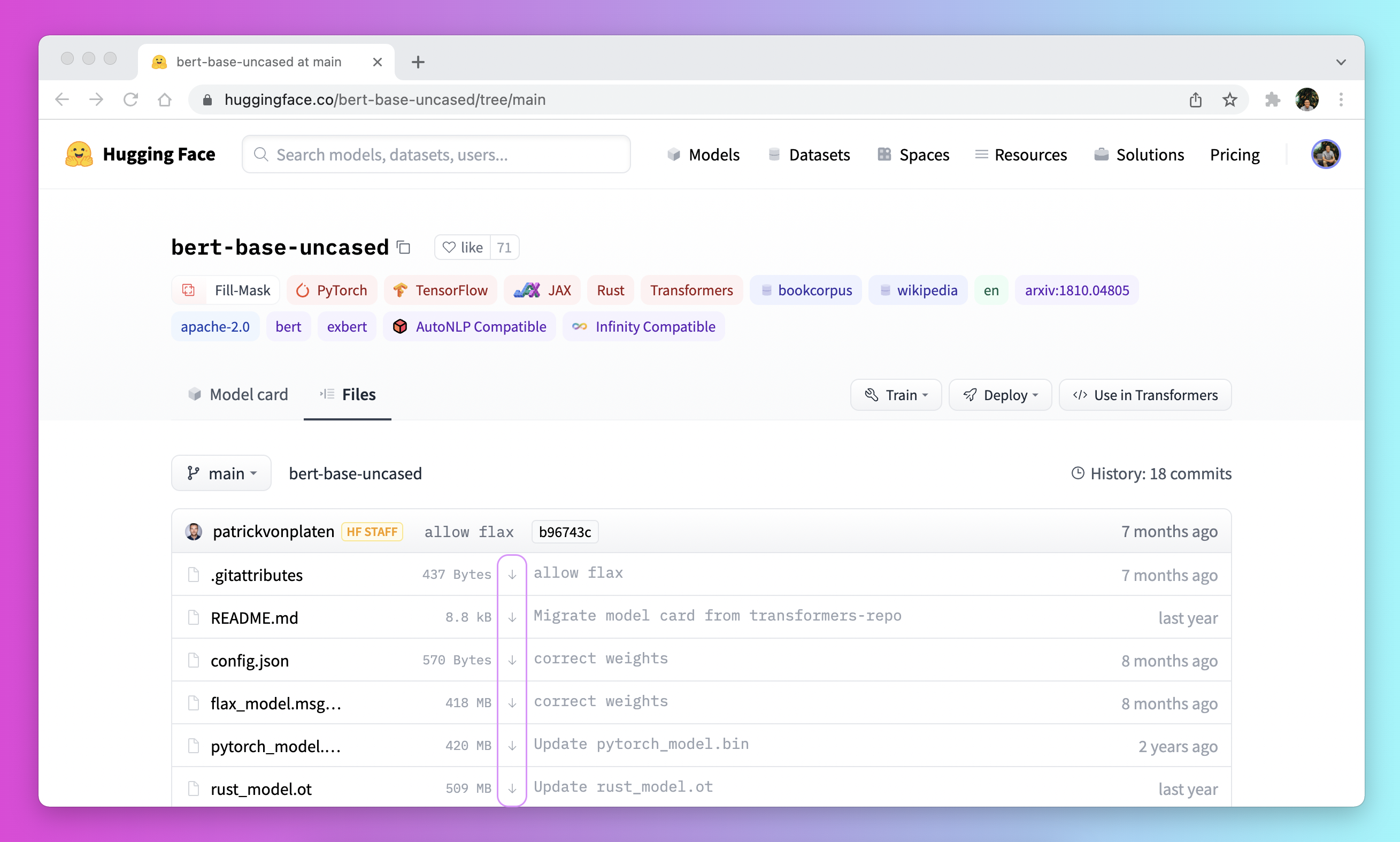
|
||||
|
||||
* Use the [`PreTrainedModel.from_pretrained`] and [`PreTrainedModel.save_pretrained`] workflow:
|
||||
|
||||
1. Download your files ahead of time with [`PreTrainedModel.from_pretrained`]:
|
||||
|
||||
```py
|
||||
>>> from transformers import AutoTokenizer, AutoModelForSeq2SeqLM
|
||||
|
||||
>>> tokenizer = AutoTokenizer.from_pretrained("bigscience/T0_3B")
|
||||
>>> model = AutoModelForSeq2SeqLM.from_pretrained("bigscience/T0_3B")
|
||||
```
|
||||
|
||||
2. Save your files to a specified directory with [`PreTrainedModel.save_pretrained`]:
|
||||
|
||||
```py
|
||||
>>> tokenizer.save_pretrained("./your/path/bigscience_t0")
|
||||
>>> model.save_pretrained("./your/path/bigscience_t0")
|
||||
```
|
||||
|
||||
3. Now when you're offline, reload your files with [`PreTrainedModel.from_pretrained`] from the specified directory:
|
||||
|
||||
```py
|
||||
>>> tokenizer = AutoTokenizer.from_pretrained("./your/path/bigscience_t0")
|
||||
>>> model = AutoModel.from_pretrained("./your/path/bigscience_t0")
|
||||
```
|
||||
|
||||
* Programmatically download files with the [huggingface_hub](https://github.com/huggingface/huggingface_hub/tree/main/src/huggingface_hub) library:
|
||||
|
||||
1. Install the `huggingface_hub` library in your virtual environment:
|
||||
|
||||
```bash
|
||||
python -m pip install huggingface_hub
|
||||
```
|
||||
|
||||
2. Use the [`hf_hub_download`](https://huggingface.co/docs/hub/adding-a-library#download-files-from-the-hub) function to download a file to a specific path. For example, the following command downloads the `config.json` file from the [T0](https://huggingface.co/bigscience/T0_3B) model to your desired path:
|
||||
|
||||
```py
|
||||
>>> from huggingface_hub import hf_hub_download
|
||||
|
||||
>>> hf_hub_download(repo_id="bigscience/T0_3B", filename="config.json", cache_dir="./your/path/bigscience_t0")
|
||||
```
|
||||
|
||||
Once your file is downloaded and locally cached, specify it's local path to load and use it:
|
||||
|
||||
```py
|
||||
>>> from transformers import AutoConfig
|
||||
|
||||
>>> config = AutoConfig.from_pretrained("./your/path/bigscience_t0/config.json")
|
||||
```
|
||||
|
||||
<Tip>
|
||||
|
||||
See the [How to download files from the Hub](https://huggingface.co/docs/hub/how-to-downstream) section for more details on downloading files stored on the Hub.
|
||||
|
||||
</Tip>
|
||||
@@ -1,40 +0,0 @@
|
||||
<!--Copyright 2022 The HuggingFace Team. All rights reserved.
|
||||
|
||||
Licensed under the Apache License, Version 2.0 (the "License"); you may not use this file except in compliance with
|
||||
the License. You may obtain a copy of the License at
|
||||
|
||||
http://www.apache.org/licenses/LICENSE-2.0
|
||||
|
||||
Unless required by applicable law or agreed to in writing, software distributed under the License is distributed on
|
||||
an "AS IS" BASIS, WITHOUT WARRANTIES OR CONDITIONS OF ANY KIND, either express or implied. See the License for the
|
||||
specific language governing permissions and limitations under the License.
|
||||
-->
|
||||
|
||||
# Generation
|
||||
|
||||
Each framework has a generate method for auto-regressive text generation implemented in their respective `GenerationMixin` class:
|
||||
|
||||
- PyTorch [`~generation_utils.GenerationMixin.generate`] is implemented in [`~generation_utils.GenerationMixin`].
|
||||
- TensorFlow [`~generation_tf_utils.TFGenerationMixin.generate`] is implemented in [`~generation_tf_utils.TFGenerationMixin`].
|
||||
- Flax/JAX [`~generation_flax_utils.FlaxGenerationMixin.generate`] is implemented in [`~generation_flax_utils.FlaxGenerationMixin`].
|
||||
|
||||
## GenerationMixin
|
||||
|
||||
[[autodoc]] generation_utils.GenerationMixin
|
||||
- generate
|
||||
- greedy_search
|
||||
- sample
|
||||
- beam_search
|
||||
- beam_sample
|
||||
- group_beam_search
|
||||
- constrained_beam_search
|
||||
|
||||
## TFGenerationMixin
|
||||
|
||||
[[autodoc]] generation_tf_utils.TFGenerationMixin
|
||||
- generate
|
||||
|
||||
## FlaxGenerationMixin
|
||||
|
||||
[[autodoc]] generation_flax_utils.FlaxGenerationMixin
|
||||
- generate
|
||||
@@ -1,147 +0,0 @@
|
||||
<!--Copyright 2021 The HuggingFace Team. All rights reserved.
|
||||
|
||||
Licensed under the Apache License, Version 2.0 (the "License"); you may not use this file except in compliance with
|
||||
the License. You may obtain a copy of the License at
|
||||
|
||||
http://www.apache.org/licenses/LICENSE-2.0
|
||||
|
||||
Unless required by applicable law or agreed to in writing, software distributed under the License is distributed on
|
||||
an "AS IS" BASIS, WITHOUT WARRANTIES OR CONDITIONS OF ANY KIND, either express or implied. See the License for the
|
||||
specific language governing permissions and limitations under the License.
|
||||
-->
|
||||
|
||||
# ByT5
|
||||
|
||||
## Overview
|
||||
|
||||
The ByT5 model was presented in [ByT5: Towards a token-free future with pre-trained byte-to-byte models](https://arxiv.org/abs/2105.13626) by Linting Xue, Aditya Barua, Noah Constant, Rami Al-Rfou, Sharan Narang, Mihir
|
||||
Kale, Adam Roberts, Colin Raffel.
|
||||
|
||||
The abstract from the paper is the following:
|
||||
|
||||
*Most widely-used pre-trained language models operate on sequences of tokens corresponding to word or subword units.
|
||||
Encoding text as a sequence of tokens requires a tokenizer, which is typically created as an independent artifact from
|
||||
the model. Token-free models that instead operate directly on raw text (bytes or characters) have many benefits: they
|
||||
can process text in any language out of the box, they are more robust to noise, and they minimize technical debt by
|
||||
removing complex and error-prone text preprocessing pipelines. Since byte or character sequences are longer than token
|
||||
sequences, past work on token-free models has often introduced new model architectures designed to amortize the cost of
|
||||
operating directly on raw text. In this paper, we show that a standard Transformer architecture can be used with
|
||||
minimal modifications to process byte sequences. We carefully characterize the trade-offs in terms of parameter count,
|
||||
training FLOPs, and inference speed, and show that byte-level models are competitive with their token-level
|
||||
counterparts. We also demonstrate that byte-level models are significantly more robust to noise and perform better on
|
||||
tasks that are sensitive to spelling and pronunciation. As part of our contribution, we release a new set of
|
||||
pre-trained byte-level Transformer models based on the T5 architecture, as well as all code and data used in our
|
||||
experiments.*
|
||||
|
||||
This model was contributed by [patrickvonplaten](https://huggingface.co/patrickvonplaten). The original code can be
|
||||
found [here](https://github.com/google-research/byt5).
|
||||
|
||||
ByT5's architecture is based on the T5v1.1 model, so one can refer to [T5v1.1's documentation page](t5v1.1). They
|
||||
only differ in how inputs should be prepared for the model, see the code examples below.
|
||||
|
||||
Since ByT5 was pre-trained unsupervisedly, there's no real advantage to using a task prefix during single-task
|
||||
fine-tuning. If you are doing multi-task fine-tuning, you should use a prefix.
|
||||
|
||||
|
||||
### Example
|
||||
|
||||
ByT5 works on raw UTF-8 bytes, so it can be used without a tokenizer:
|
||||
|
||||
```python
|
||||
>>> from transformers import T5ForConditionalGeneration
|
||||
>>> import torch
|
||||
|
||||
>>> model = T5ForConditionalGeneration.from_pretrained("google/byt5-small")
|
||||
|
||||
>>> num_special_tokens = 3
|
||||
>>> # Model has 3 special tokens which take up the input ids 0,1,2 of ByT5.
|
||||
>>> # => Need to shift utf-8 character encodings by 3 before passing ids to model.
|
||||
|
||||
>>> input_ids = torch.tensor([list("Life is like a box of chocolates.".encode("utf-8"))]) + num_special_tokens
|
||||
|
||||
>>> labels = torch.tensor([list("La vie est comme une boîte de chocolat.".encode("utf-8"))]) + num_special_tokens
|
||||
|
||||
>>> loss = model(input_ids, labels=labels).loss
|
||||
>>> loss.item()
|
||||
2.66
|
||||
```
|
||||
|
||||
For batched inference and training it is however recommended to make use of the tokenizer:
|
||||
|
||||
```python
|
||||
>>> from transformers import T5ForConditionalGeneration, AutoTokenizer
|
||||
|
||||
>>> model = T5ForConditionalGeneration.from_pretrained("google/byt5-small")
|
||||
>>> tokenizer = AutoTokenizer.from_pretrained("google/byt5-small")
|
||||
|
||||
>>> model_inputs = tokenizer(
|
||||
... ["Life is like a box of chocolates.", "Today is Monday."], padding="longest", return_tensors="pt"
|
||||
... )
|
||||
>>> labels_dict = tokenizer(
|
||||
... ["La vie est comme une boîte de chocolat.", "Aujourd'hui c'est lundi."], padding="longest", return_tensors="pt"
|
||||
... )
|
||||
>>> labels = labels_dict.input_ids
|
||||
|
||||
>>> loss = model(**model_inputs, labels=labels).loss
|
||||
>>> loss.item()
|
||||
17.9
|
||||
```
|
||||
|
||||
Similar to [T5](t5), ByT5 was trained on the span-mask denoising task. However,
|
||||
since the model works directly on characters, the pretraining task is a bit
|
||||
different. Let's corrupt some characters of the
|
||||
input sentence `"The dog chases a ball in the park."` and ask ByT5 to predict them
|
||||
for us.
|
||||
|
||||
```python
|
||||
>>> from transformers import AutoTokenizer, AutoModelForSeq2SeqLM
|
||||
>>> import torch
|
||||
|
||||
>>> tokenizer = AutoTokenizer.from_pretrained("google/byt5-base")
|
||||
>>> model = AutoModelForSeq2SeqLM.from_pretrained("google/byt5-base")
|
||||
|
||||
>>> input_ids_prompt = "The dog chases a ball in the park."
|
||||
>>> input_ids = tokenizer(input_ids_prompt).input_ids
|
||||
|
||||
>>> # Note that we cannot add "{extra_id_...}" to the string directly
|
||||
>>> # as the Byte tokenizer would incorrectly merge the tokens
|
||||
>>> # For ByT5, we need to work directly on the character level
|
||||
>>> # Contrary to T5, ByT5 does not use sentinel tokens for masking, but instead
|
||||
>>> # uses final utf character ids.
|
||||
>>> # UTF-8 is represented by 8 bits and ByT5 has 3 special tokens.
|
||||
>>> # => There are 2**8+2 = 259 input ids and mask tokens count down from index 258.
|
||||
>>> # => mask to "The dog [258]a ball [257]park."
|
||||
|
||||
>>> input_ids = torch.tensor([input_ids[:8] + [258] + input_ids[14:21] + [257] + input_ids[28:]])
|
||||
>>> input_ids
|
||||
tensor([[ 87, 107, 104, 35, 103, 114, 106, 35, 258, 35, 100, 35, 101, 100, 111, 111, 257, 35, 115, 100, 117, 110, 49, 1]])
|
||||
|
||||
>>> # ByT5 produces only one char at a time so we need to produce many more output characters here -> set `max_length=100`.
|
||||
>>> output_ids = model.generate(input_ids, max_length=100)[0].tolist()
|
||||
>>> output_ids
|
||||
[0, 258, 108, 118, 35, 119, 107, 104, 35, 114, 113, 104, 35, 122, 107, 114, 35, 103, 114, 104, 118, 257, 35, 108, 113, 35, 119, 107, 104, 35, 103, 108, 118, 102, 114, 256, 108, 113, 35, 119, 107, 104, 35, 115, 100, 117, 110, 49, 35, 87, 107, 104, 35, 103, 114, 106, 35, 108, 118, 35, 119, 107, 104, 35, 114, 113, 104, 35, 122, 107, 114, 35, 103, 114, 104, 118, 35, 100, 35, 101, 100, 111, 111, 35, 108, 113, 255, 35, 108, 113, 35, 119, 107, 104, 35, 115, 100, 117, 110, 49]
|
||||
|
||||
>>> # ^- Note how 258 descends to 257, 256, 255
|
||||
|
||||
>>> # Now we need to split on the sentinel tokens, let's write a short loop for this
|
||||
>>> output_ids_list = []
|
||||
>>> start_token = 0
|
||||
>>> sentinel_token = 258
|
||||
>>> while sentinel_token in output_ids:
|
||||
... split_idx = output_ids.index(sentinel_token)
|
||||
... output_ids_list.append(output_ids[start_token:split_idx])
|
||||
... start_token = split_idx
|
||||
... sentinel_token -= 1
|
||||
|
||||
>>> output_ids_list.append(output_ids[start_token:])
|
||||
>>> output_string = tokenizer.batch_decode(output_ids_list)
|
||||
>>> output_string
|
||||
['<pad>', 'is the one who does', ' in the disco', 'in the park. The dog is the one who does a ball in', ' in the park.']
|
||||
```
|
||||
|
||||
|
||||
## ByT5Tokenizer
|
||||
|
||||
[[autodoc]] ByT5Tokenizer
|
||||
|
||||
See [`ByT5Tokenizer`] for all details.
|
||||
@@ -1,74 +0,0 @@
|
||||
<!--Copyright 2022 The HuggingFace Team. All rights reserved.
|
||||
|
||||
Licensed under the Apache License, Version 2.0 (the "License"); you may not use this file except in compliance with
|
||||
the License. You may obtain a copy of the License at
|
||||
|
||||
http://www.apache.org/licenses/LICENSE-2.0
|
||||
|
||||
Unless required by applicable law or agreed to in writing, software distributed under the License is distributed on
|
||||
an "AS IS" BASIS, WITHOUT WARRANTIES OR CONDITIONS OF ANY KIND, either express or implied. See the License for the
|
||||
specific language governing permissions and limitations under the License.
|
||||
-->
|
||||
|
||||
# ConvNeXT
|
||||
|
||||
## Overview
|
||||
|
||||
The ConvNeXT model was proposed in [A ConvNet for the 2020s](https://arxiv.org/abs/2201.03545) by Zhuang Liu, Hanzi Mao, Chao-Yuan Wu, Christoph Feichtenhofer, Trevor Darrell, Saining Xie.
|
||||
ConvNeXT is a pure convolutional model (ConvNet), inspired by the design of Vision Transformers, that claims to outperform them.
|
||||
|
||||
The abstract from the paper is the following:
|
||||
|
||||
*The "Roaring 20s" of visual recognition began with the introduction of Vision Transformers (ViTs), which quickly superseded ConvNets as the state-of-the-art image classification model.
|
||||
A vanilla ViT, on the other hand, faces difficulties when applied to general computer vision tasks such as object detection and semantic segmentation. It is the hierarchical Transformers
|
||||
(e.g., Swin Transformers) that reintroduced several ConvNet priors, making Transformers practically viable as a generic vision backbone and demonstrating remarkable performance on a wide
|
||||
variety of vision tasks. However, the effectiveness of such hybrid approaches is still largely credited to the intrinsic superiority of Transformers, rather than the inherent inductive
|
||||
biases of convolutions. In this work, we reexamine the design spaces and test the limits of what a pure ConvNet can achieve. We gradually "modernize" a standard ResNet toward the design
|
||||
of a vision Transformer, and discover several key components that contribute to the performance difference along the way. The outcome of this exploration is a family of pure ConvNet models
|
||||
dubbed ConvNeXt. Constructed entirely from standard ConvNet modules, ConvNeXts compete favorably with Transformers in terms of accuracy and scalability, achieving 87.8% ImageNet top-1 accuracy
|
||||
and outperforming Swin Transformers on COCO detection and ADE20K segmentation, while maintaining the simplicity and efficiency of standard ConvNets.*
|
||||
|
||||
Tips:
|
||||
|
||||
- See the code examples below each model regarding usage.
|
||||
|
||||
<img src="https://huggingface.co/datasets/huggingface/documentation-images/resolve/main/convnext_architecture.jpg"
|
||||
alt="drawing" width="600"/>
|
||||
|
||||
<small> ConvNeXT architecture. Taken from the <a href="https://arxiv.org/abs/2201.03545">original paper</a>.</small>
|
||||
|
||||
This model was contributed by [nielsr](https://huggingface.co/nielsr). TensorFlow version of the model was contributed by [ariG23498](https://github.com/ariG23498),
|
||||
[gante](https://github.com/gante), and [sayakpaul](https://github.com/sayakpaul) (equal contribution). The original code can be found [here](https://github.com/facebookresearch/ConvNeXt).
|
||||
|
||||
## ConvNextConfig
|
||||
|
||||
[[autodoc]] ConvNextConfig
|
||||
|
||||
|
||||
## ConvNextFeatureExtractor
|
||||
|
||||
[[autodoc]] ConvNextFeatureExtractor
|
||||
|
||||
|
||||
## ConvNextModel
|
||||
|
||||
[[autodoc]] ConvNextModel
|
||||
- forward
|
||||
|
||||
|
||||
## ConvNextForImageClassification
|
||||
|
||||
[[autodoc]] ConvNextForImageClassification
|
||||
- forward
|
||||
|
||||
|
||||
## TFConvNextModel
|
||||
|
||||
[[autodoc]] TFConvNextModel
|
||||
- call
|
||||
|
||||
|
||||
## TFConvNextForImageClassification
|
||||
|
||||
[[autodoc]] TFConvNextForImageClassification
|
||||
- call
|
||||
@@ -1,147 +0,0 @@
|
||||
<!--Copyright 2022 The HuggingFace Team. All rights reserved.
|
||||
|
||||
Licensed under the Apache License, Version 2.0 (the "License"); you may not use this file except in compliance with
|
||||
the License. You may obtain a copy of the License at
|
||||
|
||||
http://www.apache.org/licenses/LICENSE-2.0
|
||||
|
||||
Unless required by applicable law or agreed to in writing, software distributed under the License is distributed on
|
||||
an "AS IS" BASIS, WITHOUT WARRANTIES OR CONDITIONS OF ANY KIND, either express or implied. See the License for the
|
||||
specific language governing permissions and limitations under the License.
|
||||
-->
|
||||
|
||||
# Data2Vec
|
||||
|
||||
## Overview
|
||||
|
||||
The Data2Vec model was proposed in [data2vec: A General Framework for Self-supervised Learning in Speech, Vision and Language](https://arxiv.org/pdf/2202.03555) by Alexei Baevski, Wei-Ning Hsu, Qiantong Xu, Arun Babu, Jiatao Gu and Michael Auli.
|
||||
Data2Vec proposes a unified framework for self-supervised learning across different data modalities - text, audio and images.
|
||||
Importantly, predicted targets for pre-training are contextualized latent representations of the inputs, rather than modality-specific, context-independent targets.
|
||||
|
||||
The abstract from the paper is the following:
|
||||
|
||||
*While the general idea of self-supervised learning is identical across modalities, the actual algorithms and
|
||||
objectives differ widely because they were developed with a single modality in mind. To get us closer to general
|
||||
self-supervised learning, we present data2vec, a framework that uses the same learning method for either speech,
|
||||
NLP or computer vision. The core idea is to predict latent representations of the full input data based on a
|
||||
masked view of the input in a selfdistillation setup using a standard Transformer architecture.
|
||||
Instead of predicting modality-specific targets such as words, visual tokens or units of human speech which
|
||||
are local in nature, data2vec predicts contextualized latent representations that contain information from
|
||||
the entire input. Experiments on the major benchmarks of speech recognition, image classification, and
|
||||
natural language understanding demonstrate a new state of the art or competitive performance to predominant approaches.
|
||||
Models and code are available at www.github.com/pytorch/fairseq/tree/master/examples/data2vec.*
|
||||
|
||||
Tips:
|
||||
|
||||
- Data2VecAudio, Data2VecText, and Data2VecVision have all been trained using the same self-supervised learning method.
|
||||
- For Data2VecAudio, preprocessing is identical to [`Wav2Vec2Model`], including feature extraction
|
||||
- For Data2VecText, preprocessing is identical to [`RobertaModel`], including tokenization.
|
||||
- For Data2VecVision, preprocessing is identical to [`BeitModel`], including feature extraction.
|
||||
- To know how a pre-trained Data2Vec vision model can be fine-tuned on the task of image classification, you can check out
|
||||
[this notebook](https://colab.research.google.com/github/sayakpaul/TF-2.0-Hacks/blob/master/data2vec_vision_image_classification.ipynb).
|
||||
|
||||
|
||||
This model was contributed by [edugp](https://huggingface.co/edugp) and [patrickvonplaten](https://huggingface.co/patrickvonplaten).
|
||||
[sayakpaul](https://github.com/sayakpaul) contributed Data2Vec for vision in TensorFlow.
|
||||
|
||||
The original code (for NLP and Speech) can be found [here](https://github.com/pytorch/fairseq/tree/main/examples/data2vec).
|
||||
The original code for vision can be found [here](https://github.com/facebookresearch/data2vec_vision/tree/main/beit).
|
||||
|
||||
|
||||
## Data2VecTextConfig
|
||||
|
||||
[[autodoc]] Data2VecTextConfig
|
||||
|
||||
## Data2VecAudioConfig
|
||||
|
||||
[[autodoc]] Data2VecAudioConfig
|
||||
|
||||
## Data2VecVisionConfig
|
||||
|
||||
[[autodoc]] Data2VecVisionConfig
|
||||
|
||||
|
||||
## Data2VecAudioModel
|
||||
|
||||
[[autodoc]] Data2VecAudioModel
|
||||
- forward
|
||||
|
||||
## Data2VecAudioForAudioFrameClassification
|
||||
|
||||
[[autodoc]] Data2VecAudioForAudioFrameClassification
|
||||
- forward
|
||||
|
||||
## Data2VecAudioForCTC
|
||||
|
||||
[[autodoc]] Data2VecAudioForCTC
|
||||
- forward
|
||||
|
||||
## Data2VecAudioForSequenceClassification
|
||||
|
||||
[[autodoc]] Data2VecAudioForSequenceClassification
|
||||
- forward
|
||||
|
||||
## Data2VecAudioForXVector
|
||||
|
||||
[[autodoc]] Data2VecAudioForXVector
|
||||
- forward
|
||||
|
||||
## Data2VecTextModel
|
||||
|
||||
[[autodoc]] Data2VecTextModel
|
||||
- forward
|
||||
|
||||
## Data2VecTextForCausalLM
|
||||
|
||||
[[autodoc]] Data2VecTextForCausalLM
|
||||
- forward
|
||||
|
||||
## Data2VecTextForMaskedLM
|
||||
|
||||
[[autodoc]] Data2VecTextForMaskedLM
|
||||
- forward
|
||||
|
||||
## Data2VecTextForSequenceClassification
|
||||
|
||||
[[autodoc]] Data2VecTextForSequenceClassification
|
||||
- forward
|
||||
|
||||
## Data2VecTextForMultipleChoice
|
||||
|
||||
[[autodoc]] Data2VecTextForMultipleChoice
|
||||
- forward
|
||||
|
||||
## Data2VecTextForTokenClassification
|
||||
|
||||
[[autodoc]] Data2VecTextForTokenClassification
|
||||
- forward
|
||||
|
||||
## Data2VecTextForQuestionAnswering
|
||||
|
||||
[[autodoc]] Data2VecTextForQuestionAnswering
|
||||
- forward
|
||||
|
||||
## Data2VecVisionModel
|
||||
|
||||
[[autodoc]] Data2VecVisionModel
|
||||
- forward
|
||||
|
||||
## Data2VecVisionForImageClassification
|
||||
|
||||
[[autodoc]] Data2VecVisionForImageClassification
|
||||
- forward
|
||||
|
||||
## Data2VecVisionForSemanticSegmentation
|
||||
|
||||
[[autodoc]] Data2VecVisionForSemanticSegmentation
|
||||
- forward
|
||||
|
||||
## TFData2VecVisionModel
|
||||
|
||||
[[autodoc]] TFData2VecVisionModel
|
||||
- call
|
||||
|
||||
## TFData2VecVisionForImageClassification
|
||||
|
||||
[[autodoc]] TFData2VecVisionForImageClassification
|
||||
- call
|
||||
@@ -1,51 +0,0 @@
|
||||
<!--Copyright 2022 The HuggingFace Team. All rights reserved.
|
||||
|
||||
Licensed under the Apache License, Version 2.0 (the "License"); you may not use this file except in compliance with
|
||||
the License. You may obtain a copy of the License at
|
||||
|
||||
http://www.apache.org/licenses/LICENSE-2.0
|
||||
|
||||
Unless required by applicable law or agreed to in writing, software distributed under the License is distributed on
|
||||
an "AS IS" BASIS, WITHOUT WARRANTIES OR CONDITIONS OF ANY KIND, either express or implied. See the License for the
|
||||
specific language governing permissions and limitations under the License.
|
||||
-->
|
||||
|
||||
# Decision Transformer
|
||||
|
||||
## Overview
|
||||
|
||||
The Decision Transformer model was proposed in [Decision Transformer: Reinforcement Learning via Sequence Modeling](https://arxiv.org/abs/2106.01345)
|
||||
by Lili Chen, Kevin Lu, Aravind Rajeswaran, Kimin Lee, Aditya Grover, Michael Laskin, Pieter Abbeel, Aravind Srinivas, Igor Mordatch.
|
||||
|
||||
The abstract from the paper is the following:
|
||||
|
||||
*We introduce a framework that abstracts Reinforcement Learning (RL) as a sequence modeling problem.
|
||||
This allows us to draw upon the simplicity and scalability of the Transformer architecture, and associated advances
|
||||
in language modeling such as GPT-x and BERT. In particular, we present Decision Transformer, an architecture that
|
||||
casts the problem of RL as conditional sequence modeling. Unlike prior approaches to RL that fit value functions or
|
||||
compute policy gradients, Decision Transformer simply outputs the optimal actions by leveraging a causally masked
|
||||
Transformer. By conditioning an autoregressive model on the desired return (reward), past states, and actions, our
|
||||
Decision Transformer model can generate future actions that achieve the desired return. Despite its simplicity,
|
||||
Decision Transformer matches or exceeds the performance of state-of-the-art model-free offline RL baselines on
|
||||
Atari, OpenAI Gym, and Key-to-Door tasks.*
|
||||
|
||||
Tips:
|
||||
|
||||
This version of the model is for tasks where the state is a vector, image-based states will come soon.
|
||||
|
||||
This model was contributed by [edbeeching](https://huggingface.co/edbeeching). The original code can be found [here](https://github.com/kzl/decision-transformer).
|
||||
|
||||
## DecisionTransformerConfig
|
||||
|
||||
[[autodoc]] DecisionTransformerConfig
|
||||
|
||||
|
||||
## DecisionTransformerGPT2Model
|
||||
|
||||
[[autodoc]] DecisionTransformerGPT2Model
|
||||
- forward
|
||||
|
||||
## DecisionTransformerModel
|
||||
|
||||
[[autodoc]] DecisionTransformerModel
|
||||
- forward
|
||||
@@ -1,67 +0,0 @@
|
||||
<!--Copyright 2022 The HuggingFace Team. All rights reserved.
|
||||
|
||||
Licensed under the Apache License, Version 2.0 (the "License"); you may not use this file except in compliance with
|
||||
the License. You may obtain a copy of the License at
|
||||
|
||||
http://www.apache.org/licenses/LICENSE-2.0
|
||||
|
||||
Unless required by applicable law or agreed to in writing, software distributed under the License is distributed on
|
||||
an "AS IS" BASIS, WITHOUT WARRANTIES OR CONDITIONS OF ANY KIND, either express or implied. See the License for the
|
||||
specific language governing permissions and limitations under the License.
|
||||
-->
|
||||
|
||||
# DiT
|
||||
|
||||
## Overview
|
||||
|
||||
DiT was proposed in [DiT: Self-supervised Pre-training for Document Image Transformer](https://arxiv.org/abs/2203.02378) by Junlong Li, Yiheng Xu, Tengchao Lv, Lei Cui, Cha Zhang, Furu Wei.
|
||||
DiT applies the self-supervised objective of [BEiT](beit) (BERT pre-training of Image Transformers) to 42 million document images, allowing for state-of-the-art results on tasks including:
|
||||
|
||||
- document image classification: the [RVL-CDIP](https://www.cs.cmu.edu/~aharley/rvl-cdip/) dataset (a collection of
|
||||
400,000 images belonging to one of 16 classes).
|
||||
- document layout analysis: the [PubLayNet](https://github.com/ibm-aur-nlp/PubLayNet) dataset (a collection of more
|
||||
than 360,000 document images constructed by automatically parsing PubMed XML files).
|
||||
- table detection: the [ICDAR 2019 cTDaR](https://github.com/cndplab-founder/ICDAR2019_cTDaR) dataset (a collection of
|
||||
600 training images and 240 testing images).
|
||||
|
||||
The abstract from the paper is the following:
|
||||
|
||||
*Image Transformer has recently achieved significant progress for natural image understanding, either using supervised (ViT, DeiT, etc.) or self-supervised (BEiT, MAE, etc.) pre-training techniques. In this paper, we propose DiT, a self-supervised pre-trained Document Image Transformer model using large-scale unlabeled text images for Document AI tasks, which is essential since no supervised counterparts ever exist due to the lack of human labeled document images. We leverage DiT as the backbone network in a variety of vision-based Document AI tasks, including document image classification, document layout analysis, as well as table detection. Experiment results have illustrated that the self-supervised pre-trained DiT model achieves new state-of-the-art results on these downstream tasks, e.g. document image classification (91.11 → 92.69), document layout analysis (91.0 → 94.9) and table detection (94.23 → 96.55). *
|
||||
|
||||
<img src="https://huggingface.co/datasets/huggingface/documentation-images/resolve/main/dit_architecture.jpg"
|
||||
alt="drawing" width="600"/>
|
||||
|
||||
<small> Summary of the approach. Taken from the [original paper](https://arxiv.org/abs/2203.02378). </small>
|
||||
|
||||
One can directly use the weights of DiT with the AutoModel API:
|
||||
|
||||
```python
|
||||
from transformers import AutoModel
|
||||
|
||||
model = AutoModel.from_pretrained("microsoft/dit-base")
|
||||
```
|
||||
|
||||
This will load the model pre-trained on masked image modeling. Note that this won't include the language modeling head on top, used to predict visual tokens.
|
||||
|
||||
To include the head, you can load the weights into a `BeitForMaskedImageModeling` model, like so:
|
||||
|
||||
```python
|
||||
from transformers import BeitForMaskedImageModeling
|
||||
|
||||
model = BeitForMaskedImageModeling.from_pretrained("microsoft/dit-base")
|
||||
```
|
||||
|
||||
You can also load a fine-tuned model from the [hub](https://huggingface.co/models?other=dit), like so:
|
||||
|
||||
```python
|
||||
from transformers import AutoModelForImageClassification
|
||||
|
||||
model = AutoModelForImageClassification.from_pretrained("microsoft/dit-base-finetuned-rvlcdip")
|
||||
```
|
||||
|
||||
This particular checkpoint was fine-tuned on [RVL-CDIP](https://www.cs.cmu.edu/~aharley/rvl-cdip/), an important benchmark for document image classification.
|
||||
A notebook that illustrates inference for document image classification can be found [here](https://github.com/NielsRogge/Transformers-Tutorials/blob/master/DiT/Inference_with_DiT_(Document_Image_Transformer)_for_document_image_classification.ipynb).
|
||||
|
||||
As DiT's architecture is equivalent to that of BEiT, one can refer to [BEiT's documentation page](beit) for all tips, code examples and notebooks.
|
||||
|
||||
This model was contributed by [nielsr](https://huggingface.co/nielsr). The original code can be found [here](https://github.com/microsoft/unilm/tree/master/dit).
|
||||
@@ -1,57 +0,0 @@
|
||||
<!--Copyright 2022 The HuggingFace Team. All rights reserved.
|
||||
|
||||
Licensed under the Apache License, Version 2.0 (the "License"); you may not use this file except in compliance with
|
||||
the License. You may obtain a copy of the License at
|
||||
|
||||
http://www.apache.org/licenses/LICENSE-2.0
|
||||
|
||||
Unless required by applicable law or agreed to in writing, software distributed under the License is distributed on
|
||||
an "AS IS" BASIS, WITHOUT WARRANTIES OR CONDITIONS OF ANY KIND, either express or implied. See the License for the
|
||||
specific language governing permissions and limitations under the License.
|
||||
-->
|
||||
|
||||
# DPT
|
||||
|
||||
## Overview
|
||||
|
||||
The DPT model was proposed in [Vision Transformers for Dense Prediction](https://arxiv.org/abs/2103.13413) by René Ranftl, Alexey Bochkovskiy, Vladlen Koltun.
|
||||
DPT is a model that leverages the [Vision Transformer (ViT)](vit) as backbone for dense prediction tasks like semantic segmentation and depth estimation.
|
||||
|
||||
The abstract from the paper is the following:
|
||||
|
||||
*We introduce dense vision transformers, an architecture that leverages vision transformers in place of convolutional networks as a backbone for dense prediction tasks. We assemble tokens from various stages of the vision transformer into image-like representations at various resolutions and progressively combine them into full-resolution predictions using a convolutional decoder. The transformer backbone processes representations at a constant and relatively high resolution and has a global receptive field at every stage. These properties allow the dense vision transformer to provide finer-grained and more globally coherent predictions when compared to fully-convolutional networks. Our experiments show that this architecture yields substantial improvements on dense prediction tasks, especially when a large amount of training data is available. For monocular depth estimation, we observe an improvement of up to 28% in relative performance when compared to a state-of-the-art fully-convolutional network. When applied to semantic segmentation, dense vision transformers set a new state of the art on ADE20K with 49.02% mIoU. We further show that the architecture can be fine-tuned on smaller datasets such as NYUv2, KITTI, and Pascal Context where it also sets the new state of the art.*
|
||||
|
||||
<img src="https://huggingface.co/datasets/huggingface/documentation-images/resolve/main/dpt_architecture.jpg"
|
||||
alt="drawing" width="600"/>
|
||||
|
||||
<small> DPT architecture. Taken from the <a href="https://arxiv.org/abs/2103.13413" target="_blank">original paper</a>. </small>
|
||||
|
||||
This model was contributed by [nielsr](https://huggingface.co/nielsr). The original code can be found [here](https://github.com/isl-org/DPT).
|
||||
|
||||
## DPTConfig
|
||||
|
||||
[[autodoc]] DPTConfig
|
||||
|
||||
|
||||
## DPTFeatureExtractor
|
||||
|
||||
[[autodoc]] DPTFeatureExtractor
|
||||
- __call__
|
||||
|
||||
|
||||
## DPTModel
|
||||
|
||||
[[autodoc]] DPTModel
|
||||
- forward
|
||||
|
||||
|
||||
## DPTForDepthEstimation
|
||||
|
||||
[[autodoc]] DPTForDepthEstimation
|
||||
- forward
|
||||
|
||||
|
||||
## DPTForSemanticSegmentation
|
||||
|
||||
[[autodoc]] DPTForSemanticSegmentation
|
||||
- forward
|
||||
@@ -1,96 +0,0 @@
|
||||
<!--Copyright 2022 The HuggingFace Team. All rights reserved.
|
||||
|
||||
Licensed under the Apache License, Version 2.0 (the "License"); you may not use this file except in compliance with
|
||||
the License. You may obtain a copy of the License at
|
||||
|
||||
http://www.apache.org/licenses/LICENSE-2.0
|
||||
|
||||
Unless required by applicable law or agreed to in writing, software distributed under the License is distributed on
|
||||
an "AS IS" BASIS, WITHOUT WARRANTIES OR CONDITIONS OF ANY KIND, either express or implied. See the License for the
|
||||
specific language governing permissions and limitations under the License.
|
||||
-->
|
||||
|
||||
# FLAVA
|
||||
|
||||
## Overview
|
||||
|
||||
The FLAVA model was proposed in [FLAVA: A Foundational Language And Vision Alignment Model](https://arxiv.org/abs/2112.04482) by Amanpreet Singh, Ronghang Hu, Vedanuj Goswami, Guillaume Couairon, Wojciech Galuba, Marcus Rohrbach, and Douwe Kiela and is accepted at CVPR 2022.
|
||||
|
||||
The paper aims at creating a single unified foundation model which can work across vision, language
|
||||
as well as vision-and-language multimodal tasks.
|
||||
|
||||
The abstract from the paper is the following:
|
||||
|
||||
*State-of-the-art vision and vision-and-language models rely on large-scale visio-linguistic pretraining for obtaining good performance on a variety
|
||||
of downstream tasks. Generally, such models are often either cross-modal (contrastive) or multi-modal
|
||||
(with earlier fusion) but not both; and they often only target specific modalities or tasks. A promising
|
||||
direction would be to use a single holistic universal model, as a "foundation", that targets all modalities
|
||||
at once -- a true vision and language foundation model should be good at vision tasks, language tasks, and
|
||||
cross- and multi-modal vision and language tasks. We introduce FLAVA as such a model and demonstrate
|
||||
impressive performance on a wide range of 35 tasks spanning these target modalities.*
|
||||
|
||||
|
||||
This model was contributed by [aps](https://huggingface.co/aps). The original code can be found [here](https://github.com/facebookresearch/multimodal/tree/main/examples/flava).
|
||||
|
||||
|
||||
## FlavaConfig
|
||||
|
||||
[[autodoc]] FlavaConfig
|
||||
|
||||
## FlavaTextConfig
|
||||
|
||||
[[autodoc]] FlavaTextConfig
|
||||
|
||||
## FlavaImageConfig
|
||||
|
||||
[[autodoc]] FlavaImageConfig
|
||||
|
||||
## FlavaMultimodalConfig
|
||||
|
||||
[[autodoc]] FlavaMultimodalConfig
|
||||
|
||||
## FlavaImageCodebookConfig
|
||||
|
||||
[[autodoc]] FlavaImageCodebookConfig
|
||||
|
||||
## FlavaProcessor
|
||||
|
||||
[[autodoc]] FlavaProcessor
|
||||
|
||||
## FlavaFeatureExtractor
|
||||
|
||||
[[autodoc]] FlavaFeatureExtractor
|
||||
|
||||
## FlavaForPreTraining
|
||||
|
||||
[[autodoc]] FlavaForPreTraining
|
||||
- forward
|
||||
|
||||
## FlavaModel
|
||||
|
||||
[[autodoc]] FlavaModel
|
||||
- forward
|
||||
- get_text_features
|
||||
- get_image_features
|
||||
|
||||
## FlavaImageCodebook
|
||||
|
||||
[[autodoc]] FlavaImageCodebook
|
||||
- forward
|
||||
- get_codebook_indices
|
||||
- get_codebook_probs
|
||||
|
||||
## FlavaTextModel
|
||||
|
||||
[[autodoc]] FlavaTextModel
|
||||
- forward
|
||||
|
||||
## FlavaImageModel
|
||||
|
||||
[[autodoc]] FlavaImageModel
|
||||
- forward
|
||||
|
||||
## FlavaMultimodalModel
|
||||
|
||||
[[autodoc]] FlavaMultimodalModel
|
||||
- forward
|
||||
@@ -1,61 +0,0 @@
|
||||
<!--Copyright 2022 The HuggingFace Team. All rights reserved.
|
||||
|
||||
Licensed under the Apache License, Version 2.0 (the "License"); you may not use this file except in compliance with
|
||||
the License. You may obtain a copy of the License at
|
||||
|
||||
http://www.apache.org/licenses/LICENSE-2.0
|
||||
|
||||
Unless required by applicable law or agreed to in writing, software distributed under the License is distributed on
|
||||
an "AS IS" BASIS, WITHOUT WARRANTIES OR CONDITIONS OF ANY KIND, either express or implied. See the License for the
|
||||
specific language governing permissions and limitations under the License.
|
||||
-->
|
||||
|
||||
# GLPN
|
||||
|
||||
<Tip>
|
||||
|
||||
This is a recently introduced model so the API hasn't been tested extensively. There may be some bugs or slight
|
||||
breaking changes to fix it in the future. If you see something strange, file a [Github Issue](https://github.com/huggingface/transformers/issues/new?assignees=&labels=&template=bug-report.md&title).
|
||||
|
||||
</Tip>
|
||||
|
||||
## Overview
|
||||
|
||||
The GLPN model was proposed in [Global-Local Path Networks for Monocular Depth Estimation with Vertical CutDepth](https://arxiv.org/abs/2201.07436) by Doyeon Kim, Woonghyun Ga, Pyungwhan Ahn, Donggyu Joo, Sehwan Chun, Junmo Kim.
|
||||
GLPN combines [SegFormer](segformer)'s hierarchical mix-Transformer with a lightweight decoder for monocular depth estimation. The proposed decoder shows better performance than the previously proposed decoders, with considerably
|
||||
less computational complexity.
|
||||
|
||||
The abstract from the paper is the following:
|
||||
|
||||
*Depth estimation from a single image is an important task that can be applied to various fields in computer vision, and has grown rapidly with the development of convolutional neural networks. In this paper, we propose a novel structure and training strategy for monocular depth estimation to further improve the prediction accuracy of the network. We deploy a hierarchical transformer encoder to capture and convey the global context, and design a lightweight yet powerful decoder to generate an estimated depth map while considering local connectivity. By constructing connected paths between multi-scale local features and the global decoding stream with our proposed selective feature fusion module, the network can integrate both representations and recover fine details. In addition, the proposed decoder shows better performance than the previously proposed decoders, with considerably less computational complexity. Furthermore, we improve the depth-specific augmentation method by utilizing an important observation in depth estimation to enhance the model. Our network achieves state-of-the-art performance over the challenging depth dataset NYU Depth V2. Extensive experiments have been conducted to validate and show the effectiveness of the proposed approach. Finally, our model shows better generalisation ability and robustness than other comparative models.*
|
||||
|
||||
Tips:
|
||||
|
||||
- A notebook illustrating inference with [`GLPNForDepthEstimation`] can be found [here](https://github.com/NielsRogge/Transformers-Tutorials/blob/master/GLPN/GLPN_inference_(depth_estimation).ipynb).
|
||||
- One can use [`GLPNFeatureExtractor`] to prepare images for the model.
|
||||
|
||||
<img src="https://huggingface.co/datasets/huggingface/documentation-images/resolve/main/glpn_architecture.jpg"
|
||||
alt="drawing" width="600"/>
|
||||
|
||||
<small> Summary of the approach. Taken from the <a href="https://arxiv.org/abs/2201.07436" target="_blank">original paper</a>. </small>
|
||||
|
||||
This model was contributed by [nielsr](https://huggingface.co/nielsr). The original code can be found [here](https://github.com/vinvino02/GLPDepth).
|
||||
|
||||
## GLPNConfig
|
||||
|
||||
[[autodoc]] GLPNConfig
|
||||
|
||||
## GLPNFeatureExtractor
|
||||
|
||||
[[autodoc]] GLPNFeatureExtractor
|
||||
- __call__
|
||||
|
||||
## GLPNModel
|
||||
|
||||
[[autodoc]] GLPNModel
|
||||
- forward
|
||||
|
||||
## GLPNForDepthEstimation
|
||||
|
||||
[[autodoc]] GLPNForDepthEstimation
|
||||
- forward
|
||||
@@ -1,71 +0,0 @@
|
||||
<!--Copyright 2022 The HuggingFace Team. All rights reserved.
|
||||
|
||||
Licensed under the Apache License, Version 2.0 (the "License"); you may not use this file except in compliance with
|
||||
the License. You may obtain a copy of the License at
|
||||
|
||||
http://www.apache.org/licenses/LICENSE-2.0
|
||||
|
||||
Unless required by applicable law or agreed to in writing, software distributed under the License is distributed on
|
||||
an "AS IS" BASIS, WITHOUT WARRANTIES OR CONDITIONS OF ANY KIND, either express or implied. See the License for the
|
||||
specific language governing permissions and limitations under the License.
|
||||
-->
|
||||
|
||||
# MaskFormer
|
||||
|
||||
<Tip>
|
||||
|
||||
This is a recently introduced model so the API hasn't been tested extensively. There may be some bugs or slight
|
||||
breaking changes to fix it in the future. If you see something strange, file a [Github Issue](https://github.com/huggingface/transformers/issues/new?assignees=&labels=&template=bug-report.md&title).
|
||||
|
||||
</Tip>
|
||||
|
||||
## Overview
|
||||
|
||||
The MaskFormer model was proposed in [Per-Pixel Classification is Not All You Need for Semantic Segmentation](https://arxiv.org/abs/2107.06278) by Bowen Cheng, Alexander G. Schwing, Alexander Kirillov. MaskFormer addresses semantic segmentation with a mask classification paradigm instead of performing classic pixel-level classification.
|
||||
|
||||
The abstract from the paper is the following:
|
||||
|
||||
*Modern approaches typically formulate semantic segmentation as a per-pixel classification task, while instance-level segmentation is handled with an alternative mask classification. Our key insight: mask classification is sufficiently general to solve both semantic- and instance-level segmentation tasks in a unified manner using the exact same model, loss, and training procedure. Following this observation, we propose MaskFormer, a simple mask classification model which predicts a set of binary masks, each associated with a single global class label prediction. Overall, the proposed mask classification-based method simplifies the landscape of effective approaches to semantic and panoptic segmentation tasks and shows excellent empirical results. In particular, we observe that MaskFormer outperforms per-pixel classification baselines when the number of classes is large. Our mask classification-based method outperforms both current state-of-the-art semantic (55.6 mIoU on ADE20K) and panoptic segmentation (52.7 PQ on COCO) models.*
|
||||
|
||||
Tips:
|
||||
- MaskFormer's Transformer decoder is identical to the decoder of [DETR](detr). During training, the authors of DETR did find it helpful to use auxiliary losses in the decoder, especially to help the model output the correct number of objects of each class. If you set the parameter `use_auxilary_loss` of [`MaskFormerConfig`] to `True`, then prediction feedforward neural networks and Hungarian losses are added after each decoder layer (with the FFNs sharing parameters).
|
||||
- If you want to train the model in a distributed environment across multiple nodes, then one should update the
|
||||
`get_num_masks` function inside in the `MaskFormerLoss` class of `modeling_maskformer.py`. When training on multiple nodes, this should be
|
||||
set to the average number of target masks across all nodes, as can be seen in the original implementation [here](https://github.com/facebookresearch/MaskFormer/blob/da3e60d85fdeedcb31476b5edd7d328826ce56cc/mask_former/modeling/criterion.py#L169).
|
||||
- One can use [`MaskFormerFeatureExtractor`] to prepare images for the model and optional targets for the model.
|
||||
- To get the final segmentation, depending on the task, you can call [`~MaskFormerFeatureExtractor.post_process_semantic_segmentation`] or [`~MaskFormerFeatureExtractor.post_process_panoptic_segmentation`]. Both tasks can be solved using [`MaskFormerForInstanceSegmentation`] output, the latter needs an additional `is_thing_map` to know which instances must be merged together..
|
||||
|
||||
The figure below illustrates the architecture of MaskFormer. Taken from the [original paper](https://arxiv.org/abs/2107.06278).
|
||||
|
||||
<img width="600" src="https://huggingface.co/datasets/huggingface/documentation-images/resolve/main/maskformer_architecture.png"/>
|
||||
|
||||
This model was contributed by [francesco](https://huggingface.co/francesco). The original code can be found [here](https://github.com/facebookresearch/MaskFormer).
|
||||
|
||||
## MaskFormer specific outputs
|
||||
|
||||
[[autodoc]] models.maskformer.modeling_maskformer.MaskFormerModelOutput
|
||||
|
||||
[[autodoc]] models.maskformer.modeling_maskformer.MaskFormerForInstanceSegmentationOutput
|
||||
|
||||
## MaskFormerConfig
|
||||
|
||||
[[autodoc]] MaskFormerConfig
|
||||
|
||||
## MaskFormerFeatureExtractor
|
||||
|
||||
[[autodoc]] MaskFormerFeatureExtractor
|
||||
- __call__
|
||||
- encode_inputs
|
||||
- post_process_segmentation
|
||||
- post_process_semantic_segmentation
|
||||
- post_process_panoptic_segmentation
|
||||
|
||||
## MaskFormerModel
|
||||
|
||||
[[autodoc]] MaskFormerModel
|
||||
- forward
|
||||
|
||||
## MaskFormerForInstanceSegmentation
|
||||
|
||||
[[autodoc]] MaskFormerForInstanceSegmentation
|
||||
- forward
|
||||
@@ -1,47 +0,0 @@
|
||||
<!--Copyright 2022 The HuggingFace Team. All rights reserved.
|
||||
|
||||
Licensed under the Apache License, Version 2.0 (the "License"); you may not use this file except in compliance with
|
||||
the License. You may obtain a copy of the License at
|
||||
|
||||
http://www.apache.org/licenses/LICENSE-2.0
|
||||
|
||||
Unless required by applicable law or agreed to in writing, software distributed under the License is distributed on
|
||||
an "AS IS" BASIS, WITHOUT WARRANTIES OR CONDITIONS OF ANY KIND, either express or implied. See the License for the
|
||||
specific language governing permissions and limitations under the License.
|
||||
-->
|
||||
|
||||
# OPT
|
||||
|
||||
## Overview
|
||||
|
||||
The OPT model was proposed in [Open Pre-trained Transformer Language Models](https://arxiv.org/pdf/2205.01068) by Meta AI.
|
||||
OPT is a series of open-sourced large causal language models which perform similar in performance to GPT3.
|
||||
|
||||
|
||||
The abstract from the paper is the following:
|
||||
|
||||
*Large language models, which are often trained for hundreds of thousands of compute days, have shown remarkable capabilities for zero- and few-shot learning. Given their computational cost, these models are difficult to replicate without significant capital. For the few that are available through APIs, no access is granted to the full model weights, making them difficult to study. We present Open Pre-trained Transformers (OPT), a suite of decoder-only pre-trained transformers ranging from 125M to 175B parameters, which we aim to fully and responsibly share with interested researchers. We show that OPT-175B is comparable to GPT-3, while requiring only 1/7th the carbon footprint to develop. We are also releasing our logbook detailing the infrastructure challenges we faced, along with code for experimenting with all of the released models.*
|
||||
|
||||
Tips:
|
||||
- OPT has the same architecture as [`BartDecoder`].
|
||||
- Contrary to GPT2, OPT adds the EOS token `</s>` to the beginning of every prompt. **Note**: Make sure to pass `use_fast=False` when loading OPT's tokenizer with [`AutoTokenizer`] to get the correct tokenizer.
|
||||
|
||||
This model was contributed by [Arthur Zucker](https://huggingface.co/ArthurZ), [Younes Belkada](https://huggingface.co/ybelkada), and [Patrick Von Platen](https://huggingface.co/patrickvonplaten).
|
||||
The original code can be found [here](https://github.com/facebookresearch/metaseq).
|
||||
|
||||
|
||||
## OPTConfig
|
||||
|
||||
[[autodoc]] OPTConfig
|
||||
|
||||
## OPTModel
|
||||
|
||||
[[autodoc]] OPTModel
|
||||
- forward
|
||||
|
||||
|
||||
## OPTForCausalLM
|
||||
|
||||
[[autodoc]] OPTForCausalLM
|
||||
- forward
|
||||
|
||||
@@ -1,112 +0,0 @@
|
||||
<!--Copyright 2022 The HuggingFace Team. All rights reserved.
|
||||
|
||||
Licensed under the Apache License, Version 2.0 (the "License"); you may not use this file except in compliance with
|
||||
the License. You may obtain a copy of the License at
|
||||
|
||||
http://www.apache.org/licenses/LICENSE-2.0
|
||||
|
||||
Unless required by applicable law or agreed to in writing, software distributed under the License is distributed on
|
||||
an "AS IS" BASIS, WITHOUT WARRANTIES OR CONDITIONS OF ANY KIND, either express or implied. See the License for the
|
||||
specific language governing permissions and limitations under the License.
|
||||
-->
|
||||
|
||||
# PLBart
|
||||
|
||||
**DISCLAIMER:** If you see something strange, file a [Github Issue](https://github.com/huggingface/transformers/issues/new?assignees=&labels=&template=bug-report.md&title) and assign
|
||||
[@gchhablani](https://www.github.com/gchhablani).
|
||||
|
||||
## Overview of PLBart
|
||||
|
||||
The PLBART model was proposed in [Unified Pre-training for Program Understanding and Generation](https://arxiv.org/abs/2103.06333) by Wasi Uddin Ahmad, Saikat Chakraborty, Baishakhi Ray, Kai-Wei Chang.
|
||||
This is a BART-like model which can be used to perform code-summarization, code-generation, and code-translation tasks. The pre-trained model `plbart-base` has been trained using multilingual denoising task
|
||||
on Java, Python and English.
|
||||
|
||||
According to the abstract
|
||||
|
||||
*Code summarization and generation empower conversion between programming language (PL) and natural language (NL),
|
||||
while code translation avails the migration of legacy code from one PL to another. This paper introduces PLBART,
|
||||
a sequence-to-sequence model capable of performing a broad spectrum of program and language understanding and generation tasks.
|
||||
PLBART is pre-trained on an extensive collection of Java and Python functions and associated NL text via denoising autoencoding.
|
||||
Experiments on code summarization in the English language, code generation, and code translation in seven programming languages
|
||||
show that PLBART outperforms or rivals state-of-the-art models. Moreover, experiments on discriminative tasks, e.g., program
|
||||
repair, clone detection, and vulnerable code detection, demonstrate PLBART's effectiveness in program understanding.
|
||||
Furthermore, analysis reveals that PLBART learns program syntax, style (e.g., identifier naming convention), logical flow
|
||||
(e.g., if block inside an else block is equivalent to else if block) that are crucial to program semantics and thus excels
|
||||
even with limited annotations.*
|
||||
|
||||
This model was contributed by [gchhablani](https://huggingface.co/gchhablani). The Authors' code can be found [here](https://github.com/wasiahmad/PLBART).
|
||||
|
||||
### Training of PLBart
|
||||
|
||||
PLBart is a multilingual encoder-decoder (sequence-to-sequence) model primarily intended for code-to-text, text-to-code, code-to-code tasks. As the
|
||||
model is multilingual it expects the sequences in a different format. A special language id token is added in both the
|
||||
source and target text. The source text format is `X [eos, src_lang_code]` where `X` is the source text. The
|
||||
target text format is `[tgt_lang_code] X [eos]`. `bos` is never used.
|
||||
|
||||
However, for fine-tuning, in some cases no language token is provided in cases where a single language is used. Please refer to [the paper](https://arxiv.org/abs/2103.06333) to learn more about this.
|
||||
|
||||
In cases where the language code is needed, The regular [`~PLBartTokenizer.__call__`] will encode source text format, and it should be wrapped
|
||||
inside the context manager [`~PLBartTokenizer.as_target_tokenizer`] to encode target text format.
|
||||
|
||||
- Supervised training
|
||||
|
||||
```python
|
||||
>>> from transformers import PLBartForConditionalGeneration, PLBartTokenizer
|
||||
|
||||
>>> tokenizer = PLBartTokenizer.from_pretrained("uclanlp/plbart-base", src_lang="en_XX", tgt_lang="python")
|
||||
>>> example_python_phrase = "def maximum(a,b,c):NEW_LINE_INDENTreturn max([a,b,c])"
|
||||
>>> expected_translation_english = "Returns the maximum value of a b c."
|
||||
>>> inputs = tokenizer(example_python_phrase, return_tensors="pt")
|
||||
>>> with tokenizer.as_target_tokenizer():
|
||||
... labels = tokenizer(expected_translation_english, return_tensors="pt")
|
||||
>>> inputs["labels"] = labels["input_ids"]
|
||||
>>> # forward pass
|
||||
>>> model(**inputs)
|
||||
```
|
||||
|
||||
- Generation
|
||||
|
||||
While generating the target text set the `decoder_start_token_id` to the target language id. The following
|
||||
example shows how to translate Python to English using the `uclanlp/plbart-python-en_XX` model.
|
||||
|
||||
```python
|
||||
>>> from transformers import PLBartForConditionalGeneration, PLBartTokenizer
|
||||
|
||||
>>> tokenizer = PLBartTokenizer.from_pretrained("uclanlp/plbart-python-en_XX", src_lang="python", tgt_lang="en_XX")
|
||||
>>> example_python_phrase = "def maximum(a,b,c):NEW_LINE_INDENTreturn max([a,b,c])"
|
||||
>>> inputs = tokenizer(example_python_phrase, return_tensors="pt")
|
||||
>>> model = PLBartForConditionalGeneration.from_pretrained("uclanlp/plbart-python-en_XX")
|
||||
>>> translated_tokens = model.generate(**inputs, decoder_start_token_id=tokenizer.lang_code_to_id["en_XX"])
|
||||
>>> tokenizer.batch_decode(translated_tokens, skip_special_tokens=True)[0]
|
||||
"Returns the maximum value of a b c."
|
||||
```
|
||||
|
||||
## PLBartConfig
|
||||
|
||||
[[autodoc]] PLBartConfig
|
||||
|
||||
## PLBartTokenizer
|
||||
|
||||
[[autodoc]] PLBartTokenizer
|
||||
- as_target_tokenizer
|
||||
- build_inputs_with_special_tokens
|
||||
|
||||
## PLBartModel
|
||||
|
||||
[[autodoc]] PLBartModel
|
||||
- forward
|
||||
|
||||
## PLBartForConditionalGeneration
|
||||
|
||||
[[autodoc]] PLBartForConditionalGeneration
|
||||
- forward
|
||||
|
||||
## PLBartForSequenceClassification
|
||||
|
||||
[[autodoc]] PLBartForSequenceClassification
|
||||
- forward
|
||||
|
||||
## PLBartForCausalLM
|
||||
|
||||
[[autodoc]] PLBartForCausalLM
|
||||
- forward
|
||||
@@ -1,61 +0,0 @@
|
||||
<!--Copyright 2022 The HuggingFace Team. All rights reserved.
|
||||
|
||||
Licensed under the Apache License, Version 2.0 (the "License"); you may not use this file except in compliance with
|
||||
the License. You may obtain a copy of the License at
|
||||
|
||||
http://www.apache.org/licenses/LICENSE-2.0
|
||||
|
||||
Unless required by applicable law or agreed to in writing, software distributed under the License is distributed on
|
||||
an "AS IS" BASIS, WITHOUT WARRANTIES OR CONDITIONS OF ANY KIND, either express or implied. See the License for the
|
||||
specific language governing permissions and limitations under the License.
|
||||
-->
|
||||
|
||||
# PoolFormer
|
||||
|
||||
## Overview
|
||||
|
||||
The PoolFormer model was proposed in [MetaFormer is Actually What You Need for Vision](https://arxiv.org/abs/2111.11418) by Sea AI Labs. Instead of designing complicated token mixer to achieve SOTA performance, the target of this work is to demonstrate the competence of transformer models largely stem from the general architecture MetaFormer.
|
||||
|
||||
The abstract from the paper is the following:
|
||||
|
||||
*Transformers have shown great potential in computer vision tasks. A common belief is their attention-based token mixer module contributes most to their competence. However, recent works show the attention-based module in transformers can be replaced by spatial MLPs and the resulted models still perform quite well. Based on this observation, we hypothesize that the general architecture of the transformers, instead of the specific token mixer module, is more essential to the model's performance. To verify this, we deliberately replace the attention module in transformers with an embarrassingly simple spatial pooling operator to conduct only the most basic token mixing. Surprisingly, we observe that the derived model, termed as PoolFormer, achieves competitive performance on multiple computer vision tasks. For example, on ImageNet-1K, PoolFormer achieves 82.1% top-1 accuracy, surpassing well-tuned vision transformer/MLP-like baselines DeiT-B/ResMLP-B24 by 0.3%/1.1% accuracy with 35%/52% fewer parameters and 48%/60% fewer MACs. The effectiveness of PoolFormer verifies our hypothesis and urges us to initiate the concept of "MetaFormer", a general architecture abstracted from transformers without specifying the token mixer. Based on the extensive experiments, we argue that MetaFormer is the key player in achieving superior results for recent transformer and MLP-like models on vision tasks. This work calls for more future research dedicated to improving MetaFormer instead of focusing on the token mixer modules. Additionally, our proposed PoolFormer could serve as a starting baseline for future MetaFormer architecture design.*
|
||||
|
||||
The figure below illustrates the architecture of PoolFormer. Taken from the [original paper](https://arxiv.org/abs/2111.11418).
|
||||
|
||||
<img width="600" src="https://user-images.githubusercontent.com/15921929/142746124-1ab7635d-2536-4a0e-ad43-b4fe2c5a525d.png"/>
|
||||
|
||||
|
||||
Tips:
|
||||
|
||||
- PoolFormer has a hierarchical architecture, where instead of Attention, a simple Average Pooling layer is present. All checkpoints of the model can be found on the [hub](https://huggingface.co/models?other=poolformer).
|
||||
- One can use [`PoolFormerFeatureExtractor`] to prepare images for the model.
|
||||
- As most models, PoolFormer comes in different sizes, the details of which can be found in the table below.
|
||||
|
||||
| **Model variant** | **Depths** | **Hidden sizes** | **Params (M)** | **ImageNet-1k Top 1** |
|
||||
| :---------------: | ------------- | ------------------- | :------------: | :-------------------: |
|
||||
| s12 | [2, 2, 6, 2] | [64, 128, 320, 512] | 12 | 77.2 |
|
||||
| s24 | [4, 4, 12, 4] | [64, 128, 320, 512] | 21 | 80.3 |
|
||||
| s36 | [6, 6, 18, 6] | [64, 128, 320, 512] | 31 | 81.4 |
|
||||
| m36 | [6, 6, 18, 6] | [96, 192, 384, 768] | 56 | 82.1 |
|
||||
| m48 | [8, 8, 24, 8] | [96, 192, 384, 768] | 73 | 82.5 |
|
||||
|
||||
This model was contributed by [heytanay](https://huggingface.co/heytanay). The original code can be found [here](https://github.com/sail-sg/poolformer).
|
||||
|
||||
## PoolFormerConfig
|
||||
|
||||
[[autodoc]] PoolFormerConfig
|
||||
|
||||
## PoolFormerFeatureExtractor
|
||||
|
||||
[[autodoc]] PoolFormerFeatureExtractor
|
||||
- __call__
|
||||
|
||||
## PoolFormerModel
|
||||
|
||||
[[autodoc]] PoolFormerModel
|
||||
- forward
|
||||
|
||||
## PoolFormerForImageClassification
|
||||
|
||||
[[autodoc]] PoolFormerForImageClassification
|
||||
- forward
|
||||
@@ -1,48 +0,0 @@
|
||||
<!--Copyright 2022 The HuggingFace Team. All rights reserved.
|
||||
|
||||
Licensed under the Apache License, Version 2.0 (the "License"); you may not use this file except in compliance with
|
||||
the License. You may obtain a copy of the License at
|
||||
|
||||
http://www.apache.org/licenses/LICENSE-2.0
|
||||
|
||||
Unless required by applicable law or agreed to in writing, software distributed under the License is distributed on
|
||||
an "AS IS" BASIS, WITHOUT WARRANTIES OR CONDITIONS OF ANY KIND, either express or implied. See the License for the
|
||||
specific language governing permissions and limitations under the License.
|
||||
-->
|
||||
|
||||
# RegNet
|
||||
|
||||
## Overview
|
||||
|
||||
The RegNet model was proposed in [Designing Network Design Spaces](https://arxiv.org/abs/2003.13678) by Ilija Radosavovic, Raj Prateek Kosaraju, Ross Girshick, Kaiming He, Piotr Dollár.
|
||||
|
||||
The authors design search spaces to perform Neural Architecture Search (NAS). They first start from a high dimensional search space and iteratively reduce the search space by empirically applying constraints based on the best-performing models sampled by the current search space.
|
||||
|
||||
The abstract from the paper is the following:
|
||||
|
||||
*In this work, we present a new network design paradigm. Our goal is to help advance the understanding of network design and discover design principles that generalize across settings. Instead of focusing on designing individual network instances, we design network design spaces that parametrize populations of networks. The overall process is analogous to classic manual design of networks, but elevated to the design space level. Using our methodology we explore the structure aspect of network design and arrive at a low-dimensional design space consisting of simple, regular networks that we call RegNet. The core insight of the RegNet parametrization is surprisingly simple: widths and depths of good networks can be explained by a quantized linear function. We analyze the RegNet design space and arrive at interesting findings that do not match the current practice of network design. The RegNet design space provides simple and fast networks that work well across a wide range of flop regimes. Under comparable training settings and flops, the RegNet models outperform the popular EfficientNet models while being up to 5x faster on GPUs.*
|
||||
|
||||
Tips:
|
||||
|
||||
- One can use [`AutoFeatureExtractor`] to prepare images for the model.
|
||||
- The huge 10B model from [Self-supervised Pretraining of Visual Features in the Wild](https://arxiv.org/abs/2103.01988), trained on one billion Instagram images, is available on the [hub](https://huggingface.co/facebook/regnet-y-10b-seer)
|
||||
|
||||
This model was contributed by [Francesco](https://huggingface.co/Francesco).
|
||||
The original code can be found [here](https://github.com/facebookresearch/pycls).
|
||||
|
||||
|
||||
## RegNetConfig
|
||||
|
||||
[[autodoc]] RegNetConfig
|
||||
|
||||
|
||||
## RegNetModel
|
||||
|
||||
[[autodoc]] RegNetModel
|
||||
- forward
|
||||
|
||||
|
||||
## RegNetForImageClassification
|
||||
|
||||
[[autodoc]] RegNetForImageClassification
|
||||
- forward
|
||||
@@ -1,50 +0,0 @@
|
||||
<!--Copyright 2022 The HuggingFace Team. All rights reserved.
|
||||
|
||||
Licensed under the Apache License, Version 2.0 (the "License"); you may not use this file except in compliance with
|
||||
the License. You may obtain a copy of the License at
|
||||
|
||||
http://www.apache.org/licenses/LICENSE-2.0
|
||||
|
||||
Unless required by applicable law or agreed to in writing, software distributed under the License is distributed on
|
||||
an "AS IS" BASIS, WITHOUT WARRANTIES OR CONDITIONS OF ANY KIND, either express or implied. See the License for the
|
||||
specific language governing permissions and limitations under the License.
|
||||
-->
|
||||
|
||||
# ResNet
|
||||
|
||||
## Overview
|
||||
|
||||
The ResNet model was proposed in [Deep Residual Learning for Image Recognition](https://arxiv.org/abs/1512.03385) by Kaiming He, Xiangyu Zhang, Shaoqing Ren and Jian Sun. Our implementation follows the small changes made by [Nvidia](https://catalog.ngc.nvidia.com/orgs/nvidia/resources/resnet_50_v1_5_for_pytorch), we apply the `stride=2` for downsampling in bottleneck's `3x3` conv and not in the first `1x1`. This is generally known as "ResNet v1.5".
|
||||
|
||||
ResNet introduced residual connections, they allow to train networks with an unseen number of layers (up to 1000). ResNet won the 2015 ILSVRC & COCO competition, one important milestone in deep computer vision.
|
||||
|
||||
The abstract from the paper is the following:
|
||||
|
||||
*Deeper neural networks are more difficult to train. We present a residual learning framework to ease the training of networks that are substantially deeper than those used previously. We explicitly reformulate the layers as learning residual functions with reference to the layer inputs, instead of learning unreferenced functions. We provide comprehensive empirical evidence showing that these residual networks are easier to optimize, and can gain accuracy from considerably increased depth. On the ImageNet dataset we evaluate residual nets with a depth of up to 152 layers---8x deeper than VGG nets but still having lower complexity. An ensemble of these residual nets achieves 3.57% error on the ImageNet test set. This result won the 1st place on the ILSVRC 2015 classification task. We also present analysis on CIFAR-10 with 100 and 1000 layers.
|
||||
The depth of representations is of central importance for many visual recognition tasks. Solely due to our extremely deep representations, we obtain a 28% relative improvement on the COCO object detection dataset. Deep residual nets are foundations of our submissions to ILSVRC & COCO 2015 competitions, where we also won the 1st places on the tasks of ImageNet detection, ImageNet localization, COCO detection, and COCO segmentation.*
|
||||
|
||||
Tips:
|
||||
|
||||
- One can use [`AutoFeatureExtractor`] to prepare images for the model.
|
||||
|
||||
The figure below illustrates the architecture of ResNet. Taken from the [original paper](https://arxiv.org/abs/1512.03385).
|
||||
|
||||
<img width="600" src="https://huggingface.co/datasets/huggingface/documentation-images/resolve/main/resnet_architecture.png"/>
|
||||
|
||||
This model was contributed by [Francesco](https://huggingface.co/Francesco). The original code can be found [here](https://github.com/KaimingHe/deep-residual-networks).
|
||||
|
||||
## ResNetConfig
|
||||
|
||||
[[autodoc]] ResNetConfig
|
||||
|
||||
|
||||
## ResNetModel
|
||||
|
||||
[[autodoc]] ResNetModel
|
||||
- forward
|
||||
|
||||
|
||||
## ResNetForImageClassification
|
||||
|
||||
[[autodoc]] ResNetForImageClassification
|
||||
- forward
|
||||
@@ -1,373 +0,0 @@
|
||||
<!--Copyright 2020 The HuggingFace Team. All rights reserved.
|
||||
|
||||
Licensed under the Apache License, Version 2.0 (the "License"); you may not use this file except in compliance with
|
||||
the License. You may obtain a copy of the License at
|
||||
|
||||
http://www.apache.org/licenses/LICENSE-2.0
|
||||
|
||||
Unless required by applicable law or agreed to in writing, software distributed under the License is distributed on
|
||||
an "AS IS" BASIS, WITHOUT WARRANTIES OR CONDITIONS OF ANY KIND, either express or implied. See the License for the
|
||||
specific language governing permissions and limitations under the License.
|
||||
-->
|
||||
|
||||
# T5
|
||||
|
||||
## Overview
|
||||
|
||||
The T5 model was presented in [Exploring the Limits of Transfer Learning with a Unified Text-to-Text Transformer](https://arxiv.org/pdf/1910.10683.pdf) by Colin Raffel, Noam Shazeer, Adam Roberts, Katherine Lee, Sharan Narang,
|
||||
Michael Matena, Yanqi Zhou, Wei Li, Peter J. Liu.
|
||||
|
||||
The abstract from the paper is the following:
|
||||
|
||||
*Transfer learning, where a model is first pre-trained on a data-rich task before being fine-tuned on a downstream
|
||||
task, has emerged as a powerful technique in natural language processing (NLP). The effectiveness of transfer learning
|
||||
has given rise to a diversity of approaches, methodology, and practice. In this paper, we explore the landscape of
|
||||
transfer learning techniques for NLP by introducing a unified framework that converts every language problem into a
|
||||
text-to-text format. Our systematic study compares pretraining objectives, architectures, unlabeled datasets, transfer
|
||||
approaches, and other factors on dozens of language understanding tasks. By combining the insights from our exploration
|
||||
with scale and our new "Colossal Clean Crawled Corpus", we achieve state-of-the-art results on many benchmarks covering
|
||||
summarization, question answering, text classification, and more. To facilitate future work on transfer learning for
|
||||
NLP, we release our dataset, pre-trained models, and code.*
|
||||
|
||||
Tips:
|
||||
|
||||
- T5 is an encoder-decoder model pre-trained on a multi-task mixture of unsupervised and supervised tasks and for which
|
||||
each task is converted into a text-to-text format. T5 works well on a variety of tasks out-of-the-box by prepending a
|
||||
different prefix to the input corresponding to each task, e.g., for translation: *translate English to German: ...*,
|
||||
for summarization: *summarize: ...*.
|
||||
|
||||
- T5 uses relative scalar embeddings. Encoder input padding can be done on the left and on the right.
|
||||
|
||||
- See the [training](#training), [inference](#inference) and [scripts](#scripts) sections below for all details regarding usage.
|
||||
|
||||
T5 comes in different sizes:
|
||||
|
||||
- [t5-small](https://huggingface.co/t5-small)
|
||||
|
||||
- [t5-base](https://huggingface.co/t5-base)
|
||||
|
||||
- [t5-large](https://huggingface.co/t5-large)
|
||||
|
||||
- [t5-3b](https://huggingface.co/t5-3b)
|
||||
|
||||
- [t5-11b](https://huggingface.co/t5-11b).
|
||||
|
||||
Based on the original T5 model, Google has released some follow-up works:
|
||||
|
||||
- **T5v1.1**: T5v1.1 is an improved version of T5 with some architectural tweaks, and is pre-trained on C4 only without
|
||||
mixing in the supervised tasks. Refer to the documentation of T5v1.1 which can be found [here](t5v1.1).
|
||||
|
||||
- **mT5**: mT5 is a multilingual T5 model. It is pre-trained on the mC4 corpus, which includes 101 languages. Refer to
|
||||
the documentation of mT5 which can be found [here](mt5).
|
||||
|
||||
- **byT5**: byT5 is a T5 model pre-trained on byte sequences rather than SentencePiece subword token sequences. Refer
|
||||
to the documentation of byT5 which can be found [here](byt5).
|
||||
|
||||
All checkpoints can be found on the [hub](https://huggingface.co/models?search=t5).
|
||||
|
||||
This model was contributed by [thomwolf](https://huggingface.co/thomwolf). The original code can be found [here](https://github.com/google-research/text-to-text-transfer-transformer).
|
||||
|
||||
<a id='training'></a>
|
||||
|
||||
## Training
|
||||
|
||||
T5 is an encoder-decoder model and converts all NLP problems into a text-to-text format. It is trained using teacher
|
||||
forcing. This means that for training, we always need an input sequence and a corresponding target sequence. The input
|
||||
sequence is fed to the model using `input_ids`. The target sequence is shifted to the right, i.e., prepended by a
|
||||
start-sequence token and fed to the decoder using the `decoder_input_ids`. In teacher-forcing style, the target
|
||||
sequence is then appended by the EOS token and corresponds to the `labels`. The PAD token is hereby used as the
|
||||
start-sequence token. T5 can be trained / fine-tuned both in a supervised and unsupervised fashion.
|
||||
|
||||
One can use [`T5ForConditionalGeneration`] (or the Tensorflow/Flax variant), which includes the
|
||||
language modeling head on top of the decoder.
|
||||
|
||||
- Unsupervised denoising training
|
||||
|
||||
In this setup, spans of the input sequence are masked by so-called sentinel tokens (*a.k.a* unique mask tokens) and
|
||||
the output sequence is formed as a concatenation of the same sentinel tokens and the *real* masked tokens. Each
|
||||
sentinel token represents a unique mask token for this sentence and should start with `<extra_id_0>`,
|
||||
`<extra_id_1>`, ... up to `<extra_id_99>`. As a default, 100 sentinel tokens are available in
|
||||
[`T5Tokenizer`].
|
||||
|
||||
For instance, the sentence "The cute dog walks in the park" with the masks put on "cute dog" and "the" should be
|
||||
processed as follows:
|
||||
|
||||
```python
|
||||
>>> from transformers import T5Tokenizer, T5ForConditionalGeneration
|
||||
|
||||
>>> tokenizer = T5Tokenizer.from_pretrained("t5-small")
|
||||
>>> model = T5ForConditionalGeneration.from_pretrained("t5-small")
|
||||
|
||||
>>> input_ids = tokenizer("The <extra_id_0> walks in <extra_id_1> park", return_tensors="pt").input_ids
|
||||
>>> labels = tokenizer("<extra_id_0> cute dog <extra_id_1> the <extra_id_2>", return_tensors="pt").input_ids
|
||||
|
||||
>>> # the forward function automatically creates the correct decoder_input_ids
|
||||
>>> loss = model(input_ids=input_ids, labels=labels).loss
|
||||
>>> loss.item()
|
||||
3.7837
|
||||
```
|
||||
|
||||
If you're interested in pre-training T5 on a new corpus, check out the [run_t5_mlm_flax.py](https://github.com/huggingface/transformers/tree/main/examples/flax/language-modeling) script in the Examples
|
||||
directory.
|
||||
|
||||
- Supervised training
|
||||
|
||||
In this setup, the input sequence and output sequence are a standard sequence-to-sequence input-output mapping.
|
||||
Suppose that we want to fine-tune the model for translation for example, and we have a training example: the input
|
||||
sequence "The house is wonderful." and output sequence "Das Haus ist wunderbar.", then they should be prepared for
|
||||
the model as follows:
|
||||
|
||||
```python
|
||||
>>> from transformers import T5Tokenizer, T5ForConditionalGeneration
|
||||
|
||||
>>> tokenizer = T5Tokenizer.from_pretrained("t5-small")
|
||||
>>> model = T5ForConditionalGeneration.from_pretrained("t5-small")
|
||||
|
||||
>>> input_ids = tokenizer("translate English to German: The house is wonderful.", return_tensors="pt").input_ids
|
||||
>>> labels = tokenizer("Das Haus ist wunderbar.", return_tensors="pt").input_ids
|
||||
|
||||
>>> # the forward function automatically creates the correct decoder_input_ids
|
||||
>>> loss = model(input_ids=input_ids, labels=labels).loss
|
||||
>>> loss.item()
|
||||
0.2542
|
||||
```
|
||||
|
||||
As you can see, only 2 inputs are required for the model in order to compute a loss: `input_ids` (which are the
|
||||
`input_ids` of the encoded input sequence) and `labels` (which are the `input_ids` of the encoded
|
||||
target sequence). The model will automatically create the `decoder_input_ids` based on the `labels`, by
|
||||
shifting them one position to the right and prepending the `config.decoder_start_token_id`, which for T5 is
|
||||
equal to 0 (i.e. the id of the pad token). Also note the task prefix: we prepend the input sequence with 'translate
|
||||
English to German: ' before encoding it. This will help in improving the performance, as this task prefix was used
|
||||
during T5's pre-training.
|
||||
|
||||
However, the example above only shows a single training example. In practice, one trains deep learning models in
|
||||
batches. This entails that we must pad/truncate examples to the same length. For encoder-decoder models, one
|
||||
typically defines a `max_source_length` and `max_target_length`, which determine the maximum length of the
|
||||
input and output sequences respectively (otherwise they are truncated). These should be carefully set depending on
|
||||
the task.
|
||||
|
||||
In addition, we must make sure that padding token id's of the `labels` are not taken into account by the loss
|
||||
function. In PyTorch and Tensorflow, this can be done by replacing them with -100, which is the `ignore_index`
|
||||
of the `CrossEntropyLoss`. In Flax, one can use the `decoder_attention_mask` to ignore padded tokens from
|
||||
the loss (see the [Flax summarization script](https://github.com/huggingface/transformers/tree/main/examples/flax/summarization) for details). We also pass
|
||||
`attention_mask` as additional input to the model, which makes sure that padding tokens of the inputs are
|
||||
ignored. The code example below illustrates all of this.
|
||||
|
||||
```python
|
||||
>>> from transformers import T5Tokenizer, T5ForConditionalGeneration
|
||||
>>> import torch
|
||||
|
||||
>>> tokenizer = T5Tokenizer.from_pretrained("t5-small")
|
||||
>>> model = T5ForConditionalGeneration.from_pretrained("t5-small")
|
||||
|
||||
>>> # the following 2 hyperparameters are task-specific
|
||||
>>> max_source_length = 512
|
||||
>>> max_target_length = 128
|
||||
|
||||
>>> # Suppose we have the following 2 training examples:
|
||||
>>> input_sequence_1 = "Welcome to NYC"
|
||||
>>> output_sequence_1 = "Bienvenue à NYC"
|
||||
|
||||
>>> input_sequence_2 = "HuggingFace is a company"
|
||||
>>> output_sequence_2 = "HuggingFace est une entreprise"
|
||||
|
||||
>>> # encode the inputs
|
||||
>>> task_prefix = "translate English to French: "
|
||||
>>> input_sequences = [input_sequence_1, input_sequence_2]
|
||||
|
||||
>>> encoding = tokenizer(
|
||||
... [task_prefix + sequence for sequence in input_sequences],
|
||||
... padding="longest",
|
||||
... max_length=max_source_length,
|
||||
... truncation=True,
|
||||
... return_tensors="pt",
|
||||
... )
|
||||
|
||||
>>> input_ids, attention_mask = encoding.input_ids, encoding.attention_mask
|
||||
|
||||
>>> # encode the targets
|
||||
>>> target_encoding = tokenizer(
|
||||
... [output_sequence_1, output_sequence_2], padding="longest", max_length=max_target_length, truncation=True
|
||||
... )
|
||||
>>> labels = target_encoding.input_ids
|
||||
|
||||
>>> # replace padding token id's of the labels by -100 so it's ignored by the loss
|
||||
>>> labels = torch.tensor(labels)
|
||||
>>> labels[labels == tokenizer.pad_token_id] = -100
|
||||
|
||||
>>> # forward pass
|
||||
>>> loss = model(input_ids=input_ids, attention_mask=attention_mask, labels=labels).loss
|
||||
>>> loss.item()
|
||||
0.188
|
||||
```
|
||||
|
||||
Additional training tips:
|
||||
|
||||
- T5 models need a slightly higher learning rate than the default one set in the `Trainer` when using the AdamW
|
||||
optimizer. Typically, 1e-4 and 3e-4 work well for most problems (classification, summarization, translation, question
|
||||
answering, question generation). Note that T5 was pre-trained using the AdaFactor optimizer.
|
||||
|
||||
According to [this forum post](https://discuss.huggingface.co/t/t5-finetuning-tips/684), task prefixes matter when
|
||||
(1) doing multi-task training (2) your task is similar or related to one of the supervised tasks used in T5's
|
||||
pre-training mixture (see Appendix D of the [paper](https://arxiv.org/pdf/1910.10683.pdf) for the task prefixes
|
||||
used).
|
||||
|
||||
If training on TPU, it is recommended to pad all examples of the dataset to the same length or make use of
|
||||
*pad_to_multiple_of* to have a small number of predefined bucket sizes to fit all examples in. Dynamically padding
|
||||
batches to the longest example is not recommended on TPU as it triggers a recompilation for every batch shape that is
|
||||
encountered during training thus significantly slowing down the training. only padding up to the longest example in a
|
||||
batch) leads to very slow training on TPU.
|
||||
|
||||
<a id='inference'></a>
|
||||
|
||||
## Inference
|
||||
|
||||
At inference time, it is recommended to use [`~generation_utils.GenerationMixin.generate`]. This
|
||||
method takes care of encoding the input and feeding the encoded hidden states via cross-attention layers to the decoder
|
||||
and auto-regressively generates the decoder output. Check out [this blog post](https://huggingface.co/blog/how-to-generate) to know all the details about generating text with Transformers.
|
||||
There's also [this blog post](https://huggingface.co/blog/encoder-decoder#encoder-decoder) which explains how
|
||||
generation works in general in encoder-decoder models.
|
||||
|
||||
```python
|
||||
>>> from transformers import T5Tokenizer, T5ForConditionalGeneration
|
||||
|
||||
>>> tokenizer = T5Tokenizer.from_pretrained("t5-small")
|
||||
>>> model = T5ForConditionalGeneration.from_pretrained("t5-small")
|
||||
|
||||
>>> input_ids = tokenizer("translate English to German: The house is wonderful.", return_tensors="pt").input_ids
|
||||
>>> outputs = model.generate(input_ids)
|
||||
>>> print(tokenizer.decode(outputs[0], skip_special_tokens=True))
|
||||
Das Haus ist wunderbar.
|
||||
```
|
||||
|
||||
Note that T5 uses the `pad_token_id` as the `decoder_start_token_id`, so when doing generation without using
|
||||
[`~generation_utils.GenerationMixin.generate`], make sure you start it with the `pad_token_id`.
|
||||
|
||||
The example above only shows a single example. You can also do batched inference, like so:
|
||||
|
||||
```python
|
||||
>>> from transformers import T5Tokenizer, T5ForConditionalGeneration
|
||||
|
||||
>>> tokenizer = T5Tokenizer.from_pretrained("t5-small")
|
||||
>>> model = T5ForConditionalGeneration.from_pretrained("t5-small")
|
||||
|
||||
>>> task_prefix = "translate English to German: "
|
||||
>>> # use different length sentences to test batching
|
||||
>>> sentences = ["The house is wonderful.", "I like to work in NYC."]
|
||||
|
||||
>>> inputs = tokenizer([task_prefix + sentence for sentence in sentences], return_tensors="pt", padding=True)
|
||||
|
||||
>>> output_sequences = model.generate(
|
||||
... input_ids=inputs["input_ids"],
|
||||
... attention_mask=inputs["attention_mask"],
|
||||
... do_sample=False, # disable sampling to test if batching affects output
|
||||
... )
|
||||
|
||||
>>> print(tokenizer.batch_decode(output_sequences, skip_special_tokens=True))
|
||||
['Das Haus ist wunderbar.', 'Ich arbeite gerne in NYC.']
|
||||
```
|
||||
|
||||
Because T5 has been trained with the span-mask denoising objective,
|
||||
it can be used to predict the sentinel (masked-out) tokens during inference.
|
||||
The predicted tokens will then be placed between the sentinel tokens.
|
||||
|
||||
```python
|
||||
>>> from transformers import T5Tokenizer, T5ForConditionalGeneration
|
||||
|
||||
>>> tokenizer = T5Tokenizer.from_pretrained("t5-small")
|
||||
>>> model = T5ForConditionalGeneration.from_pretrained("t5-small")
|
||||
|
||||
>>> input_ids = tokenizer("The <extra_id_0> walks in <extra_id_1> park", return_tensors="pt").input_ids
|
||||
|
||||
>>> sequence_ids = model.generate(input_ids)
|
||||
>>> sequences = tokenizer.batch_decode(sequence_ids)
|
||||
>>> sequences
|
||||
['<pad> <extra_id_0> park offers<extra_id_1> the<extra_id_2> park.</s>']
|
||||
```
|
||||
|
||||
|
||||
<a id='scripts'></a>
|
||||
|
||||
## Performance
|
||||
|
||||
If you'd like a faster training and inference performance, install [apex](https://github.com/NVIDIA/apex#quick-start) and then the model will automatically use `apex.normalization.FusedRMSNorm` instead of `T5LayerNorm`. The former uses an optimized fused kernel which is several times faster than the latter.
|
||||
|
||||
|
||||
## Example scripts
|
||||
|
||||
T5 is supported by several example scripts, both for pre-training and fine-tuning.
|
||||
|
||||
- pre-training: the [run_t5_mlm_flax.py](https://github.com/huggingface/transformers/blob/main/examples/flax/language-modeling/run_t5_mlm_flax.py)
|
||||
script allows you to further pre-train T5 or pre-train T5 from scratch on your own data. The [t5_tokenizer_model.py](https://github.com/huggingface/transformers/blob/main/examples/flax/language-modeling/t5_tokenizer_model.py)
|
||||
script allows you to further train a T5 tokenizer or train a T5 Tokenizer from scratch on your own data. Note that
|
||||
Flax (a neural network library on top of JAX) is particularly useful to train on TPU hardware.
|
||||
|
||||
- fine-tuning: T5 is supported by the official summarization scripts ([PyTorch](https://github.com/huggingface/transformers/tree/main/examples/pytorch/summarization), [Tensorflow](https://github.com/huggingface/transformers/tree/main/examples/tensorflow/summarization), and [Flax](https://github.com/huggingface/transformers/tree/main/examples/flax/summarization)) and translation scripts
|
||||
([PyTorch](https://github.com/huggingface/transformers/tree/main/examples/pytorch/translation) and [Tensorflow](https://github.com/huggingface/transformers/tree/main/examples/tensorflow/translation)). These scripts allow
|
||||
you to easily fine-tune T5 on custom data for summarization/translation.
|
||||
|
||||
## T5Config
|
||||
|
||||
[[autodoc]] T5Config
|
||||
|
||||
## T5Tokenizer
|
||||
|
||||
[[autodoc]] T5Tokenizer
|
||||
- build_inputs_with_special_tokens
|
||||
- get_special_tokens_mask
|
||||
- create_token_type_ids_from_sequences
|
||||
- save_vocabulary
|
||||
|
||||
## T5TokenizerFast
|
||||
|
||||
[[autodoc]] T5TokenizerFast
|
||||
|
||||
## T5Model
|
||||
|
||||
[[autodoc]] T5Model
|
||||
- forward
|
||||
- parallelize
|
||||
- deparallelize
|
||||
|
||||
## T5ForConditionalGeneration
|
||||
|
||||
[[autodoc]] T5ForConditionalGeneration
|
||||
- forward
|
||||
- parallelize
|
||||
- deparallelize
|
||||
|
||||
## T5EncoderModel
|
||||
|
||||
[[autodoc]] T5EncoderModel
|
||||
- forward
|
||||
- parallelize
|
||||
- deparallelize
|
||||
|
||||
## TFT5Model
|
||||
|
||||
[[autodoc]] TFT5Model
|
||||
- call
|
||||
|
||||
## TFT5ForConditionalGeneration
|
||||
|
||||
[[autodoc]] TFT5ForConditionalGeneration
|
||||
- call
|
||||
|
||||
## TFT5EncoderModel
|
||||
|
||||
[[autodoc]] TFT5EncoderModel
|
||||
- call
|
||||
|
||||
## FlaxT5Model
|
||||
|
||||
[[autodoc]] FlaxT5Model
|
||||
- __call__
|
||||
- encode
|
||||
- decode
|
||||
|
||||
## FlaxT5ForConditionalGeneration
|
||||
|
||||
[[autodoc]] FlaxT5ForConditionalGeneration
|
||||
- __call__
|
||||
- encode
|
||||
- decode
|
||||
@@ -1,130 +0,0 @@
|
||||
<!--Copyright 2022 The HuggingFace Team. All rights reserved.
|
||||
|
||||
Licensed under the Apache License, Version 2.0 (the "License"); you may not use this file except in compliance with
|
||||
the License. You may obtain a copy of the License at
|
||||
|
||||
http://www.apache.org/licenses/LICENSE-2.0
|
||||
|
||||
Unless required by applicable law or agreed to in writing, software distributed under the License is distributed on
|
||||
an "AS IS" BASIS, WITHOUT WARRANTIES OR CONDITIONS OF ANY KIND, either express or implied. See the License for the
|
||||
specific language governing permissions and limitations under the License.
|
||||
-->
|
||||
|
||||
# TAPEX
|
||||
|
||||
## Overview
|
||||
|
||||
The TAPEX model was proposed in [TAPEX: Table Pre-training via Learning a Neural SQL Executor](https://arxiv.org/abs/2107.07653) by Qian Liu,
|
||||
Bei Chen, Jiaqi Guo, Morteza Ziyadi, Zeqi Lin, Weizhu Chen, Jian-Guang Lou. TAPEX pre-trains a BART model to solve synthetic SQL queries, after
|
||||
which it can be fine-tuned to answer natural language questions related to tabular data, as well as performing table fact checking.
|
||||
|
||||
TAPEX has been fine-tuned on several datasets:
|
||||
- [SQA](https://www.microsoft.com/en-us/download/details.aspx?id=54253) (Sequential Question Answering by Microsoft)
|
||||
- [WTQ](https://github.com/ppasupat/WikiTableQuestions) (Wiki Table Questions by Stanford University)
|
||||
- [WikiSQL](https://github.com/salesforce/WikiSQL) (by Salesforce)
|
||||
- [TabFact](https://tabfact.github.io/) (by USCB NLP Lab).
|
||||
|
||||
The abstract from the paper is the following:
|
||||
|
||||
*Recent progress in language model pre-training has achieved a great success via leveraging large-scale unstructured textual data. However, it is
|
||||
still a challenge to apply pre-training on structured tabular data due to the absence of large-scale high-quality tabular data. In this paper, we
|
||||
propose TAPEX to show that table pre-training can be achieved by learning a neural SQL executor over a synthetic corpus, which is obtained by automatically
|
||||
synthesizing executable SQL queries and their execution outputs. TAPEX addresses the data scarcity challenge via guiding the language model to mimic a SQL
|
||||
executor on the diverse, large-scale and high-quality synthetic corpus. We evaluate TAPEX on four benchmark datasets. Experimental results demonstrate that
|
||||
TAPEX outperforms previous table pre-training approaches by a large margin and achieves new state-of-the-art results on all of them. This includes improvements
|
||||
on the weakly-supervised WikiSQL denotation accuracy to 89.5% (+2.3%), the WikiTableQuestions denotation accuracy to 57.5% (+4.8%), the SQA denotation accuracy
|
||||
to 74.5% (+3.5%), and the TabFact accuracy to 84.2% (+3.2%). To our knowledge, this is the first work to exploit table pre-training via synthetic executable programs
|
||||
and to achieve new state-of-the-art results on various downstream tasks.*
|
||||
|
||||
Tips:
|
||||
|
||||
- TAPEX is a generative (seq2seq) model. One can directly plug in the weights of TAPEX into a BART model.
|
||||
- TAPEX has checkpoints on the hub that are either pre-trained only, or fine-tuned on WTQ, SQA, WikiSQL and TabFact.
|
||||
- Sentences + tables are presented to the model as `sentence + " " + linearized table`. The linearized table has the following format:
|
||||
`col: col1 | col2 | col 3 row 1 : val1 | val2 | val3 row 2 : ...`.
|
||||
- TAPEX has its own tokenizer, that allows to prepare all data for the model easily. One can pass Pandas DataFrames and strings to the tokenizer,
|
||||
and it will automatically create the `input_ids` and `attention_mask` (as shown in the usage examples below).
|
||||
|
||||
## Usage: inference
|
||||
|
||||
Below, we illustrate how to use TAPEX for table question answering. As one can see, one can directly plug in the weights of TAPEX into a BART model.
|
||||
We use the [Auto API](auto), which will automatically instantiate the appropriate tokenizer ([`TapexTokenizer`]) and model ([`BartForConditionalGeneration`]) for us,
|
||||
based on the configuration file of the checkpoint on the hub.
|
||||
|
||||
```python
|
||||
>>> from transformers import AutoTokenizer, AutoModelForSeq2SeqLM
|
||||
>>> import pandas as pd
|
||||
|
||||
>>> tokenizer = AutoTokenizer.from_pretrained("microsoft/tapex-large-finetuned-wtq")
|
||||
>>> model = AutoModelForSeq2SeqLM.from_pretrained("microsoft/tapex-large-finetuned-wtq")
|
||||
|
||||
>>> # prepare table + question
|
||||
>>> data = {"Actors": ["Brad Pitt", "Leonardo Di Caprio", "George Clooney"], "Number of movies": ["87", "53", "69"]}
|
||||
>>> table = pd.DataFrame.from_dict(data)
|
||||
>>> question = "how many movies does Leonardo Di Caprio have?"
|
||||
|
||||
>>> encoding = tokenizer(table, question, return_tensors="pt")
|
||||
|
||||
>>> # let the model generate an answer autoregressively
|
||||
>>> outputs = model.generate(**encoding)
|
||||
|
||||
>>> # decode back to text
|
||||
>>> predicted_answer = tokenizer.batch_decode(outputs, skip_special_tokens=True)[0]
|
||||
>>> print(predicted_answer)
|
||||
53
|
||||
```
|
||||
|
||||
Note that [`TapexTokenizer`] also supports batched inference. Hence, one can provide a batch of different tables/questions, or a batch of a single table
|
||||
and multiple questions, or a batch of a single query and multiple tables. Let's illustrate this:
|
||||
|
||||
```python
|
||||
>>> # prepare table + question
|
||||
>>> data = {"Actors": ["Brad Pitt", "Leonardo Di Caprio", "George Clooney"], "Number of movies": ["87", "53", "69"]}
|
||||
>>> table = pd.DataFrame.from_dict(data)
|
||||
>>> questions = [
|
||||
... "how many movies does Leonardo Di Caprio have?",
|
||||
... "which actor has 69 movies?",
|
||||
... "what's the first name of the actor who has 87 movies?",
|
||||
... ]
|
||||
>>> encoding = tokenizer(table, questions, padding=True, return_tensors="pt")
|
||||
|
||||
>>> # let the model generate an answer autoregressively
|
||||
>>> outputs = model.generate(**encoding)
|
||||
|
||||
>>> # decode back to text
|
||||
>>> tokenizer.batch_decode(outputs, skip_special_tokens=True)
|
||||
[' 53', ' george clooney', ' brad pitt']
|
||||
```
|
||||
|
||||
In case one wants to do table verification (i.e. the task of determining whether a given sentence is supported or refuted by the contents
|
||||
of a table), one can instantiate a [`BartForSequenceClassification`] model. TAPEX has checkpoints on the hub fine-tuned on TabFact, an important
|
||||
benchmark for table fact checking (it achieves 84% accuracy). The code example below again leverages the [Auto API](auto).
|
||||
|
||||
```python
|
||||
>>> from transformers import AutoTokenizer, AutoModelForSequenceClassification
|
||||
|
||||
>>> tokenizer = AutoTokenizer.from_pretrained("microsoft/tapex-large-finetuned-tabfact")
|
||||
>>> model = AutoModelForSequenceClassification.from_pretrained("microsoft/tapex-large-finetuned-tabfact")
|
||||
|
||||
>>> # prepare table + sentence
|
||||
>>> data = {"Actors": ["Brad Pitt", "Leonardo Di Caprio", "George Clooney"], "Number of movies": ["87", "53", "69"]}
|
||||
>>> table = pd.DataFrame.from_dict(data)
|
||||
>>> sentence = "George Clooney has 30 movies"
|
||||
|
||||
>>> encoding = tokenizer(table, sentence, return_tensors="pt")
|
||||
|
||||
>>> # forward pass
|
||||
>>> outputs = model(**encoding)
|
||||
|
||||
>>> # print prediction
|
||||
>>> predicted_class_idx = outputs.logits[0].argmax(dim=0).item()
|
||||
>>> print(model.config.id2label[predicted_class_idx])
|
||||
Refused
|
||||
```
|
||||
|
||||
|
||||
## TapexTokenizer
|
||||
|
||||
[[autodoc]] TapexTokenizer
|
||||
- __call__
|
||||
- save_vocabulary
|
||||
@@ -1,51 +0,0 @@
|
||||
<!--Copyright 2022 The HuggingFace Team. All rights reserved.
|
||||
|
||||
Licensed under the Apache License, Version 2.0 (the "License"); you may not use this file except in compliance with
|
||||
the License. You may obtain a copy of the License at
|
||||
|
||||
http://www.apache.org/licenses/LICENSE-2.0
|
||||
|
||||
Unless required by applicable law or agreed to in writing, software distributed under the License is distributed on
|
||||
an "AS IS" BASIS, WITHOUT WARRANTIES OR CONDITIONS OF ANY KIND, either express or implied. See the License for the
|
||||
specific language governing permissions and limitations under the License.
|
||||
-->
|
||||
|
||||
# VAN
|
||||
|
||||
## Overview
|
||||
|
||||
The VAN model was proposed in [Visual Attention Network](https://arxiv.org/abs/2202.09741) by Meng-Hao Guo, Cheng-Ze Lu, Zheng-Ning Liu, Ming-Ming Cheng, Shi-Min Hu.
|
||||
|
||||
This paper introduces a new attention layer based on convolution operations able to capture both local and distant relationships. This is done by combining normal and large kernel convolution layers. The latter uses a dilated convolution to capture distant correlations.
|
||||
|
||||
The abstract from the paper is the following:
|
||||
|
||||
*While originally designed for natural language processing tasks, the self-attention mechanism has recently taken various computer vision areas by storm. However, the 2D nature of images brings three challenges for applying self-attention in computer vision. (1) Treating images as 1D sequences neglects their 2D structures. (2) The quadratic complexity is too expensive for high-resolution images. (3) It only captures spatial adaptability but ignores channel adaptability. In this paper, we propose a novel large kernel attention (LKA) module to enable self-adaptive and long-range correlations in self-attention while avoiding the above issues. We further introduce a novel neural network based on LKA, namely Visual Attention Network (VAN). While extremely simple, VAN outperforms the state-of-the-art vision transformers and convolutional neural networks with a large margin in extensive experiments, including image classification, object detection, semantic segmentation, instance segmentation, etc. Code is available at [this https URL](https://github.com/Visual-Attention-Network/VAN-Classification).*
|
||||
|
||||
Tips:
|
||||
|
||||
- VAN does not have an embedding layer, thus the `hidden_states` will have a length equal to the number of stages.
|
||||
|
||||
The figure below illustrates the architecture of a Visual Aattention Layer. Taken from the [original paper](https://arxiv.org/abs/2202.09741).
|
||||
|
||||
<img width="600" src="https://huggingface.co/datasets/huggingface/documentation-images/resolve/main/van_architecture.png"/>
|
||||
|
||||
This model was contributed by [Francesco](https://huggingface.co/Francesco). The original code can be found [here](https://github.com/Visual-Attention-Network/VAN-Classification).
|
||||
|
||||
|
||||
## VanConfig
|
||||
|
||||
[[autodoc]] VanConfig
|
||||
|
||||
|
||||
## VanModel
|
||||
|
||||
[[autodoc]] VanModel
|
||||
- forward
|
||||
|
||||
|
||||
## VanForImageClassification
|
||||
|
||||
[[autodoc]] VanForImageClassification
|
||||
- forward
|
||||
|
||||
@@ -1,75 +0,0 @@
|
||||
<!--Copyright 2021 The HuggingFace Team. All rights reserved.
|
||||
|
||||
Licensed under the Apache License, Version 2.0 (the "License"); you may not use this file except in compliance with
|
||||
the License. You may obtain a copy of the License at
|
||||
|
||||
http://www.apache.org/licenses/LICENSE-2.0
|
||||
|
||||
Unless required by applicable law or agreed to in writing, software distributed under the License is distributed on
|
||||
an "AS IS" BASIS, WITHOUT WARRANTIES OR CONDITIONS OF ANY KIND, either express or implied. See the License for the
|
||||
specific language governing permissions and limitations under the License.
|
||||
-->
|
||||
|
||||
# XGLM
|
||||
|
||||
## Overview
|
||||
|
||||
The XGLM model was proposed in [Few-shot Learning with Multilingual Language Models](https://arxiv.org/abs/2112.10668)
|
||||
by Xi Victoria Lin, Todor Mihaylov, Mikel Artetxe, Tianlu Wang, Shuohui Chen, Daniel Simig, Myle Ott, Naman Goyal,
|
||||
Shruti Bhosale, Jingfei Du, Ramakanth Pasunuru, Sam Shleifer, Punit Singh Koura, Vishrav Chaudhary, Brian O'Horo,
|
||||
Jeff Wang, Luke Zettlemoyer, Zornitsa Kozareva, Mona Diab, Veselin Stoyanov, Xian Li.
|
||||
|
||||
The abstract from the paper is the following:
|
||||
|
||||
*Large-scale autoregressive language models such as GPT-3 are few-shot learners that can perform a wide range of language
|
||||
tasks without fine-tuning. While these models are known to be able to jointly represent many different languages,
|
||||
their training data is dominated by English, potentially limiting their cross-lingual generalization.
|
||||
In this work, we train multilingual autoregressive language models on a balanced corpus covering a diverse set of languages,
|
||||
and study their few- and zero-shot learning capabilities in a wide range of tasks. Our largest model with 7.5 billion parameters
|
||||
sets new state of the art in few-shot learning in more than 20 representative languages, outperforming GPT-3 of comparable size
|
||||
in multilingual commonsense reasoning (with +7.4% absolute accuracy improvement in 0-shot settings and +9.4% in 4-shot settings)
|
||||
and natural language inference (+5.4% in each of 0-shot and 4-shot settings). On the FLORES-101 machine translation benchmark,
|
||||
our model outperforms GPT-3 on 171 out of 182 translation directions with 32 training examples, while surpassing the
|
||||
official supervised baseline in 45 directions. We present a detailed analysis of where the model succeeds and fails,
|
||||
showing in particular that it enables cross-lingual in-context learning on some tasks, while there is still room for improvement
|
||||
on surface form robustness and adaptation to tasks that do not have a natural cloze form. Finally, we evaluate our models
|
||||
in social value tasks such as hate speech detection in five languages and find it has limitations similar to comparable sized GPT-3 models.*
|
||||
|
||||
|
||||
This model was contributed by [Suraj](https://huggingface.co/valhalla). The original code can be found [here](https://github.com/pytorch/fairseq/tree/main/examples/xglm).
|
||||
|
||||
## XGLMConfig
|
||||
|
||||
[[autodoc]] XGLMConfig
|
||||
|
||||
## XGLMTokenizer
|
||||
|
||||
[[autodoc]] XGLMTokenizer
|
||||
- build_inputs_with_special_tokens
|
||||
- get_special_tokens_mask
|
||||
- create_token_type_ids_from_sequences
|
||||
- save_vocabulary
|
||||
|
||||
## XGLMTokenizerFast
|
||||
|
||||
[[autodoc]] XGLMTokenizerFast
|
||||
|
||||
## XGLMModel
|
||||
|
||||
[[autodoc]] XGLMModel
|
||||
- forward
|
||||
|
||||
## XGLMForCausalLM
|
||||
|
||||
[[autodoc]] XGLMForCausalLM
|
||||
- forward
|
||||
|
||||
## FlaxXGLMModel
|
||||
|
||||
[[autodoc]] FlaxXGLMModel
|
||||
- __call__
|
||||
|
||||
## FlaxXGLMForCausalLM
|
||||
|
||||
[[autodoc]] FlaxXGLMForCausalLM
|
||||
- __call__
|
||||
@@ -1,69 +0,0 @@
|
||||
<!--Copyright 2022 The HuggingFace Team. All rights reserved.
|
||||
|
||||
Licensed under the Apache License, Version 2.0 (the "License"); you may not use this file except in compliance with
|
||||
the License. You may obtain a copy of the License at
|
||||
|
||||
http://www.apache.org/licenses/LICENSE-2.0
|
||||
|
||||
Unless required by applicable law or agreed to in writing, software distributed under the License is distributed on
|
||||
an "AS IS" BASIS, WITHOUT WARRANTIES OR CONDITIONS OF ANY KIND, either express or implied. See the License for the
|
||||
specific language governing permissions and limitations under the License.
|
||||
-->
|
||||
|
||||
# XLM-RoBERTa-XL
|
||||
|
||||
## Overview
|
||||
|
||||
The XLM-RoBERTa-XL model was proposed in [Larger-Scale Transformers for Multilingual Masked Language Modeling](https://arxiv.org/abs/2105.00572) by Naman Goyal, Jingfei Du, Myle Ott, Giri Anantharaman, Alexis Conneau.
|
||||
|
||||
The abstract from the paper is the following:
|
||||
|
||||
*Recent work has demonstrated the effectiveness of cross-lingual language model pretraining for cross-lingual understanding. In this study, we present the results of two larger multilingual masked language models, with 3.5B and 10.7B parameters. Our two new models dubbed XLM-R XL and XLM-R XXL outperform XLM-R by 1.8% and 2.4% average accuracy on XNLI. Our model also outperforms the RoBERTa-Large model on several English tasks of the GLUE benchmark by 0.3% on average while handling 99 more languages. This suggests pretrained models with larger capacity may obtain both strong performance on high-resource languages while greatly improving low-resource languages. We make our code and models publicly available.*
|
||||
|
||||
Tips:
|
||||
|
||||
- XLM-RoBERTa-XL is a multilingual model trained on 100 different languages. Unlike some XLM multilingual models, it does
|
||||
not require `lang` tensors to understand which language is used, and should be able to determine the correct
|
||||
language from the input ids.
|
||||
|
||||
This model was contributed by [Soonhwan-Kwon](https://github.com/Soonhwan-Kwon) and [stefan-it](https://huggingface.co/stefan-it). The original code can be found [here](https://github.com/pytorch/fairseq/tree/master/examples/xlmr).
|
||||
|
||||
|
||||
## XLMRobertaXLConfig
|
||||
|
||||
[[autodoc]] XLMRobertaXLConfig
|
||||
|
||||
## XLMRobertaXLModel
|
||||
|
||||
[[autodoc]] XLMRobertaXLModel
|
||||
- forward
|
||||
|
||||
## XLMRobertaXLForCausalLM
|
||||
|
||||
[[autodoc]] XLMRobertaXLForCausalLM
|
||||
- forward
|
||||
|
||||
## XLMRobertaXLForMaskedLM
|
||||
|
||||
[[autodoc]] XLMRobertaXLForMaskedLM
|
||||
- forward
|
||||
|
||||
## XLMRobertaXLForSequenceClassification
|
||||
|
||||
[[autodoc]] XLMRobertaXLForSequenceClassification
|
||||
- forward
|
||||
|
||||
## XLMRobertaXLForMultipleChoice
|
||||
|
||||
[[autodoc]] XLMRobertaXLForMultipleChoice
|
||||
- forward
|
||||
|
||||
## XLMRobertaXLForTokenClassification
|
||||
|
||||
[[autodoc]] XLMRobertaXLForTokenClassification
|
||||
- forward
|
||||
|
||||
## XLMRobertaXLForQuestionAnswering
|
||||
|
||||
[[autodoc]] XLMRobertaXLForQuestionAnswering
|
||||
- forward
|
||||
@@ -1,60 +0,0 @@
|
||||
<!--Copyright 2022 The HuggingFace Team. All rights reserved.
|
||||
|
||||
Licensed under the Apache License, Version 2.0 (the "License"); you may not use this file except in compliance with
|
||||
the License. You may obtain a copy of the License at
|
||||
|
||||
http://www.apache.org/licenses/LICENSE-2.0
|
||||
|
||||
Unless required by applicable law or agreed to in writing, software distributed under the License is distributed on
|
||||
an "AS IS" BASIS, WITHOUT WARRANTIES OR CONDITIONS OF ANY KIND, either express or implied. See the License for the
|
||||
specific language governing permissions and limitations under the License.
|
||||
-->
|
||||
|
||||
# YOLOS
|
||||
|
||||
## Overview
|
||||
|
||||
The YOLOS model was proposed in [You Only Look at One Sequence: Rethinking Transformer in Vision through Object Detection](https://arxiv.org/abs/2106.00666) by Yuxin Fang, Bencheng Liao, Xinggang Wang, Jiemin Fang, Jiyang Qi, Rui Wu, Jianwei Niu, Wenyu Liu.
|
||||
YOLOS proposes to just leverage the plain [Vision Transformer (ViT)](vit) for object detection, inspired by DETR. It turns out that a base-sized encoder-only Transformer can also achieve 42 AP on COCO, similar to DETR and much more complex frameworks such as Faster R-CNN.
|
||||
|
||||
The abstract from the paper is the following:
|
||||
|
||||
*Can Transformer perform 2D object- and region-level recognition from a pure sequence-to-sequence perspective with minimal knowledge about the 2D spatial structure? To answer this question, we present You Only Look at One Sequence (YOLOS), a series of object detection models based on the vanilla Vision Transformer with the fewest possible modifications, region priors, as well as inductive biases of the target task. We find that YOLOS pre-trained on the mid-sized ImageNet-1k dataset only can already achieve quite competitive performance on the challenging COCO object detection benchmark, e.g., YOLOS-Base directly adopted from BERT-Base architecture can obtain 42.0 box AP on COCO val. We also discuss the impacts as well as limitations of current pre-train schemes and model scaling strategies for Transformer in vision through YOLOS.*
|
||||
|
||||
Tips:
|
||||
|
||||
- One can use [`YolosFeatureExtractor`] for preparing images (and optional targets) for the model. Contrary to [DETR](detr), YOLOS doesn't require a `pixel_mask` to be created.
|
||||
- Demo notebooks (regarding inference and fine-tuning on custom data) can be found [here](https://github.com/NielsRogge/Transformers-Tutorials/tree/master/YOLOS).
|
||||
|
||||
<img src="https://huggingface.co/datasets/huggingface/documentation-images/resolve/main/yolos_architecture.png"
|
||||
alt="drawing" width="600"/>
|
||||
|
||||
<small> YOLOS architecture. Taken from the <a href="https://arxiv.org/abs/2106.00666">original paper</a>.</small>
|
||||
|
||||
This model was contributed by [nielsr](https://huggingface.co/nielsr). The original code can be found [here](https://github.com/hustvl/YOLOS).
|
||||
|
||||
## YolosConfig
|
||||
|
||||
[[autodoc]] YolosConfig
|
||||
|
||||
|
||||
## YolosFeatureExtractor
|
||||
|
||||
[[autodoc]] YolosFeatureExtractor
|
||||
- __call__
|
||||
- pad
|
||||
- post_process
|
||||
- post_process_segmentation
|
||||
- post_process_panoptic
|
||||
|
||||
|
||||
## YolosModel
|
||||
|
||||
[[autodoc]] YolosModel
|
||||
- forward
|
||||
|
||||
|
||||
## YolosForObjectDetection
|
||||
|
||||
[[autodoc]] YolosForObjectDetection
|
||||
- forward
|
||||
@@ -1,228 +0,0 @@
|
||||
<!--Copyright 2022 The HuggingFace Team. All rights reserved.
|
||||
|
||||
Licensed under the Apache License, Version 2.0 (the "License"); you may not use this file except in compliance with
|
||||
the License. You may obtain a copy of the License at
|
||||
|
||||
http://www.apache.org/licenses/LICENSE-2.0
|
||||
|
||||
Unless required by applicable law or agreed to in writing, software distributed under the License is distributed on
|
||||
an "AS IS" BASIS, WITHOUT WARRANTIES OR CONDITIONS OF ANY KIND, either express or implied. See the License for the
|
||||
specific language governing permissions and limitations under the License.
|
||||
-->
|
||||
|
||||
# Share a model
|
||||
|
||||
The last two tutorials showed how you can fine-tune a model with PyTorch, Keras, and 🤗 Accelerate for distributed setups. The next step is to share your model with the community! At Hugging Face, we believe in openly sharing knowledge and resources to democratize artificial intelligence for everyone. We encourage you to consider sharing your model with the community to help others save time and resources.
|
||||
|
||||
In this tutorial, you will learn two methods for sharing a trained or fine-tuned model on the [Model Hub](https://huggingface.co/models):
|
||||
|
||||
- Programmatically push your files to the Hub.
|
||||
- Drag-and-drop your files to the Hub with the web interface.
|
||||
|
||||
<iframe width="560" height="315" src="https://www.youtube.com/embed/XvSGPZFEjDY" title="YouTube video player"
|
||||
frameborder="0" allow="accelerometer; autoplay; clipboard-write; encrypted-media; gyroscope;
|
||||
picture-in-picture" allowfullscreen></iframe>
|
||||
|
||||
<Tip>
|
||||
|
||||
To share a model with the community, you need an account on [huggingface.co](https://huggingface.co/join). You can also join an existing organization or create a new one.
|
||||
|
||||
</Tip>
|
||||
|
||||
## Repository features
|
||||
|
||||
Each repository on the Model Hub behaves like a typical GitHub repository. Our repositories offer versioning, commit history, and the ability to visualize differences.
|
||||
|
||||
The Model Hub's built-in versioning is based on git and [git-lfs](https://git-lfs.github.com/). In other words, you can treat one model as one repository, enabling greater access control and scalability. Version control allows *revisions*, a method for pinning a specific version of a model with a commit hash, tag or branch.
|
||||
|
||||
As a result, you can load a specific model version with the `revision` parameter:
|
||||
|
||||
```py
|
||||
>>> model = AutoModel.from_pretrained(
|
||||
... "julien-c/EsperBERTo-small", revision="v2.0.1" # tag name, or branch name, or commit hash
|
||||
... )
|
||||
```
|
||||
|
||||
Files are also easily edited in a repository, and you can view the commit history as well as the difference:
|
||||
|
||||
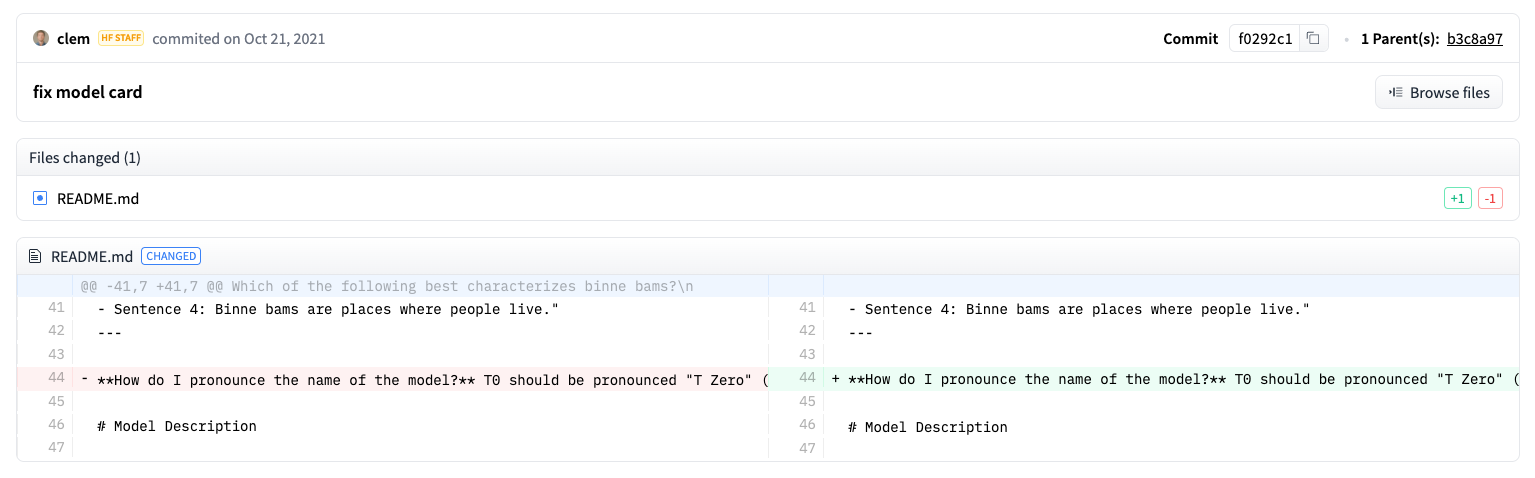
|
||||
|
||||
## Setup
|
||||
|
||||
Before sharing a model to the Hub, you will need your Hugging Face credentials. If you have access to a terminal, run the following command in the virtual environment where 🤗 Transformers is installed. This will store your access token in your Hugging Face cache folder (`~/.cache/` by default):
|
||||
|
||||
```bash
|
||||
huggingface-cli login
|
||||
```
|
||||
|
||||
If you are using a notebook like Jupyter or Colaboratory, make sure you have the [`huggingface_hub`](https://huggingface.co/docs/hub/adding-a-library) library installed. This library allows you to programmatically interact with the Hub.
|
||||
|
||||
```bash
|
||||
pip install huggingface_hub
|
||||
```
|
||||
|
||||
Then use `notebook_login` to sign-in to the Hub, and follow the link [here](https://huggingface.co/settings/token) to generate a token to login with:
|
||||
|
||||
```py
|
||||
>>> from huggingface_hub import notebook_login
|
||||
|
||||
>>> notebook_login()
|
||||
```
|
||||
|
||||
## Convert a model for all frameworks
|
||||
|
||||
To ensure your model can be used by someone working with a different framework, we recommend you convert and upload your model with both PyTorch and TensorFlow checkpoints. While users are still able to load your model from a different framework if you skip this step, it will be slower because 🤗 Transformers will need to convert the checkpoint on-the-fly.
|
||||
|
||||
Converting a checkpoint for another framework is easy. Make sure you have PyTorch and TensorFlow installed (see [here](installation) for installation instructions), and then find the specific model for your task in the other framework.
|
||||
|
||||
<frameworkcontent>
|
||||
<pt>
|
||||
Specify `from_tf=True` to convert a checkpoint from TensorFlow to PyTorch:
|
||||
|
||||
```py
|
||||
>>> pt_model = DistilBertForSequenceClassification.from_pretrained("path/to/awesome-name-you-picked", from_tf=True)
|
||||
>>> pt_model.save_pretrained("path/to/awesome-name-you-picked")
|
||||
```
|
||||
</pt>
|
||||
<tf>
|
||||
Specify `from_pt=True` to convert a checkpoint from PyTorch to TensorFlow:
|
||||
|
||||
```py
|
||||
>>> tf_model = TFDistilBertForSequenceClassification.from_pretrained("path/to/awesome-name-you-picked", from_pt=True)
|
||||
```
|
||||
|
||||
Then you can save your new TensorFlow model with it's new checkpoint:
|
||||
|
||||
```py
|
||||
>>> tf_model.save_pretrained("path/to/awesome-name-you-picked")
|
||||
```
|
||||
</tf>
|
||||
<jax>
|
||||
If a model is available in Flax, you can also convert a checkpoint from PyTorch to Flax:
|
||||
|
||||
```py
|
||||
>>> flax_model = FlaxDistilBertForSequenceClassification.from_pretrained(
|
||||
... "path/to/awesome-name-you-picked", from_pt=True
|
||||
... )
|
||||
```
|
||||
</jax>
|
||||
</frameworkcontent>
|
||||
|
||||
## Push a model during training
|
||||
|
||||
<frameworkcontent>
|
||||
<pt>
|
||||
<Youtube id="Z1-XMy-GNLQ"/>
|
||||
|
||||
Sharing a model to the Hub is as simple as adding an extra parameter or callback. Remember from the [fine-tuning tutorial](training), the [`TrainingArguments`] class is where you specify hyperparameters and additional training options. One of these training options includes the ability to push a model directly to the Hub. Set `push_to_hub=True` in your [`TrainingArguments`]:
|
||||
|
||||
```py
|
||||
>>> training_args = TrainingArguments(output_dir="my-awesome-model", push_to_hub=True)
|
||||
```
|
||||
|
||||
Pass your training arguments as usual to [`Trainer`]:
|
||||
|
||||
```py
|
||||
>>> trainer = Trainer(
|
||||
... model=model,
|
||||
... args=training_args,
|
||||
... train_dataset=small_train_dataset,
|
||||
... eval_dataset=small_eval_dataset,
|
||||
... compute_metrics=compute_metrics,
|
||||
... )
|
||||
```
|
||||
|
||||
After you fine-tune your model, call [`~transformers.Trainer.push_to_hub`] on [`Trainer`] to push the trained model to the Hub. 🤗 Transformers will even automatically add training hyperparameters, training results and framework versions to your model card!
|
||||
|
||||
```py
|
||||
>>> trainer.push_to_hub()
|
||||
```
|
||||
</pt>
|
||||
<tf>
|
||||
Share a model to the Hub with [`PushToHubCallback`]. In the [`PushToHubCallback`] function, add:
|
||||
|
||||
- An output directory for your model.
|
||||
- A tokenizer.
|
||||
- The `hub_model_id`, which is your Hub username and model name.
|
||||
|
||||
```py
|
||||
>>> from transformers.keras.callbacks import PushToHubCallback
|
||||
|
||||
>>> push_to_hub_callback = PushToHubCallback(
|
||||
... output_dir="./your_model_save_path", tokenizer=tokenizer, hub_model_id="your-username/my-awesome-model"
|
||||
... )
|
||||
```
|
||||
|
||||
Add the callback to [`fit`](https://keras.io/api/models/model_training_apis/), and 🤗 Transformers will push the trained model to the Hub:
|
||||
|
||||
```py
|
||||
>>> model.fit(tf_train_dataset, validation_data=tf_validation_dataset, epochs=3, callbacks=push_to_hub_callback)
|
||||
```
|
||||
</tf>
|
||||
</frameworkcontent>
|
||||
|
||||
## Use the `push_to_hub` function
|
||||
|
||||
You can also call `push_to_hub` directly on your model to upload it to the Hub.
|
||||
|
||||
Specify your model name in `push_to_hub`:
|
||||
|
||||
```py
|
||||
>>> pt_model.push_to_hub("my-awesome-model")
|
||||
```
|
||||
|
||||
This creates a repository under your username with the model name `my-awesome-model`. Users can now load your model with the `from_pretrained` function:
|
||||
|
||||
```py
|
||||
>>> from transformers import AutoModel
|
||||
|
||||
>>> model = AutoModel.from_pretrained("your_username/my-awesome-model")
|
||||
```
|
||||
|
||||
If you belong to an organization and want to push your model under the organization name instead, add the `organization` parameter:
|
||||
|
||||
```py
|
||||
>>> pt_model.push_to_hub("my-awesome-model", organization="my-awesome-org")
|
||||
```
|
||||
|
||||
The `push_to_hub` function can also be used to add other files to a model repository. For example, add a tokenizer to a model repository:
|
||||
|
||||
```py
|
||||
>>> tokenizer.push_to_hub("my-awesome-model")
|
||||
```
|
||||
|
||||
Or perhaps you'd like to add the TensorFlow version of your fine-tuned PyTorch model:
|
||||
|
||||
```py
|
||||
>>> tf_model.push_to_hub("my-awesome-model")
|
||||
```
|
||||
|
||||
Now when you navigate to the your Hugging Face profile, you should see your newly created model repository. Clicking on the **Files** tab will display all the files you've uploaded to the repository.
|
||||
|
||||
For more details on how to create and upload files to a repository, refer to the Hub documentation [here](https://huggingface.co/docs/hub/how-to-upstream).
|
||||
|
||||
## Upload with the web interface
|
||||
|
||||
Users who prefer a no-code approach are able to upload a model through the Hub's web interface. Visit [huggingface.co/new](https://huggingface.co/new) to create a new repository:
|
||||
|
||||
|
||||
|
||||
From here, add some information about your model:
|
||||
|
||||
- Select the **owner** of the repository. This can be yourself or any of the organizations you belong to.
|
||||
- Pick a name for your model, which will also be the repository name.
|
||||
- Choose whether your model is public or private.
|
||||
- Specify the license usage for your model.
|
||||
|
||||
Now click on the **Files** tab and click on the **Add file** button to upload a new file to your repository. Then drag-and-drop a file to upload and add a commit message.
|
||||
|
||||
|
||||
|
||||
## Add a model card
|
||||
|
||||
To make sure users understand your model's capabilities, limitations, potential biases and ethical considerations, please add a model card to your repository. The model card is defined in the `README.md` file. You can add a model card by:
|
||||
|
||||
* Manually creating and uploading a `README.md` file.
|
||||
* Clicking on the **Edit model card** button in your model repository.
|
||||
|
||||
Take a look at the DistilBert [model card](https://huggingface.co/distilbert-base-uncased) for a good example of the type of information a model card should include. For more details about other options you can control in the `README.md` file such as a model's carbon footprint or widget examples, refer to the documentation [here](https://huggingface.co/docs/hub/model-repos).
|
||||
@@ -1,175 +0,0 @@
|
||||
<!--Copyright 2022 The HuggingFace Team. All rights reserved.
|
||||
|
||||
Licensed under the Apache License, Version 2.0 (the "License"); you may not use this file except in compliance with
|
||||
the License. You may obtain a copy of the License at
|
||||
|
||||
http://www.apache.org/licenses/LICENSE-2.0
|
||||
|
||||
Unless required by applicable law or agreed to in writing, software distributed under the License is distributed on
|
||||
an "AS IS" BASIS, WITHOUT WARRANTIES OR CONDITIONS OF ANY KIND, either express or implied. See the License for the
|
||||
specific language governing permissions and limitations under the License.
|
||||
-->
|
||||
|
||||
# Multilingual models for inference
|
||||
|
||||
[[open-in-colab]]
|
||||
|
||||
There are several multilingual models in 🤗 Transformers, and their inference usage differs from monolingual models. Not *all* multilingual model usage is different though. Some models, like [bert-base-multilingual-uncased](https://huggingface.co/bert-base-multilingual-uncased), can be used just like a monolingual model. This guide will show you how to use multilingual models whose usage differs for inference.
|
||||
|
||||
## XLM
|
||||
|
||||
XLM has ten different checkpoints, only one of which is monolingual. The nine remaining model checkpoints can be split into two categories: the checkpoints that use language embeddings and those that don't.
|
||||
|
||||
### XLM with language embeddings
|
||||
|
||||
The following XLM models use language embeddings to specify the language used at inference:
|
||||
|
||||
- `xlm-mlm-ende-1024` (Masked language modeling, English-German)
|
||||
- `xlm-mlm-enfr-1024` (Masked language modeling, English-French)
|
||||
- `xlm-mlm-enro-1024` (Masked language modeling, English-Romanian)
|
||||
- `xlm-mlm-xnli15-1024` (Masked language modeling, XNLI languages)
|
||||
- `xlm-mlm-tlm-xnli15-1024` (Masked language modeling + translation, XNLI languages)
|
||||
- `xlm-clm-enfr-1024` (Causal language modeling, English-French)
|
||||
- `xlm-clm-ende-1024` (Causal language modeling, English-German)
|
||||
|
||||
Language embeddings are represented as a tensor of the same shape as the `input_ids` passed to the model. The values in these tensors depend on the language used and are identified by the tokenizer's `lang2id` and `id2lang` attributes.
|
||||
|
||||
In this example, load the `xlm-clm-enfr-1024` checkpoint (Causal language modeling, English-French):
|
||||
|
||||
```py
|
||||
>>> import torch
|
||||
>>> from transformers import XLMTokenizer, XLMWithLMHeadModel
|
||||
|
||||
>>> tokenizer = XLMTokenizer.from_pretrained("xlm-clm-enfr-1024")
|
||||
>>> model = XLMWithLMHeadModel.from_pretrained("xlm-clm-enfr-1024")
|
||||
```
|
||||
|
||||
The `lang2id` attribute of the tokenizer displays this model's languages and their ids:
|
||||
|
||||
```py
|
||||
>>> print(tokenizer.lang2id)
|
||||
{'en': 0, 'fr': 1}
|
||||
```
|
||||
|
||||
Next, create an example input:
|
||||
|
||||
```py
|
||||
>>> input_ids = torch.tensor([tokenizer.encode("Wikipedia was used to")]) # batch size of 1
|
||||
```
|
||||
|
||||
Set the language id as `"en"` and use it to define the language embedding. The language embedding is a tensor filled with `0` since that is the language id for English. This tensor should be the same size as `input_ids`.
|
||||
|
||||
```py
|
||||
>>> language_id = tokenizer.lang2id["en"] # 0
|
||||
>>> langs = torch.tensor([language_id] * input_ids.shape[1]) # torch.tensor([0, 0, 0, ..., 0])
|
||||
|
||||
>>> # We reshape it to be of size (batch_size, sequence_length)
|
||||
>>> langs = langs.view(1, -1) # is now of shape [1, sequence_length] (we have a batch size of 1)
|
||||
```
|
||||
|
||||
Now you can pass the `input_ids` and language embedding to the model:
|
||||
|
||||
```py
|
||||
>>> outputs = model(input_ids, langs=langs)
|
||||
```
|
||||
|
||||
The [run_generation.py](https://github.com/huggingface/transformers/tree/main/examples/pytorch/text-generation/run_generation.py) script can generate text with language embeddings using the `xlm-clm` checkpoints.
|
||||
|
||||
### XLM without language embeddings
|
||||
|
||||
The following XLM models do not require language embeddings during inference:
|
||||
|
||||
- `xlm-mlm-17-1280` (Masked language modeling, 17 languages)
|
||||
- `xlm-mlm-100-1280` (Masked language modeling, 100 languages)
|
||||
|
||||
These models are used for generic sentence representations, unlike the previous XLM checkpoints.
|
||||
|
||||
## BERT
|
||||
|
||||
The following BERT models can be used for multilingual tasks:
|
||||
|
||||
- `bert-base-multilingual-uncased` (Masked language modeling + Next sentence prediction, 102 languages)
|
||||
- `bert-base-multilingual-cased` (Masked language modeling + Next sentence prediction, 104 languages)
|
||||
|
||||
These models do not require language embeddings during inference. They should identify the language from the
|
||||
context and infer accordingly.
|
||||
|
||||
## XLM-RoBERTa
|
||||
|
||||
The following XLM-RoBERTa models can be used for multilingual tasks:
|
||||
|
||||
- `xlm-roberta-base` (Masked language modeling, 100 languages)
|
||||
- `xlm-roberta-large` (Masked language modeling, 100 languages)
|
||||
|
||||
XLM-RoBERTa was trained on 2.5TB of newly created and cleaned CommonCrawl data in 100 languages. It provides strong gains over previously released multilingual models like mBERT or XLM on downstream tasks like classification, sequence labeling, and question answering.
|
||||
|
||||
## M2M100
|
||||
|
||||
The following M2M100 models can be used for multilingual translation:
|
||||
|
||||
- `facebook/m2m100_418M` (Translation)
|
||||
- `facebook/m2m100_1.2B` (Translation)
|
||||
|
||||
In this example, load the `facebook/m2m100_418M` checkpoint to translate from Chinese to English. You can set the source language in the tokenizer:
|
||||
|
||||
```py
|
||||
>>> from transformers import M2M100ForConditionalGeneration, M2M100Tokenizer
|
||||
|
||||
>>> en_text = "Do not meddle in the affairs of wizards, for they are subtle and quick to anger."
|
||||
>>> chinese_text = "不要插手巫師的事務, 因為他們是微妙的, 很快就會發怒."
|
||||
|
||||
>>> tokenizer = M2M100Tokenizer.from_pretrained("facebook/m2m100_418M", src_lang="zh")
|
||||
>>> model = M2M100ForConditionalGeneration.from_pretrained("facebook/m2m100_418M")
|
||||
```
|
||||
|
||||
Tokenize the text:
|
||||
|
||||
```py
|
||||
>>> encoded_zh = tokenizer(chinese_text, return_tensors="pt")
|
||||
```
|
||||
|
||||
M2M100 forces the target language id as the first generated token to translate to the target language. Set the `forced_bos_token_id` to `en` in the `generate` method to translate to English:
|
||||
|
||||
```py
|
||||
>>> generated_tokens = model.generate(**encoded_zh, forced_bos_token_id=tokenizer.get_lang_id("en"))
|
||||
>>> tokenizer.batch_decode(generated_tokens, skip_special_tokens=True)
|
||||
'Do not interfere with the matters of the witches, because they are delicate and will soon be angry.'
|
||||
```
|
||||
|
||||
## MBart
|
||||
|
||||
The following MBart models can be used for multilingual translation:
|
||||
|
||||
- `facebook/mbart-large-50-one-to-many-mmt` (One-to-many multilingual machine translation, 50 languages)
|
||||
- `facebook/mbart-large-50-many-to-many-mmt` (Many-to-many multilingual machine translation, 50 languages)
|
||||
- `facebook/mbart-large-50-many-to-one-mmt` (Many-to-one multilingual machine translation, 50 languages)
|
||||
- `facebook/mbart-large-50` (Multilingual translation, 50 languages)
|
||||
- `facebook/mbart-large-cc25`
|
||||
|
||||
In this example, load the `facebook/mbart-large-50-many-to-many-mmt` checkpoint to translate Finnish to English. You can set the source language in the tokenizer:
|
||||
|
||||
```py
|
||||
>>> from transformers import AutoTokenizer, AutoModelForSeq2SeqLM
|
||||
|
||||
>>> en_text = "Do not meddle in the affairs of wizards, for they are subtle and quick to anger."
|
||||
>>> fi_text = "Älä sekaannu velhojen asioihin, sillä ne ovat hienovaraisia ja nopeasti vihaisia."
|
||||
|
||||
>>> tokenizer = AutoTokenizer.from_pretrained("facebook/mbart-large-50-many-to-many-mmt", src_lang="fi_FI")
|
||||
>>> model = AutoModelForSeq2SeqLM.from_pretrained("facebook/mbart-large-50-many-to-many-mmt")
|
||||
```
|
||||
|
||||
Tokenize the text:
|
||||
|
||||
```py
|
||||
>>> encoded_en = tokenizer(en_text, return_tensors="pt")
|
||||
```
|
||||
|
||||
MBart forces the target language id as the first generated token to translate to the target language. Set the `forced_bos_token_id` to `en` in the `generate` method to translate to English:
|
||||
|
||||
```py
|
||||
>>> generated_tokens = model.generate(**encoded_en, forced_bos_token_id=tokenizer.lang_code_to_id("en_XX"))
|
||||
>>> tokenizer.batch_decode(generated_tokens, skip_special_tokens=True)
|
||||
"Don't interfere with the wizard's affairs, because they are subtle, will soon get angry."
|
||||
```
|
||||
|
||||
If you are using the `facebook/mbart-large-50-many-to-one-mmt` checkpoint, you don't need to force the target language id as the first generated token otherwise the usage is the same.
|
||||
@@ -1 +0,0 @@
|
||||
../../../notebooks/README.md
|
||||
@@ -1,66 +0,0 @@
|
||||
<!--Copyright 2022 The HuggingFace Team. All rights reserved.
|
||||
|
||||
Licensed under the Apache License, Version 2.0 (the "License"); you may not use this file except in compliance with
|
||||
the License. You may obtain a copy of the License at
|
||||
|
||||
http://www.apache.org/licenses/LICENSE-2.0
|
||||
|
||||
Unless required by applicable law or agreed to in writing, software distributed under the License is distributed on
|
||||
an "AS IS" BASIS, WITHOUT WARRANTIES OR CONDITIONS OF ANY KIND, either express or implied. See the License for the
|
||||
specific language governing permissions and limitations under the License.
|
||||
-->
|
||||
|
||||
# Padding and truncation
|
||||
|
||||
Batched inputs are often different lengths, so they can't be converted to fixed-size tensors. Padding and truncation are strategies for dealing with this problem, to create rectangular tensors from batches of varying lengths. Padding adds a special **padding token** to ensure shorter sequences will have the same length as either the longest sequence in a batch or the maximum length accepted by the model. Truncation works in the other direction by truncating long sequences.
|
||||
|
||||
In most cases, padding your batch to the length of the longest sequence and truncating to the maximum length a model can accept works pretty well. However, the API supports more strategies if you need them. The three arguments you need to are: `padding`, `truncation` and `max_length`.
|
||||
|
||||
The `padding` argument controls padding. It can be a boolean or a string:
|
||||
|
||||
- `True` or `'longest'`: pad to the longest sequence in the batch (no padding is applied if you only provide
|
||||
a single sequence).
|
||||
- `'max_length'`: pad to a length specified by the `max_length` argument or the maximum length accepted
|
||||
by the model if no `max_length` is provided (`max_length=None`). Padding will still be applied if you only provide a single sequence.
|
||||
- `False` or `'do_not_pad'`: no padding is applied. This is the default behavior.
|
||||
|
||||
The `truncation` argument controls truncation. It can be a boolean or a string:
|
||||
|
||||
- `True` or `'longest_first'`: truncate to a maximum length specified by the `max_length` argument or
|
||||
the maximum length accepted by the model if no `max_length` is provided (`max_length=None`). This will
|
||||
truncate token by token, removing a token from the longest sequence in the pair until the proper length is
|
||||
reached.
|
||||
- `'only_second'`: truncate to a maximum length specified by the `max_length` argument or the maximum
|
||||
length accepted by the model if no `max_length` is provided (`max_length=None`). This will only truncate
|
||||
the second sentence of a pair if a pair of sequences (or a batch of pairs of sequences) is provided.
|
||||
- `'only_first'`: truncate to a maximum length specified by the `max_length` argument or the maximum
|
||||
length accepted by the model if no `max_length` is provided (`max_length=None`). This will only truncate
|
||||
the first sentence of a pair if a pair of sequences (or a batch of pairs of sequences) is provided.
|
||||
- `False` or `'do_not_truncate'`: no truncation is applied. This is the default behavior.
|
||||
|
||||
The `max_length` argument controls the length of the padding and truncation. It can be an integer or `None`, in which case it will default to the maximum length the model can accept. If the model has no specific maximum input length, truncation or padding to `max_length` is deactivated.
|
||||
|
||||
The following table summarizes the recommended way to setup padding and truncation. If you use pairs of input sequences in any of the following examples, you can replace `truncation=True` by a `STRATEGY` selected in
|
||||
`['only_first', 'only_second', 'longest_first']`, i.e. `truncation='only_second'` or `truncation='longest_first'` to control how both sequences in the pair are truncated as detailed before.
|
||||
|
||||
| Truncation | Padding | Instruction |
|
||||
|--------------------------------------|-----------------------------------|---------------------------------------------------------------------------------------------|
|
||||
| no truncation | no padding | `tokenizer(batch_sentences)` |
|
||||
| | padding to max sequence in batch | `tokenizer(batch_sentences, padding=True)` or |
|
||||
| | | `tokenizer(batch_sentences, padding='longest')` |
|
||||
| | padding to max model input length | `tokenizer(batch_sentences, padding='max_length')` |
|
||||
| | padding to specific length | `tokenizer(batch_sentences, padding='max_length', max_length=42)` |
|
||||
| truncation to max model input length | no padding | `tokenizer(batch_sentences, truncation=True)` or |
|
||||
| | | `tokenizer(batch_sentences, truncation=STRATEGY)` |
|
||||
| | padding to max sequence in batch | `tokenizer(batch_sentences, padding=True, truncation=True)` or |
|
||||
| | | `tokenizer(batch_sentences, padding=True, truncation=STRATEGY)` |
|
||||
| | padding to max model input length | `tokenizer(batch_sentences, padding='max_length', truncation=True)` or |
|
||||
| | | `tokenizer(batch_sentences, padding='max_length', truncation=STRATEGY)` |
|
||||
| | padding to specific length | Not possible |
|
||||
| truncation to specific length | no padding | `tokenizer(batch_sentences, truncation=True, max_length=42)` or |
|
||||
| | | `tokenizer(batch_sentences, truncation=STRATEGY, max_length=42)` |
|
||||
| | padding to max sequence in batch | `tokenizer(batch_sentences, padding=True, truncation=True, max_length=42)` or |
|
||||
| | | `tokenizer(batch_sentences, padding=True, truncation=STRATEGY, max_length=42)` |
|
||||
| | padding to max model input length | Not possible |
|
||||
| | padding to specific length | `tokenizer(batch_sentences, padding='max_length', truncation=True, max_length=42)` or |
|
||||
| | | `tokenizer(batch_sentences, padding='max_length', truncation=STRATEGY, max_length=42)` |
|
||||
@@ -1,148 +0,0 @@
|
||||
<!--Copyright 2022 The HuggingFace Team. All rights reserved.
|
||||
|
||||
Licensed under the Apache License, Version 2.0 (the "License"); you may not use this file except in compliance with
|
||||
the License. You may obtain a copy of the License at
|
||||
|
||||
http://www.apache.org/licenses/LICENSE-2.0
|
||||
|
||||
Unless required by applicable law or agreed to in writing, software distributed under the License is distributed on
|
||||
an "AS IS" BASIS, WITHOUT WARRANTIES OR CONDITIONS OF ANY KIND, either express or implied. See the License for the
|
||||
specific language governing permissions and limitations under the License.
|
||||
-->
|
||||
|
||||
# Pipelines for inference
|
||||
|
||||
The [`pipeline`] makes it simple to use any model from the [Model Hub](https://huggingface.co/models) for inference on a variety of tasks such as text generation, image segmentation and audio classification. Even if you don't have experience with a specific modality or understand the code powering the models, you can still use them with the [`pipeline`]! This tutorial will teach you to:
|
||||
|
||||
* Use a [`pipeline`] for inference.
|
||||
* Use a specific tokenizer or model.
|
||||
* Use a [`pipeline`] for audio and vision tasks.
|
||||
|
||||
<Tip>
|
||||
|
||||
Take a look at the [`pipeline`] documentation for a complete list of supported taska.
|
||||
|
||||
</Tip>
|
||||
|
||||
## Pipeline usage
|
||||
|
||||
While each task has an associated [`pipeline`], it is simpler to use the general [`pipeline`] abstraction which contains all the specific task pipelines. The [`pipeline`] automatically loads a default model and tokenizer capable of inference for your task.
|
||||
|
||||
1. Start by creating a [`pipeline`] and specify an inference task:
|
||||
|
||||
```py
|
||||
>>> from transformers import pipeline
|
||||
|
||||
>>> generator = pipeline(task="text-generation")
|
||||
```
|
||||
|
||||
2. Pass your input text to the [`pipeline`]:
|
||||
|
||||
```py
|
||||
>>> generator(
|
||||
... "Three Rings for the Elven-kings under the sky, Seven for the Dwarf-lords in their halls of stone"
|
||||
... ) # doctest: +SKIP
|
||||
[{'generated_text': 'Three Rings for the Elven-kings under the sky, Seven for the Dwarf-lords in their halls of stone, Seven for the Iron-priests at the door to the east, and thirteen for the Lord Kings at the end of the mountain'}]
|
||||
```
|
||||
|
||||
If you have more than one input, pass your input as a list:
|
||||
|
||||
```py
|
||||
>>> generator(
|
||||
... [
|
||||
... "Three Rings for the Elven-kings under the sky, Seven for the Dwarf-lords in their halls of stone",
|
||||
... "Nine for Mortal Men, doomed to die, One for the Dark Lord on his dark throne",
|
||||
... ]
|
||||
... ) # doctest: +SKIP
|
||||
```
|
||||
|
||||
Any additional parameters for your task can also be included in the [`pipeline`]. The `text-generation` task has a [`~generation_utils.GenerationMixin.generate`] method with several parameters for controlling the output. For example, if you want to generate more than one output, set the `num_return_sequences` parameter:
|
||||
|
||||
```py
|
||||
>>> generator(
|
||||
... "Three Rings for the Elven-kings under the sky, Seven for the Dwarf-lords in their halls of stone",
|
||||
... num_return_sequences=2,
|
||||
... ) # doctest: +SKIP
|
||||
```
|
||||
|
||||
### Choose a model and tokenizer
|
||||
|
||||
The [`pipeline`] accepts any model from the [Model Hub](https://huggingface.co/models). There are tags on the Model Hub that allow you to filter for a model you'd like to use for your task. Once you've picked an appropriate model, load it with the corresponding `AutoModelFor` and [`AutoTokenizer'] class. For example, load the [`AutoModelForCausalLM`] class for a causal language modeling task:
|
||||
|
||||
```py
|
||||
>>> from transformers import AutoTokenizer, AutoModelForCausalLM
|
||||
|
||||
>>> tokenizer = AutoTokenizer.from_pretrained("distilgpt2")
|
||||
>>> model = AutoModelForCausalLM.from_pretrained("distilgpt2")
|
||||
```
|
||||
|
||||
Create a [`pipeline`] for your task, and specify the model and tokenizer you've loaded:
|
||||
|
||||
```py
|
||||
>>> from transformers import pipeline
|
||||
|
||||
>>> generator = pipeline(task="text-generation", model=model, tokenizer=tokenizer)
|
||||
```
|
||||
|
||||
Pass your input text to the [`pipeline`] to generate some text:
|
||||
|
||||
```py
|
||||
>>> generator(
|
||||
... "Three Rings for the Elven-kings under the sky, Seven for the Dwarf-lords in their halls of stone"
|
||||
... ) # doctest: +SKIP
|
||||
[{'generated_text': 'Three Rings for the Elven-kings under the sky, Seven for the Dwarf-lords in their halls of stone, Seven for the Dragon-lords (for them to rule in a world ruled by their rulers, and all who live within the realm'}]
|
||||
```
|
||||
|
||||
## Audio pipeline
|
||||
|
||||
The flexibility of the [`pipeline`] means it can also be extended to audio tasks.
|
||||
|
||||
For example, let's classify the emotion in this audio clip:
|
||||
|
||||
```py
|
||||
>>> from datasets import load_dataset
|
||||
>>> import torch
|
||||
|
||||
>>> torch.manual_seed(42) # doctest: +IGNORE_RESULT
|
||||
>>> ds = load_dataset("hf-internal-testing/librispeech_asr_demo", "clean", split="validation")
|
||||
>>> audio_file = ds[0]["audio"]["path"]
|
||||
```
|
||||
|
||||
Find an [audio classification](https://huggingface.co/models?pipeline_tag=audio-classification) model on the Model Hub for emotion recognition and load it in the [`pipeline`]:
|
||||
|
||||
```py
|
||||
>>> from transformers import pipeline
|
||||
|
||||
>>> audio_classifier = pipeline(
|
||||
... task="audio-classification", model="ehcalabres/wav2vec2-lg-xlsr-en-speech-emotion-recognition"
|
||||
... )
|
||||
```
|
||||
|
||||
Pass the audio file to the [`pipeline`]:
|
||||
|
||||
```py
|
||||
>>> preds = audio_classifier(audio_file)
|
||||
>>> preds = [{"score": round(pred["score"], 4), "label": pred["label"]} for pred in preds]
|
||||
>>> preds
|
||||
[{'score': 0.1315, 'label': 'calm'}, {'score': 0.1307, 'label': 'neutral'}, {'score': 0.1274, 'label': 'sad'}, {'score': 0.1261, 'label': 'fearful'}, {'score': 0.1242, 'label': 'happy'}]
|
||||
```
|
||||
|
||||
## Vision pipeline
|
||||
|
||||
Finally, using a [`pipeline`] for vision tasks is practically identical.
|
||||
|
||||
Specify your vision task and pass your image to the classifier. The imaage can be a link or a local path to the image. For example, what species of cat is shown below?
|
||||
|
||||
|
||||
|
||||
```py
|
||||
>>> from transformers import pipeline
|
||||
|
||||
>>> vision_classifier = pipeline(task="image-classification")
|
||||
>>> preds = vision_classifier(
|
||||
... images="https://huggingface.co/datasets/huggingface/documentation-images/resolve/main/pipeline-cat-chonk.jpeg"
|
||||
... )
|
||||
>>> preds = [{"score": round(pred["score"], 4), "label": pred["label"]} for pred in preds]
|
||||
>>> preds
|
||||
[{'score': 0.4335, 'label': 'lynx, catamount'}, {'score': 0.0348, 'label': 'cougar, puma, catamount, mountain lion, painter, panther, Felis concolor'}, {'score': 0.0324, 'label': 'snow leopard, ounce, Panthera uncia'}, {'score': 0.0239, 'label': 'Egyptian cat'}, {'score': 0.0229, 'label': 'tiger cat'}]
|
||||
```
|
||||
@@ -1,504 +0,0 @@
|
||||
<!--Copyright 2022 The HuggingFace Team. All rights reserved.
|
||||
|
||||
Licensed under the Apache License, Version 2.0 (the "License"); you may not use this file except in compliance with
|
||||
the License. You may obtain a copy of the License at
|
||||
|
||||
http://www.apache.org/licenses/LICENSE-2.0
|
||||
|
||||
Unless required by applicable law or agreed to in writing, software distributed under the License is distributed on
|
||||
an "AS IS" BASIS, WITHOUT WARRANTIES OR CONDITIONS OF ANY KIND, either express or implied. See the License for the
|
||||
specific language governing permissions and limitations under the License.
|
||||
-->
|
||||
|
||||
# Preprocess
|
||||
|
||||
[[open-in-colab]]
|
||||
|
||||
Before you can use your data in a model, the data needs to be processed into an acceptable format for the model. A model does not understand raw text, images or audio. These inputs need to be converted into numbers and assembled into tensors. In this tutorial, you will:
|
||||
|
||||
* Preprocess textual data with a tokenizer.
|
||||
* Preprocess image or audio data with a feature extractor.
|
||||
* Preprocess data for a multimodal task with a processor.
|
||||
|
||||
## NLP
|
||||
|
||||
<Youtube id="Yffk5aydLzg"/>
|
||||
|
||||
The main tool for processing textual data is a [tokenizer](main_classes/tokenizer). A tokenizer starts by splitting text into *tokens* according to a set of rules. The tokens are converted into numbers, which are used to build tensors as input to a model. Any additional inputs required by a model are also added by the tokenizer.
|
||||
|
||||
<Tip>
|
||||
|
||||
If you plan on using a pretrained model, it's important to use the associated pretrained tokenizer. This ensures the text is split the same way as the pretraining corpus, and uses the same corresponding tokens-to-index (usually referrred to as the *vocab*) during pretraining.
|
||||
|
||||
</Tip>
|
||||
|
||||
Get started quickly by loading a pretrained tokenizer with the [`AutoTokenizer`] class. This downloads the *vocab* used when a model is pretrained.
|
||||
|
||||
### Tokenize
|
||||
|
||||
Load a pretrained tokenizer with [`AutoTokenizer.from_pretrained`]:
|
||||
|
||||
```py
|
||||
>>> from transformers import AutoTokenizer
|
||||
|
||||
>>> tokenizer = AutoTokenizer.from_pretrained("bert-base-cased")
|
||||
```
|
||||
|
||||
Then pass your sentence to the tokenizer:
|
||||
|
||||
```py
|
||||
>>> encoded_input = tokenizer("Do not meddle in the affairs of wizards, for they are subtle and quick to anger.")
|
||||
>>> print(encoded_input)
|
||||
{'input_ids': [101, 2079, 2025, 19960, 10362, 1999, 1996, 3821, 1997, 16657, 1010, 2005, 2027, 2024, 11259, 1998, 4248, 2000, 4963, 1012, 102],
|
||||
'token_type_ids': [0, 0, 0, 0, 0, 0, 0, 0, 0, 0, 0, 0, 0, 0, 0, 0, 0, 0, 0, 0, 0],
|
||||
'attention_mask': [1, 1, 1, 1, 1, 1, 1, 1, 1, 1, 1, 1, 1, 1, 1, 1, 1, 1, 1, 1, 1]}
|
||||
```
|
||||
|
||||
The tokenizer returns a dictionary with three important itmes:
|
||||
|
||||
* [input_ids](glossary#input-ids) are the indices corresponding to each token in the sentence.
|
||||
* [attention_mask](glossary#attention-mask) indicates whether a token should be attended to or not.
|
||||
* [token_type_ids](glossary#token-type-ids) identifies which sequence a token belongs to when there is more than one sequence.
|
||||
|
||||
You can decode the `input_ids` to return the original input:
|
||||
|
||||
```py
|
||||
>>> tokenizer.decode(encoded_input["input_ids"])
|
||||
'[CLS] Do not meddle in the affairs of wizards, for they are subtle and quick to anger. [SEP]'
|
||||
```
|
||||
|
||||
As you can see, the tokenizer added two special tokens - `CLS` and `SEP` (classifier and separator) - to the sentence. Not all models need
|
||||
special tokens, but if they do, the tokenizer will automatically add them for you.
|
||||
|
||||
If there are several sentences you want to process, pass the sentences as a list to the tokenizer:
|
||||
|
||||
```py
|
||||
>>> batch_sentences = [
|
||||
... "But what about second breakfast?",
|
||||
... "Don't think he knows about second breakfast, Pip.",
|
||||
... "What about elevensies?",
|
||||
... ]
|
||||
>>> encoded_inputs = tokenizer(batch_sentences)
|
||||
>>> print(encoded_inputs)
|
||||
{'input_ids': [[101, 1252, 1184, 1164, 1248, 6462, 136, 102],
|
||||
[101, 1790, 112, 189, 1341, 1119, 3520, 1164, 1248, 6462, 117, 21902, 1643, 119, 102],
|
||||
[101, 1327, 1164, 5450, 23434, 136, 102]],
|
||||
'token_type_ids': [[0, 0, 0, 0, 0, 0, 0, 0],
|
||||
[0, 0, 0, 0, 0, 0, 0, 0, 0, 0, 0, 0, 0, 0, 0],
|
||||
[0, 0, 0, 0, 0, 0, 0]],
|
||||
'attention_mask': [[1, 1, 1, 1, 1, 1, 1, 1],
|
||||
[1, 1, 1, 1, 1, 1, 1, 1, 1, 1, 1, 1, 1, 1, 1],
|
||||
[1, 1, 1, 1, 1, 1, 1]]}
|
||||
```
|
||||
|
||||
### Pad
|
||||
|
||||
This brings us to an important topic. When you process a batch of sentences, they aren't always the same length. This is a problem because tensors, the input to the model, need to have a uniform shape. Padding is a strategy for ensuring tensors are rectangular by adding a special *padding token* to sentences with fewer tokens.
|
||||
|
||||
Set the `padding` parameter to `True` to pad the shorter sequences in the batch to match the longest sequence:
|
||||
|
||||
```py
|
||||
>>> batch_sentences = [
|
||||
... "But what about second breakfast?",
|
||||
... "Don't think he knows about second breakfast, Pip.",
|
||||
... "What about elevensies?",
|
||||
... ]
|
||||
>>> encoded_input = tokenizer(batch_sentences, padding=True)
|
||||
>>> print(encoded_input)
|
||||
{'input_ids': [[101, 1252, 1184, 1164, 1248, 6462, 136, 102, 0, 0, 0, 0, 0, 0, 0],
|
||||
[101, 1790, 112, 189, 1341, 1119, 3520, 1164, 1248, 6462, 117, 21902, 1643, 119, 102],
|
||||
[101, 1327, 1164, 5450, 23434, 136, 102, 0, 0, 0, 0, 0, 0, 0, 0]],
|
||||
'token_type_ids': [[0, 0, 0, 0, 0, 0, 0, 0, 0, 0, 0, 0, 0, 0, 0],
|
||||
[0, 0, 0, 0, 0, 0, 0, 0, 0, 0, 0, 0, 0, 0, 0],
|
||||
[0, 0, 0, 0, 0, 0, 0, 0, 0, 0, 0, 0, 0, 0, 0]],
|
||||
'attention_mask': [[1, 1, 1, 1, 1, 1, 1, 1, 0, 0, 0, 0, 0, 0, 0],
|
||||
[1, 1, 1, 1, 1, 1, 1, 1, 1, 1, 1, 1, 1, 1, 1],
|
||||
[1, 1, 1, 1, 1, 1, 1, 0, 0, 0, 0, 0, 0, 0, 0]]}
|
||||
```
|
||||
|
||||
Notice the tokenizer padded the first and third sentences with a `0` because they are shorter!
|
||||
|
||||
### Truncation
|
||||
|
||||
On the other end of the spectrum, sometimes a sequence may be too long for a model to handle. In this case, you will need to truncate the sequence to a shorter length.
|
||||
|
||||
Set the `truncation` parameter to `True` to truncate a sequence to the maximum length accepted by the model:
|
||||
|
||||
```py
|
||||
>>> batch_sentences = [
|
||||
... "But what about second breakfast?",
|
||||
... "Don't think he knows about second breakfast, Pip.",
|
||||
... "What about elevensies?",
|
||||
... ]
|
||||
>>> encoded_input = tokenizer(batch_sentences, padding=True, truncation=True)
|
||||
>>> print(encoded_input)
|
||||
{'input_ids': [[101, 1252, 1184, 1164, 1248, 6462, 136, 102, 0, 0, 0, 0, 0, 0, 0],
|
||||
[101, 1790, 112, 189, 1341, 1119, 3520, 1164, 1248, 6462, 117, 21902, 1643, 119, 102],
|
||||
[101, 1327, 1164, 5450, 23434, 136, 102, 0, 0, 0, 0, 0, 0, 0, 0]],
|
||||
'token_type_ids': [[0, 0, 0, 0, 0, 0, 0, 0, 0, 0, 0, 0, 0, 0, 0],
|
||||
[0, 0, 0, 0, 0, 0, 0, 0, 0, 0, 0, 0, 0, 0, 0],
|
||||
[0, 0, 0, 0, 0, 0, 0, 0, 0, 0, 0, 0, 0, 0, 0]],
|
||||
'attention_mask': [[1, 1, 1, 1, 1, 1, 1, 1, 0, 0, 0, 0, 0, 0, 0],
|
||||
[1, 1, 1, 1, 1, 1, 1, 1, 1, 1, 1, 1, 1, 1, 1],
|
||||
[1, 1, 1, 1, 1, 1, 1, 0, 0, 0, 0, 0, 0, 0, 0]]}
|
||||
```
|
||||
|
||||
### Build tensors
|
||||
|
||||
Finally, you want the tokenizer to return the actual tensors that are fed to the model.
|
||||
|
||||
Set the `return_tensors` parameter to either `pt` for PyTorch, or `tf` for TensorFlow:
|
||||
|
||||
<frameworkcontent>
|
||||
<pt>
|
||||
|
||||
```py
|
||||
>>> batch_sentences = [
|
||||
... "But what about second breakfast?",
|
||||
... "Don't think he knows about second breakfast, Pip.",
|
||||
... "What about elevensies?",
|
||||
... ]
|
||||
>>> encoded_input = tokenizer(batch_sentences, padding=True, truncation=True, return_tensors="pt")
|
||||
>>> print(encoded_input)
|
||||
{'input_ids': tensor([[101, 1252, 1184, 1164, 1248, 6462, 136, 102, 0, 0, 0, 0, 0, 0, 0],
|
||||
[101, 1790, 112, 189, 1341, 1119, 3520, 1164, 1248, 6462, 117, 21902, 1643, 119, 102],
|
||||
[101, 1327, 1164, 5450, 23434, 136, 102, 0, 0, 0, 0, 0, 0, 0, 0]]),
|
||||
'token_type_ids': tensor([[0, 0, 0, 0, 0, 0, 0, 0, 0, 0, 0, 0, 0, 0, 0],
|
||||
[0, 0, 0, 0, 0, 0, 0, 0, 0, 0, 0, 0, 0, 0, 0],
|
||||
[0, 0, 0, 0, 0, 0, 0, 0, 0, 0, 0, 0, 0, 0, 0]]),
|
||||
'attention_mask': tensor([[1, 1, 1, 1, 1, 1, 1, 1, 0, 0, 0, 0, 0, 0, 0],
|
||||
[1, 1, 1, 1, 1, 1, 1, 1, 1, 1, 1, 1, 1, 1, 1],
|
||||
[1, 1, 1, 1, 1, 1, 1, 0, 0, 0, 0, 0, 0, 0, 0]])}
|
||||
```
|
||||
</pt>
|
||||
<tf>
|
||||
```py
|
||||
>>> batch_sentences = [
|
||||
... "But what about second breakfast?",
|
||||
... "Don't think he knows about second breakfast, Pip.",
|
||||
... "What about elevensies?",
|
||||
... ]
|
||||
>>> encoded_input = tokenizer(batch_sentences, padding=True, truncation=True, return_tensors="tf")
|
||||
>>> print(encoded_input)
|
||||
{'input_ids': <tf.Tensor: shape=(2, 9), dtype=int32, numpy=
|
||||
array([[101, 1252, 1184, 1164, 1248, 6462, 136, 102, 0, 0, 0, 0, 0, 0, 0],
|
||||
[101, 1790, 112, 189, 1341, 1119, 3520, 1164, 1248, 6462, 117, 21902, 1643, 119, 102],
|
||||
[101, 1327, 1164, 5450, 23434, 136, 102, 0, 0, 0, 0, 0, 0, 0, 0]],
|
||||
dtype=int32)>,
|
||||
'token_type_ids': <tf.Tensor: shape=(2, 9), dtype=int32, numpy=
|
||||
array([[0, 0, 0, 0, 0, 0, 0, 0, 0, 0, 0, 0, 0, 0, 0],
|
||||
[0, 0, 0, 0, 0, 0, 0, 0, 0, 0, 0, 0, 0, 0, 0],
|
||||
[0, 0, 0, 0, 0, 0, 0, 0, 0, 0, 0, 0, 0, 0, 0]], dtype=int32)>,
|
||||
'attention_mask': <tf.Tensor: shape=(2, 9), dtype=int32, numpy=
|
||||
array([[1, 1, 1, 1, 1, 1, 1, 1, 0, 0, 0, 0, 0, 0, 0],
|
||||
[1, 1, 1, 1, 1, 1, 1, 1, 1, 1, 1, 1, 1, 1, 1],
|
||||
[1, 1, 1, 1, 1, 1, 1, 0, 0, 0, 0, 0, 0, 0, 0]], dtype=int32)>}
|
||||
```
|
||||
</tf>
|
||||
</frameworkcontent>
|
||||
|
||||
## Audio
|
||||
|
||||
Audio inputs are preprocessed differently than textual inputs, but the end goal remains the same: create numerical sequences the model can understand. A [feature extractor](main_classes/feature_extractor) is designed for the express purpose of extracting features from raw image or audio data and converting them into tensors. Before you begin, install 🤗 Datasets to load an audio dataset to experiment with:
|
||||
|
||||
```bash
|
||||
pip install datasets
|
||||
```
|
||||
|
||||
Load the [MInDS-14](https://huggingface.co/datasets/PolyAI/minds14) dataset (see the 🤗 [Datasets tutorial](https://huggingface.co/docs/datasets/load_hub.html) for more details on how to load a dataset):
|
||||
|
||||
```py
|
||||
>>> from datasets import load_dataset, Audio
|
||||
|
||||
>>> dataset = load_dataset("PolyAI/minds14", name="en-US", split="train")
|
||||
```
|
||||
|
||||
Access the first element of the `audio` column to take a look at the input. Calling the `audio` column will automatically load and resample the audio file:
|
||||
|
||||
```py
|
||||
>>> dataset[0]["audio"]
|
||||
{'array': array([ 0. , 0.00024414, -0.00024414, ..., -0.00024414,
|
||||
0. , 0. ], dtype=float32),
|
||||
'path': '/root/.cache/huggingface/datasets/downloads/extracted/f14948e0e84be638dd7943ac36518a4cf3324e8b7aa331c5ab11541518e9368c/en-US~JOINT_ACCOUNT/602ba55abb1e6d0fbce92065.wav',
|
||||
'sampling_rate': 8000}
|
||||
```
|
||||
|
||||
This returns three items:
|
||||
|
||||
* `array` is the speech signal loaded - and potentially resampled - as a 1D array.
|
||||
* `path` points to the location of the audio file.
|
||||
* `sampling_rate` refers to how many data points in the speech signal are measured per second.
|
||||
|
||||
### Resample
|
||||
|
||||
For this tutorial, you will use the [Wav2Vec2](https://huggingface.co/facebook/wav2vec2-base) model. As you can see from the model card, the Wav2Vec2 model is pretrained on 16kHz sampled speech audio. It is important your audio data's sampling rate matches the sampling rate of the dataset used to pretrain the model. If your data's sampling rate isn't the same, then you need to resample your audio data.
|
||||
|
||||
For example, the [MInDS-14](https://huggingface.co/datasets/PolyAI/minds14) dataset has a sampling rate of 8000kHz. In order to use the Wav2Vec2 model with this dataset, upsample the sampling rate to 16kHz:
|
||||
|
||||
```py
|
||||
>>> dataset = load_dataset("PolyAI/minds14", name="en-US", split="train")
|
||||
>>> dataset[0]["audio"]
|
||||
{'array': array([ 0. , 0.00024414, -0.00024414, ..., -0.00024414,
|
||||
0. , 0. ], dtype=float32),
|
||||
'path': '/root/.cache/huggingface/datasets/downloads/extracted/f14948e0e84be638dd7943ac36518a4cf3324e8b7aa331c5ab11541518e9368c/en-US~JOINT_ACCOUNT/602ba55abb1e6d0fbce92065.wav',
|
||||
'sampling_rate': 8000}
|
||||
```
|
||||
|
||||
1. Use 🤗 Datasets' [`cast_column`](https://huggingface.co/docs/datasets/package_reference/main_classes.html#datasets.Dataset.cast_column) method to upsample the sampling rate to 16kHz:
|
||||
|
||||
```py
|
||||
>>> dataset = dataset.cast_column("audio", Audio(sampling_rate=16_000))
|
||||
```
|
||||
|
||||
2. Load the audio file:
|
||||
|
||||
```py
|
||||
>>> dataset[0]["audio"]
|
||||
{'array': array([ 2.3443763e-05, 2.1729663e-04, 2.2145823e-04, ...,
|
||||
3.8356509e-05, -7.3497440e-06, -2.1754686e-05], dtype=float32),
|
||||
'path': '/root/.cache/huggingface/datasets/downloads/extracted/f14948e0e84be638dd7943ac36518a4cf3324e8b7aa331c5ab11541518e9368c/en-US~JOINT_ACCOUNT/602ba55abb1e6d0fbce92065.wav',
|
||||
'sampling_rate': 16000}
|
||||
```
|
||||
|
||||
As you can see, the `sampling_rate` is now 16kHz!
|
||||
|
||||
### Feature extractor
|
||||
|
||||
The next step is to load a feature extractor to normalize and pad the input. When padding textual data, a `0` is added for shorter sequences. The same idea applies to audio data, and the audio feature extractor will add a `0` - interpreted as silence - to `array`.
|
||||
|
||||
Load the feature extractor with [`AutoFeatureExtractor.from_pretrained`]:
|
||||
|
||||
```py
|
||||
>>> from transformers import AutoFeatureExtractor
|
||||
|
||||
>>> feature_extractor = AutoFeatureExtractor.from_pretrained("facebook/wav2vec2-base")
|
||||
```
|
||||
|
||||
Pass the audio `array` to the feature extractor. We also recommend adding the `sampling_rate` argument in the feature extractor in order to better debug any silent errors that may occur.
|
||||
|
||||
```py
|
||||
>>> audio_input = [dataset[0]["audio"]["array"]]
|
||||
>>> feature_extractor(audio_input, sampling_rate=16000)
|
||||
{'input_values': [array([ 3.8106556e-04, 2.7506407e-03, 2.8015103e-03, ...,
|
||||
5.6335266e-04, 4.6588284e-06, -1.7142107e-04], dtype=float32)]}
|
||||
```
|
||||
|
||||
### Pad and truncate
|
||||
|
||||
Just like the tokenizer, you can apply padding or truncation to handle variable sequences in a batch. Take a look at the sequence length of these two audio samples:
|
||||
|
||||
```py
|
||||
>>> dataset[0]["audio"]["array"].shape
|
||||
(173398,)
|
||||
|
||||
>>> dataset[1]["audio"]["array"].shape
|
||||
(106496,)
|
||||
```
|
||||
|
||||
As you can see, the first sample has a longer sequence than the second sample. Let's create a function that will preprocess the dataset. Specify a maximum sample length, and the feature extractor will either pad or truncate the sequences to match it:
|
||||
|
||||
```py
|
||||
>>> def preprocess_function(examples):
|
||||
... audio_arrays = [x["array"] for x in examples["audio"]]
|
||||
... inputs = feature_extractor(
|
||||
... audio_arrays,
|
||||
... sampling_rate=16000,
|
||||
... padding=True,
|
||||
... max_length=100000,
|
||||
... truncation=True,
|
||||
... )
|
||||
... return inputs
|
||||
```
|
||||
|
||||
Apply the function to the the first few examples in the dataset:
|
||||
|
||||
```py
|
||||
>>> processed_dataset = preprocess_function(dataset[:5])
|
||||
```
|
||||
|
||||
Now take another look at the processed sample lengths:
|
||||
|
||||
```py
|
||||
>>> processed_dataset["input_values"][0].shape
|
||||
(100000,)
|
||||
|
||||
>>> processed_dataset["input_values"][1].shape
|
||||
(100000,)
|
||||
```
|
||||
|
||||
The lengths of the first two samples now match the maximum length you specified.
|
||||
|
||||
## Vision
|
||||
|
||||
A feature extractor is also used to process images for vision tasks. Once again, the goal is to convert the raw image into a batch of tensors as input.
|
||||
|
||||
Let's load the [food101](https://huggingface.co/datasets/food101) dataset for this tutorial. Use 🤗 Datasets `split` parameter to only load a small sample from the training split since the dataset is quite large:
|
||||
|
||||
```py
|
||||
>>> from datasets import load_dataset
|
||||
|
||||
>>> dataset = load_dataset("food101", split="train[:100]")
|
||||
```
|
||||
|
||||
Next, take a look at the image with 🤗 Datasets [`Image`](https://huggingface.co/docs/datasets/package_reference/main_classes.html?highlight=image#datasets.Image) feature:
|
||||
|
||||
```py
|
||||
>>> dataset[0]["image"]
|
||||
```
|
||||
|
||||

|
||||
|
||||
### Feature extractor
|
||||
|
||||
Load the feature extractor with [`AutoFeatureExtractor.from_pretrained`]:
|
||||
|
||||
```py
|
||||
>>> from transformers import AutoFeatureExtractor
|
||||
|
||||
>>> feature_extractor = AutoFeatureExtractor.from_pretrained("google/vit-base-patch16-224")
|
||||
```
|
||||
|
||||
### Data augmentation
|
||||
|
||||
For vision tasks, it is common to add some type of data augmentation to the images as a part of preprocessing. You can add augmentations with any library you'd like, but in this tutorial, you will use torchvision's [`transforms`](https://pytorch.org/vision/stable/transforms.html) module.
|
||||
|
||||
1. Normalize the image and use [`Compose`](https://pytorch.org/vision/master/generated/torchvision.transforms.Compose.html) to chain some transforms - [`RandomResizedCrop`](https://pytorch.org/vision/main/generated/torchvision.transforms.RandomResizedCrop.html) and [`ColorJitter`](https://pytorch.org/vision/main/generated/torchvision.transforms.ColorJitter.html) - together:
|
||||
|
||||
```py
|
||||
>>> from torchvision.transforms import Compose, Normalize, RandomResizedCrop, ColorJitter, ToTensor
|
||||
|
||||
>>> normalize = Normalize(mean=feature_extractor.image_mean, std=feature_extractor.image_std)
|
||||
>>> _transforms = Compose(
|
||||
... [RandomResizedCrop(feature_extractor.size), ColorJitter(brightness=0.5, hue=0.5), ToTensor(), normalize]
|
||||
... )
|
||||
```
|
||||
|
||||
2. The model accepts [`pixel_values`](model_doc/visionencoderdecoder#transformers.VisionEncoderDecoderModel.forward.pixel_values) as it's input. This value is generated by the feature extractor. Create a function that generates `pixel_values` from the transforms:
|
||||
|
||||
```py
|
||||
>>> def transforms(examples):
|
||||
... examples["pixel_values"] = [_transforms(image.convert("RGB")) for image in examples["image"]]
|
||||
... return examples
|
||||
```
|
||||
|
||||
3. Then use 🤗 Datasets [`set_transform`](https://huggingface.co/docs/datasets/process.html#format-transform) to apply the transforms on-the-fly:
|
||||
|
||||
```py
|
||||
>>> dataset.set_transform(transforms)
|
||||
```
|
||||
|
||||
4. Now when you access the image, you will notice the feature extractor has added the model input `pixel_values`:
|
||||
|
||||
```py
|
||||
>>> dataset[0]["image"]
|
||||
{'image': <PIL.JpegImagePlugin.JpegImageFile image mode=RGB size=384x512 at 0x7F1A7B0630D0>,
|
||||
'label': 6,
|
||||
'pixel_values': tensor([[[ 0.0353, 0.0745, 0.1216, ..., -0.9922, -0.9922, -0.9922],
|
||||
[-0.0196, 0.0667, 0.1294, ..., -0.9765, -0.9843, -0.9922],
|
||||
[ 0.0196, 0.0824, 0.1137, ..., -0.9765, -0.9686, -0.8667],
|
||||
...,
|
||||
[ 0.0275, 0.0745, 0.0510, ..., -0.1137, -0.1216, -0.0824],
|
||||
[ 0.0667, 0.0824, 0.0667, ..., -0.0588, -0.0745, -0.0980],
|
||||
[ 0.0353, 0.0353, 0.0431, ..., -0.0039, -0.0039, -0.0588]],
|
||||
|
||||
[[ 0.2078, 0.2471, 0.2863, ..., -0.9451, -0.9373, -0.9451],
|
||||
[ 0.1608, 0.2471, 0.3098, ..., -0.9373, -0.9451, -0.9373],
|
||||
[ 0.2078, 0.2706, 0.3020, ..., -0.9608, -0.9373, -0.8275],
|
||||
...,
|
||||
[-0.0353, 0.0118, -0.0039, ..., -0.2392, -0.2471, -0.2078],
|
||||
[ 0.0196, 0.0353, 0.0196, ..., -0.1843, -0.2000, -0.2235],
|
||||
[-0.0118, -0.0039, -0.0039, ..., -0.0980, -0.0980, -0.1529]],
|
||||
|
||||
[[ 0.3961, 0.4431, 0.4980, ..., -0.9216, -0.9137, -0.9216],
|
||||
[ 0.3569, 0.4510, 0.5216, ..., -0.9059, -0.9137, -0.9137],
|
||||
[ 0.4118, 0.4745, 0.5216, ..., -0.9137, -0.8902, -0.7804],
|
||||
...,
|
||||
[-0.2314, -0.1922, -0.2078, ..., -0.4196, -0.4275, -0.3882],
|
||||
[-0.1843, -0.1686, -0.2000, ..., -0.3647, -0.3804, -0.4039],
|
||||
[-0.1922, -0.1922, -0.1922, ..., -0.2941, -0.2863, -0.3412]]])}
|
||||
```
|
||||
|
||||
Here is what the image looks like after you preprocess it. Just as you'd expect from the applied transforms, the image has been randomly cropped and it's color properties are different.
|
||||
|
||||
```py
|
||||
>>> import numpy as np
|
||||
>>> import matplotlib.pyplot as plt
|
||||
|
||||
>>> img = dataset[0]["pixel_values"]
|
||||
>>> plt.imshow(img.permute(1, 2, 0))
|
||||
```
|
||||
|
||||
|
||||
|
||||
## Multimodal
|
||||
|
||||
For multimodal tasks. you will use a combination of everything you've learned so far and apply your skills to a automatic speech recognition (ASR) task. This means you will need a:
|
||||
|
||||
* Feature extractor to preprocess the audio data.
|
||||
* Tokenizer to process the text.
|
||||
|
||||
Let's return to the [LJ Speech](https://huggingface.co/datasets/lj_speech) dataset:
|
||||
|
||||
```py
|
||||
>>> from datasets import load_dataset
|
||||
|
||||
>>> lj_speech = load_dataset("lj_speech", split="train")
|
||||
```
|
||||
|
||||
Since you are mainly interested in the `audio` and `text` column, remove the other columns:
|
||||
|
||||
```py
|
||||
>>> lj_speech = lj_speech.map(remove_columns=["file", "id", "normalized_text"])
|
||||
```
|
||||
|
||||
Now take a look at the `audio` and `text` columns:
|
||||
|
||||
```py
|
||||
>>> lj_speech[0]["audio"]
|
||||
{'array': array([-7.3242188e-04, -7.6293945e-04, -6.4086914e-04, ...,
|
||||
7.3242188e-04, 2.1362305e-04, 6.1035156e-05], dtype=float32),
|
||||
'path': '/root/.cache/huggingface/datasets/downloads/extracted/917ece08c95cf0c4115e45294e3cd0dee724a1165b7fc11798369308a465bd26/LJSpeech-1.1/wavs/LJ001-0001.wav',
|
||||
'sampling_rate': 22050}
|
||||
|
||||
>>> lj_speech[0]["text"]
|
||||
'Printing, in the only sense with which we are at present concerned, differs from most if not from all the arts and crafts represented in the Exhibition'
|
||||
```
|
||||
|
||||
Remember from the earlier section on processing audio data, you should always [resample](preprocessing#audio) your audio data's sampling rate to match the sampling rate of the dataset used to pretrain a model:
|
||||
|
||||
```py
|
||||
>>> lj_speech = lj_speech.cast_column("audio", Audio(sampling_rate=16_000))
|
||||
```
|
||||
|
||||
### Processor
|
||||
|
||||
A processor combines a feature extractor and tokenizer. Load a processor with [`AutoProcessor.from_pretrained]:
|
||||
|
||||
```py
|
||||
>>> from transformers import AutoProcessor
|
||||
|
||||
>>> processor = AutoProcessor.from_pretrained("facebook/wav2vec2-base-960h")
|
||||
```
|
||||
|
||||
1. Create a function to process the audio data to `input_values`, and tokenizes the text to `labels`. These are your inputs to the model:
|
||||
|
||||
```py
|
||||
>>> def prepare_dataset(example):
|
||||
... audio = example["audio"]
|
||||
|
||||
... example["input_values"] = processor(audio["array"], sampling_rate=16000)
|
||||
|
||||
... with processor.as_target_processor():
|
||||
... example["labels"] = processor(example["text"]).input_ids
|
||||
... return example
|
||||
```
|
||||
|
||||
2. Apply the `prepare_dataset` function to a sample:
|
||||
|
||||
```py
|
||||
>>> prepare_dataset(lj_speech[0])
|
||||
```
|
||||
|
||||
Notice the processor has added `input_values` and `labels`. The sampling rate has also been correctly downsampled to 16kHz.
|
||||
|
||||
Awesome, you should now be able to preprocess data for any modality and even combine different modalities! In the next tutorial, learn how to fine-tune a model on your newly preprocessed data.
|
||||
@@ -1,391 +0,0 @@
|
||||
<!--Copyright 2022 The HuggingFace Team. All rights reserved.
|
||||
|
||||
Licensed under the Apache License, Version 2.0 (the "License"); you may not use this file except in compliance with
|
||||
the License. You may obtain a copy of the License at
|
||||
|
||||
http://www.apache.org/licenses/LICENSE-2.0
|
||||
|
||||
Unless required by applicable law or agreed to in writing, software distributed under the License is distributed on
|
||||
an "AS IS" BASIS, WITHOUT WARRANTIES OR CONDITIONS OF ANY KIND, either express or implied. See the License for the
|
||||
specific language governing permissions and limitations under the License.
|
||||
-->
|
||||
|
||||
# Quick tour
|
||||
|
||||
[[open-in-colab]]
|
||||
|
||||
Get up and running with 🤗 Transformers! Start using the [`pipeline`] for rapid inference, and quickly load a pretrained model and tokenizer with an [AutoClass](./model_doc/auto) to solve your text, vision or audio task.
|
||||
|
||||
<Tip>
|
||||
|
||||
All code examples presented in the documentation have a toggle on the top left for PyTorch and TensorFlow. If
|
||||
not, the code is expected to work for both backends without any change.
|
||||
|
||||
</Tip>
|
||||
|
||||
## Pipeline
|
||||
|
||||
[`pipeline`] is the easiest way to use a pretrained model for a given task.
|
||||
|
||||
<Youtube id="tiZFewofSLM"/>
|
||||
|
||||
The [`pipeline`] supports many common tasks out-of-the-box:
|
||||
|
||||
**Text**:
|
||||
* Sentiment analysis: classify the polarity of a given text.
|
||||
* Text generation (in English): generate text from a given input.
|
||||
* Name entity recognition (NER): label each word with the entity it represents (person, date, location, etc.).
|
||||
* Question answering: extract the answer from the context, given some context and a question.
|
||||
* Fill-mask: fill in the blank given a text with masked words.
|
||||
* Summarization: generate a summary of a long sequence of text or document.
|
||||
* Translation: translate text into another language.
|
||||
* Feature extraction: create a tensor representation of the text.
|
||||
|
||||
**Image**:
|
||||
* Image classification: classify an image.
|
||||
* Image segmentation: classify every pixel in an image.
|
||||
* Object detection: detect objects within an image.
|
||||
|
||||
**Audio**:
|
||||
* Audio classification: assign a label to a given segment of audio.
|
||||
* Automatic speech recognition (ASR): transcribe audio data into text.
|
||||
|
||||
<Tip>
|
||||
|
||||
For more details about the [`pipeline`] and associated tasks, refer to the documentation [here](./main_classes/pipelines).
|
||||
|
||||
</Tip>
|
||||
|
||||
### Pipeline usage
|
||||
|
||||
In the following example, you will use the [`pipeline`] for sentiment analysis.
|
||||
|
||||
Install the following dependencies if you haven't already:
|
||||
|
||||
<frameworkcontent>
|
||||
<pt>
|
||||
```bash
|
||||
pip install torch
|
||||
```
|
||||
</pt>
|
||||
<tf>
|
||||
```bash
|
||||
pip install tensorflow
|
||||
```
|
||||
</tf>
|
||||
</frameworkcontent>
|
||||
|
||||
Import [`pipeline`] and specify the task you want to complete:
|
||||
|
||||
```py
|
||||
>>> from transformers import pipeline
|
||||
|
||||
>>> classifier = pipeline("sentiment-analysis")
|
||||
```
|
||||
|
||||
The pipeline downloads and caches a default [pretrained model](https://huggingface.co/distilbert-base-uncased-finetuned-sst-2-english) and tokenizer for sentiment analysis. Now you can use the `classifier` on your target text:
|
||||
|
||||
```py
|
||||
>>> classifier("We are very happy to show you the 🤗 Transformers library.")
|
||||
[{'label': 'POSITIVE', 'score': 0.9998}]
|
||||
```
|
||||
|
||||
For more than one sentence, pass a list of sentences to the [`pipeline`] which returns a list of dictionaries:
|
||||
|
||||
```py
|
||||
>>> results = classifier(["We are very happy to show you the 🤗 Transformers library.", "We hope you don't hate it."])
|
||||
>>> for result in results:
|
||||
... print(f"label: {result['label']}, with score: {round(result['score'], 4)}")
|
||||
label: POSITIVE, with score: 0.9998
|
||||
label: NEGATIVE, with score: 0.5309
|
||||
```
|
||||
|
||||
The [`pipeline`] can also iterate over an entire dataset. Start by installing the [🤗 Datasets](https://huggingface.co/docs/datasets/) library:
|
||||
|
||||
```bash
|
||||
pip install datasets
|
||||
```
|
||||
|
||||
Create a [`pipeline`] with the task you want to solve for and the model you want to use.
|
||||
|
||||
```py
|
||||
>>> import torch
|
||||
>>> from transformers import pipeline
|
||||
|
||||
>>> speech_recognizer = pipeline("automatic-speech-recognition", model="facebook/wav2vec2-base-960h")
|
||||
```
|
||||
|
||||
Next, load a dataset (see the 🤗 Datasets [Quick Start](https://huggingface.co/docs/datasets/quickstart.html) for more details) you'd like to iterate over. For example, let's load the [MInDS-14](https://huggingface.co/datasets/PolyAI/minds14) dataset:
|
||||
|
||||
```py
|
||||
>>> from datasets import load_dataset, Audio
|
||||
|
||||
>>> dataset = load_dataset("PolyAI/minds14", name="en-US", split="train") # doctest: +IGNORE_RESULT
|
||||
```
|
||||
|
||||
We need to make sure that the sampling rate of the dataset matches the sampling
|
||||
rate `facebook/wav2vec2-base-960h` was trained on.
|
||||
|
||||
```py
|
||||
>>> dataset = dataset.cast_column("audio", Audio(sampling_rate=speech_recognizer.feature_extractor.sampling_rate))
|
||||
```
|
||||
|
||||
Audio files are automatically loaded and resampled when calling the `"audio"` column.
|
||||
Let's extract the raw waveform arrays of the first 4 samples and pass it as a list to the pipeline:
|
||||
|
||||
```py
|
||||
>>> result = speech_recognizer(dataset[:4]["audio"])
|
||||
>>> print([d["text"] for d in result])
|
||||
['I WOULD LIKE TO SET UP A JOINT ACCOUNT WITH MY PARTNER HOW DO I PROCEED WITH DOING THAT', "FONDERING HOW I'D SET UP A JOIN TO HET WITH MY WIFE AND WHERE THE AP MIGHT BE", "I I'D LIKE TOY SET UP A JOINT ACCOUNT WITH MY PARTNER I'M NOT SEEING THE OPTION TO DO IT ON THE APSO I CALLED IN TO GET SOME HELP CAN I JUST DO IT OVER THE PHONE WITH YOU AND GIVE YOU THE INFORMATION OR SHOULD I DO IT IN THE AP AND I'M MISSING SOMETHING UQUETTE HAD PREFERRED TO JUST DO IT OVER THE PHONE OF POSSIBLE THINGS", 'HOW DO I TURN A JOIN A COUNT']
|
||||
```
|
||||
|
||||
For a larger dataset where the inputs are big (like in speech or vision), you will want to pass along a generator instead of a list that loads all the inputs in memory. See the [pipeline documentation](./main_classes/pipelines) for more information.
|
||||
|
||||
### Use another model and tokenizer in the pipeline
|
||||
|
||||
The [`pipeline`] can accommodate any model from the [Model Hub](https://huggingface.co/models), making it easy to adapt the [`pipeline`] for other use-cases. For example, if you'd like a model capable of handling French text, use the tags on the Model Hub to filter for an appropriate model. The top filtered result returns a multilingual [BERT model](https://huggingface.co/nlptown/bert-base-multilingual-uncased-sentiment) fine-tuned for sentiment analysis. Great, let's use this model!
|
||||
|
||||
```py
|
||||
>>> model_name = "nlptown/bert-base-multilingual-uncased-sentiment"
|
||||
```
|
||||
|
||||
<frameworkcontent>
|
||||
<pt>
|
||||
Use the [`AutoModelForSequenceClassification`] and [`AutoTokenizer`] to load the pretrained model and it's associated tokenizer (more on an `AutoClass` below):
|
||||
|
||||
```py
|
||||
>>> from transformers import AutoTokenizer, AutoModelForSequenceClassification
|
||||
|
||||
>>> model = AutoModelForSequenceClassification.from_pretrained(model_name)
|
||||
>>> tokenizer = AutoTokenizer.from_pretrained(model_name)
|
||||
```
|
||||
</pt>
|
||||
<tf>
|
||||
Use the [`TFAutoModelForSequenceClassification`] and [`AutoTokenizer`] to load the pretrained model and it's associated tokenizer (more on an `TFAutoClass` below):
|
||||
|
||||
```py
|
||||
>>> from transformers import AutoTokenizer, TFAutoModelForSequenceClassification
|
||||
|
||||
>>> model = TFAutoModelForSequenceClassification.from_pretrained(model_name)
|
||||
>>> tokenizer = AutoTokenizer.from_pretrained(model_name)
|
||||
```
|
||||
</tf>
|
||||
</frameworkcontent>
|
||||
|
||||
Then you can specify the model and tokenizer in the [`pipeline`], and apply the `classifier` on your target text:
|
||||
|
||||
```py
|
||||
>>> classifier = pipeline("sentiment-analysis", model=model, tokenizer=tokenizer)
|
||||
>>> classifier("Nous sommes très heureux de vous présenter la bibliothèque 🤗 Transformers.")
|
||||
[{'label': '5 stars', 'score': 0.7273}]
|
||||
```
|
||||
|
||||
If you can't find a model for your use-case, you will need to fine-tune a pretrained model on your data. Take a look at our [fine-tuning tutorial](./training) to learn how. Finally, after you've fine-tuned your pretrained model, please consider sharing it (see tutorial [here](./model_sharing)) with the community on the Model Hub to democratize NLP for everyone! 🤗
|
||||
|
||||
## AutoClass
|
||||
|
||||
<Youtube id="AhChOFRegn4"/>
|
||||
|
||||
Under the hood, the [`AutoModelForSequenceClassification`] and [`AutoTokenizer`] classes work together to power the [`pipeline`]. An [AutoClass](./model_doc/auto) is a shortcut that automatically retrieves the architecture of a pretrained model from it's name or path. You only need to select the appropriate `AutoClass` for your task and it's associated tokenizer with [`AutoTokenizer`].
|
||||
|
||||
Let's return to our example and see how you can use the `AutoClass` to replicate the results of the [`pipeline`].
|
||||
|
||||
### AutoTokenizer
|
||||
|
||||
A tokenizer is responsible for preprocessing text into a format that is understandable to the model. First, the tokenizer will split the text into words called *tokens*. There are multiple rules that govern the tokenization process, including how to split a word and at what level (learn more about tokenization [here](./tokenizer_summary)). The most important thing to remember though is you need to instantiate the tokenizer with the same model name to ensure you're using the same tokenization rules a model was pretrained with.
|
||||
|
||||
Load a tokenizer with [`AutoTokenizer`]:
|
||||
|
||||
```py
|
||||
>>> from transformers import AutoTokenizer
|
||||
|
||||
>>> model_name = "nlptown/bert-base-multilingual-uncased-sentiment"
|
||||
>>> tokenizer = AutoTokenizer.from_pretrained(model_name)
|
||||
```
|
||||
|
||||
Next, the tokenizer converts the tokens into numbers in order to construct a tensor as input to the model. This is known as the model's *vocabulary*.
|
||||
|
||||
Pass your text to the tokenizer:
|
||||
|
||||
```py
|
||||
>>> encoding = tokenizer("We are very happy to show you the 🤗 Transformers library.")
|
||||
>>> print(encoding)
|
||||
{'input_ids': [101, 11312, 10320, 12495, 19308, 10114, 11391, 10855, 10103, 100, 58263, 13299, 119, 102],
|
||||
'token_type_ids': [0, 0, 0, 0, 0, 0, 0, 0, 0, 0, 0, 0, 0, 0],
|
||||
'attention_mask': [1, 1, 1, 1, 1, 1, 1, 1, 1, 1, 1, 1, 1, 1]}
|
||||
```
|
||||
|
||||
The tokenizer will return a dictionary containing:
|
||||
|
||||
* [input_ids](./glossary#input-ids): numerical representions of your tokens.
|
||||
* [atttention_mask](.glossary#attention-mask): indicates which tokens should be attended to.
|
||||
|
||||
Just like the [`pipeline`], the tokenizer will accept a list of inputs. In addition, the tokenizer can also pad and truncate the text to return a batch with uniform length:
|
||||
|
||||
<frameworkcontent>
|
||||
<pt>
|
||||
```py
|
||||
>>> pt_batch = tokenizer(
|
||||
... ["We are very happy to show you the 🤗 Transformers library.", "We hope you don't hate it."],
|
||||
... padding=True,
|
||||
... truncation=True,
|
||||
... max_length=512,
|
||||
... return_tensors="pt",
|
||||
... )
|
||||
```
|
||||
</pt>
|
||||
<tf>
|
||||
```py
|
||||
>>> tf_batch = tokenizer(
|
||||
... ["We are very happy to show you the 🤗 Transformers library.", "We hope you don't hate it."],
|
||||
... padding=True,
|
||||
... truncation=True,
|
||||
... max_length=512,
|
||||
... return_tensors="tf",
|
||||
... )
|
||||
```
|
||||
</tf>
|
||||
</frameworkcontent>
|
||||
|
||||
Read the [preprocessing](./preprocessing) tutorial for more details about tokenization.
|
||||
|
||||
### AutoModel
|
||||
|
||||
<frameworkcontent>
|
||||
<pt>
|
||||
🤗 Transformers provides a simple and unified way to load pretrained instances. This means you can load an [`AutoModel`] like you would load an [`AutoTokenizer`]. The only difference is selecting the correct [`AutoModel`] for the task. Since you are doing text - or sequence - classification, load [`AutoModelForSequenceClassification`]:
|
||||
|
||||
```py
|
||||
>>> from transformers import AutoModelForSequenceClassification
|
||||
|
||||
>>> model_name = "nlptown/bert-base-multilingual-uncased-sentiment"
|
||||
>>> pt_model = AutoModelForSequenceClassification.from_pretrained(model_name)
|
||||
```
|
||||
|
||||
<Tip>
|
||||
|
||||
See the [task summary](./task_summary) for which [`AutoModel`] class to use for which task.
|
||||
|
||||
</Tip>
|
||||
|
||||
Now you can pass your preprocessed batch of inputs directly to the model. You just have to unpack the dictionary by adding `**`:
|
||||
|
||||
```py
|
||||
>>> pt_outputs = pt_model(**pt_batch)
|
||||
```
|
||||
|
||||
The model outputs the final activations in the `logits` attribute. Apply the softmax function to the `logits` to retrieve the probabilities:
|
||||
|
||||
```py
|
||||
>>> from torch import nn
|
||||
|
||||
>>> pt_predictions = nn.functional.softmax(pt_outputs.logits, dim=-1)
|
||||
>>> print(pt_predictions)
|
||||
tensor([[0.0021, 0.0018, 0.0115, 0.2121, 0.7725],
|
||||
[0.2084, 0.1826, 0.1969, 0.1755, 0.2365]], grad_fn=<SoftmaxBackward0>)
|
||||
```
|
||||
</pt>
|
||||
<tf>
|
||||
🤗 Transformers provides a simple and unified way to load pretrained instances. This means you can load an [`TFAutoModel`] like you would load an [`AutoTokenizer`]. The only difference is selecting the correct [`TFAutoModel`] for the task. Since you are doing text - or sequence - classification, load [`TFAutoModelForSequenceClassification`]:
|
||||
|
||||
```py
|
||||
>>> from transformers import TFAutoModelForSequenceClassification
|
||||
|
||||
>>> model_name = "nlptown/bert-base-multilingual-uncased-sentiment"
|
||||
>>> tf_model = TFAutoModelForSequenceClassification.from_pretrained(model_name)
|
||||
```
|
||||
|
||||
<Tip>
|
||||
|
||||
See the [task summary](./task_summary) for which [`AutoModel`] class to use for which task.
|
||||
|
||||
</Tip>
|
||||
|
||||
Now you can pass your preprocessed batch of inputs directly to the model by passing the dictionary keys directly to the tensors:
|
||||
|
||||
```py
|
||||
>>> tf_outputs = tf_model(tf_batch)
|
||||
```
|
||||
|
||||
The model outputs the final activations in the `logits` attribute. Apply the softmax function to the `logits` to retrieve the probabilities:
|
||||
|
||||
```py
|
||||
>>> import tensorflow as tf
|
||||
|
||||
>>> tf_predictions = tf.nn.softmax(tf_outputs.logits, axis=-1)
|
||||
>>> tf_predictions # doctest: +IGNORE_RESULT
|
||||
```
|
||||
</tf>
|
||||
</frameworkcontent>
|
||||
|
||||
<Tip>
|
||||
|
||||
All 🤗 Transformers models (PyTorch or TensorFlow) outputs the tensors *before* the final activation
|
||||
function (like softmax) because the final activation function is often fused with the loss.
|
||||
|
||||
</Tip>
|
||||
|
||||
Models are a standard [`torch.nn.Module`](https://pytorch.org/docs/stable/nn.html#torch.nn.Module) or a [`tf.keras.Model`](https://www.tensorflow.org/api_docs/python/tf/keras/Model) so you can use them in your usual training loop. However, to make things easier, 🤗 Transformers provides a [`Trainer`] class for PyTorch that adds functionality for distributed training, mixed precision, and more. For TensorFlow, you can use the `fit` method from [Keras](https://keras.io/). Refer to the [training tutorial](./training) for more details.
|
||||
|
||||
<Tip>
|
||||
|
||||
🤗 Transformers model outputs are special dataclasses so their attributes are autocompleted in an IDE.
|
||||
The model outputs also behave like a tuple or a dictionary (e.g., you can index with an integer, a slice or a string) in which case the attributes that are `None` are ignored.
|
||||
|
||||
</Tip>
|
||||
|
||||
### Save a model
|
||||
|
||||
<frameworkcontent>
|
||||
<pt>
|
||||
Once your model is fine-tuned, you can save it with its tokenizer using [`PreTrainedModel.save_pretrained`]:
|
||||
|
||||
```py
|
||||
>>> pt_save_directory = "./pt_save_pretrained"
|
||||
>>> tokenizer.save_pretrained(pt_save_directory) # doctest: +IGNORE_RESULT
|
||||
>>> pt_model.save_pretrained(pt_save_directory)
|
||||
```
|
||||
|
||||
When you are ready to use the model again, reload it with [`PreTrainedModel.from_pretrained`]:
|
||||
|
||||
```py
|
||||
>>> pt_model = AutoModelForSequenceClassification.from_pretrained("./pt_save_pretrained")
|
||||
```
|
||||
</pt>
|
||||
<tf>
|
||||
Once your model is fine-tuned, you can save it with its tokenizer using [`TFPreTrainedModel.save_pretrained`]:
|
||||
|
||||
```py
|
||||
>>> tf_save_directory = "./tf_save_pretrained"
|
||||
>>> tokenizer.save_pretrained(tf_save_directory) # doctest: +IGNORE_RESULT
|
||||
>>> tf_model.save_pretrained(tf_save_directory)
|
||||
```
|
||||
|
||||
When you are ready to use the model again, reload it with [`TFPreTrainedModel.from_pretrained`]:
|
||||
|
||||
```py
|
||||
>>> tf_model = TFAutoModelForSequenceClassification.from_pretrained("./tf_save_pretrained")
|
||||
```
|
||||
</tf>
|
||||
</frameworkcontent>
|
||||
|
||||
One particularly cool 🤗 Transformers feature is the ability to save a model and reload it as either a PyTorch or TensorFlow model. The `from_pt` or `from_tf` parameter can convert the model from one framework to the other:
|
||||
|
||||
<frameworkcontent>
|
||||
<pt>
|
||||
```py
|
||||
>>> from transformers import AutoModel
|
||||
|
||||
>>> tokenizer = AutoTokenizer.from_pretrained(tf_save_directory)
|
||||
>>> pt_model = AutoModelForSequenceClassification.from_pretrained(tf_save_directory, from_tf=True)
|
||||
```
|
||||
</pt>
|
||||
<tf>
|
||||
```py
|
||||
>>> from transformers import TFAutoModel
|
||||
|
||||
>>> tokenizer = AutoTokenizer.from_pretrained(pt_save_directory)
|
||||
>>> tf_model = TFAutoModelForSequenceClassification.from_pretrained(pt_save_directory, from_pt=True)
|
||||
```
|
||||
</tf>
|
||||
</frameworkcontent>
|
||||
@@ -1,347 +0,0 @@
|
||||
<!--Copyright 2022 The HuggingFace Team. All rights reserved.
|
||||
|
||||
Licensed under the Apache License, Version 2.0 (the "License"); you may not use this file except in compliance with
|
||||
the License. You may obtain a copy of the License at
|
||||
|
||||
http://www.apache.org/licenses/LICENSE-2.0
|
||||
|
||||
Unless required by applicable law or agreed to in writing, software distributed under the License is distributed on
|
||||
an "AS IS" BASIS, WITHOUT WARRANTIES OR CONDITIONS OF ANY KIND, either express or implied. See the License for the
|
||||
specific language governing permissions and limitations under the License.
|
||||
-->
|
||||
|
||||
# Train with a script
|
||||
|
||||
Along with the 🤗 Transformers [notebooks](./noteboks/README), there are also example scripts demonstrating how to train a model for a task with [PyTorch](https://github.com/huggingface/transformers/tree/main/examples/pytorch), [TensorFlow](https://github.com/huggingface/transformers/tree/main/examples/tensorflow), or [JAX/Flax](https://github.com/huggingface/transformers/tree/main/examples/flax).
|
||||
|
||||
You will also find scripts we've used in our [research projects](https://github.com/huggingface/transformers/tree/main/examples/research_projects) and [legacy examples](https://github.com/huggingface/transformers/tree/main/examples/legacy) which are mostly community contributed. These scripts are not actively maintained and require a specific version of 🤗 Transformers that will most likely be incompatible with the latest version of the library.
|
||||
|
||||
The example scripts are not expected to work out-of-the-box on every problem, and you may need to adapt the script to the problem you're trying to solve. To help you with this, most of the scripts fully expose how data is preprocessed, allowing you to edit it as necessary for your use case.
|
||||
|
||||
For any feature you'd like to implement in an example script, please discuss it on the [forum](https://discuss.huggingface.co/) or in an [issue](https://github.com/huggingface/transformers/issues) before submitting a Pull Request. While we welcome bug fixes, it is unlikely we will merge a Pull Request that adds more functionality at the cost of readability.
|
||||
|
||||
This guide will show you how to run an example summarization training script in [PyTorch](https://github.com/huggingface/transformers/tree/main/examples/pytorch/summarization) and [TensorFlow](https://github.com/huggingface/transformers/tree/main/examples/tensorflow/summarization). All examples are expected to work with both frameworks unless otherwise specified.
|
||||
|
||||
## Setup
|
||||
|
||||
To successfully run the latest version of the example scripts, you have to **install 🤗 Transformers from source** in a new virtual environment:
|
||||
|
||||
```bash
|
||||
git clone https://github.com/huggingface/transformers
|
||||
cd transformers
|
||||
pip install .
|
||||
```
|
||||
|
||||
For older versions of the example scripts, click on the toggle below:
|
||||
|
||||
<details>
|
||||
<summary>Examples for older versions of 🤗 Transformers</summary>
|
||||
<ul>
|
||||
<li><a href="https://github.com/huggingface/transformers/tree/v4.5.1/examples">v4.5.1</a></li>
|
||||
<li><a href="https://github.com/huggingface/transformers/tree/v4.4.2/examples">v4.4.2</a></li>
|
||||
<li><a href="https://github.com/huggingface/transformers/tree/v4.3.3/examples">v4.3.3</a></li>
|
||||
<li><a href="https://github.com/huggingface/transformers/tree/v4.2.2/examples">v4.2.2</a></li>
|
||||
<li><a href="https://github.com/huggingface/transformers/tree/v4.1.1/examples">v4.1.1</a></li>
|
||||
<li><a href="https://github.com/huggingface/transformers/tree/v4.0.1/examples">v4.0.1</a></li>
|
||||
<li><a href="https://github.com/huggingface/transformers/tree/v3.5.1/examples">v3.5.1</a></li>
|
||||
<li><a href="https://github.com/huggingface/transformers/tree/v3.4.0/examples">v3.4.0</a></li>
|
||||
<li><a href="https://github.com/huggingface/transformers/tree/v3.3.1/examples">v3.3.1</a></li>
|
||||
<li><a href="https://github.com/huggingface/transformers/tree/v3.2.0/examples">v3.2.0</a></li>
|
||||
<li><a href="https://github.com/huggingface/transformers/tree/v3.1.0/examples">v3.1.0</a></li>
|
||||
<li><a href="https://github.com/huggingface/transformers/tree/v3.0.2/examples">v3.0.2</a></li>
|
||||
<li><a href="https://github.com/huggingface/transformers/tree/v2.11.0/examples">v2.11.0</a></li>
|
||||
<li><a href="https://github.com/huggingface/transformers/tree/v2.10.0/examples">v2.10.0</a></li>
|
||||
<li><a href="https://github.com/huggingface/transformers/tree/v2.9.1/examples">v2.9.1</a></li>
|
||||
<li><a href="https://github.com/huggingface/transformers/tree/v2.8.0/examples">v2.8.0</a></li>
|
||||
<li><a href="https://github.com/huggingface/transformers/tree/v2.7.0/examples">v2.7.0</a></li>
|
||||
<li><a href="https://github.com/huggingface/transformers/tree/v2.6.0/examples">v2.6.0</a></li>
|
||||
<li><a href="https://github.com/huggingface/transformers/tree/v2.5.1/examples">v2.5.1</a></li>
|
||||
<li><a href="https://github.com/huggingface/transformers/tree/v2.4.0/examples">v2.4.0</a></li>
|
||||
<li><a href="https://github.com/huggingface/transformers/tree/v2.3.0/examples">v2.3.0</a></li>
|
||||
<li><a href="https://github.com/huggingface/transformers/tree/v2.2.0/examples">v2.2.0</a></li>
|
||||
<li><a href="https://github.com/huggingface/transformers/tree/v2.1.0/examples">v2.1.1</a></li>
|
||||
<li><a href="https://github.com/huggingface/transformers/tree/v2.0.0/examples">v2.0.0</a></li>
|
||||
<li><a href="https://github.com/huggingface/transformers/tree/v1.2.0/examples">v1.2.0</a></li>
|
||||
<li><a href="https://github.com/huggingface/transformers/tree/v1.1.0/examples">v1.1.0</a></li>
|
||||
<li><a href="https://github.com/huggingface/transformers/tree/v1.0.0/examples">v1.0.0</a></li>
|
||||
</ul>
|
||||
</details>
|
||||
|
||||
Then switch your current clone of 🤗 Transformers to a specific version, like v3.5.1 for example:
|
||||
|
||||
```bash
|
||||
git checkout tags/v3.5.1
|
||||
```
|
||||
|
||||
After you've setup the correct library version, navigate to the example folder of your choice and install the example specific requirements:
|
||||
|
||||
```bash
|
||||
pip install -r requirements.txt
|
||||
```
|
||||
|
||||
## Run a script
|
||||
|
||||
<frameworkcontent>
|
||||
<pt>
|
||||
The example script downloads and preprocesses a dataset from the 🤗 [Datasets](https://huggingface.co/docs/datasets/) library. Then the script fine-tunes a dataset with the [Trainer](https://huggingface.co/docs/transformers/main_classes/trainer) on an architecture that supports summarization. The following example shows how to fine-tune [T5-small](https://huggingface.co/t5-small) on the [CNN/DailyMail](https://huggingface.co/datasets/cnn_dailymail) dataset. The T5 model requires an additional `source_prefix` argument due to how it was trained. This prompt lets T5 know this is a summarization task.
|
||||
|
||||
```bash
|
||||
python examples/pytorch/summarization/run_summarization.py \
|
||||
--model_name_or_path t5-small \
|
||||
--do_train \
|
||||
--do_eval \
|
||||
--dataset_name cnn_dailymail \
|
||||
--dataset_config "3.0.0" \
|
||||
--source_prefix "summarize: " \
|
||||
--output_dir /tmp/tst-summarization \
|
||||
--per_device_train_batch_size=4 \
|
||||
--per_device_eval_batch_size=4 \
|
||||
--overwrite_output_dir \
|
||||
--predict_with_generate
|
||||
```
|
||||
</pt>
|
||||
<tf>
|
||||
The example script downloads and preprocesses a dataset from the 🤗 [Datasets](https://huggingface.co/docs/datasets/) library. Then the script fine-tunes a dataset using Keras on an architecture that supports summarization. The following example shows how to fine-tune [T5-small](https://huggingface.co/t5-small) on the [CNN/DailyMail](https://huggingface.co/datasets/cnn_dailymail) dataset. The T5 model requires an additional `source_prefix` argument due to how it was trained. This prompt lets T5 know this is a summarization task.
|
||||
|
||||
```bash
|
||||
python examples/tensorflow/summarization/run_summarization.py \
|
||||
--model_name_or_path t5-small \
|
||||
--dataset_name cnn_dailymail \
|
||||
--dataset_config "3.0.0" \
|
||||
--output_dir /tmp/tst-summarization \
|
||||
--per_device_train_batch_size 8 \
|
||||
--per_device_eval_batch_size 16 \
|
||||
--num_train_epochs 3 \
|
||||
--do_train \
|
||||
--do_eval
|
||||
```
|
||||
</tf>
|
||||
</frameworkcontent>
|
||||
|
||||
## Distributed training and mixed precision
|
||||
|
||||
The [Trainer](https://huggingface.co/docs/transformers/main_classes/trainer) supports distributed training and mixed precision, which means you can also use it in a script. To enable both of these features:
|
||||
|
||||
- Add the `fp16` argument to enable mixed precision.
|
||||
- Set the number of GPUs to use with the `nproc_per_node` argument.
|
||||
|
||||
```bash
|
||||
python -m torch.distributed.launch \
|
||||
--nproc_per_node 8 pytorch/summarization/run_summarization.py \
|
||||
--fp16 \
|
||||
--model_name_or_path t5-small \
|
||||
--do_train \
|
||||
--do_eval \
|
||||
--dataset_name cnn_dailymail \
|
||||
--dataset_config "3.0.0" \
|
||||
--source_prefix "summarize: " \
|
||||
--output_dir /tmp/tst-summarization \
|
||||
--per_device_train_batch_size=4 \
|
||||
--per_device_eval_batch_size=4 \
|
||||
--overwrite_output_dir \
|
||||
--predict_with_generate
|
||||
```
|
||||
|
||||
TensorFlow scripts utilize a [`MirroredStrategy`](https://www.tensorflow.org/guide/distributed_training#mirroredstrategy) for distributed training, and you don't need to add any additional arguments to the training script. The TensorFlow script will use multiple GPUs by default if they are available.
|
||||
|
||||
## Run a script on a TPU
|
||||
|
||||
<frameworkcontent>
|
||||
<pt>
|
||||
Tensor Processing Units (TPUs) are specifically designed to accelerate performance. PyTorch supports TPUs with the [XLA](https://www.tensorflow.org/xla) deep learning compiler (see [here](https://github.com/pytorch/xla/blob/master/README.md) for more details). To use a TPU, launch the `xla_spawn.py` script and use the `num_cores` argument to set the number of TPU cores you want to use.
|
||||
|
||||
```bash
|
||||
python xla_spawn.py --num_cores 8 \
|
||||
summarization/run_summarization.py \
|
||||
--model_name_or_path t5-small \
|
||||
--do_train \
|
||||
--do_eval \
|
||||
--dataset_name cnn_dailymail \
|
||||
--dataset_config "3.0.0" \
|
||||
--source_prefix "summarize: " \
|
||||
--output_dir /tmp/tst-summarization \
|
||||
--per_device_train_batch_size=4 \
|
||||
--per_device_eval_batch_size=4 \
|
||||
--overwrite_output_dir \
|
||||
--predict_with_generate
|
||||
```
|
||||
</pt>
|
||||
<tf>
|
||||
Tensor Processing Units (TPUs) are specifically designed to accelerate performance. TensorFlow scripts utilize a [`TPUStrategy`](https://www.tensorflow.org/guide/distributed_training#tpustrategy) for training on TPUs. To use a TPU, pass the name of the TPU resource to the `tpu` argument.
|
||||
|
||||
```bash
|
||||
python run_summarization.py \
|
||||
--tpu name_of_tpu_resource \
|
||||
--model_name_or_path t5-small \
|
||||
--dataset_name cnn_dailymail \
|
||||
--dataset_config "3.0.0" \
|
||||
--output_dir /tmp/tst-summarization \
|
||||
--per_device_train_batch_size 8 \
|
||||
--per_device_eval_batch_size 16 \
|
||||
--num_train_epochs 3 \
|
||||
--do_train \
|
||||
--do_eval
|
||||
```
|
||||
</tf>
|
||||
</frameworkcontent>
|
||||
|
||||
## Run a script with 🤗 Accelerate
|
||||
|
||||
🤗 [Accelerate](https://huggingface.co/docs/accelerate/index.html) is a PyTorch-only library that offers a unified method for training a model on several types of setups (CPU-only, multiple GPUs, TPUs) while maintaining complete visibility into the PyTorch training loop. Make sure you have 🤗 Accelerate installed if you don't already have it:
|
||||
|
||||
> Note: As Accelerate is rapidly developing, the git version of accelerate must be installed to run the scripts
|
||||
```bash
|
||||
pip install git+https://github.com/huggingface/accelerate
|
||||
```
|
||||
|
||||
Instead of the `run_summarization.py` script, you need to use the `run_summarization_no_trainer.py` script. 🤗 Accelerate supported scripts will have a `task_no_trainer.py` file in the folder. Begin by running the following command to create and save a configuration file:
|
||||
|
||||
```bash
|
||||
accelerate config
|
||||
```
|
||||
|
||||
Test your setup to make sure it is configured correctly:
|
||||
|
||||
```bash
|
||||
accelerate test
|
||||
```
|
||||
|
||||
Now you are ready to launch the training:
|
||||
|
||||
```bash
|
||||
accelerate launch run_summarization_no_trainer.py \
|
||||
--model_name_or_path t5-small \
|
||||
--dataset_name cnn_dailymail \
|
||||
--dataset_config "3.0.0" \
|
||||
--source_prefix "summarize: " \
|
||||
--output_dir ~/tmp/tst-summarization
|
||||
```
|
||||
|
||||
## Use a custom dataset
|
||||
|
||||
The summarization script supports custom datasets as long as they are a CSV or JSON Line file. When you use your own dataset, you need to specify several additional arguments:
|
||||
|
||||
- `train_file` and `validation_file` specify the path to your training and validation files.
|
||||
- `text_column` is the input text to summarize.
|
||||
- `summary_column` is the target text to output.
|
||||
|
||||
A summarization script using a custom dataset would look like this:
|
||||
|
||||
```bash
|
||||
python examples/pytorch/summarization/run_summarization.py \
|
||||
--model_name_or_path t5-small \
|
||||
--do_train \
|
||||
--do_eval \
|
||||
--train_file path_to_csv_or_jsonlines_file \
|
||||
--validation_file path_to_csv_or_jsonlines_file \
|
||||
--text_column text_column_name \
|
||||
--summary_column summary_column_name \
|
||||
--source_prefix "summarize: " \
|
||||
--output_dir /tmp/tst-summarization \
|
||||
--overwrite_output_dir \
|
||||
--per_device_train_batch_size=4 \
|
||||
--per_device_eval_batch_size=4 \
|
||||
--predict_with_generate
|
||||
```
|
||||
|
||||
## Test a script
|
||||
|
||||
It is often a good idea to run your script on a smaller number of dataset examples to ensure everything works as expected before committing to an entire dataset which may take hours to complete. Use the following arguments to truncate the dataset to a maximum number of samples:
|
||||
|
||||
- `max_train_samples`
|
||||
- `max_eval_samples`
|
||||
- `max_predict_samples`
|
||||
|
||||
```bash
|
||||
python examples/pytorch/summarization/run_summarization.py \
|
||||
--model_name_or_path t5-small \
|
||||
--max_train_samples 50 \
|
||||
--max_eval_samples 50 \
|
||||
--max_predict_samples 50 \
|
||||
--do_train \
|
||||
--do_eval \
|
||||
--dataset_name cnn_dailymail \
|
||||
--dataset_config "3.0.0" \
|
||||
--source_prefix "summarize: " \
|
||||
--output_dir /tmp/tst-summarization \
|
||||
--per_device_train_batch_size=4 \
|
||||
--per_device_eval_batch_size=4 \
|
||||
--overwrite_output_dir \
|
||||
--predict_with_generate
|
||||
```
|
||||
|
||||
Not all example scripts support the `max_predict_samples` argument. If you aren't sure whether your script supports this argument, add the `-h` argument to check:
|
||||
|
||||
```bash
|
||||
examples/pytorch/summarization/run_summarization.py -h
|
||||
```
|
||||
|
||||
## Resume training from checkpoint
|
||||
|
||||
Another helpful option to enable is resuming training from a previous checkpoint. This will ensure you can pick up where you left off without starting over if your training gets interrupted. There are two methods to resume training from a checkpoint.
|
||||
|
||||
The first method uses the `output_dir previous_output_dir` argument to resume training from the latest checkpoint stored in `output_dir`. In this case, you should remove `overwrite_output_dir`:
|
||||
|
||||
```bash
|
||||
python examples/pytorch/summarization/run_summarization.py
|
||||
--model_name_or_path t5-small \
|
||||
--do_train \
|
||||
--do_eval \
|
||||
--dataset_name cnn_dailymail \
|
||||
--dataset_config "3.0.0" \
|
||||
--source_prefix "summarize: " \
|
||||
--output_dir /tmp/tst-summarization \
|
||||
--per_device_train_batch_size=4 \
|
||||
--per_device_eval_batch_size=4 \
|
||||
--output_dir previous_output_dir \
|
||||
--predict_with_generate
|
||||
```
|
||||
|
||||
The second method uses the `resume_from_checkpoint path_to_specific_checkpoint` argument to resume training from a specific checkpoint folder.
|
||||
|
||||
```bash
|
||||
python examples/pytorch/summarization/run_summarization.py
|
||||
--model_name_or_path t5-small \
|
||||
--do_train \
|
||||
--do_eval \
|
||||
--dataset_name cnn_dailymail \
|
||||
--dataset_config "3.0.0" \
|
||||
--source_prefix "summarize: " \
|
||||
--output_dir /tmp/tst-summarization \
|
||||
--per_device_train_batch_size=4 \
|
||||
--per_device_eval_batch_size=4 \
|
||||
--overwrite_output_dir \
|
||||
--resume_from_checkpoint path_to_specific_checkpoint \
|
||||
--predict_with_generate
|
||||
```
|
||||
|
||||
## Share your model
|
||||
|
||||
All scripts can upload your final model to the [Model Hub](https://huggingface.co/models). Make sure you are logged into Hugging Face before you begin:
|
||||
|
||||
```bash
|
||||
huggingface-cli login
|
||||
```
|
||||
|
||||
Then add the `push_to_hub` argument to the script. This argument will create a repository with your Hugging Face username and the folder name specified in `output_dir`.
|
||||
|
||||
To give your repository a specific name, use the `push_to_hub_model_id` argument to add it. The repository will be automatically listed under your namespace.
|
||||
|
||||
The following example shows how to upload a model with a specific repository name:
|
||||
|
||||
```bash
|
||||
python examples/pytorch/summarization/run_summarization.py
|
||||
--model_name_or_path t5-small \
|
||||
--do_train \
|
||||
--do_eval \
|
||||
--dataset_name cnn_dailymail \
|
||||
--dataset_config "3.0.0" \
|
||||
--source_prefix "summarize: " \
|
||||
--push_to_hub \
|
||||
--push_to_hub_model_id finetuned-t5-cnn_dailymail \
|
||||
--output_dir /tmp/tst-summarization \
|
||||
--per_device_train_batch_size=4 \
|
||||
--per_device_eval_batch_size=4 \
|
||||
--overwrite_output_dir \
|
||||
--predict_with_generate
|
||||
```
|
||||
@@ -1,235 +0,0 @@
|
||||
<!--Copyright 2022 The HuggingFace Team. All rights reserved.
|
||||
|
||||
Licensed under the Apache License, Version 2.0 (the "License"); you may not use this file except in compliance with
|
||||
the License. You may obtain a copy of the License at
|
||||
|
||||
http://www.apache.org/licenses/LICENSE-2.0
|
||||
|
||||
Unless required by applicable law or agreed to in writing, software distributed under the License is distributed on
|
||||
an "AS IS" BASIS, WITHOUT WARRANTIES OR CONDITIONS OF ANY KIND, either express or implied. See the License for the
|
||||
specific language governing permissions and limitations under the License.
|
||||
-->
|
||||
|
||||
# Automatic speech recognition
|
||||
|
||||
<Youtube id="TksaY_FDgnk"/>
|
||||
|
||||
Automatic speech recognition (ASR) converts a speech signal to text. It is an example of a sequence-to-sequence task, going from a sequence of audio inputs to textual outputs. Voice assistants like Siri and Alexa utilize ASR models to assist users.
|
||||
|
||||
This guide will show you how to fine-tune [Wav2Vec2](https://huggingface.co/facebook/wav2vec2-base) on the [MInDS-14](https://huggingface.co/datasets/PolyAI/minds14) dataset to transcribe audio to text.
|
||||
|
||||
<Tip>
|
||||
|
||||
See the automatic speech recognition [task page](https://huggingface.co/tasks/automatic-speech-recognition) for more information about its associated models, datasets, and metrics.
|
||||
|
||||
</Tip>
|
||||
|
||||
## Load MInDS-14 dataset
|
||||
|
||||
Load the [MInDS-14](https://huggingface.co/datasets/PolyAI/minds14) from the 🤗 Datasets library:
|
||||
|
||||
```py
|
||||
>>> from datasets import load_dataset, Audio
|
||||
|
||||
>>> minds = load_dataset("PolyAI/minds14", name="en-US", split="train")
|
||||
```
|
||||
|
||||
Split this dataset into a train and test set:
|
||||
|
||||
```py
|
||||
>>> minds = minds.train_test_split(test_size=0.2)
|
||||
```
|
||||
|
||||
Then take a look at the dataset:
|
||||
|
||||
```py
|
||||
>>> minds
|
||||
DatasetDict({
|
||||
train: Dataset({
|
||||
features: ['path', 'audio', 'transcription', 'english_transcription', 'intent_class', 'lang_id'],
|
||||
num_rows: 450
|
||||
})
|
||||
test: Dataset({
|
||||
features: ['path', 'audio', 'transcription', 'english_transcription', 'intent_class', 'lang_id'],
|
||||
num_rows: 113
|
||||
})
|
||||
})
|
||||
```
|
||||
|
||||
While the dataset contains a lot of helpful information, like `lang_id` and `intent_class`, you will focus on the `audio` and `transcription` columns in this guide. Remove the other columns:
|
||||
|
||||
```py
|
||||
>>> minds = minds.remove_columns(["english_transcription", "intent_class", "lang_id"])
|
||||
```
|
||||
|
||||
Take a look at the example again:
|
||||
|
||||
```py
|
||||
>>> minds["train"][0]
|
||||
{'audio': {'array': array([-0.00024414, 0. , 0. , ..., 0.00024414,
|
||||
0.00024414, 0.00024414], dtype=float32),
|
||||
'path': '/root/.cache/huggingface/datasets/downloads/extracted/f14948e0e84be638dd7943ac36518a4cf3324e8b7aa331c5ab11541518e9368c/en-US~APP_ERROR/602ba9e2963e11ccd901cd4f.wav',
|
||||
'sampling_rate': 8000},
|
||||
'path': '/root/.cache/huggingface/datasets/downloads/extracted/f14948e0e84be638dd7943ac36518a4cf3324e8b7aa331c5ab11541518e9368c/en-US~APP_ERROR/602ba9e2963e11ccd901cd4f.wav',
|
||||
'transcription': "hi I'm trying to use the banking app on my phone and currently my checking and savings account balance is not refreshing"}
|
||||
```
|
||||
|
||||
The `audio` column contains a 1-dimensional `array` of the speech signal that must be called to load and resample the audio file.
|
||||
|
||||
## Preprocess
|
||||
|
||||
Load the Wav2Vec2 processor to process the audio signal and transcribed text:
|
||||
|
||||
```py
|
||||
>>> from transformers import AutoProcessor
|
||||
|
||||
>>> processor = AutoProcessor.from_pretrained("facebook/wav2vec2-base")
|
||||
```
|
||||
|
||||
The [MInDS-14](https://huggingface.co/datasets/PolyAI/minds14) dataset has a sampling rate of 8000khz. You will need to resample the dataset to use the pretrained Wav2Vec2 model:
|
||||
|
||||
```py
|
||||
>>> minds = minds.cast_column("audio", Audio(sampling_rate=16_000))
|
||||
>>> minds["train"][0]
|
||||
{'audio': {'array': array([-2.38064706e-04, -1.58618059e-04, -5.43987835e-06, ...,
|
||||
2.78103951e-04, 2.38446111e-04, 1.18740834e-04], dtype=float32),
|
||||
'path': '/root/.cache/huggingface/datasets/downloads/extracted/f14948e0e84be638dd7943ac36518a4cf3324e8b7aa331c5ab11541518e9368c/en-US~APP_ERROR/602ba9e2963e11ccd901cd4f.wav',
|
||||
'sampling_rate': 16000},
|
||||
'path': '/root/.cache/huggingface/datasets/downloads/extracted/f14948e0e84be638dd7943ac36518a4cf3324e8b7aa331c5ab11541518e9368c/en-US~APP_ERROR/602ba9e2963e11ccd901cd4f.wav',
|
||||
'transcription': "hi I'm trying to use the banking app on my phone and currently my checking and savings account balance is not refreshing"}
|
||||
```
|
||||
|
||||
The preprocessing function needs to:
|
||||
|
||||
1. Call the `audio` column to load and resample the audio file.
|
||||
2. Extract the `input_values` from the audio file.
|
||||
3. Typically, when you call the processor, you call the feature extractor. Since you also want to tokenize text, instruct the processor to call the tokenizer instead with a context manager.
|
||||
|
||||
```py
|
||||
>>> def prepare_dataset(batch):
|
||||
... audio = batch["audio"]
|
||||
|
||||
... batch["input_values"] = processor(audio["array"], sampling_rate=audio["sampling_rate"]).input_values[0]
|
||||
... batch["input_length"] = len(batch["input_values"])
|
||||
|
||||
... with processor.as_target_processor():
|
||||
... batch["labels"] = processor(batch["transcription"]).input_ids
|
||||
... return batch
|
||||
```
|
||||
|
||||
Use 🤗 Datasets [`map`](https://huggingface.co/docs/datasets/package_reference/main_classes.html#datasets.Dataset.map) function to apply the preprocessing function over the entire dataset. You can speed up the map function by increasing the number of processes with `num_proc`. Remove the columns you don't need:
|
||||
|
||||
```py
|
||||
>>> encoded_minds = minds.map(prepare_dataset, remove_columns=minds.column_names["train"], num_proc=4)
|
||||
```
|
||||
|
||||
🤗 Transformers doesn't have a data collator for automatic speech recognition, so you will need to create one. You can adapt the [`DataCollatorWithPadding`] to create a batch of examples for automatic speech recognition. It will also dynamically pad your text and labels to the length of the longest element in its batch, so they are a uniform length. While it is possible to pad your text in the `tokenizer` function by setting `padding=True`, dynamic padding is more efficient.
|
||||
|
||||
Unlike other data collators, this specific data collator needs to apply a different padding method to `input_values` and `labels`. You can apply a different padding method with a context manager:
|
||||
|
||||
```py
|
||||
>>> import torch
|
||||
|
||||
>>> from dataclasses import dataclass, field
|
||||
>>> from typing import Any, Dict, List, Optional, Union
|
||||
|
||||
|
||||
>>> @dataclass
|
||||
... class DataCollatorCTCWithPadding:
|
||||
|
||||
... processor: AutoProcessor
|
||||
... padding: Union[bool, str] = True
|
||||
|
||||
... def __call__(self, features: List[Dict[str, Union[List[int], torch.Tensor]]]) -> Dict[str, torch.Tensor]:
|
||||
... # split inputs and labels since they have to be of different lengths and need
|
||||
... # different padding methods
|
||||
... input_features = [{"input_values": feature["input_values"]} for feature in features]
|
||||
... label_features = [{"input_ids": feature["labels"]} for feature in features]
|
||||
|
||||
... batch = self.processor.pad(
|
||||
... input_features,
|
||||
... padding=self.padding,
|
||||
... return_tensors="pt",
|
||||
... )
|
||||
... with self.processor.as_target_processor():
|
||||
... labels_batch = self.processor.pad(
|
||||
... label_features,
|
||||
... padding=self.padding,
|
||||
... return_tensors="pt",
|
||||
... )
|
||||
|
||||
... # replace padding with -100 to ignore loss correctly
|
||||
... labels = labels_batch["input_ids"].masked_fill(labels_batch.attention_mask.ne(1), -100)
|
||||
|
||||
... batch["labels"] = labels
|
||||
|
||||
... return batch
|
||||
```
|
||||
|
||||
Create a batch of examples and dynamically pad them with `DataCollatorForCTCWithPadding`:
|
||||
|
||||
```py
|
||||
>>> data_collator = DataCollatorCTCWithPadding(processor=processor, padding=True)
|
||||
```
|
||||
|
||||
## Train
|
||||
|
||||
<frameworkcontent>
|
||||
<pt>
|
||||
Load Wav2Vec2 with [`AutoModelForCTC`]. For `ctc_loss_reduction`, it is often better to use the average instead of the default summation:
|
||||
|
||||
```py
|
||||
>>> from transformers import AutoModelForCTC, TrainingArguments, Trainer
|
||||
|
||||
>>> model = AutoModelForCTC.from_pretrained(
|
||||
... "facebook/wav2vec2-base",
|
||||
... ctc_loss_reduction="mean",
|
||||
... pad_token_id=processor.tokenizer.pad_token_id,
|
||||
... )
|
||||
```
|
||||
|
||||
<Tip>
|
||||
|
||||
If you aren't familiar with fine-tuning a model with the [`Trainer`], take a look at the basic tutorial [here](../training#finetune-with-trainer)!
|
||||
|
||||
</Tip>
|
||||
|
||||
At this point, only three steps remain:
|
||||
|
||||
1. Define your training hyperparameters in [`TrainingArguments`].
|
||||
2. Pass the training arguments to [`Trainer`] along with the model, datasets, tokenizer, and data collator.
|
||||
3. Call [`~Trainer.train`] to fine-tune your model.
|
||||
|
||||
```py
|
||||
>>> training_args = TrainingArguments(
|
||||
... output_dir="./results",
|
||||
... group_by_length=True,
|
||||
... per_device_train_batch_size=16,
|
||||
... evaluation_strategy="steps",
|
||||
... num_train_epochs=3,
|
||||
... fp16=True,
|
||||
... gradient_checkpointing=True,
|
||||
... learning_rate=1e-4,
|
||||
... weight_decay=0.005,
|
||||
... save_total_limit=2,
|
||||
... )
|
||||
|
||||
>>> trainer = Trainer(
|
||||
... model=model,
|
||||
... args=training_args,
|
||||
... train_dataset=encoded_minds["train"],
|
||||
... eval_dataset=encoded_minds["test"],
|
||||
... tokenizer=processor.feature_extractor,
|
||||
... data_collator=data_collator,
|
||||
... )
|
||||
|
||||
>>> trainer.train()
|
||||
```
|
||||
</pt>
|
||||
</frameworkcontent>
|
||||
|
||||
<Tip>
|
||||
|
||||
For a more in-depth example of how to fine-tune a model for automatic speech recognition, take a look at this blog [post](https://huggingface.co/blog/fine-tune-wav2vec2-english) for English ASR and this [post](https://huggingface.co/blog/fine-tune-xlsr-wav2vec2) for multilingual ASR.
|
||||
|
||||
</Tip>
|
||||
@@ -1,192 +0,0 @@
|
||||
<!--Copyright 2022 The HuggingFace Team. All rights reserved.
|
||||
|
||||
Licensed under the Apache License, Version 2.0 (the "License"); you may not use this file except in compliance with
|
||||
the License. You may obtain a copy of the License at
|
||||
|
||||
http://www.apache.org/licenses/LICENSE-2.0
|
||||
|
||||
Unless required by applicable law or agreed to in writing, software distributed under the License is distributed on
|
||||
an "AS IS" BASIS, WITHOUT WARRANTIES OR CONDITIONS OF ANY KIND, either express or implied. See the License for the
|
||||
specific language governing permissions and limitations under the License.
|
||||
-->
|
||||
|
||||
# Audio classification
|
||||
|
||||
<Youtube id="KWwzcmG98Ds"/>
|
||||
|
||||
Audio classification assigns a label or class to audio data. It is similar to text classification, except an audio input is continuous and must be discretized, whereas text can be split into tokens. Some practical applications of audio classification include identifying intent, speakers, and even animal species by their sounds.
|
||||
|
||||
This guide will show you how to fine-tune [Wav2Vec2](https://huggingface.co/facebook/wav2vec2-base) on the [MInDS-14](https://huggingface.co/datasets/PolyAI/minds14) to classify intent.
|
||||
|
||||
<Tip>
|
||||
|
||||
See the audio classification [task page](https://huggingface.co/tasks/audio-classification) for more information about its associated models, datasets, and metrics.
|
||||
|
||||
</Tip>
|
||||
|
||||
## Load MInDS-14 dataset
|
||||
|
||||
Load the [MInDS-14](https://huggingface.co/datasets/PolyAI/minds14) from the 🤗 Datasets library:
|
||||
|
||||
```py
|
||||
>>> from datasets import load_dataset, Audio
|
||||
|
||||
>>> minds = load_dataset("PolyAI/minds14", name="en-US", split="train")
|
||||
```
|
||||
|
||||
Split this dataset into a train and test set:
|
||||
|
||||
```py
|
||||
>>> minds = minds.train_test_split(test_size=0.2)
|
||||
```
|
||||
|
||||
Then take a look at the dataset:
|
||||
|
||||
```py
|
||||
>>> minds
|
||||
DatasetDict({
|
||||
train: Dataset({
|
||||
features: ['path', 'audio', 'transcription', 'english_transcription', 'intent_class', 'lang_id'],
|
||||
num_rows: 450
|
||||
})
|
||||
test: Dataset({
|
||||
features: ['path', 'audio', 'transcription', 'english_transcription', 'intent_class', 'lang_id'],
|
||||
num_rows: 113
|
||||
})
|
||||
})
|
||||
```
|
||||
|
||||
While the dataset contains a lot of other useful information, like `lang_id` and `english_transcription`, you will focus on the `audio` and `intent_class` in this guide. Remove the other columns:
|
||||
|
||||
```py
|
||||
>>> minds = minds.remove_columns(["path", "transcription", "english_transcription", "lang_id"])
|
||||
```
|
||||
|
||||
Take a look at an example now:
|
||||
|
||||
```py
|
||||
>>> minds["train"][0]
|
||||
{'audio': {'array': array([ 0. , 0. , 0. , ..., -0.00048828,
|
||||
-0.00024414, -0.00024414], dtype=float32),
|
||||
'path': '/root/.cache/huggingface/datasets/downloads/extracted/f14948e0e84be638dd7943ac36518a4cf3324e8b7aa331c5ab11541518e9368c/en-US~APP_ERROR/602b9a5fbb1e6d0fbce91f52.wav',
|
||||
'sampling_rate': 8000},
|
||||
'intent_class': 2}
|
||||
```
|
||||
|
||||
The `audio` column contains a 1-dimensional `array` of the speech signal that must be called to load and resample the audio file. The `intent_class` column is an integer that represents the class id of intent. Create a dictionary that maps a label name to an integer and vice versa. The mapping will help the model recover the label name from the label number:
|
||||
|
||||
```py
|
||||
>>> labels = minds["train"].features["intent_class"].names
|
||||
>>> label2id, id2label = dict(), dict()
|
||||
>>> for i, label in enumerate(labels):
|
||||
... label2id[label] = str(i)
|
||||
... id2label[str(i)] = label
|
||||
```
|
||||
|
||||
Now you can convert the label number to a label name for more information:
|
||||
|
||||
```py
|
||||
>>> id2label[str(2)]
|
||||
'app_error'
|
||||
```
|
||||
|
||||
Each keyword - or label - corresponds to a number; `2` indicates `app_error` in the example above.
|
||||
|
||||
## Preprocess
|
||||
|
||||
Load the Wav2Vec2 feature extractor to process the audio signal:
|
||||
|
||||
```py
|
||||
>>> from transformers import AutoFeatureExtractor
|
||||
|
||||
>>> feature_extractor = AutoFeatureExtractor.from_pretrained("facebook/wav2vec2-base")
|
||||
```
|
||||
|
||||
The [MInDS-14](https://huggingface.co/datasets/PolyAI/minds14) dataset has a sampling rate of 8000khz. You will need to resample the dataset to use the pretrained Wav2Vec2 model:
|
||||
|
||||
```py
|
||||
>>> minds = minds.cast_column("audio", Audio(sampling_rate=16_000))
|
||||
>>> minds["train"][0]
|
||||
{'audio': {'array': array([ 2.2098757e-05, 4.6582241e-05, -2.2803260e-05, ...,
|
||||
-2.8419291e-04, -2.3305941e-04, -1.1425107e-04], dtype=float32),
|
||||
'path': '/root/.cache/huggingface/datasets/downloads/extracted/f14948e0e84be638dd7943ac36518a4cf3324e8b7aa331c5ab11541518e9368c/en-US~APP_ERROR/602b9a5fbb1e6d0fbce91f52.wav',
|
||||
'sampling_rate': 16000},
|
||||
'intent_class': 2}
|
||||
```
|
||||
|
||||
The preprocessing function needs to:
|
||||
|
||||
1. Call the `audio` column to load and if necessary resample the audio file.
|
||||
2. Check the sampling rate of the audio file matches the sampling rate of the audio data a model was pretrained with. You can find this information on the Wav2Vec2 [model card]((https://huggingface.co/facebook/wav2vec2-base)).
|
||||
3. Set a maximum input length so longer inputs are batched without being truncated.
|
||||
|
||||
```py
|
||||
>>> def preprocess_function(examples):
|
||||
... audio_arrays = [x["array"] for x in examples["audio"]]
|
||||
... inputs = feature_extractor(
|
||||
... audio_arrays, sampling_rate=feature_extractor.sampling_rate, max_length=16000, truncation=True
|
||||
... )
|
||||
... return inputs
|
||||
```
|
||||
|
||||
Use 🤗 Datasets [`map`](https://huggingface.co/docs/datasets/package_reference/main_classes.html#datasets.Dataset.map) function to apply the preprocessing function over the entire dataset. You can speed up the `map` function by setting `batched=True` to process multiple elements of the dataset at once. Remove the columns you don't need, and rename `intent_class` to `label` because that is what the model expects:
|
||||
|
||||
```py
|
||||
>>> encoded_minds = minds.map(preprocess_function, remove_columns="audio", batched=True)
|
||||
>>> encoded_minds = encoded_minds.rename_column("intent_class", "label")
|
||||
```
|
||||
|
||||
## Train
|
||||
|
||||
<frameworkcontent>
|
||||
<pt>
|
||||
Load Wav2Vec2 with [`AutoModelForAudioClassification`]. Specify the number of labels, and pass the model the mapping between label number and label class:
|
||||
|
||||
```py
|
||||
>>> from transformers import AutoModelForAudioClassification, TrainingArguments, Trainer
|
||||
|
||||
>>> num_labels = len(id2label)
|
||||
>>> model = AutoModelForAudioClassification.from_pretrained(
|
||||
... "facebook/wav2vec2-base", num_labels=num_labels, label2id=label2id, id2label=id2label
|
||||
... )
|
||||
```
|
||||
|
||||
<Tip>
|
||||
|
||||
If you aren't familiar with fine-tuning a model with the [`Trainer`], take a look at the basic tutorial [here](../training#finetune-with-trainer)!
|
||||
|
||||
</Tip>
|
||||
|
||||
At this point, only three steps remain:
|
||||
|
||||
1. Define your training hyperparameters in [`TrainingArguments`].
|
||||
2. Pass the training arguments to [`Trainer`] along with the model, datasets, and feature extractor.
|
||||
3. Call [`~Trainer.train`] to fine-tune your model.
|
||||
|
||||
```py
|
||||
>>> training_args = TrainingArguments(
|
||||
... output_dir="./results",
|
||||
... evaluation_strategy="epoch",
|
||||
... save_strategy="epoch",
|
||||
... learning_rate=3e-5,
|
||||
... num_train_epochs=5,
|
||||
... )
|
||||
|
||||
>>> trainer = Trainer(
|
||||
... model=model,
|
||||
... args=training_args,
|
||||
... train_dataset=encoded_minds["train"],
|
||||
... eval_dataset=encoded_minds["test"],
|
||||
... tokenizer=feature_extractor,
|
||||
... )
|
||||
|
||||
>>> trainer.train()
|
||||
```
|
||||
</pt>
|
||||
</frameworkcontent>
|
||||
|
||||
<Tip>
|
||||
|
||||
For a more in-depth example of how to fine-tune a model for audio classification, take a look at the corresponding [PyTorch notebook](https://colab.research.google.com/github/huggingface/notebooks/blob/main/examples/audio_classification.ipynb).
|
||||
|
||||
</Tip>
|
||||
@@ -1,174 +0,0 @@
|
||||
<!--Copyright 2022 The HuggingFace Team. All rights reserved.
|
||||
|
||||
Licensed under the Apache License, Version 2.0 (the "License"); you may not use this file except in compliance with
|
||||
the License. You may obtain a copy of the License at
|
||||
|
||||
http://www.apache.org/licenses/LICENSE-2.0
|
||||
|
||||
Unless required by applicable law or agreed to in writing, software distributed under the License is distributed on
|
||||
an "AS IS" BASIS, WITHOUT WARRANTIES OR CONDITIONS OF ANY KIND, either express or implied. See the License for the
|
||||
specific language governing permissions and limitations under the License.
|
||||
-->
|
||||
|
||||
# Image classification
|
||||
|
||||
<Youtube id="tjAIM7BOYhw"/>
|
||||
|
||||
Image classification assigns a label or class to an image. Unlike text or audio classification, the inputs are the pixel values that represent an image. There are many uses for image classification, like detecting damage after a disaster, monitoring crop health, or helping screen medical images for signs of disease.
|
||||
|
||||
This guide will show you how to fine-tune [ViT](https://huggingface.co/docs/transformers/v4.16.2/en/model_doc/vit) on the [Food-101](https://huggingface.co/datasets/food101) dataset to classify a food item in an image.
|
||||
|
||||
<Tip>
|
||||
|
||||
See the image classification [task page](https://huggingface.co/tasks/audio-classification) for more information about its associated models, datasets, and metrics.
|
||||
|
||||
</Tip>
|
||||
|
||||
## Load Food-101 dataset
|
||||
|
||||
Load only the first 5000 images of the Food-101 dataset from the 🤗 Datasets library since it is pretty large:
|
||||
|
||||
```py
|
||||
>>> from datasets import load_dataset
|
||||
|
||||
>>> food = load_dataset("food101", split="train[:5000]")
|
||||
```
|
||||
|
||||
Split this dataset into a train and test set:
|
||||
|
||||
```py
|
||||
>>> food = food.train_test_split(test_size=0.2)
|
||||
```
|
||||
|
||||
Then take a look at an example:
|
||||
|
||||
```py
|
||||
>>> food["train"][0]
|
||||
{'image': <PIL.JpegImagePlugin.JpegImageFile image mode=RGB size=512x512 at 0x7F52AFC8AC50>,
|
||||
'label': 79}
|
||||
```
|
||||
|
||||
The `image` field contains a PIL image, and each `label` is an integer that represents a class. Create a dictionary that maps a label name to an integer and vice versa. The mapping will help the model recover the label name from the label number:
|
||||
|
||||
```py
|
||||
>>> labels = food["train"].features["label"].names
|
||||
>>> label2id, id2label = dict(), dict()
|
||||
>>> for i, label in enumerate(labels):
|
||||
... label2id[label] = str(i)
|
||||
... id2label[str(i)] = label
|
||||
```
|
||||
|
||||
Now you can convert the label number to a label name for more information:
|
||||
|
||||
```py
|
||||
>>> id2label[str(79)]
|
||||
'prime_rib'
|
||||
```
|
||||
|
||||
Each food class - or label - corresponds to a number; `79` indicates a prime rib in the example above.
|
||||
|
||||
## Preprocess
|
||||
|
||||
Load the ViT feature extractor to process the image into a tensor:
|
||||
|
||||
```py
|
||||
>>> from transformers import AutoFeatureExtractor
|
||||
|
||||
>>> feature_extractor = AutoFeatureExtractor.from_pretrained("google/vit-base-patch16-224-in21k")
|
||||
```
|
||||
|
||||
Apply several image transformations to the dataset to make the model more robust against overfitting. Here you'll use torchvision's [`transforms`](https://pytorch.org/vision/stable/transforms.html) module. Crop a random part of the image, resize it, and normalize it with the image mean and standard deviation:
|
||||
|
||||
```py
|
||||
>>> from torchvision.transforms import RandomResizedCrop, Compose, Normalize, ToTensor
|
||||
|
||||
>>> normalize = Normalize(mean=feature_extractor.image_mean, std=feature_extractor.image_std)
|
||||
>>> _transforms = Compose([RandomResizedCrop(feature_extractor.size), ToTensor(), normalize])
|
||||
```
|
||||
|
||||
Create a preprocessing function that will apply the transforms and return the `pixel_values` - the inputs to the model - of the image:
|
||||
|
||||
```py
|
||||
>>> def transforms(examples):
|
||||
... examples["pixel_values"] = [_transforms(img.convert("RGB")) for img in examples["image"]]
|
||||
... del examples["image"]
|
||||
... return examples
|
||||
```
|
||||
|
||||
Use 🤗 Dataset's [`with_transform`](https://huggingface.co/docs/datasets/package_reference/main_classes.html?#datasets.Dataset.with_transform) method to apply the transforms over the entire dataset. The transforms are applied on-the-fly when you load an element of the dataset:
|
||||
|
||||
```py
|
||||
>>> food = food.with_transform(transforms)
|
||||
```
|
||||
|
||||
Use [`DefaultDataCollator`] to create a batch of examples. Unlike other data collators in 🤗 Transformers, the DefaultDataCollator does not apply additional preprocessing such as padding.
|
||||
|
||||
```py
|
||||
>>> from transformers import DefaultDataCollator
|
||||
|
||||
>>> data_collator = DefaultDataCollator()
|
||||
```
|
||||
|
||||
## Train
|
||||
|
||||
<frameworkcontent>
|
||||
<pt>
|
||||
Load ViT with [`AutoModelForImageClassification`]. Specify the number of labels, and pass the model the mapping between label number and label class:
|
||||
|
||||
```py
|
||||
>>> from transformers import AutoModelForImageClassification, TrainingArguments, Trainer
|
||||
|
||||
>>> model = AutoModelForImageClassification.from_pretrained(
|
||||
... "google/vit-base-patch16-224-in21k",
|
||||
... num_labels=len(labels),
|
||||
... id2label=id2label,
|
||||
... label2id=label2id,
|
||||
... )
|
||||
```
|
||||
|
||||
<Tip>
|
||||
|
||||
If you aren't familiar with fine-tuning a model with the [`Trainer`], take a look at the basic tutorial [here](../training#finetune-with-trainer)!
|
||||
|
||||
</Tip>
|
||||
|
||||
At this point, only three steps remain:
|
||||
|
||||
1. Define your training hyperparameters in [`TrainingArguments`]. It is important you don't remove unused columns because this will drop the `image` column. Without the `image` column, you can't create `pixel_values`. Set `remove_unused_columns=False` to prevent this behavior!
|
||||
2. Pass the training arguments to [`Trainer`] along with the model, datasets, tokenizer, and data collator.
|
||||
3. Call [`~Trainer.train`] to fine-tune your model.
|
||||
|
||||
```py
|
||||
>>> training_args = TrainingArguments(
|
||||
... output_dir="./results",
|
||||
... per_device_train_batch_size=16,
|
||||
... evaluation_strategy="steps",
|
||||
... num_train_epochs=4,
|
||||
... fp16=True,
|
||||
... save_steps=100,
|
||||
... eval_steps=100,
|
||||
... logging_steps=10,
|
||||
... learning_rate=2e-4,
|
||||
... save_total_limit=2,
|
||||
... remove_unused_columns=False,
|
||||
... )
|
||||
|
||||
>>> trainer = Trainer(
|
||||
... model=model,
|
||||
... args=training_args,
|
||||
... data_collator=data_collator,
|
||||
... train_dataset=food["train"],
|
||||
... eval_dataset=food["test"],
|
||||
... tokenizer=feature_extractor,
|
||||
... )
|
||||
|
||||
>>> trainer.train()
|
||||
```
|
||||
</pt>
|
||||
</frameworkcontent>
|
||||
|
||||
<Tip>
|
||||
|
||||
For a more in-depth example of how to fine-tune a model for image classification, take a look at the corresponding [PyTorch notebook](https://colab.research.google.com/github/huggingface/notebooks/blob/main/examples/image_classification.ipynb).
|
||||
|
||||
</Tip>
|
||||
@@ -1,418 +0,0 @@
|
||||
<!--Copyright 2022 The HuggingFace Team. All rights reserved.
|
||||
|
||||
Licensed under the Apache License, Version 2.0 (the "License"); you may not use this file except in compliance with
|
||||
the License. You may obtain a copy of the License at
|
||||
|
||||
http://www.apache.org/licenses/LICENSE-2.0
|
||||
|
||||
Unless required by applicable law or agreed to in writing, software distributed under the License is distributed on
|
||||
an "AS IS" BASIS, WITHOUT WARRANTIES OR CONDITIONS OF ANY KIND, either express or implied. See the License for the
|
||||
specific language governing permissions and limitations under the License.
|
||||
-->
|
||||
|
||||
# Language modeling
|
||||
|
||||
Language modeling predicts words in a sentence. There are two forms of language modeling.
|
||||
|
||||
<Youtube id="Vpjb1lu0MDk"/>
|
||||
|
||||
Causal language modeling predicts the next token in a sequence of tokens, and the model can only attend to tokens on the left.
|
||||
|
||||
<Youtube id="mqElG5QJWUg"/>
|
||||
|
||||
Masked language modeling predicts a masked token in a sequence, and the model can attend to tokens bidirectionally.
|
||||
|
||||
This guide will show you how to fine-tune [DistilGPT2](https://huggingface.co/distilgpt2) for causal language modeling and [DistilRoBERTa](https://huggingface.co/distilroberta-base) for masked language modeling on the [r/askscience](https://www.reddit.com/r/askscience/) subset of the [ELI5](https://huggingface.co/datasets/eli5) dataset.
|
||||
|
||||
<Tip>
|
||||
|
||||
You can fine-tune other architectures for language modeling such as [GPT-Neo](https://huggingface.co/EleutherAI/gpt-neo-125M), [GPT-J](https://huggingface.co/EleutherAI/gpt-j-6B), and [BERT](https://huggingface.co/bert-base-uncased), following the same steps presented in this guide!
|
||||
|
||||
See the text generation [task page](https://huggingface.co/tasks/text-generation) and fill mask [task page](https://huggingface.co/tasks/fill-mask) for more information about their associated models, datasets, and metrics.
|
||||
|
||||
</Tip>
|
||||
|
||||
## Load ELI5 dataset
|
||||
|
||||
Load only the first 5000 rows of the ELI5 dataset from the 🤗 Datasets library since it is pretty large:
|
||||
|
||||
```py
|
||||
>>> from datasets import load_dataset
|
||||
|
||||
>>> eli5 = load_dataset("eli5", split="train_asks[:5000]")
|
||||
```
|
||||
|
||||
Split this dataset into a train and test set:
|
||||
|
||||
```py
|
||||
eli5 = eli5.train_test_split(test_size=0.2)
|
||||
```
|
||||
|
||||
Then take a look at an example:
|
||||
|
||||
```py
|
||||
>>> eli5["train"][0]
|
||||
{'answers': {'a_id': ['c3d1aib', 'c3d4lya'],
|
||||
'score': [6, 3],
|
||||
'text': ["The velocity needed to remain in orbit is equal to the square root of Newton's constant times the mass of earth divided by the distance from the center of the earth. I don't know the altitude of that specific mission, but they're usually around 300 km. That means he's going 7-8 km/s.\n\nIn space there are no other forces acting on either the shuttle or the guy, so they stay in the same position relative to each other. If he were to become unable to return to the ship, he would presumably run out of oxygen, or slowly fall into the atmosphere and burn up.",
|
||||
"Hope you don't mind me asking another question, but why aren't there any stars visible in this photo?"]},
|
||||
'answers_urls': {'url': []},
|
||||
'document': '',
|
||||
'q_id': 'nyxfp',
|
||||
'selftext': '_URL_0_\n\nThis was on the front page earlier and I have a few questions about it. Is it possible to calculate how fast the astronaut would be orbiting the earth? Also how does he stay close to the shuttle so that he can return safely, i.e is he orbiting at the same speed and can therefore stay next to it? And finally if his propulsion system failed, would he eventually re-enter the atmosphere and presumably die?',
|
||||
'selftext_urls': {'url': ['http://apod.nasa.gov/apod/image/1201/freeflyer_nasa_3000.jpg']},
|
||||
'subreddit': 'askscience',
|
||||
'title': 'Few questions about this space walk photograph.',
|
||||
'title_urls': {'url': []}}
|
||||
```
|
||||
|
||||
Notice `text` is a subfield nested inside the `answers` dictionary. When you preprocess the dataset, you will need to extract the `text` subfield into a separate column.
|
||||
|
||||
## Preprocess
|
||||
|
||||
<Youtube id="ma1TrR7gE7I"/>
|
||||
|
||||
For causal language modeling, load the DistilGPT2 tokenizer to process the `text` subfield:
|
||||
|
||||
```py
|
||||
>>> from transformers import AutoTokenizer
|
||||
|
||||
>>> tokenizer = AutoTokenizer.from_pretrained("distilgpt2")
|
||||
```
|
||||
|
||||
<Youtube id="8PmhEIXhBvI"/>
|
||||
|
||||
For masked language modeling, load the DistilRoBERTa tokenizer instead:
|
||||
|
||||
```py
|
||||
>>> from transformers import AutoTokenizer
|
||||
|
||||
>>> tokenizer = AutoTokenizer.from_pretrained("distilroberta-base")
|
||||
```
|
||||
|
||||
Extract the `text` subfield from its nested structure with the [`flatten`](https://huggingface.co/docs/datasets/process.html#flatten) method:
|
||||
|
||||
```py
|
||||
>>> eli5 = eli5.flatten()
|
||||
>>> eli5["train"][0]
|
||||
{'answers.a_id': ['c3d1aib', 'c3d4lya'],
|
||||
'answers.score': [6, 3],
|
||||
'answers.text': ["The velocity needed to remain in orbit is equal to the square root of Newton's constant times the mass of earth divided by the distance from the center of the earth. I don't know the altitude of that specific mission, but they're usually around 300 km. That means he's going 7-8 km/s.\n\nIn space there are no other forces acting on either the shuttle or the guy, so they stay in the same position relative to each other. If he were to become unable to return to the ship, he would presumably run out of oxygen, or slowly fall into the atmosphere and burn up.",
|
||||
"Hope you don't mind me asking another question, but why aren't there any stars visible in this photo?"],
|
||||
'answers_urls.url': [],
|
||||
'document': '',
|
||||
'q_id': 'nyxfp',
|
||||
'selftext': '_URL_0_\n\nThis was on the front page earlier and I have a few questions about it. Is it possible to calculate how fast the astronaut would be orbiting the earth? Also how does he stay close to the shuttle so that he can return safely, i.e is he orbiting at the same speed and can therefore stay next to it? And finally if his propulsion system failed, would he eventually re-enter the atmosphere and presumably die?',
|
||||
'selftext_urls.url': ['http://apod.nasa.gov/apod/image/1201/freeflyer_nasa_3000.jpg'],
|
||||
'subreddit': 'askscience',
|
||||
'title': 'Few questions about this space walk photograph.',
|
||||
'title_urls.url': []}
|
||||
```
|
||||
|
||||
Each subfield is now a separate column as indicated by the `answers` prefix. Notice that `answers.text` is a list. Instead of tokenizing each sentence separately, convert the list to a string to jointly tokenize them.
|
||||
|
||||
Here is how you can create a preprocessing function to convert the list to a string and truncate sequences to be no longer than DistilGPT2's maximum input length:
|
||||
|
||||
```py
|
||||
>>> def preprocess_function(examples):
|
||||
... return tokenizer([" ".join(x) for x in examples["answers.text"]], truncation=True)
|
||||
```
|
||||
|
||||
Use 🤗 Datasets [`map`](https://huggingface.co/docs/datasets/package_reference/main_classes.html#datasets.Dataset.map) function to apply the preprocessing function over the entire dataset. You can speed up the `map` function by setting `batched=True` to process multiple elements of the dataset at once and increasing the number of processes with `num_proc`. Remove the columns you don't need:
|
||||
|
||||
```py
|
||||
>>> tokenized_eli5 = eli5.map(
|
||||
... preprocess_function,
|
||||
... batched=True,
|
||||
... num_proc=4,
|
||||
... remove_columns=eli5["train"].column_names,
|
||||
... )
|
||||
```
|
||||
|
||||
Now you need a second preprocessing function to capture text truncated from any lengthy examples to prevent loss of information. This preprocessing function should:
|
||||
|
||||
- Concatenate all the text.
|
||||
- Split the concatenated text into smaller chunks defined by `block_size`.
|
||||
|
||||
```py
|
||||
>>> block_size = 128
|
||||
|
||||
|
||||
>>> def group_texts(examples):
|
||||
... concatenated_examples = {k: sum(examples[k], []) for k in examples.keys()}
|
||||
... total_length = len(concatenated_examples[list(examples.keys())[0]])
|
||||
... result = {
|
||||
... k: [t[i : i + block_size] for i in range(0, total_length, block_size)]
|
||||
... for k, t in concatenated_examples.items()
|
||||
... }
|
||||
... result["labels"] = result["input_ids"].copy()
|
||||
... return result
|
||||
```
|
||||
|
||||
Apply the `group_texts` function over the entire dataset:
|
||||
|
||||
```py
|
||||
>>> lm_dataset = tokenized_eli5.map(group_texts, batched=True, num_proc=4)
|
||||
```
|
||||
|
||||
For causal language modeling, use [`DataCollatorForLanguageModeling`] to create a batch of examples. It will also *dynamically pad* your text to the length of the longest element in its batch, so they are a uniform length. While it is possible to pad your text in the `tokenizer` function by setting `padding=True`, dynamic padding is more efficient.
|
||||
|
||||
<frameworkcontent>
|
||||
<pt>
|
||||
You can use the end of sequence token as the padding token, and set `mlm=False`. This will use the inputs as labels shifted to the right by one element:
|
||||
|
||||
```py
|
||||
>>> from transformers import DataCollatorForLanguageModeling
|
||||
|
||||
>>> tokenizer.pad_token = tokenizer.eos_token
|
||||
>>> data_collator = DataCollatorForLanguageModeling(tokenizer=tokenizer, mlm=False)
|
||||
```
|
||||
|
||||
For masked language modeling, use the same [`DataCollatorForLanguageModeling`] except you should specify `mlm_probability` to randomly mask tokens each time you iterate over the data.
|
||||
|
||||
```py
|
||||
>>> from transformers import DataCollatorForLanguageModeling
|
||||
|
||||
>>> tokenizer.pad_token = tokenizer.eos_token
|
||||
>>> data_collator = DataCollatorForLanguageModeling(tokenizer=tokenizer, mlm_probability=0.15)
|
||||
```
|
||||
</pt>
|
||||
<tf>
|
||||
You can use the end of sequence token as the padding token, and set `mlm=False`. This will use the inputs as labels shifted to the right by one element:
|
||||
|
||||
```py
|
||||
>>> from transformers import DataCollatorForLanguageModeling
|
||||
|
||||
>>> data_collator = DataCollatorForLanguageModeling(tokenizer=tokenizer, mlm=False, return_tensors="tf")
|
||||
```
|
||||
|
||||
For masked language modeling, use the same [`DataCollatorForLanguageModeling`] except you should specify `mlm_probability` to randomly mask tokens each time you iterate over the data.
|
||||
|
||||
```py
|
||||
>>> from transformers import DataCollatorForLanguageModeling
|
||||
|
||||
>>> data_collator = DataCollatorForLanguageModeling(tokenizer=tokenizer, mlm=False, return_tensors="tf")
|
||||
```
|
||||
</tf>
|
||||
</frameworkcontent>
|
||||
|
||||
## Causal language modeling
|
||||
|
||||
Causal language modeling is frequently used for text generation. This section shows you how to fine-tune [DistilGPT2](https://huggingface.co/distilgpt2) to generate new text.
|
||||
|
||||
### Train
|
||||
|
||||
<frameworkcontent>
|
||||
<pt>
|
||||
Load DistilGPT2 with [`AutoModelForCausalLM`]:
|
||||
|
||||
```py
|
||||
>>> from transformers import AutoModelForCausalLM, TrainingArguments, Trainer
|
||||
|
||||
>>> model = AutoModelForCausalLM.from_pretrained("distilgpt2")
|
||||
```
|
||||
|
||||
<Tip>
|
||||
|
||||
If you aren't familiar with fine-tuning a model with the [`Trainer`], take a look at the basic tutorial [here](../training#finetune-with-trainer)!
|
||||
|
||||
</Tip>
|
||||
|
||||
At this point, only three steps remain:
|
||||
|
||||
1. Define your training hyperparameters in [`TrainingArguments`].
|
||||
2. Pass the training arguments to [`Trainer`] along with the model, datasets, and data collator.
|
||||
3. Call [`~Trainer.train`] to fine-tune your model.
|
||||
|
||||
```py
|
||||
>>> training_args = TrainingArguments(
|
||||
... output_dir="./results",
|
||||
... evaluation_strategy="epoch",
|
||||
... learning_rate=2e-5,
|
||||
... weight_decay=0.01,
|
||||
... )
|
||||
|
||||
>>> trainer = Trainer(
|
||||
... model=model,
|
||||
... args=training_args,
|
||||
... train_dataset=lm_dataset["train"],
|
||||
... eval_dataset=lm_dataset["test"],
|
||||
... data_collator=data_collator,
|
||||
... )
|
||||
|
||||
>>> trainer.train()
|
||||
```
|
||||
</pt>
|
||||
<tf>
|
||||
To fine-tune a model in TensorFlow, start by converting your datasets to the `tf.data.Dataset` format with [`to_tf_dataset`](https://huggingface.co/docs/datasets/package_reference/main_classes.html#datasets.Dataset.to_tf_dataset). Specify inputs and labels in `columns`, whether to shuffle the dataset order, batch size, and the data collator:
|
||||
|
||||
```py
|
||||
>>> tf_train_set = lm_dataset["train"].to_tf_dataset(
|
||||
... columns=["attention_mask", "input_ids", "labels"],
|
||||
... dummy_labels=True,
|
||||
... shuffle=True,
|
||||
... batch_size=16,
|
||||
... collate_fn=data_collator,
|
||||
... )
|
||||
|
||||
>>> tf_test_set = lm_dataset["test"].to_tf_dataset(
|
||||
... columns=["attention_mask", "input_ids", "labels"],
|
||||
... dummy_labels=True,
|
||||
... shuffle=False,
|
||||
... batch_size=16,
|
||||
... collate_fn=data_collator,
|
||||
... )
|
||||
```
|
||||
|
||||
<Tip>
|
||||
|
||||
If you aren't familiar with fine-tuning a model with Keras, take a look at the basic tutorial [here](training#finetune-with-keras)!
|
||||
|
||||
</Tip>
|
||||
|
||||
Set up an optimizer function, learning rate, and some training hyperparameters:
|
||||
|
||||
```py
|
||||
>>> from transformers import create_optimizer, AdamWeightDecay
|
||||
|
||||
>>> optimizer = AdamWeightDecay(learning_rate=2e-5, weight_decay_rate=0.01)
|
||||
```
|
||||
|
||||
Load DistilGPT2 with [`TFAutoModelForCausalLM`]:
|
||||
|
||||
```py
|
||||
>>> from transformers import TFAutoModelForCausalLM
|
||||
|
||||
>>> model = TFAutoModelForCausalLM.from_pretrained("distilgpt2")
|
||||
```
|
||||
|
||||
Configure the model for training with [`compile`](https://keras.io/api/models/model_training_apis/#compile-method):
|
||||
|
||||
```py
|
||||
>>> import tensorflow as tf
|
||||
|
||||
>>> model.compile(optimizer=optimizer)
|
||||
```
|
||||
|
||||
Call [`fit`](https://keras.io/api/models/model_training_apis/#fit-method) to fine-tune the model:
|
||||
|
||||
```py
|
||||
>>> model.fit(x=tf_train_set, validation_data=tf_test_set, epochs=3)
|
||||
```
|
||||
</tf>
|
||||
</frameworkcontent>
|
||||
|
||||
## Masked language modeling
|
||||
|
||||
Masked language modeling is also known as a fill-mask task because it predicts a masked token in a sequence. Models for masked language modeling require a good contextual understanding of an entire sequence instead of only the left context. This section shows you how to fine-tune [DistilRoBERTa](https://huggingface.co/distilroberta-base) to predict a masked word.
|
||||
|
||||
### Train
|
||||
|
||||
<frameworkcontent>
|
||||
<pt>
|
||||
Load DistilRoBERTa with [`AutoModelForMaskedlM`]:
|
||||
|
||||
```py
|
||||
>>> from transformers import AutoModelForMaskedLM
|
||||
|
||||
>>> model = AutoModelForMaskedLM.from_pretrained("distilroberta-base")
|
||||
```
|
||||
|
||||
<Tip>
|
||||
|
||||
If you aren't familiar with fine-tuning a model with the [`Trainer`], take a look at the basic tutorial [here](../training#finetune-with-trainer)!
|
||||
|
||||
</Tip>
|
||||
|
||||
At this point, only three steps remain:
|
||||
|
||||
1. Define your training hyperparameters in [`TrainingArguments`].
|
||||
2. Pass the training arguments to [`Trainer`] along with the model, datasets, and data collator.
|
||||
3. Call [`~Trainer.train`] to fine-tune your model.
|
||||
|
||||
```py
|
||||
>>> training_args = TrainingArguments(
|
||||
... output_dir="./results",
|
||||
... evaluation_strategy="epoch",
|
||||
... learning_rate=2e-5,
|
||||
... num_train_epochs=3,
|
||||
... weight_decay=0.01,
|
||||
... )
|
||||
|
||||
>>> trainer = Trainer(
|
||||
... model=model,
|
||||
... args=training_args,
|
||||
... train_dataset=lm_dataset["train"],
|
||||
... eval_dataset=lm_dataset["test"],
|
||||
... data_collator=data_collator,
|
||||
... )
|
||||
|
||||
>>> trainer.train()
|
||||
```
|
||||
</pt>
|
||||
<tf>
|
||||
To fine-tune a model in TensorFlow, start by converting your datasets to the `tf.data.Dataset` format with [`to_tf_dataset`](https://huggingface.co/docs/datasets/package_reference/main_classes.html#datasets.Dataset.to_tf_dataset). Specify inputs and labels in `columns`, whether to shuffle the dataset order, batch size, and the data collator:
|
||||
|
||||
```py
|
||||
>>> tf_train_set = lm_dataset["train"].to_tf_dataset(
|
||||
... columns=["attention_mask", "input_ids", "labels"],
|
||||
... dummy_labels=True,
|
||||
... shuffle=True,
|
||||
... batch_size=16,
|
||||
... collate_fn=data_collator,
|
||||
... )
|
||||
|
||||
>>> tf_test_set = lm_dataset["test"].to_tf_dataset(
|
||||
... columns=["attention_mask", "input_ids", "labels"],
|
||||
... dummy_labels=True,
|
||||
... shuffle=False,
|
||||
... batch_size=16,
|
||||
... collate_fn=data_collator,
|
||||
... )
|
||||
```
|
||||
|
||||
<Tip>
|
||||
|
||||
If you aren't familiar with fine-tuning a model with Keras, take a look at the basic tutorial [here](training#finetune-with-keras)!
|
||||
|
||||
</Tip>
|
||||
|
||||
Set up an optimizer function, learning rate, and some training hyperparameters:
|
||||
|
||||
```py
|
||||
>>> from transformers import create_optimizer, AdamWeightDecay
|
||||
|
||||
>>> optimizer = AdamWeightDecay(learning_rate=2e-5, weight_decay_rate=0.01)
|
||||
```
|
||||
|
||||
Load DistilRoBERTa with [`TFAutoModelForMaskedLM`]:
|
||||
|
||||
```py
|
||||
>>> from transformers import TFAutoModelForMaskedLM
|
||||
|
||||
>>> model = TFAutoModelForCausalLM.from_pretrained("distilroberta-base")
|
||||
```
|
||||
|
||||
Configure the model for training with [`compile`](https://keras.io/api/models/model_training_apis/#compile-method):
|
||||
|
||||
```py
|
||||
>>> import tensorflow as tf
|
||||
|
||||
>>> model.compile(optimizer=optimizer)
|
||||
```
|
||||
|
||||
Call [`fit`](https://keras.io/api/models/model_training_apis/#fit-method) to fine-tune the model:
|
||||
|
||||
```py
|
||||
>>> model.fit(x=tf_train_set, validation_data=tf_test_set, epochs=3)
|
||||
```
|
||||
</tf>
|
||||
</frameworkcontent>
|
||||
|
||||
<Tip>
|
||||
|
||||
For a more in-depth example of how to fine-tune a model for causal language modeling, take a look at the corresponding
|
||||
[PyTorch notebook](https://colab.research.google.com/github/huggingface/notebooks/blob/main/examples/language_modeling.ipynb)
|
||||
or [TensorFlow notebook](https://colab.research.google.com/github/huggingface/notebooks/blob/main/examples/language_modeling-tf.ipynb).
|
||||
|
||||
</Tip>
|
||||
@@ -1,288 +0,0 @@
|
||||
<!--Copyright 2022 The HuggingFace Team. All rights reserved.
|
||||
|
||||
Licensed under the Apache License, Version 2.0 (the "License"); you may not use this file except in compliance with
|
||||
the License. You may obtain a copy of the License at
|
||||
|
||||
http://www.apache.org/licenses/LICENSE-2.0
|
||||
|
||||
Unless required by applicable law or agreed to in writing, software distributed under the License is distributed on
|
||||
an "AS IS" BASIS, WITHOUT WARRANTIES OR CONDITIONS OF ANY KIND, either express or implied. See the License for the
|
||||
specific language governing permissions and limitations under the License.
|
||||
-->
|
||||
|
||||
# Multiple choice
|
||||
|
||||
A multiple choice task is similar to question answering, except several candidate answers are provided along with a context. The model is trained to select the correct answer from multiple inputs given a context.
|
||||
|
||||
This guide will show you how to fine-tune [BERT](https://huggingface.co/bert-base-uncased) on the `regular` configuration of the [SWAG](https://huggingface.co/datasets/swag) dataset to select the best answer given multiple options and some context.
|
||||
|
||||
## Load SWAG dataset
|
||||
|
||||
Load the SWAG dataset from the 🤗 Datasets library:
|
||||
|
||||
```py
|
||||
>>> from datasets import load_dataset
|
||||
|
||||
>>> swag = load_dataset("swag", "regular")
|
||||
```
|
||||
|
||||
Then take a look at an example:
|
||||
|
||||
```py
|
||||
>>> swag["train"][0]
|
||||
{'ending0': 'passes by walking down the street playing their instruments.',
|
||||
'ending1': 'has heard approaching them.',
|
||||
'ending2': "arrives and they're outside dancing and asleep.",
|
||||
'ending3': 'turns the lead singer watches the performance.',
|
||||
'fold-ind': '3416',
|
||||
'gold-source': 'gold',
|
||||
'label': 0,
|
||||
'sent1': 'Members of the procession walk down the street holding small horn brass instruments.',
|
||||
'sent2': 'A drum line',
|
||||
'startphrase': 'Members of the procession walk down the street holding small horn brass instruments. A drum line',
|
||||
'video-id': 'anetv_jkn6uvmqwh4'}
|
||||
```
|
||||
|
||||
The `sent1` and `sent2` fields show how a sentence begins, and each `ending` field shows how a sentence could end. Given the sentence beginning, the model must pick the correct sentence ending as indicated by the `label` field.
|
||||
|
||||
## Preprocess
|
||||
|
||||
Load the BERT tokenizer to process the start of each sentence and the four possible endings:
|
||||
|
||||
```py
|
||||
>>> from transformers import AutoTokenizer
|
||||
|
||||
>>> tokenizer = AutoTokenizer.from_pretrained("bert-base-uncased")
|
||||
```
|
||||
|
||||
The preprocessing function needs to do:
|
||||
|
||||
1. Make four copies of the `sent1` field so you can combine each of them with `sent2` to recreate how a sentence starts.
|
||||
2. Combine `sent2` with each of the four possible sentence endings.
|
||||
3. Flatten these two lists so you can tokenize them, and then unflatten them afterward so each example has a corresponding `input_ids`, `attention_mask`, and `labels` field.
|
||||
|
||||
```py
|
||||
>>> ending_names = ["ending0", "ending1", "ending2", "ending3"]
|
||||
|
||||
|
||||
>>> def preprocess_function(examples):
|
||||
... first_sentences = [[context] * 4 for context in examples["sent1"]]
|
||||
... question_headers = examples["sent2"]
|
||||
... second_sentences = [
|
||||
... [f"{header} {examples[end][i]}" for end in ending_names] for i, header in enumerate(question_headers)
|
||||
... ]
|
||||
|
||||
... first_sentences = sum(first_sentences, [])
|
||||
... second_sentences = sum(second_sentences, [])
|
||||
|
||||
... tokenized_examples = tokenizer(first_sentences, second_sentences, truncation=True)
|
||||
... return {k: [v[i : i + 4] for i in range(0, len(v), 4)] for k, v in tokenized_examples.items()}
|
||||
```
|
||||
|
||||
Use 🤗 Datasets [`map`](https://huggingface.co/docs/datasets/package_reference/main_classes.html#datasets.Dataset.map) function to apply the preprocessing function over the entire dataset. You can speed up the `map` function by setting `batched=True` to process multiple elements of the dataset at once:
|
||||
|
||||
```py
|
||||
tokenized_swag = swag.map(preprocess_function, batched=True)
|
||||
```
|
||||
|
||||
🤗 Transformers doesn't have a data collator for multiple choice, so you will need to create one. You can adapt the [`DataCollatorWithPadding`] to create a batch of examples for multiple choice. It will also *dynamically pad* your text and labels to the length of the longest element in its batch, so they are a uniform length. While it is possible to pad your text in the `tokenizer` function by setting `padding=True`, dynamic padding is more efficient.
|
||||
|
||||
`DataCollatorForMultipleChoice` will flatten all the model inputs, apply padding, and then unflatten the results:
|
||||
|
||||
<frameworkcontent>
|
||||
<pt>
|
||||
```py
|
||||
>>> from dataclasses import dataclass
|
||||
>>> from transformers.tokenization_utils_base import PreTrainedTokenizerBase, PaddingStrategy
|
||||
>>> from typing import Optional, Union
|
||||
>>> import torch
|
||||
|
||||
|
||||
>>> @dataclass
|
||||
... class DataCollatorForMultipleChoice:
|
||||
... """
|
||||
... Data collator that will dynamically pad the inputs for multiple choice received.
|
||||
... """
|
||||
|
||||
... tokenizer: PreTrainedTokenizerBase
|
||||
... padding: Union[bool, str, PaddingStrategy] = True
|
||||
... max_length: Optional[int] = None
|
||||
... pad_to_multiple_of: Optional[int] = None
|
||||
|
||||
... def __call__(self, features):
|
||||
... label_name = "label" if "label" in features[0].keys() else "labels"
|
||||
... labels = [feature.pop(label_name) for feature in features]
|
||||
... batch_size = len(features)
|
||||
... num_choices = len(features[0]["input_ids"])
|
||||
... flattened_features = [
|
||||
... [{k: v[i] for k, v in feature.items()} for i in range(num_choices)] for feature in features
|
||||
... ]
|
||||
... flattened_features = sum(flattened_features, [])
|
||||
|
||||
... batch = self.tokenizer.pad(
|
||||
... flattened_features,
|
||||
... padding=self.padding,
|
||||
... max_length=self.max_length,
|
||||
... pad_to_multiple_of=self.pad_to_multiple_of,
|
||||
... return_tensors="pt",
|
||||
... )
|
||||
|
||||
... batch = {k: v.view(batch_size, num_choices, -1) for k, v in batch.items()}
|
||||
... batch["labels"] = torch.tensor(labels, dtype=torch.int64)
|
||||
... return batch
|
||||
```
|
||||
</pt>
|
||||
<tf>
|
||||
```py
|
||||
>>> from dataclasses import dataclass
|
||||
>>> from transformers.tokenization_utils_base import PreTrainedTokenizerBase, PaddingStrategy
|
||||
>>> from typing import Optional, Union
|
||||
>>> import tensorflow as tf
|
||||
|
||||
|
||||
>>> @dataclass
|
||||
... class DataCollatorForMultipleChoice:
|
||||
... """
|
||||
... Data collator that will dynamically pad the inputs for multiple choice received.
|
||||
... """
|
||||
|
||||
... tokenizer: PreTrainedTokenizerBase
|
||||
... padding: Union[bool, str, PaddingStrategy] = True
|
||||
... max_length: Optional[int] = None
|
||||
... pad_to_multiple_of: Optional[int] = None
|
||||
|
||||
... def __call__(self, features):
|
||||
... label_name = "label" if "label" in features[0].keys() else "labels"
|
||||
... labels = [feature.pop(label_name) for feature in features]
|
||||
... batch_size = len(features)
|
||||
... num_choices = len(features[0]["input_ids"])
|
||||
... flattened_features = [
|
||||
... [{k: v[i] for k, v in feature.items()} for i in range(num_choices)] for feature in features
|
||||
... ]
|
||||
... flattened_features = sum(flattened_features, [])
|
||||
|
||||
... batch = self.tokenizer.pad(
|
||||
... flattened_features,
|
||||
... padding=self.padding,
|
||||
... max_length=self.max_length,
|
||||
... pad_to_multiple_of=self.pad_to_multiple_of,
|
||||
... return_tensors="tf",
|
||||
... )
|
||||
|
||||
... batch = {k: tf.reshape(v, (batch_size, num_choices, -1)) for k, v in batch.items()}
|
||||
... batch["labels"] = tf.convert_to_tensor(labels, dtype=tf.int64)
|
||||
... return batch
|
||||
```
|
||||
</tf>
|
||||
</frameworkcontent>
|
||||
|
||||
## Train
|
||||
|
||||
<frameworkcontent>
|
||||
<pt>
|
||||
Load BERT with [`AutoModelForMultipleChoice`]:
|
||||
|
||||
```py
|
||||
>>> from transformers import AutoModelForMultipleChoice, TrainingArguments, Trainer
|
||||
|
||||
>>> model = AutoModelForMultipleChoice.from_pretrained("bert-base-uncased")
|
||||
```
|
||||
|
||||
<Tip>
|
||||
|
||||
If you aren't familiar with fine-tuning a model with Trainer, take a look at the basic tutorial [here](../training#finetune-with-trainer)!
|
||||
|
||||
</Tip>
|
||||
|
||||
At this point, only three steps remain:
|
||||
|
||||
1. Define your training hyperparameters in [`TrainingArguments`].
|
||||
2. Pass the training arguments to [`Trainer`] along with the model, dataset, tokenizer, and data collator.
|
||||
3. Call [`~Trainer.train`] to fine-tune your model.
|
||||
|
||||
```py
|
||||
>>> training_args = TrainingArguments(
|
||||
... output_dir="./results",
|
||||
... evaluation_strategy="epoch",
|
||||
... learning_rate=5e-5,
|
||||
... per_device_train_batch_size=16,
|
||||
... per_device_eval_batch_size=16,
|
||||
... num_train_epochs=3,
|
||||
... weight_decay=0.01,
|
||||
... )
|
||||
|
||||
>>> trainer = Trainer(
|
||||
... model=model,
|
||||
... args=training_args,
|
||||
... train_dataset=tokenized_swag["train"],
|
||||
... eval_dataset=tokenized_swag["validation"],
|
||||
... tokenizer=tokenizer,
|
||||
... data_collator=DataCollatorForMultipleChoice(tokenizer=tokenizer),
|
||||
... )
|
||||
|
||||
>>> trainer.train()
|
||||
```
|
||||
</pt>
|
||||
<tf>
|
||||
To fine-tune a model in TensorFlow, start by converting your datasets to the `tf.data.Dataset` format with [`to_tf_dataset`](https://huggingface.co/docs/datasets/package_reference/main_classes.html#datasets.Dataset.to_tf_dataset). Specify inputs in `columns`, targets in `label_cols`, whether to shuffle the dataset order, batch size, and the data collator:
|
||||
|
||||
```py
|
||||
>>> data_collator = DataCollatorForMultipleChoice(tokenizer=tokenizer)
|
||||
>>> tf_train_set = tokenized_swag["train"].to_tf_dataset(
|
||||
... columns=["attention_mask", "input_ids"],
|
||||
... label_cols=["labels"],
|
||||
... shuffle=True,
|
||||
... batch_size=batch_size,
|
||||
... collate_fn=data_collator,
|
||||
... )
|
||||
|
||||
>>> tf_validation_set = tokenized_swag["validation"].to_tf_dataset(
|
||||
... columns=["attention_mask", "input_ids"],
|
||||
... label_cols=["labels"],
|
||||
... shuffle=False,
|
||||
... batch_size=batch_size,
|
||||
... collate_fn=data_collator,
|
||||
... )
|
||||
```
|
||||
|
||||
<Tip>
|
||||
|
||||
If you aren't familiar with fine-tuning a model with Keras, take a look at the basic tutorial [here](training#finetune-with-keras)!
|
||||
|
||||
</Tip>
|
||||
|
||||
Set up an optimizer function, learning rate schedule, and some training hyperparameters:
|
||||
|
||||
```py
|
||||
>>> from transformers import create_optimizer
|
||||
|
||||
>>> batch_size = 16
|
||||
>>> num_train_epochs = 2
|
||||
>>> total_train_steps = (len(tokenized_swag["train"]) // batch_size) * num_train_epochs
|
||||
>>> optimizer, schedule = create_optimizer(init_lr=5e-5, num_warmup_steps=0, num_train_steps=total_train_steps)
|
||||
```
|
||||
|
||||
Load BERT with [`TFAutoModelForMultipleChoice`]:
|
||||
|
||||
```py
|
||||
>>> from transformers import TFAutoModelForMultipleChoice
|
||||
|
||||
>>> model = TFAutoModelForMultipleChoice.from_pretrained("bert-base-uncased")
|
||||
```
|
||||
|
||||
Configure the model for training with [`compile`](https://keras.io/api/models/model_training_apis/#compile-method):
|
||||
|
||||
```py
|
||||
>>> model.compile(
|
||||
... optimizer=optimizer,
|
||||
... loss=tf.keras.losses.SparseCategoricalCrossentropy(from_logits=True),
|
||||
... )
|
||||
```
|
||||
|
||||
Call [`fit`](https://keras.io/api/models/model_training_apis/#fit-method) to fine-tune the model:
|
||||
|
||||
```py
|
||||
>>> model.fit(x=tf_train_set, validation_data=tf_validation_set, epochs=2)
|
||||
```
|
||||
</tf>
|
||||
</frameworkcontent>
|
||||
@@ -1,273 +0,0 @@
|
||||
<!--Copyright 2022 The HuggingFace Team. All rights reserved.
|
||||
|
||||
Licensed under the Apache License, Version 2.0 (the "License"); you may not use this file except in compliance with
|
||||
the License. You may obtain a copy of the License at
|
||||
|
||||
http://www.apache.org/licenses/LICENSE-2.0
|
||||
|
||||
Unless required by applicable law or agreed to in writing, software distributed under the License is distributed on
|
||||
an "AS IS" BASIS, WITHOUT WARRANTIES OR CONDITIONS OF ANY KIND, either express or implied. See the License for the
|
||||
specific language governing permissions and limitations under the License.
|
||||
-->
|
||||
|
||||
# Question answering
|
||||
|
||||
<Youtube id="ajPx5LwJD-I"/>
|
||||
|
||||
Question answering tasks return an answer given a question. There are two common forms of question answering:
|
||||
|
||||
- Extractive: extract the answer from the given context.
|
||||
- Abstractive: generate an answer from the context that correctly answers the question.
|
||||
|
||||
This guide will show you how to fine-tune [DistilBERT](https://huggingface.co/distilbert-base-uncased) on the [SQuAD](https://huggingface.co/datasets/squad) dataset for extractive question answering.
|
||||
|
||||
<Tip>
|
||||
|
||||
See the question answering [task page](https://huggingface.co/tasks/question-answering) for more information about other forms of question answering and their associated models, datasets, and metrics.
|
||||
|
||||
</Tip>
|
||||
|
||||
## Load SQuAD dataset
|
||||
|
||||
Load the SQuAD dataset from the 🤗 Datasets library:
|
||||
|
||||
```py
|
||||
>>> from datasets import load_dataset
|
||||
|
||||
>>> squad = load_dataset("squad")
|
||||
```
|
||||
|
||||
Then take a look at an example:
|
||||
|
||||
```py
|
||||
>>> squad["train"][0]
|
||||
{'answers': {'answer_start': [515], 'text': ['Saint Bernadette Soubirous']},
|
||||
'context': 'Architecturally, the school has a Catholic character. Atop the Main Building\'s gold dome is a golden statue of the Virgin Mary. Immediately in front of the Main Building and facing it, is a copper statue of Christ with arms upraised with the legend "Venite Ad Me Omnes". Next to the Main Building is the Basilica of the Sacred Heart. Immediately behind the basilica is the Grotto, a Marian place of prayer and reflection. It is a replica of the grotto at Lourdes, France where the Virgin Mary reputedly appeared to Saint Bernadette Soubirous in 1858. At the end of the main drive (and in a direct line that connects through 3 statues and the Gold Dome), is a simple, modern stone statue of Mary.',
|
||||
'id': '5733be284776f41900661182',
|
||||
'question': 'To whom did the Virgin Mary allegedly appear in 1858 in Lourdes France?',
|
||||
'title': 'University_of_Notre_Dame'
|
||||
}
|
||||
```
|
||||
|
||||
The `answers` field is a dictionary containing the starting position of the answer and the `text` of the answer.
|
||||
|
||||
## Preprocess
|
||||
|
||||
<Youtube id="qgaM0weJHpA"/>
|
||||
|
||||
Load the DistilBERT tokenizer to process the `question` and `context` fields:
|
||||
|
||||
```py
|
||||
>>> from transformers import AutoTokenizer
|
||||
|
||||
>>> tokenizer = AutoTokenizer.from_pretrained("distilbert-base-uncased")
|
||||
```
|
||||
|
||||
There are a few preprocessing steps particular to question answering that you should be aware of:
|
||||
|
||||
1. Some examples in a dataset may have a very long `context` that exceeds the maximum input length of the model. Truncate only the `context` by setting `truncation="only_second"`.
|
||||
2. Next, map the start and end positions of the answer to the original `context` by setting
|
||||
`return_offset_mapping=True`.
|
||||
3. With the mapping in hand, you can find the start and end tokens of the answer. Use the [`sequence_ids`](https://huggingface.co/docs/tokenizers/python/latest/api/reference.html#tokenizers.Encoding.sequence_ids) method to
|
||||
find which part of the offset corresponds to the `question` and which corresponds to the `context`.
|
||||
|
||||
Here is how you can create a function to truncate and map the start and end tokens of the answer to the `context`:
|
||||
|
||||
```py
|
||||
>>> def preprocess_function(examples):
|
||||
... questions = [q.strip() for q in examples["question"]]
|
||||
... inputs = tokenizer(
|
||||
... questions,
|
||||
... examples["context"],
|
||||
... max_length=384,
|
||||
... truncation="only_second",
|
||||
... return_offsets_mapping=True,
|
||||
... padding="max_length",
|
||||
... )
|
||||
|
||||
... offset_mapping = inputs.pop("offset_mapping")
|
||||
... answers = examples["answers"]
|
||||
... start_positions = []
|
||||
... end_positions = []
|
||||
|
||||
... for i, offset in enumerate(offset_mapping):
|
||||
... answer = answers[i]
|
||||
... start_char = answer["answer_start"][0]
|
||||
... end_char = answer["answer_start"][0] + len(answer["text"][0])
|
||||
... sequence_ids = inputs.sequence_ids(i)
|
||||
|
||||
... # Find the start and end of the context
|
||||
... idx = 0
|
||||
... while sequence_ids[idx] != 1:
|
||||
... idx += 1
|
||||
... context_start = idx
|
||||
... while sequence_ids[idx] == 1:
|
||||
... idx += 1
|
||||
... context_end = idx - 1
|
||||
|
||||
... # If the answer is not fully inside the context, label it (0, 0)
|
||||
... if offset[context_start][0] > end_char or offset[context_end][1] < start_char:
|
||||
... start_positions.append(0)
|
||||
... end_positions.append(0)
|
||||
... else:
|
||||
... # Otherwise it's the start and end token positions
|
||||
... idx = context_start
|
||||
... while idx <= context_end and offset[idx][0] <= start_char:
|
||||
... idx += 1
|
||||
... start_positions.append(idx - 1)
|
||||
|
||||
... idx = context_end
|
||||
... while idx >= context_start and offset[idx][1] >= end_char:
|
||||
... idx -= 1
|
||||
... end_positions.append(idx + 1)
|
||||
|
||||
... inputs["start_positions"] = start_positions
|
||||
... inputs["end_positions"] = end_positions
|
||||
... return inputs
|
||||
```
|
||||
|
||||
Use 🤗 Datasets [`map`](https://huggingface.co/docs/datasets/package_reference/main_classes.html#datasets.Dataset.map) function to apply the preprocessing function over the entire dataset. You can speed up the `map` function by setting `batched=True` to process multiple elements of the dataset at once. Remove the columns you don't need:
|
||||
|
||||
```py
|
||||
>>> tokenized_squad = squad.map(preprocess_function, batched=True, remove_columns=squad["train"].column_names)
|
||||
```
|
||||
|
||||
Use [`DefaultDataCollator`] to create a batch of examples. Unlike other data collators in 🤗 Transformers, the `DefaultDataCollator` does not apply additional preprocessing such as padding.
|
||||
|
||||
<frameworkcontent>
|
||||
<pt>
|
||||
```py
|
||||
>>> from transformers import DefaultDataCollator
|
||||
|
||||
>>> data_collator = DefaultDataCollator()
|
||||
```
|
||||
</pt>
|
||||
<tf>
|
||||
```py
|
||||
>>> from transformers import DefaultDataCollator
|
||||
|
||||
>>> data_collator = DefaultDataCollator(return_tensors="tf")
|
||||
```
|
||||
</tf>
|
||||
</frameworkcontent>
|
||||
|
||||
## Train
|
||||
|
||||
<frameworkcontent>
|
||||
<pt>
|
||||
Load DistilBERT with [`AutoModelForQuestionAnswering`]:
|
||||
|
||||
```py
|
||||
>>> from transformers import AutoModelForQuestionAnswering, TrainingArguments, Trainer
|
||||
|
||||
>>> model = AutoModelForQuestionAnswering.from_pretrained("distilbert-base-uncased")
|
||||
```
|
||||
|
||||
<Tip>
|
||||
|
||||
If you aren't familiar with fine-tuning a model with the [`Trainer`], take a look at the basic tutorial [here](../training#finetune-with-trainer)!
|
||||
|
||||
</Tip>
|
||||
|
||||
At this point, only three steps remain:
|
||||
|
||||
1. Define your training hyperparameters in [`TrainingArguments`].
|
||||
2. Pass the training arguments to [`Trainer`] along with the model, dataset, tokenizer, and data collator.
|
||||
3. Call [`~Trainer.train`] to fine-tune your model.
|
||||
|
||||
```py
|
||||
>>> training_args = TrainingArguments(
|
||||
... output_dir="./results",
|
||||
... evaluation_strategy="epoch",
|
||||
... learning_rate=2e-5,
|
||||
... per_device_train_batch_size=16,
|
||||
... per_device_eval_batch_size=16,
|
||||
... num_train_epochs=3,
|
||||
... weight_decay=0.01,
|
||||
... )
|
||||
|
||||
>>> trainer = Trainer(
|
||||
... model=model,
|
||||
... args=training_args,
|
||||
... train_dataset=tokenized_squad["train"],
|
||||
... eval_dataset=tokenized_squad["validation"],
|
||||
... tokenizer=tokenizer,
|
||||
... data_collator=data_collator,
|
||||
... )
|
||||
|
||||
>>> trainer.train()
|
||||
```
|
||||
</pt>
|
||||
<tf>
|
||||
To fine-tune a model in TensorFlow, start by converting your datasets to the `tf.data.Dataset` format with [`to_tf_dataset`](https://huggingface.co/docs/datasets/package_reference/main_classes.html#datasets.Dataset.to_tf_dataset). Specify inputs and the start and end positions of an answer in `columns`, whether to shuffle the dataset order, batch size, and the data collator:
|
||||
|
||||
```py
|
||||
>>> tf_train_set = tokenized_squad["train"].to_tf_dataset(
|
||||
... columns=["attention_mask", "input_ids", "start_positions", "end_positions"],
|
||||
... dummy_labels=True,
|
||||
... shuffle=True,
|
||||
... batch_size=16,
|
||||
... collate_fn=data_collator,
|
||||
... )
|
||||
|
||||
>>> tf_validation_set = tokenized_squad["validation"].to_tf_dataset(
|
||||
... columns=["attention_mask", "input_ids", "start_positions", "end_positions"],
|
||||
... dummy_labels=True,
|
||||
... shuffle=False,
|
||||
... batch_size=16,
|
||||
... collate_fn=data_collator,
|
||||
... )
|
||||
```
|
||||
|
||||
<Tip>
|
||||
|
||||
If you aren't familiar with fine-tuning a model with Keras, take a look at the basic tutorial [here](training#finetune-with-keras)!
|
||||
|
||||
</Tip>
|
||||
|
||||
Set up an optimizer function, learning rate schedule, and some training hyperparameters:
|
||||
|
||||
```py
|
||||
>>> from transformers import create_optimizer
|
||||
|
||||
>>> batch_size = 16
|
||||
>>> num_epochs = 2
|
||||
>>> total_train_steps = (len(tokenized_squad["train"]) // batch_size) * num_epochs
|
||||
>>> optimizer, schedule = create_optimizer(
|
||||
... init_lr=2e-5,
|
||||
... num_warmup_steps=0,
|
||||
... num_train_steps=total_train_steps,
|
||||
... )
|
||||
```
|
||||
|
||||
Load DistilBERT with [`TFAutoModelForQuestionAnswering`]:
|
||||
|
||||
```py
|
||||
>>> from transformers import TFAutoModelForQuestionAnswering
|
||||
|
||||
>>> model = TFAutoModelForQuestionAnswering("distilbert-base-uncased")
|
||||
```
|
||||
|
||||
Configure the model for training with [`compile`](https://keras.io/api/models/model_training_apis/#compile-method):
|
||||
|
||||
```py
|
||||
>>> import tensorflow as tf
|
||||
|
||||
>>> model.compile(optimizer=optimizer)
|
||||
```
|
||||
|
||||
Call [`fit`](https://keras.io/api/models/model_training_apis/#fit-method) to fine-tune the model:
|
||||
|
||||
```py
|
||||
>>> model.fit(x=tf_train_set, validation_data=tf_validation_set, epochs=3)
|
||||
```
|
||||
</tf>
|
||||
</frameworkcontent>
|
||||
|
||||
<Tip>
|
||||
|
||||
For a more in-depth example of how to fine-tune a model for question answering, take a look at the corresponding
|
||||
[PyTorch notebook](https://colab.research.google.com/github/huggingface/notebooks/blob/main/examples/question_answering.ipynb)
|
||||
or [TensorFlow notebook](https://colab.research.google.com/github/huggingface/notebooks/blob/main/examples/question_answering-tf.ipynb).
|
||||
|
||||
</Tip>
|
||||
@@ -1,214 +0,0 @@
|
||||
<!--Copyright 2022 The HuggingFace Team. All rights reserved.
|
||||
|
||||
Licensed under the Apache License, Version 2.0 (the "License"); you may not use this file except in compliance with
|
||||
the License. You may obtain a copy of the License at
|
||||
|
||||
http://www.apache.org/licenses/LICENSE-2.0
|
||||
|
||||
Unless required by applicable law or agreed to in writing, software distributed under the License is distributed on
|
||||
an "AS IS" BASIS, WITHOUT WARRANTIES OR CONDITIONS OF ANY KIND, either express or implied. See the License for the
|
||||
specific language governing permissions and limitations under the License.
|
||||
-->
|
||||
|
||||
# Text classification
|
||||
|
||||
<Youtube id="leNG9fN9FQU"/>
|
||||
|
||||
Text classification is a common NLP task that assigns a label or class to text. There are many practical applications of text classification widely used in production by some of today's largest companies. One of the most popular forms of text classification is sentiment analysis, which assigns a label like positive, negative, or neutral to a sequence of text.
|
||||
|
||||
This guide will show you how to fine-tune [DistilBERT](https://huggingface.co/distilbert-base-uncased) on the [IMDb](https://huggingface.co/datasets/imdb) dataset to determine whether a movie review is positive or negative.
|
||||
|
||||
<Tip>
|
||||
|
||||
See the text classification [task page](https://huggingface.co/tasks/text-classification) for more information about other forms of text classification and their associated models, datasets, and metrics.
|
||||
|
||||
</Tip>
|
||||
|
||||
## Load IMDb dataset
|
||||
|
||||
Load the IMDb dataset from the 🤗 Datasets library:
|
||||
|
||||
```py
|
||||
>>> from datasets import load_dataset
|
||||
|
||||
>>> imdb = load_dataset("imdb")
|
||||
```
|
||||
|
||||
Then take a look at an example:
|
||||
|
||||
```py
|
||||
>>> imdb["test"][0]
|
||||
{
|
||||
"label": 0,
|
||||
"text": "I love sci-fi and am willing to put up with a lot. Sci-fi movies/TV are usually underfunded, under-appreciated and misunderstood. I tried to like this, I really did, but it is to good TV sci-fi as Babylon 5 is to Star Trek (the original). Silly prosthetics, cheap cardboard sets, stilted dialogues, CG that doesn't match the background, and painfully one-dimensional characters cannot be overcome with a 'sci-fi' setting. (I'm sure there are those of you out there who think Babylon 5 is good sci-fi TV. It's not. It's clichéd and uninspiring.) While US viewers might like emotion and character development, sci-fi is a genre that does not take itself seriously (cf. Star Trek). It may treat important issues, yet not as a serious philosophy. It's really difficult to care about the characters here as they are not simply foolish, just missing a spark of life. Their actions and reactions are wooden and predictable, often painful to watch. The makers of Earth KNOW it's rubbish as they have to always say \"Gene Roddenberry's Earth...\" otherwise people would not continue watching. Roddenberry's ashes must be turning in their orbit as this dull, cheap, poorly edited (watching it without advert breaks really brings this home) trudging Trabant of a show lumbers into space. Spoiler. So, kill off a main character. And then bring him back as another actor. Jeeez! Dallas all over again.",
|
||||
}
|
||||
```
|
||||
|
||||
There are two fields in this dataset:
|
||||
|
||||
- `text`: a string containing the text of the movie review.
|
||||
- `label`: a value that can either be `0` for a negative review or `1` for a positive review.
|
||||
|
||||
## Preprocess
|
||||
|
||||
Load the DistilBERT tokenizer to process the `text` field:
|
||||
|
||||
```py
|
||||
>>> from transformers import AutoTokenizer
|
||||
|
||||
>>> tokenizer = AutoTokenizer.from_pretrained("distilbert-base-uncased")
|
||||
```
|
||||
|
||||
Create a preprocessing function to tokenize `text` and truncate sequences to be no longer than DistilBERT's maximum input length:
|
||||
|
||||
```py
|
||||
>>> def preprocess_function(examples):
|
||||
... return tokenizer(examples["text"], truncation=True)
|
||||
```
|
||||
|
||||
Use 🤗 Datasets [`map`](https://huggingface.co/docs/datasets/package_reference/main_classes.html#datasets.Dataset.map) function to apply the preprocessing function over the entire dataset. You can speed up the `map` function by setting `batched=True` to process multiple elements of the dataset at once:
|
||||
|
||||
```py
|
||||
tokenized_imdb = imdb.map(preprocess_function, batched=True)
|
||||
```
|
||||
|
||||
Use [`DataCollatorWithPadding`] to create a batch of examples. It will also *dynamically pad* your text to the length of the longest element in its batch, so they are a uniform length. While it is possible to pad your text in the `tokenizer` function by setting `padding=True`, dynamic padding is more efficient.
|
||||
|
||||
<frameworkcontent>
|
||||
<pt>
|
||||
```py
|
||||
>>> from transformers import DataCollatorWithPadding
|
||||
|
||||
>>> data_collator = DataCollatorWithPadding(tokenizer=tokenizer)
|
||||
```
|
||||
</pt>
|
||||
<tf>
|
||||
```py
|
||||
>>> from transformers import DataCollatorWithPadding
|
||||
|
||||
>>> data_collator = DataCollatorWithPadding(tokenizer=tokenizer, return_tensors="tf")
|
||||
```
|
||||
</tf>
|
||||
</frameworkcontent>
|
||||
|
||||
## Train
|
||||
|
||||
<frameworkcontent>
|
||||
<pt>
|
||||
Load DistilBERT with [`AutoModelForSequenceClassification`] along with the number of expected labels:
|
||||
|
||||
```py
|
||||
>>> from transformers import AutoModelForSequenceClassification, TrainingArguments, Trainer
|
||||
|
||||
>>> model = AutoModelForSequenceClassification.from_pretrained("distilbert-base-uncased", num_labels=2)
|
||||
```
|
||||
|
||||
<Tip>
|
||||
|
||||
If you aren't familiar with fine-tuning a model with the [`Trainer`], take a look at the basic tutorial [here](../training#finetune-with-trainer)!
|
||||
|
||||
</Tip>
|
||||
|
||||
At this point, only three steps remain:
|
||||
|
||||
1. Define your training hyperparameters in [`TrainingArguments`].
|
||||
2. Pass the training arguments to [`Trainer`] along with the model, dataset, tokenizer, and data collator.
|
||||
3. Call [`~Trainer.train`] to fine-tune your model.
|
||||
|
||||
```py
|
||||
>>> training_args = TrainingArguments(
|
||||
... output_dir="./results",
|
||||
... learning_rate=2e-5,
|
||||
... per_device_train_batch_size=16,
|
||||
... per_device_eval_batch_size=16,
|
||||
... num_train_epochs=5,
|
||||
... weight_decay=0.01,
|
||||
... )
|
||||
|
||||
>>> trainer = Trainer(
|
||||
... model=model,
|
||||
... args=training_args,
|
||||
... train_dataset=tokenized_imdb["train"],
|
||||
... eval_dataset=tokenized_imdb["test"],
|
||||
... tokenizer=tokenizer,
|
||||
... data_collator=data_collator,
|
||||
... )
|
||||
|
||||
>>> trainer.train()
|
||||
```
|
||||
|
||||
<Tip>
|
||||
|
||||
[`Trainer`] will apply dynamic padding by default when you pass `tokenizer` to it. In this case, you don't need to specify a data collator explicitly.
|
||||
|
||||
</Tip>
|
||||
</pt>
|
||||
<tf>
|
||||
To fine-tune a model in TensorFlow, start by converting your datasets to the `tf.data.Dataset` format with [`to_tf_dataset`](https://huggingface.co/docs/datasets/package_reference/main_classes.html#datasets.Dataset.to_tf_dataset). Specify inputs and labels in `columns`, whether to shuffle the dataset order, batch size, and the data collator:
|
||||
|
||||
```py
|
||||
>>> tf_train_set = tokenized_imdb["train"].to_tf_dataset(
|
||||
... columns=["attention_mask", "input_ids", "label"],
|
||||
... shuffle=True,
|
||||
... batch_size=16,
|
||||
... collate_fn=data_collator,
|
||||
... )
|
||||
|
||||
>>> tf_validation_set = tokenized_imdb["test"].to_tf_dataset(
|
||||
... columns=["attention_mask", "input_ids", "label"],
|
||||
... shuffle=False,
|
||||
... batch_size=16,
|
||||
... collate_fn=data_collator,
|
||||
... )
|
||||
```
|
||||
|
||||
<Tip>
|
||||
|
||||
If you aren't familiar with fine-tuning a model with Keras, take a look at the basic tutorial [here](training#finetune-with-keras)!
|
||||
|
||||
</Tip>
|
||||
|
||||
Set up an optimizer function, learning rate schedule, and some training hyperparameters:
|
||||
|
||||
```py
|
||||
>>> from transformers import create_optimizer
|
||||
>>> import tensorflow as tf
|
||||
|
||||
>>> batch_size = 16
|
||||
>>> num_epochs = 5
|
||||
>>> batches_per_epoch = len(tokenized_imdb["train"]) // batch_size
|
||||
>>> total_train_steps = int(batches_per_epoch * num_epochs)
|
||||
>>> optimizer, schedule = create_optimizer(init_lr=2e-5, num_warmup_steps=0, num_train_steps=total_train_steps)
|
||||
```
|
||||
|
||||
Load DistilBERT with [`TFAutoModelForSequenceClassification`] along with the number of expected labels:
|
||||
|
||||
```py
|
||||
>>> from transformers import TFAutoModelForSequenceClassification
|
||||
|
||||
>>> model = TFAutoModelForSequenceClassification.from_pretrained("distilbert-base-uncased", num_labels=2)
|
||||
```
|
||||
|
||||
Configure the model for training with [`compile`](https://keras.io/api/models/model_training_apis/#compile-method):
|
||||
|
||||
```py
|
||||
>>> import tensorflow as tf
|
||||
|
||||
>>> model.compile(optimizer=optimizer)
|
||||
```
|
||||
|
||||
Call [`fit`](https://keras.io/api/models/model_training_apis/#fit-method) to fine-tune the model:
|
||||
|
||||
```py
|
||||
>>> model.fit(x=tf_train_set, validation_data=tf_validation_set, epochs=3)
|
||||
```
|
||||
</tf>
|
||||
</frameworkcontent>
|
||||
|
||||
<Tip>
|
||||
|
||||
For a more in-depth example of how to fine-tune a model for text classification, take a look at the corresponding
|
||||
[PyTorch notebook](https://colab.research.google.com/github/huggingface/notebooks/blob/main/examples/text_classification.ipynb)
|
||||
or [TensorFlow notebook](https://colab.research.google.com/github/huggingface/notebooks/blob/main/examples/text_classification-tf.ipynb).
|
||||
|
||||
</Tip>
|
||||
File diff suppressed because one or more lines are too long
Some files were not shown because too many files have changed in this diff Show More
Reference in New Issue
Block a user